At a wedding, a ribbon is tied, then tucked away after the vows. At a kitchen table, someone tightens a cord on a gift and suddenly the gesture feels larger than the package itself. Knots do that. They hold things together, but they also carry memory, promise, and sometimes a warning.
Table of Contents
- Why a Single Knot Can Carry So Much Meaning
- What Symbolic Knots Are
- How Knot Symbolism Emerged Through History
- Key Knot Types and the Meanings They Carry
- Recurring Symbolic Themes Across Cultures
- When Knots Mean Something You Did Not Expect
- Applying Knot Symbolism in Writing, Design, and Teaching
- Key Takeaways and Where to Go Next
Why a Single Knot Can Carry So Much Meaning
A friend once showed me a bracelet she had made for a wedding gift. It was only string, looped and tightened into a small pattern, but everyone at the table understood what it stood for. The knot was doing more than keeping the bracelet together. It was saying, “these people belong to each other.”
That is the strange power of the symbolism of knots. A knot can be ordinary and charged at the same time. It can sit on a shoelace one moment, then become a sign of love, continuity, restraint, or even a puzzle the next. Meaning does not come from the cord alone. It comes from what people do with it, where they place it, and what stories they attach to it.
Why people keep reading meaning into knots
Knots have been part of human life for a very long time. Archaeological and experimental evidence suggests knot-dependent artifacts may go back as far as 300,000 years, and preserved rope-and-knot remains are documented at roughly 15,000 to 17,000 years old source. Long before writing, people were already using knots to remember, signal, and symbolize.
That matters because knots sit at the meeting point of utility and meaning. Writers use them as metaphors. Designers borrow them for jewelry, tattoos, and logos. Teachers use them to show how culture stores ideas in visible form. Learners, including anyone exploring Irish-language heritage, can use knot imagery as a doorway into blessings, storytelling, and symbolic vocabulary.
Practical rule: if a knot appears in a ritual, a manuscript, a gift, or a story, it probably means more than “something tied together.”
The rest of this guide keeps that distinction clear. Some knots are purely practical. Some are decorative but still culturally loaded. Some carry opposite meanings in different settings. Once you see that range, knot symbolism becomes much easier to read.
What Symbolic Knots Are
A symbolic knot carries meaning beyond the job it performs. Its form, use, or surrounding story points to an idea, a relationship, or a belief. A shoelace knot keeps a shoe on your foot. A wedding cord, by contrast, can signal commitment, shared life, or blessing even if it never has to bear real strain.
A useful way to read a knot is to ask what kind of work it does in a given setting. Does it hold something in place, or does it also communicate something to the people who see it? If the knot does both, it belongs in symbolic territory.
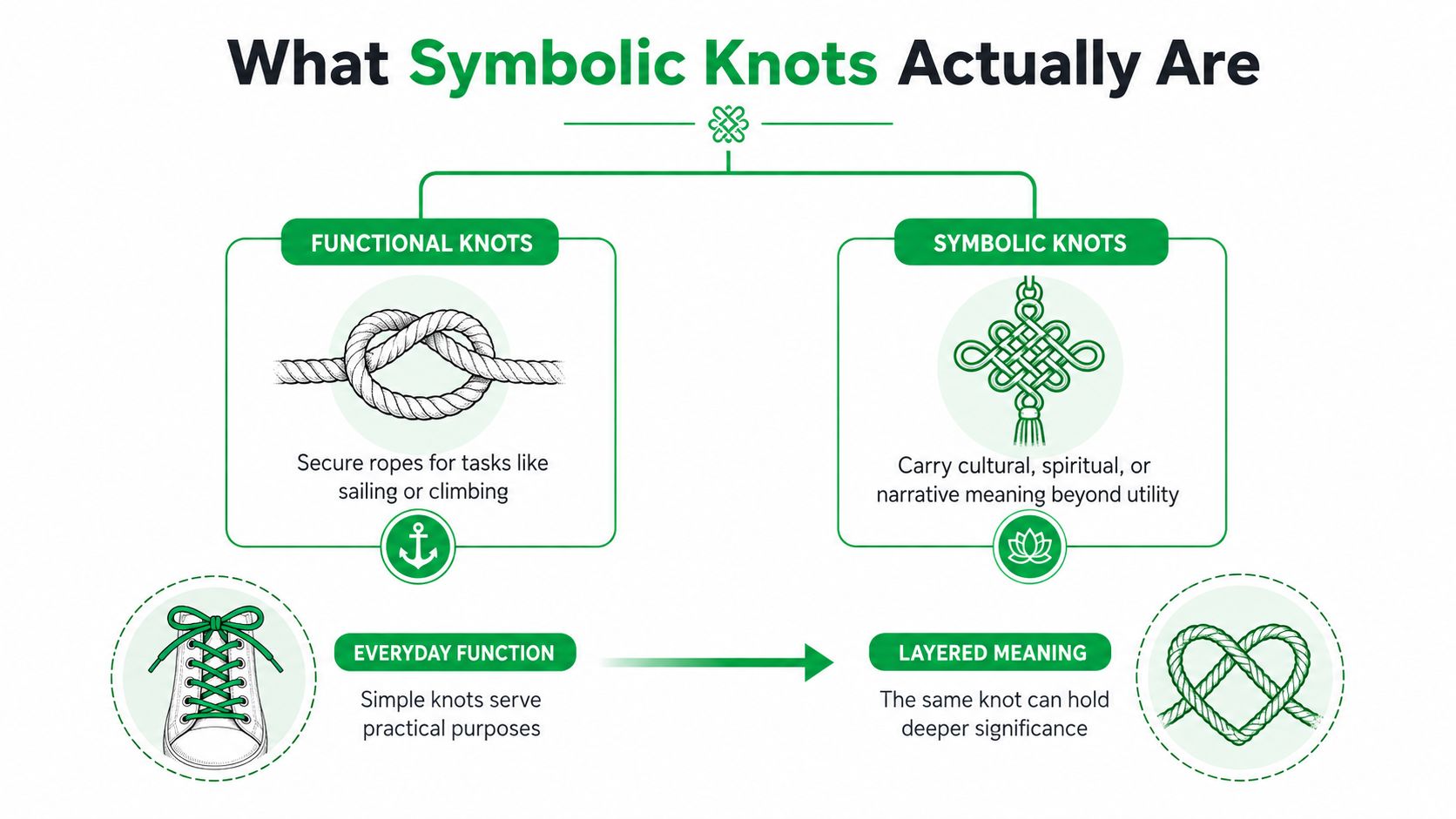
How structure turns into meaning
Three things usually shape knot symbolism. First, binding. A knot joins separate ends, so people naturally read it as connection, agreement, or restraint. Second, looping form. Some knots seem to have no clear start or finish, which makes them feel like circles, cycles, or continuity. Third, cultural memory. A community teaches that a certain knot stands for marriage, luck, wealth, or protection, and the meaning sticks.
The same logic helps explain why knot imagery appears in other traditions as well. In the history of the paper anniversary, a simple material becomes a sign of relationship and remembrance because people agree to read it that way. Knots work the same way. The shape matters, but the shared interpretation matters too.
That is why a knot can feel like a sentence that loops back on itself. The structure gives you the grammar. Culture gives you the meaning.
Why the same knot can mean different things
Context does the heavy lifting. A cord knot in sewing may be mundane. The same type of tie in a ritual can mark sacred order. A knot in a story can signal a problem. A knot in a blessing can signal unity. A scholarly discussion of knot symbolism shows that one form can carry contradictory ideas at once, which is part of why it keeps appearing in so many settings source.
That flexibility is not a flaw. It is the reason knots remain readable across cultures and genres. A knot can mean commitment in one place, restraint in another, and a puzzle somewhere else.
The pattern becomes even clearer when you compare decorative symbolism with functional everyday meaning. A knot in a story, a ritual, or a badge is being asked to represent something. A knot in a tool or garment may be doing practical work. Learners who also study visual language in other symbolic systems, including the ogham script alphabet guide, can see how form becomes meaningful once a community attaches interpretation to it.
How Knot Symbolism Emerged Through History
The earliest knot stories begin with survival, not ceremony. Rope had to be made, measured, fastened, and remembered. From that practical work, knotting moved into recordkeeping and ritual, then into visual culture. The change happened gradually, but the pattern is easy to see. A useful object became a shared symbolic language.
From memory aid to meaning system
A scholarly paper on Shang-script precursors helps draw a clear line between knotting and writing. It explains that cord knotting does not count as writing in the strict sense. Instead, it functions as a mnemonic aid for counting and verification, and it depends on rope, knotting skill, and forms that can stand for objects, events, or ideas source. That distinction matters because it shows how knots can preserve information without becoming alphabetic text.
Ancient Egypt shows a similar move from use to symbol in a different setting. Religious texts assigned knots a life-creation role in pyramid texts, coffin texts, and the Book of the Dead, where the knot signified life, flourish, sovereignty, and beginnings of life source. The symbol was not just decoration. It belonged to a larger cosmology, where shape and belief worked together.
China and early medieval Europe
Chinese knotting developed into a major symbolic system during the Warring States Period and Tang Dynasty, where knots were used in tying, recordkeeping, ritual, and markers of importance source. Accounts describe small knots for minor events and large knots for major events, which shows how one technique could encode scale and significance. Over time, the tradition became associated with luck, happiness, wealth, weddings, and gifts among lovers source.
Celtic knot imagery followed another path. Interlaced patterns are commonly traced to Roman mosaics of the 3rd and 4th centuries AD, with widely recognized Celtic forms appearing by around 450 AD and flourishing in manuscripts such as the Book of Kells and Lindisfarne Gospels source. The shape carried meaning through repetition and continuity, much like visual traditions that grow more layered over time. A useful comparison is the history of the paper anniversary, where an ordinary material becomes culturally loaded through repeated use and shared expectation. For readers who want another example of meaning carried through form, the ogham script alphabet guide shows how visual structure can hold cultural memory.
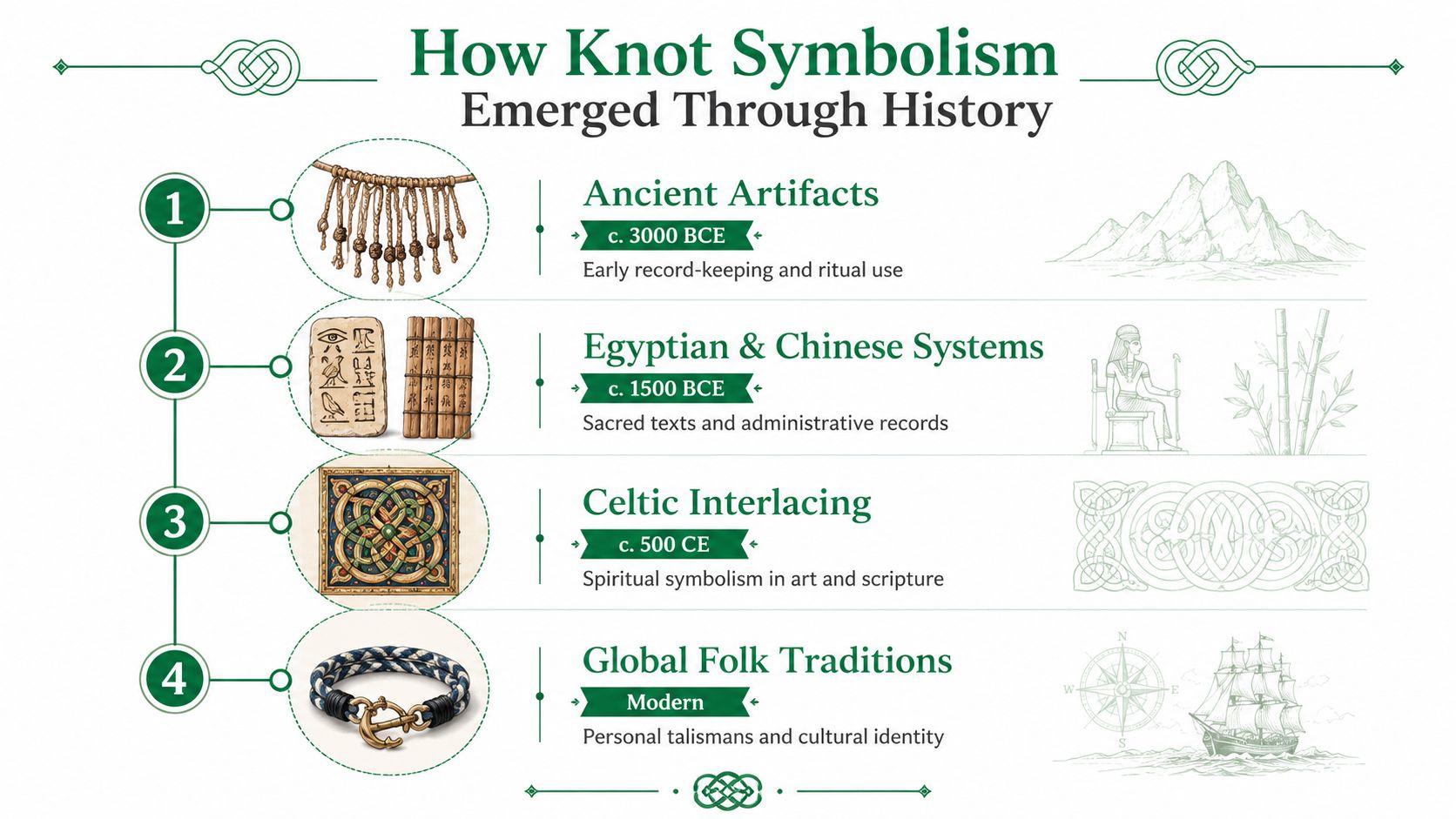
By the time knots entered illuminated manuscripts, they had already traveled from tool to symbol to visual shorthand. Later traditions could then read eternity, life, or commitment into a looping line of cord.
Key Knot Types and the Meanings They Carry
A knot type rarely speaks in a single voice. The same loop can signal devotion in one setting, restraint in another, and a problem that refuses to be solved in a third. That is why knot symbolism needs context. Shape matters, but use, setting, and audience shape the reading as well.
Celtic interlace, Chinese knots, and handfasting cords
The Celtic knot is known for its interlaced paths and its sense of continuity. In decorative and religious settings, that looping form often points toward eternity, interconnectedness, and the cycle of life, death, and rebirth. The visual logic is easy to feel. The line keeps turning back on itself, so the eye reads continuity before it reads detail.
Chinese knotting makes that same idea more explicit through named forms. The pan chang knot is read as continuity because it has no visible start or end, and it is associated with a smooth, long, happy life source. The double coin knot is linked to wealth and prosperity because its geometry resembles stacked coins source. The button knot, used on traditional clothing, is associated with the natural cycles of the universe source. The forms are decorative, but they are not empty. They turn repeated shape into a readable cultural message, much like a symbol on a door or garment tells you how to approach it.
Handfasting cords and wedding knots work in a different way. Their meaning comes less from a specific pattern and more from the act of binding itself. When hands or cords are tied together, the body becomes part of the promise, so the knot can stand for commitment, union, and a shared future. That is why knot imagery appears so often in marriage rites and love gifts. The object may be small, but the action carries weight.
How language reinforces the symbol
Language helps hold these meanings in place. The Chinese word jie means “knot,” and it also appears in compounds that mean unite, marry, and bear fruit source. That overlap matters because it shows how speech and symbolism grow together. A knot is not only something seen with the eyes. It is also something remembered through words.
Useful distinction: some knots mean something because of their shape, others because of their use, and many because shape and use work together.
| Knot Family | Origin | Core Symbolic Meaning |
|---|---|---|
| Celtic interlaced knot | Late Roman and early medieval Europe | Eternity, interconnectedness, rebirth |
| Pan chang knot | China | Continuity, long life, smooth flow |
| Double coin knot | China | Wealth, prosperity |
| Handfasting or wedding cord | Ritual marriage traditions | Commitment, union |
A helpful note from HD Asian Art on knot symbolism places Chinese knot imagery in a broader decorative context, especially where form and auspicious meaning meet. For a related example of how symbols can move between ritual, craft, and identity, see goddess Brigid symbols. The larger pattern is clear. Each knot family turns structure into a message, but the message changes with the setting.
Recurring Symbolic Themes Across Cultures
A knot tied on a cord, carved into stone, or worked into cloth can mean very different things. The surface form may look simple, yet the cultural reading often carries layers. That is why knot symbolism keeps reappearing across traditions that never shared the same language or material.
The same human concerns in different forms
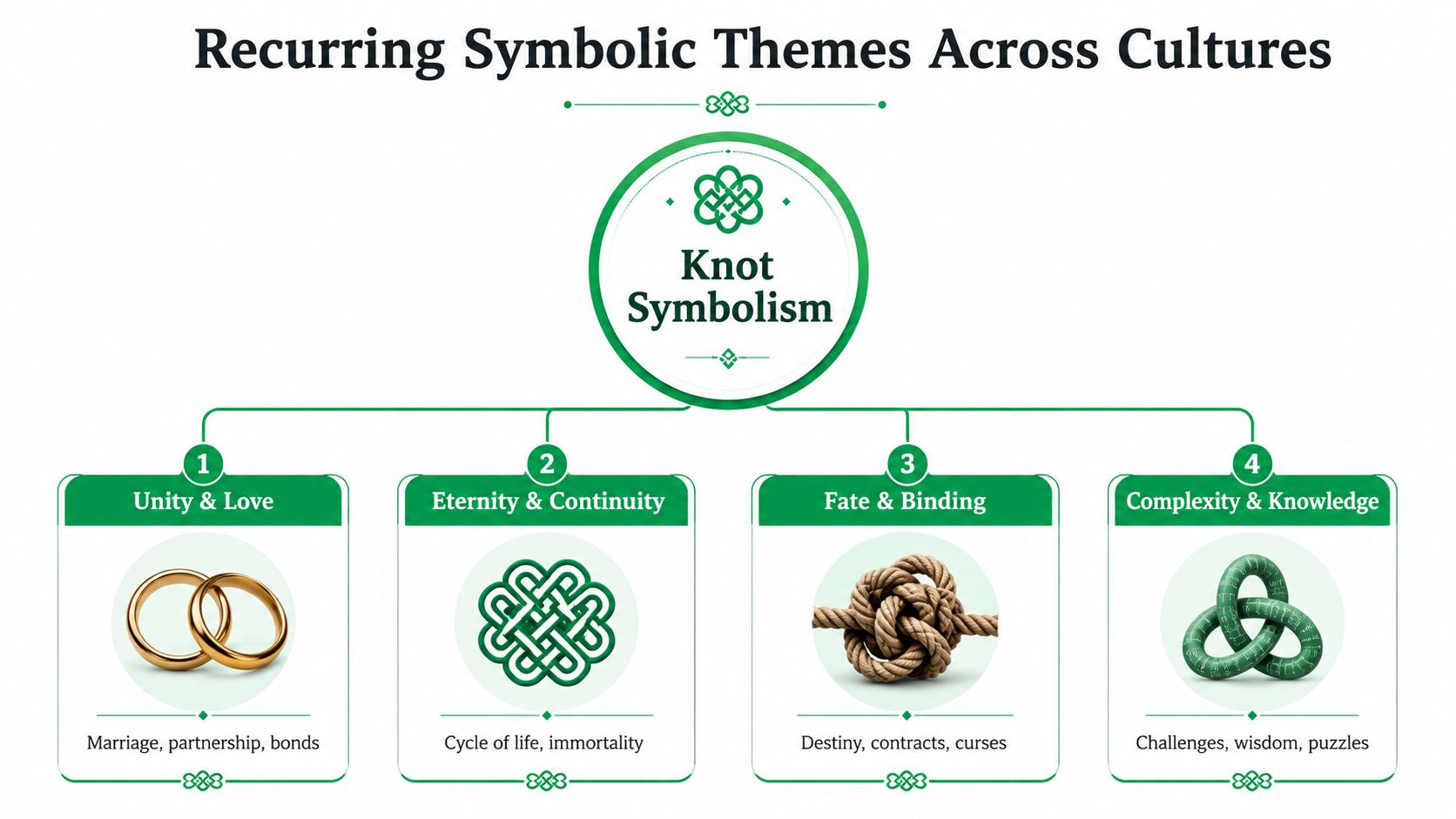
Different cultures return again and again to a familiar set of ideas. Love. Continuity. Fate. Complexity. Protection. The cord changes, but the questions stay familiar, and that is what makes the symbols feel recognizable even when the style shifts.
A Celtic knot, a Chinese knot, and an Andean quipu do not look alike, yet each can speak to unity. A circle of friends works as a simple analogy here. Each person stays distinct, but shared ties hold the group together. Knot symbolism often works in the same way, showing relationship without erasing difference.
Eternity and continuity appear through looping forms that seem to refuse a beginning or end. The visual message is steady enough that viewers often read it quickly. That is why endless interlace keeps showing up in sacred art and gift objects, where the pattern itself carries the idea of something that lasts.
Fate and binding form a darker but equally common theme. A thread that cannot be cut gives a clear image for this idea. Once something is tied, it may feel fixed, binding, or destined. That reading appears in blessings, vows, and warnings, where a knot can mark commitment or limit at the same time.
Complexity, knowledge, and protection
Knots also stand for complexity and interconnectedness. A tapestry offers a useful comparison. Pull one strand, and the whole pattern changes. A knot can suggest that kind of linked system, where every part matters to the whole. It can also suggest a puzzle, a problem, or a challenge that asks for patience.
Protection and luck belong in this family too. In many cultures, knots are active signs meant to guard, bless, or attract good fortune. Popular summaries often flatten that into “good vibes,” but the cultural meaning is more specific. A knot can be handled as an object of care, a marker of ritual, or a sign of well-being depending on where and how it appears.
The same themes show up in blessings, idioms, and proverbs because language and material culture shape each other. A culture that praises strong bonds will often speak of ties, cords, and woven connections as moral language. That is why knots feel older than ornament. They behave like compressed stories, carrying ideas about relation, order, and restraint in a form people can see and touch.
Related symbolic objects often work the same way. For a comparison with another tradition where form, use, and meaning overlap, see JewelryBuyDirect on cowrie symbolism. For another example of how linked symbols gather layered meanings in ritual and identity, Brigid's symbolic traditions offers a useful point of comparison. The object changes, but the habit of reading meaning into objects stays remarkably consistent.
When Knots Mean Something You Did Not Expect
A knot often enters discussion through love, eternity, or luck. A wedding cord, a lucky charm, a decorative braid. Those are familiar readings, but they are only part of the picture. Academic work also shows that knots can signal a problem that is hard or impossible to solve, impurity, or social and ritual binding in ordinary life. That wider range is easy to miss if you only look at knots as ornament.
The hard side of knot meaning
The Gordian knot gives the clearest starting point. The image is not just of something complex. It stands for a problem so tangled that ordinary methods fail, so a direct, forceful response becomes the only imaginable answer. That is why knot language appears so often in phrases about difficulty, obstruction, and entrapment.
A binding spell shows the same idea from another angle. A knot can represent a force that limits freedom, whether the limit is social, ritual, or emotional. In that sense, the symbol can lean toward control as easily as care. A cord tied around a person, a promise, or a boundary can signal protection in one setting and restriction in another.
A knot can bless, but it can also bind against someone's will.
That contrast helps explain why the positive meanings carry more force once you know the negative ones. A wedding cord means commitment partly because a knot can also mean restraint. A blessing feels like blessing because the same object can mark limitation elsewhere. The symbol gains emotional weight from the tension between those uses, almost like a language that changes tone depending on who is speaking.
Why this matters for readers
Popular summaries often stop at unity, eternity, love, and protection. Those ideas are real, but they leave out the tension that gives knot symbolism depth. Readers searching for the symbolism of knots usually want to know why the same form can mark a marriage vow in one setting and an unsolved problem in another. Context answers that question. It is not inconsistency, it is cultural range.
If you want to see how a knot metaphor becomes part of story and song, this Irish song guide on Casadh an tSúgáin is a useful cultural companion. It shows how tying, looping, and binding can work as narrative language rather than just visual form, much like a refrain that keeps returning with a slightly different meaning each time.
Understanding the darker meanings does not make knot symbolism less beautiful. It makes it more accurate. Human beings read symbols in more than one direction, and knots are one of the clearest examples of that habit.
Applying Knot Symbolism in Writing, Design, and Teaching
A writer, designer, or teacher can use knot imagery without flattening it into cliché. The key is to choose the right knot, the right context, and the right emotional register. If you do that, the symbol will feel earned instead of pasted on.
For writers
Use knot imagery when you want a relationship, vow, memory, or problem to feel held together. A blessing can borrow the language of binding in a hopeful way. A poem can turn a loop into a meditation on time. A story can use an untied cord to show release, or a tangled one to show conflict.
- Choose the emotional direction first: ask whether the knot should suggest union, delay, constraint, or continuity.
- Match form to theme: an endless loop works well for return or inheritance, while a tightened knot works better for tension or obligation.
- Avoid mixed signals: if the scene is about freedom, don't pair it with a knot that visually reads as confinement unless that contrast is intentional.
For designers
Knot motifs work well in tattoos, jewelry, textile patterns, and logos, but they should never be treated as interchangeable. A Celtic interlace, a Chinese decorative knot, and a handfasting cord carry different histories. If you borrow one, know what tradition you are drawing from and why.
- Respect origin: don't use sacred or culturally specific knots as generic decoration.
- Use material wisely: metal, thread, paper, and ink all change how the symbol feels.
- Keep the message readable: if the knot stands for union, let the surrounding design support that idea.
For teachers and learners
Knot symbolism is a strong entry point for Irish-language lessons because it connects language, ritual, and storytelling. Learners can trace how symbols show up in blessings, proverbs, and song, then connect those ideas to vocabulary. On platforms that let you click words for translations and save them for review, the symbol becomes a memory aid, not just a picture.
Teaching move: pair a knot image with one short phrase, then ask what kind of bond, cycle, or constraint the image suggests.
That approach works because symbols are easier to remember when they are attached to words and situations. It also helps learners avoid the mistake of assuming one knot has one fixed meaning everywhere. Cultural literacy grows faster when students compare, not just memorize.
Key Takeaways and Where to Go Next
Knots predate writing. They began as practical tools, then became memory aids, ritual signs, and cultural symbols source.
Structure encodes meaning. Endless loops, stacked-coin shapes, and binding cords all carry different ideas because people read form as message source.
The same knot can mean opposite things. A knot can mean love, continuity, or wealth, but it can also mean restraint, impurity, or an unsolved problem source.
Symbolism lives in practice. Knots matter in everyday tying, in ceremonies, and in stories, not just in museum art or decorative design.
If you want to keep exploring how symbols, language, and heritage connect, visit Gaeilgeoir AI and use it as a practical place to learn Irish words, cultural expressions, and storytelling patterns in context. It's a good next step if you want symbolism to feel lived, not just read about.