Irish prepositional pronouns matter because they show everyday meaning that English usually spreads across two words: who something is with, who something is given to, and who has something. Once you can handle forms like agam, liom, and duit, ordinary Irish sentences become much easier to read, hear, and produce.
Focus is on the forms learners meet early and often, with examples of how to use them in real sentences. The goal is not just recognizing grammar terms, but understanding common Irish patterns for possession, accompaniment, and indirect objects.
How We Built These Irish Prepositional Pronoun Examples
To make this article more useful as a reference, I rebuilt the examples around high-frequency prepositions that learners repeatedly encounter in beginner and lower-intermediate Irish: ag, le, and do. That choice is deliberate. These are the forms that show up in possession patterns such as Tá leabhar agam, in everyday interaction such as Tá sé liom, and in recipient patterns such as Abair liom or Thug mé é duit. Historical work on Irish grammar also shows that conjugated prepositions are not a quirky exception but a core structural feature inherited from Old Irish, where preposition-plus-pronoun combinations had already developed into single forms MIT overview.
Filter out examples that are technically literal but unnatural in normal speech. If a sentence sounds like a classroom puzzle rather than something a speaker would say, drop it. This is an efficient way to improve clarity: many weak explanations of Irish grammar fail not because the rule is wrong, but because the example is not the sentence a learner is likely to need first. Where possible, favor short patterns learners can immediately reuse aloud.
What Are Irish Prepositional Pronouns?
Irish prepositional pronouns are fused forms: a preposition and a pronoun combine into one word rather than standing separately. English says at me, with him, or to us. Irish usually expresses those ideas as agam, leis, and dúinn. That difference is structural, not optional. Research on Celtic languages describes this kind of prepositional agreement as a defining feature of the family, shared with related languages such as Scottish Gaelic and Manx TU Dublin paper.
A simple contrast makes the system clearer:
- at me → agam
- at you → agat
- at him → aige
- with me → liom
- with her → léi
- to us → dúinn
These forms are central to everyday Irish because they carry meanings that come up constantly: possession (Tá carr agam, I have a car), accompaniment or association (Tá sé liom, he is with me / I have him), and recipients or addressees (Tabhair dom é, give it to me). In practice, they sit at the heart of ordinary conversation more than many learners expect.
If you want a broader framework for building speaking practice around patterns like these, I also like this piece from Smart Language Learning Academy on using AI well without turning every exercise into random prompting.
The main trap, in my experience, is that learners understand the meaning but still try to build the phrase word by word from English. They reach for a plain preposition plus a separate pronoun, when Irish wants the fused form instead.
Understanding Prepositions in Irish
Before diving into prepositional pronouns, it’s essential to understand prepositions in general. Prepositions describe relationships between nouns or pronouns and other words in a sentence. They convey concepts such as direction, location, time, and manner.
Some common Irish prepositions include:
- ag (at)
- le (with)
- ar (on)
- do (to)
- ó (from)
- faoi (under/about)
In Irish, a preposition is often combined with a pronoun to indicate who is involved in the action or relationship.
How Irish Prepositional Pronouns Are Formed
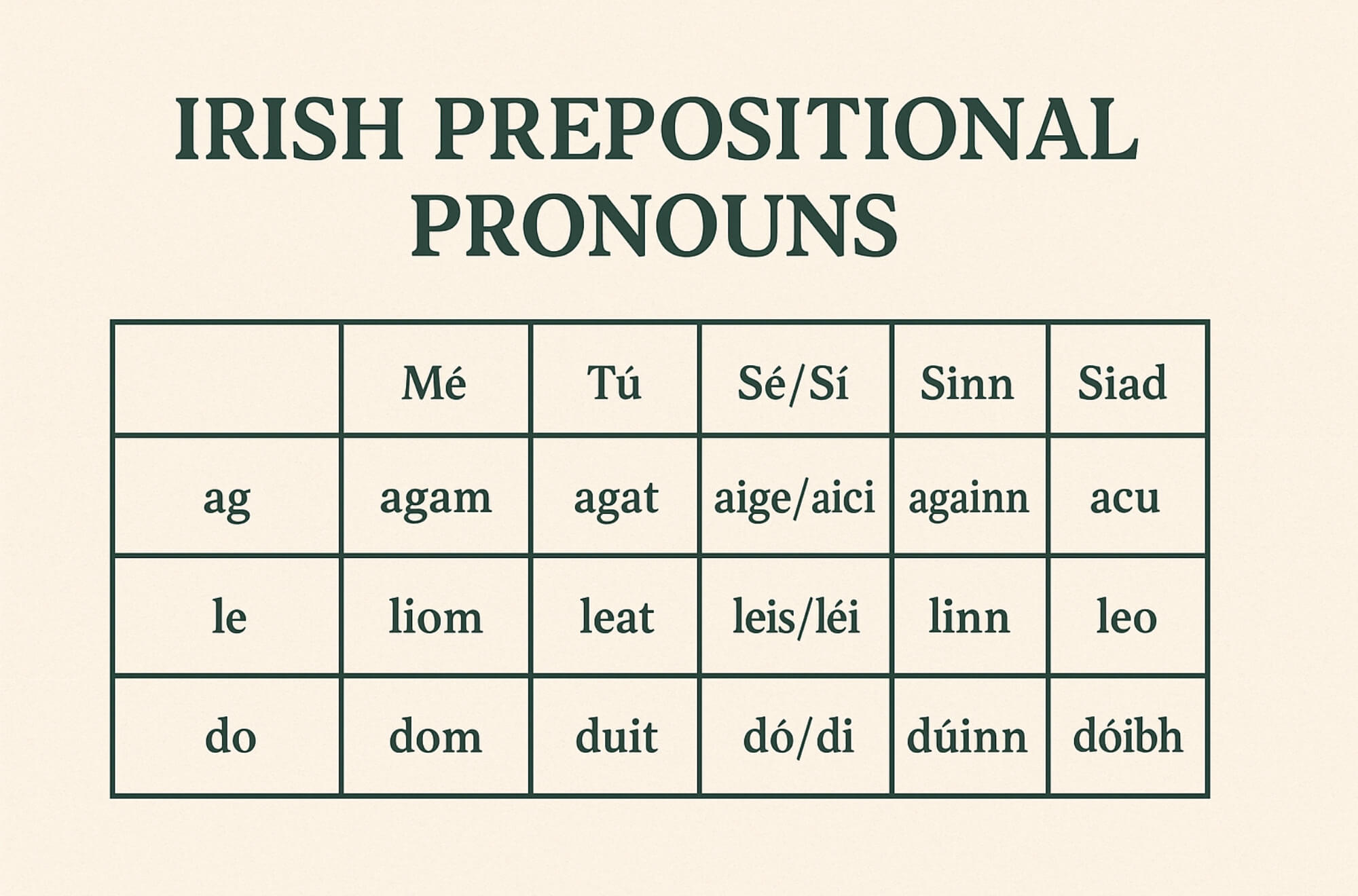
The most practical way to learn these forms is by memorizing each preposition as a full person-pattern, not as isolated vocabulary. Irish does not build them by placing mé, tú, sé, sí after the preposition. Instead, each preposition has its own established set of fused forms. For common paradigms and standard usage, traditional references such as teanglann grammar tables and Nualeargais grammar notes remain helpful checkpoints.
I strongly recommend learning the whole set aloud. When I tested sentence drills, learners retained agam / agat / aige / aici much better than when they tried to memorize one form at a time from a list.
ag — usually possession with Tá … agam
The preposition ag often means “at,” but one of its most important learner uses is possession. Irish commonly expresses “have” with Tá … ag plus a prepositional pronoun.
- agam, at me
- agat, at you
- aige, at him
- aici, at her
- againn, at us
- agaibh, at you (plural)
- acu, at them
Examples:
- Tá leabhar agam. I have a book.
- An bhfuil carr agat? Do you have a car?
- Tá freagra aici. She has an answer.
The most common learner use case here is simple possession: if you want to say you have something, Tá … agam is one of the first patterns to master.
le — with, with regard to, and sometimes preference or possession by context
The preposition le often corresponds to “with,” but its range is wider than a direct English match. It can show accompaniment, association, and in some patterns something closer to belonging or preferred possession depending on the sentence.
- liom — with me
- leat — with you
- leis — with him
- léi — with her
- linn — with us
- libh — with you (plural)
- leo — with them
Examples:
- Tá sí ag caint liom. She is talking to me.
- An dtiocfaidh tú liom? Will you come with me?
- Tá na heochracha leo. They have the keys / the keys are with them.
For learners, the most useful first meaning is accompaniment: people, objects, or qualities being “with” someone. Later, you will also meet Is maith liom and similar patterns where le helps express liking.
do — to, for a recipient, addressee, or indirect object
The preposition do usually corresponds to “to” and appears constantly when something is given, shown, said, or sent to someone.
- dom, to me
- duit, to you
- dó, to him
- di, to her
- dúinn, to us
- daoibh, to you (plural)
- dóibh, to them
Examples:
- Tabhair dom an leabhar. (Give me the book.)
- Dúirt sí liom é, ach níor dhúirt sí duit é. (She said it to me, but she didn’t say it to you.)
- Sheol siad litir dóibh. (They sent them a letter.)
The most common learner use case for do is the recipient pattern: who receives the thing, the message, or the action.
When to Use Irish Prepositional Pronouns
The easiest way to understand usage is to group these forms by function, not by abstract grammar labels. In real Irish, prepositional pronouns often answer one of three questions: who has it, who is with it, or who receives it.
Possession with ag
Irish regularly uses ag to express possession instead of a direct verb meaning “to have.” The pattern is Tá + noun + ag + person, usually as a fused form.
- Tá cupán tae agam. — I have a cup of tea.
- Tá beirt deartháireacha aici. — She has two brothers.
This is one of the most important sentence patterns in the language. If you translate English word for word and look for a separate verb “have,” you will miss how natural Irish usually handles possession.
Accompaniment, association, or “with” relationships with le
Use le when the idea is being with someone, having something with someone, or associating an action or state with a person. The exact English translation changes with context, but the relationship remains consistent.
- Tar liom anois. — Come with me now.
- Tá an fhadhb sin leis fós. — He still has that problem / that problem is still with him.
I find this category is where learners first realize that one English preposition does not map neatly onto one Irish preposition in every sentence. Meaning comes from the whole pattern, not just the dictionary gloss.
Recipient and indirect object use with do
Use do when someone is the recipient, target, or addressee of an action such as giving, sending, showing, or saying.
- Thug mé bronntanas di. — I gave her a present.
- Inis dúinn an scéal. — Tell us the story.
This is often the cleanest place to start thinking about indirect objects in Irish: who something is going to, who hears it, or who receives it.
Some verbs and fixed expressions require the fused form
Many everyday Irish patterns require these prepositional combinations because that is how the verb or expression is built.
- An maith leat caife? — Do you like coffee?
- Níl sé liom inniu. — I don’t have it with me today.
The lesson here is simple: once a pattern is established in Irish, you should learn it as a chunk rather than trying to rebuild it from English every time.
Common mistakes to avoid
A very common mistake is using a plain pronoun after a preposition when Irish requires the fused form. For example, learners may try to create the equivalent of “with tú” or “to mé,” but standard Irish uses leat and dom. Another mistake is assuming every English preposition translates directly across contexts. Sometimes English “have” becomes ag, and sometimes English “to” or “with” is part of a fixed Irish expression that must be learned as used.
Tips for Mastering Irish Prepositional Pronouns
The fastest route to confidence is to study one preposition at a time and treat it like a complete pattern. Don’t memorize only agam and hope the rest will fall into place later. Learn the full row, say it aloud, and then use every form in a short sentence.
A practical workflow looks like this:
- Memorize one preposition as a full set. Start with ag: agam, agat, aige, aici, againn, agaibh, acu.
- Drill the forms aloud in order. Then reverse the order. Then jump randomly between persons.
- Attach each form to a short sentence. For example: Tá peann agam. Tá peann agat. Tá peann aici.
- Contrast similar-looking forms. Put agam / againn / acu side by side, then liom / leis / leo.
- Reuse them in speech, not just on paper. The goal is instant recall in conversation.
A 5-minute daily routine
- Minute 1: Recite one example from memory.
- Minute 2: Write all seven forms without looking.
- Minute 3: Say three possession sentences with ag.
- Minute 4: Say three accompaniment or preference sentences with le.
- Minute 5: Say three recipient sentences with do.
What has worked best for me is timed oral recall rather than silent review. If I can produce dúinn or léi quickly in a sentence, I usually know the form well enough to keep it under pressure. Flashcards help at the beginning, but saying full mini-sentences is what usually turns recognition into usable grammar.
A good test of real mastery is this: you can produce the correct form without translating word by word from English first. When Give it to them immediately triggers Tabhair dóibh é, you are no longer just recognizing the pattern, you are using it.
How Gaeilgeoir AI Can Help You Learn Prepositional Pronouns
At Gaeilgeoir AI, we believe in the power of technology to make learning the Irish language more engaging and effective. Our platform uses AI-powered tools to help you master complex grammar concepts, including prepositional pronouns.
Whether you’re just starting out or looking to refine your skills, our platform offers personalized lessons, quizzes, and practice exercises matched to your learning pace. With Gaeilgeoir AI, you can immerse yourself in interactive lessons that focus on real-life usage, helping you feel more confident when speaking and writing in Gaeilge.
Start your Irish language journey today with Gaeilgeoir AI!
Frequently Asked Questions
What are prepositional pronouns in Irish?
They are forms where a preposition and a pronoun combine into one word, such as agam, liom, or duit. Instead of saying “at me” or “to you” as separate words, Irish usually fuses the elements into a single grammatical form.
Why does Irish combine prepositions with pronouns?
Because that is how the language is structurally built. These fused forms are an old and normal part of Irish grammar rather than an optional shortcut, and they remain essential in everyday speech and writing.
How do I memorize forms like agam, agat, aige, agus aici?
Learn them as a sequence, not as isolated items. Say the full set aloud several times, then put each form into a very short sentence such as Tá leabhar agam or Tá carr aici. That combination of pattern plus usage usually sticks faster than rote list memorization alone.
Which prepositions should I master first?
Start with ag, le, and do. They cover possession, accompaniment, and recipients, which gives you access to a large amount of everyday Irish very quickly.
Is there a direct Irish equivalent of the English verb “to have”?
Usually, Irish expresses possession with ag, as in Tá peann agam, “A pen is at me.” That is why ag forms are so important early on.
Do I need to learn every prepositional pronoun at once?
No. In fact, I think that slows most learners down. One full pattern at a time is more effective, especially if you can produce all seven forms accurately before moving to the next preposition.
Conclusion
Mastering Irish prepositional pronouns is an important step in gaining fluency in the Irish language. By understanding how to form and use these combinations effectively, you’ll be able to communicate more naturally and expressively in Gaeilge. With dedication, practice, and the right resources, you’ll soon see improvement in your language skills. For more resources to enhance your Irish learning experience, see the detailed guide to Irish language lessons and start practicing today.