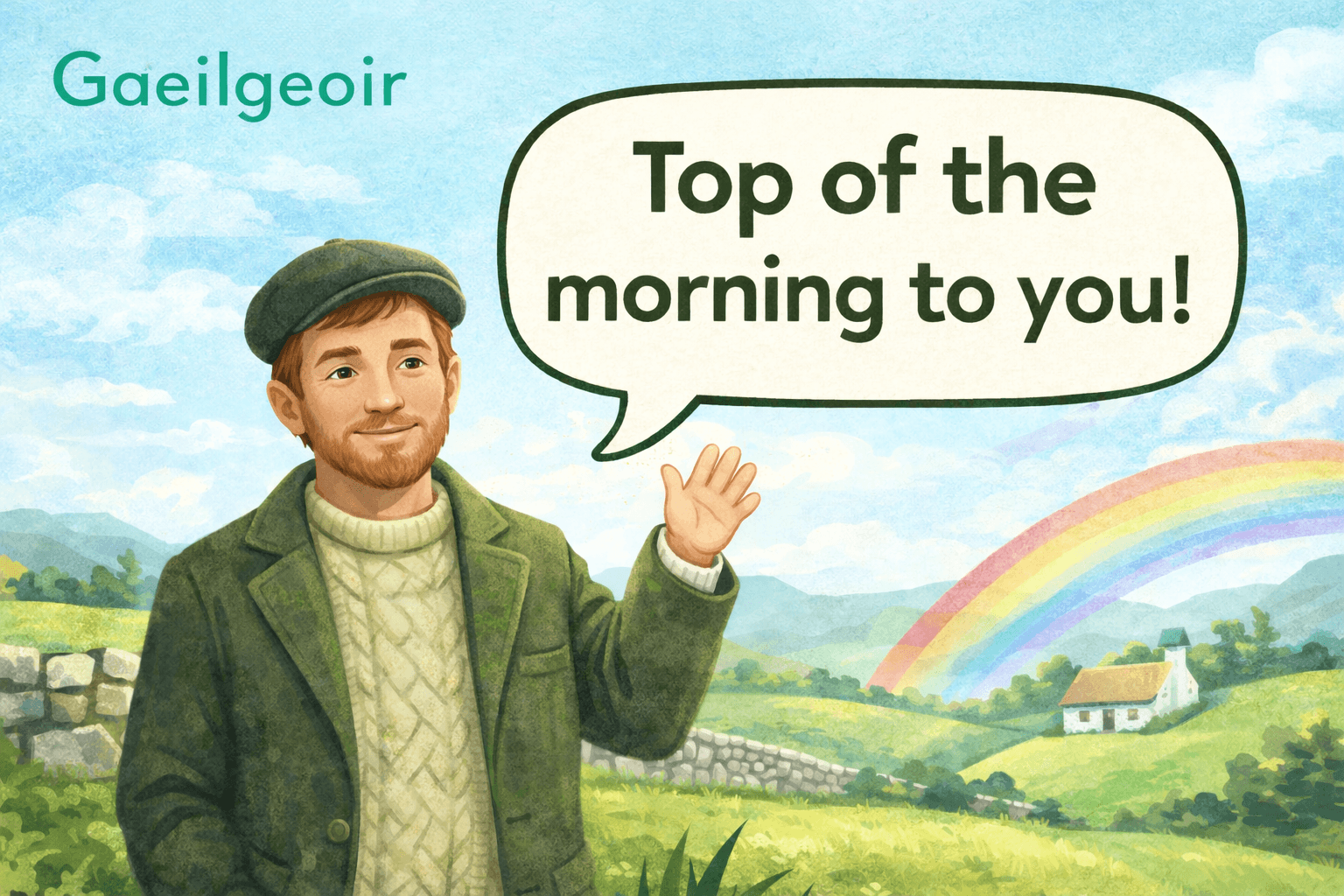
You’ve probably heard the cheerful greeting “Top of the morning to you!” in films or TV shows, often spoken in an exaggerated Irish accent. The big questions people usually have are straightforward: what does it mean, where did it come from, and do Irish people really say it, or find it offensive?
The short answer is that it’s a dated English-language greeting that became strongly associated with Ireland through literature, theatre, and film. In our review of dictionary and historical sources, the phrase is real, old, and documented—but modern Irish people generally do not use it in everyday speech.
How We Researched This Phrase
Three different kinds of sources were checked rather than repeating the usual internet folklore. First, we looked at dictionary evidence for meaning and usage, including the entry for “top” in the sense of “best” or “choicest” in the Oxford English Dictionary. Second, we reviewed historical attestations and discussions of early printed examples, including a documented 1796 appearance noted in a historical usage discussion. Third, from an Irish-language learning perspective, we compared that paper trail with how people in Ireland greet one another now.
That distinction matters. A phrase can be old and still feel unnatural in present-day Ireland. Documented origin, literary popularity, and modern Irish usage are three separate questions.
What Does “Top of the Morning to You” Mean?
“top of the morning to you” means “the best part of the morning to you” or, more naturally in modern English, “I wish you a very good morning.” Here, “top” does not mean the physical top of anything; it uses an older sense of best or choicest, which is reflected in historical dictionary usage, including the OED’s treatment of “top”.
You will also see the shorter form “top of the morning” without “to you.” Both versions point to the same basic idea: a warm morning greeting. The fuller version sounds more performative and literary today, while the shorter one can appear as a playful fragment or title.
A traditional reply often repeated online is:
“And the rest of the day to yourself.”
That answer is part of the phrase’s folklore, and it does circulate widely in quote collections and greeting lists. But in our review, the response is much more commonly repeated as a set piece than encountered in real contemporary conversation. It is better understood as a stylized old-fashioned comeback than as a standard Irish social formula you should expect to hear on the street.
In present-day English, the phrase sounds quaint, theatrical, or knowingly jokey. If someone says it now, they are usually leaning into old-time charm or into an “Irish” stereotype they picked up from popular culture. That is why the expression is understandable, but not especially natural, in ordinary 2026 conversation.
Is “Top of the Morning to You” Really Irish?
In short — not really.
Although it’s often labeled as an “Irish” expression, historians and linguists agree that “Top of the morning to you” belongs to English-language usage rather than native Irish-language tradition. It appeared in forms associated with Irish characters, but it was never a standard Gaeilge greeting and was not a defining feature of everyday speech across Ireland.
The phrase became globally recognizable through stage Irish stereotypes, novels, and later film. Once actors and screenwriters started using it as shorthand for friendliness and Irishness, it stuck in the public imagination far more firmly than it ever did in real life.
So, while you might hear it from a leprechaun in a movie, you won’t hear it in Dublin, Cork, or Galway today!
How Do Irish People Actually Say “Good Morning”?
If you want to greet someone authentically in Irish, forget “Top of the morning to you.” Instead, try learning the real Irish phrase:
Dia dhuit ar maidin! (Pronounced dee-a ghwitch er mah-jin)
Meaning: God be with you this morning.
Or just:
Maidin mhaith! (MAJ-in wah)
Meaning: Good morning!
These greetings come directly from Gaeilge, the Irish language, which predates English in Ireland by more than a thousand years. You can find more examples of authentic greetings and their usage in our Irish Language Greetings & Phrases Guide.
The Origins of “Top of the Morning to You”
The history is older and more mixed than the stereotype suggests. A documented early appearance of the full phrase shows up in 1796 in George Walker’s Theodore Cyphon, where an Irish character says, “Halloo! You toney, the top of the morning to you,” as noted in this historical discussion of the citation trail. The same source also points to Walter Scott using the phrase in 1815, which helps show that it circulated in written English beyond a single Irish setting.
That matters because the expression was not exclusively Irish at birth. The shorter idea, “top of the morning,” fits an older English habit of using top to mean the best part of something. Over time, writers attached it to Irish-speaking or Irish-coded characters often enough that audiences started treating it as specially Irish.
Two examples illustrate that shift clearly. First, the 1796 Walker novel gives us an early literary attestation tied to dialect dialogue. Second, by the nineteenth century the phrase appears often enough in printed fiction and comic writing that later readers came to associate it with stock “Irish” character speech rather than with normal morning English.
By the time mass entertainment picked it up, the phrase had become easier to parody than to place historically. Popular culture did the rest: stage routines, comic performances, and films over-Irishized it until many people assumed it must be a standard greeting in Ireland. The source trail supports this conclusion: the phrase is old, documented, and linked to Irish portrayals in literature, but its fame owes more to stereotype and performance than to ordinary Irish usage.
What Irish People Think of “Top of the Morning to You”
For most Irish people today, the phrase is not automatically offensive. It usually lands as dated, touristy, or cartoonish rather than insulting in itself. Context does the work.
If a visitor says it with a grin on St. Patrick’s Day, many people will treat it as harmless novelty. If someone uses it repeatedly as though it captures how Irish people talk, it can feel reductive, like flattening a real culture into a pub-poster slogan. That is especially true with the even more exaggerated forms “top o’ the morning” or “top o’ the morning to ya,” which sound more like stage dialogue than natural Irish speech.
From our editorial perspective as an Irish-language learning site, the phrase tends to be heard less as a greeting and more as a signal that the speaker knows Ireland through clichés. That does not make it taboo. It just means it rarely sounds informed.
A more natural set of greetings in Hiberno-English would be:
- Morning, simple, neutral, and common.
- Howya? Casual and friendly; more like “hi” than a literal request for your life story.
- How’s the form? Informal and conversational, used with people you already know.
And if you want Gaeilge options, two much better choices are:
- Dia dhuit, a standard hello, appropriate in many everyday situations.
- Maidin mhaith, specifically “good morning,” useful when you want a morning greeting rather than a general hello.
You can learn these and more through our How to Say Hi in Irish Guide.
Cultural Significance: Why the Phrase Still Resonates
Even though “Top of the morning to you” isn’t used in Ireland, it continues to appear around St. Patrick’s Day, Irish pubs abroad, and even marketing campaigns.
Why? Because it represents Irish warmth and hospitality, qualities that reflect Irish culture. It might be more myth than reality, but it is a friendly myth that connects people to an idea of Ireland as open, cheerful, and kind-hearted. If you want a more grounded feel for place beyond the stereotypes, a practical companion is this guide to Ireland’s best towns for a fuller cultural experience.
In that sense, the phrase lives on as a symbol of Irishness in the global imagination, much like shamrocks and Celtic knots.
The Real “Top of the Morning”: Irish Language and Identity
If you want to capture the spirit behind “top of the morning to you,” the best way is to learn real Irish expressions. The Irish language (Gaeilge) conveys warmth, humor, and respect in ways that English often can’t fully express.
For example:
- Go maire tú an lá! (“May you live through the day well.”)
- Ádh mór ort! (“Good luck!”)
- Sláinte! (“Health!”) (Used as a toast, like “cheers”).
Learning these phrases helps you connect with authentic Irish culture, not just the tourist version. Our Essential Gaelic Phrases Guide can help you get started.
Common Misconceptions About Irish Phrases
Myth: Irish people commonly say “Top of the morning to you.”
Fact: Most do not. The phrase is far better known as a cultural stereotype than as living everyday speech in Ireland. In our review of modern usage, ordinary greetings like “Morning,” “Howya?” or actual Gaeilge forms are much more representative.
Myth: “Top o’ the morning” is the authentic version.
Fact: The clipped “top o’ the morning” is the version most strongly tied to performance and caricature. The fuller wording “top of the morning to you” is what turns up in documented literary citations; the shortened apostrophe-heavy version is what many people now imagine because film, stage Irish routines, and novelty merchandise pushed it so hard.
Myth: If the phrase is stereotypical, it must be offensive.
Fact: Not necessarily. Tone matters. Used once, lightly, it may just sound old-fashioned. Used as if it sums up Irish identity, it can come off as lazy or patronizing.
Myth: Irish phrases in popular culture come straight from the Irish language.
Fact: Many famous “Irish” lines come from English-language representations of Ireland, not from Gaeilge itself. That is why learning even a few real expressions quickly gives you a more accurate sense of Irish speech.
Myth: Irish is disappearing into nostalgia.
Fact: Irish remains a living language with substantial public engagement. The 2022 Census profile from Ireland’s Central Statistics Office reports that more than 1.87 million people said they could speak Irish, even though daily use varies widely. From an Irish-language learning perspective, that is a far more useful reality than recycled movie catchphrases.
Frequently Asked Questions
What does “Top of the morning to you” mean?
It means something like “the best of the morning to you” or “I wish you a very good morning.” The key word is top, used in an older sense meaning the best part. Today, it sounds old-fashioned rather than normal.
Do Irish people say “Top of the morning to ya”?
Generally, no. That version sounds especially theatrical and is more associated with stereotypes, films, and novelty Irish branding than with how people in Ireland greet one another.
Is it correct to say “top of the morning”?
It is understandable English, and historically it is documented. The issue is not correctness so much as register: in modern speech it sounds playful, archaic, or performative, not natural for most everyday situations.
What is the Irish response to “Top of the morning to you”?
The stock response usually given is “And the rest of the day to yourself.” People enjoy repeating it because it sounds tidy and traditional, but you should think of it as part of the phrase’s folklore rather than as a common modern reply.
Is “Top of the Morning to You” offensive?
Usually not by itself. Readers often perceive it as cheesy or stereotypical before seeing it as hostile. It becomes more awkward when used to impersonate Irish speech or to reduce Irish culture to clichés.
Learning Irish Greetings with Gaeilgeoir AI
Understanding expressions like “Top of the morning to you” is a great entry point into learning how Irish people speak and greet each other.
At Gaeilgeoir AI, we use AI-powered tools to help learners:
- Hear and practice real Irish pronunciation.
- Learn conversational greetings in authentic contexts.
- Understand the cultural meaning behind Irish expressions.
Whether you’re learning for travel, heritage, or curiosity, our interactive lessons help you go beyond clichés and experience the Irish way of speaking.
You can get started with our Irish Language Lessons for Beginners or jump right into practice with a free trial at 👉 learn.gaeilgeoir.ai.