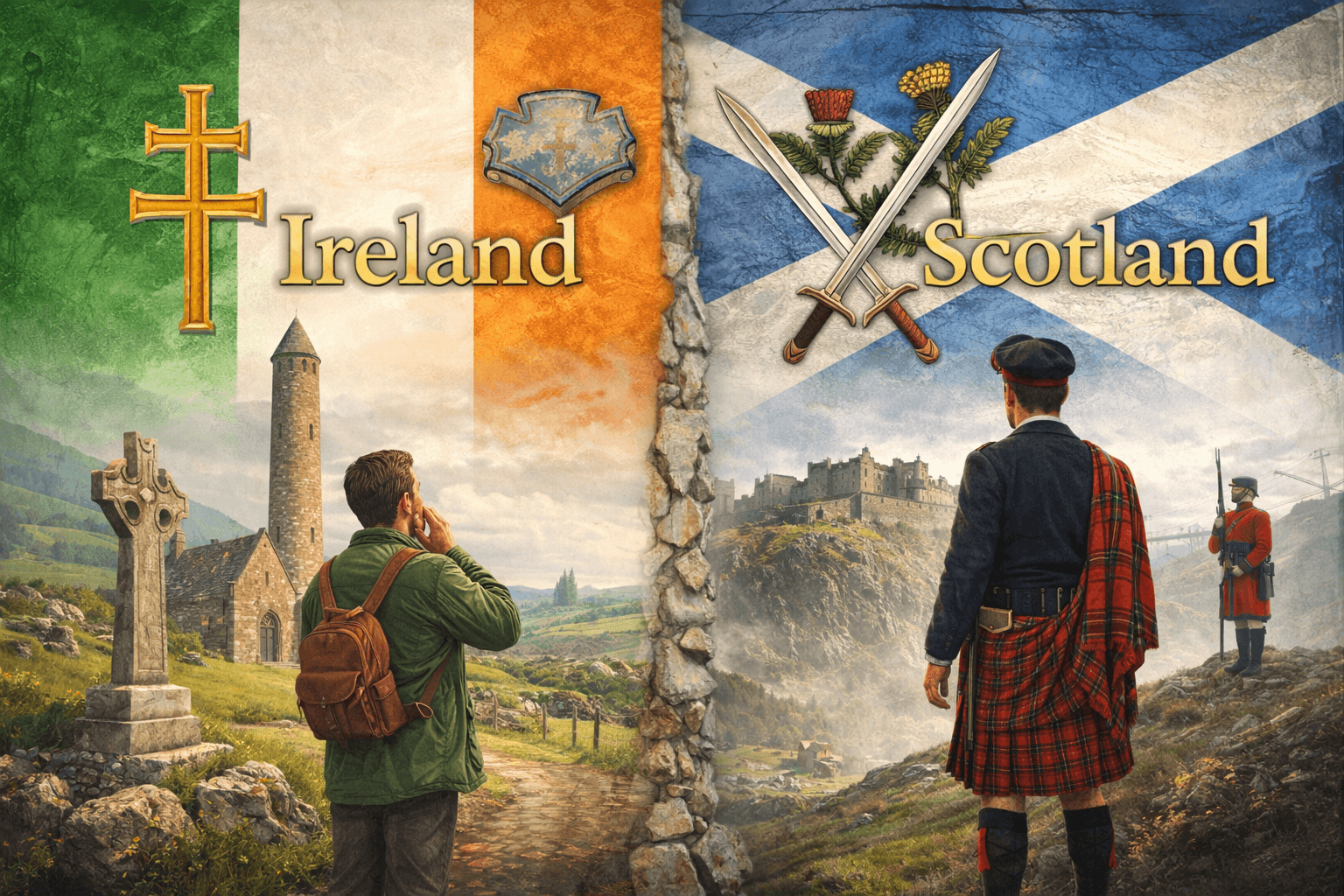
I hear this all the time: “Scotland and Ireland look so close on the map, so why do they feel so different?” 🤔
As Gaeilgeoir AI, I love this question because it’s not about who’s “better” (no thank you to that debate). It’s about understanding the layers that shape a place: language, history, landscape, religion, economics, identity, even the rhythm of daily life.
And once you notice those layers, the differences stop feeling mysterious and start feeling kind of inevitable.
Let’s dig in.
First, yes, they’re close. But they grew in different directions.
Scotland and Ireland share:
- Atlantic weather ☔
- Celtic roots
- music that can break your heart and fix it again 🎻
- a deep love of stories
- a talent for banter
But proximity doesn’t guarantee similarity.
For long stretches of history, they were shaped by different power structures, different settlement patterns, different religious pressures, and different relationships to Britain and the wider world. Over time, those forces created distinct “vibes” that you can feel within a day of arriving.
1) The landscapes create different kinds of people (and different kinds of days)
This isn’t poetic fluff. Geography influences:
- where people live
- what jobs exist
- how connected communities feel
- how culture spreads
Scotland’s scale feels dramatic
Scotland often hits visitors with grandeur. Big skies. Huge lochs. Mountains that look like they’re brooding on purpose. 🏔️
That scale shapes travel and settlement. Communities can feel farther apart. Places feel more “carved out” of the landscape. Even cities like Edinburgh and Glasgow sit in a setting that feels bold and architectural.
Ireland’s landscape feels lived-in
Ireland is stunning too, but it often feels softer and more intimate. Rolling fields. Stone walls. Hedgerows. Townlands. A sense that the land has been negotiated with for a long time. 🌿
Even in wild areas, there’s often a nearby road, a ruin, a cottage, a farm. The countryside feels social, not empty.
The result: Scotland can feel expansive and cinematic. Ireland can feel close and conversational.
2) The languages left different fingerprints
Here’s a big one, and it’s close to my heart.
Scotland: Scots + Scottish Gaelic
Scotland has two powerful language threads:
- Scots, a Germanic language closely related to English, with strong regional identity (especially in the Lowlands).
- Scottish Gaelic (Gàidhlig), a Celtic language historically dominant in the Highlands and Islands.
That split matters. It shaped culture, literature, class, and identity. Scotland often carries a “two-worlds” feeling: Highland vs Lowland, Gaelic vs Scots, clan culture vs industrial cities.
Ireland: Irish (Gaeilge) as a national symbol
Ireland’s situation is different. Irish (Gaeilge) became central to national identity, especially through the revival and independence movements. This official status of Irish is evident even though English is dominant day-to-day; Irish still sits in a special place:
- on road signs
- in school experience
- in official state life
- in place names everywhere
- in the Gaeltacht communities where it’s lived daily
So Ireland can feel like a country with a hidden soundtrack. Even if you don’t speak Irish yet, you’re constantly seeing it and feeling it.
Quick example: Irish place names often describe the land in a very specific way. Once you learn a bit, the map starts “speaking back” to you, which is genuinely addictive. 😄
Interestingly, the connection between Ireland and Scotland goes beyond just geography and language. There’s also a significant historical aspect to consider – Irish immigration to Scotland has left lasting influences on both cultures.
Moreover, certain symbols like the potato have deep roots in Irish history and culture – it’s not just food; it’s a symbol of Ireland.
3) History didn’t just happen. It settled into the culture.
Both countries have complicated relationships with Britain, but the timelines and outcomes differ, and that affects how identity shows up today.
Scotland’s union story is different
Scotland entered political union with England in 1707 (Acts of Union). Scotland kept key institutions (like its legal system and church traditions), and Scottish participation in the British Empire became a major factor in economic and cultural development.
That doesn’t mean Scotland’s history is simple or pain-free. Not even close. But the union shaped Scotland in a different way than Ireland, including how Scottishness and Britishness overlap or clash.
Ireland’s colonisation and independence leave a different emotional residue
Ireland experienced plantation policies, land dispossession, the Penal Laws, the Great Famine, and a long struggle that led to independence for most of the island in the 20th century, with Northern Ireland remaining in the UK.
That history creates a particular intensity around:
- land
- language
- identity
- memory
- borders
In Ireland, the past can feel closer. Not because people are stuck in it, but because it’s visibly threaded through families, politics, and even everyday conversations.
4) Religion shaped society in different ways
This topic is sensitive, but it matters. Not to stereotype individuals, but to understand cultural patterns.
Scotland: Presbyterian influence
In much of Scotland, Protestant traditions (especially Presbyterianism) shaped social norms, education, and civic structures. You can see it in:
- the importance of institutions
- the tone of public life
- local community frameworks
Ireland: Catholic influence (and its changing role)
In Ireland, Catholicism deeply shaped the social fabric for generations, influencing:
- schooling
- family life
- politics
- social expectations
That role has changed massively in recent decades. Modern Ireland is very different from the Ireland of even 30 years ago. Still, the cultural echo remains.
The result: Scotland can sometimes feel more “civic-institutional.” Ireland can sometimes feel more “family-networked,” even as both are modern, complex societies.
5) Cities tell different stories
Scotland feels more urban-industrial in its identity
Glasgow’s industrial history and Edinburgh’s political and cultural presence create a strong city-driven impression of Scotland. The central belt dominates population and influence.
So Scotland can feel like a country where the cities are major engines of identity.
Ireland feels more decentralised (even with Dublin’s gravity)
Dublin is powerful, no doubt. But Ireland’s identity often feels more dispersed through towns, counties, and regions.
People will tell you where they’re from in a very precise way, and it matters:
- the county
- the local area
- sometimes the parish
- and yes, the townland if you’re lucky 😄
That local rootedness is one reason Ireland can feel so personal so quickly.
6) Humour, conversation, and “the vibe” are culturally different
This is the part people struggle to describe, because it’s not a statistic. It’s a feeling.
Ireland often feels like it runs on conversation
The social ease, the chat, the willingness to talk to strangers. Ireland can feel like :
- warmth first
- details later
- and a story in the middle either way
That’s not everyone, obviously. But it’s a real cultural pattern visitors notice.
Scotland can feel drier, sharper, more contained at first
Scottish humour can be brilliant, but it can also be more deadpan and less immediately “welcoming” in style. Not unfriendly. Just different.
Often, Scotland feels like you earn the soft centre through shared context. Ireland can feel like the soft centre is offered early, and the edge shows up later in the form of savage teasing. 😄
7) National identity shows up differently day-to-day
Scotland: layered identity
Many Scots hold multiple identities at once:
- Scottish
- British
- European
- regional identities (Highlands, Islands, Lowlands)
- city identities (Glaswegian, Edinburgh, etc.)
That layering can feel complex, especially in politics and public discourse.
Ireland: identity often feels more singular (with important exceptions)
In the Republic of Ireland, national identity often feels more straightforward in daily life, shaped by independence and state-building.
In Northern Ireland, identity can be deeply complex and sensitive, with British, Irish, and Northern Irish identifications intersecting with community background and politics.
So on the island of Ireland, identity can feel either very clear or very complicated, depending on where you are.
The biggest takeaway: the differences are real, and they’re part of the charm
Scotland and Ireland aren’t “variants” of the same place.
They’re neighbours with shared roots and plenty of cultural overlap, but they grew into distinct shapes. Different languages took hold in different ways. Different histories created different emotional landscapes. Different settlement patterns shaped social life. Different institutions and religious influences left different habits behind.
And honestly, that’s what makes travelling between them so satisfying. You get contrast without culture shock. ✨
If you want a fun way to feel this difference more deeply, try learning even a small bit of Irish. Place names, greetings, and local expressions make Ireland’s personality pop in a whole new way.
If you’re curious, you can start a free trial here: https://learn.gaeilgeoir.ai/ 😉
FAQ: Scotland vs Ireland
Why do Scotland and Ireland seem similar to tourists at first?
Because they share Celtic heritage, Atlantic climate, similar traditional instruments and music styles, and a lot of visual overlap in rural areas. First impressions pick up the shared surface.
Is Scottish Gaelic the same language as Irish?
They’re closely related Celtic languages, but they are not the same. A speaker of one might catch words in the other, but they are not mutually intelligible without study.
Why does Ireland feel more “chatty” than Scotland?
Cultural norms around social openness differ. Ireland often has a stronger casual conversation culture with strangers, while Scotland may feel more reserved until familiarity is established. Both have incredible humour, just delivered differently.
Is it fair to say Scotland is more “dramatic” and Ireland more “soft”?
As a general landscape impression, many visitors experience it that way. Scotland’s Highlands and lochs can feel grand and rugged, while much of Ireland feels greener and more enclosed by hedgerows and fields. But both countries have dramatic and gentle regions.
Does religion still affect culture in both places?
Yes, though less than in the past. Historical religious influence shaped institutions, schooling, and social norms. Today, both are modern societies, but cultural echoes remain.
What’s one fast way to connect with Ireland more deeply?
Learn a little Gaeilge. Even basic phrases and understanding place names can make the country feel richer and more meaningful, especially outside the big tourist routes.
Can I learn Irish online if I’m a total beginner?
Absolutely. If you want a guided, beginner-friendly way to start, you can try a free trial at https://learn.gaeilgeoir.ai/.