
I’ve watched beginners light up when they hear Irish used in a song that feels current, messy, and alive rather than textbook-neat. That’s the effect Kneecap’s “Irish Goodbye” can have.
If you’re searching for kneecap irish goodbye lyrics, you probably want more than a direct translation. You want to know what the words are doing, why they hurt, and how Irish carries that feeling.
Table of Contents
- Introducing Kneecap and Their Song Irish Goodbye
- The Powerful Story Behind the Song
- Kneecap Irish Goodbye Lyrics and English Translation
- Deconstructing the Lyrics Key Phrases and References
- A Language Learners Guide to the Song
- Practice Irish with Modern Music on Gaeilgeoir AI
Introducing Kneecap and Their Song Irish Goodbye
Kneecap have always stood out because they treat Irish as a living street language, not a museum piece. Their music is rude, funny, political, local, and often deliberately confrontational. That’s part of why “Irish Goodbye” hits so hard. It arrives in the middle of that public persona and opens a private wound.
“Irish Goodbye” is the closing track on Fenian, Kneecap’s second studio album, released on May 1, 2026. The album has 14 tracks, and the song was written by Naoise Ó Cairealláin, better known as Móglaí Bap, as a tribute to his mother. That background matters because the song doesn’t sound like a detached literary exercise. It sounds like someone trying to remember properly.
For language learners, that makes it unusually useful. You’re not only hearing Irish grammar and vocabulary. You’re hearing Irish used for mourning, memory, and wordplay. If you’ve mostly met Gaeilge through schoolbook dialogues, this song shows a different reality. It can carry grief just as naturally as any other language.
A lot of English-language coverage of Kneecap notices the shock value first and the Irish-language craft second. That’s why it helps to approach this song through both lenses at once: as music and as language. If you want more songs broken down in that spirit, the Kneecap lyrics archive on Gaeilgeoir is a useful place to keep reading.
Some listeners also like to pair songs with physical keepsakes, lyric books, or records when they’re sitting with difficult music. If that’s you, this roundup of unique gifts for music lovers has some thoughtful ideas that feel more personal than generic merch.
Main idea: “Irish Goodbye” matters because it brings together three things at once: modern Belfast rap, intimate grief, and contemporary Irish usage.
The Powerful Story Behind the Song
Móglaí Bap wrote “Irish Goodbye” for his mother, Aoife Ní Riain, who died by suicide in October 2020. Knowing that changes how you hear the song. The tenderness isn’t a pose. The ordinary details in the lyrics feel hard-won, as if they’ve been pulled back from anger and shock.
A personal song with a public weight
The song’s emotional force also comes from where it comes from. In West Belfast, grief of this kind doesn’t sit only inside one family. It sits in streets, in silence, in community memory. In that wider context, the song carries more than one person’s pain.
Northern Ireland reported 1.8 suicides per 10,000 population in 2020, a figure cited in The Journal’s reporting on Móglaí Bap and the song. That same report frames the track within a West Belfast community where suicide has long been felt with particular intensity, alongside intergenerational trauma after the Troubles.
That context matters for interpretation. Some listeners hear the title and expect irony, swagger, or a joke. Kneecap are certainly capable of all three. Here, though, the title points toward absence. A departure without closure. A person gone before the conversation can finish.
Why the song feels so specific
One reason the lyrics are moving is that they don’t reach for grand statements all the time. They keep returning to everyday life. That’s often how grief works. You don’t only miss milestones. You miss habits, routines, and the small things you once ignored.
Later in the song, the emotional field widens further because Kae Tempest appears on the track. The collaboration adds another voice without diluting the intimacy. Instead, it gives the song a second register. One voice remembers from inside the wound. The other helps frame the loneliness around it.
A performance clip helps show how much restraint the song carries:
Grief songs often become strongest when they stop trying to sound “important” and start naming what was ordinary.
If you’re reading the kneecap irish goodbye lyrics for meaning, this is the foundation. The song isn’t just sad. It’s trying to remember a person beyond the manner of death.
Kneecap Irish Goodbye Lyrics and English Translation
A quick but important note first. I can’t reproduce the full copyrighted lyrics here. What I can do is guide you through selected lines and phrases, give you a plain-English gloss, and help you read them as a learner rather than just as a fan.
A note before reading the lyrics
Songs in Irish can frustrate beginners for three reasons:
- Literal translation often sounds wrong in English.
- Dialect and wordplay can hide the obvious meaning.
- Emotion changes syntax. Songwriters bend language for rhythm, stress, and punch.
That means you shouldn’t expect a neat one-to-one match between every Irish phrase and an English sentence. Irish often packs tone into particles, idioms, and cultural references that don’t survive a word-for-word swap.
If you’re unsure about individual words while reading, keep a proper learner-friendly reference beside you. A good starting point is this Irish dictionary guide, especially if you’re trying to tell the difference between a basic translation and a phrase that carries cultural weight.
Selected lines with plain English gloss
| Irish line or phrase | Plain English gloss | What to notice |
|---|---|---|
| Céad slán leis an Ra | A hundred goodbyes to the “Ra” / a layered farewell | This line works as a pun and sets up the song’s double meanings |
| slán | goodbye, farewell | More emotionally resonant than a flat “bye” |
| mo Mha | my mother | The lenition after mo changes the spelling and sound |
| na rudaí beaga | the small things | Ordinary details become central in grief writing |
| na hamanna maithe | the good times | Memory shifts from pain toward recall of joy |
The opening line deserves special care because beginners often freeze when they meet a phrase they can’t decode word by word. Don’t panic. Start with the part you know. Slán means farewell. Céad can intensify the leave-taking. Then ask what else the line might be doing culturally, not just grammatically.
Another useful habit is to separate dictionary meaning from song meaning.
- Dictionary meaning tells you what a word usually means.
- Song meaning tells you why that word was chosen here.
- Cultural meaning tells you what an Irish-speaking audience might hear underneath it.
That’s how you move from translation to understanding.
Practical rule: If a line in Irish seems odd in English, don’t assume you’ve failed. Assume the line is carrying more than one job.
For this song, that’s especially important because the lyrics are shaped by memory. Some phrases are simple on paper and devastating in context. “The small things” doesn’t look difficult. In the song, it’s one of the hardest ideas to hear because it points to the texture of a life shared with someone who is gone.
If you want to study the kneecap irish goodbye lyrics properly, copy out a few lines by hand, gloss only the key nouns and verbs, and then listen again. Don’t rush to “solve” every line immediately.
Deconstructing the Lyrics Key Phrases and References
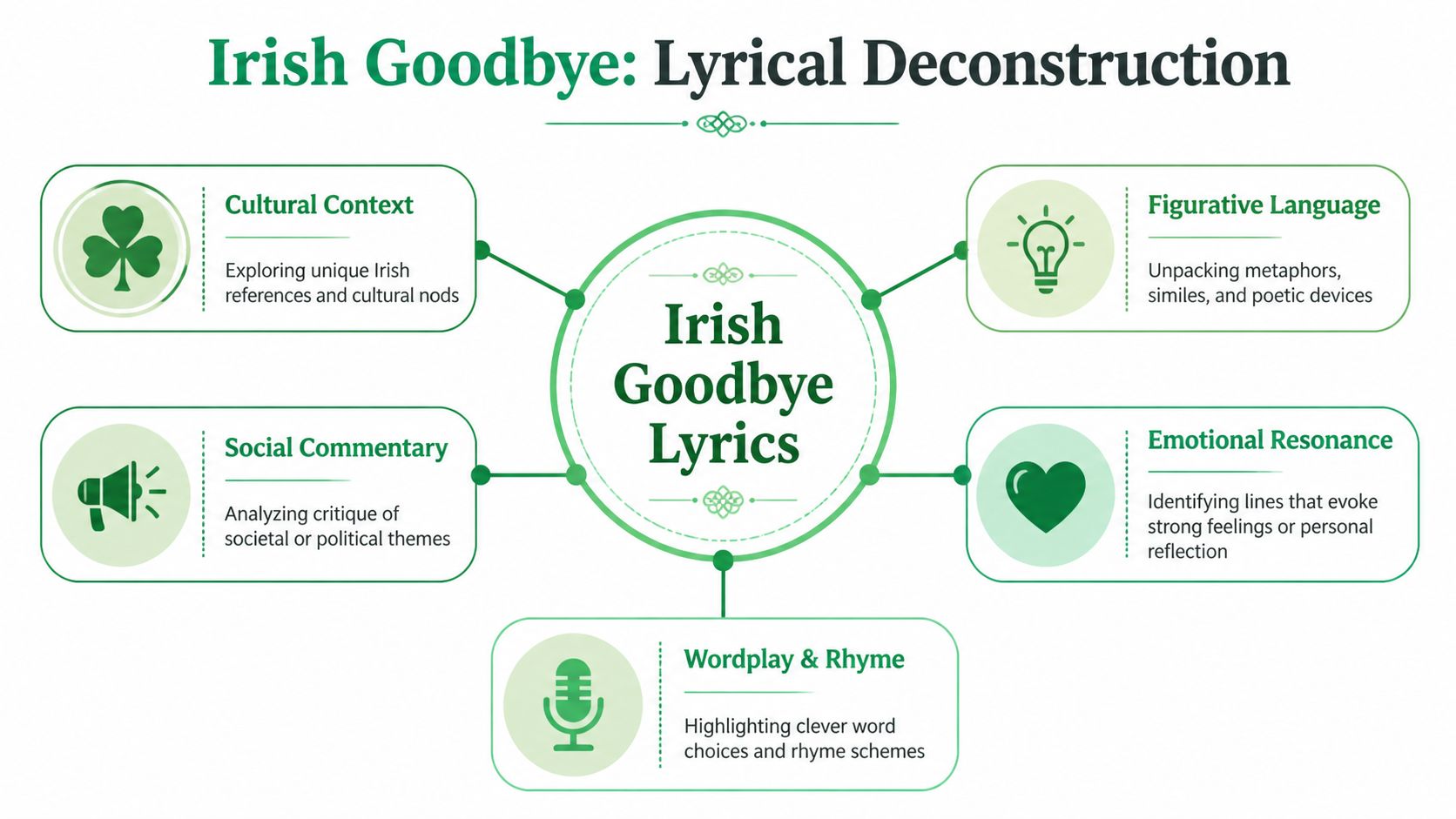
The lyrics gain power from what they imply, not only from what they state. Kneecap are skilled at packing several layers into one phrase. In “Irish Goodbye,” that technique becomes less comic and more elegiac.
What Céad slán leis an Ra is doing
The phrase “Céad slán leis an Ra” is one of the song’s most discussed openings because it doesn’t operate on one level only. In the verified reporting, it’s described as a clever Gaelic pun that says goodbye both to the UK and to personal loss. That’s classic Kneecap in one sense. Political language and private feeling are jammed into the same line.
For learners, the trap is trying to flatten that into a single English equivalent. Don’t. Let it remain layered. The line is doing farewell, irony, identity, and grief at once.
That kind of compression is one reason lyric art resonates with people. A short line can hold more than a paragraph if the phrase is built well. If you enjoy that side of songwriting, this piece on how to curate your walls with lyric art is a thoughtful read.
How memory shapes the song
The song also has a clear inner movement. It doesn’t merely list emotions. It moves from trigger to recollection, from recollection to changed perception. In a Vice interview about the song’s creation, Móglaí Bap described seeing a documentary from the 1990s featuring his father. That footage helped shift him from “constant sad memories” toward “happier times.”
That detail helps explain why the lyrics keep returning to everyday images. The song isn’t trying to narrate grief in an abstract way. It’s rebuilding memory through ordinary scenes.
Here are three useful ways to read the structure:
- Trigger first: an outside stimulus activates memory.
- Detail second: the song focuses on mundane, domestic things.
- Meaning last: those details become the proof of love and loss.
This is why the track feels organized even when it sounds emotionally raw. The writing has shape. The feelings are intense, but the lyric logic is careful.
Some songs tell you what the singer feels. This one shows you how the feeling changes when memory changes.
A beginner may also get confused by the title itself. In everyday English, “Irish goodbye” often means leaving without announcing it. In this song, that phrase takes on a much darker charge. It becomes a title about disappearance, unfinished speech, and the ache of not getting the ending you wanted.
A Language Learners Guide to the Song
Modern music is one of the best ways to meet Irish as a living language, not a classroom relic. That matters because only 1.7% of Ireland’s population speaks Irish daily, according to 2022 Census data cited in The Journal’s coverage connected to the song. If you want Irish to feel real, songs like this help.
Key vocabulary from Irish Goodbye
| Irish Phrase | Pronunciation Guide | English Meaning | Grammar/Cultural Note |
|---|---|---|---|
| céad slán | kayd slawn | a deep farewell, literally “a hundred goodbyes” | Céad can intensify the phrase rather than function as a strict count |
| leis | lesh | with / to | Common preposition form. It often appears in fixed expressions |
| mo Mha | muh wah | my mother | mo causes lenition, so máthair changes in form and sound |
| rudaí beaga | rud-ee byag-uh | small things | Useful plural noun phrase. Very common in everyday Irish |
| amanna maithe | am-anna mah-ha | good times | Plural structure. A strong phrase for memory and storytelling |
If you’re new to pronunciation, don’t aim for perfection on day one. Irish spelling is consistent, but it follows Irish sound rules, not English ones. The phrase mo Mha often catches learners because the written mh doesn’t sound like an English “m” at all.
How to study a song without getting lost
Try this instead of translating every line at once:
- Listen for repeated sounds: repeated words are your footholds.
- Mark emotional nouns first: words for family, time, memory, goodbye.
- Leave clever lines for later: puns and political references make more sense after you’ve got the emotional core.
- Read aloud slowly: Irish rhythm helps meaning stick.
A second useful tactic is to build mini-sets. If you learn slán, add related farewell language. If you learn beag, collect a few everyday adjective phrases with it. Songs are sticky memory tools because they connect sound, feeling, and repetition.
Read the lyrics as if you’re learning a person’s way of speaking, not just a list of vocabulary.
That shift helps a lot. Irish in songs isn’t sterile. It bends toward intimacy, local identity, and voice. “Irish Goodbye” is a strong example because the language never feels ornamental. It feels necessary.
Practice Irish with Modern Music on Gaeilgeoir AI
The best reason to study a song like this isn’t to impress anyone with a translation. It’s to hear how Irish lives now. Kneecap use Gaeilge for grief, wit, tension, and cultural memory. That makes the song valuable even if you only understand part of it on first listen.
A lot of learners wait until they feel “ready” before touching real music. That’s backwards. Real songs give you a reason to keep going. They attach vocabulary to emotion, and emotion helps memory. “Irish Goodbye” is difficult in places, but it rewards slow listening because every phrase is tied to something human.
If you want to keep building from songs into conversation, pronunciation, and everyday use, it helps to practice with tools that treat Irish as something spoken now, not only studied for exams. Resources that focus on living language, including learning Gaelic language with AI, can make that bridge much easier.
The important part is consistency. Take one line, one phrase, one sound pattern. Learn it well. Then return to the song and hear more than you heard before.
A CTA for Gaeilgeoir AI.