Does bilingualism make you smarter? Research points to a more precise question: how does managing two languages affect attention, mental flexibility, and the brain's response to challenge?
The proposed benefit is cognitive reserve, the capacity to keep functioning despite age-related change or neurological damage. It works like having several routes to the same destination. If one route becomes less reliable, the brain may draw on other networks or strategies. Lifelong bilingual experience is one factor researchers examine in connection with this reserve, although it does not make anyone immune to dementia.
The cognitive benefits of bilingualism are therefore better understood as selective adaptations than as a universal intelligence upgrade. Switching between languages can repeatedly practise attention, inhibition, and flexible responses, much like a musician rehearses precise movements rather than becoming better at every physical task.
Learning Irish, Spanish, Welsh, or another language will not make every mental task easier. It can, however, provide a demanding, meaningful way to strengthen the systems used to focus, switch, and respond. The research remains nuanced, so the practical value lies in building these skills while understanding what the evidence can, and cannot, establish.
Table of Contents
- The Bilingual Brain and Cognitive Reserve
- Upgrading Your Brains Executive Functions
- The Compelling Link to Delaying Dementia
- Understanding the Scientific Debate and Nuances
- How Learning Irish Can Strengthen Your Brain
- Actionable Tips to Maximize Your Cognitive Gains
The Bilingual Brain and Cognitive Reserve
Does bilingualism make people smarter? That question assumes a single general intelligence score can capture the effect. Cognitive research asks a narrower question: does managing more than one language change how the brain controls attention and responds to challenge?
The central idea is cognitive reserve, the brain's capacity to keep functioning despite age-related change or neurological damage. Cognitive reserve functions like a well-connected transport system with alternative routes through a city. If one road becomes blocked, other routes can still lead to the same destination. In the brain, this reserve may involve efficient networks, flexible strategies, and the ability to recruit additional areas when familiar pathways become less reliable.
Lifelong bilingualism is one factor researchers examine in relation to this reserve. The proposed benefit concerns how well a person continues everyday activities when the brain is under strain. It does not mean bilingualism prevents dementia or guarantees protection from neurological disease.
The practical meaning: bilingualism may affect when symptoms become noticeable, rather than whether the underlying disease develops.
That distinction matters. Cognitive reserve does not remove the biological processes associated with dementia. A person with more flexible cognitive resources may continue handling familiar tasks while disease-related changes are already present. The symptoms can therefore become visible later, even though the disease itself has not necessarily been stopped.
The possible explanation rests on repeated mental practice. During a bilingual conversation, speakers select one language, suppress another, interpret context, and adjust to the person they are addressing. Each choice places demands on systems involved in attention and control. Across years, those demands may encourage more efficient or adaptable responses, although the size and consistency of the effect can vary.
Learning a language gives this idea a practical dimension. Choosing an Irish expression instead of the first English word that comes to mind requires attention, retrieval, and adjustment to context. These moments are small, but they provide meaningful practice in managing competing information.
The result is not a collection of extra IQ points. It is a potentially more resilient cognitive system, able to regulate attention, respond flexibly, and find another way to complete a task. Language history, proficiency, age of acquisition, daily use, education, health, and social environment all shape that experience, so bilingualism should be understood as one possible contributor to cognitive reserve, not a universal brain upgrade.
Upgrading Your Brains Executive Functions
Executive function is the brain's management system. A useful analogy is an air traffic controller: several planes may be approaching at once, but the controller must decide which one lands, which one waits, and which route needs to change. Your brain performs a similar job whenever you ignore a notification, hold instructions in mind, or shift from one problem to another.
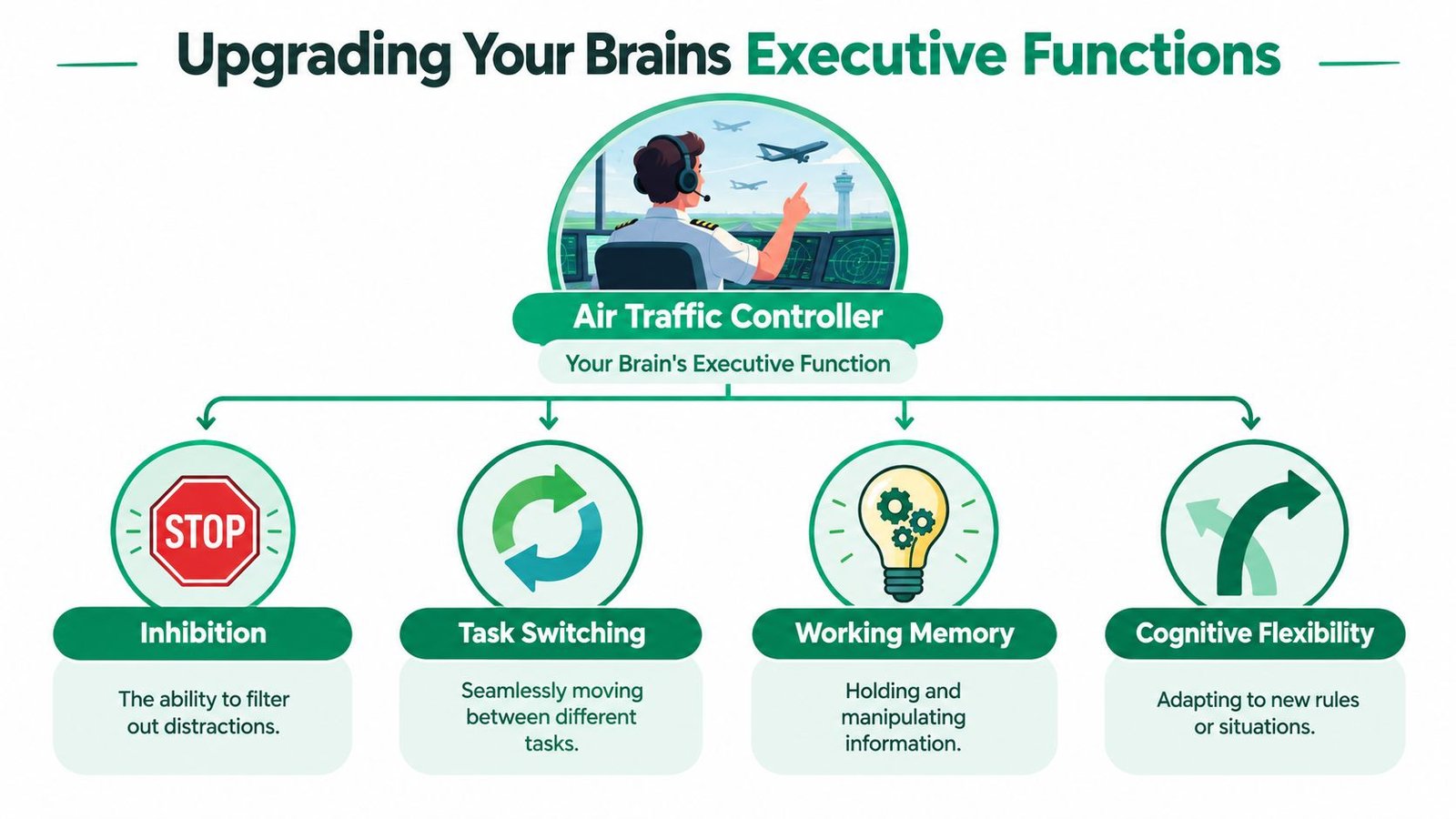
Bilingual conversation gives this control system regular work. The speaker may know the word in both languages, hear cues from the surrounding conversation, choose the appropriate language, and prevent the alternative word from taking over. That process doesn't make every bilingual person better at every mental task, but it creates a clear reason researchers focus on executive control.
Inhibition filters the wrong signal
Inhibitory control is the ability to stop an irrelevant response. If you're speaking Irish and the English word arrives first, you need to hold it back long enough to retrieve the Irish expression. The same principle appears when you concentrate in a noisy room or resist checking your phone while reading.
The key point is not that bilinguals never experience interference. They do. The mental work comes from handling that interference. A learner who practises saying the intended Irish word instead of defaulting to English is repeatedly training selection under pressure.
Task switching changes the active rule
Task switching is the ability to move between mental activities without losing the governing rule. A bilingual speaker might discuss family in Irish, answer a work message in English, then return to Irish. Each shift requires a change in vocabulary, grammar, sound patterns, and social expectations.
Language learning makes this visible. You may read a sentence, listen for a familiar ending, search memory for a verb form, and then revise your answer after hearing the other person. The brain isn't just storing words. It's switching among rules and updating them as the conversation develops.
Working memory holds information in play
Working memory allows you to keep information available while using it. You might hear a question in Irish, remember its opening, translate its meaning, plan a response, and keep the relevant grammar pattern active while speaking.
The evidence doesn't support claiming that bilingualism produces a broad improvement in working memory. A 2024 meta-analysis found a small but significant overall executive-function advantage, Hedges' g = 0.18, with the strongest effects in inhibitory control and cognitive flexibility rather than working memory. The meta-analysis reports these findings in detail.
| Executive function | Everyday language-learning demand |
|---|---|
| Inhibition | Suppressing a familiar English word while retrieving the Irish equivalent |
| Task switching | Moving between languages, topics, speakers, or conversation rules |
| Working memory | Holding a question in mind while constructing an answer |
| Cognitive flexibility | Adapting when a familiar phrase or grammar pattern doesn't fit |
These processes overlap, but they aren't interchangeable. A learner can become more flexible when switching tasks without gaining the same advantage on a memory exercise. That selectivity is why careful explanations are more useful than the phrase “bilingual brains are better.” Language practice provides a structured workout for control, especially when it requires active decisions rather than passive exposure.
The Compelling Link to Delaying Dementia
Dementia research separates two questions. Does bilingualism reduce the chance of developing dementia, or can it delay the point when symptoms disrupt everyday function? Current evidence offers more support for delayed clinical expression than for prevention.
The cognitive-reserve model provides a possible explanation. Repeatedly choosing between languages practises attention, response inhibition, and strategy switching. Over time, the brain may have more than one route for handling a task, much like a traveller having an alternative road when the usual route is blocked. Disease-related changes can still occur, while symptoms remain less visible for longer.
A 2013 Neurology study reported that bilingual patients received a dementia diagnosis 4.5 years later than monolingual patients. The difference remained significant after researchers accounted for education, sex, occupation, and urban versus rural residence. Those adjustments make the comparison more informative than one based only on language background. Read the PubMed record for the study details.
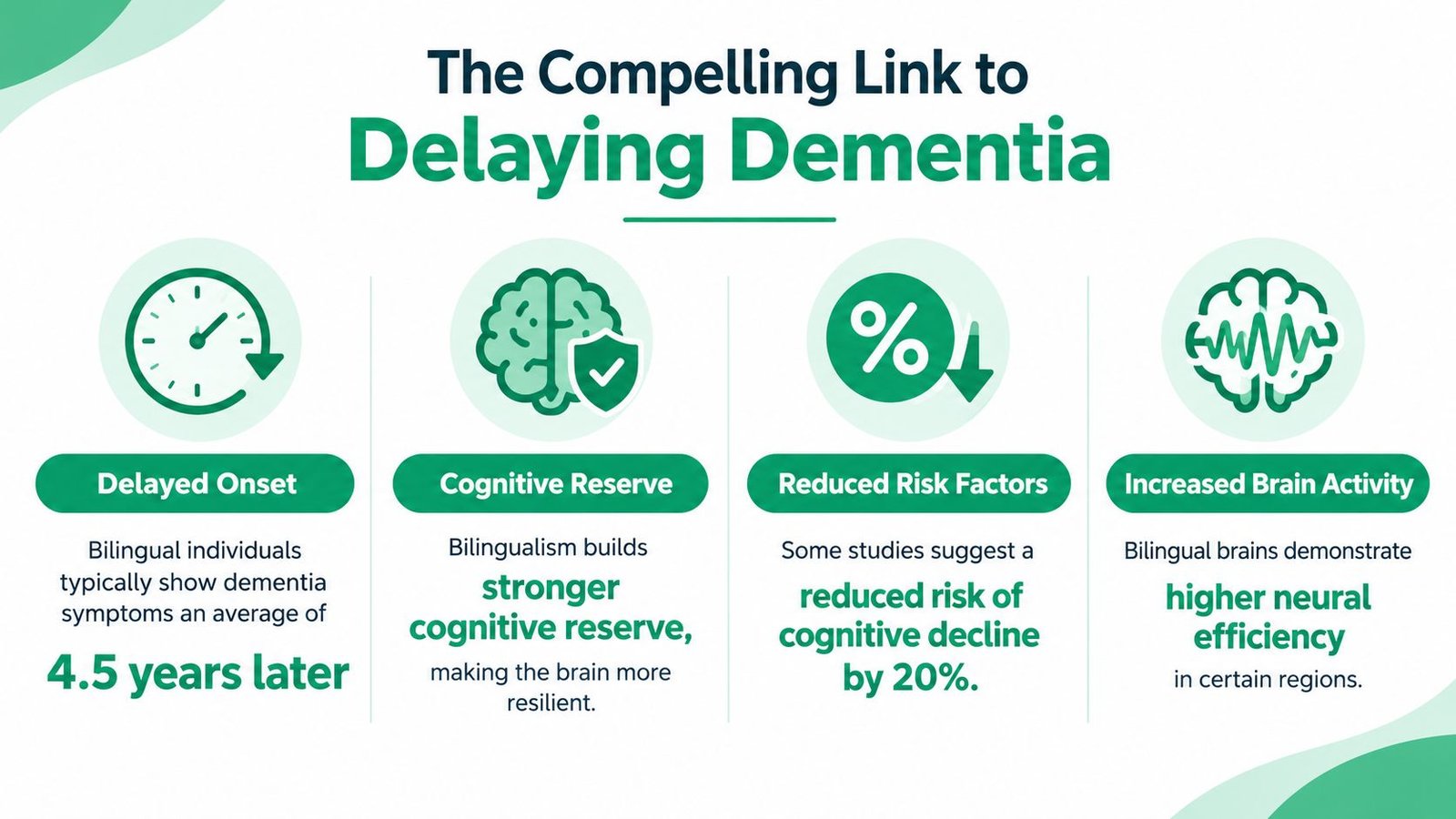
Other analyses report a comparable pattern. A 2020 meta-analysis found Alzheimer's symptom onset 4.7 years later in bilinguals, with a 95% confidence interval from 3.3 to 6.1 years. The full analysis explains the estimate and its limits. A 2026 Bayesian meta-analysis pooling 18 age-at-onset studies found bilinguals were, on average, 3.45 years older at symptom onset, with a 95% credible interval from 2.8 to 4.1 years. Its PubMed entry provides the study information.
These findings concern clinical timing, not a cure. A prospective meta-analysis including 5,527 bilingual participants reported an odds ratio of 0.96 for future dementia, which indicates no clear preventive effect on incidence itself. That review is indexed by PubMed.
The careful conclusion is encouraging but limited. Bilingualism may help some people maintain function longer or delay symptom expression, yet it cannot guarantee protection from dementia. Health, education, social engagement, physical activity, hearing, genetics, and other factors also shape cognitive aging. Learning a language in midlife can therefore be meaningful as sustained mental and social activity, rather than medical insurance.
Understanding the Scientific Debate and Nuances
The phrase “bilingual advantage” sounds broader than the evidence. Some studies report better performance on tasks involving inhibition or switching, while others find no meaningful difference. A major meta-analysis of 152 studies found no systematic evidence for a general bilingual advantage in adult executive function, describing effects as modest and inconsistent across cognitive domains, tasks, and bilingual populations. The meta-analysis is available through the White Rose research repository.
A 2019 systematic review reached a similarly nuanced starting point. Among 46 original studies, 54.3% reported beneficial effects, 28.3% reported mixed results, and 17.4% found evidence against a bilingual advantage. The systematic review is available in the National Library of Medicine.
Those results don't make the research useless. They show that the effect depends on what researchers measure and whom they study. A Stroop-style task, which requires someone to suppress a conflicting response, may reveal a difference that a simple memory test doesn't. Age, proficiency, frequency of language use, the age at which each language was learned, and the social context of bilingualism can also change the cognitive demands.
Why results can disagree
Research participants labelled “bilingual” may have very different experiences. One person may use two languages daily at home and work, while another may understand a second language but rarely speak it. Treating both participants as equivalent can blur the relationship between language management and performance.
The task itself matters too. Executive function is not a single ability. It includes inhibition, flexibility, planning, attention, and working memory, and a result in one area doesn't automatically transfer to the others. A learner may become quicker at switching between languages without becoming better at every unrelated activity.
Recent work has reinforced the need to avoid a simple better-versus-worse story. A 2024 analysis reported that bilingual advantages and disadvantages often appear together across datasets, suggesting that bilingualism changes cognitive processing in complicated ways rather than producing a blanket upgrade.
For students, this is a useful model of how to read evidence. Anyone doing practice for A-Level Psychology exams can use bilingualism as an example of why operational definitions, participant characteristics, control groups, and task selection matter. A careful learner should also distinguish association from causation. People who become bilingual may differ from monolingual participants in education, migration history, social contact, occupation, or motivation, and researchers must account for those factors as well as possible.
For a deeper look at how people acquire and use additional languages, research on language acquisition provides useful context. The practical conclusion is modest but valuable: bilingualism appears linked to selective cognitive adaptations, especially under conditions that demand conflict control and flexibility. That's more credible than promising universal intelligence, and it gives learners a clearer reason to practise actively.
How Learning Irish Can Strengthen Your Brain
Irish turns the theory into a series of small decisions. When you try to speak, you aren't only recalling vocabulary. You're selecting among alternatives, suppressing the English response, tracking the sentence structure, and adjusting when the listener gives you new information.
Take the Irish verbs “tá” and “is.” Both can relate to the English verb “to be,” but they don't function as interchangeable substitutes in every sentence. Choosing the form that fits requires you to notice the grammatical context rather than translate mechanically. That kind of decision invites cognitive flexibility, because you must adapt your response to the rule in front of you.

Conversation adds pressure in a productive way. If someone asks for directions in Irish, you need to understand the question, retrieve relevant words, organise an answer, and keep speaking even when a phrase doesn't arrive immediately. A correction isn't a failure of the exercise. It gives your control system another opportunity to update its response.
The proposed pathway for cognitive reserve involves the repeated recruitment of executive-control systems for language selection, inhibition, and switching, which may strengthen efficiency in frontal and frontoparietal networks over time. A review in Frontiers in Neurology discusses this proposed mechanism.
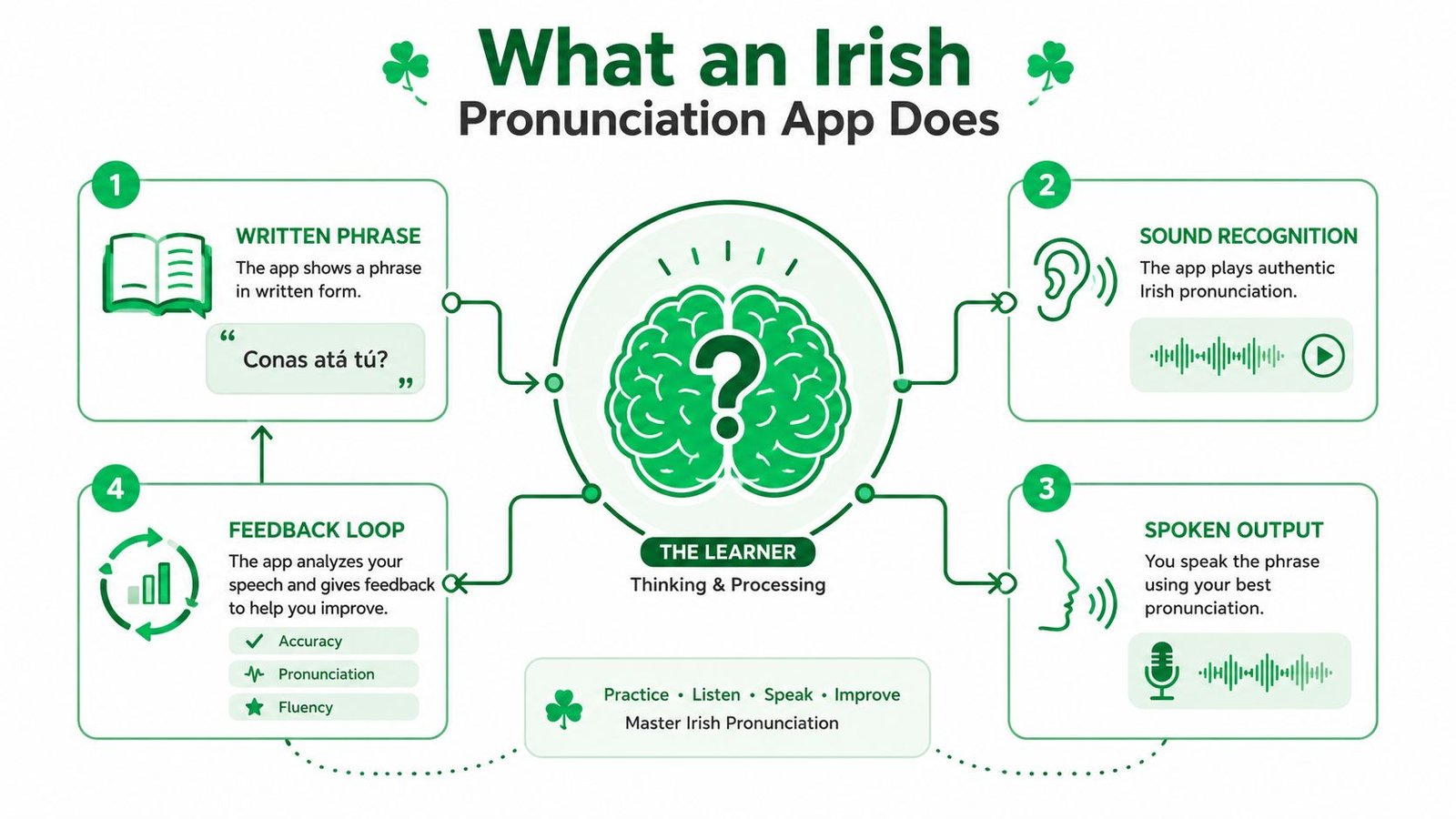
Gaeilgeoir AI is one practical option for creating these demands. It offers guided real-world conversations, pronunciation support, adaptive quizzes with instant feedback, and scenario-based practice for situations such as social interactions, work, travel, ordering food, and asking for directions. Learners can click words to view translations and save them to a personalised study list, which supports active retrieval instead of relying only on rereading.
A conversation session works best when you treat it as a mental task, not a passive lesson. Try answering before checking a translation, repeat a corrected phrase, and change the subject so you must retrieve language in a new context. This guide to learning Gaelic can help you think about building a sustainable routine around communication and regular practice.
Here's a short visual explanation of how language practice can engage control processes:
Irish also offers a personal reason to persist. For learners reconnecting with family heritage, each new phrase can link cognitive effort with identity, place, and memory. That emotional relevance doesn't prove a particular neurological effect, but it can make regular practice easier to maintain, and consistency is essential for any skill that depends on repeated retrieval.
Actionable Tips to Maximize Your Cognitive Gains
The cognitive benefits of bilingualism are most likely to become relevant when language learning demands active control. Passive exposure can familiarise you with sounds and rhythm, but deliberate retrieval, conversation, and correction force you to make decisions.
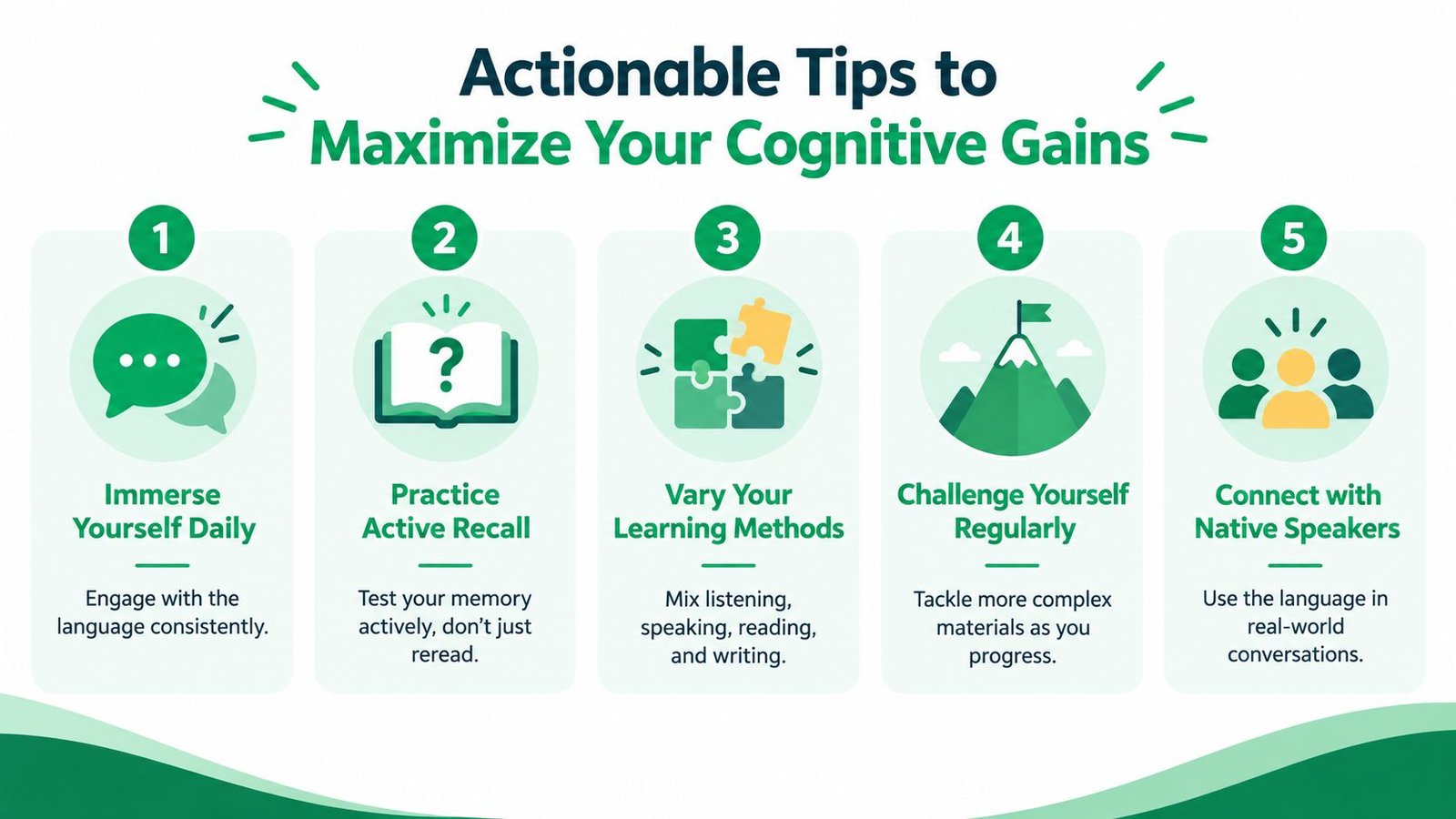
1. Speak before you feel ready
Use short exchanges instead of waiting for perfect fluency. Describe your breakfast, answer a simple question, or ask for an item in Irish. The moment you search for a word and continue after a mistake, you practise retrieval, inhibition, and flexible adjustment together.
2. Use active recall
Close the book and reconstruct the phrase. Ask yourself how to say “Where is the station?” before checking the answer. Spaced repetition guidance can help you schedule reviews so vocabulary returns just as it begins to fade.
3. Mix the channels
Read a short dialogue, listen to it, say it aloud, and write a variation of it. Each mode places a slightly different demand on attention. Varying the task also prevents you from confusing recognition with genuine recall.
4. Practise switching deliberately
Spend part of a session moving between English instructions and Irish answers. Then change the context, perhaps from ordering food to discussing your work or family. You want enough challenge to require selection, but not so much difficulty that you stop communicating.
5. Increase complexity gradually
Begin with familiar situations, then add unfamiliar vocabulary, longer answers, or follow-up questions. A useful challenge makes you retrieve and adapt. An impossible one only encourages you to abandon the task.
6. Speak with other people
Real conversation supplies timing, ambiguity, accent variation, and social feedback that a vocabulary list can't reproduce. A tutor, conversation partner, class, or guided AI exchange can all give you opportunities to respond rather than recognise.
A useful rule: choose activities that make you retrieve, decide, and adapt. If you can complete the lesson without producing language, add a speaking or recall task.
Keep the routine manageable. A short, focused session that you repeat consistently gives your brain more regular contact with the language than an occasional burst followed by a long gap. Track the phrases you can produce without prompts, not only the lessons you've completed.
Finally, keep the health claim in proportion. Language learning is a worthwhile intellectual, social, and cultural activity, and research links lifelong bilingualism with selective cognitive-control benefits and later dementia symptom onset in some populations. It isn't a guaranteed treatment or a promise of prevention. Learn Irish because it connects you with people and culture, then enjoy the possibility that the practice is also exercising a more flexible mind.
Gaeilgeoir AI offers guided Irish conversations, pronunciation support, adaptive quizzes, instant feedback, and scenario-based practice for everyday situations, so you can turn these cognitive principles into regular language use. Visit Gaeilgeoir AI to begin practising Irish through interactive lessons and build a consistent speaking routine.