Your cousin has just announced an engagement. A friend passed a tough exam. A teammate won a final. You want to say more than a plain “congratulations,” and if Irish matters to you, even a little, using the language can make that moment feel warmer and more personal.
That’s why congratulations in irish is such a useful phrase to learn. It gives you something practical you can say right away, but it also opens a door into how Irish expresses celebration. The words carry a sense of shared happiness, not just polite praise.
Table of Contents
- Why Saying Congratulations in Irish Matters
- The Essential Phrase Comhghairdeas Explained
- Your Guide to Perfect Pronunciation
- Beyond Comhghairdeas More Ways to Celebrate
- Using Irish Congratulations in Real Life
- Understanding the Simple Grammar Rules
- How to Practice Irish with Gaeilgeoir AI
Why Saying Congratulations in Irish Matters
A lot of learners start with greetings. That makes sense. But congratulations is different. You usually say it at a real emotional moment, when someone has done something difficult, joyful, or life-changing.
If you tell a friend Comhghairdeas leat, you’re not just swapping English for Irish. You’re joining their happiness in a way that fits the spirit of the language. Irish tends to hold onto community, family, local pride, and shared milestones, so this phrase feels especially natural at engagements, exam results, sports wins, and family celebrations.
A phrase that feels personal
Think about the difference between sending a quick “Congrats!” and taking a moment to write a thoughtful message. Irish can have that second effect. Even if your sentence is short, it sounds intentional.
That matters for:
- Family news: engagements, weddings, new babies, anniversaries
- Student life: exam results, oral practice, school achievements
- Community moments: local matches, music performances, club events
- Heritage connection: reconnecting with Irish roots through everyday phrases
Saying it in Irish can turn a simple message into a shared cultural gesture.
For many people, that’s the appeal. You don’t need advanced grammar to make someone smile. You just need one phrase you can say with sincerity.
The Essential Phrase Comhghairdeas Explained
The core phrase you need is Comhghairdeas. This is the standard Irish word for “congratulations,” and it’s the one you’ll see most often in learning materials, spoken use, and celebratory messages.
What the word really means
This word is special because it isn’t just a flat translation. Comhghairdeas comes from comh- meaning “together” and gairdeas meaning “joy.” In other words, it carries the sense of shared joy or joint rejoicing.
That’s one reason the phrase feels so alive. You’re not standing outside someone’s success and commenting on it. You’re stepping into the moment with them.
Why that meaning matters
English speakers often treat “congratulations” as a standard response. Irish gives the phrase more emotional shape. The meaning suggests celebration as something communal.
Historically, the phrase’s standardized use was strongly promoted during the Gaelic Revival from circa 1893 to 1922, and the Gaelic League was founded on July 31, 1893, helping promote Irish as a living language in public life and celebration, as noted in this explanation of Comhghairdeas and the Gaelic Revival.
Your first useful forms
Once you know the base word, you can build the two forms you’ll use most often:
Comhghairdeas leat
congratulations to you, singularComhghairdeas libh
congratulations to you, plural
Practical rule: Learn Comhghairdeas first as a whole phrase, not as a grammar puzzle. Meaning comes before analysis.
If you remember only one thing from this section, remember this. Comhghairdeas doesn’t just praise achievement. It expresses shared happiness, and that’s why it feels so culturally rich.
Your Guide to Perfect Pronunciation
Most learners hesitate here. The spelling looks unfamiliar, and that’s normal. Irish spelling often maps sounds differently from English, so the trick is to aim for clear, confident pronunciation rather than perfection on day one.
A helpful English-style approximation for Comhghairdeas is “ko-raid-as” or “koh-ghawr-jess.” Those aren’t exact, but they’ll get you close enough to start speaking.
Start with the shape of the word
Try saying it in three beats:
Comh
Start with a “koh” sound.ghair
This middle part is softer than many learners expect. Don’t force a hard “g.”deas
Keep the ending crisp and light.
Say it slowly first, then smooth it out: koh-ghair-deas.
Why dialects sound different
Irish changes across dialects, and that’s one reason you may hear more than one version. The common form comhghairdeas is often pronounced /koːɾʲdʲas/, while in Ulster Irish it may extend to comhghairdeachas /koːɣaɾdʲaxəs/. This reflects dialectal sound patterns where Ulster preserves distinct velar fricatives /ɣ/ and /x/, a feature highlighted in this note on pronunciation and dialect variation.
A learner-friendly approach
If you’re a beginner, use this approach:
- Pick one version first: Start with Comhghairdeas before worrying about regional variation.
- Listen more than you analyze: Your ear will improve faster than you think.
- Copy rhythm, not just sounds: Irish has a musical flow that matters as much as individual letters.
For extra listening practice, this Irish pronunciation guide can help you hear recurring sound patterns beyond this one phrase.
Clear pronunciation beats overthinking. If your listener understands your warmth and your meaning, you’re doing well.
Beyond Comhghairdeas More Ways to Celebrate
Once you’ve got the main phrase, it helps to have a few more options. Some moments call for full congratulations. Others need something lighter, quicker, or more enthusiastic.
When to choose a different phrase
The longer form Comhghairdeachas can sound more heartfelt or emphatic. It’s associated with communal celebration, and it’s often heard in big public moments such as GAA culture. GAA All-Ireland Finals have been a cultural staple since 1887, and the 2023 hurling final reached 1.8 million viewers, helping spread these celebratory phrases widely through broadcasts and public language, as described in this discussion of Comhghairdeachas in Irish celebration.
For everyday praise, many speakers switch to shorter expressions.
Irish Phrases for Congratulations
| Irish Phrase | Pronunciation | Meaning & Formality | Best Used For |
|---|---|---|---|
| Comhghairdeas | ko-raid-as | Congratulations. Standard and versatile. | Exams, engagements, job news, formal or warm messages |
| Comhghairdeachas | koh-wir-jah-kus | Heartfelt congratulations. More emphatic. | Big public celebrations, speeches, extra warmth |
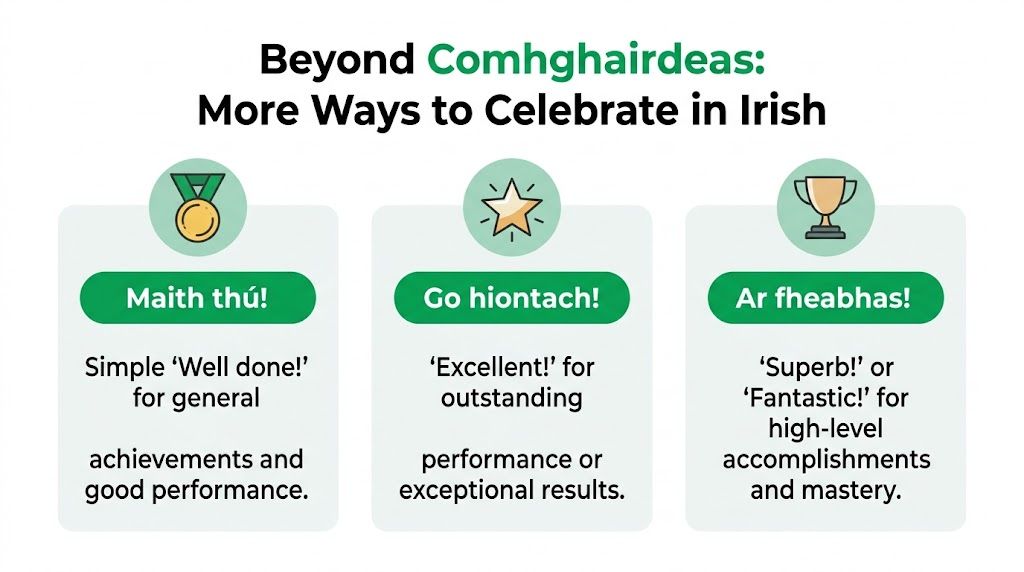
| Maith thú! | mah hoo | Well done. Informal and common. | Schoolwork, sport, finishing a task |
| Go hiontach! | guh hin-takh | Excellent. Positive and lively. | Strong performance, results, praise |
| Ar fheabhas! | ar yab-has | Superb or fantastic. Enthusiastic praise. | Outstanding work, high achievement |
How these feel in real use
- Use Comhghairdeas when the event is significant and you want a complete “congratulations.”
- Use Maith thú! when someone has done well and the mood is casual.
- Use Ar fheabhas! when you want your praise to sound energetic and impressed.
If you’re writing a card for an engagement or wedding and want ideas for tone before you add the Irish phrase, these congratulations message engagement ideas are useful for shaping the message around the occasion.
You can also build out your celebration vocabulary with other Irish greetings and phrases, especially if you want your message to sound more natural from start to finish.
Using Irish Congratulations in Real Life
A phrase becomes memorable when you attach it to a real situation. That’s where most learners relax. Instead of asking “What does this word mean?” you start asking “When would I say this?”
Ready-to-use examples
Here are some natural examples you can borrow, adapt, or send as they are.
Comhghairdeas leat as do phost nua!
Congratulations on your new job!Comhghairdeas libh ar bhur bpósadh!
Congratulations on your wedding!Comhghairdeas ó chroí leat, a chara!
Heartfelt congratulations to you, my friend!Maith thú féin!
Well done yourself!Comhghairdeas leis an bhfoireann!
Congratulations to the team!
Matching the phrase to the moment
For a one-to-one message, Comhghairdeas leat works beautifully. It sounds warm without being too formal. If you’re speaking to a couple, a family, or a group, switch to Comhghairdeas libh.
That small change matters. It’s one of the easiest ways to sound more natural in Irish.
Sample situations
A few common situations come up again and again:
Exam results:
Comhghairdeas leat as do thorthaí sna scrúduithe.
Congratulations on your exam results.Engagement:
Comhghairdeas ar bhur ngealltanas.
Congratulations on your engagement.Wedding day:
Comhghairdeas libh ar lá bhur bainise.
Congratulations on your wedding day.Victory in sport:
Maith sibh. Comhghairdeas libh as an mbua.
Well done. Congratulations on the win.
A short Irish phrase often lands better than a long sentence you’re unsure about.
A simple message formula
If you want a reliable pattern, use this:
Comhghairdeas + leat/libh + ar/as + the occasion
Examples:
- Comhghairdeas leat as do bhua.
- Comhghairdeas libh ar bhur bpósadh.
- Comhghairdeas leat as an obair mhaith.
This is enough for texts, cards, speeches, and quick spoken moments. You don’t need fancy vocabulary to sound thoughtful. You need a phrase you can reach for naturally.
Understanding the Simple Grammar Rules
Irish congratulations become much easier once you notice one key feature. Irish often builds this idea around a noun, not a dedicated verb. Instead of a direct “to congratulate” verb doing all the work, Irish commonly uses structures around comhghairdeas itself.
That’s why forms like déanamh comhghairdeas mean “to make congratulations.” In formal settings such as exams and sports, this noun-based style appears in 85% of contexts compared with informal alternatives like Maith thú!, according to this grammar-focused explanation of congratulating someone in Irish.
Leat and libh
This is the grammar point you’ll use most:
- Leat means “to you” when speaking to one person
- Libh means “to you” when speaking to more than one person
So:
- Comhghairdeas leat = congratulations to one person
- Comhghairdeas libh = congratulations to multiple people
Why names and phrases shift
Irish learners often expect a one-word-for-one-word translation. Irish doesn’t always work that way. It links meaning through small particles and prepositions, so the phrase grows outward from comhghairdeas.
That’s also why you may see names or following words change shape slightly after prepositions. You don’t need to master every mutation right now. What matters first is recognizing the pattern and using it consistently.
Learn the frame first. Comhghairdeas leat and Comhghairdeas libh will carry you through most everyday situations.
If you keep those two forms ready, your Irish will already sound much more grounded.
How to Practice Irish with Gaeilgeoir AI
The fastest way to remember congratulations in irish is to use it in context. Say it out loud. Put it in a text message. Practice it after real events in your day, even if you’re only talking to yourself.
That kind of repetition works better when it feels active rather than mechanical. Short speaking drills, scenario practice, and feedback on pronunciation help far more than staring at one word on a flashcard.
A practice routine that actually sticks
Try a simple weekly loop:
- Listen: hear native or learner-friendly audio of key phrases
- Repeat: say Comhghairdeas leat and Comhghairdeas libh aloud
- Apply: send one message or write one short sentence
- Recycle: reuse the phrase later in a different context
If you enjoy structured motivation, it also helps to understand how game elements affect study habits. This article on how to boost engagement with gamification gives a useful overview of why points, progress tracking, and small wins keep learners consistent.
One tool for guided speaking practice
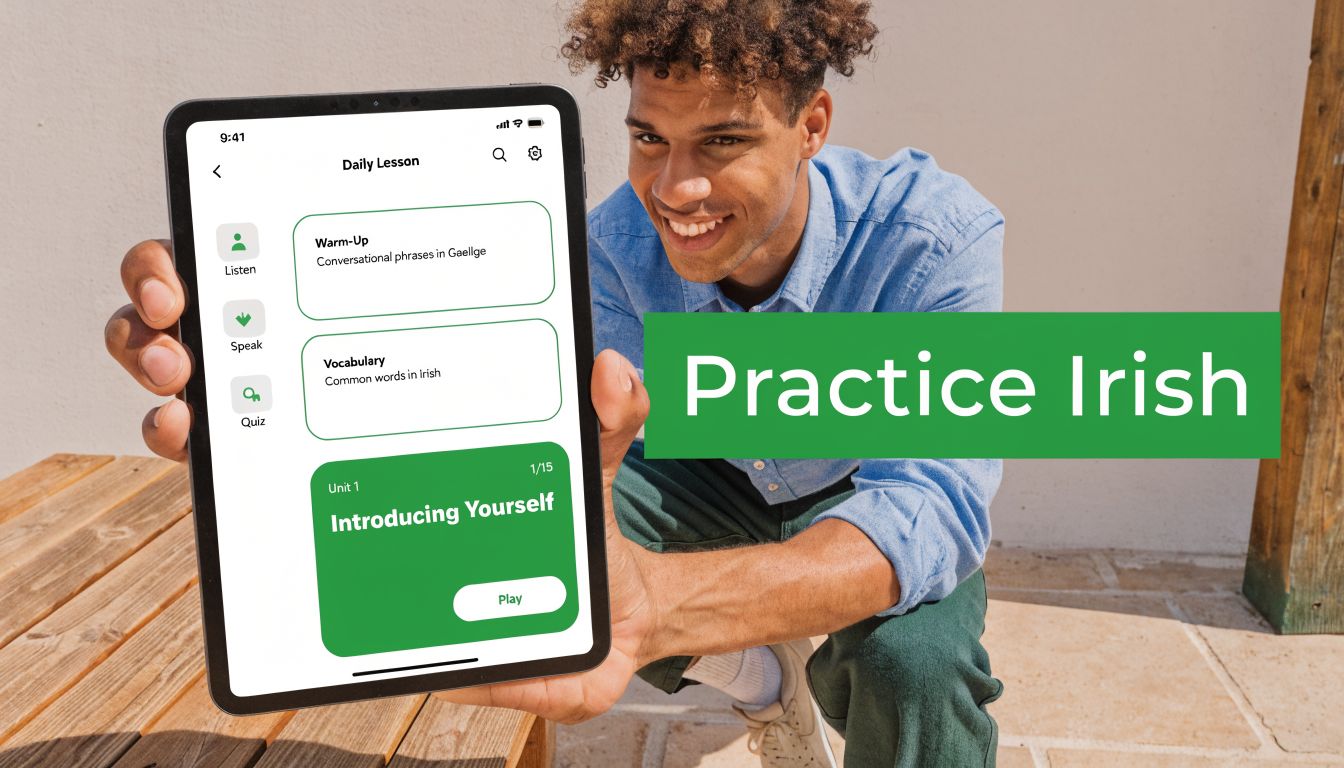
If you want interactive practice, learn Gaelic language with AI offers a route into guided conversation work. Gaeilgeoir AI includes pronunciation support, adaptive quizzes with instant feedback, and scenario-based practice for everyday situations such as social interactions, travel, and Leaving Cert oral preparation.
That matters because congratulations phrases rarely live on their own. You say them in a full interaction. Someone shares news, you respond, you ask a follow-up question, and the conversation moves on. Practicing that flow makes the phrase usable, not just memorable.
The key is consistency. A short session done often will take you further than occasional cramming.
If you’re ready to turn a few Irish phrases into real speaking confidence, try Gaeilgeoir AI. It gives you guided, real-world conversation practice so phrases like Comhghairdeas leat don’t stay on the page. They become part of how you speak.