Le do thoil is the most common way to say please in Irish when you're speaking to one person, and le bhur dtoil is used when you're speaking to more than one person. But if you're learning please in gaelic, the appropriate answer depends on context, politeness level, and who you're speaking to.
Maybe you're about to order a coffee in Ireland, prepping for an oral exam, or reconnecting with family roots and want to sound respectful from the start. In English, “please” feels simple. In Irish, it’s simple at first, then quickly becomes more interesting.
That’s good news for learners. It means you don't need a huge vocabulary to sound thoughtful. You need the right phrase, used in the right moment.
Irish politeness often works through tone, relationship, and phrasing, not just through dropping in one magic word. So yes, you can memorize le do thoil today. But if you also understand why Irish speakers sometimes choose a more formal option, or why the same phrase sounds different in Galway and Donegal, you'll feel much more confident using it in real life.
Table of Contents
- Your Guide to Saying Please in Irish
- The Most Common Ways to Say Please
- Choosing Between Formal and Informal Please
- Quick Reference Table for Irish Polite Phrases
- Understanding Regional Pronunciation Differences
- Common Mistakes to Avoid When Saying Please
- Practice Saying Please with Gaeilgeoir AI
- Building Your Foundation of Irish Politeness
Your Guide to Saying Please in Irish
A lot of learners start in the same place. They search for “please in gaelic,” find le do thoil, write it down, and assume they’re done. Then they hear another version, or notice that a textbook example doesn’t quite match a real conversation, and the doubt starts creeping in.
That confusion makes sense. Irish is not just English with different words swapped in. The phrase you choose can reflect whether you’re speaking to one person or several people, whether the setting is casual or formal, and how much deference you want to show.
Why the simple answer isn't the whole answer
At beginner level, le do thoil is the right place to start. It’s useful, common, and safe in everyday situations. If you use it while ordering food, asking for help, or making a basic request, you’ll be understood.
But Irish politeness has layers. A shop interaction, a classroom exchange, and a formal oral exam don’t all feel the same. That’s why learners benefit from knowing not only the phrase itself, but the social meaning behind it.
Practical rule: Start with le do thoil for everyday requests. Learn the more formal option later, once your basic speech feels comfortable.
A heritage learner often wants more than a phrasebook answer. They want to know what sounds natural. A student preparing for the Leaving Cert wants language that fits the occasion. A traveler wants to avoid sounding abrupt without overdoing it. The same small phrase serves all three goals, but only if you use it with awareness.
What confidence sounds like
Confident Irish doesn’t mean perfect Irish. It means choosing language that fits the moment.
That’s why this guide focuses on real usage. You’ll see the common forms first, then the formal one, then the pronunciation differences that catch many beginners off guard. By the end, “please in gaelic” won’t feel like a single translation problem. It’ll feel like a skill you can use.
The Most Common Ways to Say Please
If you only remember two phrases from this article, make them these: le do thoil and le bhur dtoil.

They both mean “please,” but they aren’t interchangeable. The difference depends on who you’re speaking to.
Le do thoil for one person
Le do thoil is the everyday form when speaking to one person.
A helpful way to remember it is that do means “your” in the singular sense. So the phrase conveys the idea of “with your will.” You don’t need to translate it word for word when speaking, but knowing that background helps it feel less random.
Pronunciation guides in the available material give it as /leh duh huh-el/. Many learners simplify that to something like “leh duh hull” when starting out. That’s close enough to begin with, as long as you stay open to regional variations later.
You might hear it in short requests such as:
Caife, le do thoil.
Coffee, please.Cabhair, le do thoil.
Help, please.An bille, le do thoil.
The bill, please.
Le bhur dtoil for more than one person
When you’re speaking to two or more people, use le bhur dtoil.
Here, bhur is the plural “your.” That’s the key shift. English doesn’t always mark this distinction clearly, but Irish does, and using the plural form is one of those small details that makes your speech sound more natural.
The pronunciation guide in the verified material gives /leh woor duh-el/. For an English-speaking beginner, “leh woor dull” is a workable memory aid, even if your sound gets refined with practice.
Use it in situations like these:
- addressing a group at a table
- speaking to staff as a group
- asking several classmates to listen
- making a polite request to more than one person
A quick memory trick
Here’s the easiest way to keep them straight:
| Phrase | Use it with | Simple memory cue |
|---|---|---|
| le do thoil | one person | do = one person’s “your” |
| le bhur dtoil | more than one person | bhur = plural “your” |
Don’t overthink the grammar while speaking. Just connect do with one person and bhur with a group.
Why beginners sometimes hesitate
Many learners freeze because they want perfect pronunciation before they try the phrase aloud. Don’t wait for that. Irish pronunciation takes time, and politeness counts even when your accent is still developing.
A more useful goal is this:
- Choose the right form for one person or a group.
- Say it clearly and calmly.
- Listen for local pronunciation and adjust over time.
That order matters. Correct social use comes first. Fine pronunciation tuning comes after repeated listening and practice.
Choosing Between Formal and Informal Please
Once le do thoil feels comfortable, the next step is learning when Irish uses a more formal kind of politeness. That phrase is Más é do thoil é.
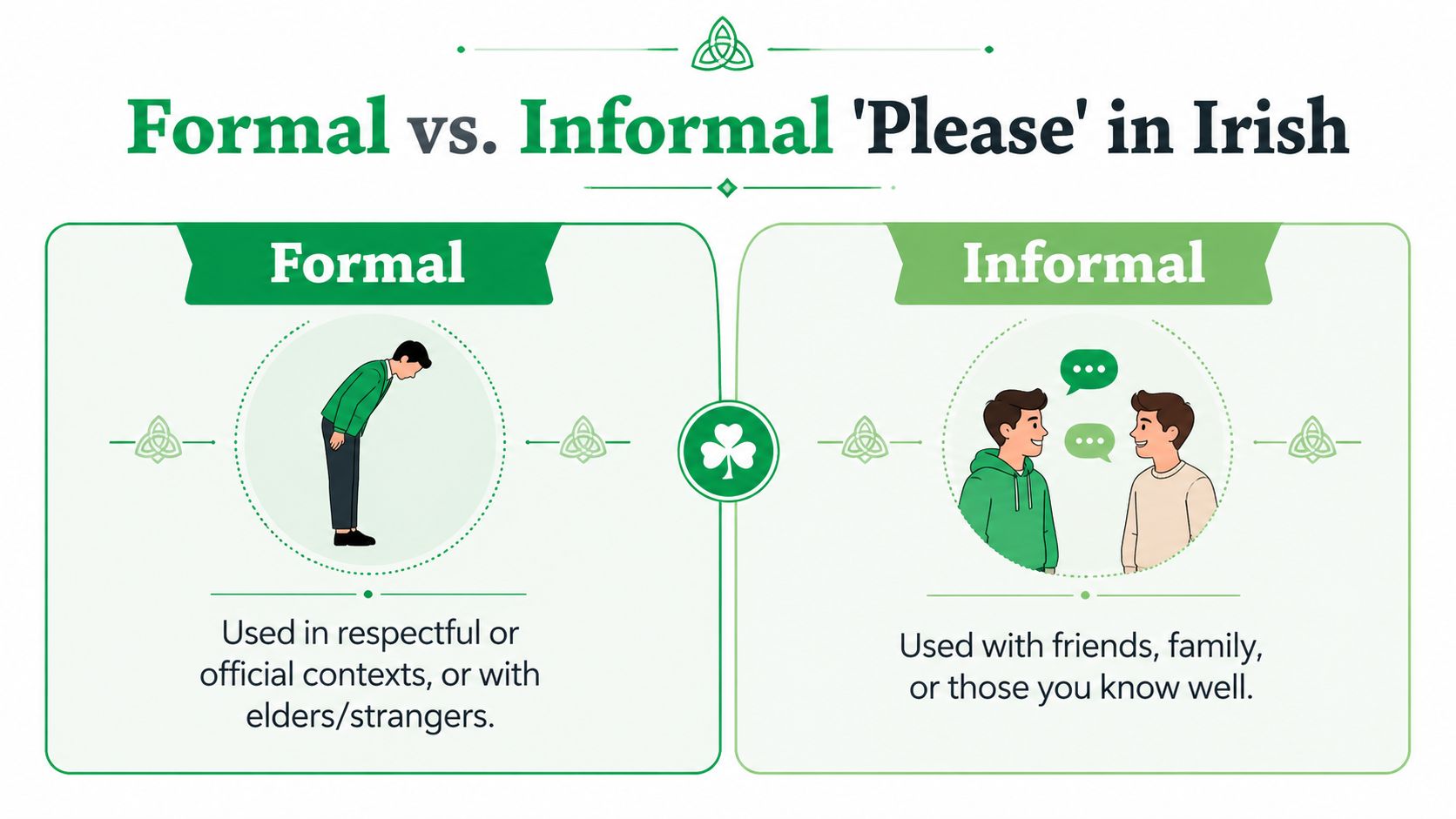
It’s often translated as “if it is your will.” That sounds more elaborate than English “please,” and that’s exactly the point. This version carries extra respect and restraint.
When le do thoil is enough
In most everyday situations, le do thoil does the job well.
Use it when you’re:
- ordering something casually
- asking for directions
- speaking with a teacher in a normal classroom exchange
- making a simple request in conversation
It’s polite without sounding stiff. For beginners, that balance matters. You want language that feels natural, not memorized from a ceremonial script.
When Más é do thoil é fits better
Más é do thoil é belongs in more formal or deferential moments. Think of it as a step up in politeness, not a replacement for the everyday phrase.
It works especially well in contexts like:
- formal speaking tasks
- service interactions where you want extra courtesy
- requests to elders or strangers when you want a more respectful tone
- exam settings where control and register matter
One verified example is: “Más é do thoil é, an bhfuil an bus ag stopadh anseo?”
“Please, does the bus stop here?”
That sounds measured and respectful. It’s not something you need in every conversation, but it’s useful to recognize and practice.
Why this matters in exams and advanced speech
This isn’t just a style preference. The verified data notes that candidates using formal variants scored 12% higher on average in the “social interaction” portion of TEG assessments in relation to advanced politeness use, according to Bitesize Irish on polite Irish phrases.
For a learner, the deeper lesson is simple. Register matters. Examiners and listeners notice when your language fits the social setting.
The strongest learners don’t just know vocabulary. They choose the right level of politeness for the moment.
A side by side comparison
| Situation | Better choice | Why |
|---|---|---|
| Ordering a tea in a casual café | le do thoil | simple, natural, everyday |
| Asking a formal question in an oral exam | Más é do thoil é | shows control and courtesy |
| Speaking to a friend | le do thoil | formal phrasing may sound too heavy |
| Making a respectful public-facing request | Más é do thoil é | adds deference |
Beginners sometimes worry that the formal phrase will make them sound more fluent all the time. It won’t. If you use it everywhere, it can sound mismatched.
The key skill is judgment. Casual request. Use the everyday phrase. High-politeness situation. Reach for the formal one.
Quick Reference Table for Irish Polite Phrases
A quick-reference chart helps when your brain goes blank mid-conversation. That’s common with polite language because you often need it fast, in the middle of ordering, asking, thanking, or apologizing.
If you want a broader starter set beyond this page, this collection of essential Gaelic phrases for everyday use pairs well with the phrases below.
Irish politeness quick reference
| Irish Phrase | Pronunciation Guide | English Meaning | When to Use It |
|---|---|---|---|
| le do thoil | leh duh hull | please | Use with one person in everyday requests |
| le bhur dtoil | leh woor dull | please | Use with more than one person |
| Más é do thoil é | maws ay duh huh-el ay | please, if you would be so kind | Use in formal or highly respectful situations |
| Go raibh maith agat | guh rev mah ah-gut | thank you | Use when thanking one person |
| Gabh mo leithscéal | gov muh lehsh-kale | excuse me / pardon me | Use to get attention, apologize lightly, or move past someone |
| Tá fáilte romhat | taw fall-cha row-ut | you’re welcome | Use after someone thanks you |
How to use the table well
Don’t try to memorize all six phrases at once. Start with a pair that naturally belongs together.
For example:
- Request pair: le do thoil and Gabh mo leithscéal
- Response pair: Go raibh maith agat and Tá fáilte romhat
- Formal pair: Más é do thoil é and Gabh mo leithscéal
That approach works better than isolated word lists because politeness usually comes in sequences. You ask, someone answers, you thank them, and the conversation keeps moving.
Understanding Regional Pronunciation Differences
One reason learners get confused about please in gaelic is that the phrase they learned from one recording may sound different when spoken by someone from another part of Ireland. That doesn’t mean you learned it wrong. It means Irish has strong regional pronunciation patterns.
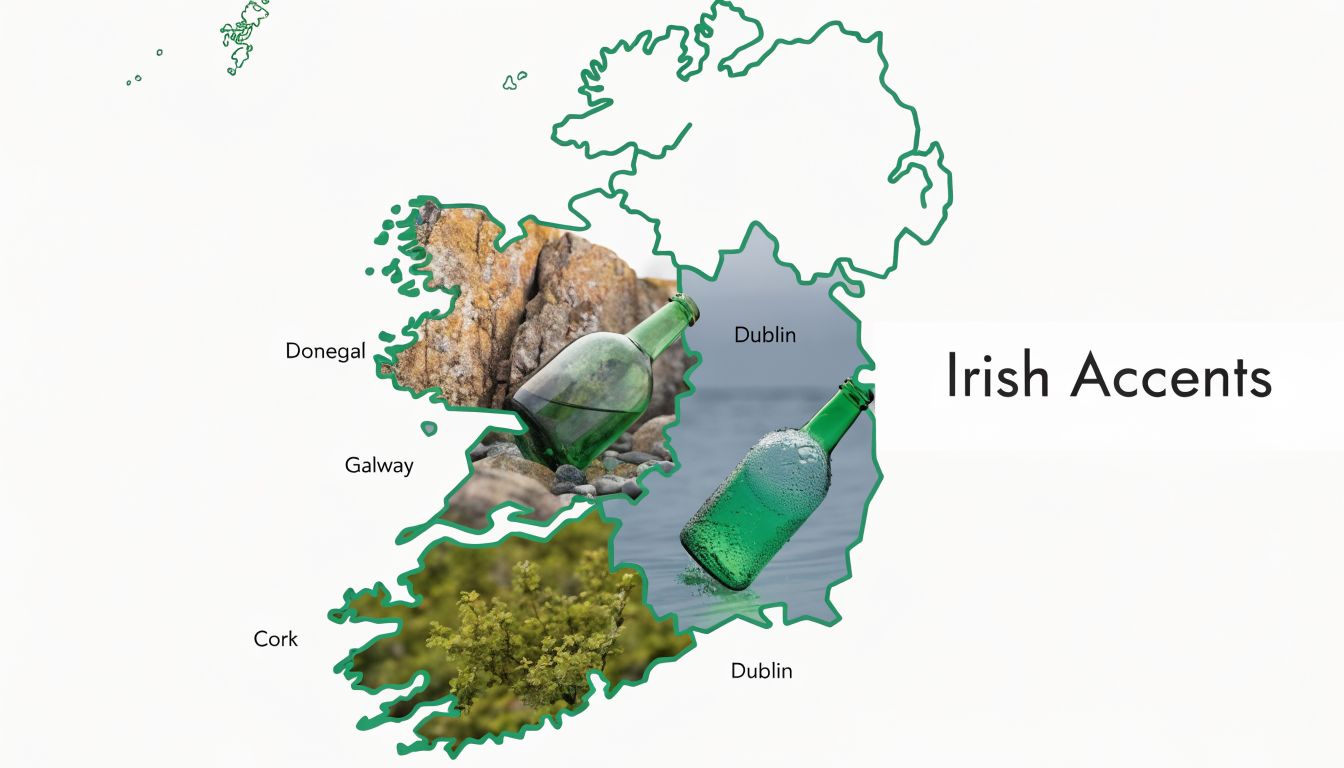
The standard learner form often points toward Connacht-style pronunciation, but native speech is broader than any single teaching model.
What changes across regions
The verified data notes that a Foras na Gaeilge-related discussion on regional politeness usage and pronunciation differences reported 70% of Gaeltacht speakers use dialect-specific politeness markers. It also highlights a common learner problem: online resources rarely explain how a phrase like le do thoil shifts in sound from one region to another.
A few examples from the verified material:
- Conamara tends to soften the sound, giving learners a lighter “h” feel.
- Ulster keeps a sharper quality in the vowels and consonants.
- Dingle or Kerry speech may have a different rhythm again.
These aren’t separate phrases. They’re regional realizations of the same polite expression.
Why this matters for listening
A beginner often assumes pronunciation variation means there must be a different word involved. Usually there isn’t. The issue is listening range.
That’s why it helps to train your ear with more than one model. A pronunciation guide that includes regional comparison can prevent the “I know this phrase on paper, but I missed it in speech” problem. If you want to build that listening flexibility, this Irish pronunciation guide for learners is a useful companion.
A phrase can be correct in every region and still sound different in each one.
A simple way to respond as a learner
You don’t need to master all dialects at once. Do this instead:
- Pick one pronunciation model first. Connacht-based learner audio is a practical starting point.
- Expect variation when listening. Native speakers may shape the same phrase differently.
- Copy before analyzing. Repeat what you hear, then compare it with your base form later.
Here’s the reassuring part. Irish speakers are used to accent variation. What matters most at beginner level is respectful usage and steady listening practice, not reproducing every local feature perfectly on day one.
Common Mistakes to Avoid When Saying Please
Most learner mistakes with Irish politeness aren’t rude. They’re just direct transfers from English. Once you spot them, they’re easy to clean up.
Mixing up singular and plural
This is the most common slip. A learner memorizes le do thoil and then uses it for everyone, including groups.
If you’re speaking to several people, switch to le bhur dtoil. That small change shows you’re paying attention to the structure of Irish, not just reciting a single fixed phrase.
A good habit is to pause and ask yourself one quick question before speaking: one person or more than one?
Treating please as a decoration
In English, “please” often gets dropped into commands to soften them. Beginners sometimes try to do the same thing mechanically in Irish.
Irish often sounds more natural when the whole request is phrased gently, rather than when a blunt command gets a polite word attached to the end. Tone matters. Sentence shape matters too.
If the request sounds pushy in English without “please,” it may still sound pushy in Irish with the phrase added.
That’s why short request patterns are so useful. “The bill, please” or “Coffee, please” often works better than building a direct imperative too early in your learning.
Overusing the formal phrase
After learning Más é do thoil é, some students want to use it everywhere because it sounds impressive. The problem is fit.
With friends or in relaxed conversation, it can sound heavier than the situation needs. Irish politeness is not about sounding maximally formal at all times. It’s about matching the social setting.
Mishearing the sounds
Certain sounds trip learners repeatedly:
- The “th” area in thoil can sound lighter than expected.
- The “bh” in bhur doesn’t behave like an English “b.”
- Vowel quality can shift depending on region.
A simple fix is to repeat full chunks, not isolated letters. Learn le do thoil as one unit. Learn le bhur dtoil as another. Chunking helps your mouth remember what your grammar is still catching up to.
Practice Saying Please with Gaeilgeoir AI
Knowing the phrase is one thing. Saying it comfortably, at the right speed, in a real exchange, is another.
That’s where guided practice helps. Instead of memorizing isolated phrases, you can rehearse them in the kinds of situations where politeness matters, such as ordering food, asking for directions, or speaking carefully in an oral exam setting.
Turn polite phrases into automatic speech
A useful practice cycle looks like this:
- Start with recognition by hearing the phrase in context.
- Move to controlled repetition so your pronunciation settles.
- Use contrast drills for pairs like le do thoil and le bhur dtoil.
- Finish with live-style prompts where you have to choose the right form yourself.
That kind of progression is one reason language learners often benefit from spaced review tools. If you’re interested in how repetition and retrieval can support memory, Maeve’s piece on learning with AI using flashcards gives a helpful overview of the method, even though it focuses on another language.
Another strong approach is scenario practice. A phrase becomes usable faster when you meet it inside a realistic exchange instead of on a bare vocabulary list.
Practice in context, not in isolation
This is the kind of listening and speaking input that helps polite language stick:
You’ll improve faster if you rotate through different tasks:
- Order something politely using the everyday form.
- Address a group and switch to the plural correctly.
- Rehearse a formal request using Más é do thoil é.
- Listen to accent variation so you don’t panic when the phrase sounds different.
For structured speaking practice, the AI Irish learning platform for guided conversation practice gives learners a way to repeat these patterns in context instead of guessing whether they sounded right.
What to focus on first
Don’t try to perfect every nuance at once. Build the skill in layers.
First, choose the right phrase. Then work on clarity. Then improve pronunciation and register. That order mirrors how real confidence develops. You become polite first, precise second, polished third.
Building Your Foundation of Irish Politeness
Once you can use “please” naturally, your Irish starts sounding warmer very quickly. That’s because politeness in conversation is a system, not a single word.
A request often leads to thanks. A question may begin with getting someone’s attention. A helpful answer usually ends with a courteous response. When you learn these phrases together, your Irish stops sounding like a list and starts sounding like interaction.
The core phrases that belong together
Three expressions fit naturally beside le do thoil:
- Go raibh maith agat for “thank you”
- Gabh mo leithscéal for “excuse me” or “pardon me”
- Tá fáilte romhat for “you’re welcome”
Used together, they create the rhythm of polite speech. You ask respectfully. You acknowledge help. You respond graciously.
That matters more than many beginners realize. Fluency isn’t only about saying longer sentences. It’s also about handling small social moments smoothly.
Why this approach works
When learners focus only on translation, they tend to collect isolated equivalents. When they focus on exchanges, they build usable language.
A good comparison comes from conversational AI design. When people train a chatbot, they don’t just feed it single words. They build patterns, responses, and context so the interaction feels natural. Human language learning works in a similar way. The phrase “please” becomes much easier to remember when your brain stores it beside thanking, apologizing, and responding.
Politeness is one of the fastest ways to make beginner Irish sound human.
Keep your goals modest and practical. Learn the one-person and group forms. Recognize the formal version. Add thank you and excuse me. Practice short exchanges until they feel easy.
That foundation goes a long way. It helps travelers sound courteous, heritage learners reconnect through respectful speech, and students show maturity in spoken Irish.
If you want to turn these phrases into real speaking habits, Gaeilgeoir AI gives you guided Irish conversation practice, pronunciation support, and everyday scenarios so you can start using polite Irish with confidence from day one.