How to Speak in Irish: A Guide for Total Beginners

You open your mouth to say a simple sentence in Irish. You know the word you want. You may even remember seeing it in school or hearing it at home. Then everything stalls the second you try to say it out loud.

That moment frustrates a lot of learners, and it does not mean you are bad at languages. It usually means your knowledge is sitting in one place and your speaking practice is sitting in another. Irish often lives in people's memories as something they studied, recognised, or read, but not something they used in everyday conversation.

That gap is common in Ireland too. As noted earlier, many people report that they can speak Irish, while far fewer use it daily outside education. So if your Irish feels stuck in your head instead of coming out of your mouth, you are far from alone.

The encouraging part is simple. Spoken Irish can begin with very small wins.

A short phrase about your morning. A greeting you can say without translating. One sentence you repeat until it feels natural in your mouth. That is how active speaking starts. It works a bit like learning to play a tune. Reading the notes helps, but your hands only learn it by playing.

This article focuses on getting you from passive knowledge to real speech from day one. That means starting with sounds you can copy, sentence patterns you can reuse, and topics from your actual life. It also means using tools that give you a chance to respond, hear yourself, and get feedback. Modern support, including tools like Gaeilgeoir AI, can help you practise conversation earlier and more often, especially when you do not have a speaking partner beside you.

You do not need perfect grammar before you begin. You need a starting point that gets your voice involved early, so Irish becomes a language you use, not just one you recognise.

Table of Contents

Start with speaking, not studying

You meet an Irish speaker at a café, hear a friendly Dia duit, and suddenly your brain goes blank. You know more than you can say. That gap between recognising Irish and putting it into use is where many beginners get stuck.

The fix is simple. Put speaking at the centre from day one.

If you want to learn how to speak in Irish, treat speech as practice, not as a test you earn after enough reading. A language is a bit like music in that way. You do not master the theory first and then touch the instrument. You play early, badly, and often. Irish works the same way. Reading, grammar, and listening all support you, but your speaking only grows when you open your mouth and use what you have.

As noted earlier, many people have some Irish but do not use it regularly. As a teacher, I see that pattern all the time. Knowledge sitting in your head is passive. The moment you say even one short sentence, it starts becoming active.

Practical rule: Speak Irish with the words you already know. Start small and start now.

A strong day-one goal is to build one tiny conversation you can use:

  • Introduce yourself: Is mise Aoife.
  • Ask a simple question: Conas atá tú?
  • Give a simple answer: Tá mé go maith.
  • Say one preference: Is maith liom caife.
  • Say one fact about your day: Tá mé tuirseach.

This may seem small. It is still real speaking.

That matters because beginners often study Irish as if they are filling a bookshelf. Useful speaking works more like building a footpath. One solid phrase leads to the next. You do not need a huge vocabulary to begin. You need a few phrases you can reach for quickly, without freezing.

If speaking to another person feels like too much on day one, use a tool that lets you rehearse safely. Gaeilgeoir AI can help you practise short exchanges, repeat common responses, and turn passive knowledge into spoken habits before you try them in real conversation. That kind of practice is helpful because it closes the gap between “I know this” and “I can say this.”

Aim for use, not perfection. If you can greet someone, answer a basic question, and say one true thing about your life, you are already speaking Irish.

Learn the sound before the rule

Irish spelling can look intimidating at first. The solution isn't to stare at the page longer. The solution is to connect sound, spelling, and meaning at the same time.

Build your ear first

A useful approach is to hear a short line slowly, repeat it, then hear it at normal speed and repeat again. The teaching method described in the Tús Maith methodology video on progressive auditory imitation lays out a four-step pattern: slow playback with support, normal-speed repetition, memorisation through adapted scripts, and then freer off-script speaking.

That order matters because beginners often try to jump straight into free conversation. Their brain hasn't had enough sound input yet, so the language feels slippery.

Use this sequence with one short phrase:

  1. Listen slowly
    Hear: Conas atá tú?

  2. Repeat slowly
    Say it with care, not speed.

  3. Repeat at normal pace
    Let the rhythm become more natural.

  4. Use it in a tiny exchange
    Conas atá tú?
    Tá mé go maith.

Slow, clear repetition helps you notice patterns that disappear when you rush.

Copy whole phrases, not isolated words

Irish becomes easier when you learn it in chunks. Instead of collecting random nouns, collect whole lines you can say today.

A few strong beginner chunks:

Situation Irish phrase Plain meaning
Greeting Dia duit Hello
Asking after someone Conas atá tú? How are you?
Fine response Tá mé go maith I am well
Saying your name Is mise Seán I am Seán
Wanting something Ba mhaith liom tae I would like tea

Chunk learning solves a common beginner problem. If you learn the word for tea, the word for like, and the word for I, you still might not say anything. If you learn Ba mhaith liom tae, you can use it at once.

Use simple Irish sentence patterns

Irish feels different from English because the structure often changes. That can be frustrating until you stop trying to force English patterns into Irish.

Irish often starts with the verb

One of the biggest shifts is that Irish commonly uses verb-subject-object order. The Preply guide to learning Irish points to this as an important pattern for learners to practise actively rather than leaving it as a grammar note.

In plain English, that means the action often comes first.

Look at the difference:

English idea Irish pattern
I eat bread Ithim arán
I am eating an apple Tá mé ag ithe úll

If you keep trying to build every sentence in English order first, your speech will stall. So don't begin with abstract grammar terms. Begin with frames you can reuse.

Sentence frames to use every day

These are strong early patterns because they cover a lot of real conversation:

  • Tá mé…
    Use it for states and feelings.
    Tá mé tuirseach.
    Tá mé sásta.

  • Is maith liom…
    Use it for likes.
    Is maith liom ceol.
    Is maith liom tae.

  • Ba mhaith liom…
    Use it for wants and polite requests.
    Ba mhaith liom caife.
    Ba mhaith liom cabhair.

  • Tá mé ag…
    Use it for actions happening now.
    Tá mé ag léamh.
    Tá mé ag obair.

  • An bhfuil…?
    Use it for yes-no questions.
    An bhfuil tú anseo?
    An bhfuil sé fuar?

A good rule is to stay with a sentence frame until it feels automatic. Don't race to cover everything. Depth beats breadth in speaking.

If a phrase helps you describe your actual day, it belongs in your first week of Irish.

Say useful things about your real life

You meet an Irish speaker at a café. You do not need a speech about literature or a perfect grammar chart. You need a few honest lines about your day.

That is why real-life sentences matter so much at the start. If your first Irish helps you talk about your name, your mood, your work, your home, or what you want to eat, you can start speaking from day one. The goal is not to collect interesting sentences. The goal is to say things you might use before lunch.

A good shortcut is to build your early Irish around small personal topics. These topics come up again and again in normal conversation, so every sentence pulls double duty. You are learning vocabulary, and you are also rehearsing real interaction.

Start with tiny personal topics

Choose three areas from your own life and write five short sentences for each. Keep them simple enough that you could say them without stopping to translate.

About yourself

  • Is mise Niamh.
  • Tá mé i mBaile Átha Cliath.
  • Tá mé ag foghlaim Gaeilge.
  • Is maith liom leabhair.
  • Tá mé ag obair inniu.

About home

  • Tá mé sa bhaile.
  • Tá tae sa chistin.
  • Tá sé ciúin anseo.
  • Tá fuinneog mhór ann.
  • Is maith liom an seomra seo.

About today

  • Tá sé fuar.
  • Tá ocras orm.
  • Tá mé ag dul amach.
  • Ba mhaith liom lón.
  • Tá mé tuirseach anois.

This kind of practice closes the gap between recognising Irish and using it. Many learners already know more words than they can say out loud. Personal sentences fix that because they give those words a job to do.

It also makes practice easier to repeat. You already know your own routines, preferences, and plans. You are not inventing content from scratch. You are just learning how to say your life in Irish.

Turn passive vocabulary into active speech

Use a simple four-step drill:

  1. Pick five words you already know.
  2. Put each one into a full sentence about your real life.
  3. Say each sentence aloud three times.
  4. Change one detail in each sentence.

Here is what that looks like with caife:

  • Is maith liom caife.
  • Ba mhaith liom caife.
  • Tá an caife te.
  • Tá mé ag ól caife.
  • An bhfuil caife anseo?

Now caife is not just a word on a list. It works in likes, wants, descriptions, actions, and questions. That is how speaking starts to feel quicker.

If you want extra help turning your own daily life into spoken practice, tools like Gaeilgeoir AI can help you generate simple personalised prompts, check phrasing, and rehearse short exchanges. Used well, that kind of support can speed up the jump from passive knowledge to active conversation.

Keep the bar low at first. A short true sentence is better than a clever sentence you will never say again.

Expect dialect differences early

Some learners get discouraged when they hear one phrase in a course and a different phrase in a real conversation. That's not failure. That's Irish being a living language.

Why greetings can sound different

Irish has regional variation, and beginners often meet it immediately in greetings and short social phrases. The video discussing Irish dialect differences in greetings highlights forms such as Conas atá tú?, Cad mar atá tú?, and other regional variants.

This can feel unsettling if you expected one fixed form for everything. It helps to think of dialects the same way you'd think about accents and regional wording in English. Different does not mean wrong.

A few things may change:

  • The greeting itself
  • The pronunciation
  • The natural response
  • The form you hear in a specific region

How to avoid dialect overload

You don't need to master every dialect as a beginner. You do need a clear starting point.

Use this approach:

Situation What to do
You want one steady beginner path Learn one common form and stick with it for now
You have family ties to a region Prioritise that dialect when possible
You're studying for school exams Stay close to the expected school forms
You hear a different version Notice it, don't panic, and save it for later

Pick one greeting and one response first. Use them until they feel natural. You can add variants gradually.

A beginner doesn't need every version of a phrase. A beginner needs one version they can say comfortably.

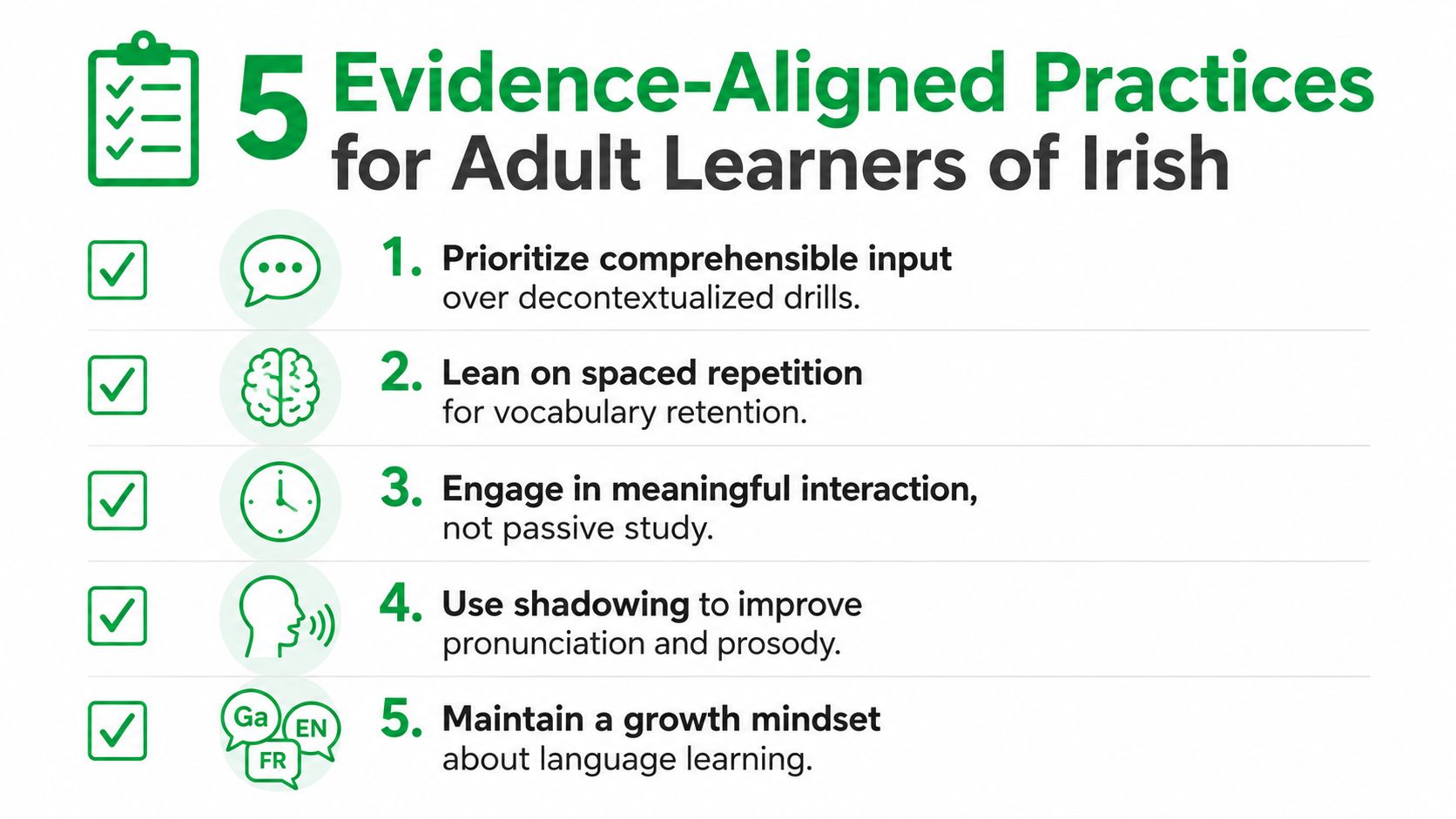
Practice out loud every day

You don't need marathon study sessions. You need repetition that your mouth, ear, and memory can handle.

A short daily routine that works

Here's a simple routine you can keep:

  1. Warm up with two greetings
    Say them aloud without reading if you can.

  2. Review three sentence frames
    For example: Tá mé…, Is maith liom…, Ba mhaith liom…

  3. Describe your day for one minute
    Use tiny facts. Weather, food, mood, plans.

  4. Repeat one short dialogue
    Keep it short enough that you can memorise it.

  5. Finish with self-talk
    Narrate what you're doing.
    Tá mé ag siúl.
    Tá mé ag déanamh tae.

This kind of active use is far more valuable than passive review alone. It also fits the reality of adult learners, who usually need short, flexible practice rather than long classroom blocks.

What to do when you get stuck

Everyone freezes. The trick is to have rescue moves ready.

Use these when speaking breaks down:

  • Go back to a frame: If you can't build a sentence, start with Tá mé… or Is maith liom…
  • Shrink the idea: Don't say everything. Say one fact.
  • Repeat a known phrase: Familiar language restarts your rhythm.
  • Swap the word: If you don't know the exact noun, choose a simpler one you do know.
  • Write down the missing piece: Keep a note on your phone and return to it later.

A stuck moment doesn't mean your Irish is bad. It usually means your sentence was too ambitious for that moment.

Find ways to speak with feedback

You say a sentence out loud, and it feels fine in your head. Then a listener replies, or your app catches a sound you missed, and you notice the gap. That moment is useful. Feedback turns private practice into real speaking.

Solo work still has a clear job. It helps you build the physical side of Irish: the mouth movements, the rhythm, and the habit of answering without freezing. It also gives you a safe place to test what you know before another person joins in.

Use solo practice for:

  • Training pronunciation
  • Speeding up recall
  • Getting comfortable with your own Irish voice
  • Turning words on a page into spoken language
  • Trying out sentence patterns before conversation

A mirror helps. Voice notes help. Reading a short exchange, then closing the page and saying it from memory helps too. This kind of practice is like doing scales before playing music with others. It does not replace conversation, but it makes conversation much easier to enter.

Then add feedback as early as you can.

Choose feedback that matches your level

You do not need a perfect conversation partner from day one. You need a response that shows you what to keep, what to fix, and what to say again.

A few good options:

  • Pronunciation and dictionary tools
    Use TEanglann to hear words and check forms when a sound or spelling confuses you.

  • Language exchange apps
    Tandem or HelloTalk can help you find short, low-pressure exchanges with other learners or speakers.

  • AI speaking practice
    Gaeilgeoir AI offers guided conversations based on real situations, along with pronunciation support and adaptive practice. That is helpful for learners who know some Irish passively but need a bridge into active speaking.

  • Oral-topic practice for school
    Leaving Cert students usually improve faster by answering common speaking topics out loud than by trying to revise everything at once.

The best feedback is the kind you will use three or four times a week. Consistency matters more than finding one perfect method.

If live conversation feels intimidating, start with a simple loop: say one sentence, get a correction, repeat it correctly, then use it again in a new sentence. That loop is small, but it teaches your brain how spoken Irish grows. You stop collecting phrases and start using them.

Keep going even when your Irish feels messy

You are in the middle of a sentence, you know the word you want in English, and your Irish comes out in bits and pieces. That is not failure. That is speaking.

Spoken Irish usually grows the same way a tune grows under your fingers. At first, it feels slow and uneven. Then a few phrases start to come more quickly. After that, you stop building every sentence word by word and begin to answer more naturally. The jump from passive knowledge to active speech rarely feels tidy while it is happening.

That matters because many learners already know more Irish than they can say out loud. They recognise school phrases, understand bits of conversation, or remember grammar they cannot use quickly enough in real life. The goal is not to wait until everything feels polished. The goal is to keep turning recognition into response.

Give yourself small speaking wins.

Say hello.
Say your name.
Say what you like.
Say how you feel.
Say one true thing about your day.

Then change one part and say it again.

That simple habit trains your brain to build with the Irish you already have, instead of freezing while you search for perfect Irish. Messy speech is often the working stage between “I know that” and “I can say that.”

Irish also lives through ordinary use. Every time a learner moves from understanding to speaking, even for one short sentence, the language becomes a little more present in daily life. That is part of what makes speaking practice feel personal and cultural at the same time.

If you need extra support, Gaeilgeoir AI can give you another place to practise turning passive Irish into active conversation, one short exchange at a time.

How to Pronounce Aine: A Simple Irish Guide (2026)

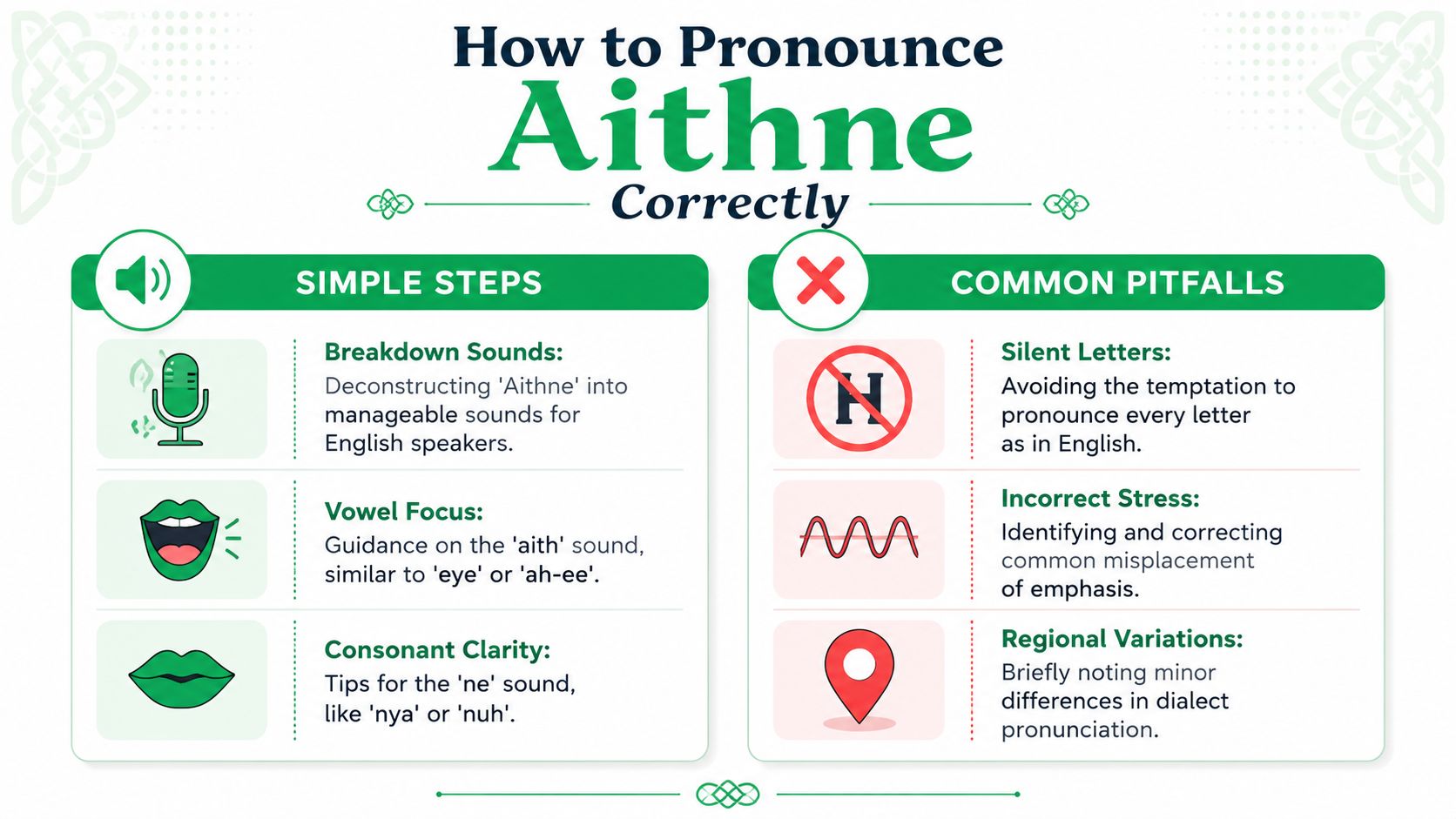
Áine is usually pronounced Awn-ya, with the Á sounding like the vowel in law and the full Irish pronunciation written as [ˈaːnʲə]. If you've been saying Ay-nee, you're not alone. A 2025 analysis found 65% of beginners struggle with this distinction in online Irish forums, especially when they see the unaccented spelling Aine in English-language contexts (discussion of Áine pronunciation confusion).

If you're here because you've seen the name in a book, met an Áine at work, or need to say it out loud for class, the good news is that this one gets much easier once you know what to listen for. Irish spelling can look mysterious at first, but it isn't random. With Áine, one tiny accent mark changes everything.

Table of Contents

The Correct Pronunciation of Áine Explained

Say it as Awn-ya.

That simple guide will serve you well in most situations, especially if you're aiming for the standard pronunciation most learners are taught. In the International Phonetic Alphabet, that's [ˈaːnʲə]. Think of IPA as a cheat code. It gives you the sound directly instead of making you guess from English spelling habits.

A close-up side view of a person sticking out their tongue against a bright green background.

Break the name into two parts

The easiest way to hear it is this:

  • Á sounds like aw in law
  • ine softens into something close to nya

Put them together and you get Awn-ya.

The most important piece is the fada, the accent mark over the Á. In Irish, that mark tells you the vowel is long. For Áine, it creates the long /aː/ sound. That's part of Irish orthography standardized since 1958, and it's why the name isn't read the way an English speaker might expect (Irish pronunciation guide for Áine and the fada).

Practical rule: If you see Á, slow the vowel down a little. Don't rush it into a short English "a."

Why the ending sounds like ya

The second part often trips people up because learners expect every written letter to sound as it would in English. Irish doesn't work that way. In Áine, the consonant and following vowel create a softer sound, so the ending comes out close to ya, not nee.

If you want a useful memory aid, say this aloud a few times:

  1. Awn
  2. Ya
  3. Awn-ya

The name also carries lovely cultural weight. Áine is an Irish feminine given name meaning radiance, and it's linked to the Celtic goddess of summer and wealth. That older cultural connection helps many learners remember the name because it doesn't feel like a random sound to memorize. It feels rooted in Irish tradition.

For a broader look at sound patterns like this, a good next step is this Irish pronunciation guide for beginners.

Common Mispronunciations and How to Avoid Them

You are introduced to someone called Áine, you glance at the spelling, and your English reading habits jump in first. That is why the name often comes out as Ay-nee before a learner has had a chance to apply Irish sound rules.

A graphic showing the common mispronunciations of the Irish name Áine, highlighting the correct pronunciation as Awn-ya.

The mistake English speakers make first

English trains readers to trust familiar letter patterns. So Aine may look as if it should rhyme with Jane, sound like Aimee, or end with a clear nee sound. Irish uses a different sound system, so those guesses lead you away from the name a Gaeilgeoir would expect to hear.

These are the pronunciations learners stumble into most often:

  • Ay-nee: The classic English-style reading. It treats the name as if it followed English vowel patterns.
  • Ayn: This cuts the name short and leaves out the soft ending.
  • Ah-neh: This sounds careful, but it breaks the name into parts that do not match the usual Irish pronunciation.
  • Anya: Closer, but still often too flat or too rushed at the start.

A helpful correction is simple. Keep the opening broad and long, then let the ending soften. If the final part sounds like a firm English nee, you are still reading the name through English spelling habits.

Why Áine and Aine cause so much confusion

The accented form, Áine, and the unaccented form, Aine, get mixed together constantly in everyday writing. That confuses beginners because English often treats accent marks as optional decoration, while Irish does not. In Irish, the fada changes the vowel sound and helps signal how the word should be read.

So the problem is not just pronunciation. It is also spelling recognition.

If you see Áine, the safest target is the familiar Irish pronunciation Awn-ya. If you see Aine without the accent, pause for a moment. It may be a simplified spelling used in English-language contexts, or it may reflect someone's own preferred written form. In real life, asking politely is often the best choice.

Spelling Common English misread Safer response
Áine Ay-nee Say Awn-ya
Aine Ayne, Ay-nee Check whether it is standing in for Áine

That distinction matters even more if you are listening to family names, local introductions, or regional speech. Irish pronunciation shifts by dialect, and the same name can sound a little different across the country. If you want a clear overview of those patterns, this guide to dialectal differences in Irish pronunciation gives helpful background.

A quick self-correction check

Use this short test while you practise:

  • Does the first part sound like "day"? Start again.
  • Does the first vowel feel longer, closer to "law" or "awn"? Better.
  • Does the ending sound like a soft "ya" or "yə"? Good.
  • Are you saying it as one smooth name rather than two separate chunks? That is what you want.

One more gentle warning for English speakers. Do not over-pronounce every written letter. Irish names often work more like a melody than a spelling puzzle. Once your ear catches the pattern, your mouth usually follows.

Understanding Regional Pronunciation Differences

Not every Irish speaker says Áine in exactly the same way.

The standard learner version, Awn-ya or [ˈaːnʲə], reflects Munster and Connacht pronunciation most closely. That's the form you'll hear in many guides, and it's a safe choice if you want a widely understood pronunciation.

Three artistic, textured 3D representations of Ireland in brown, green, and blue, labeled Dialect Nuances below.

The three main dialect areas

Irish has three major dialects:

  • Munster
  • Connacht
  • Ulster

For Áine, Munster and Connacht are usually closest to the pronunciation learners are taught first. In Ulster, the á can shift a bit further back in the mouth, so the opening vowel may sound slightly different from the southern and western forms. That nuance is easy to miss, but it matters if you're learning speech tied to a particular region or family background (overview of dialect differences in pronouncing Áine).

When dialect matters

If you're introducing yourself, reading a name aloud, or speaking general Irish, the standard Awn-ya is completely reasonable. If you're reconnecting with family roots in Donegal or another Ulster area, it can be worth listening for that regional vowel quality.

Some guides teach one "correct" version. Real Irish has regional life in it.

That point matters because many learners aren't confused about the name itself. They're confused because they've heard more than one authentic version. If you want to explore those patterns further, this overview of dialectal differences in Irish pronunciation is a helpful next stop.

Practice Your Pronunciation with Guided Feedback

You are far more likely to say Áine well after using it in a real greeting than after repeating the name like a spelling drill. Irish names live in rhythm. Once the name sits inside a short phrase, your ear starts to notice whether the first vowel is long enough and whether the ending stays soft.

A person wearing a green beanie and headphones holding a tablet while learning to pronounce Áine.

Try these out loud

Say each line slowly first, then at a natural speaking pace.

  • Dia duit, a Áine
  • Conas atá tú, a Áine
  • Slán, a Áine

That small change matters. English speakers often pronounce a name more accurately in a phrase than on its own because the surrounding words guide the timing. It also helps you hear a point that often causes confusion. Áine with the fada has a long opening vowel, while Aine without the fada may be read differently depending on the speaker, the context, or whether the accent mark has been left off in writing.

What to listen for when you practice

Keep your attention on three parts of the sound:

  1. The long opening vowel. Let Á last a beat longer than an English "a."
  2. The glide into the second part. The ending should flow, not snap into two separate English syllables.
  3. The version you are aiming for. If you are following a family pronunciation, stay with that one consistently. If you are learning a general Irish form, keep your target steady from repetition to repetition.

A useful comparison is singing the first note of a tune slightly longer before moving on. If you rush that first note, the whole phrase feels off. The same thing happens with Áine.

Many learners also need to hear two authentic targets before the name really clicks. One speaker may give you the familiar southern or western sound close to Awn-ya. Another, especially from an Ulster background, may use a tenser or slightly further-back opening vowel. Neither recording means you have failed. It means Irish pronunciation carries regional life, and your job is to match the version you want to use.

For guided help rather than guessing, Gaeilgeoir AI offers pronunciation support, adaptive quizzes, and speaking practice. If you want one-to-one support as well, this guide on how to find an Irish tutor for enhanced learning is a practical next step.

Here's a short listening aid you can use before repeating the name yourself:

One final habit helps a lot. Record yourself saying the three phrases, then compare your version with a strong model. Listen for vowel length first, then for the smooth ending. If your pronunciation slips toward an English "Ayne" or a flattened "Anya," slow down, reset, and try again. A few careful repetitions beat twenty rushed ones.

Frequently Asked Questions About Pronouncing Irish Names

Is the fada really that important

Yes. In Irish, the fada changes the vowel sound. With Áine, it tells you the first vowel is long. If you ignore it, you're likely to fall into an English-style guess that doesn't match the Irish pronunciation.

Is Áine the same as Anya

Not exactly. They may sound similar to English ears, but they are not the same name in different spellings. Áine has its own Irish spelling, history, and pronunciation pattern. If you're saying an Irish name, it's worth aiming for the Irish sound rather than replacing it with the nearest familiar English or Slavic-sounding version.

Treat Irish names as names, not puzzles. Learn the sound the person uses.

Does every Irish name ending in ne sound like nya

No. Irish pronunciation depends on the full spelling and the relationship between vowels and consonants, not just the last two letters. That's why it's risky to learn one pattern and force it onto every name you meet.

What if I'm still not confident saying it

Start with Awn-ya, listen carefully, and repeat it slowly in short phrases. If you later learn a family or regional version, you can adjust. A respectful close pronunciation is better than avoiding the name altogether.


If you want more guided speaking practice, Gaeilgeoir AI gives you a structured way to work on Irish pronunciation, listening, and everyday conversation at your own pace.

Please in Gaelic: How to Say It in Irish (& When)

Le do thoil is the most common way to say please in Irish when you're speaking to one person, and le bhur dtoil is used when you're speaking to more than one person. But if you're learning please in gaelic, the appropriate answer depends on context, politeness level, and who you're speaking to.

Maybe you're about to order a coffee in Ireland, prepping for an oral exam, or reconnecting with family roots and want to sound respectful from the start. In English, “please” feels simple. In Irish, it’s simple at first, then quickly becomes more interesting.

That’s good news for learners. It means you don't need a huge vocabulary to sound thoughtful. You need the right phrase, used in the right moment.

Irish politeness often works through tone, relationship, and phrasing, not just through dropping in one magic word. So yes, you can memorize le do thoil today. But if you also understand why Irish speakers sometimes choose a more formal option, or why the same phrase sounds different in Galway and Donegal, you'll feel much more confident using it in real life.

Table of Contents

Your Guide to Saying Please in Irish

A lot of learners start in the same place. They search for “please in gaelic,” find le do thoil, write it down, and assume they’re done. Then they hear another version, or notice that a textbook example doesn’t quite match a real conversation, and the doubt starts creeping in.

That confusion makes sense. Irish is not just English with different words swapped in. The phrase you choose can reflect whether you’re speaking to one person or several people, whether the setting is casual or formal, and how much deference you want to show.

Why the simple answer isn't the whole answer

At beginner level, le do thoil is the right place to start. It’s useful, common, and safe in everyday situations. If you use it while ordering food, asking for help, or making a basic request, you’ll be understood.

But Irish politeness has layers. A shop interaction, a classroom exchange, and a formal oral exam don’t all feel the same. That’s why learners benefit from knowing not only the phrase itself, but the social meaning behind it.

Practical rule: Start with le do thoil for everyday requests. Learn the more formal option later, once your basic speech feels comfortable.

A heritage learner often wants more than a phrasebook answer. They want to know what sounds natural. A student preparing for the Leaving Cert wants language that fits the occasion. A traveler wants to avoid sounding abrupt without overdoing it. The same small phrase serves all three goals, but only if you use it with awareness.

What confidence sounds like

Confident Irish doesn’t mean perfect Irish. It means choosing language that fits the moment.

That’s why this guide focuses on real usage. You’ll see the common forms first, then the formal one, then the pronunciation differences that catch many beginners off guard. By the end, “please in gaelic” won’t feel like a single translation problem. It’ll feel like a skill you can use.

The Most Common Ways to Say Please

If you only remember two phrases from this article, make them these: le do thoil and le bhur dtoil.

A person wearing a green sweater and jewelry with the text Irish Please displayed below them.

They both mean “please,” but they aren’t interchangeable. The difference depends on who you’re speaking to.

Le do thoil for one person

Le do thoil is the everyday form when speaking to one person.

A helpful way to remember it is that do means “your” in the singular sense. So the phrase conveys the idea of “with your will.” You don’t need to translate it word for word when speaking, but knowing that background helps it feel less random.

Pronunciation guides in the available material give it as /leh duh huh-el/. Many learners simplify that to something like “leh duh hull” when starting out. That’s close enough to begin with, as long as you stay open to regional variations later.

You might hear it in short requests such as:

  • Caife, le do thoil.
    Coffee, please.

  • Cabhair, le do thoil.
    Help, please.

  • An bille, le do thoil.
    The bill, please.

Le bhur dtoil for more than one person

When you’re speaking to two or more people, use le bhur dtoil.

Here, bhur is the plural “your.” That’s the key shift. English doesn’t always mark this distinction clearly, but Irish does, and using the plural form is one of those small details that makes your speech sound more natural.

The pronunciation guide in the verified material gives /leh woor duh-el/. For an English-speaking beginner, “leh woor dull” is a workable memory aid, even if your sound gets refined with practice.

Use it in situations like these:

  • addressing a group at a table
  • speaking to staff as a group
  • asking several classmates to listen
  • making a polite request to more than one person

A quick memory trick

Here’s the easiest way to keep them straight:

Phrase Use it with Simple memory cue
le do thoil one person do = one person’s “your”
le bhur dtoil more than one person bhur = plural “your”

Don’t overthink the grammar while speaking. Just connect do with one person and bhur with a group.

Why beginners sometimes hesitate

Many learners freeze because they want perfect pronunciation before they try the phrase aloud. Don’t wait for that. Irish pronunciation takes time, and politeness counts even when your accent is still developing.

A more useful goal is this:

  1. Choose the right form for one person or a group.
  2. Say it clearly and calmly.
  3. Listen for local pronunciation and adjust over time.

That order matters. Correct social use comes first. Fine pronunciation tuning comes after repeated listening and practice.

Choosing Between Formal and Informal Please

Once le do thoil feels comfortable, the next step is learning when Irish uses a more formal kind of politeness. That phrase is Más é do thoil é.

An infographic showing the difference between formal and informal ways to say please in Irish.

It’s often translated as “if it is your will.” That sounds more elaborate than English “please,” and that’s exactly the point. This version carries extra respect and restraint.

When le do thoil is enough

In most everyday situations, le do thoil does the job well.

Use it when you’re:

  • ordering something casually
  • asking for directions
  • speaking with a teacher in a normal classroom exchange
  • making a simple request in conversation

It’s polite without sounding stiff. For beginners, that balance matters. You want language that feels natural, not memorized from a ceremonial script.

When Más é do thoil é fits better

Más é do thoil é belongs in more formal or deferential moments. Think of it as a step up in politeness, not a replacement for the everyday phrase.

It works especially well in contexts like:

  • formal speaking tasks
  • service interactions where you want extra courtesy
  • requests to elders or strangers when you want a more respectful tone
  • exam settings where control and register matter

One verified example is: “Más é do thoil é, an bhfuil an bus ag stopadh anseo?”
“Please, does the bus stop here?”

That sounds measured and respectful. It’s not something you need in every conversation, but it’s useful to recognize and practice.

Why this matters in exams and advanced speech

This isn’t just a style preference. The verified data notes that candidates using formal variants scored 12% higher on average in the “social interaction” portion of TEG assessments in relation to advanced politeness use, according to Bitesize Irish on polite Irish phrases.

For a learner, the deeper lesson is simple. Register matters. Examiners and listeners notice when your language fits the social setting.

The strongest learners don’t just know vocabulary. They choose the right level of politeness for the moment.

A side by side comparison

Situation Better choice Why
Ordering a tea in a casual café le do thoil simple, natural, everyday
Asking a formal question in an oral exam Más é do thoil é shows control and courtesy
Speaking to a friend le do thoil formal phrasing may sound too heavy
Making a respectful public-facing request Más é do thoil é adds deference

Beginners sometimes worry that the formal phrase will make them sound more fluent all the time. It won’t. If you use it everywhere, it can sound mismatched.

The key skill is judgment. Casual request. Use the everyday phrase. High-politeness situation. Reach for the formal one.

Quick Reference Table for Irish Polite Phrases

A quick-reference chart helps when your brain goes blank mid-conversation. That’s common with polite language because you often need it fast, in the middle of ordering, asking, thanking, or apologizing.

If you want a broader starter set beyond this page, this collection of essential Gaelic phrases for everyday use pairs well with the phrases below.

Irish politeness quick reference

Irish Phrase Pronunciation Guide English Meaning When to Use It
le do thoil leh duh hull please Use with one person in everyday requests
le bhur dtoil leh woor dull please Use with more than one person
Más é do thoil é maws ay duh huh-el ay please, if you would be so kind Use in formal or highly respectful situations
Go raibh maith agat guh rev mah ah-gut thank you Use when thanking one person
Gabh mo leithscéal gov muh lehsh-kale excuse me / pardon me Use to get attention, apologize lightly, or move past someone
Tá fáilte romhat taw fall-cha row-ut you’re welcome Use after someone thanks you

How to use the table well

Don’t try to memorize all six phrases at once. Start with a pair that naturally belongs together.

For example:

  • Request pair: le do thoil and Gabh mo leithscéal
  • Response pair: Go raibh maith agat and Tá fáilte romhat
  • Formal pair: Más é do thoil é and Gabh mo leithscéal

That approach works better than isolated word lists because politeness usually comes in sequences. You ask, someone answers, you thank them, and the conversation keeps moving.

Understanding Regional Pronunciation Differences

One reason learners get confused about please in gaelic is that the phrase they learned from one recording may sound different when spoken by someone from another part of Ireland. That doesn’t mean you learned it wrong. It means Irish has strong regional pronunciation patterns.

A map of Ireland showing different regional accents with bottles of water illustrating Irish speech patterns.

The standard learner form often points toward Connacht-style pronunciation, but native speech is broader than any single teaching model.

What changes across regions

The verified data notes that a Foras na Gaeilge-related discussion on regional politeness usage and pronunciation differences reported 70% of Gaeltacht speakers use dialect-specific politeness markers. It also highlights a common learner problem: online resources rarely explain how a phrase like le do thoil shifts in sound from one region to another.

A few examples from the verified material:

  • Conamara tends to soften the sound, giving learners a lighter “h” feel.
  • Ulster keeps a sharper quality in the vowels and consonants.
  • Dingle or Kerry speech may have a different rhythm again.

These aren’t separate phrases. They’re regional realizations of the same polite expression.

Why this matters for listening

A beginner often assumes pronunciation variation means there must be a different word involved. Usually there isn’t. The issue is listening range.

That’s why it helps to train your ear with more than one model. A pronunciation guide that includes regional comparison can prevent the “I know this phrase on paper, but I missed it in speech” problem. If you want to build that listening flexibility, this Irish pronunciation guide for learners is a useful companion.

A phrase can be correct in every region and still sound different in each one.

A simple way to respond as a learner

You don’t need to master all dialects at once. Do this instead:

  1. Pick one pronunciation model first. Connacht-based learner audio is a practical starting point.
  2. Expect variation when listening. Native speakers may shape the same phrase differently.
  3. Copy before analyzing. Repeat what you hear, then compare it with your base form later.

Here’s the reassuring part. Irish speakers are used to accent variation. What matters most at beginner level is respectful usage and steady listening practice, not reproducing every local feature perfectly on day one.

Common Mistakes to Avoid When Saying Please

Most learner mistakes with Irish politeness aren’t rude. They’re just direct transfers from English. Once you spot them, they’re easy to clean up.

Mixing up singular and plural

This is the most common slip. A learner memorizes le do thoil and then uses it for everyone, including groups.

If you’re speaking to several people, switch to le bhur dtoil. That small change shows you’re paying attention to the structure of Irish, not just reciting a single fixed phrase.

A good habit is to pause and ask yourself one quick question before speaking: one person or more than one?

Treating please as a decoration

In English, “please” often gets dropped into commands to soften them. Beginners sometimes try to do the same thing mechanically in Irish.

Irish often sounds more natural when the whole request is phrased gently, rather than when a blunt command gets a polite word attached to the end. Tone matters. Sentence shape matters too.

If the request sounds pushy in English without “please,” it may still sound pushy in Irish with the phrase added.

That’s why short request patterns are so useful. “The bill, please” or “Coffee, please” often works better than building a direct imperative too early in your learning.

Overusing the formal phrase

After learning Más é do thoil é, some students want to use it everywhere because it sounds impressive. The problem is fit.

With friends or in relaxed conversation, it can sound heavier than the situation needs. Irish politeness is not about sounding maximally formal at all times. It’s about matching the social setting.

Mishearing the sounds

Certain sounds trip learners repeatedly:

  • The “th” area in thoil can sound lighter than expected.
  • The “bh” in bhur doesn’t behave like an English “b.”
  • Vowel quality can shift depending on region.

A simple fix is to repeat full chunks, not isolated letters. Learn le do thoil as one unit. Learn le bhur dtoil as another. Chunking helps your mouth remember what your grammar is still catching up to.

Practice Saying Please with Gaeilgeoir AI

Knowing the phrase is one thing. Saying it comfortably, at the right speed, in a real exchange, is another.

A person using a smartphone to practice speaking Gaelic with an interactive AI language learning application.

That’s where guided practice helps. Instead of memorizing isolated phrases, you can rehearse them in the kinds of situations where politeness matters, such as ordering food, asking for directions, or speaking carefully in an oral exam setting.

Turn polite phrases into automatic speech

A useful practice cycle looks like this:

  • Start with recognition by hearing the phrase in context.
  • Move to controlled repetition so your pronunciation settles.
  • Use contrast drills for pairs like le do thoil and le bhur dtoil.
  • Finish with live-style prompts where you have to choose the right form yourself.
That kind of progression is one reason language learners often benefit from spaced review tools. If you’re interested in how repetition and retrieval can support memory, Maeve’s piece on learning with AI using flashcards gives a helpful overview of the method, even though it focuses on another language.
Another strong approach is scenario practice. A phrase becomes usable faster when you meet it inside a realistic exchange instead of on a bare vocabulary list.

Practice in context, not in isolation

This is the kind of listening and speaking input that helps polite language stick:

You’ll improve faster if you rotate through different tasks:

  1. Order something politely using the everyday form.
  2. Address a group and switch to the plural correctly.
  3. Rehearse a formal request using Más é do thoil é.
  4. Listen to accent variation so you don’t panic when the phrase sounds different.

For structured speaking practice, the AI Irish learning platform for guided conversation practice gives learners a way to repeat these patterns in context instead of guessing whether they sounded right.

What to focus on first

Don’t try to perfect every nuance at once. Build the skill in layers.

First, choose the right phrase. Then work on clarity. Then improve pronunciation and register. That order mirrors how real confidence develops. You become polite first, precise second, polished third.

Building Your Foundation of Irish Politeness

Once you can use “please” naturally, your Irish starts sounding warmer very quickly. That’s because politeness in conversation is a system, not a single word.

A request often leads to thanks. A question may begin with getting someone’s attention. A helpful answer usually ends with a courteous response. When you learn these phrases together, your Irish stops sounding like a list and starts sounding like interaction.

The core phrases that belong together

Three expressions fit naturally beside le do thoil:

  • Go raibh maith agat for “thank you”
  • Gabh mo leithscéal for “excuse me” or “pardon me”
  • Tá fáilte romhat for “you’re welcome”

Used together, they create the rhythm of polite speech. You ask respectfully. You acknowledge help. You respond graciously.

That matters more than many beginners realize. Fluency isn’t only about saying longer sentences. It’s also about handling small social moments smoothly.

Why this approach works

When learners focus only on translation, they tend to collect isolated equivalents. When they focus on exchanges, they build usable language.

A good comparison comes from conversational AI design. When people train a chatbot, they don’t just feed it single words. They build patterns, responses, and context so the interaction feels natural. Human language learning works in a similar way. The phrase “please” becomes much easier to remember when your brain stores it beside thanking, apologizing, and responding.

Politeness is one of the fastest ways to make beginner Irish sound human.

Keep your goals modest and practical. Learn the one-person and group forms. Recognize the formal version. Add thank you and excuse me. Practice short exchanges until they feel easy.

That foundation goes a long way. It helps travelers sound courteous, heritage learners reconnect through respectful speech, and students show maturity in spoken Irish.


If you want to turn these phrases into real speaking habits, Gaeilgeoir AI gives you guided Irish conversation practice, pronunciation support, and everyday scenarios so you can start using polite Irish with confidence from day one.

Start Speaking Irish Today — 25% Off
Use code START25

Learn real Irish for real life with guided practice, pronunciation support, and everyday conversations.

Get 25% off any plan with code START25

Start Speaking Irish Today — 25% Off