You've probably met the Irish blessing already, even if you didn't know its history. It shows up in wedding speeches, sympathy cards, graduation gifts, church programs, and framed prints in family kitchens. Many people know the opening by heart, yet still wonder what it means, where it came from, and whether they're using it in the right setting.
That uncertainty makes sense. The Irish blessing feels familiar, but it also carries real cultural weight. If you want to share it at a funeral, include it in a toast, or say part of it in Gaeilge, a little context helps. The words become richer when you understand them as part of a living tradition rather than a decorative quote.
A family gathers after a graduation. Someone raises a glass. Another person reaches for words that sound warm, hopeful, and a little wiser than everyday speech. That's often when the Irish blessing appears. It fits moments when people are moving from one chapter to another, and that's part of why it has lasted.
People also meet it in quieter ways. You might see it engraved on a keepsake, printed inside a condolence card, or read aloud at a wedding by someone honoring Irish family roots. In each case, the words do the same job. They offer goodwill without sounding stiff or formal.
That's one reason the Irish blessing travels so well across generations and across countries. It speaks plainly, but it doesn't sound plain. The images of road, wind, sun, rain, and hand create a feeling of movement, shelter, and companionship.
The Irish blessing endures because it gives people language for uncertain moments, when ordinary conversation doesn't quite feel enough.
Irish blessings are commonly described as short poems or prayers used at key life moments, especially weddings, funerals, home blessings, travel, and seasonal gatherings, which helps explain why this one became so widely recognized in practice and memory (Irish blessing background and uses).
If you're here because you need the text for an event, you'll find it below. If you're here because you want to understand whether it's traditional, how to pronounce the Gaeilge, or which version fits a wedding better than a funeral, you're in the right place too.
The Full Irish Blessing Text and Gaeilge Translation
The version generally understood when searching for the Irish blessing is the familiar one that begins with “May the road rise to meet you.” It's usually shared in English, but many readers also want at least one line in Gaeilge to honor the language behind the tradition.
May the road rise to meet you. May the wind be always at your back. May the sun shine warm upon your face. The rains fall soft upon your fields. And until we meet again, May God hold you in the palm of His hand.
A well-known Gaeilge form of the opening line is Go n-éirí an bóthar leat, often given as the Irish equivalent people learn first when they want to speak the blessing aloud.
Why this wording feels so memorable
Irish blessings are structurally different from formal prayers. They're usually addressed to another person, not directly to God, and the repeated opening word “May” signals benevolent wishing rather than command. That pattern is part of what makes the language feel gentle, ceremonial, and easy to remember in spoken settings (Irish blessing form and function).
The wording also works well aloud because the lines are short and balanced. You can hear the rhythm even when reading to yourself.
Irish Blessing Text Translation and Pronunciation
Gaeilge (Irish)
Phonetic Pronunciation
English Translation
Go n-éirí an bóthar leat
guh NAY-ree on BOH-her lat
May the road rise to meet you
Go raibh an ghaoth go deo ag do chúl
guh rev on GHEE goh joh egg duh khool
May the wind be always at your back
Go lonraí an ghrian go te ar d'aghaidh
guh LUN-ree on GHREE-un go teh er DYE
May the sun shine warm upon your face
Go dtite an bháisteach go mín ar do chuid páirceanna
guh DIT-eh on WAW-shtekh go meen er duh khid PAWRK-yuh-nuh
May the rains fall soft upon your fields
Agus go mbuaile muid le chéile arís
AH-gus guh MOO-il mid leh KHAY-leh ah-REESH
And until we meet again
Go gcoinní Dia i mbos a láimhe thú
guh GWIN-ee DEE-uh ihm-bus uh LAW-veh hoo
May God hold you in the palm of His hand
Use the phonetic guide as a starting point, not as perfect linguistic transcription. Gaeilge sounds don't always map neatly onto English spelling, so your accent won't be flawless on the first try. That's normal.
For a card or printed program, the English text is often the most practical choice. For a toast, memorial, or family gathering, adding the first Gaeilge line can make the blessing feel more rooted and personal.
Uncovering the Origins and Cultural Significance
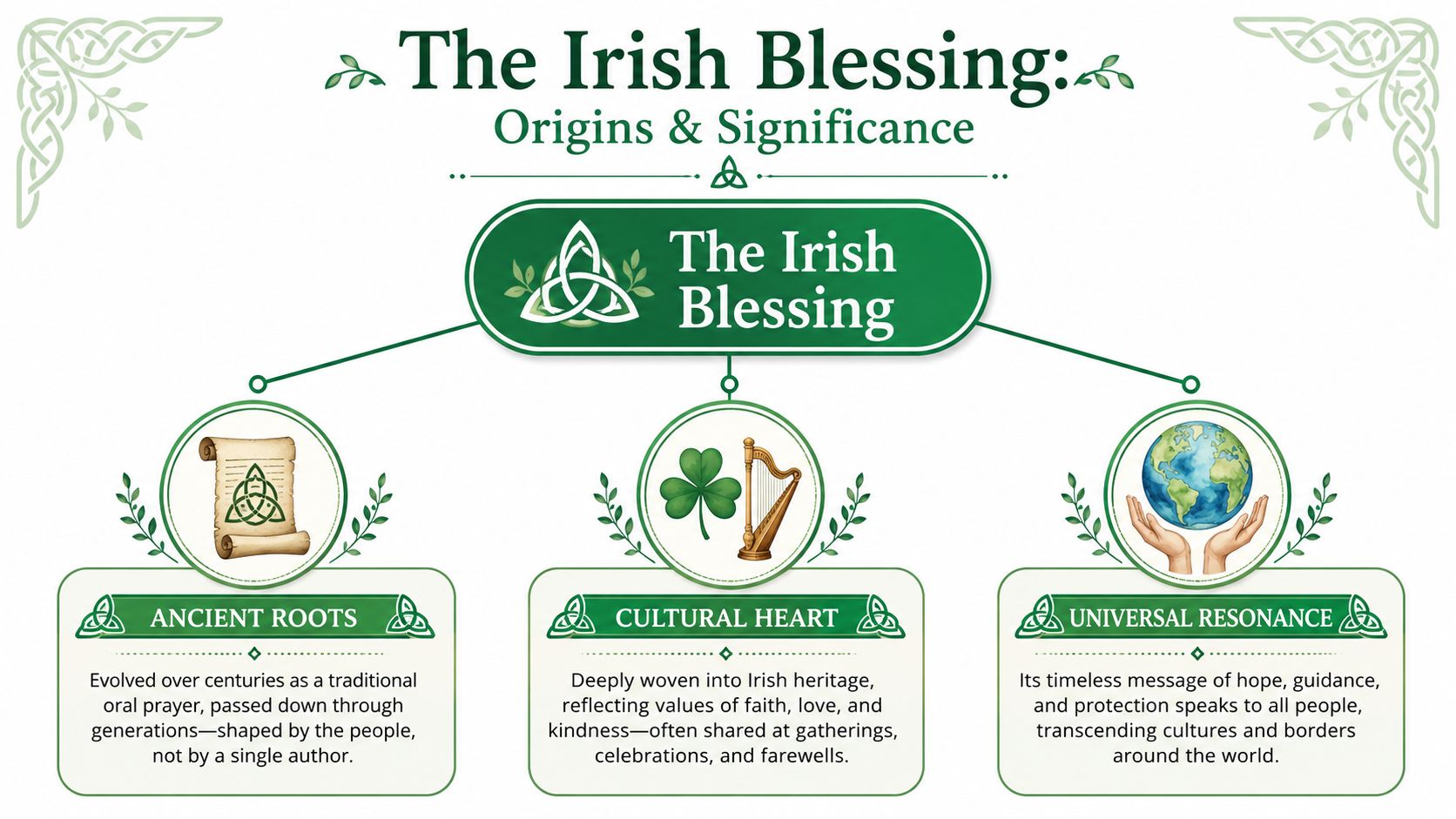
A common moment of hesitation happens right before someone writes the blessing into a card or reads it aloud at a service. They pause and wonder, “Who wrote this?” That question makes sense, especially because the blessing is so well known. Yet the best answer is still a humble one. No single author can be firmly tied to the most familiar version.
Why no single author is named
That uncertainty tells us something useful about the blessing itself. It likely lived first in memory, speech, prayer, and ceremony, then appeared in print later in different forms. Folk material often works this way. A song, proverb, or blessing can belong to a community long before anyone tries to pin it to one name.
That also explains why people sometimes get mixed messages online. One page calls it ancient. Another presents it as a Christian prayer. Another treats it like a modern poem. A discussion of the authorship and authenticity gap shows how easily performance and popular sharing can blur the historical picture.
Practical rule: Treat the Irish blessing as a traditional cultural form, not as a quotation to credit to a famous individual.
A blessing shaped by more than one tradition
Its imagery gives us better clues than a missing byline. The blessing opens with the natural world: road, wind, sun, rain, fields. Those images feel grounded in everyday Irish life, where weather, travel, and land were not poetic decorations but part of survival. Then the final line turns openly Christian with the wish that God may hold the person in the palm of His hand.
That blend matters. It reflects Ireland's layered history, where older seasonal and land-based patterns of thought continued alongside Christian belief rather than disappearing all at once. If you want to see that kind of continuity in another setting, the festival of Imbolc in Irish tradition offers a helpful example of how older customs can remain visible within later cultural forms.
A blessing like this works a bit like a river fed by more than one stream. One current carries natural scenery, weather, and travel. Another carries prayer, protection, and faith. Together, they create the version many people know today.
Variation is part of that history too.
Traditional blessings rarely exist as one frozen master copy. Families shorten them. Singers reshape the rhythm. Speakers choose only the opening line for a toast, or the final line for a funeral card. That does not weaken the tradition. It shows that the blessing is still living, still spoken, and still adapted with care to fit real moments in people's lives.
How to Use the Blessing for Any Occasion
You are standing with a wedding card in one hand and a pen in the other. Or you are trying to choose a reading for a funeral and wondering whether the familiar lines feel comforting or too bright for the room. That is where this blessing becomes more than a lovely quote. It becomes something you use.
The Irish blessing works best when you match the version to the moment. A blessing is a bit like clothing for a ceremony. The same fabric can be adapted for celebration, grief, travel, or everyday encouragement. The heart stays the same, but the length, tone, and language can shift.
That practical choice also opens a door into Irish itself. Learning even one line in Gaeilge helps you hear the blessing as part of a living culture, not only as a piece of English verse. For many readers, that step is an effective way to learn languages because it ties vocabulary to a real occasion, a real memory, and a real human connection.
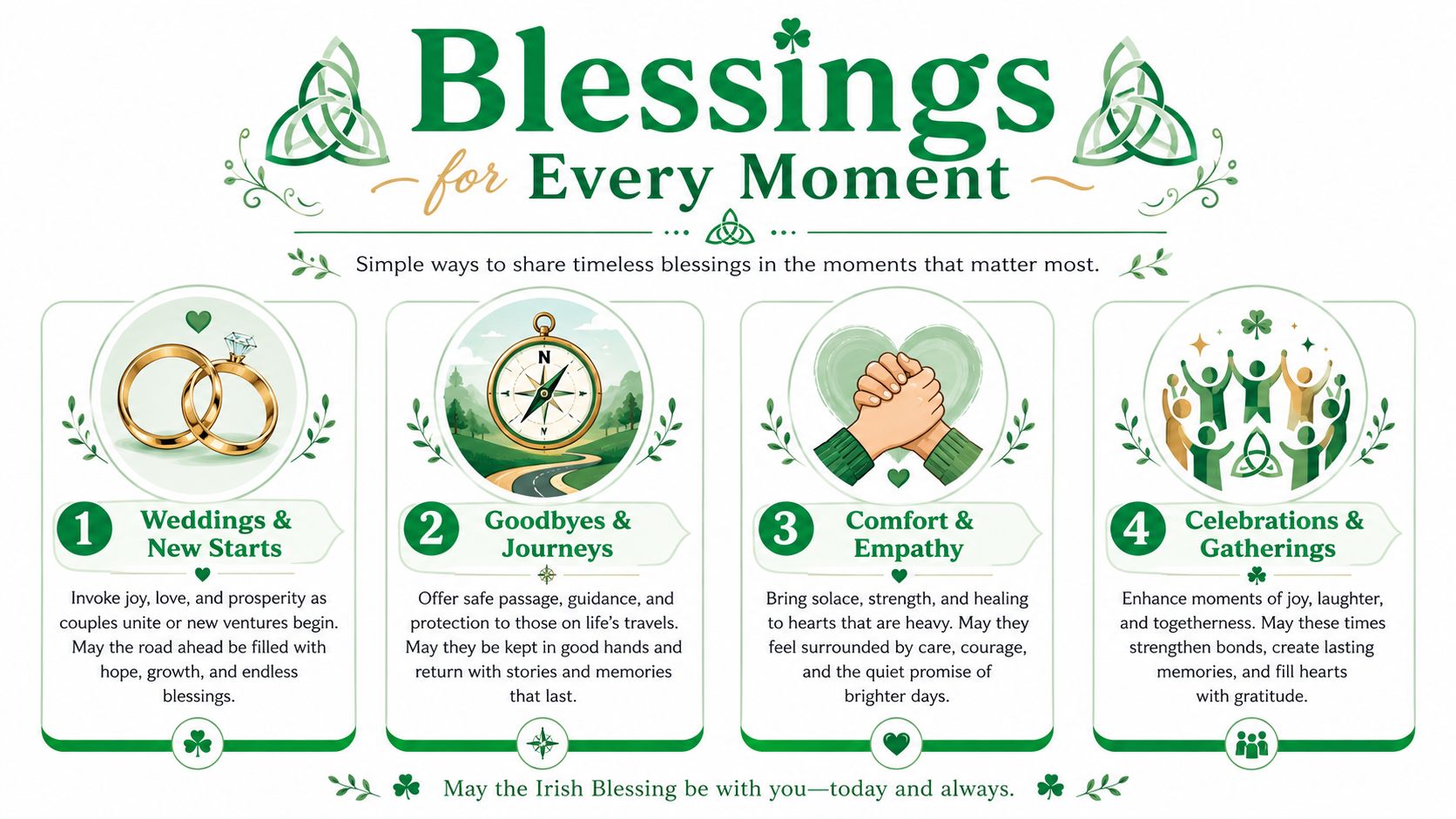
Weddings are one of the easiest places to use the full blessing. The imagery of road, sun, and soft rain looks ahead to shared life. It feels generous without sounding stiff, which is why it works well in a toast, a reading, or a printed program.
A few formats tend to work especially well:
Full ceremonial reading Use the complete familiar English version for a broad audience. It is recognizable, easy to follow, and well suited to a formal gathering.
Short toast format Use the opening line, then stop after the second or third line. This keeps the feeling warm and memorable without turning a toast into a speech.
Heritage touch Start with Go n-éirí an bóthar leat before continuing in English. That small shift gives the moment an Irish voice while still keeping everyone with you.
If you want to say the Gaeilge line with confidence, break it into sound groups: Guh nyee-ree on BOH-har lat. It does not need to sound perfect to be respectful. Care matters more than accent.
For a wedding card, a light adaptation often feels more personal than copying the full text:
May the road rise to meet you both, and may joy and kindness travel with you in all the years ahead.
For funerals and remembrance
Funerals call for a gentler hand. The full blessing can still work, especially because the closing wish carries tenderness and protection. But the middle lines about sunshine and soft rain may feel too airy for a service shaped by deep grief.
A good test is simple. Read the words aloud and ask whether they sound like comfort offered to the mourners, not a performance by the speaker.
These options are often more fitting:
Use the closing lines only The final lines usually suit funeral cards, memorial programs, or graveside readings because they focus on care, farewell, and reunion.
Choose a shortened excerpt “May the road rise to meet you” can work at the start, but many families prefer to move quickly to the ending when the mood is solemn.
Keep the language plain If mourners are not familiar with Irish phrases, English may be the kinder choice in the service itself. You can still include a Gaeilge line discreetly on a memorial card if the family has Irish roots or a personal connection to the language.
At a funeral, less is often more.
For everyday encouragement, travel, and milestones
The blessing also lives well outside formal ceremonies. It fits graduations, retirements, farewell parties, housewarmings, and messages to someone leaving for a new chapter. In those settings, the travel imagery feels natural rather than ceremonial.
You do not always need the full version. A single line can do the job:
For someone starting a new job: “May the road rise to meet you.”
For a traveler: “May the wind be always at your back.”
For a note of steady support: “May God hold you in the palm of His hand.”
Each line carries a slightly different mood. The first suggests progress. The second suggests help along the way. The third offers protection. Once you hear those differences, choosing a version gets much easier.
A respectful way to bring Gaeilge into the moment
Using a little Irish can be beautiful, but it should feel thoughtful, not decorative. If you are adding Gaeilge to a speech or card for the first time, keep it short. One line is enough. Say it clearly, then offer the English version. That gives the language presence without leaving listeners behind.
A practical pattern looks like this:
Go n-éirí an bóthar leat. May the road rise to meet you.
That pairing works well because it welcomes beginners. It also reflects something deeper about Irish heritage. Appreciation grows stronger when it includes language, even in small pieces. A blessing remembered in both English and Gaeilge is not just quoted. It is carried.
You've probably run into this already. You open an Irish app, start a lesson, and within a few minutes you're thinking, “This is Irish, but it doesn't sound like the Irish I've heard from Donegal or from relatives in the North.” That feeling is common, especially for heritage learners.
A lot of beginners assume they have to accept that mismatch and learn a generic version first. You don't. If your goal is Ulster Irish, your study path can match that goal from the start. That makes the language feel more personal, more coherent, and often easier to stick with.
Ulster Irish language learning becomes much less intimidating when you stop treating it like a special advanced track. It's just a dialect path with its own sounds, habits, and media. And you're not learning it in isolation either. In the 2021 Northern Ireland Census, 228,600 people, or 12.4% of the population, reported some ability in Irish, which points to a real community of speakers and learners around you, not just a niche academic interest, as noted in the Northern Ireland Irish language overview.
If standard learning materials have felt slightly off to your ear, that's not you failing. It's often a dialect fit problem. You're hearing Irish, but not the version that feels local, familiar, or emotionally connected to the part of Ireland you care about.
That matters more than many courses admit. Adults stay motivated when the language sounds like something they can imagine using with family, in local media, or on visits to Ulster. When the sound and rhythm match your goal, practice stops feeling abstract.
Why Ulster Irish feels worth learning
Ulster Irish, or Gaeilge Uladh, isn't just a side variation. It carries local pronunciation, vocabulary choices, and speech patterns that connect directly to Donegal and to Irish in Northern Ireland. For many learners, that local link is the whole point.
A dialect path also makes culture easier to absorb. Songs, interviews, community media, and everyday speech start to sound less like “advanced content” and more like usable input.
Start with the Irish you want to hear and speak. Motivation gets stronger when the dialect matches your reason for learning.
Where beginners often get stuck
Most confusion starts with one false assumption: that there's one neutral Irish you should master before touching dialects. In real life, learners usually meet Irish through actual speakers, and actual speakers always have a way of speaking.
A better starting point is simpler:
Choose your target community: Donegal, Northern learners, or a broader Ulster focus.
Train your ear early: Listen before you obsess over grammar charts.
Build small wins: Learn greetings, names, requests, and short questions first.
That approach makes Ulster Irish language learning feel practical from day one.
What Makes Ulster Irish Sound Different
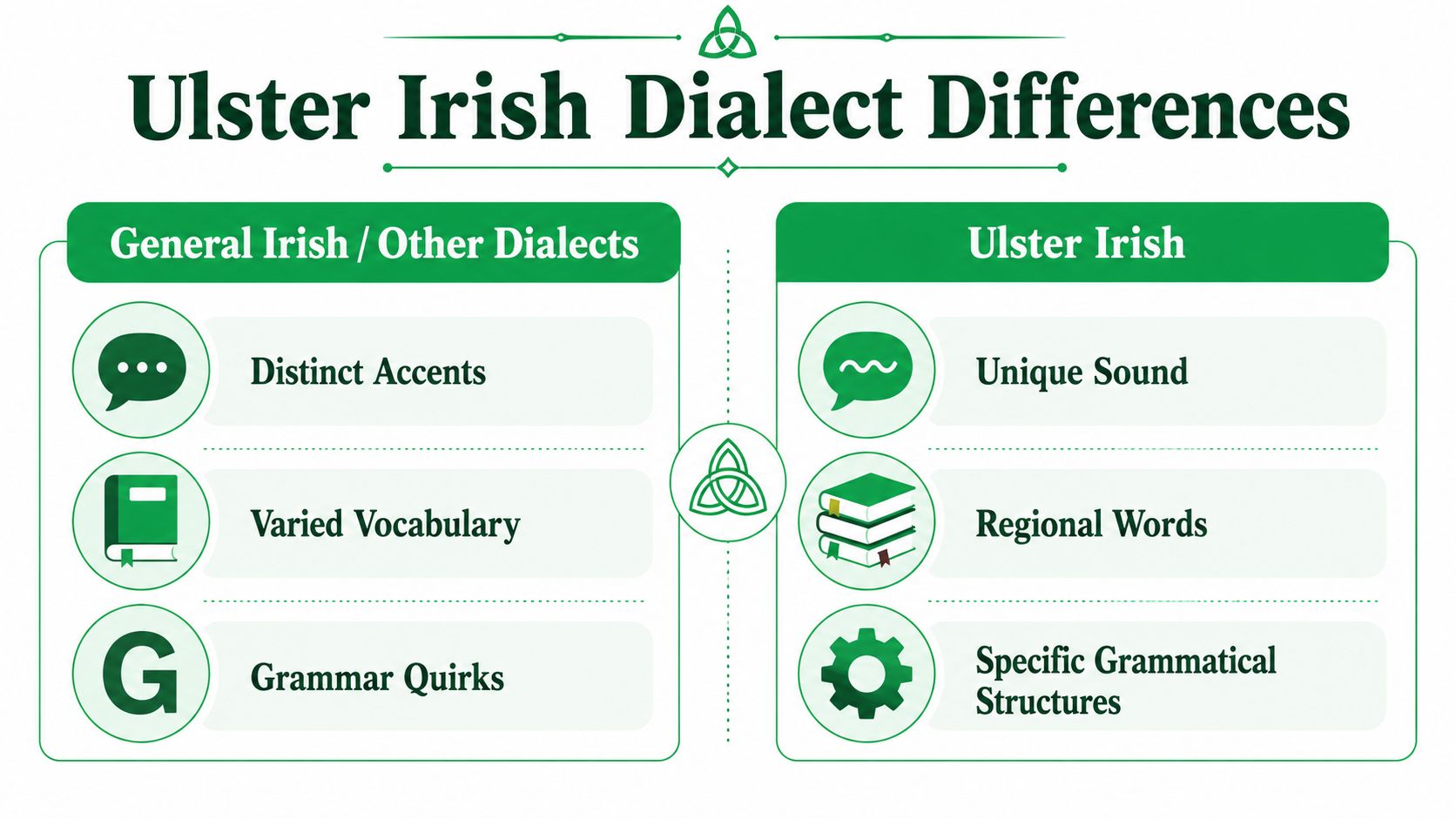
Ulster Irish is still Irish. The grammar system is recognizably the same, and a lot of core vocabulary overlaps with other dialects. The difference is in the sound, some word choices, and the way common patterns show up in speech.
Think of dialects like accents in English
If you've heard American, Scottish, and Australian English, you already understand the basic idea. People can share one language while sounding distinct enough that beginners notice it immediately.
That's why dialect choice shouldn't be brushed aside. Some beginner advice tells learners not to worry much about dialects, and one learning resource even notes that its recordings lean toward Munster pronunciation, which can leave Ulster-focused learners practicing the wrong sounds for their own goals, as discussed in this guide to Irish dialects and beginner pronunciation choices.
For a beginner, three things matter most:
Sound system: The melody and pronunciation can feel sharper or different from what you hear in non-Ulster recordings.
Vocabulary habits: Some everyday words and preferred expressions differ by region.
Grammar in use: The underlying grammar is shared, but familiar spoken patterns can vary.
Ulster Irish vs. Standard Irish at a glance
Feature
Ulster Irish (Gaeilge Uladh)
Standard/Other Dialects
What it means for you
Pronunciation
Local Ulster sound and rhythm
Often taught with non-Ulster audio
Your ear needs Ulster-focused listening practice early
Vocabulary
Some regional everyday choices
More generalized textbook wording
You may recognize both, but should practice the forms you want to use
Spoken patterns
Regional habits in common phrases
Often more neutralized for teaching
Learn phrases as chunks, not as isolated grammar rules
What to listen for first
Don't try to catalogue every dialect feature. That overwhelms beginners fast. Instead, listen for repetition.
When you hear the same greeting, response, or question shape appear across several Ulster recordings, treat that as a useful pattern. Your first job isn't to become a dialect scholar. It's to become comfortable hearing Ulster Irish as normal speech.
Practical rule: If your goal is Ulster pronunciation, your listening should be more specific than your grammar study.
Should You Learn Standard Irish First
This is the question that stalls a lot of learners. They want Ulster Irish, but they keep getting told to begin somewhere else and “move into” the dialect later.
That advice usually comes from a real problem. For a long time, Ulster-specific materials were harder to find, so learners were pushed toward more general courses by default. You can still see that confusion in learner discussions where people ask for Ulster resources and get mixed answers, including the familiar suggestion to start with standard Irish first, as shown in this discussion about beginning with Ulster Irish or standard Irish.
Why the standard-first advice confuses beginners
The standard-first path sounds safe, but it creates friction. You build habits in one pronunciation model, then later try to swap them out. You learn phrases that are technically useful, but they may not sound like the speech community you want to join.
That doesn't mean standard Irish is bad. It means it may not be the most direct route for your purpose.
Common beginner worries look like this:
“Will I limit myself?” Not really. Dialect learning still gives you access to the wider language.
“Will textbooks become harder?” Sometimes, but not unmanageably. You just learn to notice where textbook Irish and local speech diverge.
“Will I sound strange mixing things?” At first, maybe a little. That's normal in any language journey.
A simpler rule for beginners
If your goal is to speak and understand Ulster Irish, start with Ulster Irish.
If your goal is a broad school-based overview with no strong regional preference, a general course can still help. But learners with a clear dialect goal usually do better when they train the right ear from the beginning.
A useful way to think about it is this:
Learn the version you want coming out of your own mouth.
That one sentence clears up a lot of hesitation. It keeps your effort aligned with your outcome.
Your Realistic Learning Pathway
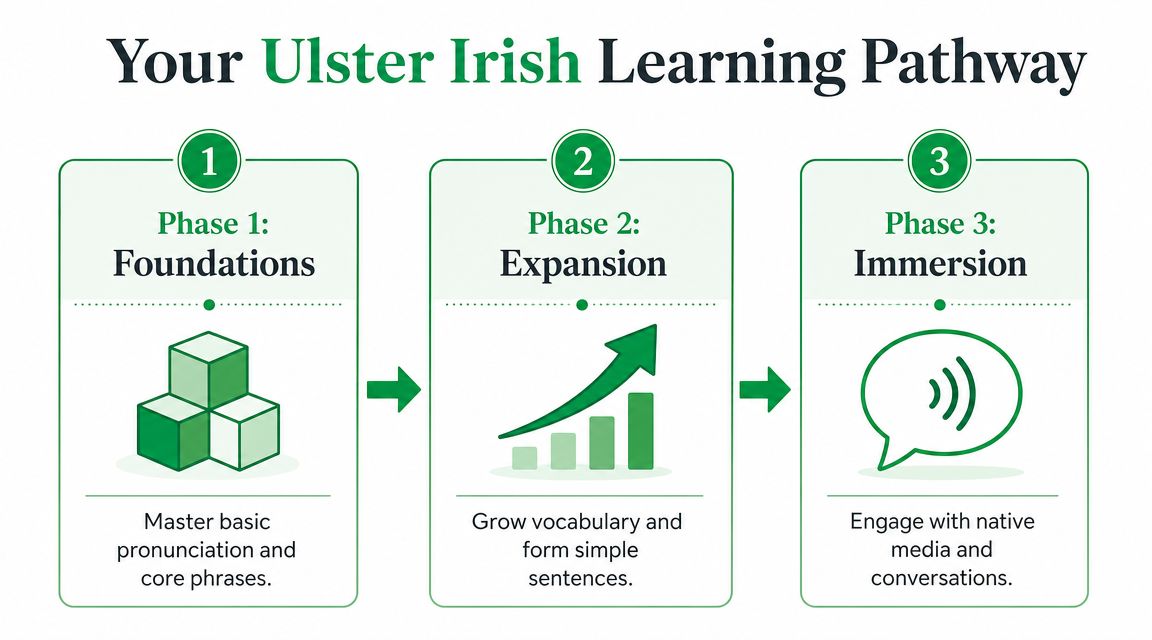
A common need isn't more motivation. It's a sequence. Ulster Irish language learning becomes manageable when you split it into stages and give each stage a narrow job.
Research from Northern Ireland points in the same direction. Irish knowledge is more stable when practice is repeated and socially reinforced, rather than left to one-off exposure, according to this analysis of Irish and Ulster-Scots language patterns in Northern Ireland. That's why a pathway matters. It gives your practice rhythm.
Phase 1 foundations
Your first phase is about sound and survival phrases. Don't begin with big grammar ambitions.
Focus on:
Pronunciation first: Copy short audio clips aloud.
Core phrases: Greetings, introductions, yes-no answers, thanks, and simple requests.
A small word bank: Build around everyday words you'll often reuse.
A lot of online teachers would recognize this as a course design issue, not just a language issue. If you're interested in how sequencing affects retention, this piece on mastering online course design is a useful parallel. Good learning design reduces friction by controlling what comes first.
Phase 2 expansion
Once your ear is less tense, start building sentences. Keep them short and high-frequency.
Try a checklist like this:
Introduce yourself
Say where you're from
Talk about what you like
Ask a basic question
Answer with one full sentence
At this stage, many learners get distracted by rare grammar points. Don't. If you can say a few accurate things repeatedly, you're making real progress.
Phase 3 immersion
Now you start turning study into use. At this point, Ulster-specific input matters most.
Use a mix of:
Native or locally oriented audio
Short conversation practice
Shadowing, where you repeat after a speaker
Household use, even if it's only labels, greetings, or one repeated phrase a day
A speaker-rich environment isn't available to everyone, but you can simulate some of it. Repeat the same dialogue over several days. Reuse phrases with a friend. Answer yourself aloud while walking or cooking.
Consistency beats intensity here. Ten steady minutes with real spoken input does more than a single long cram session you won't repeat.
Essential Ulster Irish Phrases for Practice
You don't need a huge phrase list at the beginning. You need a few phrases you can reuse until they feel automatic. That's how speech starts.
A first hello
Start with a tiny self-introduction.
Haigh! Dónall is ainm dom. Approximate pronunciation: Hi! DOH-nul ish an-im dum Meaning: Hi! My name is Dónall.
Cad é mar atá tú? Approximate pronunciation: Kad ay mar a-TAW too? Meaning: How are you?
Tá mé go maith. Approximate pronunciation: Taw may guh mah Meaning: I am well.
Mini dialogue:
A: Haigh! Dónall is ainm dom.
B: Haigh! Máire is ainm dom.
A: Cad é mar atá tú?
B: Tá mé go maith.
In a café
Useful language sticks when it belongs to a real scene.
Caife le bainne, le do thoil. Approximate pronunciation: KAF-eh leh BAN-yeh, leh duh huh-il Meaning: Coffee with milk, please.
Go raibh maith agat. Approximate pronunciation: Guh rev mah ah-gut Meaning: Thank you.
If you enjoy tying vocabulary to the Irish calendar and seasonal culture, this short guide to Imbolc in Irish tradition gives you another memorable context for early words and phrases.
Asking for directions
Direction questions are perfect for beginners because they repeat the same structure.
Caidé an bealach go…? Approximate pronunciation: Ka-jay an BYAL-akh guh…? Meaning: What is the way to…?
Caidé an bealach go dtí an siopa? Approximate pronunciation: Ka-jay an BYAL-akh guh jee an SHUP-ah? Meaning: How do I get to the shop?
Practice it by swapping the last noun:
…go dtí an stáisiún
…go dtí an baile
…go dtí an scoil
Don't wait until you “know enough” to speak. Repeated short phrases are how you begin knowing enough.
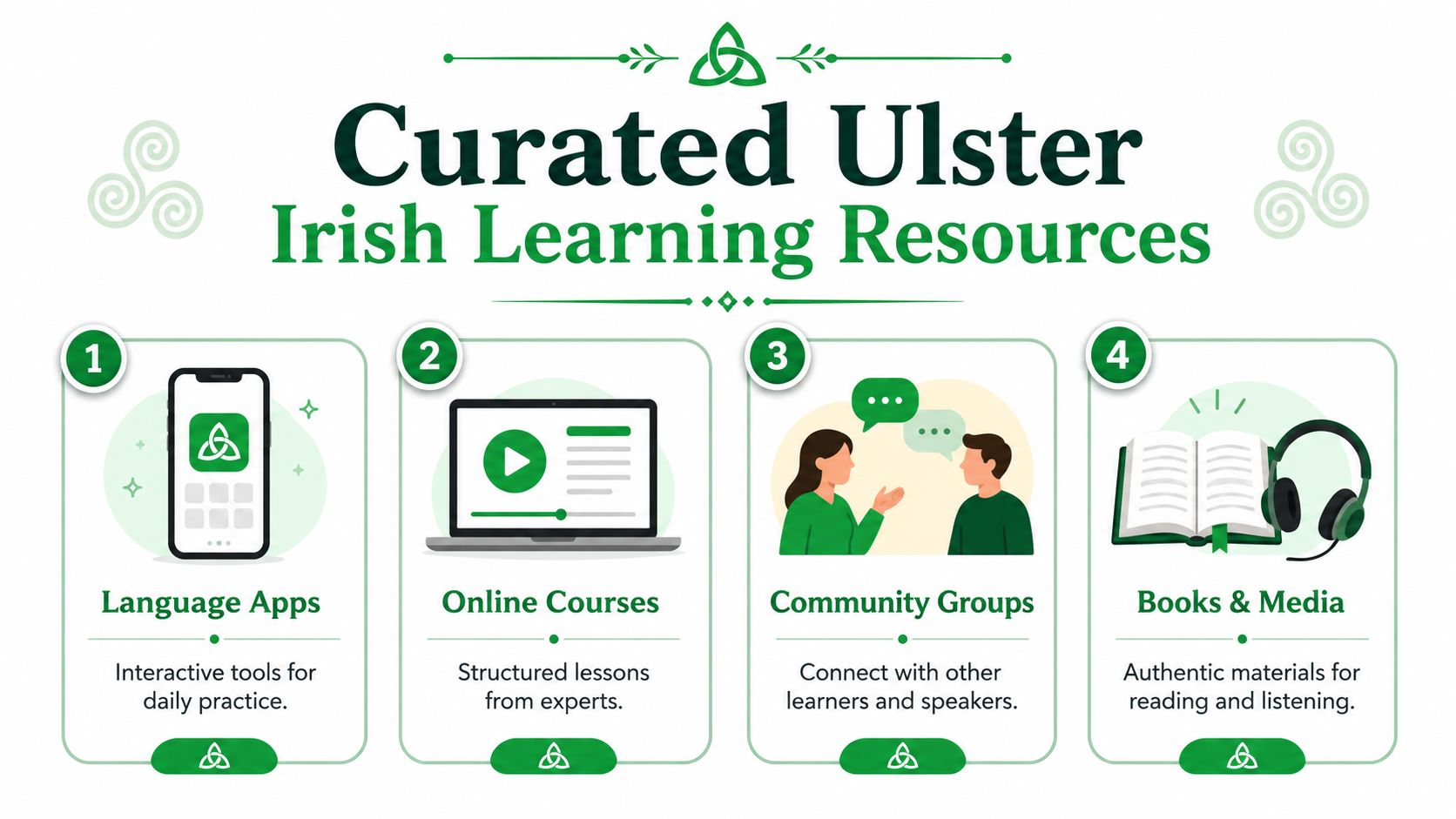
Curated Learning Resources for Ulster Irish
The hardest part for many learners isn't effort. It's sorting through scattered materials without knowing what helps. A good Ulster toolkit should reduce that noise.
Some guides note that Ulster Irish has been less well served than other dialects by mainstream materials, but they also identify useful Ulster-oriented options such as Meon Eile and Gaeilge Uladh materials from Oide Lurgan. The same guidance stresses the value of authentic audio for retention and dialect learning, as explained in this overview of Irish learning resources with Ulster-specific options.
Audio and media first
If you only remember one rule from this section, make it this one: listen early and often.
Good categories to prioritize:
Ulster-oriented media: Meon Eile is useful because it gives you speech closer to Northern contexts.
Dialect materials: Gaeilge Uladh resources from Oide Lurgan help narrow the gap between textbook Irish and local speech.
Conversation playlists: Short clips are often better than long lessons when you're still training your ear.
Structured tools and practice options
Once you have audio, add structure. That's what keeps you from bouncing between tabs and forgetting what you meant to review.
A practical toolkit might look like this:
Resource type
Best use
What to look for
Audio and video
Ear training
Ulster speech, short clips, repeatable phrases
Flashcards or saved words
Review
Ability to save words from real content
Guided practice platform
Speaking and feedback
Scenario-based dialogue and pronunciation help
Community practice
Confidence
Learner groups or conversation exchanges
One structured option is Gaeilgeoir AI, which offers guided conversations, pronunciation support, adaptive quizzes, and scenario-based practice for everyday situations. For learners who want a more coherent path than scattered links and older forum advice, that kind of setup can help turn passive exposure into repeated active use.
Your Next Step to Speaking Ulster Irish
You don't need to solve every dialect question before you begin. You need a clear target, a small set of phrases, and regular contact with Ulster-focused audio.
That's the heart of this approach. Start with the dialect you want. Train your ear before chasing every grammar detail. Build speech from short, reusable patterns. Then make your practice social, repeated, and grounded in real situations.
Ulster Irish is not too specific for a beginner. In many cases, it's the more honest starting point.
If you're ready to move from reading about Irish to using it, start with a guided path that gives you spoken practice right away at Gaeilgeoir AI's learning platform.
Frequently Asked Questions about Learning Ulster Irish
Can I still understand other dialects later
Yes. Starting with Ulster Irish doesn't trap you. It gives you a strong base. As your listening improves, you'll begin noticing patterns across Irish more broadly, and other dialects become easier to place.
Think of it as starting with one home base, not building a wall around yourself.
Is there really a future for Irish in the North
Yes, and one practical sign is education. By 2025, 7,598 students were being taught in Irish-medium schools in Northern Ireland, including 926 in nursery schools and 4,621 in primary schools, showing real institutional support and a continuing path for intergenerational language use, according to these Irish-medium student figures for Northern Ireland.
That matters because languages stay alive when children, families, and communities keep using them.
How do I stay motivated when resources feel scattered
Shrink the task. Pick one audio source, one phrase notebook, and one place to practice speaking. Don't build a giant resource pile in week one.
A simple rhythm works better:
Listen to one short clip
Repeat it aloud
Save a few useful words
Reuse one phrase in speech the same day
That's enough to build momentum. The scattered feeling usually comes from trying to use everything at once.
If you want a simple place to begin, Gaeilgeoir AI offers guided Irish conversations, pronunciation support, and everyday scenario practice that can help you start speaking from day one.
You've probably done some version of this already. You open a tab to learn Irish words, save a few phrase lists, maybe watch a pronunciation video, and then stall when the first simple sentence feels harder than it should. You know more than you can use. Or you remember isolated words, but not when to say them.
That's a normal place to start.
Irish often feels difficult at the beginning because many beginner resources teach it as scattered vocabulary, grammar rules, or tourist phrases. What most learners need is a system: learn the right words first, remember them actively, and turn them into sentences you can say out loud.
Irish attracts people for very human reasons. Some want to reconnect with family history. Some are preparing for school exams. Some want enough Irish to travel, join a local conversation circle, or finally understand the language they saw on signs and heard in school. The motivation is real, but the path often isn't clear.
The first problem is volume. Search for help and you'll find pronunciation guides, grammar charts, random word lists, short-form videos, and beginner lessons that don't connect to each other. One page teaches colors. Another teaches greetings. A third drops you into grammar terms you haven't seen in years.
That confusion matters because it can make you think Irish is the problem, when the actual issue is the order you were taught in.
Practical rule: Don't start by trying to “cover the language.” Start by building a small set of useful words you can actually use.
There's also a wider pattern behind this feeling. In Ireland's 2022 Census profile on Irish language use, 40% of people said they could speak Irish, but only 71,968 people said they spoke it daily. That gap shows something many learners know personally: it's possible to recognize Irish, remember some school Irish, or understand bits of it, while still not being ready to use it in ordinary speech.
What usually goes wrong
You collect words without a plan. You learn “window,” “horse,” and “purple,” but can't introduce yourself.
You read more than you speak. Irish needs sound, rhythm, and mouth practice.
You mistake recognition for recall. Seeing a word and understanding it isn't the same as producing it when you need it.
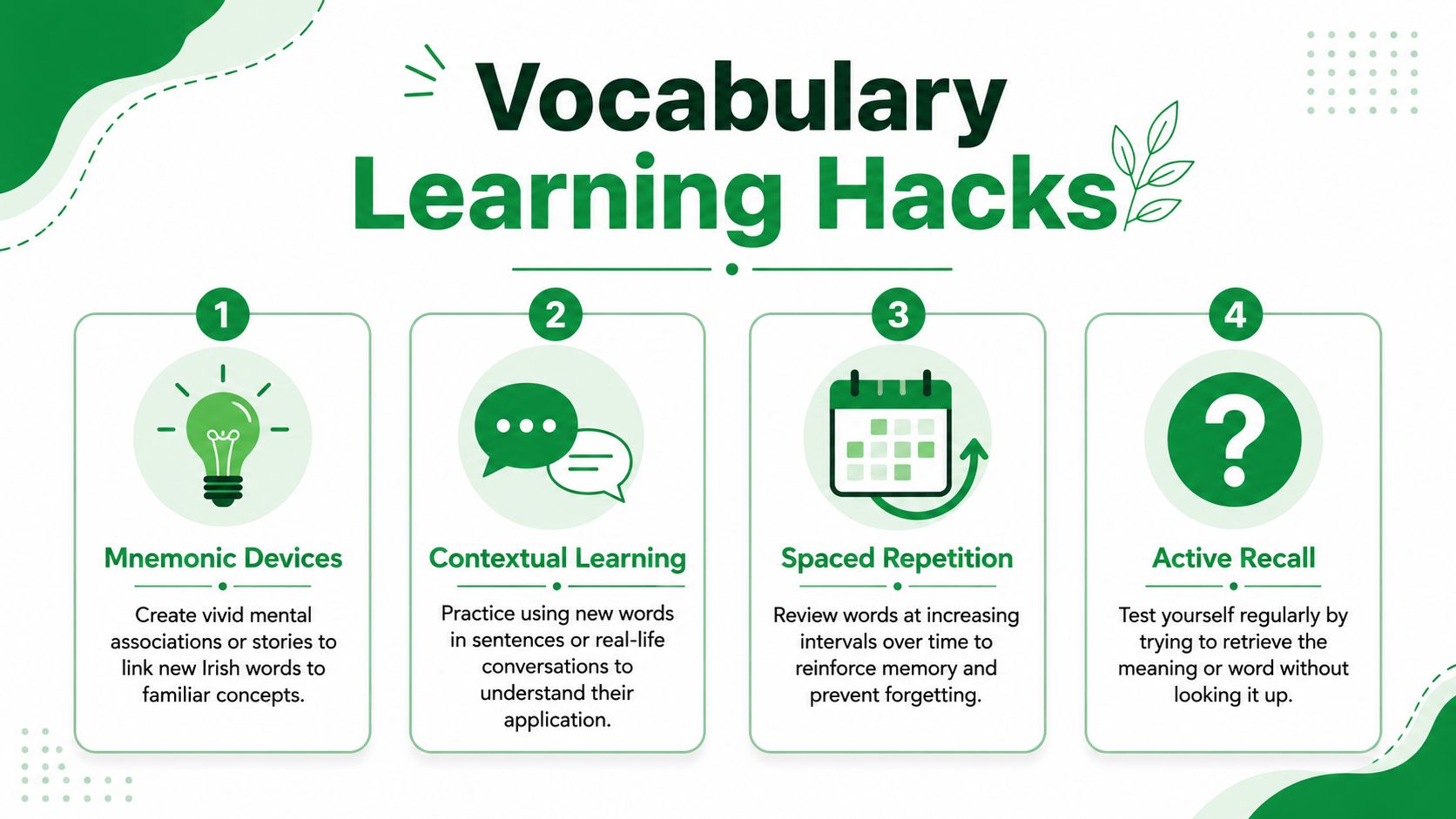
A better approach is simpler than it sounds. First, choose words by frequency and usefulness. Then review them in a way that forces memory. Then place them into short, reusable sentence patterns. That's how you move from passive knowledge to active use.
Build Your Foundation with High-Frequency Words
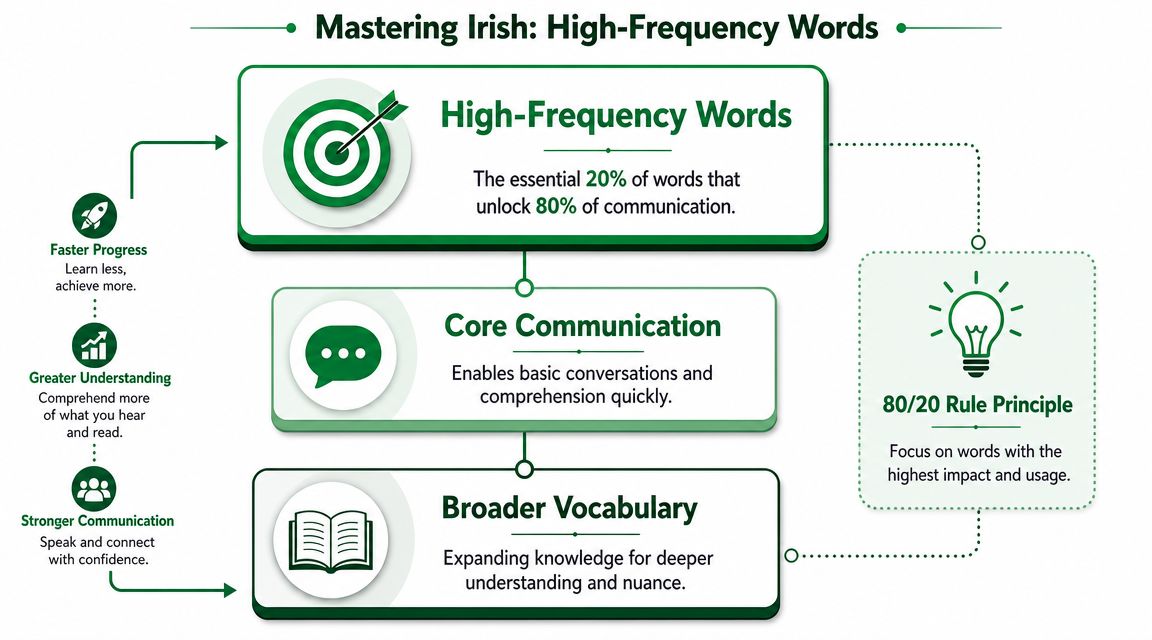
If you want to learn Irish words efficiently, don't begin with long themed lists. Start with the words that hold everyday speech together. These are the words you meet again and again in basic conversation, reading, and listening.
Some of them won't look exciting. Words like agus (and), le (with), ar (on), and forms built around tá matter because they connect ideas. They're sentence glue. If you skip them and focus only on nouns, your vocabulary grows, but your communication doesn't.
A frequency-based method suits adults especially well because time is limited. Bitesize Irish notes that for time-poor learners, an optimized 1,000-word foundation tied to common scenarios is more efficient than traditional topic-by-topic lists. That's the key idea. Learning the right words matters more than learning more words.
What to learn first
Start with a compact core you'll reuse constantly:
Connectors and structure words.Agus, ach, le, ar, i.
High-use verbs and forms.Tá, is, bí, téigh, déan.
People words.mé, tú, sé, sí, muid.
Everyday function vocabulary. Greetings, numbers, time, family, food.
One Irish-learning resource recommends beginning with the first 100 most common words, and another emphasizes high-frequency functional vocabulary because it gives immediate communication value and lowers early cognitive load, as summarized by Gaeilge.ca's guidance on learning vocabulary in useful order.
Why random topic lists slow you down
Topic lists feel organized, but they often hide a problem. You may finish a unit on animals and still be unable to say basic things like:
I am tired.
I am at home.
I want tea.
She is with me.
Those sentences depend less on rare nouns and more on common structural words.
Learn your first words as tools, not decorations.
A good test is this: can the word appear in many situations? If yes, learn it early. If it only appears in one narrow topic, save it for later.
Here's a simple contrast:
Approach
Result
Learn 30 kitchen nouns
You can label objects
Learn common verbs, pronouns, connectors, and daily-use nouns
You can begin forming messages
That's why a lean, high-frequency vocabulary base works so well. It gives you material you can speak with, not just words you can recognize on a page.
Use Active Recall to Make Irish Words Stick
Learners often don't struggle because they're bad at memory. They struggle because they review in a passive way. Reading a list five times feels productive, but it often creates familiarity, not recall.
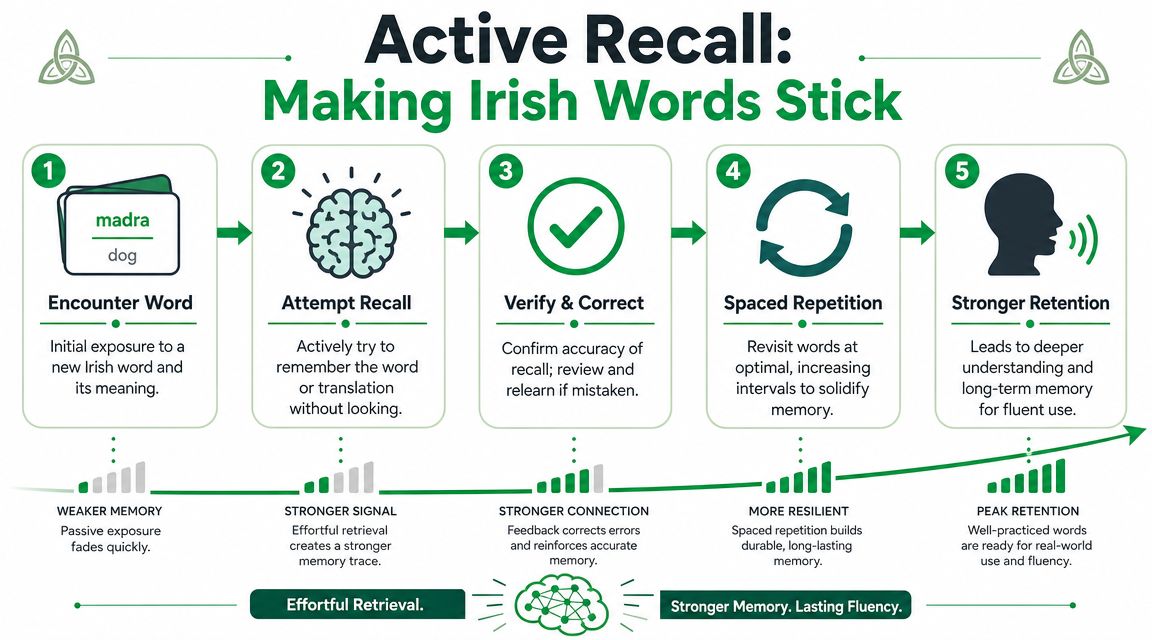
If you want Irish words to stay with you, make your brain retrieve them. Close the answer. Try to say it. Then check. That moment of effort is where memory strengthens.
Preply's beginner guidance on learning Irish recommends 10–15 minutes of daily speaking practice, recording yourself, and using spaced repetition with flashcards. It also warns that passive recognition without active production is a common pitfall. That's exactly why flashcards only work if you use them actively.
A simple active recall drill
Try this with five to ten new words at a time.
Look at the English meaning first. For example, “with.”
Say the Irish word aloud from memory. Try to produce it before you peek.
Check the answer. If you missed it, say the correct form aloud.
Use it in a tiny phrase. Not just le, but le mo chara if that's within your level.
Come back later. Review the same card after a short break, then again the next day.
That's better than rereading because you're practicing retrieval, pronunciation, and use.
Organize flashcards by context
Alphabetical lists make review neat, but not memorable. The more useful option is to group cards by situation:
At home
Introductions
Food and drink
Travel
Time and routine
This makes recall more realistic. When you need a word in conversation, you won't search alphabetically in your head. You'll search by context.
A helpful companion idea appears in Maeve's active recall study guide, which explains retrieval-based study in plain language. It's written for learners generally, but the method transfers well to vocabulary work.
Say the word before you think you're ready. Spoken mistakes are easier to fix than silent hesitation.
Add your voice early
Irish spelling and pronunciation can drift apart in a beginner's memory if you only read. That's why short speaking practice matters. Say the word. Record it. Compare it with native audio. Then say it again.
A simple notebook works. So does a flashcard app. If you use a tool, keep one rule: every review session should include some spoken output, even if it's brief. Recognition gets you through quizzes. Production gets you into conversation.
Go from Words to Sentences with Contextual Learning
Knowing a word in isolation is only the first step. Communication starts when a word lives inside a phrase you can reuse. If you know madra, that's a noun. If you know Tá an madra mór, you're beginning to think in Irish.
That jump from word lists to live sentences is where many learners get stuck. Rosetta Stone's Irish learning page highlights pronunciation, vocabulary, comprehension, and tutoring, but a big gap remains between memorizing words and using them in real conversation. For beginners, that bridge matters even more because Irish spelling and pronunciation can be tricky without spoken context.
Start with sentence frames
A sentence frame is a short pattern that lets you swap in new words. You don't need many at first. You need a few reliable ones.
Examples:
Tá mé … Tá mé tuirseach. Tá mé sa bhaile.
Ba mhaith liom … Ba mhaith liom tae. Ba mhaith liom caife.
Tá … agam Tá leabhar agam. Tá am agam.
When you learn a new word, ask one question: what sentence frame can carry it?
This is close to what language learners in other fields call sentence mining. If you're curious how that idea appears in another language context, Mandarin learners often use the same principle to accelerate Mandarin fluency by collecting usable sentences, not isolated words.
Learn by situation, not by theme alone
“Food” is a topic. “Ordering lunch” is a situation. Situations are better because they force action.
Instead of memorizing twenty food words, build a mini-dialogue:
Hello
I would like tea
Please
Thank you
How much is it
Do the same for:
introducing yourself
asking for directions
talking about family
chatting about your day
A cultural theme can also make practice feel more alive. If you want seasonal vocabulary with context, the Imbolc guide on Gaeilgeoir is a good example of how words become easier to remember when they're attached to a tradition, image, or moment in the year.
After you've built a few sentence frames, use spoken examples to hear how they move in real speech. This short video works well as a listening prompt before shadowing practice.
A word learned alone is fragile. A word learned inside a sentence is ready for use.
When you review, don't ask only “What does this word mean?” Ask “Where would I say this?” That small change turns vocabulary study into conversation practice.
Your 30-Day Irish Vocabulary Action Plan
A good plan feels light enough to repeat. If it's too ambitious, you'll do it for a few days and then disappear. Irish improves through regular contact, especially when that contact includes review, listening, and speech.
The easiest pattern is short daily work with one main focus per session. You don't need a marathon. You need a routine you'll stick with.
A simple daily routine
Use this structure as a base:
Review first. Spend a few minutes on old cards before adding anything new.
Add a small set of words. Choose words connected to one real situation.
Build two or three sentences. Use the new words immediately.
Say them aloud. Record yourself if possible.
Finish with listening. Hear the same words in speech.
This keeps vocabulary from floating loose in memory.
Sample Weekly Irish Study Plan
Day
Focus
Activity
Monday
Core words
Review older flashcards, then learn a small set of high-frequency words and say each aloud
Tuesday
Sentence building
Use yesterday's words in short sentence frames and write a few personal examples
Wednesday
Listening and repetition
Listen to beginner Irish audio and repeat key phrases out loud
Thursday
Scenario practice
Practice one situation such as introducing yourself or ordering a drink
Friday
Recall check
Cover your notes and retrieve words and phrases from memory before checking
Saturday
Speaking day
Record a short self-introduction or mini-dialogue using the week's vocabulary
Sunday
Light review
Revisit difficult cards, tidy your study list, and choose next week's scenario
A few practical habits make this plan work better:
Keep one active list. Don't scatter words across screenshots, notebooks, and browser tabs.
Track trouble words. If a word keeps slipping, mark it for extra speaking practice.
Reuse before expanding. A word isn't learned because you saw it once. It's learned when you can call it up and use it.
Tie words to your life. “I am tired,” “I am working,” and “I want coffee” are better beginner sentences than abstract textbook examples.
You can also rotate tools. Some days a notebook is enough. Other days you might want flashcards, beginner audio, or a guided platform. One option is Gaeilgeoir AI, which is built around the 1,000 most-used Irish words, scenario-based conversations, pronunciation support, and adaptive quizzes. Used well, it fits the same method: high-frequency vocabulary first, then active use.
A month of work like this won't make everything easy. It will do something more important. It will make your Irish feel reachable and usable. That's what keeps learners going.
Start Speaking Irish with Confidence
Irish gets easier when you stop treating vocabulary as a pile of facts to memorize. A better path is to learn useful words first, retrieve them actively, and attach them to situations where you'd speak.
That approach changes the feeling of study. You're no longer trying to conquer the whole language at once. You're building a working core. One phrase becomes three. Three become a short exchange. Then you start noticing words in audio, on signs, and in conversation because you've given them structure and repetition.
If you're returning to Irish after school, this method removes a lot of old frustration. If you're a complete beginner, it stops you from wasting time on word lists that don't lead anywhere. If you're studying for the Leaving Cert oral, it gives you a practical way to turn known vocabulary into usable speech.
Keep your expectations steady. Speak early. Review often. Learn words that carry real meaning in daily life. That's how you learn Irish words in a way that lasts.
If you want a guided way to put this method into practice, Gaeilgeoir AI offers structured Irish study built around common words, real-world scenarios, pronunciation support, and speaking-focused practice.
You might be coming to Brigid from different directions at once. Maybe you're learning Irish because of family roots, maybe you're preparing for a class or oral exam, or maybe you saw a Brigid's cross in an Irish home and realized there was a whole layer of meaning behind it. That moment matters, because language and symbol often travel together.
Brigid stands at a rare crossroads in Irish culture. She appears as goddess and saint, in seasonal custom and household tradition, in stories about healing, craft, poetry, and protection. When people talk about Irish heritage in a living, everyday sense, Brigid is often somewhere close by. Her symbols aren't just decorative. They carry memory, belief, and ways of seeing the world.
Learning the meanings behind goddess Brigid symbols can make your Irish feel less like isolated vocabulary and more like part of a cultural tapestry. A word like lasair becomes more memorable when you connect it to Brigid's flame. A word like baile gains warmth when you picture a cross hanging over a family doorway. Cultural context gives language weight.
This guide focuses on eight key symbols linked with Brigid, their meanings, and their place in both older tradition and modern life. Along the way, each symbol becomes a language-learning tool. You'll get simple Irish terms, conversation ideas, and ways to use cultural knowledge as speaking practice.
You notice a small woven cross above an Irish doorway in early spring. It looks simple at first, just rushes folded into a balanced shape. Then someone tells you it is made for Brigid, hung for protection, and tied to the turning of the season. A household object becomes a piece of cultural memory.
A home symbol that carries history
Brigid's cross is traditionally woven from rushes or reeds and placed in the home, often over a door or near an entrance. In Irish tradition, that placement matters. The cross marks the house as a protected space, but it also points to a wider pattern in the year. It is closely associated with Imbolc and the beginning of spring, when people marked change not with abstract ideas, but with objects they could make, hold, and hang in daily life.
Its form also helps explain why the symbol has lasted. The woven center gathers the arms together, much like a spoken phrase gathers separate words into one meaning. For learners of Irish, that is a useful comparison. You are not only memorizing the word crois. You are connecting it to baile (home), doras (door), cosaint (protection), and the seasonal language around Imbolc in Irish tradition and learning.
Some readers may wonder about the spelling here. You will often see Crois Bhríde as the standard Irish name for Brigid's cross. If your source uses a variant such as Croíoch Bhríde, treat that as a prompt to pay attention to regional usage and editorial choices. That habit helps in language learning too, because Irish often preserves meaning through local form as well as standard spelling.
Learn the symbol by speaking around it
Brigid's cross is one of the easiest symbols to turn into real language practice because it gives you visible, concrete things to describe. You can say what it is made from, where it hangs, who made it, and why it is kept.
Start with short, usable ideas. Tá an chros os cionn an dorais. The cross is above the door. Tá sí déanta as luachair. It is made from rushes. Cosnaíonn sí an baile. It protects the home.
That kind of practice works well for beginners because the object stays in front of you. It gives your memory a hook. A woven cross also teaches culture and vocabulary at the same time, which is often how Irish is best learned.
Home words: practice baile, teach, doras, and fuinneog with simple location phrases
Craft words: add luachair (rushes), déanta (made), and fite (woven)
Speaking prompt: describe a Brigid's cross you have seen in a house, school, museum, or photo
Conversation idea: ask a partner, An bhfuil cros Bhríde i do theach? and answer with one or two full sentences
If you want a visual prompt while practicing, even a crafted object can help you hold the image of form, balance, and radiating shape in mind. Collections such as Astro West's curated mineral art can serve as a reminder that symbolic objects often teach through shape before they teach through explanation.
That is part of Brigid's lasting appeal. Her cross is not only something to study. It is something people still make, still display, and still talk about. For an Irish learner, that makes it more than a symbol from the past. It becomes a doorway into vocabulary, memory, and lived tradition.
2. The Sacred Flame (An Lasair Dhílis)
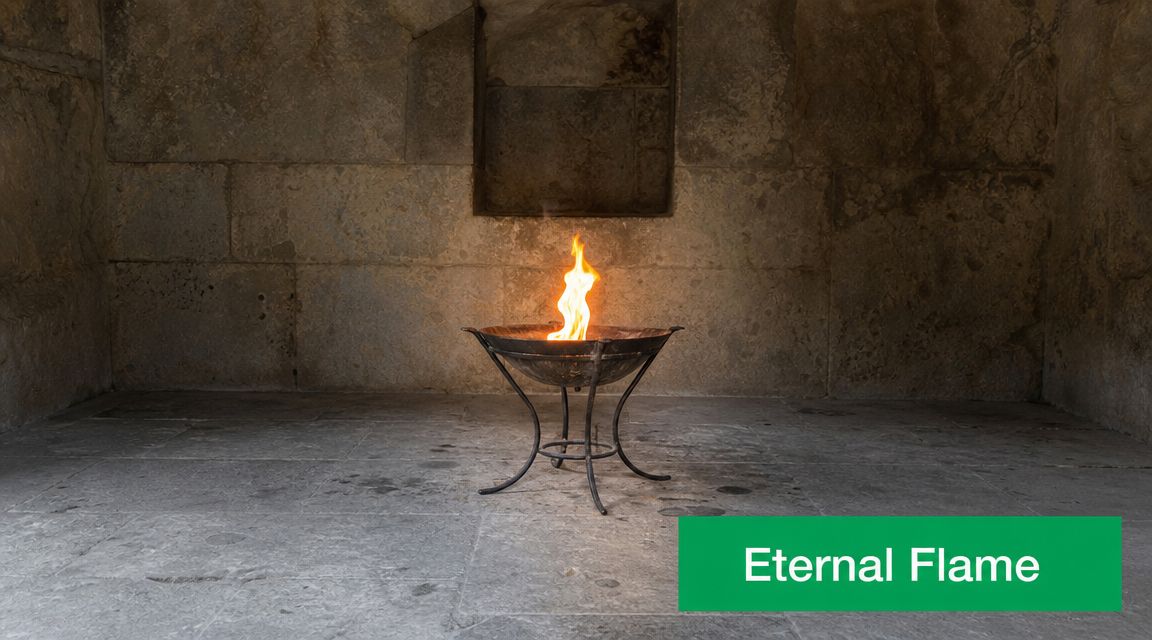
You are studying Irish on a dark evening, and one word stays with you after the lesson ends. Lasair. Flame. Brigid's sacred flame works that way in tradition too. It is less like a museum object and more like a living image that keeps meaning warm.
Fire as sacred presence
Brigid's flame is closely tied to Kildare and to the long memory of fire as both daily necessity and holy sign. In older tradition, a tended flame suggests continuity, care, and devotion. It also points to ordinary human needs. Fire gives heat, light, cooked food, and the conditions for skilled work.
That overlap helps explain why this symbol matters so much. Brigid is not linked to inspiration in an abstract way only. The flame represents the kind of inspiration that feeds life, shelters people, and supports making, healing, and learning.
A flame also changes whatever comes near it. Metal softens. Darkness recedes. Raw food becomes nourishing. That makes it a strong symbol for inner change as well. In stories and devotional memory, Brigid's fire often stands for the spark that turns effort into insight.
A helpful symbol for Irish learners
This image is especially useful if you are learning Irish because it gives you a small cluster of words that belong together. That is how memory often works best. One image holds several meanings at once.
Start with a few core terms:
lasair, flame
solas, light
teas, warmth
dóchas, hope
Then build very short sentences:
Tá an lasair geal. The flame is bright.
Tugann sí solas. It gives light.
Tugann sí teas dom. It gives me warmth.
Coinním an dóchas beo. I keep hope alive.
If metaphor feels difficult, begin with the physical sense first. Describe what fire does. Then move one step outward and describe what learning feels like. That progression is useful for conversation practice because it teaches concrete language before abstract language.
For example, a learner on Gaeilgeoir AI might practice seasonal vocabulary through Imbolc-focused Irish lessons and then answer a prompt such as: Cad a choinníonn do chuid Gaeilge beo? What keeps your Irish alive? You could answer with simple phrases about daily study, songs, prayer, community, or memory.
Why the flame still speaks to people
The sacred flame remains relevant because it expresses steady attention. Language learning needs that same quality. You do not master Irish in one burst. You tend it, return to it, and protect it from going cold.
A visual reminder can help. Even a modern object shaped by flame imagery, such as Astro West's curated mineral art, can keep that association in view. Shape teaches before explanation does. A rising form suggests energy, focus, and renewal.
Brigid's flame, then, is more than a religious or mythic symbol from the past. For an Irish learner, it becomes a practical model. Keep the light small if needed. Keep it steady.
3. The Triple Goddess Form (Tríocha na Bandia)
Not every Brigid symbol is an object. Some are patterns of identity. The triple form is one of the most important because it helps explain why Brigid appears in so many roles at once.
Three roles, one figure
In tradition, Brigid is often understood through a threefold nature. People commonly describe her as healer, poet, and smith or craftsperson. That combination tells you a lot about the kind of power she represents. She doesn't belong to only one domain. She joins care, imagination, and skill.
For learners, this is useful because it keeps Brigid from becoming a flat historical figure. She isn't just “the goddess of one thing.” She's a cultural figure who gathers several valued human activities into one presence. Healing tends the body and spirit. Poetry shapes language. Craft turns effort into something durable.
In some modern interpretations, people also connect this triple form to broader life stages or cycles of feminine power. Even when details vary, the central idea remains clear. Brigid often stands for wholeness through plurality.
A strong model for descriptive Irish
This symbol is perfect for practicing linked description in Irish. Learn three words together and use conjunctions naturally: leigheas for healing, filíocht for poetry, and a craft-related word set for making or skilled work. Then build sentences with agus.
Describe a person: “She is a healer and a poet.”
Describe yourself: “I like language and craft.”
Compare qualities: “Poetry is creative, healing is gentle, and smithcraft is strong.”
That kind of triad practice helps beginners move beyond naming isolated nouns. You start organizing ideas, which is what actual conversation requires.
If a symbol has three parts, use it to make three-part sentences. The structure of the tradition can support the structure of your language practice.
This is also a good symbol for mythology-themed discussion prompts. Ask simple questions in Irish or English first, then answer in Irish where you can: Which part of Brigid speaks to you most? Healing, poetry, or craft? The answer usually becomes more personal than a textbook exercise.
4. The Healing Wells (Toibreacha Leighis)
Brigid's world isn't only made of fire and woven rushes. It also includes water. That contrast is one reason her symbolism feels so complete.
Water, place, and pilgrimage
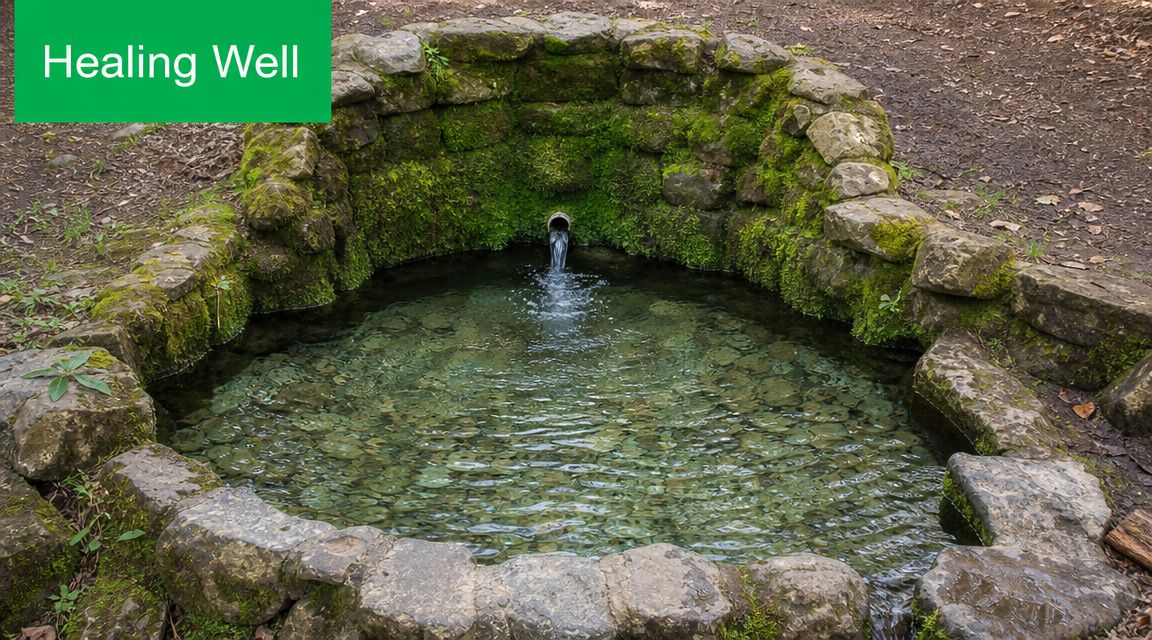
Healing wells associated with Brigid appear in Irish cultural memory as places of care, prayer, and connection to the land. Whether someone approaches them through folklore, devotion, local history, or pilgrimage, the key idea is the same. Water becomes a sign of restoration.
This is one of the goddess Brigid symbols that links belief directly to geography. A cross can be brought into the home. A well asks you to go somewhere. It places Brigid in the Irish land itself, not just in story.
That matters for language learners because place is central to Irish identity. Talking about a well quickly leads into talking about roads, counties, journeys, weather, and local tradition. A single symbol opens a whole practical vocabulary field.
Speaking about landscape in Irish
Words connected to this symbol can support real conversation. Learn tobar for well, leigheas for healing, taisteal for travel, and ionad for a site or place. Then use them in simple travel-style exchanges.
You might practice a scenario such as asking for directions to a holy well, describing the setting around it, or saying why someone wants to visit. These are realistic speaking tasks because they combine place, purpose, and feeling.
Direction language: Ask where a site is and how to get there.
Surroundings language: Describe stones, water, grass, roads, and quiet places.
Personal response: Say whether a place feels peaceful, important, or beautiful.
A good exercise is to describe a sacred place you already know, even if it isn't a Brigid well. Then swap in the new vocabulary. This keeps the language grounded in real memory instead of abstract study.
5. The Serpent and Renewal (An Nathair agus Athnuachan)
Some Brigid symbols feel gentle and domestic. The serpent feels older, wilder, and closer to the deep rhythms of nature.
A symbol of change
The serpent is often linked with renewal because it sheds its skin. That makes it a natural symbol for rebirth, healing, and transition. In Brigid-centered interpretation, those themes fit well with springtime and with the movement from darkness into light around Imbolc.
The serpent also carries a sense of ancient wisdom. It is more than a sign of danger. In this context, it suggests life returning, patterns repeating, and change arriving in visible form. That fits Brigid's role as a figure of transformation.
For a modern reader, this symbol can also work psychologically. Language learning often feels like shedding an old layer of self. You begin awkwardly, repeat basic forms, and slowly emerge into a new level of expression.
Seasonal vocabulary you can actually use
This symbol is useful because it supports discussion of cycles. Learn nathair for serpent, athnuachan for renewal, cruth for form, and words connected to seasons and natural change. Then put them into personal language rather than keeping them at the level of myth.
Growth in language is usually cyclical, not linear. You revisit old material and return to it with a new skin.
Try a speaking prompt such as, “What changes in spring?” or “How am I changing as a learner?” Those questions can be answered with simple structures and still feel meaningful. If dream or symbol interpretation interests you, cultural reflection can also branch into wider symbolic reading, including topics like interpreting snake dreams, though your Irish practice should stay grounded in clear everyday vocabulary.
This is also a strong symbol for journal work. Write a few lines about what you're leaving behind in your learning and what feels new. Then read those lines aloud in Irish as far as your level allows.
6. The Brigid Doll (Bab Bhríde)
A learner sits at a kitchen table, tying straw with awkward fingers and saying each step out loud in Irish. That small scene captures why the Bab Bhríde matters. It turns culture into something you can hold, name, and remember.
A living folk tradition
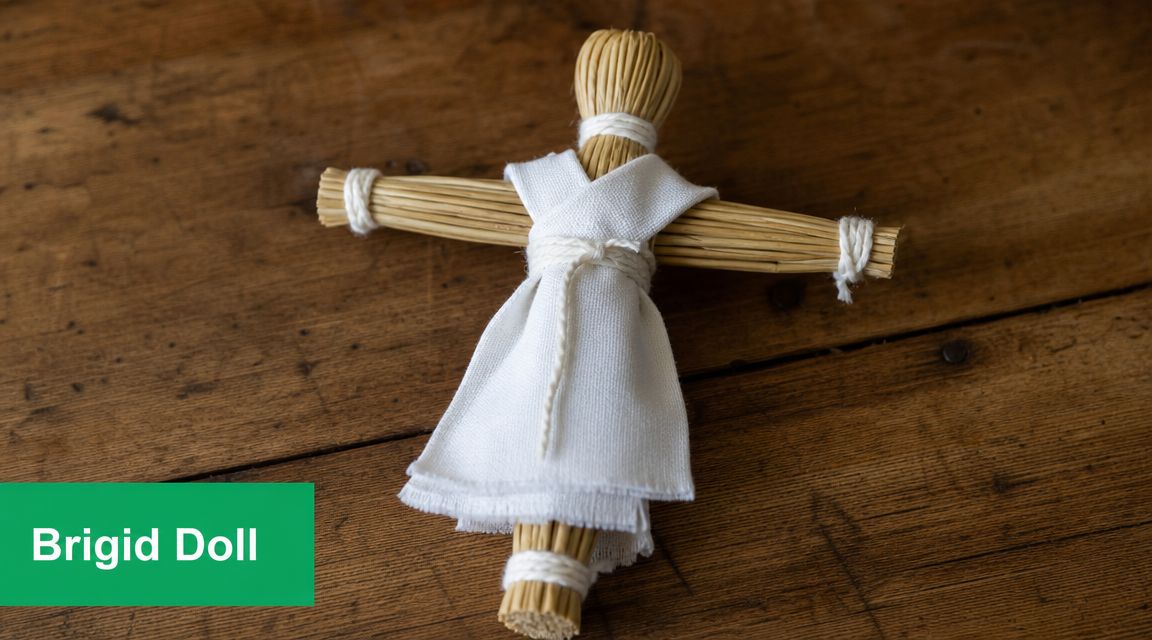
The Brigid doll, or Bab Bhríde, belongs to seasonal folk practice linked with Brigid and Imbolc. People have often made it from rushes, straw, or cloth, then placed it in the home as part of a local custom of welcome, blessing, and remembrance. That matters because this symbol is not only something seen in art or read about in myth. It lives in hands, homes, and repeated actions.
For language learners, that difference is useful. Abstract symbols can stay distant. A handmade object gives you concrete nouns, visible details, and actions you can describe in simple Irish. In other words, the doll works like a beginner-friendly lesson in cultural fluency.
It also teaches an important point about Irish tradition. Brigid is remembered not only through grand stories, but through ordinary domestic practices passed between generations.
Turn craft into speaking practice
The Bab Bhríde is especially helpful because it gives you verbs you can use right away. You can practice déan (make), ceangail (tie), cuir (put), glac (take), and éascaigh or simpler descriptive phrases for handling materials, depending on your level. You also get everyday nouns such as straw, cloth, thread, dress, hand, and table.
Try a short spoken routine while you make or examine the doll. Say what the object is made of. Say what color it is. Say where you place it. This kind of repetition helps the language stick because each word attaches to a physical action, much like labeling tools while learning a craft.
Materials vocabulary: Practice words for rushes, straw, cloth, thread, and dress.
Action verbs: Use simple commands and present-tense forms such as make, tie, hold, place, and cut.
Home and placement language: Describe where the doll rests, such as on a shelf, near a door, or on a table.
This symbol also opens conversation practice that goes beyond naming objects. Ask, “Who made this?” “What is it for?” or “What customs does my family have in spring?” Those questions connect heritage and speech. For learners using Gaeilgeoir AI or any structured Irish practice, that connection is powerful because language grows faster when words belong to a real cultural scene, not an isolated word list.
7. The Brigandine and Metalwork (Gréine agus Ceardaíochta)
Brigid isn't only associated with soft things like wells, mantles, and household blessings. She's also linked with the forge, skilled labor, and the transformation of raw material through heat and effort.
Brigid the maker
Her connection with smithcraft gives Brigid a practical strength that many learners find memorable. In this form, she stands for craft, technique, discipline, and the ability to shape something useful from something rough. That image broadens how people understand the feminine in Irish tradition. Brigid protects, but she also makes.
Metalwork symbolism fits her especially well because forging is both physical and symbolic. It requires patience, repetition, timing, and attention. Those same qualities matter in language learning.
A poem, a tool, and a sentence all have something in common. Someone shaped them.
Why this matters for learners
This symbol opens excellent vocabulary for work and skill. Learn words connected to craftsperson, forge, metal, tools, and making. Then use them metaphorically to talk about your own progress. A beginner doesn't need advanced grammar to say, “I am building my Irish,” or “Practice makes my speech stronger.”
Skill language: Speak about learning as a craft rather than a test.
Work verbs: Make, build, shape, practice, and improve.
Personal reflection: Describe what part of Irish still feels raw and what has become more polished.
This is also a helpful way to talk about mistakes. In a forge, rough material isn't failure. It's the starting point. That mindset can calm learners who expect perfect speech too early.
Treat pronunciation like metalwork. Heat it with repetition, shape it with feedback, and return to it often.
Among goddess Brigid symbols, this may be the one that speaks most directly to steady effort. It reminds you that fluency isn't magic. It's made.
8. The Brigid's Mantle and Protection (Brat Bhríde)
If the forge shows Brigid's strength, the mantle shows her care. This is one of the warmest and most intimate symbols connected with her.
Care, shelter, and blessing
Brigid's mantle, or Brat Bhríde, represents protection, covering, and blessing. In tradition, being under Brigid's mantle suggests being sheltered from harm and held within a space of care. It's a symbol centered on relationships. It speaks to family, home, safety, and community.
That makes it especially resonant in Irish cultural memory, where household spirituality and spoken blessing often remain important. The mantle isn't dramatic in the way a flame is dramatic. Its force is quieter. It protects by enclosing.
For many learners reconnecting with heritage, this symbol lands strongly because it feels close to ordinary life. It belongs around children, elders, kitchens, thresholds, and daily routines.
Useful Irish for home and community
This symbol supports some of the most useful beginner vocabulary in the language. Learn brat for mantle or cloak, dídean for protection or shelter, baile for home, and pobal for community. Those words lead naturally into real conversation.
You can practice speaking about who lives in your home, what makes a place safe, and how a community cares for its members. Those are practical topics for everyday Irish, not only cultural study.
A simple speaking exercise works well here. Describe your home in a few sentences, then add one sentence about protection, welcome, or comfort. If you know any Irish blessings, this is also a natural place to learn and repeat them aloud.
Among all goddess Brigid symbols, the mantle may be the easiest to translate into daily speech. Discussions of home and family are frequent. Brigid gives those topics a deeper cultural frame.
Brigids Symbols: 8-Item Comparison
Item
🔄 Implementation Complexity
⚡ Resource Requirements
📊 Expected Outcomes
⭐ Key Advantages
💡 Quick Tips
The Brigid's Cross (Croíoch Bhríde)
Low–Medium, simple weaving pattern; practice needed
Low, rushes/straw and basic tools
Tangible craft + seasonal vocabulary for conversations
Highly recognizable cultural icon; hands-on learning
Learn "croíoch", "dídean"; describe construction in present tense
The Sacred Flame (An Lasair Dhílis)
Low, conceptual study of history and symbolism
Low, texts, images, occasional site visits (Kildare)
Deep literary/spiritual vocabulary and metaphor use
Highly interactive; multisensory and culturally immersive
Practice imperative verbs while making a doll; follow Irish instructions
The Brigandine and Metalwork (Gréine agus Ceardaíochta)
Medium–High, technical craft terms and metaphorical use
Medium, texts, museum examples, tool vocabulary
Skill-building metaphors; craft and tool vocabulary
Strong metaphor for mastery; connects to Irish craft heritage
Learn "gréine", "ceardaí", "iarainn"; use craft metaphors to explain learning
The Brigid's Mantle and Protection (Brat Bhríde)
Low, straightforward metaphorical concept
Low, prayers, examples, short texts
Core family/home vocabulary and blessing phrases
Emotionally resonant and accessible for beginners
Learn "brat", "dídean"; practice home and family dialogues
From Symbols to Speech Deepen Your Irish Connection
Understanding goddess Brigid symbols isn't only about collecting bits of folklore. It's about learning how Irish culture stores meaning. A woven cross over a door, a remembered flame, a healing well, a handmade doll, a mantle of protection. Each one carries vocabulary, but each one also carries a worldview. When you learn both together, the language starts to feel more alive.
That's especially important if you're returning to Irish after years away, or starting from scratch with family history somewhere in the background. Many learners don't struggle because they lack motivation. They struggle because vocabulary can feel detached from real life. Brigid's symbols solve part of that problem. They root words in image, place, craft, ritual, and memory.
The cross teaches household language and seasonal custom. The flame gives you a way to talk about inspiration and perseverance. The triple form helps you describe layered identity. The wells lead into travel, environments, and place-based speech. The serpent opens the door to renewal and the language of change. The doll turns making into verbal practice. Metalwork reframes learning as craft. The mantle brings you back to family, safety, and community.
That kind of cultural fluency matters. It helps you understand why certain words matter, not just what they translate to. It also helps you sound more natural in conversation because you're responding to Irish culture as people live and remember it. Even at beginner level, that makes a difference.
You don't need to master every symbol at once. Pick one that stays with you. Learn a handful of related Irish words. Describe the image aloud. Use it in a short conversation. Write two or three sentences about it. Repeat that process and you'll build language through connection rather than memorization alone.
If you want structured practice, a platform like Gaeilgeoir AI can help turn these ideas into actual speaking habits. The goal isn't only to recognize Brigid in art or tradition. It's to speak about her, and about Irish culture more broadly, with growing confidence and clarity. To continue that work through guided conversation practice, explore Gaeilgeoir AI.
If you want to turn cultural knowledge into actual speaking practice, Gaeilgeoir AI offers guided, real-world Irish conversation work for beginners and returning learners. It's a practical next step if Brigid's symbols have sparked your interest and you want to build everyday vocabulary, pronunciation, and confidence through regular use.
If you searched for slan leath, you almost certainly mean slán leat. It means goodbye, or more precisely, “safety with you.”
That confusion is extremely common. You type what you think you heard, then search results give you song titles, lyric pages, or scattered translations that don't quite explain what the phrase is. If you're learning Irish for the first time, that's frustrating.
The good news is that this is an easy fix. Once you know the correct spelling and the basic pattern behind it, slán leat becomes one of the most useful beginner phrases in Irish.
You type slan leath into a search bar because that is what it sounded like when you heard it. That is a very normal beginner mistake. The correct phrase is slán leat.
Two details make the difference. Slán needs a fada over the a, and the second word is leat, not leath. Those spellings are close enough to confuse a new learner, but they are different words.
Practical rule: If you want the Irish farewell, write slán leat.
Search results often make this harder than it should be. A beginner may find song titles, lyric pages, or casual spellings before finding a clear language explanation. That is why many learners end up with the right sound in mind but the wrong form on the page. A simple correction helps: slan leath is a misspelling, and slán leat is the phrase you want.
What Slán Leat means
At the simplest level, slán leat means goodbye.
It also carries a warmer idea underneath that translation. The word slán is tied to safety, health, and well-being, so the phrase has the feeling of wishing someone well as they go. Irish often does this. Instead of using a plain label for parting, it wraps a small good wish into the farewell.
A beginner-friendly breakdown looks like this:
Slán = safe, well, goodbye
Leat = with you
Slán leat = goodbye, with the sense of wishing the other person well
That is a useful way to remember it. English speakers often look for a one-word match, but slán leat works more like a kind farewell with a built-in blessing. Once you see that, the phrase becomes easier to remember and easier to use with confidence.
Why Irish Has More Than One Way To Say Goodbye
You are at the door after a visit. Your friend picks up their coat, you stay inside, and both of you want to say goodbye in Irish. Beginners often pause here, because Irish pays attention to direction in a way English usually does not.
With slán leat, the goodbye is aimed at the person who is going. With slán agat, the speaker is the one heading off. So Irish is not using two random versions of the same phrase. It is marking who is leaving and who is staying.
That can feel odd at first. English uses “goodbye” the same way on both sides of the exchange, so learners often expect slán leat to work in every case.
A doorways rule helps:
Situation
Phrase
You stay, they go
Slán leat
You go, they stay
Slán agat
Here is the pattern in real life.
Your neighbour is leaving your house. You are still standing in the hall. You say, Slán leat. If you are the one walking away instead, you say, Slán agat.
Irish often does this. It builds the situation into the phrase itself. That is one reason learners meet more than one way to say goodbye.
If you only keep one line in your head for now, keep this one: say slán leat to the person who is heading off.
How To Use Slán Leat In Real Life
A beginner usually meets slán leat at the exact moment they need to say something quickly. Someone is putting on their coat, ending a call, or stepping out of the room, and you want a simple Irish goodbye that fits the situation. That is the job of slán leat.
It also helps to clear up the common spelling mistake here. If you have seen slan leath, that is not the standard phrase. The form you want is slán leat. The fada on slán matters, and leat is the word that belongs in the phrase.
Everyday situations
The easiest way to learn it is to attach it to small, ordinary moments:
At the door Your cousin is leaving after tea. You stay where you are. You say, Slán leat.
After class A classmate heads out first while you are still packing your bag. You say, Slán leat.
On the phone or on a video call The other person is the one signing off first. A friendly Slán leat sounds natural.
Leaving a shop or office conversation Someone turns to go, and you are staying behind. Slán leat works well as a polite, brief farewell.
This phrase is useful because it is short, clear, and easy to repeat. Beginners do well with phrases like that. You can use them early, then build around them later.
A quick way to test yourself
Use one question: Who is going?
If the other person is going, slán leat fits.
That question works like a small checkpoint in your head. It keeps you from guessing, and it helps the phrase feel tied to a real situation instead of a vocabulary list.
A few related farewell phrases
You will also hear other goodbye phrases built around slán. They are related, but they are not interchangeable.
Phrase
Plain meaning
When it fits
Slán
Goodbye
General farewell
Slán leat
Goodbye
The other person is leaving
Slán agat
Goodbye
You are leaving
Slán abhaile
Safe home
Someone is heading home
Slán go fóill
Goodbye for now
You expect to see them again
Treat these like tools in a small toolkit. You do not need every tool on day one. Start with slán leat, use it in real conversations, and add the others one at a time.
How To Pronounce Slán Leat Without Overthinking It
Focus on clarity first
Pronunciation worries stop a lot of adults from speaking. Don't let that happen here.
Your first goal isn't to sound perfect. Your first goal is to say the phrase clearly enough that you can recognize it, repeat it, and use it without freezing. Because slán leat is short and common, teachers often introduce it early as a foundation phrase for beginners, alongside related forms like slán agat, slán leibh, and slán abhaile, as shown in this Irish lesson video on basic farewells.
A practical approach works best:
Listen first to a native or fluent speaker.
Repeat the whole phrase, not just isolated sounds.
Use it in context, such as pretending someone is leaving the room.
Common pronunciation worries
Beginners often get snagged on three things:
The fada in slán The fada changes the vowel sound. Don't skip it in writing, even if your keyboard makes it awkward at first.
Blending the two words Say the phrase as one unit. That helps it sound more natural.
Fear of getting it wrong Irish speakers are used to learners building confidence one phrase at a time.
Say it often enough that it becomes a reflex, not a test.
If you can say it politely and at the right moment, you're already using real Irish.
The Mistakes Beginners Usually Make
Spelling mistakes
The most common written mistake is exactly the one that brought you here: Slan Leath.
That version usually comes from hearing the phrase before seeing it written down. Irish spelling can look unfamiliar at first, especially if you're returning to the language after school or learning through songs.
Watch for these:
Missing the fada Writing slan instead of slán is common, but the proper spelling includes the accent.
Writing leath instead of leat These are different words. For the farewell, you want leat.
Capitalizing randomly In mid-sentence English, write it naturally as slán leat unless it begins a sentence or appears in a title.
Usage mistakes
The next mistake is using the right phrase in the wrong direction.
If you say slán leat when you're the one leaving, a learner or teacher may notice. It's not a disaster, but it does miss the pattern that makes the expression interesting and useful.
A good beginner habit is to tie the phrase to a visual cue:
They walk away from you. Say slán leat.
You walk away from them. Use slán agat.
That tiny distinction gives you a better feel for Irish than memorizing a flat translation ever could.
A Short Practice Routine That Helps It Stick
A short phrase sticks best when you meet it in the same small pattern again and again. That is especially helpful here, because many beginners arrive with the misspelling slan leath in their head and need the correct form, slán leat, to start feeling familiar.
Try a five-minute routine for a few days in a row:
Write slán leat three times by hand.
Pause and check the two parts: slán with the fada, leat without the extra h.
Say it out loud as if someone is leaving the room.
Add one nearby phrase, such as slán abhaile.
Finish with a tiny two-line exchange.
For example:
A: I'm off now. B: Slán leat.
Then try a second one:
A: I'm heading home. B: Slán abhaile.
This gives your memory more than a single label. It gives it a little scene. Language often sticks that way, much like remembering where you put your keys by recalling the whole moment, not just the object.
If speaking is the hard part, keep the practice very small. Say the phrase while closing a notebook, ending a call, or standing up from your desk. The goal is not perfection. The goal is to make slán leat feel like something you can reach for without hesitation.
You can also use simple supports:
beginner phrase lists that group farewells together
repeat-after-me videos with clear pronunciation
tiny role-plays based on everyday moments
Short, regular practice beats cramming. A few calm repetitions will do more for your Irish than trying to memorize a long list in one sitting.
Final Takeaway
If you searched for Slan Leath, the phrase you want is slán leat.
It means goodbye, with the deeper sense of wishing safety or well-being to the person who is leaving. That's why it's such a good beginner phrase. It's short, practical, and it teaches you something real about how Irish works.
Most of all, don't let a misspelling make you think you're far off. You were very close. You just needed the correct form, the right context, and a little confidence to start using it.
You're probably staring at a sea of green right now. Maybe it's for a St. Patrick's Day party, a heritage festival, a themed work event, or a pub night where you want to join the fun without looking like you grabbed the first plastic hat at the checkout.
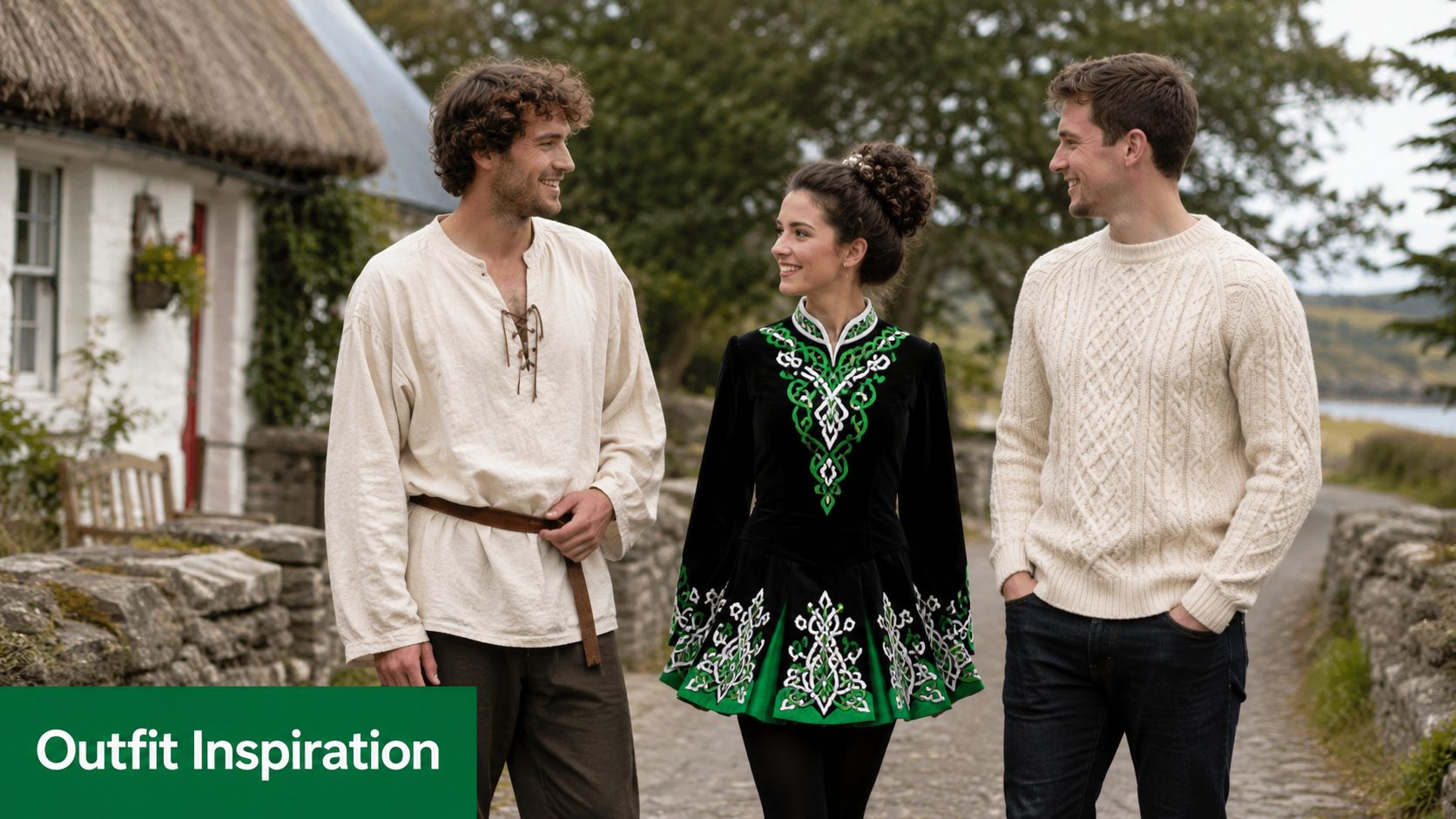
That's a good instinct. The best Irish costumes for adults can be playful and social while still showing some care for the culture behind them. Ireland has a rich clothing history, and it's far more interesting than shamrock sunglasses and a fake orange beard.
A thoughtful outfit doesn't need to be stiff or museum-like. It just needs to match the moment. Some adults want a historically inspired look. Others want something festive but polished. Others want an easy DIY outfit that feels Irish in spirit without pretending to be ancient. All of those can work.
Choosing Your Irish Costume Beyond the Leprechaun Hat
Many individuals start in the same place. They search for Irish costumes for adults and get hit with novelty hats, bright green suits, shamrock suspenders, and outfits that treat Irish culture like one long joke. Some of that can be harmless party fun, but it often leaves adults wondering what genuinely feels right.
A better approach is to ask one question first. What kind of event are you dressing for? A pub crawl, a céilí, a heritage gathering, and an office celebration all call for different choices. The outfit that gets a laugh at a casual party may feel out of place at a cultural event.
Here's a simple way to choose:
Name the setting. Is it playful, formal, outdoors, family-friendly, or heritage-focused?
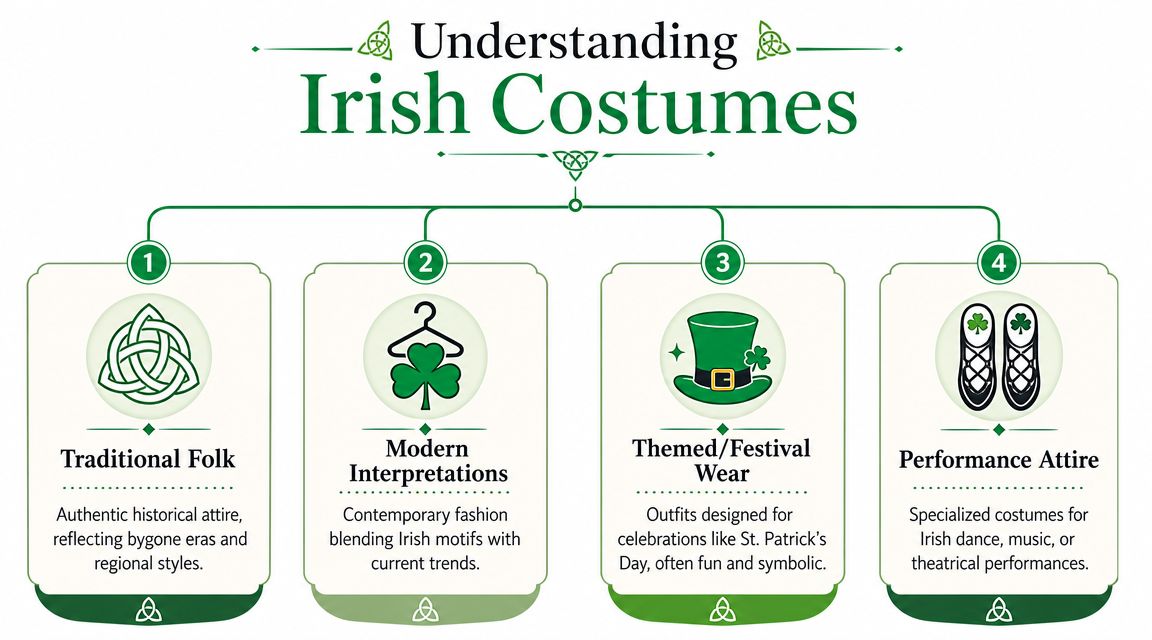
Pick your lane. Historical, dance-inspired, festive modern, or DIY interpretation.
Decide your comfort level. Do you want a full costume, or just a themed outfit with subtle Irish touches?
Check the tone. If a piece feels cartoonish, ask whether it celebrates the culture or reduces it to a stereotype.
Practical rule: If you'd feel awkward explaining why an item represents Ireland, skip it.
A lot of confusion comes from mixing mythology, festival wear, and history into one bundle. Irish culture includes folklore, music, dance, language, regional identity, and older Gaelic dress traditions. Those aren't all the same thing. If you enjoy the symbolic side of Irish culture, a good next read is this guide to Celtic deities and mythology, which helps separate folklore from historical clothing.
You don't need to get every detail perfect. You just want to avoid the lazy version. A flat cap, tweed jacket, wool shawl, linen tunic, Celtic jewelry, or a well-chosen green dress can all say “Irish” more effectively than a bargain-bin leprechaun kit.
The Four Main Types of Irish Adult Costumes
Some people say “Irish costume” and mean medieval Gaelic clothing. Others mean Irish dancewear. Others mean party gear for March celebrations. That's why shopping can feel confusing. These are four different categories, and each one serves a different purpose.
Historical reconstructions
This is the closest category to heritage clothing. It draws on garments associated with Gaelic dress, especially layered pieces and natural fabrics. If you want something grounded in history, this is the strongest path.
These outfits usually look less flashy than party costumes. That's a good sign. Historical dress was practical, wearable, and tied to climate and daily life.
Traditional dance costumes
Dancewear often gets mistaken for “old Irish dress,” but it belongs in its own category. It's a performance tradition with its own visual rules, stage needs, and changing standards.
The distinction matters. In the Irish dance world, women's costumes shifted away from earlier shared male-female styles, and by 2015 the regulating commission banned cartoon characters, feathers, and other “less traditional” designs to maintain a heritage standard, as noted in this Irish costume overview. That tells you something important. Even performance costumes aren't random. They're curated and debated.
Performance attire isn't the same as historical clothing. It's a cultural form with its own logic.
Novelty and party costumes
This is the most common search result. Leprechaun suits, oversized hats, green tuxedos, and joke accessories live here. These can work for a relaxed party if you keep the tone friendly and don't treat Irish identity itself as the punchline.
If you choose novelty, try upgrading it. Swap plastic pieces for better fabrics, tone down the caricature, and add one or two details with more character. A tweed cap or harp pin often goes further than ten shamrock stickers.
DIY and inspired outfits
This is my favorite category for many adults because it's flexible. You're not claiming strict historical accuracy, and you're not trapped in novelty either. You're building an outfit inspired by Irish textiles, colors, motifs, and atmosphere.
A modern inspired look might include:
A linen shirt or dress: It nods to older natural-fiber traditions.
A wool layer: Think shawl, cloak-style wrap, or structured coat.
Celtic details: Knotwork jewelry, a brooch, or subtle embroidery.
Grounded color choices: Greens, creams, browns, greys, and saffron-inspired tones often feel richer than neon green.
If you've ever felt that search results jump from “museum” to “mascot,” this fourth category is the bridge. It gives you room to be creative without becoming careless.
Dressing with Respect The History Behind the Threads
When people ask what an authentic Irish adult costume looks like, the honest answer is that there wasn't one single national outfit worn by everyone. Irish dress varied by time, place, and purpose. That's the first myth to let go of.
Another useful correction is this. What many people now imagine as “traditional Irish dress” was not a frozen costume preserved unchanged through the centuries. One reconstruction source notes that these styles were largely abandoned by the 17th century in favor of English dress, and that the modern historical model is built from recurring garments such as the léine, brat, ionar, and trews, explained in this reconstruction of traditional Irish dress.
The core garments to know
If you want your outfit to feel rooted rather than random, start with two key terms.
Garment
What it is
Why it matters
Léine
A linen tunic reaching mid-thigh to knee-length
It formed the base layer and shows that Irish dress was practical, not costume-store fantasy
Brat
A wool cloak about 2 by 3 meters
It added warmth, protection, and a strong outer silhouette
Those details matter because they shift the picture. Historical Irish clothing was layered, useful, and climate-aware. It wasn't built around glitter, synthetic shine, or a single symbolic accessory.
Why clothing carried identity
Clothing in Ireland also had political meaning. The 1367 Statutes of Kilkenny prohibited English settlers in Ireland from adopting Irish dress, which shows that clothing was already a visible marker of identity by the 14th century. Dress could signal Gaelic heritage, and items such as the saffron-dyed léine and woolen brat carried cultural weight.
That's one reason respectful costuming matters. You're not just choosing a look. You're stepping into a tradition where clothing could communicate belonging, resistance, and local identity.
Historical note: In Ireland, dress wasn't only about fashion. It could mark who you were and where you stood.
If you're exploring family background alongside clothing history, this guide to Irish clans and heritage can add another layer of context.
The Irish kilt myth
This is the misconception I correct most often. The commonly imagined Irish kilt has no pre-1900 Irish tradition and was not worn in Ireland before 1900, according to the same reconstruction source linked above. That doesn't mean no one can wear an Irish kilt now. It means you shouldn't present it as ancient Gaelic everyday dress.
That single myth shapes a lot of shopping mistakes. Adults often buy a tartan kilt because it looks “Celtic” and assume they've chosen the most authentic option. In fact, a simple léine and brat style outfit is usually a stronger historical choice.
What respect looks like in practice
Respect doesn't mean you need archival perfection. It means you make intentional choices.
Choose garments with a reason: Linen, wool, cloaks, tunics, brooches, and layered shapes all have a stronger historical basis.
Avoid invented “ancient” claims: If a seller markets every green tartan item as old Irish tradition, be cautious.
Treat heritage as lived culture: Irish clothing history is more interesting when you see it as real dress worn by real adults.
That mindset makes your costume better looking, too. It tends to produce outfits with texture, balance, and personality instead of a grab bag of symbols.
How to Source or Create Your Irish Costume
Once you know what kind of look you want, the next challenge is practical. Where do you find Irish costumes for adults that fit well, suit the event, and don't feel flimsy?
That's where many shoppers get frustrated. Retail pages often group Ireland-themed items together without helping you think about fit, weather, or formality. One of the biggest market gaps is practical planning for diverse adults, especially for plus-size fits, formal parties, or colder outdoor events. Many retail collections lean toward one-size novelty gimmicks instead, as seen in this Ireland costume retail category.
If you're buying
Start by filtering sellers, not just products. Party superstores are useful for accessories, but if you want a more grounded look, also check historical reenactment makers, independent artisans, costume rental shops, and handmade marketplaces.
Use this checklist before you buy:
Check the silhouette: Does it look like clothing an adult could wear, or only a joke outfit?
Read the fabric description: Linen, wool blends, cotton, tweed, and heavier weaves usually look better than shiny synthetics.
Look at closure and layering: Cloaks, wraps, belts, tunics, and brooch-style fastening often create a more believable shape.
Think about the event: A pub celebration can handle whimsy. A heritage event usually calls for restraint.
If you're unsure how a costume shape might sit on your body, tools that digitally try on costumes can help you preview proportion before you spend money or start sewing.
Buy for the room, not just the product photo.
If you're making your own
DIY works especially well for Irish-inspired outfits because the look depends so much on texture and layering. You don't need advanced sewing to make something effective.
A simple beginner route looks like this:
Start with a base piece. A loose linen tunic, long shirt, plain dress, or neutral skirt and blouse.
Add one outer layer. A wool wrap, cloak-style rectangle, shawl, or structured vest.
Choose one fastener or accessory. Brooch, leather belt, Celtic pendant, or knotwork trim.
Ground the colors. Cream, brown, moss green, charcoal, soft gold, or rust often work better than loud holiday green.
Fit, comfort, and weather matter more than people think
A respectful outfit should still be wearable. Adults often need to move, sit, dance, commute, or stand outside for hours. That changes what “good costume” means.
A few practical fixes help a lot:
Situation
Smart adaptation
Plus-size fit
Choose wrap layers, belted shapes, and draped garments instead of stiff one-piece costumes
Formal gathering
Use a tailored dress, blazer, shawl, or cloak-inspired outer layer with subtle Irish accessories
Cold outdoor event
Build upward with thermal base layers, wool textures, boots, and a cloak or heavy wrap
Budget limit
Invest in one strong anchor piece, then style around basics you already own
That's often the difference between a costume you wear once and an outfit you'll gladly use again.
Three Irish Costume Ideas from Historical to Modern
Sometimes it's easier to build a costume from a complete picture than from abstract advice. These three looks cover different moods, from heritage-inspired to party-ready.
The Gaelic poet or warrior
This look works for heritage events, Renaissance-style gatherings, and adults who want a historical silhouette without trying to reproduce every last detail. The mood is simple, layered, and strong.
Try building it with:
A long linen tunic: Off-white, cream, or soft saffron-toned if available
A wool cloak or wrap: Dark green, brown, grey, or natural wool
A belt or cord: To shape the tunic
Simple boots or leather shoes: Keep them plain
A brooch or pin: One statement fastening is enough
This outfit works because it doesn't over-decorate. It lets the fabric and shape do the talking.
The modern Celtic creative
This one suits adults who want something stylish enough for a dinner, arts event, or polished party. It isn't presented as ancient dress. It's a modern outfit that borrows Irish textures and symbols thoughtfully.
A version of it might include an Aran-style sweater, well-fitted trousers or a midi skirt, a plaid or wool shawl, and one piece of Celtic jewelry. The palette matters here. Go for earthy greens, oat, charcoal, navy, or berry tones.
To see how movement and styling can shape an Irish-inspired look, this video adds some visual context:
A simple checklist:
Knitwear: Aran-style or cable-knit piece
Structured base: Trousers, skirt, or dress in a muted color
Layer: Shawl, capelet, or structured coat
Jewelry: Celtic knot earrings, brooch, or pendant
Finish: Clean boots or loafers instead of novelty footwear
Style tip: If the outfit could pass as real clothing first and costume second, you're often in a good place.
The festive reveler
This is for the adult who wants fun without looking like a cartoon. It works well for pub events, casual parties, and group celebrations.
Instead of a full novelty suit, build a sharper version:
A green or tweed jacket, blazer, or waistcoat
Dark jeans or trousers
A flat cap instead of a foam top hat
A shamrock, harp, or knotwork pin
One playful accent: Green socks, a themed tie, or festive scarf
This look is forgiving, easy to assemble, and much more wearable than a one-piece party costume. It also photographs better because the textures look intentional.
The common thread across all three ideas is balance. You don't need to reject fun. You just want the fun to sit on top of some real thought.
Speak the Part Easy Irish Phrases for Your Costume
A costume gets warmer and more memorable when you pair it with a few words of Irish. You don't need a full conversation. Even one greeting or toast can show genuine interest in the culture.
The biggest mistake beginners make is worrying too much about perfection. Irish pronunciation takes practice, but simple phrases are still worth trying. If you say them with respect and a bit of care, people usually appreciate the effort.
A few small usage notes help. Dia duit is a greeting, not a toast. Sláinte is widely recognized, and it's perfect for celebrations. Go raibh maith agat is especially nice if you're attending a heritage event and want to be gracious.
You don't need to sprinkle Irish into every sentence. One well-timed phrase can do more than a whole costume full of clichés.
If you enjoyed adding a bit of language to your outfit, Gaeilgeoir AI is a great next step. It helps you start speaking Irish through guided, real-world practice, so your connection to Irish culture can go beyond the costume and into everyday conversation.
Daideo is the Irish word for grandfather, often used in a warm, family-centered way. It's pronounced approximately “daj-oh”, and once you know that, the word starts to feel much more approachable.
Maybe you saw daideo in a children's book, heard it in a family conversation, or typed it into a search engine and got a confusing mix of company listings, products, and unrelated pages. That happens a lot with Irish words. A simple family term can end up buried under results that don't help a learner at all.
That's a pity, because Daideo is exactly the kind of word that opens a door into real Irish. It isn't just vocabulary for a flashcard. It's a word tied to memory, family stories, heritage, and everyday affection. If you're reconnecting with Irish, learning it for the first time, or helping a child understand family words, this is one of those terms worth learning properly.
You often meet a new Irish word in a very ordinary moment. A relative says it. A song lyric catches your ear. A school memory returns years later. Then you want more than a one-word translation. You want to know how to say it, when to use it, and what kind of feeling it carries.
Daideo is one of those words. In Irish, it means grandfather. A learner-focused explanation matters here because many search results for this term don't help with the language itself. One credible discussion of the search environment notes that results can skew toward company names, business listings, or retail products instead of explaining the Irish word and how people use it in daily life, which leaves a clear gap for learners looking for meaning and usage guidance through a company listing context that highlights that search mismatch.
That gap can make Irish feel harder than it is. It isn't that the word is complicated. It's that the learner often isn't being met at the right starting point.
Practical rule: When you learn a family word in Irish, learn three things together. Meaning, sound, and one sentence you can actually say.
That approach works especially well with kinship words because they live in real conversation. You don't learn Daideo to passively recognize it once. You learn it so you can say “my grandfather,” introduce someone in a family photo, or understand a story someone tells about home.
The Meaning and Pronunciation of Daideo
Why this word confuses learners
At the simplest level, Daideo means grandfather in Irish. A credible Irish language reference also gives the pronunciation as approximately “daj-oh”, with the stress on the first syllable and a long sound at the end, which helps learners avoid the usual spelling-based guesses in English, as noted in this Irish pronunciation entry for daideo.
Irish spelling can feel unfamiliar at first because you can't always map the letters directly onto English sounds. That's why many beginners hesitate. They see daideo and try to force an English reading onto it.
A better approach is to treat it as a sound pattern, not a spelling puzzle.
Say it aloud before you try to memorize it. Irish often settles into place through the ear faster than through the eye.
If you're curious about formal notation, some learners also like to check IPA when studying pronunciation. That can be useful, but don't let it slow you down. For most beginners, the plain-English sound cue is enough to get started.
The important thing is to say Daideo warmly and naturally, not stiffly. Family words sound best when they feel lived in.
Using Daideo in Everyday Sentences
A word becomes real when you can use it in a sentence. With Daideo, the most useful everyday pattern is talking about your grandfather.
The most useful form to learn first
In Irish, “my” is mo. When mo comes before many nouns, the next sound changes. With Daideo, that gives you mo dhaideo.
This change is called lenition. You don't need to master the full grammar today. You only need to notice the before-and-after pattern:
English
Basic noun
With “my”
grandfather
Daideo
mo dhaideo
That small spelling change matters because it reflects how Irish words behave together in real speech. If you learn mo dhaideo as one useful chunk, you'll sound more natural right away.
For a broader feel for how Irish builds meaning through word order and small grammatical changes, this Irish sentence structure guide is a helpful next step.
Common learner mistake: keeping the noun unchanged and saying mo daideo. You'll often want mo dhaideo instead.
Simple examples you can start using
Here are a few friendly, practical examples:
Seo é mo dhaideo. This is my grandfather.
Tá mo dhaideo sa bhaile. My grandfather is at home.
Is fear cineálta é mo dhaideo. My grandfather is a kind man.
Bhí mé le mo dhaideo inné. I was with my grandfather yesterday.
Is breá liom mo dhaideo. I love my grandfather.
Notice how often Irish learning comes down to reusable chunks. You don't need a huge vocabulary to say meaningful things. One family word plus a few common structures can already carry a lot of feeling.
Try these short practice tasks:
Introduce a family photo Say: Seo é mo dhaideo.
Describe him in one word Try: Tá mo dhaideo greannmhar. My grandfather is funny.
Add a memory Try: Bhí mé le mo dhaideo aréir. I was with my grandfather last night.
If you're teaching a child, keep it playful. Point to a picture and repeat the phrase together. If you're learning for yourself, say each sentence three times aloud. The rhythm matters as much as the translation.
Daideo vs Seanathair and Regional Terms
Not every Irish speaker uses the same family word in the same way. That's part of the beauty of the language. Daideo is one option, but not the only one.
A quick comparison
The most common comparison learners meet is Daideo versus Seanathair.
Term
Usual feel
Rough English equivalent
Daideo
warm, familiar, affectionate
grandad, grandpa
Seanathair
more formal, traditional, dictionary-like
grandfather
This isn't a strict rule for every family. Some households prefer one term because that's what they've always said. Still, for many learners, Daideo feels more intimate and immediately usable in family speech, while Seanathair can sound more formal.
What about regional variation
Irish is a living language with strong regional identities. Families in different parts of Ireland may prefer different expressions, pronunciations, or affectionate forms. That doesn't mean one version is “the only correct one” and the others are wrong. It means language belongs to people and place.
Start with one usable word. Daideo is a strong choice.
Notice alternatives when they appear. Don't panic if you hear something else.
Respect family habit. Homes often keep their own preferred term.
The best word for grandfather in conversation is often the word your family actually says.
That gives you permission to learn with warmth instead of anxiety. Irish isn't asking you to choose one perfect form forever. It's inviting you into real usage.
The Cultural Significance of a Daideo
More than a dictionary meaning
Some words carry family structure. Others carry family feeling. Daideo does both.
In many Irish-speaking and Irish-rooted families, a grandfather isn't only an older male relative. He may be the person who tells the same story at the fire, remembers older place-names, passes on songs, or uses turns of phrase that younger people hear nowhere else. Even when family life looks modern and busy, the idea of the grandfather as a link to continuity remains powerful.
That's why words like Daideo matter. They hold affection inside them. They can feel less distant than a plain formal label.
Why family words stay with us
Family vocabulary is often among the last language people forget and the first language they want back. Someone may know very little Irish, yet still remember a grandparent term, a blessing, or a pet name from childhood. These are often the words that survive in emigrant families too. They stay because they're attached to voice, not just meaning.
Think of how people speak when they remember a grandparent. They rarely begin with grammar. They begin with texture. The chair by the window. The walk to school. The stories repeated so many times they became part of the house itself.
A heritage word becomes powerful when it names a relationship you can still feel.
That's one reason learners reconnect so strongly through kinship terms. Daideo can be a vocabulary item, yes. It can also be an entry point into personal history. When you say it, you're not only practicing Irish. You're naming a role that often carries wisdom, humour, steadiness, and memory.
Practice and Master Daideo with Gaeilgeoir AI
Learning sticks when you use the word in ways that matter to you. Daideo is perfect for that because it's personal, concrete, and easy to place in everyday speech.
Three easy ways to practise
Try a short routine like this:
Write one true sentence. Use a real memory or description, even if it's simple. Bhí mo dhaideo greannmhar. A real sentence is easier to remember than a random one.
Say it while looking at a photo. That keeps the word attached to a person, not just a notebook. Speak slowly and aim for a relaxed rhythm.
Build a tiny family set. Once Daideo feels comfortable, add other family words around it. That helps your brain store vocabulary by relationship, which is how people often use it in conversation.
If you're helping a child learn at home, keep the atmosphere light and repetitive. Songs, family pictures, and short spoken routines work well. Parents looking for broader ideas may also find this guide on teaching kids a second language at home useful.
When guided practice helps most
Some learners do well with self-study at first, then hit a wall when pronunciation, recall, and sentence-building need regular feedback. That's normal. Family words may be emotionally familiar, but using them fluently still takes repetition.
A good practice tool should make it easy to do three things: hear the word, say the word, and use the word in context. That matters far more than memorizing long lists in isolation.
Keep your first goal modest:
Recognize Daideo when you hear it.
Say it comfortably.
Use it in one sentence about your own family.
Once you can do that, the word is no longer abstract. It belongs to your spoken Irish.
If you'd like to turn words like Daideo into real conversation, Gaeilgeoir AI is a practical next step. It helps learners start speaking from day one with guided conversations, pronunciation support, adaptive quizzes, and everyday vocabulary practice built around the most-used Irish words. You can also get started at Learn Gaeilgeoir AI.
You're probably here because you wanted a simple answer and then realized you also want to say it correctly. Maybe you're looking at a fireplace, writing a poem, tracing family roots, or trying to remember a word from school Irish. The good news is that the main Irish word for fire is tine.
That one word is a great starting point, but it's only the beginning. Irish isn't just English with different labels attached. It's a Celtic language, and its English name “Gaelic” comes from Gaeilge, the Irish word for the language itself, as explained by the University of Notre Dame's overview of Irish. That matters because Irish words have their own sound patterns, grammar habits, and sentence flow.
If you've searched “Irish word for fire,” this guide is meant to help with the part most pages skip. You won't just learn the translation. You'll learn how to say tine, how to use it in short everyday phrases, and how it connects to Irish tradition.
A lot of learners meet this word in a cozy setting. You see a fire in the hearth, or you want to say “the fire is warm,” and suddenly you realize that knowing one translation isn't enough. You need the sound, the article, and the shape of the phrase.
The everyday answer is tine. If you want to say “the fire,” you'll often meet an tine in beginner material. That's useful because it gives you the noun in action, not just as an isolated vocabulary item.
Why Irish feels different
Irish doesn't map neatly onto English. It belongs to the Celtic family, not the Germanic or Romance families, so familiar English instincts won't always help. Word order can feel different. Pronunciation can surprise you. Even small words around the noun can change its form or sound.
Practical rule: Learn the word and one short phrase together. Don't memorize only tine. Memorize an tine as well.
That habit makes vocabulary easier to use in real speech. It also helps you hear the rhythm of Irish sooner.
A better way to learn this word
If you're a beginner, try this order:
Hear it first: Say tine aloud before worrying about spelling perfection.
Use it in a phrase: Try an tine and cois tine.
Attach a scene: Think of a glowing hearth, campfire, or stove.
Repeat it naturally: Short daily repetition works better than cramming.
Irish comes alive when words are tied to lived moments. Fire is perfect for that. It's warm, visible, concrete, and firmly rooted in the cultural memory of the language.
The Main Word for Fire 'Tine' Explained
The core word you need is tine. Bitesize Irish gives the standard learner-friendly form an tine for “the fire” and notes that tine is pronounced roughly “chin-eh” in standard Irish in its learning material on the phrase “an tine”.
How to pronounce tine
Say it slowly at first: chin-eh.
The first part sounds close to “chin.” The second part is light and quick. Don't stretch it into an English-style “tyne,” and don't pronounce the final e too heavily.
A simple IPA guide is /ˈtʲɪnʲə/. If IPA feels unfamiliar, don't worry. The plain cue is enough for most beginners.
Keep the ending soft. English speakers often want to pronounce every letter strongly, but Irish often uses a lighter final sound here.
A quick listening model can help fix the sound in your ear before you practice it alone.
What the word means in real use
In ordinary beginner use, tine means fire. Depending on context, it can also overlap with the idea of a flame. If someone asks for the Irish word for fire, this is the one to learn first.
You'll often meet it in forms like these:
tine: fire
an tine: the fire
cois tine: by the fire
tine oscailte: open fire
Those phrase-level uses matter more than memorizing a dictionary list on day one.
A note on grammar
Treat tine as a noun you learn through patterns, not through abstract grammar labels first. The fastest route is to notice what happens in short chunks.
A few beginner-friendly habits help:
Learn the article with the noun:an tine
Notice preposition phrases:cois tine
Reuse one sentence frame:Tá an tine… for “The fire is…”
If you're returning to Irish from school, you may remember being told to master every form before speaking. That often slows people down. It's better to use tine in small correct phrases and let the grammar settle in through repetition.
The Cultural Heartbeat of Fire in Ireland
Fire in Irish isn't only a household word. It carries memory, ritual, gathering, and seasonal tradition. That's one reason the word tends to stick with learners. It doesn't feel flat.
Why fire feels bigger than a household word
In older Irish life, fire sat at the center of the home. It gave heat, light, and a place to gather. Even if you're only learning a simple noun, you're touching a word that has lived in daily speech and shared custom for a very long time.
That cultural weight becomes clearer when you look at bonfires and seasonal celebrations. If you're curious about one of the best-known fire traditions, this guide to the Beltane fire feast celebration gives useful background.
The story inside bonfire
The Irish Times notes that the term bonfire is linked to tine cnámh, meaning “fire of bones,” and describes a tradition in which bones were burned and ashes were spread on fields for fertility. The same piece explains that the English word developed from the 16th-century Middle English form bonefire, as discussed in the Irish Times article on “bone fire”.
That detail matters for learners because it shows how a basic word like tine lives inside larger expressions. A single noun opens a door into history.
Some words are easier to remember once you know the story they carry. Tine is one of them.
If you remember tine only as a vocabulary flashcard, it may fade. If you remember it as the word at the center of hearths, gatherings, and tine cnámh, it starts to feel anchored.
Using 'Tine' in Everyday Sentences
Now, the word becomes usable. Start small and keep the sentences practical. You don't need long, literary Irish to make progress.
Start with short usable phrases
Here are a few beginner-friendly examples:
An tine. The fire.
Cois tine. By the fire.
Tine oscailte. Open fire.
Tá an tine te. The fire is hot.
Say each one aloud more than once. Irish becomes much easier when your mouth gets used to the pattern.
Building full beginner sentences
Once you've got the short phrases, use them in mini-scenes:
Tá mé i mo shuí cois tine. I am sitting by the fire.
Tá an tine sa teach. The fire is in the house.
Tá an tine láidir. The fire is strong.
You don't need to master every grammar point in these examples right away. The important thing is that you're seeing tine inside a sentence, not alone on a list.
If sentence building feels shaky, a simple guide to Irish sentence structure can help you see where nouns like tine sit in everyday patterns.
One grammar habit to notice
Irish often teaches through chunks. That's especially helpful with a word like tine, because the surroundings matter.
Try this method:
Start with the noun:tine
Add the article:an tine
Add a location phrase:cois tine
Add a description:Tá an tine te
Don't wait until you “know all the grammar” to speak. Use one safe phrase well, then expand it.
Learners also get confused by direct translation. In English, you might think word-for-word first. In Irish, it's better to absorb whole patterns. That's why cois tine is more useful than memorizing cois and tine separately and hoping they join neatly under pressure.
Expanding Your Vocabulary Beyond 'Tine'
Once tine feels comfortable, your Irish gets more expressive when you add a few nearby words. You don't always want the broad word “fire.” Sometimes you mean flame, spark, or ash.
Related words worth learning early
Teanglann notes that dictionaries include multiple related forms and entries around the idea of fire, including draig, bácáil, and loisc, but for beginners tine is the essential standard noun to learn first in its dictionary entry for “fire”.
Here's a practical learner table that keeps the focus on everyday use.
Irish Word
Pronunciation Cue
English Meaning
When to Use
tine
chin-eh
fire
Use for the general idea of a fire or blaze
lasair
lah-sir
flame
Use when talking about a visible flame
spréach
spray-kh
spark
Use for a small spark
aingeal
an-gyal
ember, live coal
Use for glowing remains in a fire
luaith
loo-ah
ash
Use for ashes after burning
A small set like this is enough to make your language feel more precise.
For example:
tine is broad
lasair is what you see flickering
spréach is tiny and brief
luaith is what remains
If you want to build vocabulary in themed groups like this, a resource on how to expand Irish vocabulary can help you connect words by context instead of memorizing them randomly.
Quick Tips for Remembering Your New Words
A new Irish word stays with you faster when you give it a job to do. Tine becomes easier to remember once you hear it, say it, and place it in a small real-life scene.
Start with sound. Tine is said roughly like chin-eh. If that feels slippery at first, attach it to a simple picture, such as your chin close to a warm hearth. The picture does not need to be clever. It just needs to be clear enough that your brain can find the word again.
Then give the word a pattern. Language memory works a bit like building a path through grass. One step helps, but several steps in the same direction make the route easier to follow. With tine, that can be as simple as moving through this short cycle:
Say it aloud:tine
Add the article:an tine
Put it in a place:cois tine
Make a full sentence:Tá an tine te.
That last step matters most. Many learners know a translation but freeze when they try to use it. A full sentence closes that gap. It turns tine from a word you recognize into a word you can say.
Keep your practice short and active. Read the word. Cover it. Recall it. Write one phrase from memory. Come back to it later the same day. Five focused minutes usually helps more than a long study session where the word only stays on the page.
If you use Gaeilgeoir AI, you can practise the same way with pronunciation support and sentence-based review. A notebook or paper flashcards work well too.
Use beats recognition. Once you can say tine in one natural sentence, it starts to feel like part of your Irish, not just a translation on a list.
Frequently Asked Questions
Is it Irish or Gaelic
In everyday English, Irish is the clearest term for the language of Ireland. You'll also hear Gaelic, but that can be broader and less precise for beginners. Since the language's own name is Gaeilge, people sometimes use “Gaelic” in English conversation, but “Irish” is usually the most straightforward label when you're learning.
Are there other Irish words related to fire
Yes. Dictionary material includes related entries such as draig, bácáil, and loisc, but those aren't the first forms a beginner needs. Start with tine and build from there.
That's the main answer to the search “Irish word for fire.” If all you remember today is one word, make it tine.
How do I keep improving from here
Use the word in three ways today:
Say it aloud several times.
Write one phrase such as an tine.
Build one sentence such as Tá an tine te.
If you keep meeting the word in context, it will stop feeling like something you memorized and start feeling like something you can say.
If you want to keep going beyond one vocabulary item, Gaeilgeoir AI offers guided Irish practice for beginners and returning learners, including pronunciation support, real-world conversation work, and vocabulary study you can fit into a busy routine. If you're ready to practice regularly, you can Start Your Free Trial.
The main modern Irish word for sister is deirfiúr. Irish is a living language with a large speaker and learner base, and in the 2022 census 1,873,997 people over age 3 said they could speak Irish, while 13% said they spoke it daily.
If you're here, you're probably in a very familiar place. You've looked up “sister in Irish Gaelic,” found a translation, and then immediately wondered what to do with it. How do you pronounce it? How do you say my sister? Why does the word seem to change in some sentences?
That's where many beginners get stuck. A dictionary gives you the word, but not the confidence to use it. So let's make this practical. By the end, you'll know how to say deirfiúr, how to hear its shape, and how to build real sentences about your own family.
Many learners don't start with abstract grammar. They start with the people they love. You might want to describe your sister to a grandparent, add a few Irish words to a family card, or reconnect with heritage in a way that feels personal rather than academic.
That's why family words matter so much. They're among the first things you reach for in real conversation. If you know how to say a family term naturally, the language starts feeling usable instead of distant.
A learner might begin with a simple goal: “I want to say, ‘This is my sister.’” That sounds easy in English. In Irish, it's still very doable, but there are a few small patterns you need to notice. Once you learn them, a lot of other family vocabulary becomes easier too.
If you're building out your home and family vocabulary, this guide to family words in the Irish language can help you widen the picture.
Family terms are often the first words that turn language study into actual communication.
There's also a cultural reason this matters. Irish isn't only a language of old songs, place names, or school memory. It's spoken today in communities across Ireland, including the Gaeltacht, so learning a word like deirfiúr gives you something useful in current contexts.
How to Say Sister in Irish
The word you want is deirfiúr. If you're searching for “sister in Irish Gaelic,” this is the standard modern Irish form you'll most often meet in current learning materials and dictionaries.
A common way to ease into the pronunciation is deh-RHEE-fyoor. You may also hear learners describe it more roughly as “drih-foor,” but that can flatten the middle of the word too much. Irish pronunciation is best learned by listening as well as reading, because spelling and sound don't always line up in the way English speakers expect.
Start with the shape of the word
Break deirfiúr into two parts in your ear:
deir
fiúr
Don't worry about making it perfect on day one. Aim for a smooth rhythm rather than a word-by-word English reading. The stress tends to fall strongly near the start, and the ending should sound rounded, not chopped short.
A good beginner habit is to say it in three steps:
Listen first
Repeat slowly
Use it in a tiny phrase
That last step matters most. A word settles in faster when it appears inside a sentence.
Add the article
You'll also see an deirfiúr, which means the sister.
Irish words often appear with small helpers in front of them, meaning that if you only memorize isolated vocabulary, you'll feel lost the moment you meet a sentence. If you learn deirfiúr and an deirfiúr, you already have two useful building blocks.
Here's the simplest pair:
English
Irish
sister
deirfiúr
the sister
an deirfiúr
Modern Irish uses stable, standardized forms, which helps learners a lot. That matters in a language that's actively spoken today. According to Bitesize Irish on deirfiúr, 1,873,997 people over age 3 said in the 2022 census that they could speak Irish, and 13% said they spoke it daily.
Practical rule: Don't stop at the translation. Learn the word, say it aloud, then place it in one short phrase immediately.
One more point that often surprises learners. Irish and Scottish Gaelic are related, but they don't always use the same everyday family words. Modern Irish uses deirfiúr, while Scottish Gaelic commonly uses piuthar. That difference is normal.
Understanding the Grammar of Deirfiúr
Once you know deirfiúr, the next challenge is grammar. Often, beginners think Irish is becoming complicated, but the first ideas are manageable if you treat them as sound patterns instead of rules to fear.
Deirfiúr is a feminine noun
In Irish, nouns belong to grammatical groups, and deirfiúr is a feminine noun. That doesn't mean the word has some magical property. It just means other words around it may behave a certain way.
If that sounds strange, think of it as a category label. English has traces of this kind of idea in older expressions and literary language, but Irish uses it more clearly. You don't need to memorize every feminine noun at once. You only need to notice that deirfiúr is one of them.
Why is this useful? Because later, when you meet phrases around the word, the changes won't feel random.
Irish often softens the first sound
One of the biggest beginner hurdles is séimhiú, usually called lenition in English. This is a kind of sound-softening at the start of a word. In writing, it often shows up as an extra h after the first consonant.
So a word can change shape a little without becoming a different word.
For example:
deirfiúr
dheirfiúr
That added h tells you the opening sound has softened.
Irish often changes the beginning of a word because of the word in front of it. If you expect that, the language starts making more sense.
You don't need a full mutation chart yet. What matters is the idea that Irish likes flow. Instead of every word staying frozen in one form, the language lets nearby words influence one another.
When beginners see mo dheirfiúr, they often ask, “Why did the word change?” The short answer is that mo triggers that softening.
You don't have to solve every grammar question immediately. Start by noticing these pairs:
Base form
Changed form
deirfiúr
dheirfiúr
Then say them aloud. The learning order that generally works best is:
Notice the pattern
Hear the difference
Use it in one phrase
Repeat often
That's much better than trying to memorize a long grammar table with no examples.
Older and newer forms both exist
Irish also has layers of older and newer vocabulary. One older root word for sister is siúr, while modern everyday Irish commonly uses deirfiúr. That older literary layer still appears in some texts and religious writing, which is why learners sometimes meet more than one form.
As discussed on the Irish Language Forum thread about siúr and deirfiúr, modern standard forms matter in a living language used across the island, including by 71,968 daily Irish users outside the education system in the 2022 census, and the 2021 census in Northern Ireland found 228,617 people with some ability in Irish, equal to 12.45% of the population.
How to Say My Sister Your Sister and Her Sister
This is the point where the word becomes useful. Once you can say my sister, your sister, and her sister, you can start talking about real people instead of repeating isolated vocabulary.
The key forms side by side
Here are the forms beginners need most:
English
Irish
Simple pronunciation
my sister
mo dheirfiúr
muh yer-FURE
your sister
do dheirfiúr
duh yer-FURE
his sister
a dheirfiúr
uh yer-FURE
her sister
a deirfiúr
ah deh-RHEE-fyoor
our sister
ár ndeirfiúr
awr nyer-FURE
your sister plural
bhur ndeirfiúr
vur nyer-FURE
their sister
a ndeirfiúr
ah nyer-FURE
The first thing to notice is the change after mo and do. Both cause lenition, so deirfiúr becomes dheirfiúr.
The common confusion with a
The trickiest pair is this one:
a dheirfiúr = his sister
a deirfiúr = her sister
They look very similar, but they don't behave the same way. His causes lenition. Her does not.
That small difference can feel frustrating at first, but it becomes familiar quickly if you practise in pairs. Always learn them as a contrast, not as separate facts.
Say these together out loud: a dheirfiúr, a deirfiúr. Your ear will start catching the difference faster than your eyes do.
A useful memory trick
Try this beginner-friendly way to remember the most common forms:
mo softens
do softens
his a softens
her a doesn't
That's not the whole grammar system, but it's enough to get moving.
If you want to compare this with another close family word, this guide to mother in Irish Gaelic helps reinforce the same kind of pattern.
The standard modern use of deirfiúr is especially helpful because learners need one dependable everyday form. The discussion on the earlier linked forum source notes the older siúr alongside modern deirfiúr, and that standardization supports clear communication for everyday speakers.
Common Phrases and Sentences Using Deirfiúr
Single words are only the start. The true breakthrough comes when you can say a full sentence without freezing halfway through.
Here are some natural beginner phrases built around deirfiúr.
Short phrases you can start using
Seo mo dheirfiúr. Pronunciation: shoh muh yer-FURE Meaning: This is my sister.
An bhfuil deirfiúr agat? Pronunciation: an will jer-FURE ah-gut Meaning: Do you have a sister?
Cad is ainm do do dheirfiúr? Pronunciation: cod iss ann-im duh duh yer-FURE Meaning: What is your sister's name?
Is múinteoir í mo dheirfiúr. Pronunciation: iss MOON-choir ee muh yer-FURE Meaning: My sister is a teacher.
Tá mo dheirfiúr ag teacht abhaile. Pronunciation: taw muh yer-FURE egg tyacht uh-wal-yeh Meaning: My sister is coming home.
Direct address sounds a little different
When you speak directly to your sister, you may hear:
Dia duit, a dheirfiúr! Meaning: Hello, sister!
Breithlá sona, a dheirfiúr! Meaning: Happy birthday, sister!
That direct-address pattern can look unusual, so don't worry if it feels less familiar than mo dheirfiúr. It's enough at first to recognize it when you hear it.
Here's a short video to support your listening practice:
A simple way to practise without overwhelm
Use one sentence pattern and swap in your own details.
Try this mini routine:
Seo mo dheirfiúr.
Is [job] í mo dheirfiúr.
Tá mo dheirfiúr [verb phrase].
That gives you a repeatable frame. You're not inventing Irish from scratch each time. You're using a known structure and changing one piece.
Learn one phrase until it feels easy, then vary one word. That's how confidence grows.
Start Your Irish Language Journey Today
You came looking for the Irish Gaelic word for sister, and now you've got much more than a translation. You know that deirfiúr is the main modern Irish word, you've seen how to pronounce it, and you've worked through the first grammar patterns that appear the moment you try to say my sister or her sister.
That's real progress. It's how Irish becomes speakable. Not by memorizing huge lists, but by learning one useful word well and then putting it into phrases you can say.
Keep going in that same spirit. Stay close to high-frequency words. Say them aloud. Reuse them in short sentences about your own life. That's where fluency starts to feel possible.
If you want the next step, focus on practice that lets you hear, repeat, and respond. The more often you use words like deirfiúr in context, the less they feel like vocabulary items and the more they feel like part of your voice.
If you're ready to move from reading about Irish to speaking it, Gaeilgeoir AI is a strong next step. It helps beginners and returning learners practise real-world Irish through guided conversations, pronunciation support, and everyday vocabulary that you can start using right away.
The Gaelic for white is bán in Irish and geal in Scottish Gaelic. That split matters right away, because “Gaelic” isn't one single language, and the right word depends on which one you're learning.
A lot of people search for Gaelic for white because they need one quick answer. Maybe you're labeling artwork, writing a tattoo idea in a notebook, choosing a name, or trying to reconnect with family language. The tricky part is that a one-word answer can steer you wrong if nobody tells you which Gaelic they mean.
That's where beginners usually get stuck. They find bán on one site, geal on another, and start wondering whether one is old, one is modern, or one is “more correct.” The core issue is simpler. You're looking at two related but different languages, and each has its own normal word, pronunciation, and grammar patterns.
You can ask for “Gaelic for white” and still be asking two different questions.
If you mean Irish Gaelic, the usual word is bán. If you mean Scottish Gaelic, the common word is geal. Many beginner guides flatten that difference and give only one answer, which is why learners often come away confused. The distinction matters from the first word.
Gaelic is a family label, not one single everyday language
In ordinary conversation, people often use “Gaelic” loosely. But learners get better results when they get more specific. Irish is Gaeilge. Scottish Gaelic is Gàidhlig. They're related, but they aren't interchangeable.
Imagine looking for the word “white” in Spanish and being handed a Portuguese answer. The languages are cousins, not copies. That's why choosing the language first is the primary first step.
Practical rule: Before you memorize the translation, decide whether you need Irish or Scottish Gaelic. The same English word can lead to different answers.
If you want a broader overview of how the two languages differ beyond vocabulary, this comparison of Irish and Scottish Gaelic grammar is a helpful next read.
Why beginners get mixed answers online
Search results often favor short dictionary-style answers. Those are useful, but they skip the part that helps you speak effectively. A color word in Gaelic usually isn't just a label you paste into a sentence unchanged. It interacts with pronunciation, grammar, and context.
That's why Gaelic for white is a better learning moment than it first appears. You're not just learning a color. You're learning how the language organizes meaning.
Here's the short version:
If you study Irish: learn bán
If you study Scottish Gaelic: learn geal
If you want to use the word in a real phrase: expect the form or sound to shift depending on the sentence
The Irish Word for White Bán
In Irish, the standard word for white is bán. A simple English-friendly pronunciation guide is “bawn.”
That long vowel matters. If you say it too quickly or too flatly, it can lose the shape that makes it sound recognizably Irish. Slow is good when you're starting.
Bán means more than a color
This is one of the most useful details learners usually miss. In Irish, bán doesn't only point to the color white. Lexicographic sources also give related senses such as blank, fallow, or empty in context, which is why a direct one-to-one translation can be too narrow in real use, as shown in the Majstro entry for white.
That doesn't mean every use of bán is mysterious. It means the word has a wider field of meaning than English learners expect. Languages do this all the time. One word can cover a family of related ideas rather than a single neat box.
A first phrase you can actually use
A very basic pattern is noun plus adjective:
teach bán = white house
That structure helps beginners because it shows where the color word often sits. English says “white house.” Irish often puts the describing word after the noun.
Don't treat bán like a sticker you place before every noun. In Irish, adjectives commonly follow the thing they describe.
A few beginner habits help here:
Say it out loud: “bawn” is easier to remember when your ear joins in.
Pair it with a noun: single words fade fast, but phrases stick.
Watch the context: if a dictionary gives extra meanings, that's a clue the word has nuance.
Why this matters for real Irish
A learner who only memorizes “white = bán” can still freeze when reading an actual sentence. A learner who knows that bán can stretch into nearby meanings is much less likely to panic.
That's part of what makes Irish feel alive. Words carry history, habit, and context, not just labels.
The Scottish Gaelic Word for White Geal
In Scottish Gaelic, the common word for white is geal. A beginner-friendly pronunciation guide is often written as “gyal” or “gal” with a light palatal quality, depending on how closely you're trying to imitate native sound.
What matters most at first is recognizing that geal is not the same word as Irish bán. They may both answer the English question “what's the Gaelic for white?”, but they belong to different languages.
Geal has a wider job than English white
Scottish Gaelic often packs more function into a word than beginners expect. Authoritative dictionary material shows that geal can refer to a white object or substance, and it can also work as a verb meaning whiten or bleach, as shown in the LearnGaelic dictionary entry for geal.
That's a big clue about how Gaelic works. A word may describe a state, point to a thing, or suggest a process. English often splits those jobs across separate words. Gaelic doesn't always do that.
Why geal feels different from bán
Irish bán often gets taught as a plain color word first. Scottish Gaelic geal invites you to think a little more dynamically. It can describe whiteness, but it can also lean toward the idea of something becoming white or being treated as white in appearance.
That doesn't make it difficult. It just means you should learn it in context, not as an isolated flashcard.
A simple memory aid can help:
bán feels like the standard Irish answer
geal feels like the standard Scottish Gaelic answer with a broader functional range
A useful beginner mindset
If you're learning Scottish Gaelic, don't ask only, “What does geal mean?” Ask, “How does geal behave?” That small change leads to better reading and better speaking.
A Gaelic word often acts more like a small toolkit than a single English label.
Once you start looking for that pattern, the language becomes more logical.
How These Words Change in a Sentence
Memorizing bán and geal is only the first step. The next surprise is that these words may change shape when they move into a sentence.
This change is often called lenition. If that sounds technical, don't worry. You can think of it as the word's first sound softening after certain grammar triggers. It's a bit like a key turning in a lock. The sentence around the word changes how the word opens.
Irish example with bán and bhán
In Irish, bán can become bhán in the right environment. Beginners often hear that new form as something like “vawn.”
The spelling looks dramatic at first, but the pattern becomes familiar. Irish uses added h after certain consonants to show that the sound has softened. So b can soften into bh.
Here's the basic idea:
Base form
Changed form
Rough learner pronunciation
bán
bhán
vawn
Scottish Gaelic example with geal and gheal
Scottish Gaelic uses a related softening pattern. geal can become gheal after certain triggers.
The exact sound can vary with dialect and speed of speech, which is normal in living languages. The important beginner lesson is visual and structural. You need to recognize that the word you learned in the dictionary may show up in a changed form in real writing.
A simple comparison helps:
Base form
Changed form
geal
gheal
If you want extra practice with how descriptive words behave in Irish, this guide on mastering adjectives in Irish gives a wider picture.
Why mutations exist at all
To English speakers, mutation can feel unfair. You finally learn the word, and then the language changes it.
But there is a reason. These changes help signal grammar relationships. They tell you something about what came before, how words connect, or how a phrase is functioning. In other words, the change is not random decoration. It carries information.
Here's a good way to think about it:
English often uses word order to show relationships.
Gaelic often uses sound changes too.
That means your ear matters as much as your eyes.
A quick watch can make the pattern feel less abstract:
How to practice without getting overwhelmed
You don't need to master every mutation rule today. Start smaller.
Learn the base word first: know bán and geal on sight.
Notice changed forms when reading: treat bhán and gheal as family members, not brand-new words.
Say both versions aloud: your mouth learns patterns faster than silent reading alone.
Once you stop seeing mutation as a mistake and start seeing it as grammar doing its job, a lot of Gaelic becomes easier to trust.
Common Phrases Using Bán and Geal
The best way to make these words stick is to see them side by side. A comparison table helps you notice two things at once. First, Irish and Scottish Gaelic use different core words. Second, the phrase structure can look similar even when the vocabulary differs.
Irish vs. Scottish Gaelic Phrase Comparison
English Phrase
Irish (Gaeilge)
Scottish Gaelic (Gàidhlig)
white house
teach bán
taigh geal
white horse
capall bán
each geal
white flower
bláth bán
flùr geal
white stone
cloch bhán
clach gheal
white hair
gruaig bhán
falt geal
white sheep
caora bhán
caora gheal
white wine
fíon bán
fìon geal
white thing
rud bán
rud geal
What this table teaches you
A table like this does more than give you phrases to copy.
Word order: the color word often follows the noun.
Mutation in action: some Irish and Scottish Gaelic phrases show the softened form.
Vocabulary boundaries: one English idea doesn't force the same Gaelic word in both languages.
If you only memorize isolated color words, you'll hesitate in conversation. If you memorize short phrases, you'll speak sooner.
Try picking three phrases from the table and using them with real objects around you. That turns passive recognition into active recall.
The Ancient Roots of White Fionn and Finn
The story of white in Gaelic doesn't end with bán and geal. Older Celtic material also preserves forms like fionn or finn, which helps explain why learners sometimes meet several related-looking words in names, legends, and historical discussions.
Verified language background notes that older Celtic-root explanations connect the idea of white to Proto-Celtic *windos, and Old Irish had finn meaning white, bright, blessed. That older layer matters because it shows how a color word can carry ideas of brightness or radiance, not only surface color.
Why fionn shows up in names and stories
If you've heard of Fionn mac Cumhaill, you've already seen this older root at work. In that context, the meaning leans toward brightness, fairness, or shining quality. Here, language and storytelling meet. A descriptive word becomes part of a cultural image.
For learners, the useful lesson is simple. Gaelic vocabulary often has a long memory. Modern everyday words do one job, while older forms continue to live in names, poetry, and myth.
White as a color is not the same as white as identity
This is another place readers can get tangled. A translation question about color can slide into a social-history question about identity.
Historically, Gaelic-speaking populations were increasingly classified within broader white racial frameworks in the nineteenth and twentieth centuries. In the United States, the Census reported over 235 million people identifying as White alone or in combination in 2020, and among detailed responses in that population, English (46.6 million), German (45 million), and Irish (38.6 million) were the largest ancestral groups, according to the U.S. Census Bureau's overview of the White population in 2020.
That history is important, but it's a different conversation from translation. In language study, bán, geal, and older forms like fionn are vocabulary items. In social history, “white” refers to classification and identity. Mixing those two meanings too quickly causes confusion.
Start Using Your New Gaelic Words Today
You don't need to wait until you “know enough” to start using these words.
Keep these takeaways in front of you:
Irish uses bán
Scottish Gaelic uses geal
Sentence grammar can soften the opening sound
Context matters more than a one-word lookup
A simple practice routine works well:
Pick one object near you and name it with the color.
Say the phrase out loud three times.
Write one short sentence with the base form.
Notice any mutated form when you read later.
One final point helps keep the cultural side clear. In modern official statistics, White Irish is treated as an ethnic category rather than a separate race. Ireland's 2016 Census reported 3,854,226 people as White Irish, equal to 82.2% of usual residents, as shown in the Central Statistics Office release on ethnicity and Irish Travellers. That's useful background if your interest in Gaelic for white comes from heritage as well as language.
The most effective next step is regular use. Label a few white objects at home. Repeat one Irish phrase and one Scottish Gaelic phrase. Let the language become something you do, not just something you look up.
If you want guided practice after learning words like bán and seeing how Irish changes inside real phrases, Gaeilgeoir AI is a smart next step. It helps you start speaking from day one with practical conversations, pronunciation support, and beginner-friendly practice that turns vocabulary into usable Irish. For a direct start, visit Learn Gaeilgeoir AI. Comments are closed and pingbacks are disabled.
Start Speaking Irish Today — 25% Off Use code START25
Learn real Irish for real life with guided practice, pronunciation support, and everyday conversations.