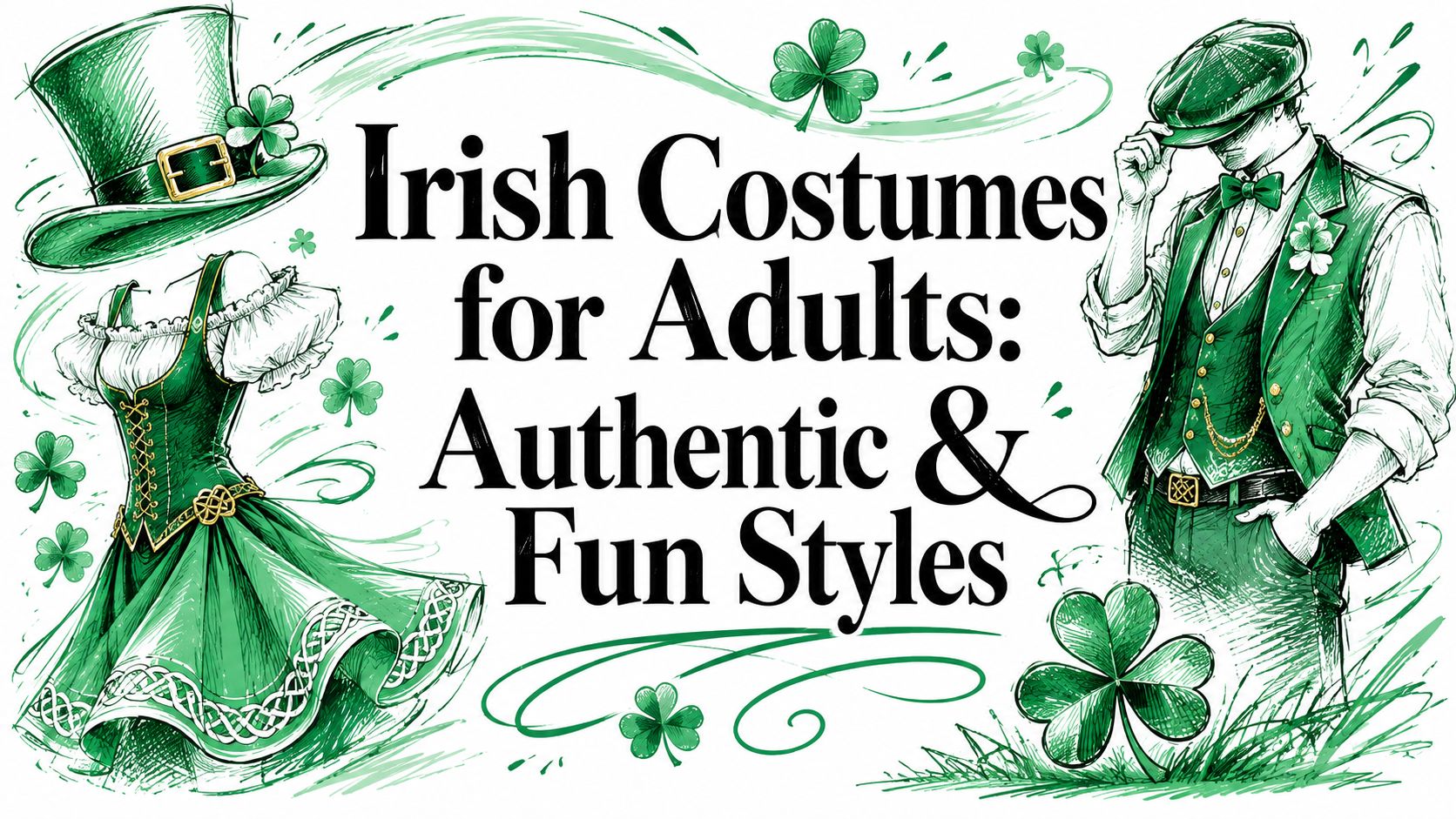
You're probably staring at a sea of green right now. Maybe it's for a St. Patrick's Day party, a heritage festival, a themed work event, or a pub night where you want to join the fun without looking like you grabbed the first plastic hat at the checkout.
That's a good instinct. The best Irish costumes for adults can be playful and social while still showing some care for the culture behind them. Ireland has a rich clothing history, and it's far more interesting than shamrock sunglasses and a fake orange beard.
A thoughtful outfit doesn't need to be stiff or museum-like. It just needs to match the moment. Some adults want a historically inspired look. Others want something festive but polished. Others want an easy DIY outfit that feels Irish in spirit without pretending to be ancient. All of those can work.
Table of Contents
- Choosing Your Irish Costume Beyond the Leprechaun Hat
- The Four Main Types of Irish Adult Costumes
- Dressing with Respect The History Behind the Threads
- How to Source or Create Your Irish Costume
- Three Irish Costume Ideas from Historical to Modern
- Speak the Part Easy Irish Phrases for Your Costume
Choosing Your Irish Costume Beyond the Leprechaun Hat
Many individuals start in the same place. They search for Irish costumes for adults and get hit with novelty hats, bright green suits, shamrock suspenders, and outfits that treat Irish culture like one long joke. Some of that can be harmless party fun, but it often leaves adults wondering what genuinely feels right.
A better approach is to ask one question first. What kind of event are you dressing for? A pub crawl, a céilí, a heritage gathering, and an office celebration all call for different choices. The outfit that gets a laugh at a casual party may feel out of place at a cultural event.
Here's a simple way to choose:
- Name the setting. Is it playful, formal, outdoors, family-friendly, or heritage-focused?
- Pick your lane. Historical, dance-inspired, festive modern, or DIY interpretation.
- Decide your comfort level. Do you want a full costume, or just a themed outfit with subtle Irish touches?
- Check the tone. If a piece feels cartoonish, ask whether it celebrates the culture or reduces it to a stereotype.
Practical rule: If you'd feel awkward explaining why an item represents Ireland, skip it.
A lot of confusion comes from mixing mythology, festival wear, and history into one bundle. Irish culture includes folklore, music, dance, language, regional identity, and older Gaelic dress traditions. Those aren't all the same thing. If you enjoy the symbolic side of Irish culture, a good next read is this guide to Celtic deities and mythology, which helps separate folklore from historical clothing.
You don't need to get every detail perfect. You just want to avoid the lazy version. A flat cap, tweed jacket, wool shawl, linen tunic, Celtic jewelry, or a well-chosen green dress can all say “Irish” more effectively than a bargain-bin leprechaun kit.
The Four Main Types of Irish Adult Costumes
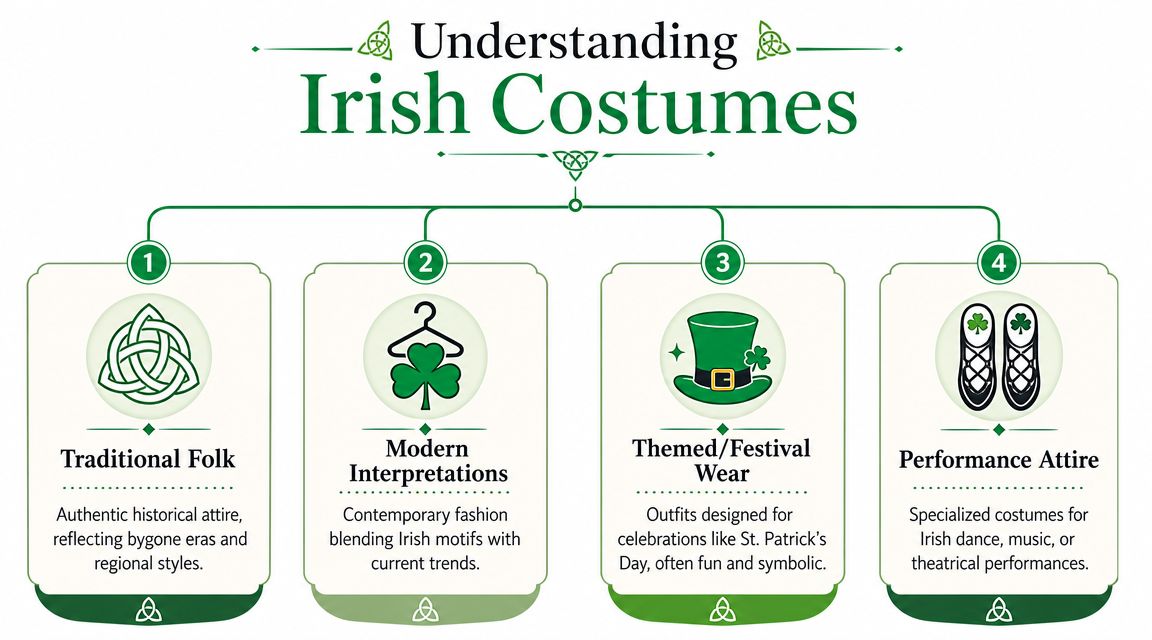
Some people say “Irish costume” and mean medieval Gaelic clothing. Others mean Irish dancewear. Others mean party gear for March celebrations. That's why shopping can feel confusing. These are four different categories, and each one serves a different purpose.
Historical reconstructions
This is the closest category to heritage clothing. It draws on garments associated with Gaelic dress, especially layered pieces and natural fabrics. If you want something grounded in history, this is the strongest path.
These outfits usually look less flashy than party costumes. That's a good sign. Historical dress was practical, wearable, and tied to climate and daily life.
Traditional dance costumes
Dancewear often gets mistaken for “old Irish dress,” but it belongs in its own category. It's a performance tradition with its own visual rules, stage needs, and changing standards.
The distinction matters. In the Irish dance world, women's costumes shifted away from earlier shared male-female styles, and by 2015 the regulating commission banned cartoon characters, feathers, and other “less traditional” designs to maintain a heritage standard, as noted in this Irish costume overview. That tells you something important. Even performance costumes aren't random. They're curated and debated.
Performance attire isn't the same as historical clothing. It's a cultural form with its own logic.
Novelty and party costumes
This is the most common search result. Leprechaun suits, oversized hats, green tuxedos, and joke accessories live here. These can work for a relaxed party if you keep the tone friendly and don't treat Irish identity itself as the punchline.
If you choose novelty, try upgrading it. Swap plastic pieces for better fabrics, tone down the caricature, and add one or two details with more character. A tweed cap or harp pin often goes further than ten shamrock stickers.
DIY and inspired outfits
This is my favorite category for many adults because it's flexible. You're not claiming strict historical accuracy, and you're not trapped in novelty either. You're building an outfit inspired by Irish textiles, colors, motifs, and atmosphere.
A modern inspired look might include:
- A linen shirt or dress: It nods to older natural-fiber traditions.
- A wool layer: Think shawl, cloak-style wrap, or structured coat.
- Celtic details: Knotwork jewelry, a brooch, or subtle embroidery.
- Grounded color choices: Greens, creams, browns, greys, and saffron-inspired tones often feel richer than neon green.
If you've ever felt that search results jump from “museum” to “mascot,” this fourth category is the bridge. It gives you room to be creative without becoming careless.
Dressing with Respect The History Behind the Threads
When people ask what an authentic Irish adult costume looks like, the honest answer is that there wasn't one single national outfit worn by everyone. Irish dress varied by time, place, and purpose. That's the first myth to let go of.
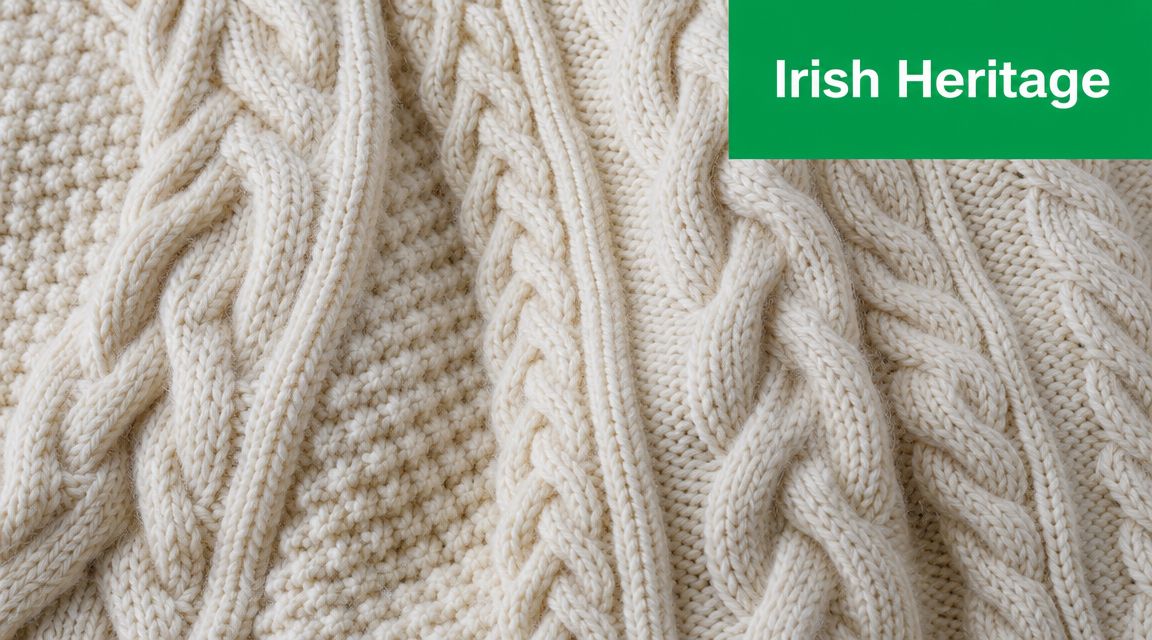
Another useful correction is this. What many people now imagine as “traditional Irish dress” was not a frozen costume preserved unchanged through the centuries. One reconstruction source notes that these styles were largely abandoned by the 17th century in favor of English dress, and that the modern historical model is built from recurring garments such as the léine, brat, ionar, and trews, explained in this reconstruction of traditional Irish dress.
The core garments to know
If you want your outfit to feel rooted rather than random, start with two key terms.
| Garment | What it is | Why it matters |
|---|---|---|
| Léine | A linen tunic reaching mid-thigh to knee-length | It formed the base layer and shows that Irish dress was practical, not costume-store fantasy |
| Brat | A wool cloak about 2 by 3 meters | It added warmth, protection, and a strong outer silhouette |
Those details matter because they shift the picture. Historical Irish clothing was layered, useful, and climate-aware. It wasn't built around glitter, synthetic shine, or a single symbolic accessory.
Why clothing carried identity
Clothing in Ireland also had political meaning. The 1367 Statutes of Kilkenny prohibited English settlers in Ireland from adopting Irish dress, which shows that clothing was already a visible marker of identity by the 14th century. Dress could signal Gaelic heritage, and items such as the saffron-dyed léine and woolen brat carried cultural weight.
That's one reason respectful costuming matters. You're not just choosing a look. You're stepping into a tradition where clothing could communicate belonging, resistance, and local identity.
Historical note: In Ireland, dress wasn't only about fashion. It could mark who you were and where you stood.
If you're exploring family background alongside clothing history, this guide to Irish clans and heritage can add another layer of context.
The Irish kilt myth
This is the misconception I correct most often. The commonly imagined Irish kilt has no pre-1900 Irish tradition and was not worn in Ireland before 1900, according to the same reconstruction source linked above. That doesn't mean no one can wear an Irish kilt now. It means you shouldn't present it as ancient Gaelic everyday dress.
That single myth shapes a lot of shopping mistakes. Adults often buy a tartan kilt because it looks “Celtic” and assume they've chosen the most authentic option. In fact, a simple léine and brat style outfit is usually a stronger historical choice.
What respect looks like in practice
Respect doesn't mean you need archival perfection. It means you make intentional choices.
- Choose garments with a reason: Linen, wool, cloaks, tunics, brooches, and layered shapes all have a stronger historical basis.
- Avoid invented “ancient” claims: If a seller markets every green tartan item as old Irish tradition, be cautious.
- Treat heritage as lived culture: Irish clothing history is more interesting when you see it as real dress worn by real adults.
That mindset makes your costume better looking, too. It tends to produce outfits with texture, balance, and personality instead of a grab bag of symbols.
How to Source or Create Your Irish Costume
Once you know what kind of look you want, the next challenge is practical. Where do you find Irish costumes for adults that fit well, suit the event, and don't feel flimsy?
That's where many shoppers get frustrated. Retail pages often group Ireland-themed items together without helping you think about fit, weather, or formality. One of the biggest market gaps is practical planning for diverse adults, especially for plus-size fits, formal parties, or colder outdoor events. Many retail collections lean toward one-size novelty gimmicks instead, as seen in this Ireland costume retail category.
If you're buying
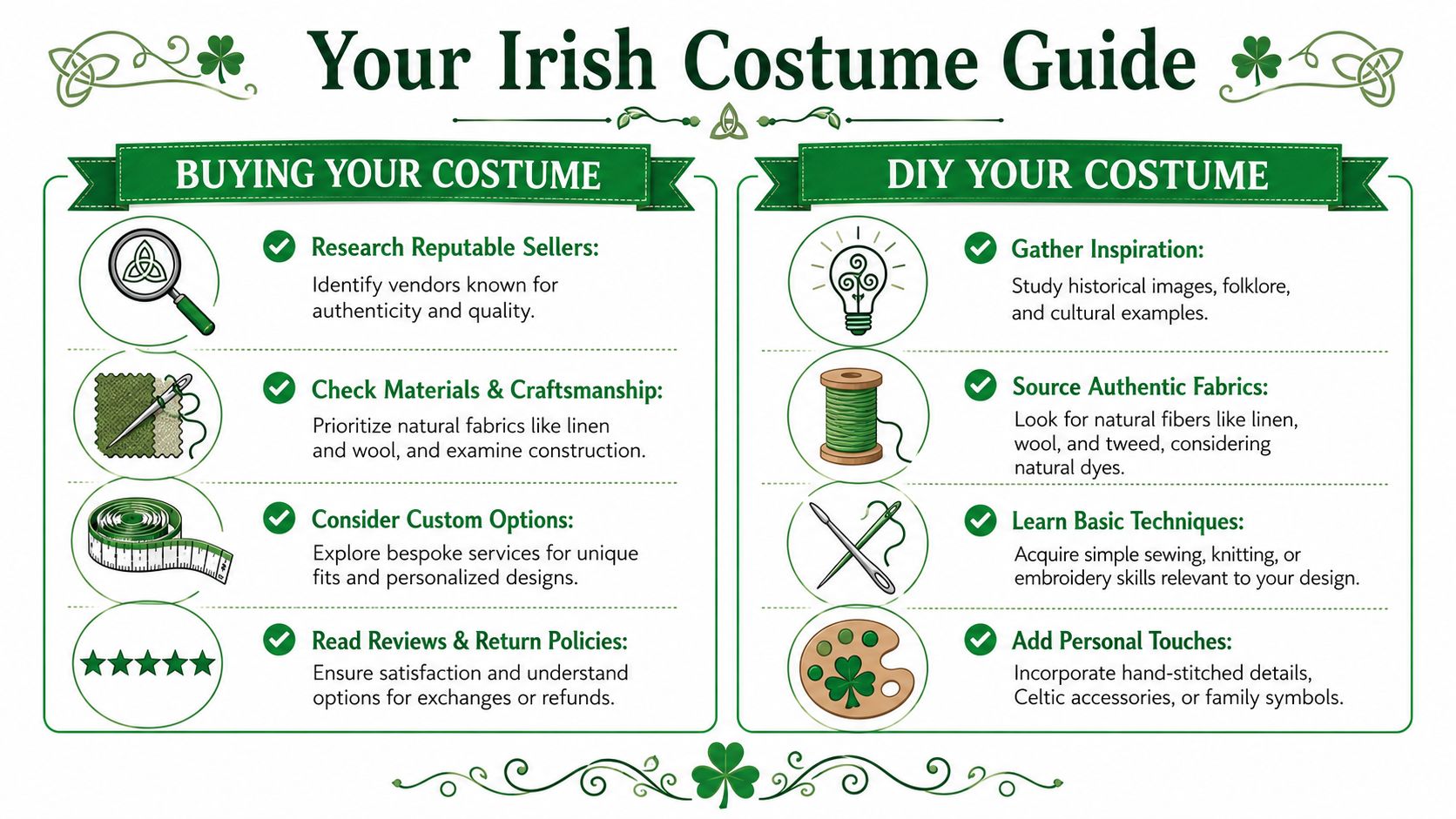
Start by filtering sellers, not just products. Party superstores are useful for accessories, but if you want a more grounded look, also check historical reenactment makers, independent artisans, costume rental shops, and handmade marketplaces.
Use this checklist before you buy:
- Check the silhouette: Does it look like clothing an adult could wear, or only a joke outfit?
- Read the fabric description: Linen, wool blends, cotton, tweed, and heavier weaves usually look better than shiny synthetics.
- Look at closure and layering: Cloaks, wraps, belts, tunics, and brooch-style fastening often create a more believable shape.
- Think about the event: A pub celebration can handle whimsy. A heritage event usually calls for restraint.
If you're unsure how a costume shape might sit on your body, tools that digitally try on costumes can help you preview proportion before you spend money or start sewing.
Buy for the room, not just the product photo.
If you're making your own
DIY works especially well for Irish-inspired outfits because the look depends so much on texture and layering. You don't need advanced sewing to make something effective.
A simple beginner route looks like this:
- Start with a base piece. A loose linen tunic, long shirt, plain dress, or neutral skirt and blouse.
- Add one outer layer. A wool wrap, cloak-style rectangle, shawl, or structured vest.
- Choose one fastener or accessory. Brooch, leather belt, Celtic pendant, or knotwork trim.
- Ground the colors. Cream, brown, moss green, charcoal, soft gold, or rust often work better than loud holiday green.
Fit, comfort, and weather matter more than people think
A respectful outfit should still be wearable. Adults often need to move, sit, dance, commute, or stand outside for hours. That changes what “good costume” means.
A few practical fixes help a lot:
| Situation | Smart adaptation |
|---|---|
| Plus-size fit | Choose wrap layers, belted shapes, and draped garments instead of stiff one-piece costumes |
| Formal gathering | Use a tailored dress, blazer, shawl, or cloak-inspired outer layer with subtle Irish accessories |
| Cold outdoor event | Build upward with thermal base layers, wool textures, boots, and a cloak or heavy wrap |
| Budget limit | Invest in one strong anchor piece, then style around basics you already own |
That's often the difference between a costume you wear once and an outfit you'll gladly use again.
Three Irish Costume Ideas from Historical to Modern
Sometimes it's easier to build a costume from a complete picture than from abstract advice. These three looks cover different moods, from heritage-inspired to party-ready.
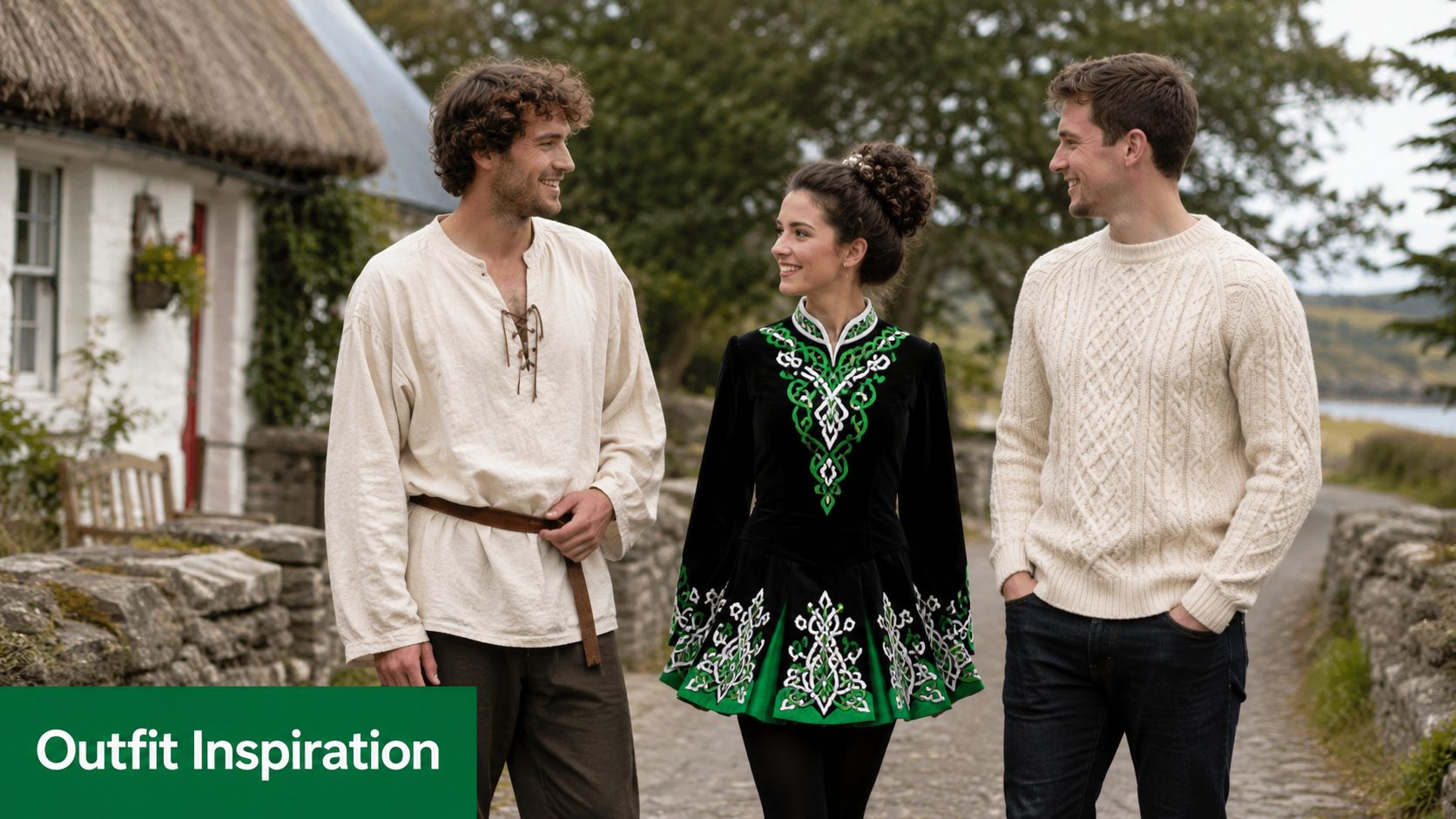
The Gaelic poet or warrior
This look works for heritage events, Renaissance-style gatherings, and adults who want a historical silhouette without trying to reproduce every last detail. The mood is simple, layered, and strong.
Try building it with:
- A long linen tunic: Off-white, cream, or soft saffron-toned if available
- A wool cloak or wrap: Dark green, brown, grey, or natural wool
- A belt or cord: To shape the tunic
- Simple boots or leather shoes: Keep them plain
- A brooch or pin: One statement fastening is enough
This outfit works because it doesn't over-decorate. It lets the fabric and shape do the talking.
The modern Celtic creative
This one suits adults who want something stylish enough for a dinner, arts event, or polished party. It isn't presented as ancient dress. It's a modern outfit that borrows Irish textures and symbols thoughtfully.
A version of it might include an Aran-style sweater, well-fitted trousers or a midi skirt, a plaid or wool shawl, and one piece of Celtic jewelry. The palette matters here. Go for earthy greens, oat, charcoal, navy, or berry tones.
To see how movement and styling can shape an Irish-inspired look, this video adds some visual context:
A simple checklist:
- Knitwear: Aran-style or cable-knit piece
- Structured base: Trousers, skirt, or dress in a muted color
- Layer: Shawl, capelet, or structured coat
- Jewelry: Celtic knot earrings, brooch, or pendant
- Finish: Clean boots or loafers instead of novelty footwear
Style tip: If the outfit could pass as real clothing first and costume second, you're often in a good place.
The festive reveler
This is for the adult who wants fun without looking like a cartoon. It works well for pub events, casual parties, and group celebrations.
Instead of a full novelty suit, build a sharper version:
- A green or tweed jacket, blazer, or waistcoat
- Dark jeans or trousers
- A flat cap instead of a foam top hat
- A shamrock, harp, or knotwork pin
- One playful accent: Green socks, a themed tie, or festive scarf
This look is forgiving, easy to assemble, and much more wearable than a one-piece party costume. It also photographs better because the textures look intentional.
The common thread across all three ideas is balance. You don't need to reject fun. You just want the fun to sit on top of some real thought.
Speak the Part Easy Irish Phrases for Your Costume
A costume gets warmer and more memorable when you pair it with a few words of Irish. You don't need a full conversation. Even one greeting or toast can show genuine interest in the culture.
The biggest mistake beginners make is worrying too much about perfection. Irish pronunciation takes practice, but simple phrases are still worth trying. If you say them with respect and a bit of care, people usually appreciate the effort.
For extra help, this guide to essential Irish phrases is a handy companion.
Essential Irish phrases
| Irish Phrase | Simple Pronunciation | English Meaning | When to Use It |
|---|---|---|---|
| Dia duit | DEE-ah gwit | Hello | A friendly greeting |
| Sláinte | SLAWN-cha | Cheers | When raising a glass |
| Go raibh maith agat | guh rev mah ah-gut | Thank you | When someone helps you |
| Céad míle fáilte | kayd MEE-leh FAWL-cha | A hundred thousand welcomes | To welcome guests or add warmth to an event |
| Oíche mhaith | EE-ha wah | Good night | When leaving at the end of the evening |
A few small usage notes help. Dia duit is a greeting, not a toast. Sláinte is widely recognized, and it's perfect for celebrations. Go raibh maith agat is especially nice if you're attending a heritage event and want to be gracious.
You don't need to sprinkle Irish into every sentence. One well-timed phrase can do more than a whole costume full of clichés.
If you enjoyed adding a bit of language to your outfit, Gaeilgeoir AI is a great next step. It helps you start speaking Irish through guided, real-world practice, so your connection to Irish culture can go beyond the costume and into everyday conversation.