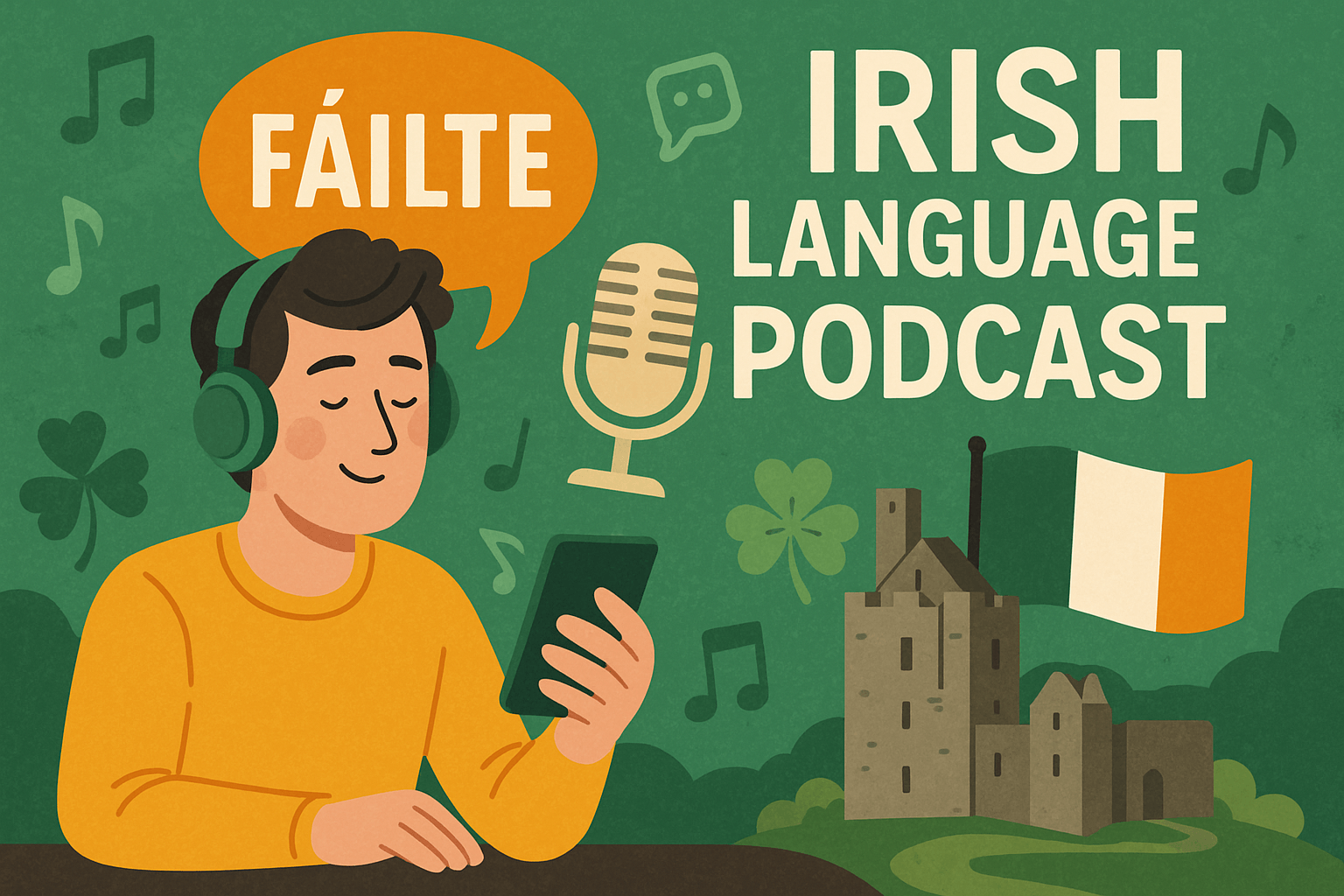
Irish Language Podcasts: How to Improve Your Gaeilge Through Listening

Listening to Irish regularly is one of the best ways to make the language feel more natural.

You can study vocabulary and grammar for months, but spoken Gaeilge can still feel fast and unfamiliar if you rarely hear it used in real conversations. Podcasts help bridge that gap because they expose you to Irish pronunciation, rhythm, vocabulary and sentence patterns over and over again.

The good news is that you don’t need to understand every word for listening practice to be useful.

Whether you’re a complete beginner or trying to move beyond classroom Irish, this guide will show you how to use Irish-language podcasts effectively and how to make listening part of a realistic learning routine.

Why Listen to Irish-Language Podcasts?

Podcasts give you something textbooks can’t: sustained exposure to spoken Irish.

When you listen regularly, you start becoming more familiar with how words flow together, where speakers naturally pause and which phrases appear repeatedly.

At first, you may only catch a few words.

Then those individual words become short phrases.

Eventually, entire sentences start standing out.

That progress happens gradually, which is why regular listening matters more than waiting until you think your Irish is “good enough”.

If you’re still building your foundations, you can learn Irish online for free alongside your listening practice and gradually develop the vocabulary and sentence patterns that make podcasts easier to follow.

Are Irish Podcasts Too Difficult for Beginners?

Some are.

A fast conversation between native speakers about politics or current affairs can be overwhelming if you’ve only just started learning Gaeilge.

That doesn’t mean beginners should avoid Irish audio entirely.

Instead, choose shorter or more learner-friendly material and change your goal.

You don’t need to understand an entire episode.

Try listening for:

  • familiar greetings
  • numbers
  • common verbs
  • names and places
  • words you studied recently
  • repeated expressions

If you recognise even a few things, you’re training your ear.

As your vocabulary grows, the same material will gradually become more understandable.

Start With Short Listening Sessions

You don’t need to listen to a 45-minute podcast every day.

Five focused minutes can be more useful than half an hour of audio playing in the background while you stop paying attention.

Choose a short section and listen carefully.

Then replay it.

The second time, you’ll often notice things that completely passed you by on the first listen.

A simple listening routine could be:

First listen: Focus on the overall meaning.

Second listen: Listen for familiar words.

Third listen: Choose one short phrase and repeat it aloud.

That might only take a few minutes, but it gives you much more active contact with the Irish than simply letting an episode play.

Don’t Try to Translate Every Word

One of the biggest mistakes learners make is trying to mentally translate everything into English.

Spoken language moves too quickly for that.

Instead, try to understand the idea.

If you recognise enough vocabulary to know that someone is talking about work, weather or travel, you’re already following part of the conversation.

You may not know every word inside the sentence.

That’s fine.

As your Irish improves, your brain gradually becomes better at understanding phrases directly rather than translating one word at a time.

Listen More Than Once

Repetition is particularly valuable with podcasts.

The first listen might feel difficult.

On the second, familiar phrases begin to appear.

By the third or fourth listen, sections that initially sounded like one continuous stream of sound may start breaking into recognisable words.

You don’t need to replay the entire episode.

Pick a 30-second or one-minute segment and work with that.

A small amount of audio you understand increasingly well can teach you more than constantly jumping to new episodes.

Use Transcripts When They’re Available

A transcript can be extremely helpful, especially at the beginning.

But use it in the right order.

Try listening before reading.

Then check the transcript to see what you missed.

Afterwards, listen again while following the text.

Finally, try listening once more without looking.

This connects the written form of Gaeilge with the sounds you’re hearing.

It also helps you notice cases where a word you already knew looked familiar on the page but sounded different from what you expected.

Repeat Irish Phrases Out Loud

Listening doesn’t have to remain passive.

When you hear a useful phrase, pause the audio and repeat it.

Try to imitate the speaker’s rhythm, not just the individual sounds.

This technique is sometimes called shadowing when you closely follow the speaker.

You don’t need to shadow entire episodes.

Even one or two sentences can help you become more comfortable producing Irish.

Listening and speaking reinforce one another.

The better your ear becomes, the easier it is to notice how your own pronunciation differs from what you’re hearing.

Combine Podcasts With Structured Irish Learning

Podcasts are excellent for immersion, but they don’t necessarily tell you what vocabulary or grammar to learn next.

That’s where structured learning can help.

A lesson might introduce a sentence pattern or group of words. Later, you hear one of those words in a podcast and suddenly recognise it in a real context.

That recognition is powerful because the language stops feeling like something that exists only in exercises.

If you want to combine podcasts with lessons, vocabulary, conversation practice and review, explore how to learn Irish online with a more structured approach.

The two methods work well together: structured study helps you understand more of what you hear, while listening gives everything you learn a real-world context.

Learn Vocabulary From What You Hear

Podcasts can become a useful source of vocabulary, but don’t try to collect every unfamiliar word.

Choose words that:

  • appear repeatedly
  • seem important to the topic
  • are useful for everyday conversation
  • connect with something you’re already learning

Write the word down with the phrase or sentence where you heard it.

Context makes vocabulary much easier to remember.

Instead of learning an isolated translation, you’re remembering how the word actually appeared in spoken Irish.

Expect Dialect Differences

Irish has three major traditional dialect regions: Munster, Connacht and Ulster.

That means podcasts may expose you to differences in pronunciation, vocabulary and phrasing.

At first, that can be confusing.

You don’t need to memorise every regional variation.

The important thing is to keep listening.

Over time, your ear becomes more flexible and you start recognising that different pronunciations can belong to the same language.

This exposure is one of the advantages of listening to different speakers rather than relying on a single voice.

Use Podcasts for Background Exposure Too

Focused listening is important, but not every podcast session needs to be intense study.

Sometimes it’s useful to simply have Irish around you.

Put on a podcast while walking, cooking or commuting.

You may not catch every sentence, but regular exposure helps the rhythm of the language become familiar.

Think of this as background immersion, not your only form of listening practice.

Combine it with occasional focused sessions where you pause, repeat and actively work with the audio.

Both serve different purposes.

How Often Should You Listen to Irish?

A little most days is ideal.

Even five or ten minutes can help.

You might listen to a short section during breakfast, on your commute or while walking.

The important thing is frequency.

Hearing Irish once every two weeks makes it much harder for your ear to adjust than hearing a small amount several times a week.

You don’t need to schedule a huge study session.

Make Irish something that appears regularly in your day.

A Simple 15-Minute Podcast Routine

Here’s an easy routine you can use with almost any Irish-language podcast.

Minutes 1–4: Listen to a short section without stopping.

Minutes 5–7: Replay it and listen for familiar words or phrases.

Minutes 8–10: Check a transcript or look up one or two important words if needed.

Minutes 11–13: Replay the same section.

Minutes 14–15: Repeat one or two sentences aloud.

This gives you listening, vocabulary, pronunciation and repetition in one short session.

What If You Understand Almost Nothing?

Keep going, but adjust the difficulty.

If every episode feels completely incomprehensible, find something slower or shorter.

You need enough difficulty to challenge you, but not so much that every second feels like noise.

Learner-focused audio can be useful until your vocabulary is large enough to move into more natural-speed content.

Then gradually increase the difficulty.

The transition doesn’t have to happen all at once.

Podcasts and the Irish Learning Habit

Podcasts are particularly useful because they make Gaeilge easier to fit into ordinary life.

You don’t always need a desk, notebook or dedicated study session.

A walk can become listening practice.

A commute can become immersion.

Ten minutes while making dinner can give you another encounter with spoken Irish.

That matters because language learning isn’t just about how much you study in one sitting.

It’s also about how frequently the language returns.

Use More Than One Type of Irish Audio

Podcasts are excellent, but don’t make them your only listening source.

Combine them with:

  • Irish-language radio
  • television and video
  • songs
  • interviews
  • learner audio
  • conversations

Different formats expose you to different voices, speeds and vocabulary.

Music can make phrases memorable.

News can expose you to formal vocabulary.

Conversational podcasts can help you hear natural speech.

Variety makes your listening skills more adaptable.

How Gaeilgeoir Fits Into Podcast Learning

Gaeilgeoir includes access to dozens of Irish podcasts and videos, allowing learners to move between structured learning and immersion.

You might begin with a lesson or vocabulary session, then listen to Irish content and see which words you can recognise.

On another day, listening might be your main activity.

That flexibility makes immersion easier to maintain without requiring you to search for new content every time you want to practise.

You can also pair listening with the 1,000 Word Way, personalised study lists, quizzes, conversation practice and Irish song lessons.

The point is to connect what you’re learning with the Irish you actually hear.

Start Listening Before You Feel Ready

There’s a tendency to think:

“I’ll start listening to real Irish once I know more vocabulary.”

But listening is part of how you build that vocabulary and understanding.

You don’t have to wait.

Start with five minutes.

Listen for one phrase.

Recognise one word.

Replay it tomorrow.

That’s enough.

As the weeks pass, things that once sounded completely unfamiliar begin to stand out.

Build Podcasts Into Your Irish Learning Routine

Irish-language podcasts are most effective when they sit alongside the rest of your Gaeilge learning rather than replacing it.

Use structured learning to build vocabulary and understand patterns.

Use podcasts to hear those patterns in real speech.

Use speaking practice to reproduce what you hear.

Then keep repeating the cycle.

If you want to build those skills together, explore how to learn Irish online through structured lessons and immersion.

Or, if you’re just beginning, you can learn Irish online for free and gradually introduce more listening as your foundation grows.

Final Thoughts

You don’t need to understand an entire Irish-language podcast for it to help your Gaeilge.

Listen for what you know.

Replay short sections.

Use transcripts strategically.

Repeat phrases aloud.

Save useful vocabulary.

And keep exposing yourself to different Irish voices.

At first you may recognise almost nothing.

Then you’ll catch a word.

Then a phrase.

Then part of a sentence.

That gradual change is exactly what listening practice is supposed to do.

The goal isn’t to understand everything immediately.

It’s to make spoken Irish less unfamiliar every time you hear it.

Go n-éirí leat!

Irish Gypsy Language: Exploring Shelta and Its Origins

Ireland’s rich linguistic heritage is more complex than many people realize. While Gaeilge (Irish Gaelic) is widely known and increasingly celebrated, there’s another lesser-known but deeply fascinating element of Irish language culture: the Irish Gypsy language, often referred to as Shelta.

Spoken within the Irish Traveller community, Shelta is a secretive, hybrid language with roots in both Irish Gaelic and English. Though Gaeilgeoir AI does not offer lessons in Shelta, we believe it’s important to acknowledge and explore all linguistic expressions of Irish identity. Understanding Shelta not only enriches our grasp of Ireland’s cultural landscape but also deepens our appreciation of the Irish language’s impact beyond mainstream usage.


What Is the Irish Gypsy Language?

The term Irish Gypsy language generally refers to Shelta, a traditionally spoken language used by Irish Travellers, a nomadic ethnic group indigenous to Ireland. Shelta is also known by other names, such as Cant, Gammon, or the Traveller’s language.

Key Features of Shelta:

  • Oral tradition: Passed down verbally through generations.
  • Blend of influences: Combines elements of Irish Gaelic, English, and unique Traveller-specific vocabulary.
  • Privacy and identity: Served as a linguistic shield to protect community identity and information from outsiders.

While some outsiders refer to it as a “gypsy language,” it’s more accurate—and respectful—to call it Shelta or Cant, recognizing the Traveller community’s own terminology.


Is Shelta the Same as Irish Gaelic?

No—but there are connections.

Shelta is not mutually intelligible with Irish Gaelic (Gaeilge). However, it contains many lexical influences from Gaeilge, often altered in form or pronunciation. This was historically done to obscure meanings from non-Travellers.

For example:

  • The Irish word uisce (water) may appear as a modified form like skuwi in some Shelta dialects.
  • Words are often reversed, masked, or changed in spelling to maintain their secretive nature.

If you’re interested in exploring how Gaeilge has influenced other languages and dialects, our Ancient Irish Language Guide is a great place to start.


A Brief History of the Irish Traveller Community

The Irish Travellers are a distinct ethnic group with their own customs, history, and language traditions. They’ve lived in Ireland for centuries—some scholars argue their roots predate Norman invasion, while others suggest their distinctiveness grew during the post-Famine period.

Shelta emerged as a code language, a way for Travellers to preserve autonomy and privacy in the face of discrimination and marginalization. Because it was never standardized in writing, the language evolved organically, varying across regions and families.


Why Shelta Is Culturally Important

Shelta is more than a language—it’s a living symbol of identity, resilience, and tradition for Irish Travellers. It carries not only words, but stories, rituals, and worldviews.

Its significance includes:

  • 🔐 Cultural preservation: It serves as a means of passing on traditions and values.
  • 🧠 Cognitive flexibility: The mixing and transforming of words show incredible linguistic creativity.
  • 📚 Historical insight: The influence of Gaelic vocabulary reveals how Irish has quietly endured outside formal education systems.

At Gaeilgeoir AI, we believe exploring this kind of cultural-linguistic intersection helps broaden awareness of Ireland’s diverse language heritage, even when it falls outside the scope of what we directly teach.


The Role of Language in Cultural Identity

Language is central to how people understand themselves and the world. For both Irish Travellers and speakers of Gaeilge, language has long been a tool of resistance and survival.

While mainstream Irish society has often viewed Gaeilge as a national heritage in need of revival, Travellers have fought to keep Shelta alive within their own communities, often in the face of misunderstanding or cultural erasure.

Understanding these parallels can spark deeper conversations about:

  • 🧭 How languages evolve under social pressure
  • 🎓 Why minority languages deserve recognition and respect
  • 🌐 How technology (including AI) might someday assist in documentation and preservation

Want to learn more about Irish as a cultural cornerstone? Visit our guide on The History of Learning Gaeilge.


Should Shelta Be Taught in Schools?

This is a growing debate in Ireland. Some advocate for Shelta to be recognized as a minority language, similar to Irish or Scots Gaelic. Others argue that it should remain a community-controlled and private tradition.

No matter your stance, it’s clear that Shelta deserves acknowledgment, respect, and preservation—ideally led by the Traveller community themselves.

At Gaeilgeoir AI, while we don’t offer Shelta lessons, we fully support community-led efforts to preserve linguistic heritage and celebrate cultural diversity through digital means, research, and storytelling.


How AI Can Support Lesser-Known Languages

While our AI tools are currently focused on Gaeilge, the underlying technology has the potential to support other minority or endangered languages, including:

  • Automated transcription of oral histories
  • AI-assisted language recognition for dialect preservation
  • Digital flashcards and pronunciation tools

If such tools were ever developed for Shelta, they’d need to be created in collaboration with the Traveller community to ensure ethical and accurate representation.


Learn More, Respectfully

Interested in exploring Shelta further? Here are a few ways to do so respectfully:

✅ 1. Start with cultural understanding

Learn about Irish Travellers’ history and heritage via Pavee Point, an advocacy organization dedicated to Traveller rights and culture.

📘 2. Deepen your knowledge of Gaeilge

Since Gaeilge forms the backbone of much of Shelta’s vocabulary, learning Irish can give you valuable insights into its linguistic structure. Check out our Learn Irish Gaelic for Beginners guide.

🎧 3. Listen to Irish voices

Podcasts, documentaries, and interviews with Traveller advocates and linguists offer powerful perspectives.


Final Thoughts: Honoring All Irish Voices

Ireland’s linguistic legacy is more than one language. From the poetic cadences of Gaeilge to the hidden syllables of Shelta, the country’s voice is multi-layered and profound.

At Gaeilgeoir AI, we’re proud to be part of a movement that champions language—not just as a tool for communication, but as a carrier of culture, memory, and meaning.

While we focus on helping learners master Irish Gaelic, we also recognize the importance of languages like Shelta in Ireland’s broader story. Learning Irish isn’t just about vocabulary and verbs—it’s about opening the door to a deeper, more inclusive Ireland.

👉 Curious to start your own journey? Sign up for a free trial of Gaeilgeoir AI and explore how language learning and cultural understanding go hand-in-hand.

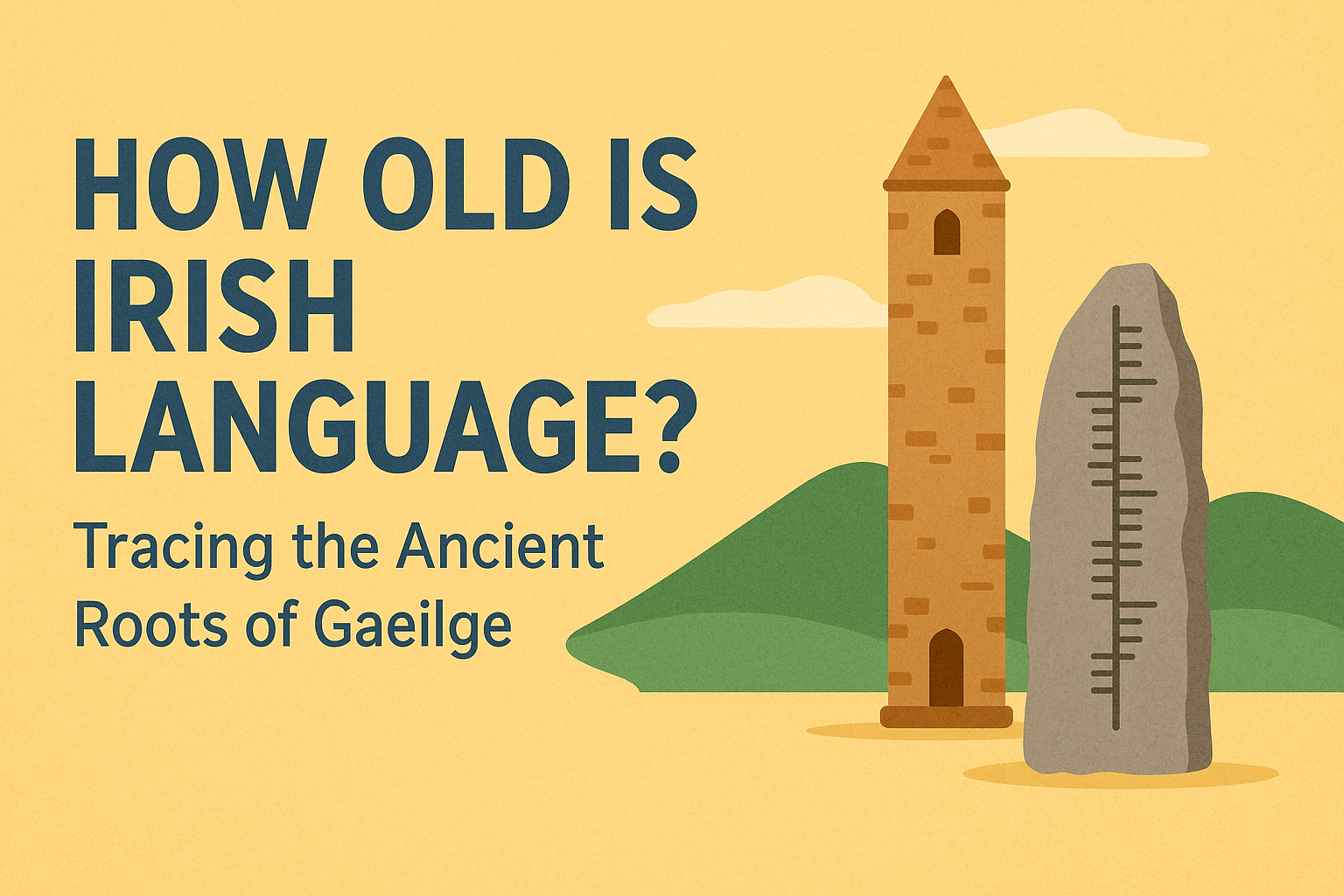
How Old Is Irish Language? Tracing the Ancient Roots of Gaeilge

The question “How old is Irish language?” may seem simple, but the answer opens the door to one of the most fascinating linguistic journeys in Europe. The Irish language—Gaeilge—is not only one of the oldest written and spoken languages still in use today, but it’s also a living connection to a rich Celtic heritage that has endured for thousands of years.

In this article, we’ll explore the origins and evolution of the Irish language, its survival through centuries of change, and how modern tools like Gaeilgeoir AI are helping ensure its vibrant future.


The Origins of Irish: How Far Back Does It Go?

A Language Older Than English

Irish is a Gaelic language from the Celtic branch of the Indo-European language family. It is believed to have arrived in Ireland with Celtic tribes sometime between 500 BCE and 100 BCE. This makes Irish at least 2,500 years old, possibly older.

By comparison, English—as we know it—only began to take form after the 5th century CE, making Irish significantly older than English, German, and many other European languages.

Old Irish (c. 600–900 CE)

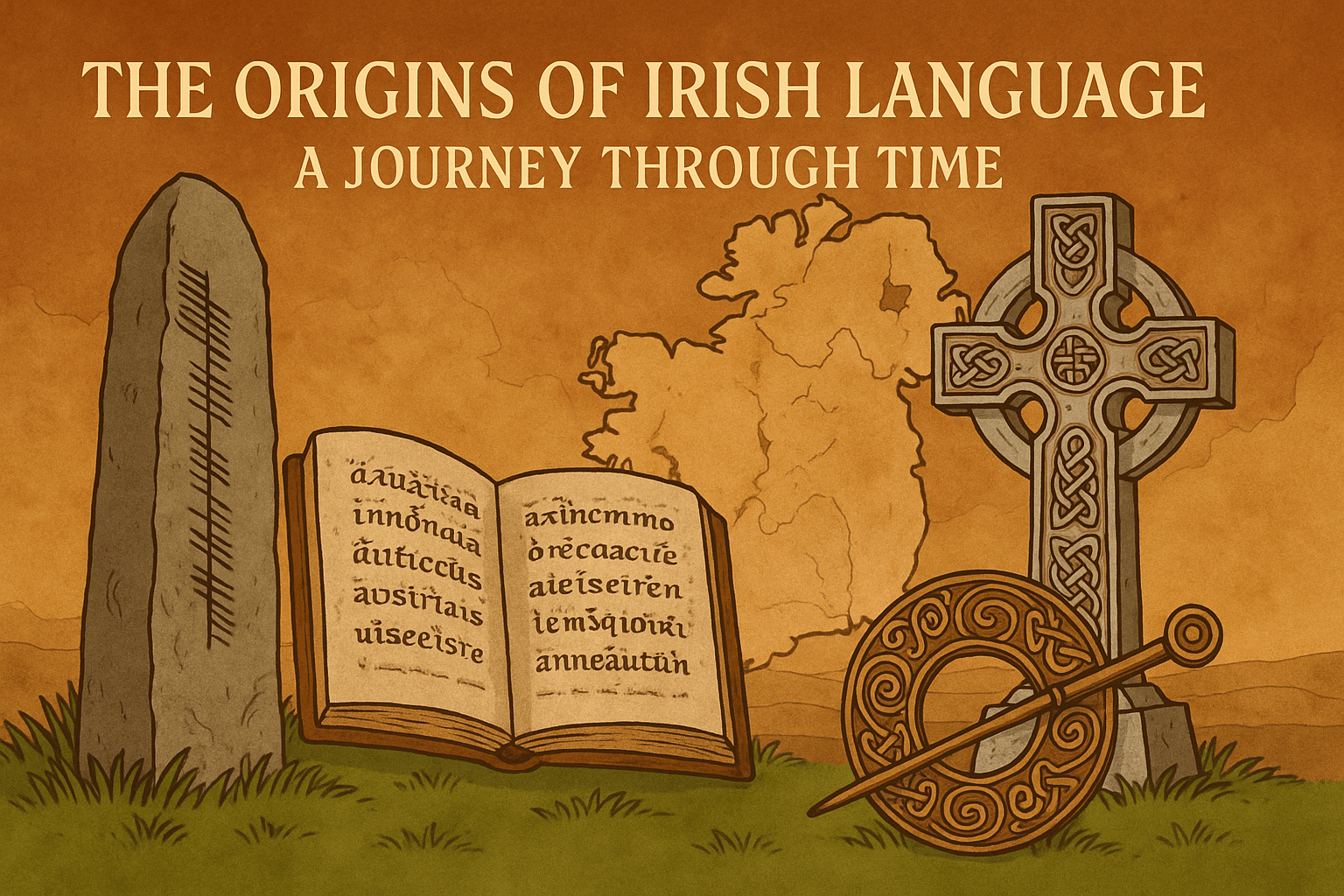
One of the earliest records of written Irish comes from the Ogham script, used between the 4th and 7th centuries CE. This early alphabet, often carved on standing stones, provides some of the first concrete evidence of Irish as a written language.

From there, Irish evolved into what scholars now call Old Irish, a complex and highly inflected language preserved in monastic manuscripts. These documents, such as the Book of Armagh and the Lebor na hUidre, are crucial for understanding early Irish thought, religion, and society.

For more on the Ogham script and early writing, check out this Ogham Alphabet Guide.


Irish Through the Ages

Middle Irish (c. 900–1200 CE)

Middle Irish developed after the Viking invasions, serving as a bridge between Old Irish and Modern Irish. It was widely spoken across Ireland, Scotland, and the Isle of Man, influencing both Scottish Gaelic and Manx Gaelic.

Early Modern Irish (c. 1200–1650)

As English and Norman influence increased, Irish continued to be spoken by the majority of people on the island. However, colonial policies, such as those during the Tudor and Cromwellian eras, began to undermine Irish as a public and administrative language.

Despite suppression, the Irish language remained dominant in rural areas and held strong cultural and poetic traditions. Explore more about this era’s decline and revival.

Modern Irish (1650–Present)

From the 17th century onward, Irish entered its modern phase. Though the language faced steep decline due to British rule, famine, and emigration, it never disappeared. Today, Irish is recognized as Ireland’s first official language and one of the 24 official languages of the European Union.


How Gaeilge Is Still Evolving

So, how old is Irish language in a living sense? While its roots stretch back over two millennia, Gaeilge is still evolving today—shaped by modern media, technology, and learners across the globe.

Irish has adapted remarkably well to the digital age, thanks in part to innovations like Gaeilgeoir AI, which uses artificial intelligence to make Irish language learning more accessible, accurate, and engaging.


Why the Age of Irish Matters Today

Understanding the age and depth of Irish isn’t just trivia—it’s empowering. Here’s why:

1. Cultural Identity and Pride

Knowing you’re learning one of the oldest living languages in Europe creates a strong connection to Irish heritage.

2. Linguistic Uniqueness

Irish has sounds, grammar, and structures found in few other languages. This makes learning Irish a deeply rewarding intellectual experience.

3. Preserving a Language Under Threat

While Irish has seen a revival in recent decades, it remains a minority language. By learning and using it, you contribute to its survival.

To dive deeper into the cultural impact of Irish, check out this guide to ancient Irish language and its legacy.


Modern Tools for Learning an Ancient Language

Learning Irish has never been easier, despite its ancient roots. Here’s how Gaeilgeoir AI is helping the next generation of Gaeilgeoirí:

📱 AI-Powered Language Assistance

  • Instant grammar correction
  • Smart translation and context suggestions
  • Adaptive learning tailored to your level

🎧 Pronunciation and Listening Practice

  • Native-speaker audio clips in multiple dialects
  • Real-time pronunciation feedback

📚 Rich Learning Materials

  • Flashcards, quizzes, and lesson plans
  • Daily practice goals and progress tracking
  • Cultural notes embedded in lessons

Explore their free daily Irish practice plan to build habits around learning.


Fun Facts About the Irish Language’s Age and Legacy

  • Ogham, the first known Irish alphabet, was often written vertically on standing stones.
  • Some Old Irish texts predate English literature by centuries.
  • Irish influenced English: words like “brogue,” “galore,” and “smithereens” have Irish roots.
  • Irish was once spoken as far away as Newfoundland, Canada, by Irish immigrants.

External Resource Spotlight: Harvard’s Celtic Languages Program

For academic learners, the Harvard University Celtic Languages Program offers a deep dive into Old and Middle Irish and their relationship with other Celtic tongues. It’s one of many reputable programs preserving Irish through research and teaching.


FAQs About the Age of the Irish Language

Q: Is Irish older than Latin?

While Latin is also ancient (dating to the 6th century BCE), Irish as a distinct language likely formed later. However, Irish has remained continuously spoken and written for longer than many other European tongues.

Q: Is Irish still spoken today?

Yes! Irish is spoken daily in Gaeltacht regions, taught in schools across Ireland, and used by a global community of learners and heritage speakers.

Q: Can I learn Irish even if I’m not in Ireland?

Absolutely. Thanks to online tools like Gaeilgeoir AI, learners from anywhere in the world can access high-quality lessons and resources. See if it’s right for you—start your free trial today.


Final Thoughts: A Timeless Language for Modern Learners

So, how old is Irish language? At least 2,500 years, and it’s still going strong. Whether you’re learning Irish to explore your heritage, understand Celtic mythology, or simply take on a new challenge, there’s never been a better time to begin.

With cutting-edge support from Gaeilgeoir AI, you can tap into an ancient tradition with modern tools—keeping Gaeilge alive for generations to come.


Interested in learning more?
Explore other topics like common mistakes in Irish or basic Irish conversation tips, and continue your journey toward fluency.

Ready to begin your own Irish language journey?
Join thousands of learners preserving this ancient language—sign up for free with Gaeilgeoir AI and start speaking Gaeilge today

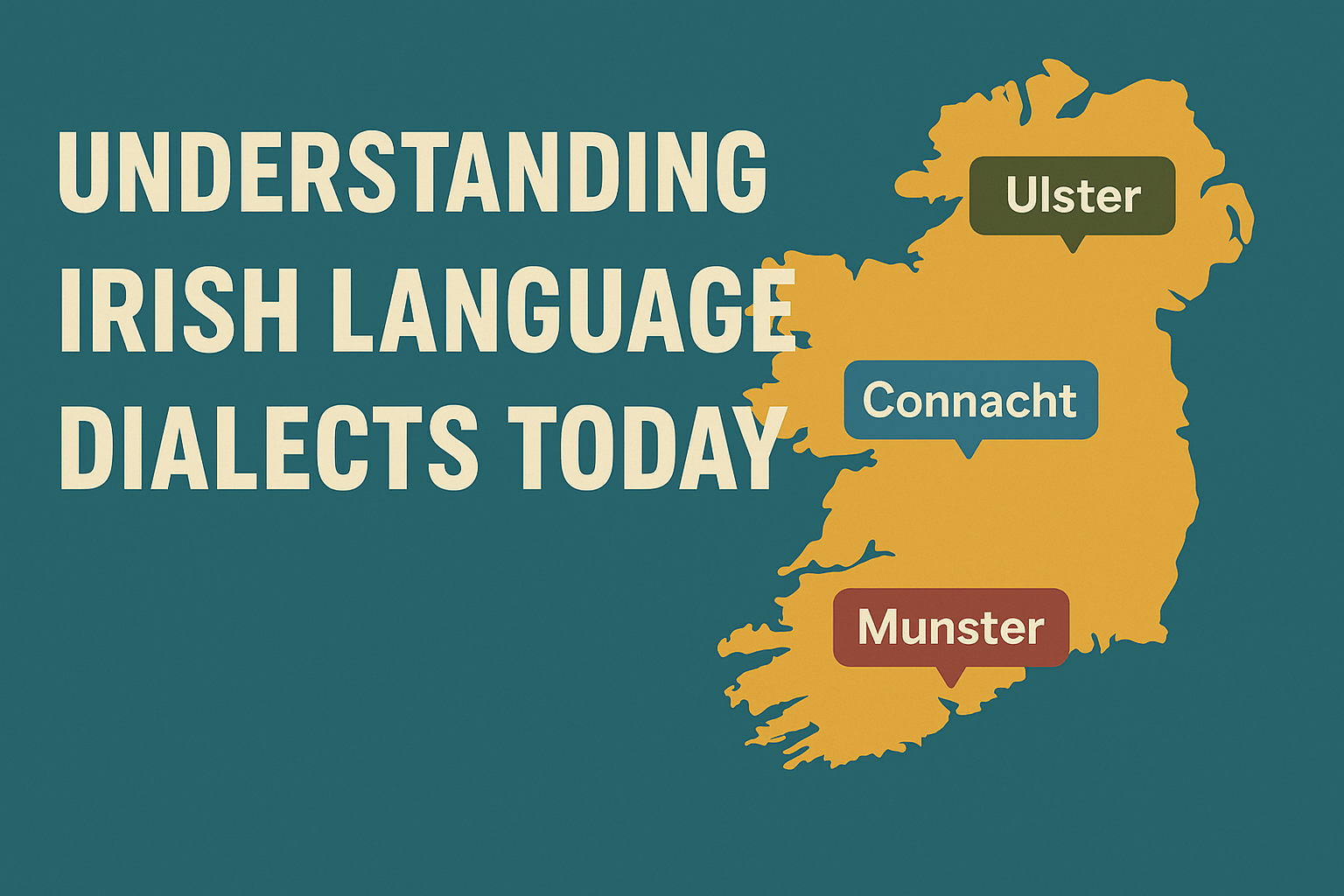
Understanding Irish Language Dialects Today

The Irish language dialects—Munster, Connacht, and Ulster—are rich in sound, vocabulary, and identity. For learners, these dialects represent both a challenge and a unique opportunity to engage with the living, breathing culture of Ireland. At Gaeilgeoir AI, we recognize that no two Irish speakers are exactly the same, and our platform is designed to help you understand and navigate the subtle and beautiful differences in each dialect.

Whether you’re just starting out or deepening your Gaeilge skills, understanding the distinctions among Irish dialects is key to becoming a confident and culturally aware speaker.


What Are Irish Language Dialects?

A Language of Many Voices

Irish, or Gaeilge, is spoken in different forms across the island of Ireland. Though it’s the same language at its core, the way people speak it in different regions varies significantly. These variations form the three main dialects:

  • Ulster Irish (Gaeilge Uladh) – Predominantly spoken in County Donegal and parts of Northern Ireland.
  • Connacht Irish (Gaeilge Chonnacht) – Common in Connemara and surrounding regions in the west.
  • Munster Irish (Gaeilge na Mumhan) – Heard in counties Kerry, Cork, and Waterford in the south.

There is also Urban Irish, a more standardized or blended form spoken in cities and taught in schools across the country.

Each dialect has its own unique accent, vocabulary, and grammatical quirks—something that learners should embrace rather than fear.


Why Do Dialects Matter When Learning Irish?

Language Is Cultural Context

Learning about Irish dialects isn’t just an academic exercise; it connects you to the history, identity, and people of each region. Understanding dialects helps you:

  • Speak more naturally with native speakers in specific regions
  • Appreciate regional literature, music, and folklore
  • Avoid confusion between different terms and pronunciations
  • Choose a dialect focus that suits your interests and learning goals

At Gaeilgeoir AI, we incorporate dialectal variation into your learning journey, helping you recognize and adapt to different forms of Irish.

Check out our guide to dialectal differences in Irish for a more detailed breakdown.


Key Differences Between the Irish Language Dialects

1. Pronunciation

  • Ulster Irish has a Scottish Gaelic–like cadence and tends to pronounce the final consonants more distinctly.
  • Connacht Irish is known for a clearer vowel sound and has a more “neutral” tone compared to others.
  • Munster Irish has a musical intonation and longer vowels, often considered lyrical and flowing.

2. Vocabulary

While the meaning stays the same, words often differ by region:

  • “girl”:
    • cailín (Ulster)
    • girseach (Connacht)
    • cailínín (Munster)
  • “soon”:
    • go luath (Ulster)
    • ar ball (Connacht)
    • gan mhoill (Munster)

3. Grammar and Syntax

  • Ulster Irish favors the independent verb form in certain past tense situations.
  • Munster Irish may use double negatives, which are ungrammatical in standard English but completely acceptable in the local dialect.
  • Connacht Irish often preserves archaic structures that have faded elsewhere.

Choosing a Dialect: Which One Is Right for You?

There’s no “best” dialect—each is equally valid and fascinating. But your choice might depend on:

  • Where you plan to visit or live (e.g., Donegal = Ulster Irish)
  • Your interest in traditional music or literature from a specific region
  • Family heritage or ancestral ties
  • Your preferred sound or accent

Still not sure where to start? Many learners begin with a standardized form (like the one taught in schools), then dive deeper into dialects as they grow more confident.

Explore helpful basic Irish conversation phrases to get a feel for each dialect’s flavor.


Gaeilgeoir AI: Learn Dialects with AI-Powered Insight

Personalized Learning, Rooted in Culture

Our mission at Gaeilgeoir AI is to make Irish learning smart, accessible, and authentic. That means:

  • Offering custom lessons based on your dialect of interest
  • Providing audio from native speakers across regions
  • Highlighting dialectal differences in vocabulary and grammar
  • Delivering real-time pronunciation feedback using AI speech recognition
  • Blending technology and tradition to keep your learning dynamic and enjoyable

Whether you’re drawn to Munster’s musical flow, Connacht’s clarity, or Ulster’s strength, our platform lets you explore all three in a structured and intuitive way.


The Importance of Dialects in Language Revitalization

Ireland’s dialects are more than regional curiosities—they are living legacies. As the Irish language continues its revival, preserving dialectal diversity is critical. Here’s why:

  • Authentic Identity: Dialects preserve local expressions, sayings, and idioms that reveal the soul of a community.
  • Educational Value: They help linguists and learners understand how languages evolve and adapt.
  • Resilience: Language diversity makes Irish more flexible, inclusive, and resistant to standardization or loss.

Learn more about how Irish is experiencing a cultural comeback in our post on Irish language revival.


Real-World Application: Which Dialect Is Spoken Where?

Here’s a quick reference of where each dialect thrives:

RegionPrimary Dialect
DonegalUlster
Galway, MayoConnacht
Kerry, CorkMunster
Dublin, BelfastUrban/Standardized

Want to hear what these dialects sound like? Many top Irish-speaking courses include native audio recordings that demonstrate regional accents.


Helpful Tips for Navigating Irish Dialects

  1. Start with one dialect to avoid confusion, then branch out once you’re confident.
  2. Listen to native speakers via radio, YouTube, or podcasts like Raidió na Gaeltachta.
  3. Use Gaeilgeoir AI to hear and compare pronunciations across dialects.
  4. Practice aloud—AI can correct your pronunciation and help you sound natural.
  5. Don’t stress about differences—fluency matters more than perfection!

Looking for a structured routine? Try our Daily Irish Practice Plan for bite-sized, focused learning.


Embrace the Sound of Ireland – One Dialect at a Time

Irish language dialects are a treasure trove of history, culture, and color. Whether you’re practicing with native audio clips in Ulster Irish or writing your first sentence in Munster Irish, every step you take helps preserve and celebrate the language’s rich diversity.

Start your journey today—sign up for a free trial of Gaeilgeoir AI’s learning platform and explore the dialect that speaks to you. From smart AI feedback to cultural deep dives, we’re here to help you connect with Irish the way it’s really spoken.

Do Irish Have Their Own Language? Exploring Gaeilge Today

Do Irish have their own language? It’s a question that often arises among curious learners, travelers, and even some Irish people themselves. The short answer is yes—the Irish do have their own language, called Gaeilge (or Irish Gaelic). It’s one of the oldest written languages in Europe, deeply tied to Ireland’s history, culture, and identity.

In this post, we’ll explore the roots of the Irish language, its current status, the challenges it has faced, and how it’s being revived today through modern tools—including AI-powered resources from Gaeilgeoir AI.


What Is the Irish Language?

Irish, or Gaeilge, is a Celtic language native to Ireland. It is a member of the Goidelic branch of the Celtic language family, which also includes Scottish Gaelic and Manx. While English is now the dominant language in Ireland, Irish remains the first official language of the Republic of Ireland, protected by the Constitution and used in government, education, and media.

Gaeilge is not just a historical relic. It’s a living language spoken daily in communities across Ireland known as the Gaeltacht. And thanks to a growing movement to preserve and promote Irish culture, more and more people—both in Ireland and abroad—are learning it today.


A Brief History of the Irish Language

Irish has been spoken for over 2,000 years and was once the dominant language across the island. During the medieval period, it was used in legal documents, literature, and education. However, centuries of colonization, famine, and emigration led to a sharp decline in native speakers.

By the 19th century, English became the language of economic opportunity and public life, while Irish was often discouraged or outright suppressed. Despite these setbacks, a cultural revival in the late 19th and early 20th centuries helped reestablish Irish as a symbol of national identity.

Today, the answer to “Do Irish have their own language?” comes with a proud yes—but also a sense of urgency to keep Gaeilge thriving.

For a deeper historical perspective, check out our Ancient Irish Language Guide.


Is Irish Still Spoken Today?

Yes, Irish is still spoken today, though the number of daily speakers is relatively small. According to the Central Statistics Office (CSO) in Ireland, over 1.7 million people say they can speak Irish, though only around 70,000 use it daily outside of school. That said, Irish language schools, radio stations, and TV channels like TG4 have helped keep the language vibrant.

The Gaeltacht regions, primarily located in counties Galway, Kerry, Donegal, and Mayo, are areas where Irish is the community’s first language. However, learners are emerging from every corner of Ireland—and around the world—thanks to online resources and communities.


Why Learn Irish Today?

Irish is more than a means of communication; it’s a connection to heritage, culture, and identity. Learning Gaeilge allows you to:

  • Explore Irish mythology, poetry, and storytelling in their original form
  • Understand the deeper meaning behind Irish place names and expressions
  • Connect with Irish-speaking communities both locally and globally
  • Participate in the cultural revival of a language once endangered

For many, answering “Do Irish have their own language?” is just the beginning. The next question becomes: “Can I learn it?”

The answer is absolutely. And you don’t have to do it alone.


Common Misconceptions About the Irish Language

1. “Irish is just a dialect of English.”
False. Irish is a completely separate language with its own grammar, vocabulary, and syntax. It’s not related to English and predates it by centuries.

2. “Nobody speaks Irish anymore.”
Also false. While daily usage is limited, there are thriving communities and a growing number of learners and enthusiasts, both in Ireland and worldwide.

3. “Irish is impossible to learn.”
It may seem tricky at first, especially with its unique sounds and sentence structure, but tools like Gaeilgeoir AI make it accessible and fun for everyone.

Want to explore more common challenges? Read our article on Common Mistakes in Irish.


Fun Facts About the Irish Language

  • The word “smithereens” comes from the Irish smidiríní, meaning small fragments.
  • Irish was one of the earliest written European languages, using Ogham script.
  • The word “galore” is derived from go leor, meaning “plenty”.
  • There is no word for “yes” or “no” in Irish—you answer with the verb.
  • Irish is one of 24 official languages of the EU.

Discover more intriguing terms in our Cool Irish Words to Know post.


Ways to Start Learning Irish Today

Here are a few practical steps you can take if you’re ready to start learning Irish:

  1. Use Gaeilgeoir AI for structured, personalized lessons.
  2. Listen to Irish music or watch Irish-language films and shows on TG4.
  3. Label everyday items in your home with their Irish names.
  4. Join an online or local Irish language group.
  5. Practice a few minutes daily using digital flashcards or our Daily Practice Plan.
  6. Learn greetings and expressions with our Basic Irish Conversation Guide.

Even five minutes a day adds up over time. Start small, stay consistent, and enjoy the process.


Conclusion: Yes, the Irish Have Their Own Language—And You Can Learn It

To answer the question, “Do Irish have their own language?”—absolutely. That language is Gaeilge, a resilient and beautiful Celtic tongue that continues to evolve with the people who speak and cherish it.

Whether you’re Irish by birth, heritage, or heart, learning Irish opens doors to culture, community, and history. And with platforms like Gaeilgeoir AI, there’s never been a better or easier time to begin your journey.

Join the movement. Reconnect with Gaeilge.
👉 Sign up for a free trial of Gaeilgeoir AI and become part of the future of the Irish language.


Related Reading:

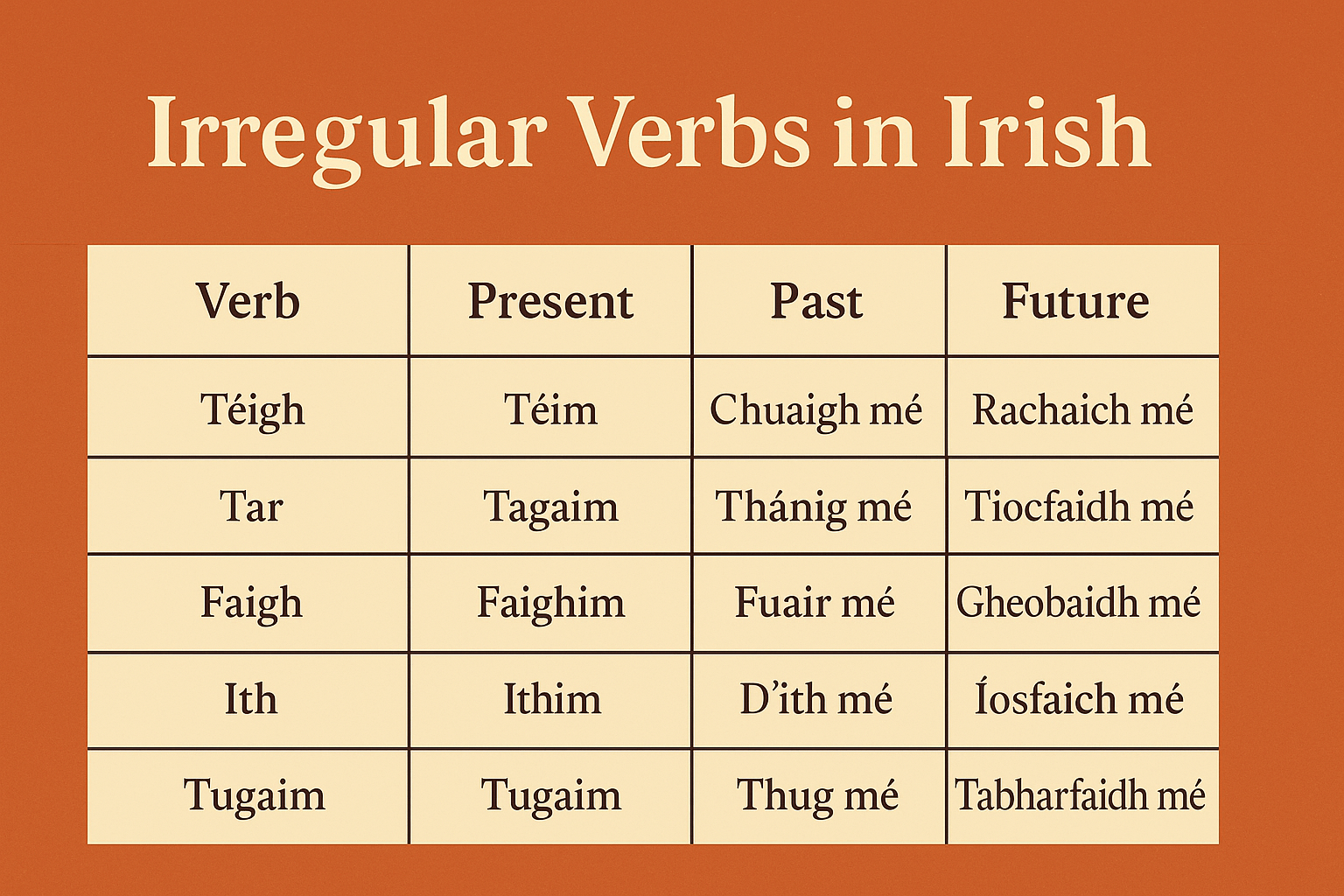
Mastering Irregular Verbs in Irish: A Practical Guide for Learners

If you’re learning the Irish language, you’ve likely stumbled upon one of its trickiest aspects—irregular verbs in Irish. These verbs, known in Irish as briathra neamhrialta, don’t follow the standard rules of conjugation and can leave even the most motivated learners scratching their heads.

But don’t worry—you’re not alone, and you’re not without support. With the help of Gaeilgeoir AI’s powerful learning tools, understanding and using these irregular Irish verbs becomes much more manageable. In this guide, we’ll walk you through what irregular verbs are, why they matter, and how to master them effectively—even if you’re just starting out.

What Are Irregular Verbs in Irish?
In any language, irregular verbs are those that don’t follow the usual conjugation patterns. Irish has 11 core irregular verbs, each with unique forms in the past, present, and future tenses. Rather than simply adding an ending like regular verbs, irregular verbs can change their stems entirely.

Here are the 11 irregular verbs you’ll need to know:

  1. Abair – to say
  2. Beir – to catch
  3. – to be
  4. Clois – to hear
  5. Déan – to do/make
  6. Faigh – to get
  7. Feic – to see
  8. Ith – to eat
  9. Tabhair – to give
  10. Tar – to come
  11. Téigh – to go

These verbs appear all the time in Irish, so getting comfortable with them early can dramatically improve your fluency.

Why Irregular Verbs Matter So Much
Irregular verbs in Irish form the backbone of everyday conversation. They help you express basic actions like going places (Téigh), being somewhere (), seeing things (Feic), or saying how you feel (Abair). Mastering these will help you move from basic phrases to actual conversations with confidence.

Many irregular verbs are also part of idiomatic expressions, which are essential if you want to sound natural and native. For example, Rug mé greim air means “I grabbed hold of it,” using the past tense of Beir.

How Gaeilgeoir AI Helps You Learn Irregular Verbs
Gaeilgeoir AI is designed specifically to make tricky grammar like this easier. With AI-powered grammar tools, real-time feedback, and interactive flashcards, you can master Irish irregular verbs with personalized support. You’ll get smart conjugation tools, targeted quizzes, and pronunciation feedback to help you nail each form. Best of all, the system adapts to your level, so whether you’re a complete beginner or brushing up for an exam, you’ll get exactly what you need. You can start your free trial here to explore these tools firsthand.

Breakdown of the 11 Irregular Irish Verbs

1. Abair (to say)
Present: Deir mé
Past: Dúirt mé
Future: Déarfaidh mé
Example: Dúirt sé go raibh sé tuirseach – He said he was tired.

2. Beir (to catch)
Present: Beirim
Past: Rug mé
Future: Béarfaidh mé
Used in expressions like rug mé greim air – I grabbed it.

3. Bí (to be)
Present: Tá mé
Past: Bhí mé
Future: Beidh mé
Arguably the most important verb in Irish.

4. Clois (to hear)
Present: Cloisim
Past: Chuala mé
Future: Cloisfidh mé
Example: Chuala mé an ceol – I heard the music.

5. Déan (to do/make)
Present: Déanaim
Past: Rinne mé
Future: Déanfaidh mé
Example: Rinne sí an obair bhaile – She did the homework.

6. Faigh (to get)
Present: Faighim
Past: Fuair mé
Future: Gheobhaidh mé
Example: Fuair mé bronntanas – I got a present.

7. Feic (to see)
Present: Feicim
Past: Chonaic mé
Future: Feicfidh mé
Example: Feicfidh mé thú amárach – I’ll see you tomorrow.

8. Ith (to eat)
Present: Ithim
Past: D’ith mé
Future: Íosfaidh mé
Example: D’ith mé an t-arán – I ate the bread.

9. Tabhair (to give)
Present: Tugaim
Past: Thug mé
Future: Tabharfaidh mé
Example: Thug sé an leabhar dom – He gave me the book.

10. Tar (to come)
Present: Tagaim
Past: Tháinig mé
Future: Tiocfaidh mé
Example: Tháinig siad go mall – They came late.

11. Téigh (to go)
Present: Téim
Past: Chuaigh mé
Future: Rachaidh mé
Example: Chuaigh muid chuig an trá – We went to the beach.

Quick Verb Conjugation Table

VerbPresentPastFuture
TéighTéimChuaigh méRachaidh mé
TarTagaimTháinig méTiocfaidh mé
FaighFaighimFuair méGheobhaidh mé
IthIthimD’ith méÍosfaidh mé
TabhairTugaimThug méTabharfaidh mé

Tips for Learning Irregular Verbs Effectively

1. Start Small
Begin with just 2 or 3 verbs and focus on using them in full sentences.

2. Group Similar Patterns
Note that some verbs follow similar patterns in certain tenses. For example, Chonaic mé (I saw) and Chuala mé (I heard) both start with “Cho-” in the past.

3. Use Context
Don’t just memorize isolated verb forms. Try using them in real contexts. For example, in your daily journal: Dúirt mé le mo chara…

4. Practice with Flashcards
Gaeilgeoir AI offers smart flashcards that test you on conjugation forms and usage.

5. Check for Common Errors
Avoid mistakes like saying deanaigh mé instead of rinne mé. These small slips are common but easily corrected. You can read more about them in our Common Mistakes in Irish article.

6. Use Realistic Dialogue
Check out our Basic Irish Conversation Guide to see these verbs in actual use. It’s easier to remember verbs when they’re tied to meaning and emotion.

How AI Is Revolutionizing Irish Grammar Learning
AI in education has made language learning more engaging and effective. According to a Cambridge study on AI tools in language learning, AI systems help learners retain grammar patterns, reduce errors, and stay motivated. Gaeilgeoir AI follows these same principles by offering smart, adaptive learning tailored to Irish.

Common Pitfalls to Avoid

  • Confusing irregular forms (e.g., Feic vs. Faigh)
  • Over-regularizing verbs (e.g., deanaigh mé)
  • Forgetting tense-specific stem changes

Final Thoughts
Irregular verbs in Irish may seem like an intimidating hurdle, but with the right approach and consistent practice, you’ll master them. These verbs are essential for expressing everyday actions and emotions. Learning them unlocks your ability to have real, flowing conversations.

Gaeilgeoir AI is here to make that journey easier. With personalized lessons, grammar tools, and pronunciation feedback, you’ll gain confidence in no time. If you’re serious about learning Irish, don’t waitjoin our learning platform and take your Irish to the next level today.

Further Reading

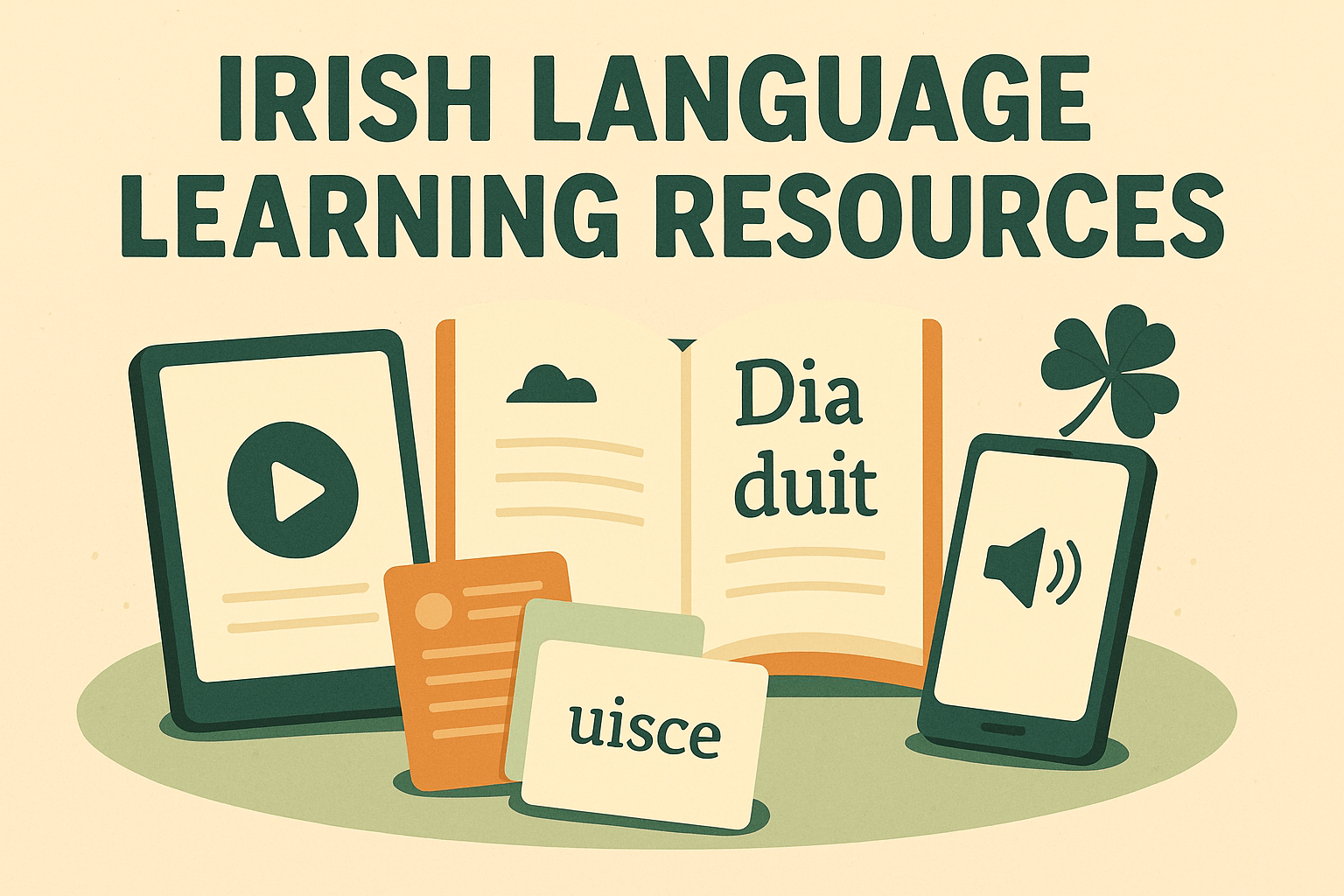
Best Irish Language Learning Resources Online

Learning the Irish language (Gaeilge) can be an incredibly rewarding experience—whether you’re connecting with your heritage, planning a trip to Ireland, or simply embracing a new linguistic challenge. Thanks to innovative technologies and dedicated platforms like Gaeilgeoir AI, learners today have access to some of the best Irish language learning resources available online.

In this article, we’ll explore a range of tools, strategies, and support systems that can help you master Gaeilge at your own pace. From AI-powered apps and digital flashcards to pronunciation guides and community support, there’s something here for every level of learner.


Why Learn the Irish Language?

Before diving into the tools, it’s worth pausing to consider why learning Irish is so valuable. Gaeilge is more than just a language—it’s a gateway to Irish culture, identity, and history. It’s spoken daily in the Gaeltacht regions of Ireland and taught in schools across the country. But outside of Ireland, there’s a growing global movement of people learning Irish as a second language.

Plus, modern learners now benefit from a range of intuitive, tech-enabled tools that make learning easier and more fun than ever before.


Gaeilgeoir AI: The Future of Irish Language Learning

At the heart of this digital learning revolution is Gaeilgeoir AI, a comprehensive platform offering AI-powered Irish language resources tailored for learners of all levels. From complete beginners to advanced students, the platform provides:

  • Smart grammar tools that correct and explain usage in real time
  • Vocabulary builders with spaced repetition systems
  • Interactive pronunciation guides powered by natural language processing
  • On-demand lessons and cultural insights to deepen understanding

Ready to give it a try? You can sign up for free here.


Top Irish Language Learning Resources (With Gaeilgeoir AI)

Here are some of the most effective resources offered through Gaeilgeoir AI and beyond, ideal for self-study or structured learning.

1. Interactive Irish Grammar Tools

Grammar can be tricky in any language, but Gaeilge comes with its own set of unique rules—mutations, verb conjugations, and prepositional pronouns, to name a few. Gaeilgeoir AI’s Irish grammar resources include smart quizzes, visual guides, and AI-generated explanations that break down complex rules into bite-sized lessons.

Tip: Check out the article on mastering Irish prepositional pronouns for a deeper dive.


2. Pronunciation and Listening Tools

One of the biggest challenges for learners is mastering authentic Irish pronunciation. With dialectal differences across Munster, Connacht, and Ulster, it can be confusing to know where to start.

Gaeilgeoir AI’s platform offers AI-generated voice samples in various dialects, helping you develop an ear for native sounds. Pair these tools with this pronunciation guide to get started.

For external practice, the Foras na Gaeilge website offers free sound files and language programs backed by the Irish government.


3. Daily Practice Plans and Flashcards

Consistency is key to language acquisition. Gaeilgeoir AI helps you stay on track with daily practice plans and flashcards based on spaced repetition, a proven technique for long-term retention. These bite-sized learning tools ensure you absorb new vocabulary and grammar gradually and naturally.

Explore their daily Irish practice plan to start building a sustainable routine.


4. Irish Language Vocabulary Expansion

Gaeilgeoir AI offers a variety of themed vocabulary sets—from emotions and colors to weather and Irish mythology. Whether you’re preparing for a conversation or a cultural event, these packs are ideal for expanding your lexicon.

We recommend browsing their guide to expanding your Irish vocabulary, which includes interactive lists and pronunciation aids.


5. Cultural and Historical Context

Understanding the culture behind the language adds richness to your learning. Gaeilgeoir AI integrates cultural notes throughout its lessons—everything from ancient Celtic traditions to modern Irish slang.

For example, this engaging guide to Bealtaine explains the cultural significance of the May festival in Ireland, offering phrases and terms linked to the season.


Irish Language Learning Resources for Self-Study

While Gaeilgeoir AI provides a robust foundation, here are other trusted tools and resources to enhance your self-study journey:

External Resources:

  • Duolingo: Great for casual learning and vocabulary review.
  • Teanglann.ie: An online Irish-English dictionary with grammar, pronunciation, and historical examples.
  • TG4.ie: Watch Irish-language TV shows with subtitles to improve comprehension.

Internal Resources:


Tips for Success: Learning Gaeilge with Confidence

Here are some practical strategies for making the most of your Irish language learning resources:

Start Small

Begin with greetings and everyday expressions. This guide to basic Irish conversation is a great place to start.

Be Consistent

Even 10–15 minutes a day of focused practice can make a big difference over time.

Practice Aloud

Speaking regularly—even to yourself—helps reinforce pronunciation and sentence structure.

Join a Learning Community

Surrounding yourself with others who are also learning Gaeilge can be incredibly motivating. Gaeilgeoir AI offers discussion groups and community challenges inside the platform.


Final Thoughts: A Language Worth Learning

Gaeilge is a vibrant, poetic, and deeply meaningful language that continues to thrive thanks to learners like you—and tools like Gaeilgeoir AI. Whether you’re starting from scratch or refining your skills, there’s never been a better time to embrace this journey.

If you’re ready to take your learning further, we encourage you to sign up for a free trial of Gaeilgeoir AI and explore the world of Irish language learning resources waiting for you.

Irish Language Books: A Guide to Learning and Reading Gaeilge

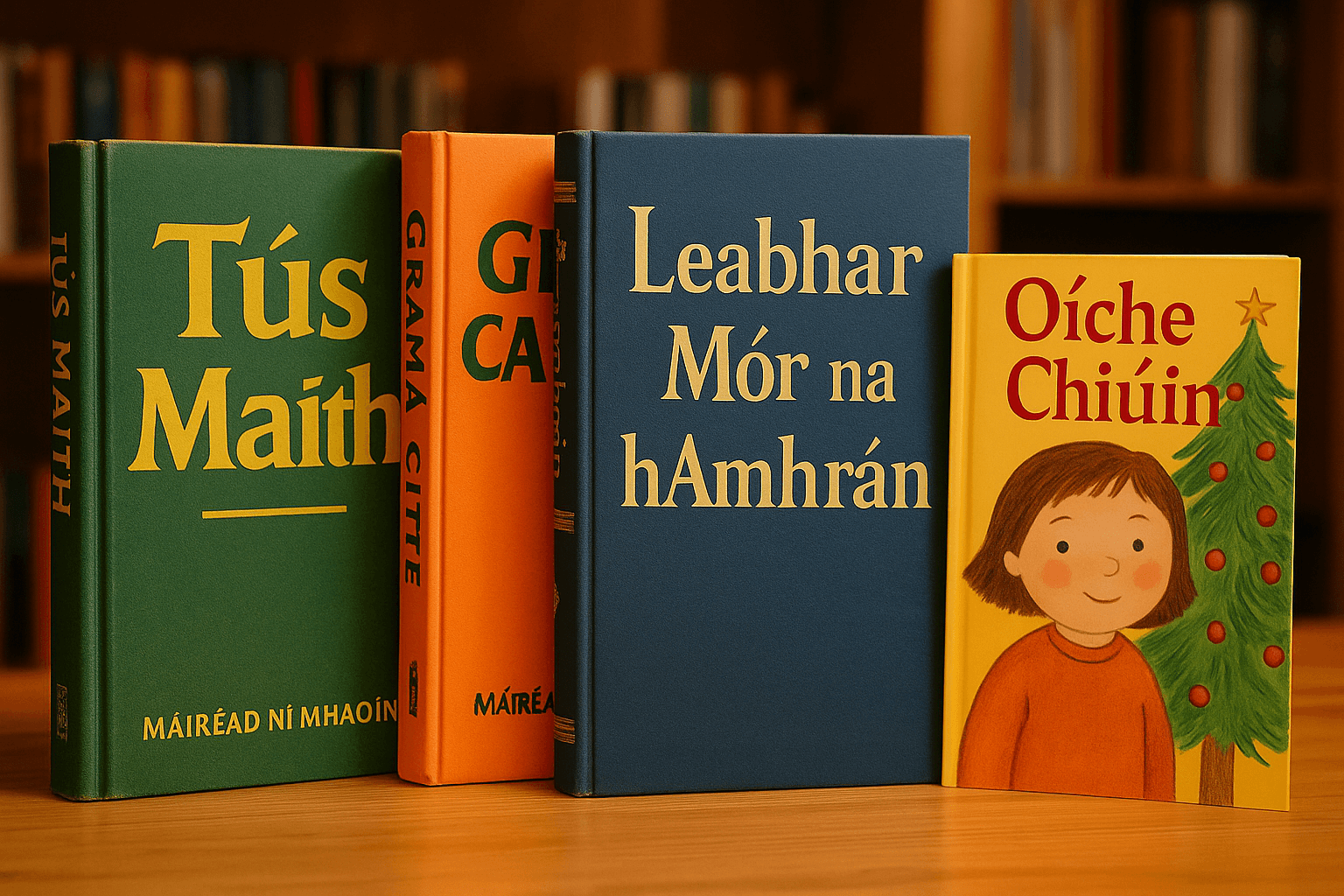
For beginners, the right book can reinforce vocabulary and sentence patterns you’re already learning. As your Irish improves, reading exposes you to more natural expressions, richer vocabulary and ways of using the language that you may not encounter in individual lessons.

The difficult part is choosing something appropriate for your level.

Start with a novel that is far beyond your current Irish and you can end up looking up every second word. Choose material that is too easy and you may not learn very much at all.

This guide looks at the different types of Irish-language books worth exploring, how to choose books for your level and, most importantly, how to actually use reading to improve your Gaeilge.

Are Irish-Language Books Good for Beginners?

Yes, but you need to choose carefully.

A complete beginner probably shouldn’t start by attempting a challenging Irish novel simply because it’s famous. At this stage, books designed for learners, children’s books, graded material and short texts can be much more useful.

The aim is to find material where you can understand enough of the Irish to follow what’s happening while still encountering unfamiliar vocabulary and structures.

You don’t need to understand every word.

In fact, learning to continue reading despite encountering unfamiliar vocabulary is an important skill in itself.

If you’re still building the foundations before tackling longer texts, you can learn Irish online for free and develop some core vocabulary and sentence patterns alongside your reading.

What Kind of Irish Books Should Beginners Read?

There isn’t one perfect first Irish book.

The right choice depends on your vocabulary, your previous experience with Gaeilge and what you actually enjoy reading.

For beginners, I’d look at a few categories.

Books Written Specifically for Irish Learners

Learner-focused books can provide a much gentler introduction to reading Gaeilge.

The vocabulary and grammar are often more controlled, allowing you to concentrate on understanding the language without encountering something unfamiliar in every sentence.

Some may include glossaries, translations or explanations to help you along.

These books can be particularly useful if your ultimate goal is to read ordinary Irish-language literature but you’re not quite ready for it yet.

Children’s Books in Irish

Children’s books can be useful, but there’s an important misconception here.

Written for children doesn’t necessarily mean easy for an adult language learner.

A children’s story may assume that its young reader already speaks Irish fluently. That means you can still encounter idioms, unusual vocabulary and grammatical structures that are difficult for a learner.

Picture books and simpler stories can nevertheless be excellent resources because illustrations provide context and the amount of text is manageable.

Just don’t assume every children’s book will automatically be beginner-level Irish.

Familiar Stories Translated Into Irish

Reading a story you already know can make comprehension much easier.

If you understand the characters and general plot, you have additional context when you encounter unfamiliar Irish.

Instead of trying to understand both the story and the language simultaneously, you can concentrate more heavily on Gaeilge.

This can make translated works a useful bridge toward more independent reading.

Don’t Look Up Every Irish Word

This is probably the most important reading habit to develop.

Imagine you’re reading a paragraph and encounter five words you don’t know.

If you immediately stop and look up all five, you’ve turned reading into dictionary practice.

Instead, ask whether you can understand the overall meaning without them.

Sometimes the surrounding sentence makes a word reasonably obvious. Sometimes the exact meaning doesn’t matter. Sometimes the same word appears repeatedly and gradually becomes clearer.

Look something up when it is preventing you from understanding an important sentence or when the word keeps appearing and seems genuinely useful.

That keeps reading enjoyable while still allowing you to learn.

Use Books Alongside Structured Irish Learning

Reading is powerful, but books don’t have to do all the work.

A novel isn’t necessarily going to stop and explain why a word changed at the beginning of a sentence. It won’t necessarily teach you pronunciation, test whether you remember vocabulary or give you speaking practice.

That’s why reading works particularly well alongside structured learning.

You might learn vocabulary or grammar in a lesson and then recognise the same pattern while reading. Suddenly the rule isn’t just an exercise anymore. You’ve encountered it being used for a real purpose.

Likewise, a word you discover in a story can become something you deliberately practise later.

If you want to combine reading with lessons, vocabulary, listening and active practice, our guide to how to learn Irish online explores how those different parts of language learning can work together.

How to Read an Irish Book When Your Gaeilge Isn’t Fluent

You don’t need to wait until you’re fluent.

Try reading in layers.

On your first pass, read a paragraph or page without reaching for a dictionary. Concentrate on what you do understand.

Then go back.

Look at the unfamiliar parts and decide which ones actually matter.

If one word keeps appearing, look it up. If you encounter a sentence structure you recognise from your studies, pause and notice how it’s being used.

Then continue reading.

The objective isn’t to produce a perfect translation of the book.

It’s to understand increasingly more Irish directly.

Keep a Vocabulary List — But Keep It Selective

Books are excellent sources of new vocabulary because words appear in context.

That doesn’t mean every unfamiliar word deserves a place in your study list.

If you encounter a useful word repeatedly, save it.

Then don’t just write:

Irish word = English word

Record the phrase or sentence where you encountered it.

That gives you context when you review the vocabulary later.

For example, learning a word connected with weather inside an actual sentence gives you much more information than simply adding another translation to a list.

Over time, you’ll build a personal vocabulary collection based partly on the Irish you actually read.

Read Irish Aloud Occasionally

Reading doesn’t always have to be silent.

Choose a short paragraph and try reading it aloud.

This forces you to pay attention to the relationship between Irish spelling and pronunciation and can reveal words that you recognise visually but aren’t confident saying.

Don’t assume English pronunciation rules apply to Gaeilge.

If you have access to an audio version of the same material, even better. Listen to the speaker and then return to the text.

You can begin connecting what Irish looks like with what Irish sounds like.

Try Reading the Same Passage More Than Once

Rereading can be extremely useful when learning a language.

The first time through a passage, you may be concentrating heavily on understanding what is happening.

The second time, familiar vocabulary requires less effort.

That gives you more mental space to notice grammar, expressions and words you missed previously.

Return to the same passage several days later and you may be surprised by how much easier it feels.

That’s a useful reminder that progress isn’t always about consuming new material.

Sometimes you learn more by revisiting something difficult until it becomes familiar.

Should You Read Irish With an English Translation?

Parallel texts and translations can be useful, but try not to let the English do all the work.

If both languages are sitting beside each other, your eyes will naturally drift toward whichever one is easier.

Usually that’s English.

Try reading the Irish first.

Work out as much as you can, then use the English to check your understanding.

That way, the translation becomes a support rather than a replacement for reading Gaeilge.

As your level improves, gradually reduce how often you rely on it.

Irish Books for Intermediate Learners

Once you’re comfortable with shorter learner-focused material, start increasing the difficulty gradually.

Short stories can be particularly useful because they give you authentic literary Irish without requiring you to commit to hundreds of pages.

You can also explore contemporary fiction, non-fiction, memoir, folklore and poetry depending on your interests.

At this level, don’t worry if you encounter unfamiliar language regularly.

You’re trying to reach the point where you can follow the meaning of a passage without understanding every individual word.

That’s a significant step toward independent reading.

Irish Books for Advanced Learners

At a more advanced level, the range opens considerably.

You can explore novels originally written in Irish, historical writing, poetry, essays, biography and more specialised material.

Reading becomes less about practising a particular grammar point and more about experiencing ideas and stories through Gaeilge itself.

You’ll also encounter much richer vocabulary, dialectal features, idiomatic language and different writing styles.

At this point, Irish literature isn’t simply a learning resource.

It’s literature.

And that’s an important distinction.

Read What You Actually Enjoy

There’s little value in forcing yourself through a book you hate simply because you think it’s educational.

If you enjoy mythology, read mythology.

If you like history, find Irish-language historical material.

If you’re interested in contemporary Ireland, look for modern writing.

If songs and poetry are what draw you toward Gaeilge, follow that interest.

Motivation matters enormously when reading in another language because everything takes more effort.

A book you’re genuinely curious about gives you a reason to push through the difficult sections.

Combine Reading With Listening

Reading and listening reinforce one another.

Reading gives you time to examine vocabulary and sentence structures carefully. Listening forces you to process Irish at the speed at which it is actually spoken.

Try combining books with audiobooks where possible.

You can also supplement reading with Irish-language podcasts, radio, songs and videos.

The more contexts in which you encounter Gaeilge, the more likely familiar words are to start jumping out at you.

A word you studied in a lesson might appear in a story.

Then you hear it in a podcast.

Then it appears in a song.

Eventually it stops feeling like a vocabulary item you’ve memorised and starts feeling like a word you simply know.

Create a Simple Irish Reading Routine

You don’t need to read fifty pages a day.

Ten minutes is enough to build the habit.

Try something like this:

First five minutes: Read without stopping and concentrate on meaning.

Next three minutes: Return to difficult sentences and investigate a few important words.

Final two minutes: Choose one or two useful phrases or words to remember.

That’s it.

If the book is enjoyable, you’ll probably continue anyway.

If it isn’t, ten focused minutes still gives you useful contact with Gaeilge without making reading feel like homework.

Where Do Irish Books Fit Into Your Learning?

Think of books as one part of a wider Gaeilge environment.

Structured lessons can introduce concepts.

Vocabulary practice helps you retrieve words.

Conversation makes you produce language.

Podcasts and videos develop your listening.

Books expose you to Gaeilge being used to tell stories, communicate ideas and create something worth reading.

Those activities support each other.

If you’re still at the beginning, explore ways to learn Irish online for free and gradually introduce reading alongside your other practice.

If you’re ready for a more structured approach, our Learn Irish Online guide explains how to combine lessons, vocabulary, listening, speaking and immersion.

Final Thoughts

Irish-language books can become one of the most rewarding parts of learning Gaeilge.

But don’t make the mistake of believing you need to understand everything before you’re allowed to read.

Start with material that’s challenging enough to teach you something but accessible enough that you can still follow it.

Read for meaning first. Look things up selectively. Save useful vocabulary. Occasionally read aloud. Revisit difficult passages. And gradually move toward more challenging material as your Irish develops.

Eventually, something quite satisfying happens.

You stop reading an Irish book primarily because you’re learning Irish.

You start reading it because you want to know what happens next.

Go n-éirí leat!

Irish Language Act: What It Means for Gaeilge Learners

For decades, the fight for official recognition and protection of the Irish language in Northern Ireland has been both political and deeply personal. The passing of the Irish Language Act marks a pivotal moment in that journey. For learners and native speakers alike, the Act is more than legal reform—it’s a powerful cultural affirmation.

But what does the Irish Language Act actually do? And how can it inspire your journey as an Irish language learner? In this post, we’ll explore the origins of the legislation, what it means in practical terms, and how it supports the ongoing revival of Irish (“Gaeilge”).


What Is the Irish Language Act?

The Irish Language Act refers to legislation passed in the UK Parliament as part of the New Decade, New Approach agreement, which aimed to restore Northern Ireland’s devolved government in 2020. After years of campaigning by language advocates, the British government formally committed to enacting legal protections for the Irish language.

The law was officially enacted as part of the Identity and Language (Northern Ireland) Act 2022, which also includes protections for Ulster Scots. This marked the first time the Irish language was given official status within a legal framework in Northern Ireland.


Key Provisions of the Act

Here are some of the Act’s most important features:

1. Commissioner for the Irish Language

An independent commissioner is appointed to monitor public authorities and promote the use of Irish in public life.

2. Language Standards for Public Bodies

Public authorities in Northern Ireland are required to adhere to language standards, making services more accessible to Irish speakers.

3. Legal Recognition of Irish Place Names

The Act allows for bilingual signage and the use of Irish names for streets, buildings, and districts, reflecting cultural heritage.

4. Cultural and Educational Support

Additional funding and resources are allocated for Irish-medium education, broadcasting, and cultural programming.

These changes align with broader European principles on minority languages, including those supported by the Council of Europe’s Charter for Regional or Minority Languages.


Why the Irish Language Act Matters

For many, the Irish Language Act is about far more than language.

  • Cultural Identity: It affirms the legitimacy of Irish heritage and expression in Northern Ireland.
  • Educational Opportunities: It opens doors for Irish-medium education and lifelong learning.
  • Equal Access: It ensures Irish speakers can engage with government services in their native language.
  • Symbolic Recognition: It acknowledges the historical marginalization of Irish and offers a path to healing.

In short, it’s a celebration of identity, equality, and resilience—core values shared by many Irish learners worldwide.


How It Impacts Irish Learners

Whether you’re a heritage speaker or just beginning your Gaeilge journey, the Irish Language Act creates momentum for the language’s growth and visibility.

Practical Benefits:

  • More learning resources and funding
  • Increased visibility of Irish in public spaces
  • Expanded job opportunities in education, translation, media, and government
  • Greater confidence among learners and speakers

These benefits extend beyond Northern Ireland. As more institutions embrace bilingualism, the prestige and accessibility of the Irish language increase across Ireland and in global Irish communities.


The Role of Technology in Supporting the Act

At Gaeilgeoir AI, we believe that legislation alone isn’t enough—learners need accessible, engaging tools to thrive. That’s why we’re committed to offering AI-powered resources that:

  • Adapt to your learning style
  • Offer pronunciation and grammar help

Want to take your next step? Explore our Creative Ways to Learn Gaeilge and see how we make language learning fun and meaningful.


A Brief History of Language Rights in Ireland

To appreciate the significance of the Irish Language Act, it helps to understand the historical backdrop.

  • Colonial Suppression: The Penal Laws (17th–18th centuries) marginalized Irish speakers.
  • 19th-Century Decline: The Great Famine and emigration accelerated language loss.
  • Gaelic Revival: Movements like Conradh na Gaeilge (founded 1893) began restoring pride in Gaeilge.
  • Good Friday Agreement (1998): Recognized Irish as a valued part of Northern Ireland’s cultural wealth.
  • Irish Language Act (2022): A legislative milestone after decades of grassroots activism.

How You Can Support the Irish Language

Whether you’re based in Belfast, Boston, or Brisbane, you can support the aims of the Irish Language Act by:

  1. Learning Gaeilge – Start with basic phrases and build from there.
  2. Using Irish in daily life – Greet friends with “Dia dhuit” or say “Slán” when parting.
  3. Encouraging bilingual signage in your community.
  4. Supporting Irish-language media and authors.
  5. Sharing your progress on social media to raise awareness.

Connect With Other Irish Learners

The Irish Language Act reminds us that language is a shared cultural treasure. Connect with others who are on the same path, ask questions, and celebrate small victories.

You can even join our Gaeilgeoir AI community to gain access to free tools, personalized lessons, and discussion spaces designed to support every stage of your learning journey.


Final Thoughts

The Irish Language Act is a significant leap forward in promoting and protecting Gaeilge in Northern Ireland and beyond. For learners, it brings new opportunities, renewed visibility, and a deeper connection to Irish identity and history.

At Gaeilgeoir AI, we celebrate this progress and stand ready to help learners like you thrive.

Ready to begin? Sign up today and experience a smarter way to connect with the Irish language.

The Origins of Irish Language: A Journey Through Time

The origins of the Irish language reach far back into ancient European history, weaving together myth, migration, and linguistic evolution. Known as Gaeilge in its native tongue, Irish is one of the oldest written and spoken languages in Europe. At Gaeilgeoir AI, we believe that understanding the roots of a language deepens your appreciation and motivation to learn it. Through our AI-powered tools, we make the beauty and complexity of Irish more accessible to learners around the world.

In this article, we’ll uncover the fascinating beginnings of the Irish language, trace its evolution from Proto-Celtic to Modern Irish, and explore how you can become a part of its vibrant future.


What Are the Origins of the Irish Language?

A Celtic Language With Ancient Roots

Irish belongs to the Celtic branch of the Indo-European language family. More specifically, it is a Goidelic (or Gaelic) language, alongside Scottish Gaelic and Manx. Its journey began over 2,500 years ago, evolving from a common Celtic language spoken by Iron Age tribes.

Historians believe that Celtic-speaking peoples arrived in Ireland around 500 BCE. These early settlers likely brought with them a Proto-Celtic language, which would eventually diverge into the Goidelic family.

Key milestones in the history of the Irish language include:

  • 500 BCE–400 CE: Arrival of Celtic-speaking tribes in Ireland
  • 4th–6th centuries CE: Emergence of Primitive Irish, evidenced by Ogham inscriptions
  • 6th–10th centuries: Development of Old Irish, preserved in manuscripts and religious texts
  • 10th–12th centuries: Transition to Middle Irish, a period of literary expansion
  • 1200–1650: Early Modern Irish, the foundation of many modern dialects
  • 1650–Present: Modern Irish, as it continues to evolve and be revitalized

For a deep dive into the ancient origins of Irish, check out our Ancient Irish Language Guide.


Irish Through the Ages: Language, Identity, and Revival

Ogham: Ireland’s First Written Language

The earliest known written form of Irish is Primitive Irish, found in Ogham inscriptions carved on standing stones. These date from the 4th to 6th centuries CE and offer us a glimpse into early Irish society, with names of individuals and clans marking territories and honoring the dead.

Learn more about this unique alphabet in our full Ogham Script Alphabet Guide.


Old Irish and the Golden Age of Learning

Between the 6th and 9th centuries, Ireland experienced a Golden Age of monastic scholarship. Monks recorded religious texts, laws, and myths in Old Irish, giving us invaluable linguistic and cultural insights. Texts like the Táin Bó Cúailnge and Lebor Gabála Érenn (Book of Invasions) are not only epic tales but also linguistic goldmines for learners and scholars.


Colonialism, Decline, and Resistance

From the 16th century onwards, English rule and cultural suppression led to a sharp decline in Irish usage. The Great Famine, forced emigration, and educational policies that banned Irish in schools nearly extinguished it. Yet, through perseverance and national pride, Irish survived.

Movements in the 19th and 20th centuries, including the Gaelic Revival, reignited interest in preserving and speaking Irish. Today, efforts to restore the language continue across schools, homes, and digital platforms.

Want to explore the ups and downs of Irish history? Visit Irish Language Decline & Revival.


Gaeilgeoir AI: A Modern Solution for an Ancient Language

Why Tech Matters for Language Learning

At Gaeilgeoir AI, we believe that combining historical context with modern tools is the best way to master the Irish language. Our AI-powered platform offers:

  • Personalized daily lessons based on your learning level
  • Real-time feedback on pronunciation and grammar
  • Vocabulary games and flashcards rooted in authentic usage
  • Cultural insights alongside linguistic practice

Curious how it works? Sign up for a free trial today and start speaking Irish with confidence!


Why Learning the Origins of Irish Matters

Understanding where Irish comes from makes your learning experience richer and more rewarding. Here’s why:

  • Cultural Connection: You gain a deeper appreciation for Irish literature, folklore, and traditions
  • Linguistic Clarity: Knowing the structure and evolution of Irish can help clarify grammar and usage
  • Personal Motivation: Learning about a language’s survival against the odds is incredibly inspiring
  • Community Building: When you study Irish, you join a global network of learners and native speakers

And yes, you can learn Irish by yourself—find out how in our self-study guide.


Fun Facts About the Irish Language

  • Irish is the first official language of Ireland, though English is more widely spoken
  • It is still spoken daily in Gaeltacht regions such as Connemara, Donegal, and Kerry
  • Irish has influenced English with words like galore, brogue, and smithereens
  • “An Ghaeilge” is the native term for Irish, and its speakers are called Gaeilgeoirí

How Gaeilgeoir AI Helps You Connect with the Past—and the Future

At Gaeilgeoir AI, we don’t just teach words—we teach meaning, heritage, and identity. Whether you’re a beginner or brushing up your skills, we help you:

  • Learn pronunciation that reflects regional dialects
  • Understand Irish grammar intuitively
  • Practice listening and conversation with smart AI tutors
  • Explore mythology, history, and traditions embedded in language

Check out our Creative Ways to Learn Gaeilge for tips on keeping your learning journey exciting.


External Resources for Language Enthusiasts

Want to dig deeper into Celtic linguistics and the evolution of Irish? We recommend the following reputable sources:


Final Thoughts: Keeping the Irish Language Alive

The origins of the Irish language are not just a scholarly topic—they are a living story of resilience, identity, and beauty. Whether you’re fascinated by Ogham stones or want to chat with your grandmother in Gaeilge, the journey begins with understanding the past and embracing the future.

Ready to take your first step? Join a growing global community of Irish language learners by signing up for Gaeilgeoir AI. Let our AI be your guide as you uncover the magic of one of the world’s most storied languages.

Start Speaking Irish Today — 25% Off
Use code START25

Learn real Irish for real life with guided practice, pronunciation support, and everyday conversations.

Get 25% off any plan with code START25

Start Speaking Irish Today — 25% Off