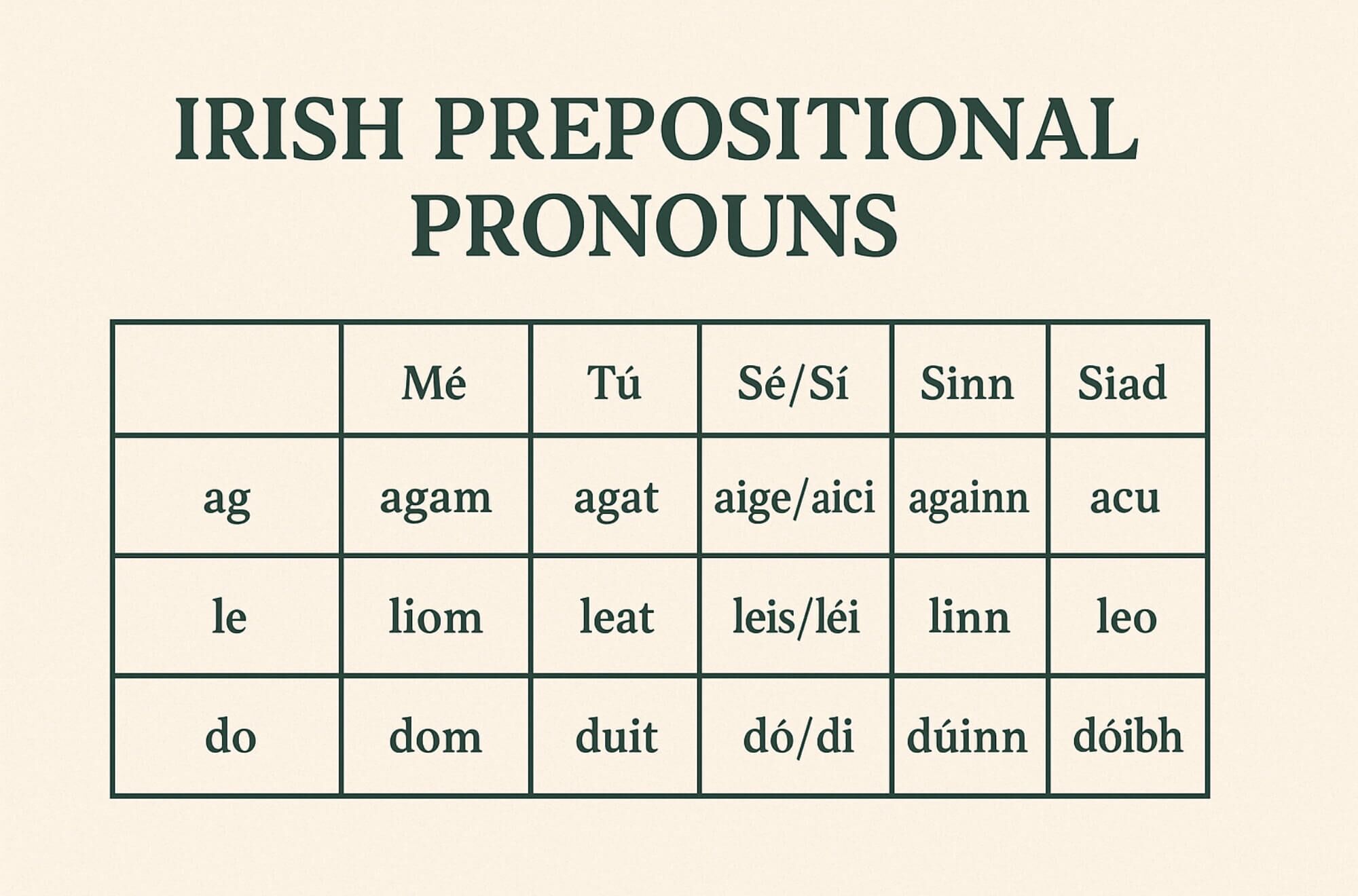
What Are Irish Prepositional Pronouns?

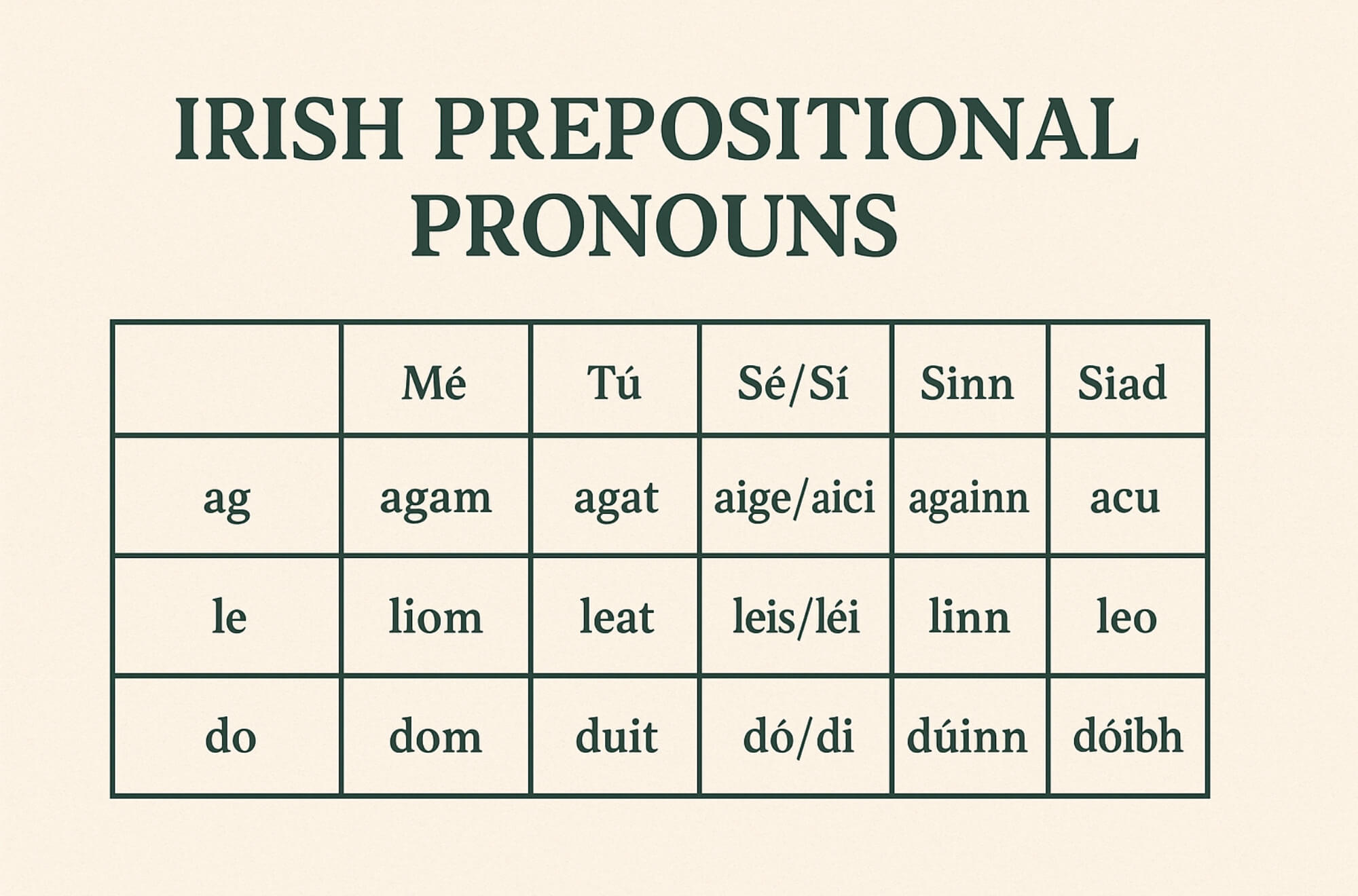
Chart displaying Irish prepositional pronouns formed from 'ag', 'le', and 'do' with pronouns mé, tú, sé/sí, sinn, siad, including examples like 'agam', 'liom', and 'dom', on a beige background with bold green text titled 'Irish Prepositional Pronouns'.

Irish prepositional pronouns matter because they show everyday meaning that English usually spreads across two words: who something is with, who something is given to, and who has something. Once you can handle forms like agam, liom, and duit, ordinary Irish sentences become much easier to read, hear, and produce.

Focus is on the forms learners meet early and often, with examples of how to use them in real sentences. The goal is not just recognizing grammar terms, but understanding common Irish patterns for possession, accompaniment, and indirect objects.

How We Built These Irish Prepositional Pronoun Examples

To make this article more useful as a reference, I rebuilt the examples around high-frequency prepositions that learners repeatedly encounter in beginner and lower-intermediate Irish: ag, le, and do. That choice is deliberate. These are the forms that show up in possession patterns such as Tá leabhar agam, in everyday interaction such as Tá sé liom, and in recipient patterns such as Abair liom or Thug mé é duit. Historical work on Irish grammar also shows that conjugated prepositions are not a quirky exception but a core structural feature inherited from Old Irish, where preposition-plus-pronoun combinations had already developed into single forms MIT overview.

Filter out examples that are technically literal but unnatural in normal speech. If a sentence sounds like a classroom puzzle rather than something a speaker would say, drop it. This is an efficient way to improve clarity: many weak explanations of Irish grammar fail not because the rule is wrong, but because the example is not the sentence a learner is likely to need first. Where possible, favor short patterns learners can immediately reuse aloud.

What Are Irish Prepositional Pronouns?

Irish prepositional pronouns are fused forms: a preposition and a pronoun combine into one word rather than standing separately. English says at me, with him, or to us. Irish usually expresses those ideas as agam, leis, and dúinn. That difference is structural, not optional. Research on Celtic languages describes this kind of prepositional agreement as a defining feature of the family, shared with related languages such as Scottish Gaelic and Manx TU Dublin paper.

A simple contrast makes the system clearer:

  • at me → agam
  • at you → agat
  • at him → aige
  • with me → liom
  • with her → léi
  • to us → dúinn

These forms are central to everyday Irish because they carry meanings that come up constantly: possession (Tá carr agam, I have a car), accompaniment or association (Tá sé liom, he is with me / I have him), and recipients or addressees (Tabhair dom é, give it to me). In practice, they sit at the heart of ordinary conversation more than many learners expect.

If you want a broader framework for building speaking practice around patterns like these, I also like this piece from Smart Language Learning Academy on using AI well without turning every exercise into random prompting.

The main trap, in my experience, is that learners understand the meaning but still try to build the phrase word by word from English. They reach for a plain preposition plus a separate pronoun, when Irish wants the fused form instead.

Understanding Prepositions in Irish

Before diving into prepositional pronouns, it’s essential to understand prepositions in general. Prepositions describe relationships between nouns or pronouns and other words in a sentence. They convey concepts such as direction, location, time, and manner.

Some common Irish prepositions include:

  • ag (at)
  • le (with)
  • ar (on)
  • do (to)
  • ó (from)
  • faoi (under/about)

In Irish, a preposition is often combined with a pronoun to indicate who is involved in the action or relationship.

How Irish Prepositional Pronouns Are Formed

The most practical way to learn these forms is by memorizing each preposition as a full person-pattern, not as isolated vocabulary. Irish does not build them by placing mé, tú, sé, sí after the preposition. Instead, each preposition has its own established set of fused forms. For common paradigms and standard usage, traditional references such as teanglann grammar tables and Nualeargais grammar notes remain helpful checkpoints.

I strongly recommend learning the whole set aloud. When I tested sentence drills, learners retained agam / agat / aige / aici much better than when they tried to memorize one form at a time from a list.

ag — usually possession with Tá … agam

The preposition ag often means “at,” but one of its most important learner uses is possession. Irish commonly expresses “have” with Tá … ag plus a prepositional pronoun.

  • agam, at me
  • agat, at you
  • aige, at him
  • aici, at her
  • againn, at us
  • agaibh, at you (plural)
  • acu, at them

Examples:

  • Tá leabhar agam. I have a book.
  • An bhfuil carr agat? Do you have a car?
  • Tá freagra aici. She has an answer.

The most common learner use case here is simple possession: if you want to say you have something, Tá … agam is one of the first patterns to master.

le — with, with regard to, and sometimes preference or possession by context

The preposition le often corresponds to “with,” but its range is wider than a direct English match. It can show accompaniment, association, and in some patterns something closer to belonging or preferred possession depending on the sentence.

  • liom — with me
  • leat — with you
  • leis — with him
  • léi — with her
  • linn — with us
  • libh — with you (plural)
  • leo — with them

Examples:

  • Tá sí ag caint liom. She is talking to me.
  • An dtiocfaidh tú liom? Will you come with me?
  • Tá na heochracha leo. They have the keys / the keys are with them.

For learners, the most useful first meaning is accompaniment: people, objects, or qualities being “with” someone. Later, you will also meet Is maith liom and similar patterns where le helps express liking.

do — to, for a recipient, addressee, or indirect object

The preposition do usually corresponds to “to” and appears constantly when something is given, shown, said, or sent to someone.

  • dom, to me
  • duit, to you
  • dó, to him
  • di, to her
  • dúinn, to us
  • daoibh, to you (plural)
  • dóibh, to them

Examples:

  • Tabhair dom an leabhar. (Give me the book.)
  • Dúirt sí liom é, ach níor dhúirt sí duit é. (She said it to me, but she didn’t say it to you.)
  • Sheol siad litir dóibh. (They sent them a letter.)

The most common learner use case for do is the recipient pattern: who receives the thing, the message, or the action.

When to Use Irish Prepositional Pronouns

The easiest way to understand usage is to group these forms by function, not by abstract grammar labels. In real Irish, prepositional pronouns often answer one of three questions: who has it, who is with it, or who receives it.

Possession with ag

Irish regularly uses ag to express possession instead of a direct verb meaning “to have.” The pattern is Tá + noun + ag + person, usually as a fused form.

  • Tá cupán tae agam. — I have a cup of tea.
  • Tá beirt deartháireacha aici. — She has two brothers.

This is one of the most important sentence patterns in the language. If you translate English word for word and look for a separate verb “have,” you will miss how natural Irish usually handles possession.

Accompaniment, association, or “with” relationships with le

Use le when the idea is being with someone, having something with someone, or associating an action or state with a person. The exact English translation changes with context, but the relationship remains consistent.

  • Tar liom anois. — Come with me now.
  • Tá an fhadhb sin leis fós. — He still has that problem / that problem is still with him.

I find this category is where learners first realize that one English preposition does not map neatly onto one Irish preposition in every sentence. Meaning comes from the whole pattern, not just the dictionary gloss.

Recipient and indirect object use with do

Use do when someone is the recipient, target, or addressee of an action such as giving, sending, showing, or saying.

  • Thug mé bronntanas di. — I gave her a present.
  • Inis dúinn an scéal. — Tell us the story.

This is often the cleanest place to start thinking about indirect objects in Irish: who something is going to, who hears it, or who receives it.

Some verbs and fixed expressions require the fused form

Many everyday Irish patterns require these prepositional combinations because that is how the verb or expression is built.

  • An maith leat caife? — Do you like coffee?
  • Níl sé liom inniu. — I don’t have it with me today.

The lesson here is simple: once a pattern is established in Irish, you should learn it as a chunk rather than trying to rebuild it from English every time.

Common mistakes to avoid

A very common mistake is using a plain pronoun after a preposition when Irish requires the fused form. For example, learners may try to create the equivalent of “with tú” or “to mé,” but standard Irish uses leat and dom. Another mistake is assuming every English preposition translates directly across contexts. Sometimes English “have” becomes ag, and sometimes English “to” or “with” is part of a fixed Irish expression that must be learned as used.

Tips for Mastering Irish Prepositional Pronouns

The fastest route to confidence is to study one preposition at a time and treat it like a complete pattern. Don’t memorize only agam and hope the rest will fall into place later. Learn the full row, say it aloud, and then use every form in a short sentence.

A practical workflow looks like this:

  1. Memorize one preposition as a full set. Start with ag: agam, agat, aige, aici, againn, agaibh, acu.
  2. Drill the forms aloud in order. Then reverse the order. Then jump randomly between persons.
  3. Attach each form to a short sentence. For example: Tá peann agam. Tá peann agat. Tá peann aici.
  4. Contrast similar-looking forms. Put agam / againn / acu side by side, then liom / leis / leo.
  5. Reuse them in speech, not just on paper. The goal is instant recall in conversation.

A 5-minute daily routine

  • Minute 1: Recite one example from memory.
  • Minute 2: Write all seven forms without looking.
  • Minute 3: Say three possession sentences with ag.
  • Minute 4: Say three accompaniment or preference sentences with le.
  • Minute 5: Say three recipient sentences with do.

What has worked best for me is timed oral recall rather than silent review. If I can produce dúinn or léi quickly in a sentence, I usually know the form well enough to keep it under pressure. Flashcards help at the beginning, but saying full mini-sentences is what usually turns recognition into usable grammar.

A good test of real mastery is this: you can produce the correct form without translating word by word from English first. When Give it to them immediately triggers Tabhair dóibh é, you are no longer just recognizing the pattern, you are using it.

How Gaeilgeoir AI Can Help You Learn Prepositional Pronouns

At Gaeilgeoir AI, we believe in the power of technology to make learning the Irish language more engaging and effective. Our platform uses AI-powered tools to help you master complex grammar concepts, including prepositional pronouns.

Whether you’re just starting out or looking to refine your skills, our platform offers personalized lessons, quizzes, and practice exercises matched to your learning pace. With Gaeilgeoir AI, you can immerse yourself in interactive lessons that focus on real-life usage, helping you feel more confident when speaking and writing in Gaeilge.

Start your Irish language journey today with Gaeilgeoir AI!

Frequently Asked Questions

What are prepositional pronouns in Irish?

They are forms where a preposition and a pronoun combine into one word, such as agam, liom, or duit. Instead of saying “at me” or “to you” as separate words, Irish usually fuses the elements into a single grammatical form.

Why does Irish combine prepositions with pronouns?

Because that is how the language is structurally built. These fused forms are an old and normal part of Irish grammar rather than an optional shortcut, and they remain essential in everyday speech and writing.

How do I memorize forms like agam, agat, aige, agus aici?

Learn them as a sequence, not as isolated items. Say the full set aloud several times, then put each form into a very short sentence such as Tá leabhar agam or Tá carr aici. That combination of pattern plus usage usually sticks faster than rote list memorization alone.

Which prepositions should I master first?

Start with ag, le, and do. They cover possession, accompaniment, and recipients, which gives you access to a large amount of everyday Irish very quickly.

Is there a direct Irish equivalent of the English verb “to have”?

Usually, Irish expresses possession with ag, as in Tá peann agam, “A pen is at me.” That is why ag forms are so important early on.

Do I need to learn every prepositional pronoun at once?

No. In fact, I think that slows most learners down. One full pattern at a time is more effective, especially if you can produce all seven forms accurately before moving to the next preposition.

Conclusion

Mastering Irish prepositional pronouns is an important step in gaining fluency in the Irish language. By understanding how to form and use these combinations effectively, you’ll be able to communicate more naturally and expressively in Gaeilge. With dedication, practice, and the right resources, you’ll soon see improvement in your language skills. For more resources to enhance your Irish learning experience, see the detailed guide to Irish language lessons and start practicing today.
Understanding the Irish Language Decline and Its Revival Efforts

The Irish language decline has been a significant issue throughout the history of Ireland, raising concerns about its future survival. Once spoken by the majority, Irish is now considered an endangered language with fewer speakers every year. However, efforts to revive the language have gained momentum, driven by educational programs, technology, and a renewed cultural interest. Understanding the causes behind the decline of the Irish language and the actions taken to preserve and promote it is essential in our collective effort to safeguard this important part of Ireland’s heritage.

In this post, we’ll explore the historical context of the Irish language decline, the current state of the language, available resources for learning Irish, and the ongoing efforts to breathe life into this linguistic treasure.


Historical Context of Irish Language Decline

Irish Language Decline in the 1800s

The decline of the Irish language can be traced back to the 19th century, a period marked by significant political, social, and economic upheaval. The most notable event contributing to this decline was the Great Famine (1845-1852), which devastated Ireland’s population. With millions dying from hunger and others emigrating, the rural communities where Irish was primarily spoken were decimated. The famine’s aftermath significantly impacted the transmission of the language to future generations.

Additionally, British colonial rule in Ireland exerted a strong influence on the decline of Irish. English was promoted as the language of governance, education, and commerce, making it more desirable for individuals to speak English rather than Irish. The imposition of English through laws and cultural policies further diminished the use of Irish in daily life.

By the late 19th century, Irish was relegated to the status of a minority language. This period of decline was exacerbated by the suppression of Irish culture and language under British rule. Despite being widely spoken up until the 1800s, Irish was soon considered the language of the uneducated and rural poor, which created social stigma around speaking it.


Current State and Resources for Learning Irish

Irish Language Lessons and Resources Available Today

In recent decades, the Irish language has seen a revival, with many resources now available to learners interested in speaking and understanding Irish. The introduction of online courses, language apps like Duolingo, and platforms such as Gaelchultúr has made learning Irish more accessible than ever before. These tools offer beginner to advanced levels of Irish language lessons, helping learners gain fluency at their own pace.

Gaeilgeoir AI, for instance, offers AI-powered tools and resources that make learning Irish easy and efficient. Whether you’re preparing for the Leaving Cert, looking for creative ways to learn, or mastering pronunciation, these resources make the language more approachable.

Education’s Role in Language Preservation

Education plays a critical role in the preservation and revitalization of Irish. Schools across Ireland now offer Irish as part of the curriculum, and many adult learners are turning to online courses to learn the language. These educational platforms have breathed new life into Irish by making it possible for individuals of all ages to become fluent in Irish, preserving the language for future generations.

One of the challenges is ensuring that students engage with the language outside the classroom. Language immersion programs and cultural initiatives, such as summer camps or “seachtain na Gaeilge” (Irish Language Week), are vital to ensuring learners gain practical speaking experience.


Efforts Towards Reviving the Irish Language

Mastering the Irish Language: Vocabulary and Grammar

Efforts to revive the Irish language involve mastering its many facets, including grammar, vocabulary, and pronunciation. Learning key elements such as verb conjugation, noun declensions, and sentence structure is crucial to understanding the language’s framework.

To tackle this, many learners begin by focusing on the most essential vocabulary and conversational phrases, gradually expanding their knowledge. Platforms like Gaeilgeoir AI’s Irish Pronunciation Guide and Irish Language Lessons for Beginners provide step-by-step resources for learning pronunciation and building vocabulary.

Speaking Irish: A Guide to Practice

One of the most effective ways to revive the Irish language is by speaking it regularly. Though many people can read and understand Irish, speaking the language fluently remains a challenge. To address this, learners are encouraged to practice with native speakers, join Irish-speaking communities, or engage in virtual language exchanges.

While formal education is helpful, immersion and everyday practice are key to developing fluency. Using resources such as Gaeilgeoir AI’s Daily Irish Practice Plan allows learners to improve their skills progressively through daily activities and practice.


Comparative Study: Irish vs. Scottish Gaelic

A Comparison of Irish and Scottish Gaelic Grammar

Irish and Scottish Gaelic share a common ancestry but differ in several aspects. Both languages are part of the Celtic language family, but their grammar and pronunciation diverge significantly over time.

  • Verb Conjugation: In Irish, verbs are conjugated according to tense, mood, and person. Scottish Gaelic, however, has a more complex system of verb conjugation, with distinct forms based on the subject and tense.
  • Pronunciation: The two languages also differ in their pronunciation of certain sounds, making them sound distinct despite their shared roots.

While both languages face similar challenges regarding decline, learning Irish provides insight into the broader Celtic linguistic heritage, fostering a deeper understanding of Gaelic as a whole.


Cultural Aspects in Language Revival Efforts

Exploring Seanfhocail (Irish Proverbs)

An essential part of Irish language revival is the preservation of cultural traditions, including seanfhocail (Irish proverbs). These proverbs capture the wisdom of generations and connect learners to Ireland’s rich cultural history.

  • For instance, “Ní neart go cur le chéile” (There is no strength without unity) reflects the communal values that have shaped Irish society for centuries.

By learning these proverbs, learners not only gain a deeper understanding of the language but also connect with Ireland’s cultural heritage, helping to ensure that the language remains an active part of modern life.

Counting in the Irish Language

In addition to proverbs, other cultural elements such as counting in Irish form an important aspect of language revitalization. The Irish system of counting has a distinct rhythm and structure, offering learners another layer of cultural immersion.


Conclusion: Reviving the Irish Language

While the decline of the Irish language is a real issue, there are numerous efforts underway to ensure its revival. From innovative technology platforms like Gaeilgeoir AI, to the increasing availability of language courses and immersive experiences, there are more resources than ever for learners interested in mastering Irish.

The preservation of the Irish language is not only a linguistic effort but also a cultural one. By engaging with the language, participating in revival initiatives, and supporting education, we can help ensure that Irish continues to thrive. Whether you’re a beginner or an advanced learner, it’s never too late to contribute to the revival of the Irish language and preserve this unique cultural heritage.

Get started today! Explore our guide to learning Irish and take your first steps toward mastering this beautiful language. Join our community of learners and help keep the Irish language alive!

Is Irish a Dying Language? How You Can Help Revive It Today

Is Irish a dying language? This is a question often asked when discussing the state of the Irish language today. With historical roots stretching back thousands of years, Irish Gaelic (or Gaeilge) has long been an integral part of Ireland’s identity and culture. However, over time, its usage has declined, leading many to believe that it may be on the brink of extinction. Understanding the status of Irish today is crucial for anyone interested in preserving this beautiful language. In this post, we will explore the history, challenges, and efforts being made to ensure Irish does not fade away.

A Brief History of the Irish Language

The Irish language, or Gaeilge, is one of the oldest languages in Europe. It is a member of the Celtic language family, with origins that can be traced back to the early Bronze Age. For centuries, Irish Gaelic was the dominant language of the Irish people, not only spoken in everyday life but also used in literature, law, and culture.

However, various historical events have shaped the decline of the Irish language. The English colonization of Ireland in the 16th and 17th centuries led to the widespread suppression of Irish. The imposition of English as the official language in government, law, and education severely impacted the use of Irish, and by the 19th century, English had become the dominant language of Ireland. The Great Famine in the mid-1800s, which decimated the Irish population, further accelerated the decline of Irish as many native speakers died or emigrated.

Despite these challenges, Irish has never fully disappeared. There have always been pockets of the population, especially in the Gaeltacht regions, where Irish continued to be spoken. However, the question of whether Irish is a dying language persists.

Current Status and Usage of Irish Today

As of today, Irish is recognized as the first official language of Ireland, yet its usage is limited. According to the 2016 Irish Census, approximately 1.7 million people in Ireland claim to have some knowledge of the Irish language, but only about 73,000 people speak it on a daily basis outside of the educational context. This shows that while a significant number of people understand the language, the number of active speakers remains relatively low.

The Gaeltacht regions, which are primarily located in rural parts of Ireland, are the heart of the Irish-speaking community. These areas maintain a rich tradition of Irish Gaelic, with many people still speaking the language fluently in their homes and communities. However, even in these areas, the language faces challenges. English has become more pervasive, and younger generations are increasingly choosing to speak English in their daily lives.

In comparison with other Celtic languages, Irish is more widely recognized, but it still faces similar struggles. For instance, Scottish Gaelic, another Celtic language, has even fewer speakers and faces an even steeper decline.

Decline or Revival? Factors at Play

The question of whether Irish is a dying language is complex. On one hand, the language has undeniably faced a significant decline in usage over the centuries. The social and political influences of the British Empire, combined with modern globalization, have made it difficult for Irish to compete with English. Additionally, there are challenges in education and media, where Irish is often treated as a subject to be learned rather than a living, breathing language.

On the other hand, there are many signs that Irish is far from dead. The rise of interest in language preservation and cultural identity, particularly among younger generations, has led to a revival of interest in Irish. The increasing number of resources available to help people learn Irish, including online platforms, apps, and even social media, is proof that the language is far from being relegated to history books.

Learning and Preserving Irish in the Modern Age

One of the most powerful tools in revitalizing the Irish language is the accessibility of learning resources. With the advent of technology, learning Irish has never been easier. There are now a wide variety of online Irish language courses and resources available for free or at low cost, making it more accessible than ever before.

Platforms like Gaeilgeoir AI provide innovative AI-powered tools and lessons to help learners practice and master the Irish language. Whether you are a beginner or someone looking to improve your skills, there are numerous resources, such as interactive flashcards, pronunciation guides, and grammar lessons, to help you on your journey.

Using technology to learn Irish has opened up a world of possibilities for both native and non-native speakers. With podcasts, YouTube channels, and online communities dedicated to learning Irish, you can immerse yourself in the language without leaving your home.

If you’re interested in starting your Irish language journey, be sure to check out our guide to learning Irish online to get started today.

Challenges to the Survival of Irish

Despite these advancements in language learning resources, the survival of Irish still faces significant challenges. One of the primary obstacles is the limited daily use of Irish outside of educational contexts. While students in schools are taught Irish as part of the curriculum, it is often seen as a subject rather than a means of communication. As a result, many Irish speakers revert to English once outside the classroom, which limits the opportunity for practical application of the language.

Another challenge is the overwhelming influence of English-language media and culture. With the rise of globalized media and the dominance of English in popular culture, the demand for Irish-language content is relatively low. While efforts have been made to produce Irish-language films, television shows, and music, these are still limited in comparison to the vast amounts of English-language content.

Efforts Supporting the Revival and Growth of Irish

While the challenges are significant, there are many efforts underway to support the growth and revival of Irish. One of the most important initiatives is the emphasis on learning and using Irish in educational settings. Formal lessons, especially in Gaeltacht regions, continue to play a key role in sustaining fluency in the language.

In addition to formal education, there is also a growing network of tutors and language communities that help learners at all levels. Platforms like Gaeilgeoir AI offer personalized language learning tools and access to certified Irish tutors, helping learners practice and deepen their understanding of the language.

The growing presence of Irish-language podcasts, blogs, and social media pages is also a sign of the increasing interest in the language. These platforms offer listeners a chance to immerse themselves in Irish culture, hear authentic conversations, and learn about Irish traditions.

Engaging with the Language: Practical Tips

If you’re looking to start learning Irish, there are several practical steps you can take to get started. Here are a few tips to help you engage with the language:

  1. Learn the Basics: Start with greetings and simple phrases. A basic Irish conversation guide is a great way to begin.
  2. Practice Regularly: Consistency is key when learning a new language. Try to practice speaking or listening to Irish every day, even if it’s just for a few minutes.
  3. Use Technology: Take advantage of online resources and apps to practice Irish. Gaeilgeoir AI offers a variety of tools to help you learn at your own pace.
  4. Join a Community: Find a group of fellow learners, whether online or in person, to practice with. Immersing yourself in the language through conversation is one of the best ways to improve.

Exploring Cultural Richness Beyond Language: Seanfhocail and Ogham Script

Learning Irish is not just about mastering words and grammar—it’s also about connecting to the rich cultural heritage of Ireland. One way to do this is by exploring seanfhocail (Irish proverbs), which offer wisdom passed down through generations. These proverbs are a unique way to understand the mindset and values of the Irish people.

In addition to proverbs, the Ogham script is another fascinating element of Irish heritage. It is the ancient alphabet used by the Celts and is often studied by those interested in Irish culture and history.

Conclusion

Is Irish a dying language? While the language faces many challenges, there is still hope for its revival. With modern technology, dedicated learners, and cultural pride, the future of the Irish language is far from bleak. Whether you’re a beginner or someone looking to brush up on your skills, there are more resources than ever before to help you learn and preserve this unique part of Ireland’s identity.

So, don’t wait any longer—join the growing movement to revive the Irish language today! Sign up for a free trial of Gaeilgeoir AI and start your journey toward becoming a part of Ireland’s linguistic future.

Learn Irish Online Free: Start Speaking Gaeilge Today

If you’ve ever dreamed of connecting with your heritage or embracing a beautiful and ancient language, now is the perfect time to learn Irish online free. Irish (or Gaeilge) is more than just a language—it’s a window into Ireland’s rich cultural identity, mythology, and poetic soul. Whether you’re planning a trip to the Emerald Isle or simply wish to deepen your understanding of Irish roots, learning Irish brings countless rewards.

Fortunately, the internet has made it easier than ever to access free Irish lessons, vocabulary tools, and pronunciation guides. From grammar fundamentals to authentic cultural expressions, learning Irish online at no cost is a realistic, achievable goal for anyone with curiosity and a little dedication.


Why Learn Irish Online for Free?

Accessible to Everyone

One of the biggest advantages of choosing to learn Irish Gaelic free online is accessibility. No matter where you are in the world, the door to learning opens wide with just a Wi-Fi connection. You can find free Irish language courses tailored to beginners, intermediate learners, and even advanced speakers.

Benefits of Online Learning

Here are just a few reasons why online learning works so well for Irish:

  • Self-paced study: Learn whenever and wherever you want.
  • Interactive platforms: Many sites offer games, quizzes, and real-time feedback.
  • Varied content: Practice pronunciation, grammar, and vocabulary using video, audio, and text-based materials.
  • Community: Join online forums and social media groups with fellow learners.

Free Resources Are Plentiful

There are countless platforms that offer free Irish language lessons, ranging from structured courses to fun apps and YouTube channels. For example, Duolingo offers a popular Gaeilge course, while TG4 provides media content for immersion. Additionally, Gaeilgeoir AI offers advanced AI-powered tools and curated guides to support learners at every stage.


Resources for Learning Irish Online

Best Free Online Irish Courses

  1. Duolingo – A gamified learning experience ideal for beginners.
  2. FutureLearn – Offers short Irish language courses by Dublin City University.
  3. TG4.ie – Great for listening comprehension through Irish-language TV shows and news.
  4. Gaeilgeoir AI’s Learning Hub – Combines AI with cultural context to make learning efficient and enjoyable. Visit this guide to explore structured courses and platforms.

Tips for Effective Self-Study

  • Set a daily goal (even 10 minutes helps!).
  • Practice speaking aloud.
  • Keep a dedicated notebook or app for vocabulary.
  • Use flashcards to reinforce memory—check out Gaeilgeoir AI’s flashcard tools.
  • Join an online study group or language exchange.

Mastering the Basics: Pronunciation, Vocabulary, and Grammar in Irish

Why Pronunciation Matters

Irish is a phonetic language—but not in the way English speakers might expect! Words like Dia duit (hello) aren’t pronounced how they appear, which is why a solid Irish pronunciation guide is essential when you learn Irish online free. Start by focusing on vowels and consonant combinations common in Irish.

Expanding Vocabulary Efficiently

Learning words in context works best. Focus on common themes like:

  • Numbers and greetings
  • Days of the week
  • Colors and family terms
    You can also visit this resource to expand your Irish vocabulary and grow your word bank organically.

Grammar in Small Steps

Don’t let Irish grammar intimidate you. Begin with:

  • Adjectives – Learn how they follow nouns and change form (see: Mastering adjectives in Irish)
  • Tenses – Start with the present tense before exploring others.
  • Prepositions & articles – Irish uses initial mutations like lenition and eclipsis—don’t worry, these become familiar with time!

Practical Applications: Conversations and Communication in Irish

Useful Phrases to Know

Start your journey with real-world language. Some essentials:

  • Dia duit – Hello
  • Go raibh maith agat – Thank you
  • Tá mé go maith – I’m well
  • Slán – Goodbye

Get more practical expressions from this basic Irish conversation guide.

Tips to Boost Speaking Skills

  • Record yourself and compare pronunciation.
  • Practice with a language partner.
  • Repeat phrases out loud from podcasts or videos.
  • Use AI chatbots designed to simulate Irish conversations—tools like Gaeilgeoir AI are perfect for this.

Enhancing Your Learning Experience with Additional Resources and Cultural Insights

Podcasts Make Learning Fun

Listening to top podcasts in Irish is an excellent way to absorb language passively. Whether walking, driving, or relaxing, podcasts train your ear to native pronunciation and sentence structure.

Consider a Tutor for Extra Support

While free courses are great, sometimes personalized help speeds up progress. Platforms like iTalki or local Irish tutors can make a big difference. This guide can help you find a tutor that suits your needs.

Dive Into Proverbs and Culture

The Irish language is rich in seanfhocail (proverbs) like Is fearr Gaeilge briste ná Béarla cliste—”Broken Irish is better than clever English.” Proverbs teach more than language—they offer insights into Irish thought and humor. Check out this collection of Irish proverbs to get started.

Mind the Dialects

Irish has three main dialects: Ulster, Connacht, and Munster. They differ in pronunciation, vocabulary, and even grammar. This dialectal differences in Irish guide explains these distinctions so you can choose the variety that suits your goals.


Start Your Journey Today!

Learning to count people in Irish, describe your day, or even sing a simple Irish song—these are all part of your journey toward fluency. With so many ways to learn Irish online free, there’s no reason not to start today.

Whether you’re exploring out of cultural curiosity or preparing for a Gaeltacht visit, Gaeilgeoir AI is here to guide you every step of the way. With AI-powered tools, curated flashcards, and a growing library of beginner-friendly resources, we help make learning Irish both effective and fun.


Ready to Start?

Join thousands of learners rediscovering the beauty of the Irish language. Sign up for your free trial on Gaeilgeoir AI and start your Irish language journey today. Let’s keep the Gaeilge spirit alive—together!


External Resource

Want to learn more about how AI is transforming education? Explore this UNESCO article on artificial intelligence in education for broader context on how technologies like Gaeilgeoir AI are shaping the future of learning.

ireland official languages irish

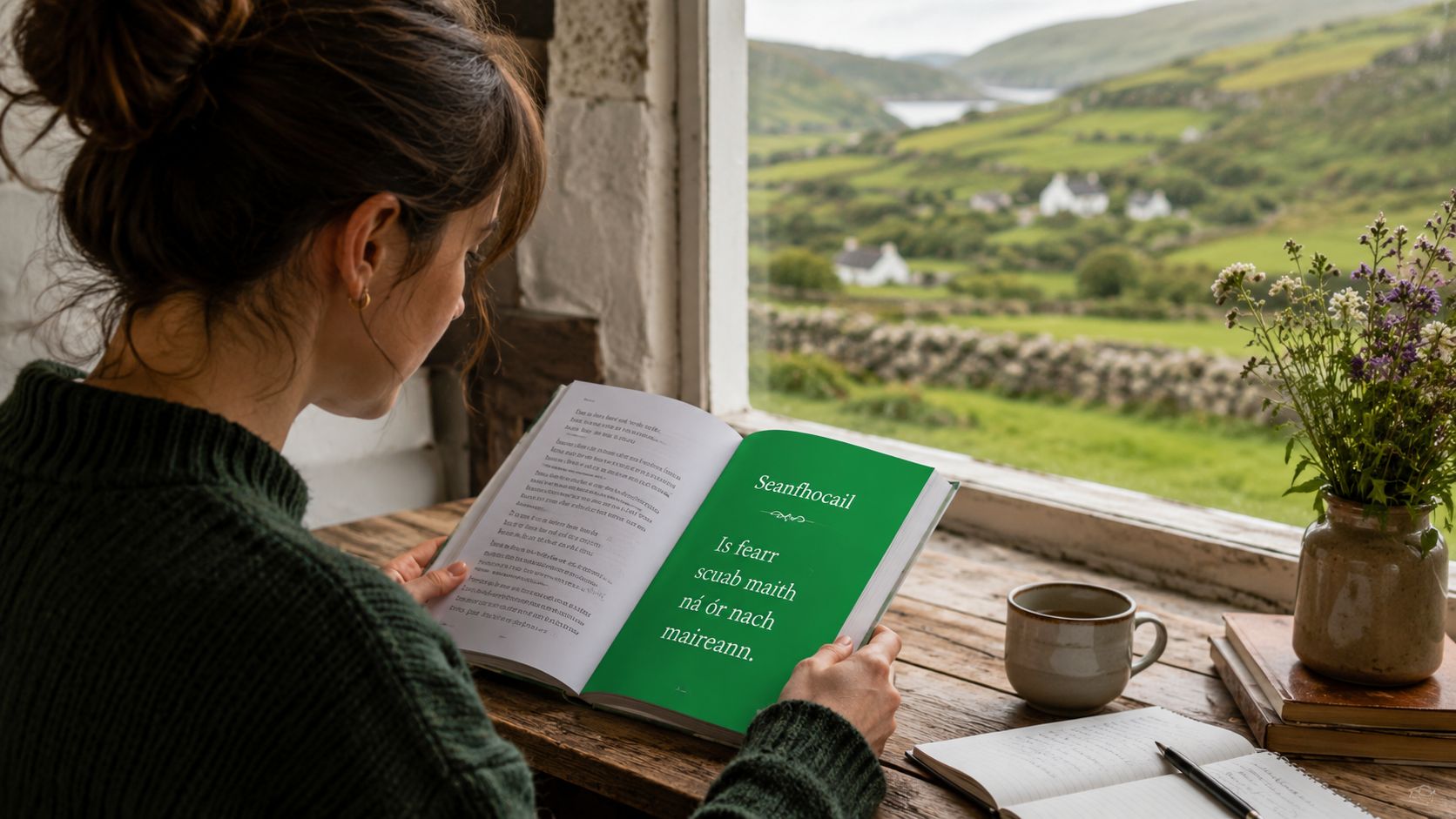
A person studying an Irish language book in a naturally lit room with a view of the Irish countryside in the background.

Ireland has two official languages in the Republic: Irish and English. Irish is the first official language under the Constitution, but English is the language commonly used in everyday life.

That distinction is the part many readers miss. In reviewing the official sources for this article, what stood out to me was how often discussions of the language of Ireland blur three separate questions: constitutional status, daily speech, and regional legal protections. This guide keeps those separate so the answer is clear from the start.

Today, Irish remains central to Ireland’s identity, education system, public signage, and state institutions, while English is the ireland main language for routine day-to-day communication. If you want to explore or practice the irish language itself, tools like Gaeilgeoir AI make that much easier than it was even a few years ago.


How We Framed This Explanation of Ireland’s Official Languages

The editorial method is simple: first, identify the legal status of each language in Ireland; second, distinguish that from how people speak in daily life; third, separate the Republic of Ireland from Northern Ireland so readers do not mix constitutional law with regional protections.

The core sources used here are official and public-interest references, including Article 8 of Bunreacht na hÉireann, Central Statistics Office language data, and Foras na Gaeilge. I think that matters because the phrase ireland official language is often answered too loosely; a good explanation has to show both the legal answer and the practical one.

Historical Journey of the Irish Language

Irish is historically one of Europe’s oldest living languages. Conradh na Gaeilge’s facts and figures notes that the earliest evidence of Irish appears on Ogham stones from the 5th century, that Irish was being written in the Roman alphabet before the beginning of the 7th century, and that it is the oldest written vernacular language north of the Alps. That long record matters because the language of Ireland did not begin as a minority tradition; for much of the island’s history, Irish was the normal spoken language.

Over time, that changed dramatically. Political control, legal pressure, social mobility, and the growing dominance of English under British rule pushed Irish out of many public and economic settings. By the early 20th century, Irish had shifted from the majority tongue to a more regionally concentrated and socially vulnerable language.

The revival movement was a turning point. Conradh na Gaeilge, founded in 1893, helped recast Irish as both a living community language and a national cultural priority. I think this is the key historical bridge readers need: the revival was not only about heritage, but about restoring public legitimacy to a language that had been pushed to the margins. For a modern example of how older languages are now made accessible across media, even through translated video learning, see this CoffeeTrans.

That revival helped shape later state policy. The 1937 Constitution gave Irish formal primacy by stating in Article 8 that Irish is the first official language and English is a second official language. Modern support has continued through schooling, broadcasting, public services, and language-planning policy. Census context also shows why the story is more nuanced than simple decline: the CSO’s comparison of 1926 and 2022 reports that 18% of the population in 1926 were recorded as Irish speakers, while in 2022, 40% of people aged three and over said they could speak Irish at some level. That does not mean Irish replaced English again; it shows that ability, identity, and everyday use are different measurements.

Official Recognition of Irish in Ireland and Northern Ireland

The plain-English answer is this: the Republic of Ireland has two official languages, Irish and English. Irish is the first official language in the Constitution, while English is the most widely spoken everyday language. So if someone asks for the official language of Ireland, the legally complete answer is both Irish and English; if they ask what people mostly speak, the answer is English.

In the Republic of Ireland, Article 8 of the Constitution gives Irish first official status and recognizes English as a second official language. In practice, that first-place wording matters symbolically and institutionally: it supports the use of Irish in state identity, public signage, education, official documents, and certain public services. But it does not mean that all daily life is conducted through Irish. The CSO’s 2022 data shows broad self-reported ability in the irish language, while also breaking usage down by frequency, including daily, weekly, less often, or never outside education. That is why ireland official languages english is also an important part of a fuller answer: English remains the default language in ireland for most homes, workplaces, and media use.

Northern Ireland needs to be treated separately. It is not governed by the Constitution of the Republic, so the phrase first official language does not apply there in the same way. Instead, Irish has legal recognition and protections through more recent legislation, including the Identity and Language (Northern Ireland) Act 2022. Many summaries merge the Republic’s constitutional status with Northern Ireland’s language-rights framework, even though they are different legal systems.

So what does first official language mean? It means Irish has a constitutionally privileged symbolic and legal position in the Republic of Ireland. It does not mean Irish is Ireland's main language in daily conversation, nor that English lacks official standing. Irish is constitutionally first; English is socially dominant.

Linguistic Features and Dialects of Irish

Irish is a Celtic language, part of the Goidelic branch, closely related to Scottish Gaelic and Manx. While it shares some characteristics with these languages, Irish has distinct grammar, syntax, and pronunciation that make it uniquely beautiful and expressive.

There are three main dialects of Irish:

  1. Munster Irish (spoken in the south)
  2. Connacht Irish (west and central Ireland)
  3. Ulster Irish (north, especially Donegal)

These dialectal differences in Irish affect vocabulary, pronunciation, and even grammar. Yet, all dialects are mutually intelligible, and learners often find one that resonates with them personally or geographically.

To explore more about how Irish compares with other Celtic tongues, visit Irish vs. Scottish Gaelic: Key Differences.


Learning and Practicing the Irish Language Today

Irish today is not confined to history books or classrooms for specialists. It appears across primary and secondary education, in Gaeltacht communities where it remains a community language, on bilingual road signs and public notices, in broadcasting, and in parts of government service delivery. Foras na Gaeilge and other public bodies continue to support the visibility and development of the language, which helps explain why Irish can be both a minority spoken language and a highly visible public language at the same time.

What struck me in updating this section is that speaking Irish today often looks different from what outsiders imagine. For some residents, it is a home or community language. For many students, it is a school-based language with varying levels of confidence in actual conversation. For heritage learners and adult returners, it may be a language of identity, travel, media, and part-time use rather than an all-day default language. That still counts as real use, even if it does not resemble majority-language dominance.

With today’s technology, learning Irish is more achievable than ever. Online courses, mobile apps, podcasts, and interactive platforms offer learners of all levels a personalized path to fluency.

Some of the most effective Irish language learning resources include:

Self-study can be flexible, but guided learning with tutors or structured programs offers accountability and quicker progress. For a deeper look into tech-driven learning, check out our article on Learning Gaeilge with Technology.

Revival efforts now combine traditional and digital approaches: school instruction, summer courses in Gaeltacht areas, Irish-language radio and TV, online communities, and learner tools that make daily repetition easier. The result is not a simple return to the past, but a modern bilingual context in which the Irish language question has multiple valid dimensions: legal status, cultural significance, and actual frequency of use.


Practical Aspects: Speaking, Vocabulary Expansion & Pronunciation Skills

Starting your journey into speaking Irish begins with mastering everyday phrases and basic grammar. Key resources to help include:

Here are a few useful phrases to get started:

  • Dia dhuit! – Hello
  • Conas atá tú? – How are you?
  • Go raibh maith agat – Thank you
  • Slán! – Goodbye

Expanding your vocabulary gradually and practicing pronunciation regularly will greatly improve your fluency.


Cultural Expressions and Tools for Enhanced Learning

Irish isn’t just a means of communication—it’s a cultural treasure chest. Idiomatic expressions, proverbs, and ancient writing systems like the Ogham script offer learners insights into the Irish worldview.

Explore:

These tools not only enrich vocabulary but also connect learners with Irish history, folklore, and humor—essential ingredients for cultural fluency.

For further external insights, check out Foras na Gaeilge, an organization promoting Irish across the island.


Frequently Asked Questions

What language is mostly spoken in Ireland?

English is the main everyday language in Ireland. The Republic has two official languages, Irish and English, but English is used commonly at home, at work, and in routine public life.

Is Irish an official language of Ireland?

Yes. In the Republic of Ireland, Irish is the first official language under Article 8 of the Constitution, and English is also an official language. That means the official language of Ireland is not just one language in legal terms.

Do Irish people speak Gaelic?

Many people use Gaelic as a loose English label, but in Ireland the more accurate term is Irish, or Gaeilge. Some people in Ireland speak Irish daily, especially in Gaeltacht areas and certain schools or homes, while many more have learned some Irish without using it as their main spoken language.

Why is Irish called the first official language if English is more common?

Because constitutional status and everyday dominance are different things. Irish has the higher symbolic and legal place in the Republic’s Constitution, but English remains the language most commonly spoken day to day.

How do you say “hi” in Irish language?

A common greeting is Dia dhuit, usually understood as “hello.” Learners also meet conversational variants depending on context and dialect, but Dia dhuit is the standard starting point.

How do Irish people say “sorry”?

A common Irish equivalent is Tá brón orm, meaning “I am sorry.” In everyday English-speaking life in Ireland, of course, people often say “sorry” in English.

The Future of the Irish Language: A Summary With a Personal Touch

The clearest takeaway is straightforward: English is the main daily language in Ireland, while Irish remains a constitutionally central and culturally significant official language. If you only look at raw daily-use numbers, you miss part of the picture. Irish has a stronger presence in education, public signage, broadcasting, government identity, and national symbolism than a simple home-use snapshot suggests.

I think that is why the ireland official languages irish question keeps resurfacing. People are really asking two things at once: what the law says, and what daily life looks like. The law says Irish and English are both official in the Republic, with Irish listed first. Daily life says English dominates most routine speech.

That does not make Irish marginal. It makes it a living national language with uneven but meaningful use: stronger in some regions and institutions, weaker in others, yet still highly visible across the country in 2026.

Initiatives like Gaeilgeoir AI are shaping the future of Irish learning. Whether you’re reconnecting with your roots or starting from scratch, there’s a place for you in the global Irish-speaking community.

Ready to begin your journey?
Join thousands of learners embracing Gaeilge today. Sign up for a free trial at Gaeilgeoir AI and start speaking your first Irish words with confidence.

Discover the Ancient Irish Language and Its Lasting Legacy

The ancient Irish language is far more than just a means of communication. It’s a vital thread woven into the fabric of Ireland’s culture and identity. Rooted in thousands of years of oral tradition, spiritual belief, and poetic expression, this linguistic treasure reflects the heart of a people and a place.

In this article, we’ll explore the evolution, characteristics, and cultural significance of the ancient Irish language, and show you how modern tools like Gaeilgeoir AI can help you connect with this extraordinary part of Ireland’s heritage.


The Evolution of the Irish Language

The history of the Irish language spans centuries, beginning with the origin of the Irish language in the early medieval period. Known as Old Irish, it emerged around the 6th century AD and was influenced by earlier Celtic tongues spoken by Ireland’s first inhabitants.

One of the remarkable aspects of this early linguistic form is the availability of Old Irish language translation today, allowing learners to explore religious texts, poetry, and legal tracts preserved from that era. Over time, Old Irish evolved into Middle Irish (900–1200 AD) and then into Modern Irish, which is still spoken today in various forms.

This linguistic journey was shaped by historical events like the Viking invasions, the Norman conquest, and English colonization, all of which left their mark on the language’s development and usage.


The Role of the Irish Language in Cultural Preservation

Throughout Irish language history, it has played a crucial role in maintaining the country’s traditions, mythology, and folklore. Unlike some other Celtic languages, Irish retained a significant literary tradition that continues to influence modern Gaelic culture.

It’s important to distinguish between Irish, Gaelic, and Celtic languages. Irish (Gaeilge) is one of the Goidelic languages, along with Scottish Gaelic and Manx. These are all part of the larger Celtic family, which also includes Welsh, Breton, and Cornish. While all share ancient roots, each language developed unique traits influenced by geography and historical context.

The resilience of the Irish language is evident in the way it has preserved oral storytelling, music, and spiritual beliefs through generations—safeguarding cultural knowledge that might otherwise have been lost.


Learning and Experiencing the Ancient Irish Language Today

Learning the ancient Irish language isn’t just about acquiring vocabulary or grammar. It’s a doorway into the soul of Ireland’s heritage. Whether you’re interested in ancestral roots or historical linguistics, there’s great value in studying this language.

Thanks to technology, accessing resources like online Irish language courses has never been easier. Platforms such as Gaeilgeoir AI provide immersive tools powered by AI to help learners practice pronunciation, understand grammar, and interact with the language in a modern context.

From personalized feedback to interactive dialogues, these tools can replicate the experience of finding an Irish tutor, making it more convenient for learners around the globe. Whether you’re a beginner or an advanced learner, Gaeilgeoir AI has something for everyone.

Looking for inspiration on how to integrate learning into your routine? Check out our guide on Creative Ways to Learn Gaeilge for tips that make language learning enjoyable and sustainable.


Linguistic Features and Dialectal Variations in Ancient Irish

One of the most intriguing aspects of the ancient Irish language lies in its grammar and syntax. Complex and poetic, it boasts a rich structure that gives it both rhythm and depth. For example, mastering adjectives in Irish involves understanding how they follow the noun and mutate based on grammatical rules—a unique feature compared to English.

In addition, the dialectal differences in Irish add layers of richness to the language. Even in ancient times, regional variations developed based on geography and social interaction. Connacht, Munster, and Ulster dialects each exhibit distinct pronunciation styles, vocabulary, and grammatical preferences that persist to this day.

Understanding these variations enhances your appreciation of the language’s adaptability and cultural nuance.


The Cultural Influence Beyond Words: Proverbs, Greetings, and Expressions in Irish

Language is culture in action, and this is especially true when exploring seanfhocail—ancient Irish proverbs. These time-tested expressions offer wisdom, humor, and values embedded in everyday life. For example:

  • Is fearr Gaeilge briste, ná Béarla cliste – Broken Irish is better than clever English.
  • Níl aon tinteán mar do thinteán féin – There’s no fireplace like your own fireplace (meaning: there’s no place like home).

Such proverbs reflect centuries of lived experience and philosophical insights.

Likewise, greetings and phrases in Irish carry deep cultural significance. Saying Dia dhuit (Hello – literally “God be with you”) is not just a greeting but a spiritual connection. Learning these expressions allows you to experience the language as it was meant to be lived—rich in meaning and layered in history.

Want to dive deeper into these traditions? Our guide to Irish language greetings and phrases is a great place to start.


Preserving Ireland’s Linguistic Heritage: Ogham Script and Numerical Expressions

A remarkable part of Ireland’s linguistic heritage is the Ogham script, an ancient alphabet used primarily between the 4th and 10th centuries AD. This unique writing system, made up of simple lines carved along stone edges, is an invaluable piece of the Ogham script alphabet guide to Ireland’s past.

These inscriptions, often found on standing stones, are some of the earliest written records of the Irish language. They typically marked territory, commemorated individuals, or served religious functions.

Preservation efforts today include digitizing these texts and integrating them into modern learning platforms. Additionally, learners can explore numerical expressions like counting people in Irish, which reveals the linguistic and cultural logic embedded in traditional counting systems.


Preserving and exploring the ancient Irish language isn’t just about keeping a linguistic tradition alive—it’s about embracing a cornerstone of Irish identity and cultural resilience. By learning this language, you gain access to the stories, values, and worldview of a people deeply connected to their land and history.

If you’re inspired to begin your own journey into Irish, there’s no better time than now. Join a growing community of learners and discover how Gaeilgeoir AI can make your experience fun, insightful, and deeply rewarding. Sign up here and be part of the movement to celebrate and protect Ireland’s unique linguistic heritage.


External Resource: Learn more about the importance of indigenous languages and their preservation from UNESCO’s official page on endangered languages.

Unlock Fluency with Top Irish Immersion Courses

If you’re serious about learning the Irish language, Irish immersion courses are one of the most powerful tools available. Immersion is more than just studying vocabulary or memorizing grammar rules—it’s about living the language, engaging with it naturally in real-world situations. Whether you’re a beginner or an intermediate learner, immersing yourself in Irish (Gaeilge) accelerates fluency by surrounding you with authentic language use, culture, and context.

At Gaeilgeoir AI, we believe that immersion isn’t limited to physical classrooms in the Gaeltacht. With today’s technology, language immersion can happen anywhere, anytime. In this article, we’ll explore the top Irish immersion courses—both physical and digital—and how AI-powered tools can elevate your learning journey.


Understanding Irish Language Learning Resources

There’s never been a better time to learn Gaeilge, thanks to a growing collection of Irish language resources. From mobile apps and podcasts to AI chat tools and flashcards, learners now have a variety of methods tailored to different learning styles.

Types of Resources That Support Irish Immersion:

  • Digital Flashcards for vocabulary building
  • AI-driven dialogue simulations to mimic real conversation
  • Interactive quizzes and pronunciation guides
  • Podcasts and videos in Irish
  • Daily Irish language practice plans

These tools help recreate the immersive experience you’d get from living in a Gaeltacht region. To see some of these in action, check out our guide to learning Gaeilge with technology.


Exploring Online Irish Language Courses

While in-person immersion in Ireland is ideal, online Irish language courses are making immersion accessible to learners around the world. These virtual platforms combine video lessons, live classes, and self-paced modules that replicate classroom interactions in a flexible format.

Benefits of Online Immersion Courses:

  1. Learn from anywhere — no travel required
  2. Structured curriculums with measurable goals
  3. Live interaction with native speakers and tutors
  4. Supplemental media like recordings, forums, and reading exercises

Platforms like Gaeilgeoir AI take this a step further by integrating AI-driven tools that provide real-time feedback on pronunciation, grammar, and conversation flow. Unlike passive courses, learners interact directly with intelligent systems that guide and adapt based on their progress.

For more options, visit our online Irish language courses page.


Mastering the Irish Language Through Pronunciation and Vocabulary Expansion

A core part of Irish immersion courses is mastering pronunciation and vocabulary—key building blocks of any language. In Irish, pronunciation can be particularly tricky due to its distinct sound system and use of lenition.

Tips to Improve Pronunciation:

  • Use a reliable Irish pronunciation guide
  • Practice with AI speech tools that mimic native speakers
  • Listen and repeat phrases from authentic Irish recordings

As for expanding your Irish vocabulary, immersion allows words and phrases to appear in natural contexts, making them easier to remember and use. Combine immersion with structured tools like flashcards and contextual quizzes to reinforce learning.

Need help expanding your vocabulary? Dive into our guide on how to expand your Irish vocabulary.


Diving Into Irish Grammar and Conversation Skills

Another pillar of immersion is understanding grammar and practicing real conversations. Irish grammar differs significantly from English and even its Celtic cousin, Scottish Gaelic.

Key Grammar Insights:

  • Verb-subject-object (VSO) structure
  • Initial mutations (lenition and eclipsis)
  • Gendered nouns and agreement

Check out our comparison of Irish and Scottish Gaelic grammar to explore more.

For conversational skills, begin with essential expressions from our basic Irish conversation guide. Practicing these regularly—even virtually with AI tutors—helps solidify the rhythm and structure of real dialogue.


Enhancing Your Learning Journey with Tutors and Additional Resources

A strong immersion course often includes access to qualified tutors, who personalize the experience and offer corrections that automated tools might miss. One-on-one sessions ensure steady progress and boost confidence in speaking.

Why Consider a Tutor?

  • Personalized feedback and tailored lessons
  • Deeper cultural insights
  • Accountability and structure

To complement this, we recommend incorporating tools like Irish language flashcards to enhance memory retention. Flashcards are a tried-and-true method, especially effective when reviewing high-frequency terms.

Need help finding expert support? Here’s how to find an Irish tutor for enhanced learning.


Immersing Yourself in the Culture and History Behind the Irish Language

True immersion goes beyond just grammar and vocabulary—it’s about experiencing the culture, history, and soul of the language. When learners connect emotionally with a language, retention and enthusiasm skyrocket.

Ways to Culturally Immerse Yourself:

  • Read traditional Irish literature and poetry
  • Listen to sean-nós music and Irish folk songs
  • Study historical events that influenced language use
  • Watch Irish-language TV and films

Understanding the language’s past helps contextualize its structure and expressions. Our article on the history of learning Gaeilge offers a compelling look into this fascinating journey.

By enrolling in Irish immersion courses, you don’t just learn a language—you step into a legacy.


Real-World Success Stories from Irish Immersion Students

Learners around the globe have experienced powerful transformations thanks to immersive learning environments. Some join Gaeltacht-based courses, while others use online tools daily for a few minutes at a time.

Common Outcomes:

  • Improved speaking confidence
  • Ability to hold full conversations in Irish
  • Deeper appreciation for Irish identity and culture

One learner from Canada shared, “I never thought I could speak Irish until I started combining AI-powered tools with daily immersion practices. Gaeilgeoir AI made it possible.”

Want to join a community of learners like this? You’re just one step away.


Whether you’re just beginning or looking to level up your Gaeilge, Irish immersion courses offer the most effective, enriching path to fluency. With options ranging from in-person programs to AI-powered virtual experiences, learners have more flexibility and support than ever before.

Gaeilgeoir AI is here to help you immerse yourself fully—with dynamic tools, expert guidance, and a passionate community of learners by your side.

👉 Ready to experience Irish immersion the smart way?
Sign up for a free trial and begin your journey toward fluency with Gaeilgeoir AI.

How to Say Happy Birthday in Irish

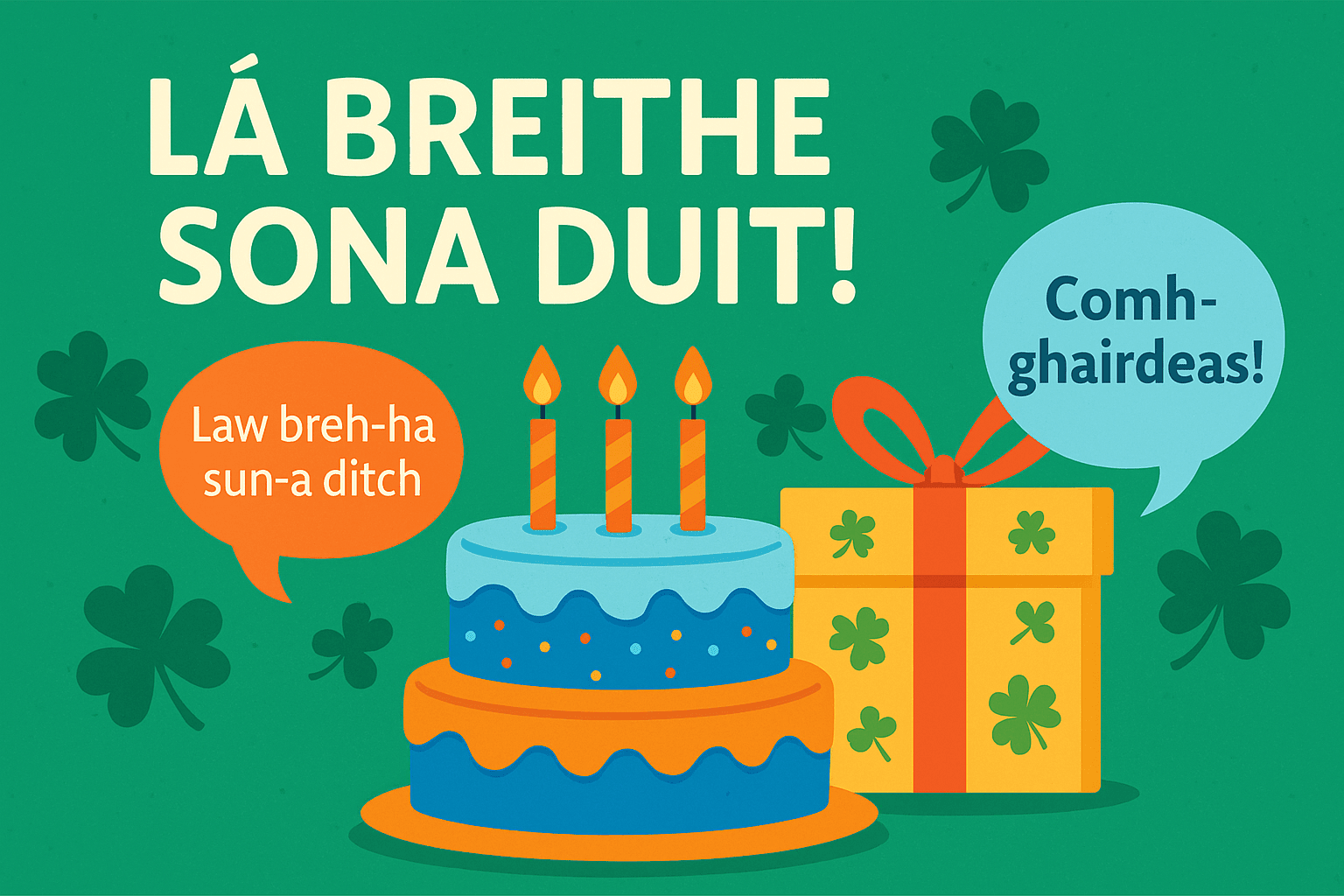
Festive digital illustration with the Irish birthday greeting 'Lá Breithe Sona Duit!' in bold white letters, a two-tier birthday cake with candles, a gift box decorated with shamrocks, and speech bubbles showing the pronunciation 'Law breh-ha sun-a ditch' and the word 'Comhghairdeas!' on a green background.

The natural everyday way to say happy birthday in Irish is Lá breithe sona duit! If you only need one phrase to put in a card, text to a friend, or say out loud in person, that is the one to learn first. In this guide, we focus on what people usually want most: the exact phrase, what it means word by word, how to pronounce it, when to use the formal alternatives, and a few birthday wishes that sound warm rather than copied from a phrase list.

How We Chose the Irish Birthday Phrases in This Guide

We selected these phrases using four editorial filters: standard modern Irish usage, beginner friendliness, suitability for real situations like speech/cards/texts, and likelihood that a learner can pronounce them without mangling the message. We also checked forms against Irish-learning and dictionary-style sources rather than relying on decorative “Gaelic quote” lists.

In practice, that meant excluding lines that are overly formal, regionally narrow, or so context-specific that a beginner could use them awkwardly. The most useful phrases are usually the shortest ones people can remember and say with confidence.

How to Say Happy Birthday in Irish

The most common way to say happy birthday in Irish is:

“Lá breithe sona duit!”

Pronunciation: Law BREH-heh SUN-uh ditch

This is the standard everyday phrase for saying “happy birthday” to one person. It is also the form most learners mean when they look for happy birthday in Irish Gaelic, happy birthday as Gaeilge, or birthday in Irish. A beginner-friendly explanation from Bitesize Irish notes that the singular form is duit, while daoibh is used when addressing more than one person.

Word by word, the phrase is useful because it shows how ordinary Irish works. means “day,” breithe relates to “birth,” sona means “happy,” and duit means “to you” when speaking to one person. I find this breakdown helps learners remember the phrase much faster than memorizing it as one sound blob.

That final word matters. If you are talking to one birthday person, use duit. If you are wishing more than one person a happy birthday together, the plural form is Lá breithe sona daoibh! Most readers will only need the singular, but knowing the switch explains why Irish greetings often change depending on who is being addressed.

In everyday speech, Lá breithe sona duit! sounds completely natural. It works face to face, in a WhatsApp message, in a birthday card, or as the spoken line before singing. We checked this section against standard learner references and kept the version that is both common and usable, not just technically correct.

A Slightly More Formal Version:

“Go maire tú do lá breithe!”

Pronounced: Guh MAIR-eh too duh law BREH-heh

Meaning: “May you enjoy your birthday!”

This version is warmer and more literary than the standard phrase. It fits nicely in a card, a caption, or a longer birthday message, but it is less likely to be the first thing said casually at a party. If you want something natural in speech, stick with Lá breithe sona duit; if you want something that reads a little more special on paper, this is a good choice.

Simple real-life examples

  • Text message: Lá breithe sona duit, a chara! Bain sult as do lá. (“Happy birthday, friend! Enjoy your day.”)
  • Birthday card line: Go maire tú do lá breithe agus go n-éirí an t-ádh leat i gcónaí. (“May you enjoy your birthday and may luck always go with you.”)
  • Saying it in person: Lá breithe sona duit! Short, direct, and the most practical version for everyday use.

Irish Birthday Traditions: A Cultural Snapshot

Irish birthday celebrations combine traditional customs with modern fun. Here are some cultural insights that make Irish birthdays unique:

  • The Birthday Bump (or Bumps): One widely repeated custom is lifting the birthday person and gently bumping them on the ground once for each year of age, plus one extra bump for good luck.
  • Nose Buttering: Another tradition sometimes mentioned is butter being smeared on a child’s nose, possibly as a sign of good fortune or abundance.
  • Music and Toasts: Songs, lively gatherings, and simple toasts such as Sláinte! often fit naturally into birthday celebrations.

These customs are not universal across all of Ireland, but they show how birthdays in Irish culture are often described as playful as well as family-centred.

Other Useful Irish Birthday Phrases

A good Irish birthday message is not always just one sentence. These are the extra phrases most worth knowing if you want your greeting to sound casual, warm, or slightly traditional instead of copied from a generic list.

Comhghairdeas!

Meaning: “Congratulations!”
Use it when: you want a short celebratory add-on, especially in speech or a cheerful message.
Tone: casual and upbeat.

This can work around birthdays, but it is broader than birthdays alone. Irish speakers also use it for achievements, weddings, exam results, and other congratulations, so it should not replace Lá breithe sona duit by itself.

Bain sult as do lá!

Meaning: “Enjoy your day!”
Use it when: you want a natural follow-up in a text, card, or spoken greeting.
Tone: warm and friendly.

This is one of the easiest birthday add-ons for beginners because it feels natural in modern messages. In our experience, learners remember it quickly and it pairs well with the main birthday phrase without sounding stiff.

Go maire tú do lá breithe!

Meaning: “May you enjoy your birthday!”
Use it when: writing in a card, adding a more thoughtful line to a social post, or speaking a little more formally.
Tone: warm, slightly traditional.

This is a good option when plain irish happy birthday wording feels too brief for the occasion. It is more elegant on the page than in quick speech, which is why I usually recommend it for messages rather than for the first thing you say out loud.

Go n-éirí an t-ádh leat.

Meaning: “May luck go with you.”
Use it when: you want to add a blessing-style line after the main greeting.
Tone: warm and traditional.

This is not a birthday-exclusive phrase, but it fits beautifully in birthday cards because it expresses goodwill beyond the day itself. It works especially well for a friend, family member, or anyone who would appreciate a more Irish-flavoured message.

Go mbeire muid beo ag an am seo arís.

Meaning: “May we all be alive at this time again.”
Use it when: offering a traditional-style toast or ending a gathering with a blessing.
Tone: traditional, reflective.

This line is broader than birthdays and can sound old-fashioned if dropped into a casual text. It is best used when you want a blessing or toast feel, not as your main birthday greeting.

A simple card-friendly birthday blessing

If you want one fuller line that feels affectionate without becoming too ornate, use this structure:

Lá breithe sona duit, agus go n-éirí an t-ádh leat i gcónaí.
“Happy birthday, and may luck always go with you.”

It reads naturally in a card and gives you more than a bare translation of gaelic happy birthday. For most readers, this is the most useful “traditional-feeling” option because it still sounds understandable and warm.

Why Learn Birthday Phrases in Irish?

Birthday greetings are one of the easiest ways to make Irish feel usable rather than abstract. You learn a phrase you can say, you hear how Irish changes for singular and plural, and you get a low-pressure way to use the language with family or friends.

They also connect well with other everyday expressions. If you want to build outward from birthday greetings into common social Irish, check out our Irish Language Greetings & Phrases Guide.

Pronunciation Tips with Gaeilgeoir AI

If the spelling looks intimidating, the biggest pronunciation win is to stop trying to read every letter as if it were English. In Lá breithe sona duit, the stress usually falls early in each word group: , BREI-the, SO-na, duit. English speakers often flatten the phrase into something like “laa bree-thay sona doo-it,” which sounds much less natural.

A simple approximation is Law BREH-heh SUN-uh ditch. A more careful version softens the middle sounds and keeps breithe lighter than many learners expect. The pronunciation guidance in teanglann.ie is helpful here because it lets you hear Irish sounds instead of guessing from spelling alone.

The two places people most often go wrong are breithe and duit. Learners tend to overpronounce breithe as three heavy syllables, and they often say duit like English “doo-eet.” When we coach beginners, I usually hear the phrase improve fastest once they shorten the middle and keep the ending crisp.

We also test pronunciation by having learners record the full phrase, then compare it to a slower model before speeding up. That is why I recommend practicing the whole line in one breath rather than word by word first. For a fuller sound-by-sound breakdown, see our Irish Pronunciation Guide.

If you want feedback while practicing, Gaeilgeoir AI can help after you have the basic sound in your ear. It is most useful for repetition and confidence-building, not as a replacement for hearing good Irish pronunciation first.

Celebrating Birthdays in Irish: Tech Meets Tradition

People often use Irish birthday greetings in very ordinary ways: saying the phrase in person, writing it in a card, sending it by text, or adding it to a social post. That is where happy birthday in gaelic irish or happy birthday in irish language matters most in real life, not in staged language exercises, but in small social moments where one authentic phrase goes a long way.

For spoken use, keep it short: Lá breithe sona duit! For cards, you can add one extra line such as Bain sult as do lá! or Go n-éirí an t-ádh leat. For social captions, the plain phrase is often enough, especially if the recipient has only a little Irish. Simpler usually sounds better than trying to stack several phrases you cannot pronounce confidently.

There is also room for small traditional touches. A toast like Sláinte! works naturally at a meal or gathering, and birthday blessings fit well in cards for relatives. Some Irish birthday customs described by Irish Jewelry Craft include playful “birthday bumps” and other family traditions, though these are not universal across every home or region.

If you are sending a voice note, record the phrase once slowly and once at normal speed. That tends to sound more personal than a copied text line. Near milestone birthdays, you can also pair the Irish greeting with a themed celebration idea, like the ones shared over at That Blanket Co, then keep the greeting itself simple and genuine.

The choice between a simple phrase and a more traditional one depends on your audience. If the person knows little or no Irish, Lá breithe sona duit is ideal because it is clear, short, and recognisable. If they enjoy Irish culture or you are writing a keepsake card, adding a blessing-style line gives the message more warmth without making it hard to understand.

Learn Beyond Birthdays

Once you’ve mastered birthday greetings, it’s easy to branch into other everyday phrases and affectionate expressions.

Why Gaeilgeoir AI Makes Language Learning Easy and Fun

Gaeilgeoir AI is most helpful when you already know what you want to say and need support saying it clearly and confidently. For birthday language, that means practicing one useful phrase, hearing it repeatedly, and getting comfortable enough to use it in a real message instead of leaving it in your notes app.

That is also why we keep pointing learners back to practical phrases first. A small set of usable expressions beats a long list you never say out loud. If you want to continue from greetings into more structured learning, explore our Online Irish Language Courses.

Trusted Resources in Irish Education

For deeper reference on Irish words and pronunciation, good starting points include Teanglann and Foclóir.ie, both of which are useful for checking meanings, audio, and standard forms. We reviewed birthday phrasing against sources like these because decorative “Celtic quote” pages often mix Irish with vague pseudo-traditional wording.

For a non-language resource linked to celebrations more broadly, you might also enjoy this birthday gift article if you are pairing a greeting with a present.

Frequently Asked Questions

How do the Irish say happy birthday?

The usual way is Lá breithe sona duit when speaking to one person. If you are addressing more than one person, the plural form is Lá breithe sona daoibh. For everyday use, the singular version is the one most learners need.

What does Lá breithe sona duit mean?

It means “Happy birthday to you.” More specifically, the phrase is built from words meaning “day,” “birth,” “happy,” and “to you.” That final part, duit, changes depending on who is being addressed, which is why Irish greetings often shift form slightly.

What is a traditional Irish birthday blessing?

A practical traditional-style option is Lá breithe sona duit, agus go n-éirí an t-ádh leat i gcónaí, meaning “Happy birthday, and may luck always go with you.” It sounds warm and card-friendly without becoming too formal. If you want something very short, Go n-éirí an t-ádh leat also works well as an added blessing line.

How do you wish an Irish friend a happy birthday?

For a friend, keep it simple and natural: Lá breithe sona duit, a chara! Bain sult as do lá. That means “Happy birthday, friend! Enjoy your day.” In our experience, this sounds more genuine than trying to force a long formal blessing into a casual message.

Is happy birthday in Irish the same as happy birthday in Gaelic?

Many people use “Irish” and “Gaelic” loosely when they mean the Irish language. If you are looking for happy birthday in gaelic in the Irish sense, the phrase you want is Lá breithe sona duit. It is better to say “Irish” or “Irish Gaelic” when you want to be specific, because “Gaelic” can also refer to Scottish Gaelic.

Start Saying “Happy Birthday” in Irish Today!

If you remember one line from this guide, make it Lá breithe sona duit. It is the standard, natural, and most useful way to say happy birthday in Irish, whether you are speaking, texting, or writing in a card.

Ready to practice it out loud? Sign up for Gaeilgeoir AI and start your free trial today. Join a growing community of passionate Irish learners around the world!

Master Irregular Irish Verbs with Ease

Learning to master irregular Irish verbs is a key step on your journey to fluency in the Irish language. While regular verbs follow predictable patterns, irregular verbs often require a deeper understanding and consistent practice. Mastering these unique verbs enhances your speaking and writing abilities, allowing you to express yourself more naturally and accurately in Irish. Whether you’re just beginning or advancing your studies, focusing on irregular Irish verbs will take your language skills to the next level.


Understanding Irish Verbs

In Irish, verbs play a central role in sentence structure and meaning. Just like in English, Irish verbs can be either regular or irregular.

  • Regular verbs follow a consistent conjugation pattern across tenses.
  • Irregular Irish verbs, however, deviate from standard patterns and require memorization and context-based learning.

There are 11 commonly recognized irregular verbs in Irish. Some of the most frequently used include:

  1. – to be
  2. Déan – to do/make
  3. Faigh – to get
  4. Feic – to see
  5. Téigh – to go

Understanding the traits of irregular Irish verbs is essential for proper conjugation and usage in real-life conversations.

For those just beginning their journey, our Irish Language Lessons for Beginners provide a helpful foundation.


Strategies for Mastering Irregular Verbs

Conquering irregular Irish verbs takes commitment, but with the right techniques, it becomes a manageable and rewarding task.

1. Break Down Each Verb

Start with one verb at a time. Learn its meaning and conjugation in different tenses:

  • Past tense (Aimsir Chaite)
  • Present tense (Aimsir Láithreach)
  • Future tense (Aimsir Fháistineach)

For instance, the verb Téigh (to go) conjugates irregularly as:

  • Present: Téann sé
  • Past: Chuaigh sé
  • Future: Rachaidh sé

2. Leverage Online Tools

Use interactive online Irish language courses like those offered by Gaeilgeoir AI. Our AI-powered platform helps learners drill down into verb conjugation with tailored quizzes and context-based learning exercises. Sign up here to get started.

3. Compare Grammar Across Celtic Languages

Understanding differences between Irish and its sister language, Scottish Gaelic, can also illuminate grammar rules. Explore this comparison in our article on Irish vs. Scottish Gaelic Grammar.

4. Use Repetition & Spaced Learning

Repeat conjugation patterns regularly over several days. Use flashcards or digital apps with spaced repetition algorithms to keep verb forms fresh in your memory.


Incorporating Irregular Verbs into Everyday Conversations

It’s not enough to simply memorize conjugations. To truly master irregular Irish verbs, learners must actively use them in conversation.

Tips for Natural Usage:

  • Construct Short Sentences: Practice using one verb at a time in basic sentences. E.g., “Chonaic mé an grian” (I saw the sun).
  • Narrate Daily Activities: Use verbs like “Bí” and “Téigh” to describe your routine. E.g., “Bhí mé ag dul ar scoil” (I was going to school).
  • Speak With Others: Join Irish-speaking groups or online communities.

Check out our Basic Irish Conversation Guide for practical phrases that incorporate common irregular verbs.


Overcoming Challenges in Learning Irregular Irish Verbs

Common Hurdles:

  1. Memorizing Irregular Forms: Unlike regular verbs, each irregular verb may have unique rules.
  2. Inconsistent Practice: Lack of routine can cause you to forget forms quickly.
  3. Pronunciation Barriers: Some verb forms can be difficult to pronounce correctly.

Solutions:

  • Self-Study Techniques: Dedicate time daily to review one verb and create sentences.
  • Use AI Tools: Our AI-based learning tools adapt to your pace and progress.
  • Hire a Tutor: Personalized instruction helps solidify your understanding. Read our article on how to Find an Irish Tutor for Enhanced Learning.
  • Learn Irish Independently: Explore how you can succeed even on your own in Can You Learn Irish by Yourself?

Conclusion

Mastering irregular Irish verbs is one of the most important steps in becoming fluent in the Irish language. With consistent practice, interactive tools, and a deep appreciation for how these verbs function within conversation and storytelling, you’ll find yourself growing more confident and expressive in Irish.

Verbs like “Téigh” (to go) and “Bí” (to be) don’t just power your sentences—they help you connect with the rich culture and heritage behind the language. And by learning to conjugate them correctly, you open the door to mastering more advanced concepts such as the Irish Future Tense or understanding the wisdom of Irish Proverbs (Seanfhocail).

If you’re ready to level up your Irish skills, join a global community of learners and take advantage of our free trial at Gaeilgeoir AI. Click here to sign up and make irregular verbs your new strength!


External Resource:

  • Teanglann.ie – A trusted online Irish-English dictionary with comprehensive verb conjugation tables.

Slán go fóill – and happy verb learning!

 How to Conjugate Irish Verbs Easily

Learning to conjugate Irish verbs is a key milestone for anyone committed to mastering the Irish language. Verb conjugation is what gives your sentences structure and meaning, allowing you to express actions, feelings, and events in the past, present, and future. In this ultimate 2025 guide, we’ll walk you through the basics and beyond, helping you gain confidence as you unlock the beauty of Gaeilge.

Whether you’re a complete beginner or brushing up on skills, understanding how to conjugate Irish verbs is essential. With the help of modern tools like Gaeilgeoir AI and smart learning strategies, you can conquer even the trickiest verb forms.


Understanding Irish Verb Conjugation

Irish verbs are conjugated based on tense (past, present, future), mood (indicative, conditional, imperative, subjunctive), and person (first, second, third). Unlike English, which uses helping verbs, Irish changes the actual form of the verb.

Key Features of Irish Verb Conjugation:

  • Verbs come first in the sentence (VSO: Verb-Subject-Object)
  • Tense is built into the verb, not via auxiliary verbs
  • Initial mutations (e.g., lenition, eclipsis) may occur based on grammatical context

Two Main Classes of Verbs:

  1. First Conjugation Verbs: One-syllable verbs (e.g., bris – break)
  2. Second Conjugation Verbs: Two or more syllables (e.g., oscail – open)

Learn more about the sentence structure in our Irish sentence structure guide.


Common Irregular Verbs in Irish

Some verbs don’t follow standard patterns and must be memorized. Here are a few essential irregular verbs every learner should know:

VerbEnglishPresentPastFuture
To beBhíBeidh
DéanTo do/makeDéanannRinneDéanfaidh
FeicTo seeFeiceannChonaicFeicfidh
FaighTo getFaigheannFuairGheobhaidh
TeighTo goTeannChuaighRachaidh

These irregular verbs are widely used in everyday speech. Memorizing their forms will significantly boost your fluency.


Tips for Mastering Irish Verb Conjugation

When learning to conjugate Irish verbs, consistency and smart strategies make a world of difference.

Here are our top tips:

  1. Use Flashcards – Practice verb forms regularly with visual aids.
  2. Practice One Tense at a Time – Avoid overwhelm by focusing on one tense before moving on.
  3. Listen to Native Speakers – Watch Irish-language shows, listen to top Irish podcasts, or tune into TG4.
  4. Repeat and Reinforce – Spaced repetition systems (SRS) help with long-term memory.
  5. Use AI Tools Like Gaeilgeoir AI – Get immediate feedback and guidance tailored to your level.

Online Resources for Practicing Irish Verb Conjugation

Digital learning has made it easier than ever to practice and master verb conjugations.

Top Tools to Help You Learn:

  • Gaeilgeoir AI – Offers AI-powered grammar correction, smart quizzes, and progress tracking.
  • Teanglann.ie – A trusted online dictionary with verb conjugation tables.
  • Duolingo – Good for casual practice but lacks depth in grammar.
  • BBC Gaeilge – Offers vocabulary and basic grammar resources.

For more options, check out our guide to online Irish language courses.


Incorporating Verbs into Everyday Conversations

Knowing how to conjugate Irish verbs is only useful if you put it into practice.

Try These Examples:

  • Tá mé ag foghlaim. – I am learning.
  • Chonaic mé an scannán. – I saw the movie.
  • Beidh sí anseo amárach. – She will be here tomorrow.

Start by forming basic sentences:

  1. Identify your verb and conjugate it appropriately.
  2. Add your subject (mé, tú, sé, sí, sinn, sibh, siad).
  3. Add object or complement (if needed).

Need help with pronunciation? Visit our Irish pronunciation guide.


Challenges and Solutions in Mastering Irish Verb Conjugation

It’s completely normal to hit roadblocks while learning to conjugate Irish verbs. Here are some typical challenges:

Common Hurdles:

  • Confusing irregularities
  • Mixing up tenses
  • Lack of practice with native materials

Solutions:

  • Use visual grammar charts
  • Review consistently with Gaeilgeoir AI’s quizzes and grammar tips
  • Immerse yourself in Irish content (radio, books, subtitles)

Summary: Mastering Irish Verb Conjugation

To truly master the Irish language, you must learn how to conjugate Irish verbs with confidence. From understanding tense changes to memorizing irregulars and applying them in real-life conversations, the journey is rewarding.

Remember:

  • Start simple, then build complexity.
  • Don’t fear mistakes—they’re essential for learning.
  • Make Gaeilge part of your daily routine.

Ready to take your learning to the next level?

Join a vibrant community of learners today with Gaeilgeoir AI. Sign up for a free trial and start mastering Irish verbs one lesson at a time!


External Reference:

  • Foras na Gaeilge – Promotes the Irish language and offers excellent grammar resources.

Start Speaking Irish Today — 25% Off
Use code START25

Learn real Irish for real life with guided practice, pronunciation support, and everyday conversations.

Get 25% off any plan with code START25

Start Speaking Irish Today — 25% Off