Old Irish Male Names: A Guide to History and Meaning

Searching for a name that carries history, myth, and a sound that still feels alive in modern Ireland? That instinct is right, but it also hides a common mistake. Old Irish male names are not one neat category, because some belong to early medieval Gaelic tradition, some survived through Christian and royal records, and some live on mainly in Anglicised form. If you want the richest picture, you need the meaning, the pronunciation, and the historical layer behind each name.

That matters for family history too. Irish naming records can be wonderfully consistent in some periods and wildly variable in others, which is why researchers are told to test Gaelic, Latin, and Anglicised variants for the same person in church and civil records, rather than relying on exact-string matches (Irish Names Project guidance on aliases). The result is a language map, not just a list.

Old Irish male names also tell a bigger story about Ireland itself. In the 1911 Census of Ireland, John was the most common male name with 220,331 men, 13.9%, while Patrick was second with 167,150 men, 10.6%. Together, those two names accounted for close to a quarter of all males, and the top ten male names made up 60% of all male names recorded that year (CSO names census release). That same concentration shows up even earlier, in 1864, when among 70,075 baby boys born in Ireland, fewer than one in six were named John, one in nine were Patrick, and the top six names covered more than 60% of boys born (Irish genealogy toolkit on 1864 names).

Table of Contents

1. Seán

Seán is the name many learners meet first, and for good reason. It's the Irish form of John, and it sits inside the long historical current that made John the dominant male name in Ireland's 1911 census (CSO names census release). If you hear Seán in a village, a classroom, or a family tree, you're hearing a form that has moved comfortably between religion, daily life, and Irish identity for generations.

Pronunciation matters here. In Irish, Seán is /ʃaːn/, roughly “shawn.” The accent on á gives the vowel its broad, open sound, and that makes the name feel smoother than many English speakers expect. In practical speech, a learner can think “shawn” and stay close enough for everyday use.
An older Irish man with a kind expression standing outdoors against a traditional white stone wall.

Why Seán stays recognizable

Seán is also one of the clearest examples of how Irish names survive through adaptation, not just preservation. The broader historical record shows that Irish male naming was already tightly concentrated by the start of civil registration in 1864, with a small core of traditional Christian names dominating boys' names (Irish genealogy toolkit on 1864 names). Seán sits in that tradition, even when it appears in modern documents beside English-language surnames, school records, or immigration papers.

For learners, the best way to remember Seán is to connect it to familiar, real-world settings. You'll see it in family trees, Irish-language classrooms, and contemporary Irish media. If you're mapping names back into Irish form, the English to Irish names tool can help you compare the Irish version with the English spelling without losing the relationship between them.

Practical rule: if a record says John, Seán, or even a Latinized form in a church register, don't assume those are different people until you check the surrounding family names and dates.

2. Liam

Liam feels modern to many people, but its roots are old enough to sit comfortably beside the historical names in Irish records. It comes through Uilliam, the Irish form of William, which reflects a broader pattern of names entering Irish life through adaptation and then becoming locally naturalized. That's one reason Liam can sound both international and unmistakably Irish at the same time.

Its pronunciation is straightforward for English speakers, /liəm/, or “lee-um.” Say the first syllable lightly, then let the second syllable fall away without overemphasizing it. In everyday speech, that relaxed rhythm is part of why the name feels so easy to use.

Liam also shows how modern popularity and historical authenticity don't always line up neatly. A name can be widely loved now without being the oldest form in the tradition. That distinction matters if you're trying to choose a name for heritage reasons, because a modern baby-name favorite and a historically attested Gaelic form are not always the same thing.

How Liam fits Irish naming history

The best way to think about Liam is as a bridge. It sits between Germanic naming roots, Irish linguistic adaptation, and current global use. In an Irish setting, that blending is ordinary, not accidental. Irish naming has long absorbed outside forms and reshaped them into something local and graceful.

For learners, Liam is useful because it's short, memorable, and easy to recognize in both Irish and English contexts. It also appears in real family settings, in school roll calls, and in name translation work, where clarity matters more than ornament. A simple practice routine is to say Liam, Uilliam, William out loud and notice how the sound shifts across languages.

If you're exploring Irish name forms for heritage or study, a focused language tool can help you move from recognition to active use. The ancient Celtic male names resource is a useful next stop if you want to compare older forms and see how Irish name traditions connect across time.

3. Pádraig

Pádraig is one of the most culturally loaded names in Irish tradition. It is the Irish form of Patrick, and that places it close to both faith and national memory. Saint Patrick's role in Irish Christianity gives the name a weight that goes far beyond sound alone, which is why it remains one of the most recognizable Irish male names anywhere in the world.

The pronunciation is /ˈpˠaːd̪ˠɾˠiɟ/, often simplified for learners as “PAW-drig” or “PAH-drig.” The broad first vowel and the slimmer ending are the key features to listen for. If you can keep the first syllable open and the second syllable soft, you're already close.
A scenic view of a historic stone church and cemetery at sunset in the English countryside.

Why Pádraig carries so much cultural memory

The historical depth of Patrick naming in Ireland is easy to see in the census record. In 1911, Patrick was the second most common male name in Ireland with 167,150 men, 10.6%, and that concentration shows how central the name remained in Irish male identity (CSO names census release). In older naming patterns too, Patrick appears in a small core of names that structured Irish boyhood for generations (Irish genealogy toolkit on 1864 names).

For learners, Pádraig is especially helpful because it teaches respect for Irish spelling conventions. The fada is not decorative. It changes the sound, and in a name like this, it carries the identity of the Irish form itself. It also reminds you that translation is not always enough. Patrick and Pádraig are connected, but they do different cultural work.

In family history, that distinction matters. A baptismal record may use the Latin tradition, a later civil record may use Patrick, and a household memory may preserve Pádraig. Each version tells part of the same story.

4. Cian

Cian is one of the oldest-looking Irish names that still feels clean and contemporary. Its meaning is commonly given as ancient or enduring, and that fits the name's tone perfectly. It sounds spare, strong, and a little mysterious, which is probably why it continues to appeal to learners, heritage seekers, and parents alike.

The pronunciation is /ˈkiən/, usually “kee-an.” Keep both vowels light, and don't turn the name into a hard two-syllable English word. Irish names often reward subtlety, and Cian is a good example of that.

Cian also works well as a teaching name because it sits at the intersection of history and modern use. It appears in older Irish tradition, but it's short enough to feel current. That makes it a useful entry point for anyone learning how Irish names can survive without sounding frozen in the past.

Myth and memory in one short name

Traditional storytelling links Cian with figures from Irish legend, and the name carries a sense of depth even when the mythic detail isn't always front and center in casual use. That's part of its appeal. A learner doesn't need to memorize every story before appreciating the way the name sounds and feels.

One of the strongest lessons Cian offers is that Irish names often preserve qualities as much as identities. Enduring, in this case, is more than a meaning. It reflects how some names stay visible across centuries because they fit both poetic and everyday registers.

If you're hearing Cian in a family setting, a sports club, or a classroom, the name will usually sound natural rather than formal. That flexibility makes it especially useful for learners who want names they can pronounce confidently in conversation. It's a name that doesn't demand ceremony, but still carries history in the background.

Cian is one of those names where a quiet pronunciation does the work. Speak it cleanly, and the name sounds much closer to Irish rhythm than an over-stressed English approximation.

5. Cormac

Cormac has a different kind of authority. It sounds older, heavier, and more regal than many short Irish names, and that tone matches its mythic associations. The name is linked to the legendary Cormac mac Airt, remembered as a High King whose reign is associated with wisdom and justice in Irish tradition.

The pronunciation is /ˈkɔɾˠmˠək/, often simplified as “كور-muk” or “KOR-mak.” The stress lands clearly at the start, and the ending is softer than many English speakers expect. If you want the name to sound natural, don't flatten it into a sharp English two-part word.
A rugged man with dark hair and a beard standing outdoors with a raven perched on a rock.

What the name suggests in Irish tradition

Cormac is often interpreted through old Irish elements connected with a chariot or charioteer, which gives it a martial, mobile feel. That makes sense beside the royal and heroic associations attached to the name. It's a name that sounds capable of carrying responsibility.

For learners, Cormac is also one of the best examples of how a name can move between literature, genealogy, and modern life. It appears in historical material, in family names, and in contemporary Irish usage without losing its distinctive shape. That continuity makes it especially satisfying to study.

If you're comparing older Irish male names, Cormac is a useful reminder that sound and status often travel together. A strong opening consonant, a compact shape, and a long cultural memory can make a name feel instantly substantial.

The ancient Celtic names for males resource is a good companion here if you want to place Cormac beside other historically rooted names and see how their forms differ across Irish tradition.

6. Tadhg

Tadhg is one of the most characterful names in Irish tradition. It has a compact shape, a striking sound, and a reputation that ties directly to poetry and storytelling. That combination makes it feel especially Irish, not because it's decorative, but because it points to the value Gaelic culture placed on learning and oral art.

Its pronunciation is /t̪ˠaɪɡ/, usually heard as “tige” or “tieg.” English speakers often want to add extra vowels, but the name works best when it stays tight. The final consonant should not disappear, because that crisp ending is part of the name's force.

Tadhg has long been used by kings and princes, especially in Munster and Connacht. That historical presence gives the name a noble edge, but its deeper significance lies in the way it honors the wordcraft of Irish culture.

Why poets matter in a name like Tadhg

In Gaelic society, poets were not decorative entertainers. They were custodians of memory, language, and status. A name associated with the poet or storyteller therefore carries social meaning, not just aesthetic charm. Tadhg captures that world elegantly.

For learners, the best way to approach Tadhg is to stop trying to make it behave like English spelling. It won't. The letters point to a sound system that rewards patience and listening. Say it slowly, then speed it up only after the shape feels stable in your mouth.

Practical rule: if a name looks short but feels difficult, write the pronunciation beside it and rehearse it in a full sentence, not in isolation.

Tadhg is also a strong reminder that old Irish male names often preserve occupations, social roles, or values, not just lineage. That's one reason the name still feels alive. It doesn't merely label a person, it gestures toward a culture that prized spoken skill.

7. Rían

Rían has the kind of royal resonance people notice immediately, even before they know the meaning. It's often understood as little king, which makes it sound both affectionate and commanding at the same time. That balance is rare, and it helps explain the name's enduring appeal.

The pronunciation is /ˈriːən/, commonly “ree-an.” Keep the first vowel long and clear, then let the second syllable stay light. The name should feel graceful, not clipped.

Rían also matters because it links directly to the modern surname Ryan. That makes it especially useful for learners who are tracing family names across time. A surname can begin as a personal name, survive through descent, and then come back into use as a first name again.

A name with clan memory

Traditionally, Rían is associated with the ancestor of the Ó Riain line, a connection that gives the name a dynastic feel. You can hear why families and heritage learners are drawn to it. It suggests lineage without sounding heavy.

The modern English-language surname Ryan often hides that older shape, so Rían can be a satisfying rediscovery for someone exploring Irish roots. The name gives you a direct bridge between the older language and later family identity.

For pronunciation practice, it helps to pair Rían with other slender Irish names and notice the vowel flow. Once you hear that rhythm, the name becomes easier to reproduce naturally in conversation or study.

Rían is one of those names that feels small on the page but expansive in cultural memory. It carries nobility, ancestry, and a clean modern sound without losing its traditional character.

8. Oisín

Oisín may be the most mythically vivid name in this list. It means little deer, and in Irish storytelling it belongs to the warrior-poet son of Fionn mac Cumhaill. That alone gives it enormous cultural reach, but the name is also loved for its softness. It's heroic without sounding harsh.

The pronunciation is /ˈoʃiːnʲ/, often rendered as “uh-SHEEN” or “o-SHEEN.” The middle sound is the key. If you treat it like a straightforward English spelling, you'll miss the Irish rhythm entirely. Listen for the gentle opening and the long, slender ending.
An elderly man wearing a flat cap playing the violin in a rustic room near a fireplace.

Mythology, youth, and loss

Oisín is tied to the great cycle of Irish legend, especially the story of his journey to Tír na nÓg, the land of eternal youth, with Niamh Chinn Óir. That tale has made him one of the most recognizable figures in Irish mythology. Even people who don't know the details often recognize the name as poetic and ancient.

The beauty of Oisín is that it sounds delicate while carrying epic weight. That contrast makes it especially memorable for learners. It also shows how Irish names can preserve tenderness, not just strength.

If you want to hear how mythic names travel into modern Irish learning, the Irish mythology names resource is a useful companion. It helps connect names like Oisín to the stories that made them endure.

Oisín is also a strong example of why pronunciation practice matters so much in Irish. The spelling looks compact, but the sound has its own logic. Once you get that logic, the name becomes one of the most beautiful on the page.

Comparison of 8 Old Irish Male Names

Name Pronunciation complexity 🔄 Ease of adoption ⚡ Cultural / Historical impact 📊 Ideal use cases 💡 Key advantages ⭐
Seán Moderate, "shawn" (/ʃɔːn/) High, variants Sean/Shawn common Very high, centuries of use, religious and national ties Honoring Irish heritage; formal and familiar use ⭐⭐⭐⭐, classic, widely recognized
Liam Low, "lee-um" (/ˈliːəm/) Very high, globally popular and easy to spell High (modern global prominence with Irish roots) Contemporary naming; broad international appeal ⭐⭐⭐⭐⭐, strong, modern, highly popular
Pádraig High, "paw-drig" (/ˈpˠɑːd̪ˠɾˠəɟ/) Moderate, Anglicized as Patrick eases use Very high, linked to St. Patrick and national identity Religious or strongly traditional contexts; formal use ⭐⭐⭐⭐⭐, iconic, deeply meaningful
Cian Low, "kee-an" (/kiːən/) High, easy for non-Irish speakers High, mythological and ancient associations Authentic Irish choice with smooth pronunciation ⭐⭐⭐⭐, timeless, approachable
Cormac Moderate, "kor-mack" (/ˈkɔːrmək/) Moderate, strong but less global High, legendary High King, royal connotations Traditional, strong masculine name; literary or historical use ⭐⭐⭐⭐, authoritative, historic
Tadhg High, "tie-g" (/t̪ˠəiɡ/) Low–moderate, spelling often unfamiliar outside Ireland High, associated with poets, kings, Gaelic tradition Cultural authenticity; families valuing Gaelic roots ⭐⭐⭐⭐, culturally rich, distinctive
Rían Moderate, "ree-an" (/ˈɾˠiːən/) Moderate, Ryan widely known, fada may be dropped High, clan and royal lineage; root of surname Ryan Traditional form for heritage-conscious parents ⭐⭐⭐⭐, noble connotations, traditional
Oisín High, "ush-een" (/ˈɔʃiːn/) Moderate, mythic but appealing sound Very high, central figure in Fenian Cycle mythology Literary or poetic naming; myth-inspired choices ⭐⭐⭐⭐, romantic, mythological resonance

From Legend to Legacy Carrying the Story Forward

These old Irish male names are more than labels. They're pieces of language history, traces of family memory, and living reminders of the way Irish names have carried faith, poetry, kingship, and myth across centuries. Seán connects to the deep Christian tradition reflected in the census records, Pádraig ties directly to Irish religious identity, Cormac and Rían point to kingship and lineage, and Oisín keeps the mythology of the Fianna alive in ordinary speech.

The strongest way to choose among them is to ask what kind of connection you want to make. Some names are best when you want a familiar heritage name that still feels natural in daily life. Others are better when you want to honor older Irish language forms, family roots, or a mythological story that matters to you personally.

If you're building a family narrative, these names can do more than sound beautiful. They can help you understand how a name moved through church records, civil records, Anglicised forms, and modern Irish usage. That's why variant awareness matters so much in genealogy and language study, especially when the same person may appear under different forms in different records (Irish Names Project guidance on aliases).

For learners, the next step is pronunciation practice and recognition. Say the names aloud, compare Irish and English forms, and notice how the fada changes the sound and meaning. Small details matter, and they're often the bridge between reading a name and knowing it.

If you want to keep going, a structured learning tool can help you work with real Irish forms instead of guessing. Gaeilgeoir AI is one option for that kind of practice, especially if you want help turning heritage curiosity into spoken confidence.


If you'd like to keep learning Irish names, pronunciation, and everyday phrases, visit Gaeilgeoir AI and start practicing with guided conversation. It can help you work with Irish name forms, hear the language more clearly, and build confidence with each session.
What Do Banshees Look Like in Irish Folklore?

Banshees do not have one fixed look, across Irish folklore they are most commonly described as either a small old woman or a tall young woman, with pale hair, mournful clothing, and signs of weeping. In one household story, the cry comes before anyone sees her, and the family knows the night has turned uncanny long before dawn.

Table of Contents

The Bean Sí and the Omen of Her Cry

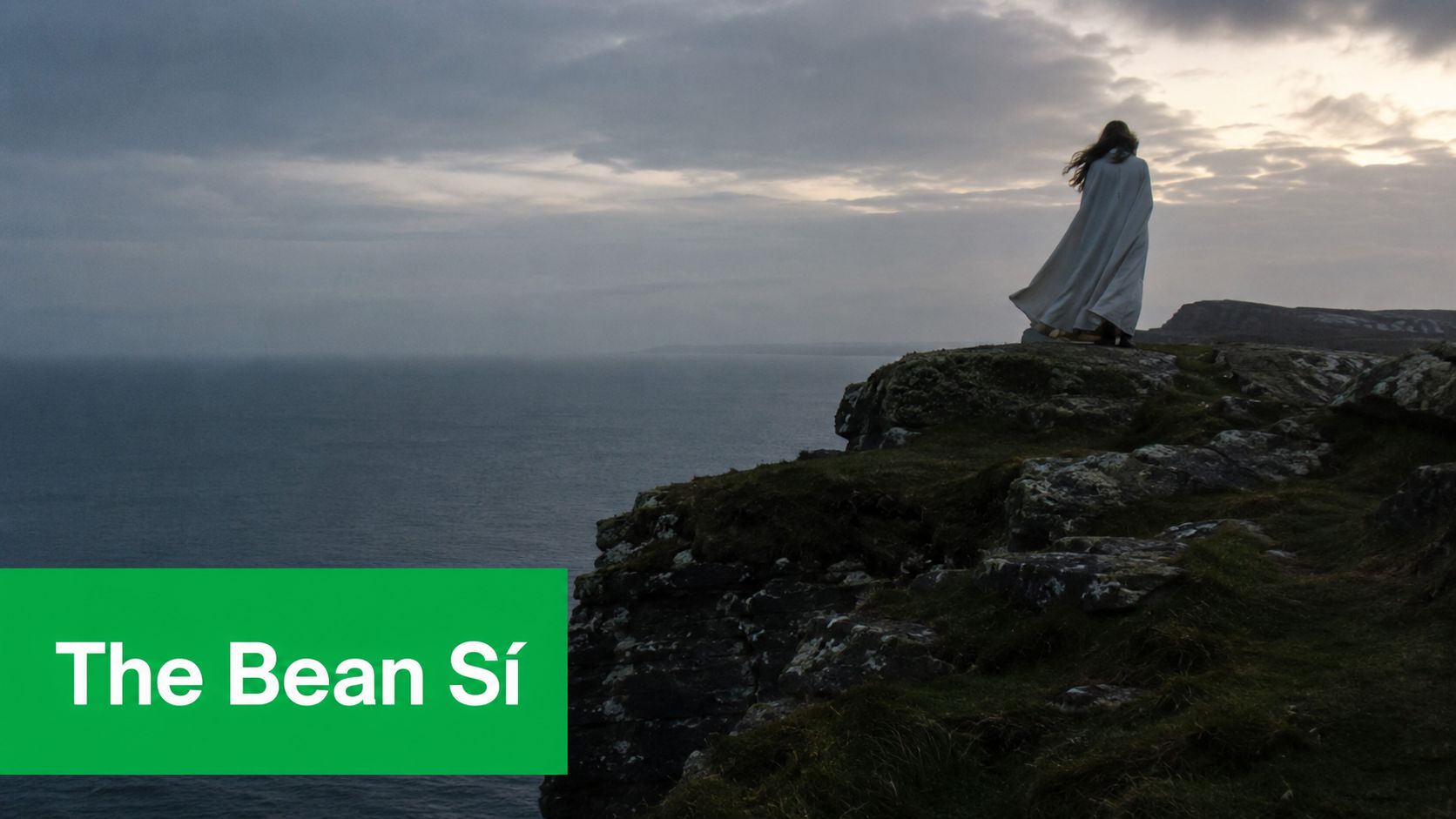
A farmer's kitchen goes quiet, then someone outside hears a woman crying where no woman should be. In Irish tradition, that sound belongs to the bean sí, the banshee, a figure whose presence is tied to a death warning rather than a simple ghost story.

The name comes from bean sí or ben síde, often glossed as “woman of the fairy mound” or “fairy woman”. That matters because it roots her in Gaelic tradition, not modern horror invention. Even the rough spoken form, ban-shee, keeps the emphasis on the figure's old Irish identity instead of a later pop-culture image. Irish folklore naming and family-lore traditions

A mysterious figure in a long white cloak stands on a rugged cliff overlooking the ocean.

Why the cry matters more than a fixed face

The banshee is first a mourning omen. People tell the story through sound, timing, and family connection, then describe the body only after the warning has already done its work. That's why asking “what do banshees look like” can be a little misleading if you ignore the cry that defines her.

Practical rule: if a description doesn't link the figure to lamentation, grief, or a household death warning, it's drifting away from the traditional bean sí.

The visual details often feel secondary because they support that role. Hair, clothing, and expression are there to make the cry believable as part of a grieving presence, not to turn her into a generic monster. Once you read her that way, the scattered descriptions start to make sense together.

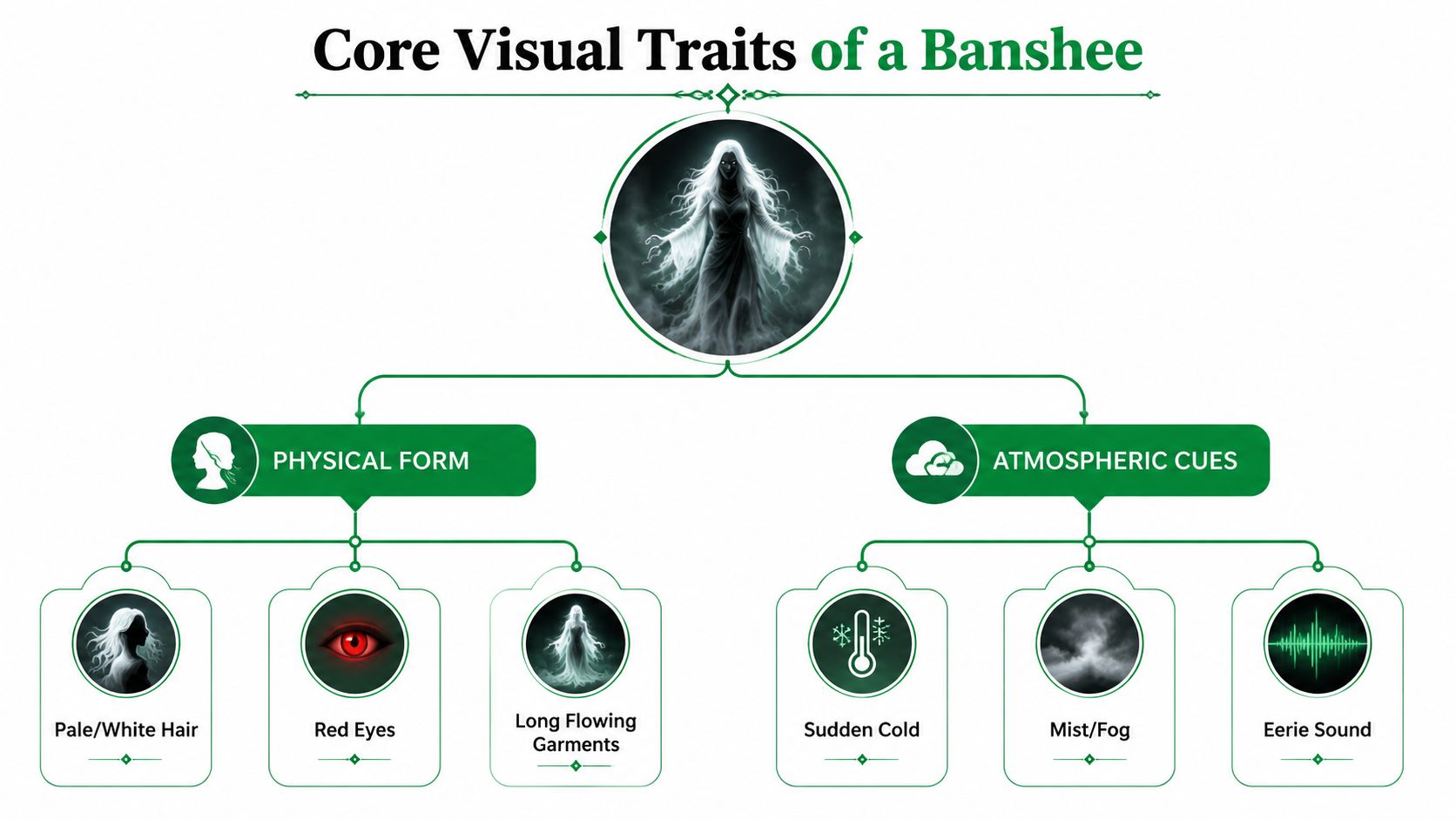
The Core Visual Traits of a Banshee

An infographic titled Core Visual Traits of a Banshee detailing her physical form and atmospheric cues.

A banshee is easier to picture when her appearance is treated as a cluster of recurring traits rather than a single fixed costume. Folklore keeps bringing her back with pale or white hair, red or inflamed eyes from weeping, long nails, and a cloak or shroud paired with a white or gray dress. Those details are not casual ornament. They fit her role as a figure whose presence is tied to lamentation, and they help explain why descriptions often feel more sorrowful than frightening. High-frequency banshee traits in folklore

Start with the hair and face

The hair is often the first detail that stands out in descriptions. It may be long, pale, white, or gray, and it usually looks uncombed or wind-tossed, as if grief has been pressing on it for a long time. The face tends to carry the same mood, with red eyes that point to endless weeping.

That pattern gives the figure her logic. A mourner who never stops crying would not look like a warrior spirit or a skeletal ghost, and banshee stories keep returning to that idea. Her body reads as worn down by lament, not shaped for battle.

Then read the clothing and hands

The clothing is usually white or gray, sometimes a cloak, sometimes a shroud-like dress, and sometimes something so plain that it feels funerary. The hands can be described with long fingernails, which make the figure feel old, strained, and unsettling without turning her into an animal or demon.

A single silhouette is not the point here. Folklore assembles a grieving presence from repeated signs, the way a room can feel like mourning before anyone speaks.

If you want a simple mental picture, gather those clues in one scene. A thin woman, pale hair loose around her face, a gray or white covering clinging to her, eyes raw from crying, standing at the edge of hearing. That image stays closer to the tradition than a polished horror design because it keeps the omen at the center. An infographic titled Core Visual Traits of a Banshee detailing her physical form and atmospheric cues.

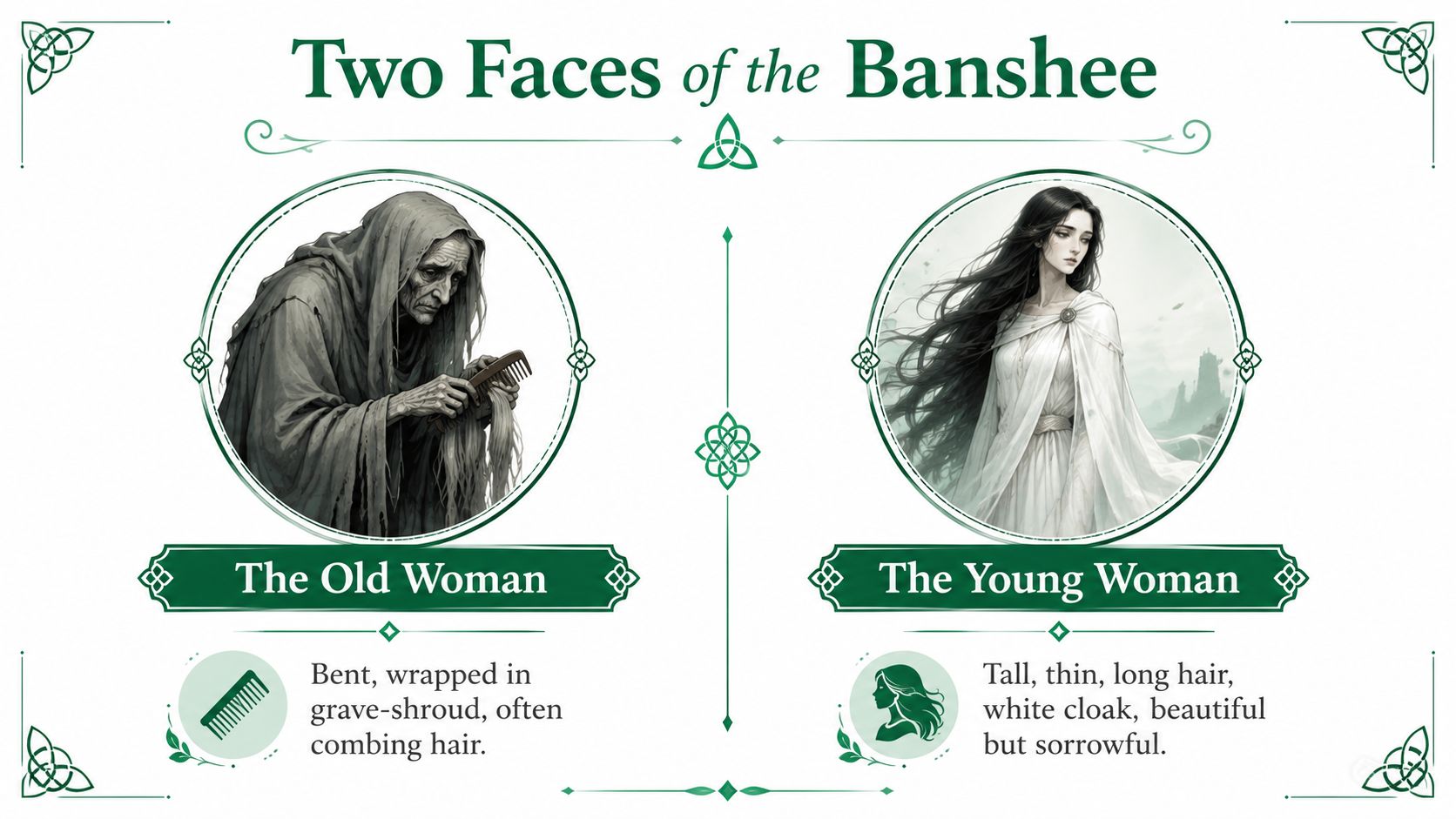
Two Faces in the folklore

Irish tradition preserves two strong visual patterns for the bean sí, and both belong to the same omen. One presents a tall, thin woman with long hair and a white cloak or sheet. The other presents a very old woman of small stature, bent and wrapped in something grave-like. These forms appear in older printed collections and later summaries of the folklore, which shows that the tradition kept both images in circulation rather than forcing one fixed model.

The small old woman tradition

In the older, harsher version, the banshee is small, bent, and worn by age. Her covering often feels like a grave cloth, so the image carries sorrow more than threat. She can seem folded in on herself, as if grief has pressed her body into that shape over time.

That is one reason this form feels so memorable. The body itself becomes a sign of mourning.

The tall young woman tradition

The other version is striking in a different way. She is tall, thin, and often described as beautiful, but the beauty sits under the shadow of sorrow. Long hair and a white cloak keep her tied to mourning, while the height gives her a more spectral, elegant presence.

A graphic illustration comparing the two traditional forms of the Irish folklore banshee: old and young.

These are not contradictions that cancel each other out. Folklore often keeps several images alive at once, and different tellers emphasize age, beauty, frailty, or severity according to what their community remembered most clearly. The important point is simple, both forms still carry the same mourning omen.

Regional Variations Across Ireland

The banshee does not keep one fixed face across Ireland. In some tellings, she is reduced to a low, compact figure, almost house-sized in her presence. In others, she appears tall and thin, with the sort of shape that seems to stretch the air around her. Regional folklore often places her somewhere along that range, which is why it helps to read the descriptions as a family of repeated traits rather than a single exact body type. Regional banshee variations across Irish folklore

What changes and what stays stable

The parts that shift most are size, the weight or plainness of the clothing, and whether the story presents her as old or young. The parts that stay steady are the mourning signs, especially white or gray hair, grave-like covering, and the sense that she appears before a death in a household. Those repeated markers work like a thread running through different local stories, holding the figure together even when the details change.

Munster, Connacht, Leinster, and Ulster each preserve their own way of telling the story. One area may emphasize a small, wrapped presence, while another prefers a tall woman with a sorrowful air. The setting changes, the family memory changes, and the image changes with it.

Folklore rarely behaves like a museum label. It behaves like memory, and memory keeps the parts that matter most to the people telling the story.

Family lore and local identity

The banshee is often linked to particular families or households, which gives her image a local root. That family connection helps explain why the same figure can take different forms in different places and still remain the same being. The name, the cry, and the omen role matter more than one settled body plan.

This is also where Irish fairies and folklore traditions helps readers place her in the wider Gaelic world. The bean sí belongs to a tradition in which place, kinship, and supernatural presence are tightly connected, so local variation is part of the folklore rather than a problem to solve.

How Banshees Differ From Similar Figures

The banshee sits near a wider family of mourning and fairy figures, but she is not identical to them. Her strongest marker is the death-warning cry attached to a household or family line, alongside the familiar visual cluster of pale hair, cloak, and grief. The bean sí also belongs to the fairy-mound tradition, which separates her from figures that look similar but carry different functions. Irish fairies and folklore traditions

Figure Region Typical Look Role
Banshee Ireland Old small woman or tall thin woman, pale hair, cloak or shroud Announces death with a cry
Keening woman Ireland Human mourner, often described in plain clothes Laments the dead at wakes or funerals
Bean nighe Scotland Washer at a river, often shown as ghostly and laboring Foretells death and washes bloodied clothes
Cyhyraeth Wales Usually an unseen or heard presence rather than a fixed body Death omen marked by a dread sound
Fairy women of the sí mounds Gaelic tradition Variable, often otherworldly and tied to mounds Broad supernatural category, not always a death omen

Why this distinction helps

The keening woman is easy to confuse with the banshee because both are connected to grief, but one is a human mourner and the other is a supernatural warning figure. The bean nighe and cyhyraeth also share the death-omen mood, yet their regional stories give them different settings and different visual habits.

If you keep one question in mind, the differences stay clear. Ask whether the figure is a mourner, a washer, a sound, or a family omen. That answer usually tells you whether you're dealing with a banshee or a related spirit.

From Oral Tradition to Modern Media

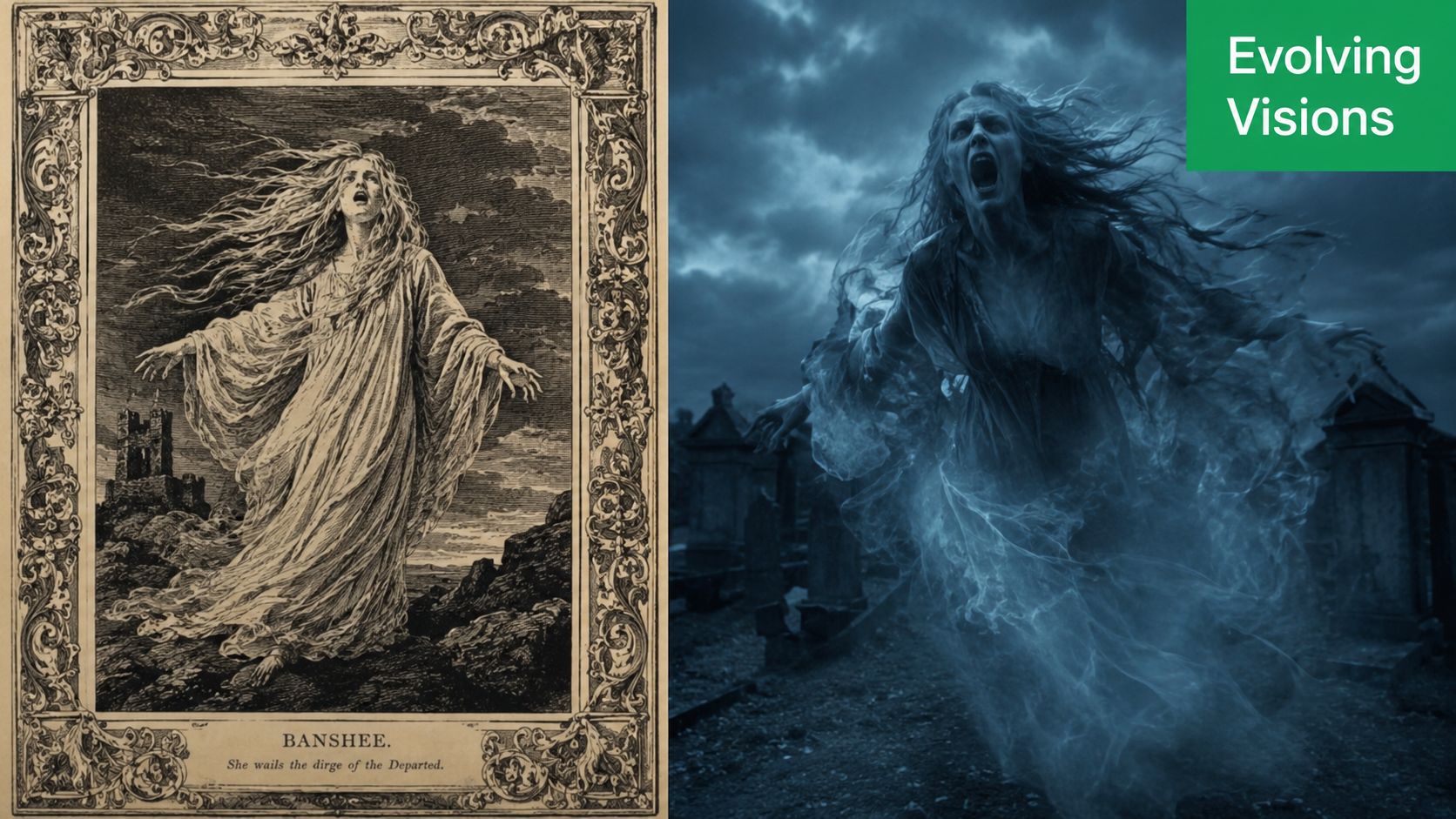
The visual banshee that reaches modern readers comes through layers of retelling. Nineteenth-century collectors preserved the tall, thin woman version and the small, bent old woman version, while later fiction and screen adaptations often narrowed the figure into a more polished ghost aesthetic. The older record is messier, but it's also richer. Banshee imagery in historical collections

A side-by-side comparison of a vintage illustration and a modern cinematic depiction of a wailing banshee.

What modern media keeps

Modern adaptations usually keep pale hair, flowing garments, a sorrowful face, and the sense of a wail. Those choices fit the folklore well because they preserve the mourning mood. When a film or game gets those pieces right, the banshee still feels like a banshee, even if the costume is stylized.

What modern media often changes

Creators sometimes add features that the folklore does not require, like heavier monster makeup, dramatic claws, or a generic horror silhouette. Those choices can work for entertainment, but they can also flatten the figure into something that loses her family-lore specificity. The strongest depictions usually keep the shape of grief instead of replacing it with a random fright mask.

After you see enough versions, a pattern becomes obvious. The tradition gives you the bones of the image, and modern media decides how glossy or severe to make them.

A note on storytelling voice

For a deeper sense of how Irish stories survive through retelling, look at Irish storytellers and seanchaí traditions. The banshee works the same way, because each generation repeats the core image while adjusting the surface details.

Depicting Banshees With Respect for the Source

If you're writing, drawing, or designing a banshee, start with the tradition instead of the genre shortcut. Give her mourning markers first, then decide how stylized you want the scene to be. A good depiction feels rooted in Irish folklore even when it's imaginative.

Keep the omen role visible

A banshee should look like someone or something connected to lamentation. If the cry, the grief, and the household warning are missing, the design stops reading as a banshee and starts reading as a generic ghost. You do not need to over-explain the folklore in the image, but the atmosphere should point toward loss.

Use attested traits, not random horror cues

The safest visual anchors are the ones folklore repeats. Pale hair, white or gray clothing, a cloak or shroud, red eyes from weeping, and a thin or aged body all fit the source material. By contrast, horns, wings, monster jaws, or excessive gore usually pull the design away from the bean sí tradition and into something else.

Best practice: build the image from grief, not from shock.

Respect the cultural setting

The banshee is part of living Irish cultural heritage, so it helps to treat her as more than a costume element. If you're adapting her for fiction or art, ground the visual choice in the kind of family-lore and mourning presence the tradition preserves. That approach keeps the work creative without turning the figure into a detached fantasy prop.

The cleanest designs often do less, not more. They let the hair, clothing, posture, and expression carry the meaning, which is exactly how the older stories tend to work.

Keep Exploring Irish Folklore Through the Language

The clearest answer to what do banshees look like is still a pattern, not a portrait. She appears as a cluster of mourning signs, pale hair, grave-like clothing, red-rimmed eyes, and the uneasy sense that a family warning has entered the room. For more folkloric context, creative arts on maxijournal.com can be a useful place to keep your curiosity moving, and you can also explore Irish Gaelic words in English to see how language carries old stories forward.

If you want to go deeper into the language behind the lore, Gaeilgeoir AI gives you a practical way to keep learning Irish while staying close to the stories that shaped words like bean sí. Visit Gaeilgeoir AI and keep building your connection to Irish folklore through the language itself.

Celtic Word for Dog: Irish, Welsh, and Gaelic Translations

I still remember the first time a learner asked me why Irish has both and madra for “dog.” The answer opened a door into myth, sound change, and the way Celtic languages keep ancient history alive in everyday speech.

Table of Contents

The Ancient Hound of Celtic Legend

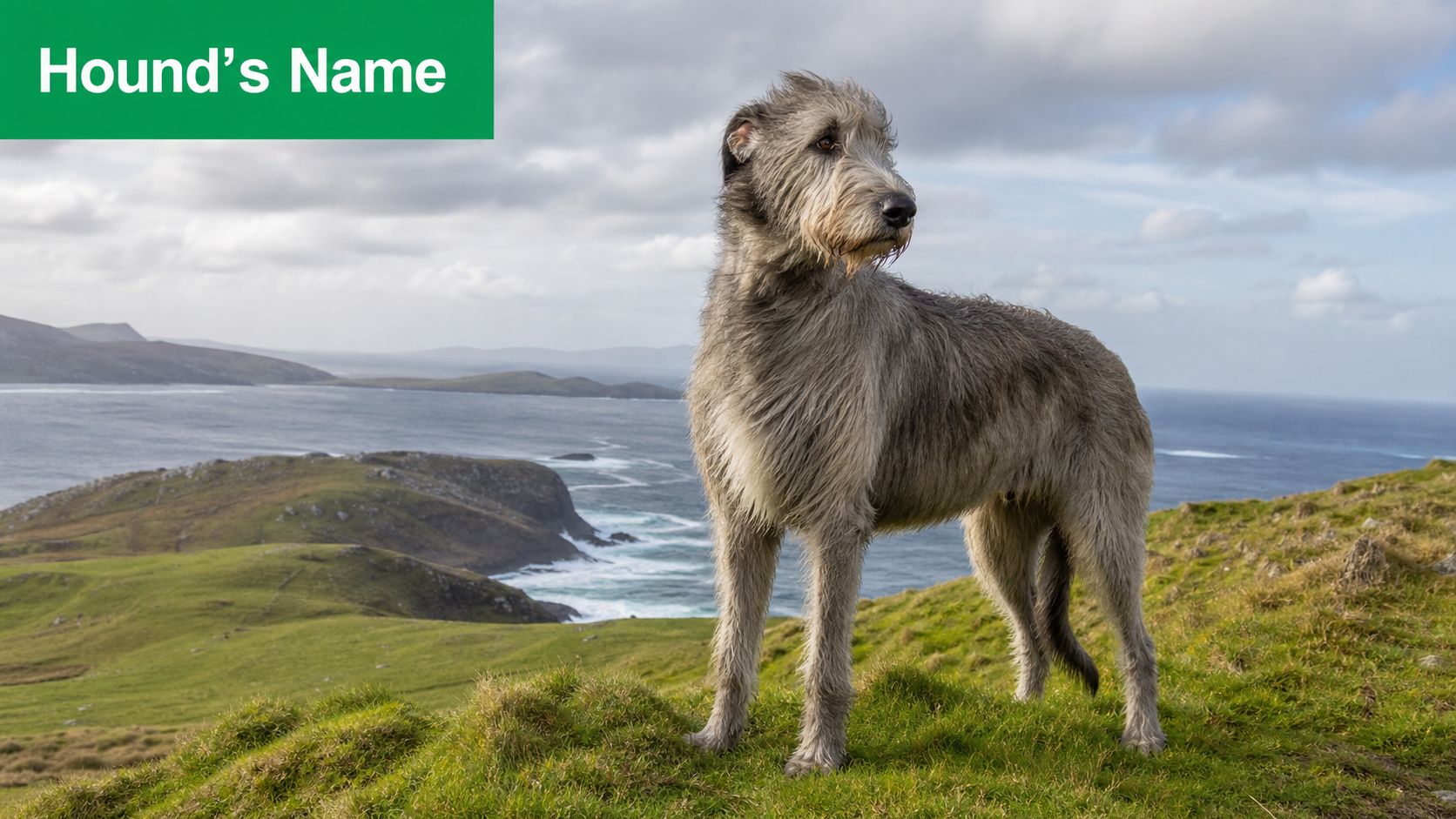
Cú Chulainn's name still stops learners in their tracks. It points to a hound, and that matters because the celtic word for dog has never been just a word for a household animal. In Irish legend, the hound carries loyalty, protection, and status, which is why the name of one of Ireland's greatest mythological heroes turns a dog into an honorific.

A majestic Irish Wolfhound standing on a grassy cliff overlooking the ocean with a scenic landscape.

The oldest inherited form behind all this is *Proto-Celtic . Comparative forms across the Celtic family include Old Irish cú, Irish cú, Scottish Gaelic cù, Manx coo, Welsh ci, Cornish ki, and Breton ki Omniglot's comparative list. That spread matters. It shows a shared inherited lexeme, not a later borrowing, and it helps explain why so many Celtic languages still feel related even when their modern everyday words look different.

A shared animal word with cultural weight

In Irish, broadened beyond “dog” to include hound, greyhound, wolf, and even honorific meanings such as hero or champion. Scottish Gaelic kept the simpler sense of dog, canine. That contrast is useful for learners because it shows how one ancient root can stay conservative in one branch and expand in another.

Practical rule: when a Celtic language seems to use a dog word in a name or title, don't assume it means a pet. It may signal rank, mythic power, or old poetic style.

For anyone building a cultural picture alongside vocabulary, this is the kind of detail that makes a word stick. A good companion resource for exploring related themes is dog probiotics, especially if you're pairing language learning with real-life dog care and want to keep the topic grounded in everyday life.

If you want a wider cultural doorway into Irish storytelling, this guide to Irish myths and legends fits naturally with the hound imagery. The language and the legend are doing the same job, they preserve memory.

Dog Words Across the Celtic Language Family

Irish learners often expect one neat translation for “dog.” Celtic languages refuse to stay that tidy. Some branches kept descendants of the ancient *kū root, while others developed everyday replacements, and that split gives you a clear view of the family tree.

A quick comparison across the family

Language Word IPA Pronunciation Usage Notes
Irish madra not supplied in the verified data Standard everyday word for “dog”
Irish not supplied in the verified data Older, literary, mythological, and honorific
Scottish Gaelic not supplied in the verified data Archaic and literary form, still used in Scotch Gaelic
Scottish Gaelic madadh not supplied in the verified data Another Gaelic term for “dog”
Welsh ci not supplied in the verified data Cognate from the old Celtic root
Breton ki not supplied in the verified data Cognate from the old Celtic root
Cornish ki not supplied in the verified data Cognate from the old Celtic root
Manx moddey not supplied in the verified data Modern everyday term
Manx coo not supplied in the verified data Preserves the older Celtic root

The broad pattern is simple. Goidelic languages, Irish, Scottish Gaelic, and Manx, show one set of developments, while Brythonic languages, Welsh, Cornish, and Breton, preserve forms closer to the old *kū shape. That's why ci and ki look strikingly familiar even before you've studied the historical grammar behind them.

What to notice when you compare them

A learner usually gets confused when a language has two words that seem to mean the same thing. In Celtic languages, the answer is often usage rather than pure dictionary meaning. Literary forms survive because poets, storytellers, and place names preserve them, while everyday speech can shift toward a newer standard. The Irish case makes this especially visible, and the same family comparison helps explain why a history guide to Celtic languages is worth reading after you've memorized the basic dog words.

If a form looks short and ancient, it often is. If it feels ordinary and conversational, it may be the newer everyday choice.

That distinction matters more than memorizing isolated translations. It helps you predict why a language keeps one form for folklore, another for the street, and another for compounds or idioms.

Why Irish Has Two Words for Dog

Irish gives learners a beautiful puzzle. Madra is the standard modern word for “dog,” but is still alive in older, poetic, and heroic contexts. That pairing isn't a contradiction, it's a record of language change.

From old forms to modern speech

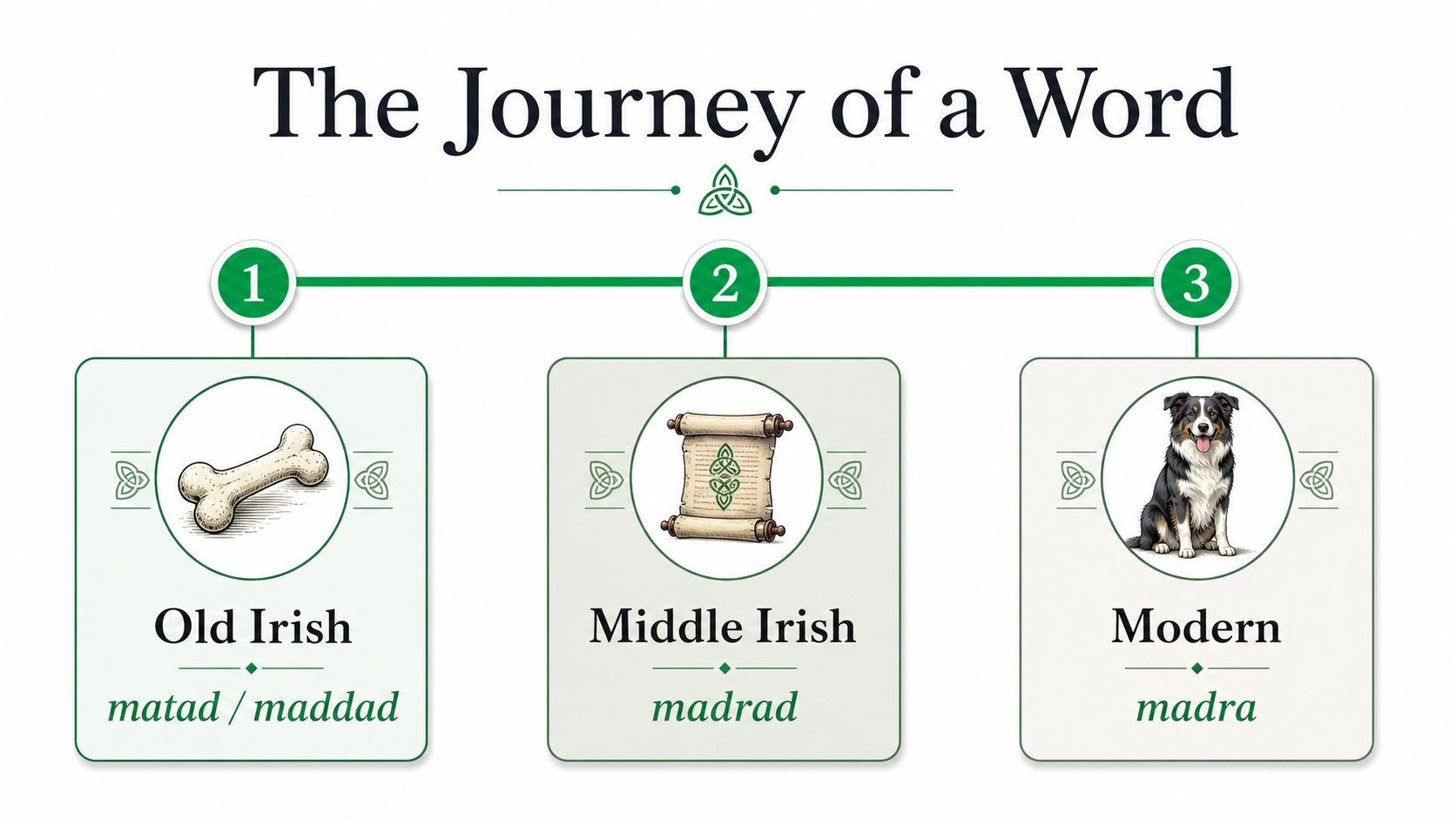
The historical pathway recorded by Alexander MacBain connects Middle Irish madrad and Early Irish matad/maddad to modern madra MacBain's etymological discussion as relayed in the linked summary. The same source ties the word to related Celtic forms such as Welsh madog and madryn, both linked to fox-related meanings. That family resemblance is useful because it shows that animal vocabulary often travels in clusters, not in isolation.

Why the everyday word changed

Language change usually follows social life. As dogs became common household animals, speakers favored the word that fit daily talk, while the older stayed in literary and mythological settings. That is why you still meet in names, epithets, and old styles, but madra handles ordinary conversation.

A visual timeline showing the evolution of the Irish word for dog from Old Irish to Modern.

The timeline makes the pattern easier to remember. Old Irish matad/maddad comes first, Middle Irish madrad sits in the middle, and Modern madra is the form you use in everyday speech.

A memory trick that actually works

Think of as the “story word” and madra as the “daily word.” That mental split helps you choose the right term without freezing up. It also explains why a learner might understand a sentence in a mythological context but hear something completely different at the kitchen table.

Creative Celtic Compounds Built on Dog

Irish does something wonderfully practical with madra. Instead of inventing unrelated animal names for every creature, it often builds compounds that describe an animal by color, habitat, or behavior. That pattern is one reason Celtic vocab can feel so logical once you see the system.

When dog becomes a naming tool

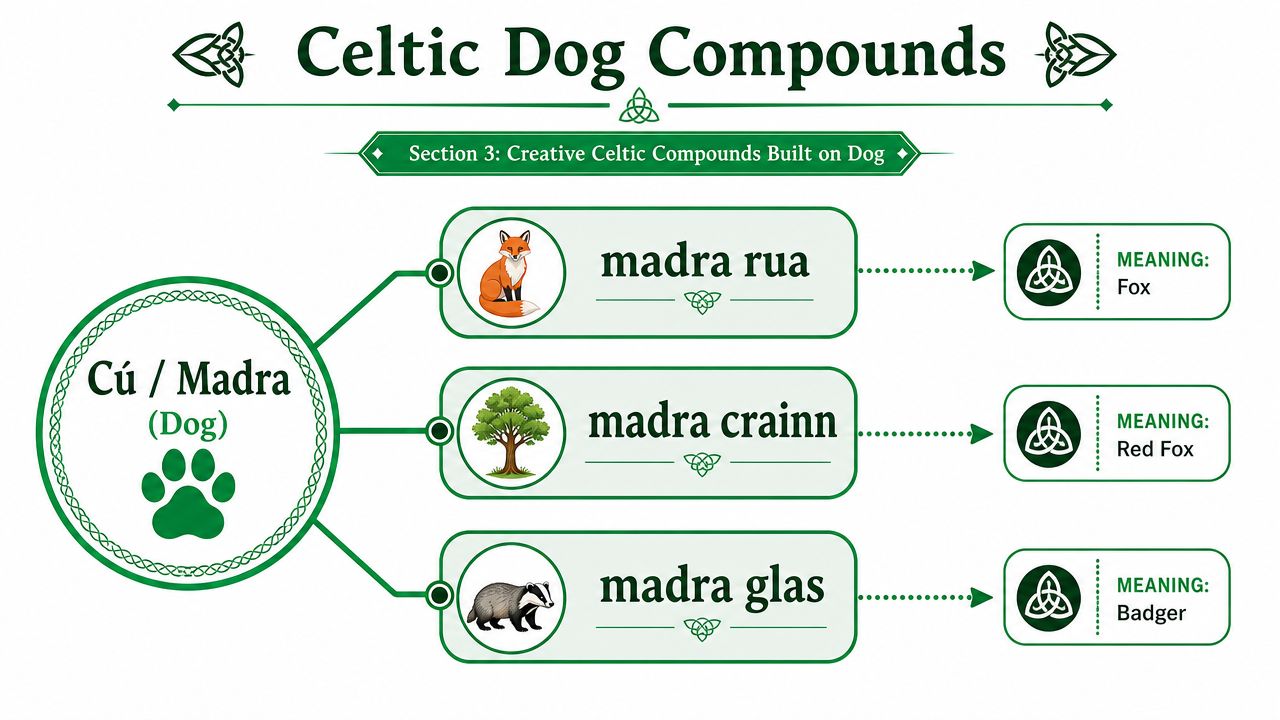
Madra rua means fox, “red dog.” Madra crainn means squirrel, “tree dog.” Madra mara means seal, “sea dog.” Madra uisce means otter, “water dog,” and a modern Irish-language reference glosses it with the pronunciation [ˈmˠad̪ˠɾˠə ˈɪʃcɪ] Omniglot's water-dog entry. That's not random poetry. It's a naming habit built on close observation.

An educational chart illustrating Irish Gaelic compound words featuring the word for dog, including fox and badger.

The logic is easy to miss if you expect modern scientific taxonomy. Celtic speakers were grouping animals by what they looked like, where they lived, or how they moved. A fox could become a “red dog” because color mattered. An otter could become a “water dog” because habitat mattered.

Why this helps you remember vocabulary

Once you know the pattern, you can decode unfamiliar words more quickly. You're no longer memorizing isolated facts, you're spotting a productive naming style.

  • See the base word first: recognize madra before you chase the second element.
  • Match the descriptor to the habitat: crainn points to trees, mara points to sea, uisce points to water.
  • Listen for image, not zoology: these compounds often reflect how speakers imagine an animal, not how a textbook classifies it.

An easy extra clue comes from Irish diminutives, because Celtic languages often create meaning through small structural changes rather than entirely new roots. That habit makes the vocabulary feel alive, especially when you start reading with your ears as well as your eyes.

Mastering Celtic Dog Word Pronunciation

Pronunciation trips up even confident learners because the letters look familiar while the sounds don't. , ci, ki, and madra all deserve a slow, careful read aloud, not silent recognition on a page.

The sounds that matter most

Scottish Gaelic begins with a consonant that English speakers often want to soften too much. Keep it firm and back in the mouth. Irish madra has a rolled or tapped r quality that many English speakers flatten, so it helps to exaggerate the tongue movement at first.

Welsh ci and Breton ki are another useful pair. They look almost identical, but the vowel quality is what keeps them distinct in speech. If you say them like English “key” without listening carefully, you'll miss the native feel of the word.

Practical rule: don't trust spelling alone. Celtic spelling often gives you structure, but your ear has to learn the actual sound shape.

A simple speaking routine

Say each word slowly, then attach it to a meaning, then say it again in a short phrase. That sequence builds muscle memory better than repeating isolated syllables. If you can, record yourself and listen back, because self-correction is where the progress happens.

A lot of learners also benefit from immediate feedback tools. AI-based pronunciation practice can help you hear the difference between a flat English approximation and a more native-like Celtic sound, especially when textbooks don't give you enough correction. The point isn't perfection. It's building confidence to speak aloud instead of staying locked in silent reading.

Common mistakes to avoid

  • Over-Englishing the vowels: Celtic vowels are often more precise than English learners expect.
  • Dropping the consonant detail: a small change can turn one form into something that sounds off.
  • Rushing the word: slow speech makes unfamiliar sounds much easier to control.

If you've been avoiding speaking because the words look hard, start with the shortest forms first. Short words are not easier because they are simple. They're easier because they let you focus on one sound at a time.

Using Dog Words in Real Celtic Conversations

Vocabulary becomes useful the moment it leaves the page. Dog words work best when they appear in short, friendly exchanges about pets, walks, and everyday life, not just in dictionary drills.

Everyday phrases you can actually use

In Irish, An bhfuil madra agat? means Do you have a dog? That's a natural opener if you're talking to someone about pets. Tá madra álainn agat means You have a lovely dog, and it works well in a casual conversation when someone introduces their dog to you.

Cultural context matters here. Asking about a dog is usually safe and warm, but the tone should still fit the setting. With someone you just met, a simple pet question feels friendly. With a stranger in a formal situation, you'd keep it lighter and more polite.

What makes these phrases stick

The strongest phrases are the ones you can reuse across settings.

  • Ask first, comment second: a question like An bhfuil madra agat? starts the exchange naturally.
  • Keep praise simple: short positive phrases are easier to remember and sound more authentic.
  • Reuse the animal pattern: once you know madra, related compounds become easier to identify in reading.

You'll also notice that Celtic languages often treat animals as part of daily life, not a separate vocabulary island. That's why dog words show up so comfortably in idioms and compound forms. The language doesn't force a rigid separation between “animal talk” and “real talk.”

A small habit helps here. Say the phrase out loud when you see a dog, a photo of a dog, or even a dog on a sign. Real-world pairing locks the vocabulary in faster than flashcards alone.

Your Next Steps for Learning Celtic Languages

Start with one Celtic language and let one word family guide the rest. If Irish is your focus, begin with madra and , then build outward into one or two compounds and one conversational phrase. That small base is enough to make the language feel less mysterious.

A simple 30-day approach

For the first week, learn the basic dog word and one greeting. In the second week, add one compound such as madra mara or madra uisce. In the third week, read a short mythic or cultural text and look for in context. By the fourth week, practice a tiny spoken exchange without looking at notes.

That approach works because it ties vocabulary to meaning, not just memorization. It also keeps the emotional payoff visible. You're not chasing abstract grammar. You're building a usable relationship with the language.

Keep the motivation concrete

Pick the language that connects most strongly to your heritage, your location, or your curiosity. Then use one theme, like dog words, as an anchor. A focused theme makes progress easier to notice, and noticed progress keeps people going.

Learn a few words deeply before you try to learn a lot of words quickly.

If you're ready to turn that kind of practice into a daily habit, Gaeilgeoir AI gives you guided Irish conversation, pronunciation support, instant feedback, and scenario-based practice that fits real life. It's a strong fit if you want to move from reading about Celtic words to using them with confidence.


Gaeilgeoir AI helps you move from curiosity to speaking, with guided Irish practice that makes words like madra and feel usable instead of distant. If you want a steady way to build confidence with Irish from the ground up, visit Gaeilgeoir AI and start practicing today.

Irish Thanksgiving Blessing: 7 Beautiful Prayers for 2026

Bringing an Irish Heart to Your Thanksgiving Table

You're probably looking at the Thanksgiving menu, the place cards, and the family group chat all at once, trying to find one small moment that feels meaningful. An Irish Thanksgiving blessing can do that beautifully. It gives you a way to pause, speak with warmth, and bring a little Gaeilge to the table without making the moment feel formal or forced. For many families, that blend of gratitude, heritage, and simple hospitality is exactly what the holiday needs. If you're also planning a cozy meal at home, these intimate holiday gathering ideas can help set the tone.

Table of Contents

1. Go raibh maith agat ar an bhia agus ar an bhealach

This phrase works well when you want a blessing that feels direct and grounded. It translates as a thank-you for the food and the way it has been given, which makes it especially fitting for a Thanksgiving table where the meal matters, but so does the care behind it.

How to say it with confidence

A simple way to break it up is Go raibh and then the rest of the phrase. In many learning settings, Go raibh is often heard with a soft, flowing sound, and that makes it easier to say aloud before dinner than it looks on the page. If you want to practice it well, say it slowly once before the meal, then repeat it naturally as the family sits down.

This kind of blessing suits a family dinner, a small friendsgiving, or a home where someone wants a short Irish phrase that doesn't feel intimidating. It also fits well in Irish-speaking communities and language classes, where learners often build gratitude vocabulary through real meal moments rather than memorizing isolated words. In other words, it's practical first, poetic second.

Use the phrase at the table, not as a performance. The best Irish blessings sound natural when they're spoken as part of the meal, not recited like a speech.

A helpful habit is to connect the phrase to a real action. Pour the drink, pass the bread, then say the blessing. That tiny sequence builds muscle memory and makes the language feel lived in, not studied from a distance.

2. Beannachtaí na Féile Fómhair oraibh

This autumn blessing brings harvest language into the room, which makes it a strong fit for Thanksgiving. Its meaning points toward blessings of the harvest season, and that seasonal focus fits the wider tradition of giving thanks for food, weather, and abundance.

Why it feels right for a harvest meal

Thanksgiving already sits close to harvest imagery, so this blessing gives you a more seasonal Irish frame. It works especially well if your table has pumpkins, apples, root vegetables, or other autumn foods, because the phrase naturally echoes the feeling of the season. In Irish cultural contexts, harvest and seasonal change are often tied to older festival traditions, including Samhain, which makes the blessing feel rooted in the rhythm of the year.

For learners, this is a good phrase for expanding beyond basic gratitude. It introduces seasonal vocabulary and shows how Irish can name time, place, and blessing in one compact line. That makes it useful in cultural conversations, especially when someone asks for a phrase that feels more specific than a simple thank-you.

  • Use it for autumn gatherings: It fits a harvest table, a fall dinner, or an Irish cultural event.
  • Say it slowly first: The sound matters less than the calm, thankful tone.
  • Pair it with seasonal words: Think of apples, grain, fields, and evening light.
  • Use it in group settings: It feels especially good when several people are gathered together.

A practical approach is to say it after everyone is seated but before the first bite. That timing gives the phrase a ceremonial feel without making the meal stiff. For a Thanksgiving host who wants one line that feels seasonal and Irish at the same time, this is a strong choice.

3. Go raibh míle blessings ar ár neart agus ar ár spiorad

This blessing leans more poetic, and that's part of its appeal. It speaks to strength and spirit, so it goes beyond food on the table and reaches toward resilience, gratitude, and emotional steadiness.

A phrase for reflective moments

The opening words Go raibh míle connect with the familiar Irish gratitude pattern that often shows up in expressions like Go raibh míle maith agat. That shared structure helps learners recognize the rhythm of Irish thanks even when the rest of the blessing is more expressive. It's a useful bridge between everyday gratitude and more reflective language.

This is the kind of blessing that works well when the gathering includes a quieter moment, maybe before dessert or after a long year that made everyone appreciate being together. It also suits spiritual settings, mindful meals, or family members who want the prayer to feel deeper than a standard table grace. If your Thanksgiving includes different generations, this phrase can sound meaningful without being overly long.

Practical pronunciation help

Break the blessing into short units. Say the gratitude opening first, then pause, then move into the line about strength and spirit. That keeps the phrase manageable and helps you avoid rushing the middle.

Practical rule: if a blessing feels too long to memorize, learn the first meaningful chunk, then add the rest after you can say it calmly once.

For a learner who wants a more advanced Irish expression, this phrase is a good stretch. It feels thoughtful at a candlelit table, during a holiday toast, or in any setting where gratitude includes more than just the meal itself.

You can compare this with other Irish blessing forms on The Irish Blessing guide, which helps place the phrase within the broader blessing tradition.

4. Go raibh fáilte romhat chun an bhoird

Hospitality sits at the heart of this blessing. It means you are welcome at this table, and that makes it one of the most useful Irish phrases for a Thanksgiving host who wants to make guests feel included right away.

A welcome that sounds warm, not formal

The key word here is fáilte, which means welcome and carries a strong sense of openness and invitation. Irish culture often treats welcome as more than politeness, it becomes a social value. That's why this phrase works so well at the beginning of a meal, when people are still settling in and the host wants the room to feel relaxed.

This blessing is a natural fit for formal toasts, family gatherings, and holiday meals where guests may not know one another well. It can also work for an Irish-American table where the host wants to acknowledge the gathering itself, not just the food. If you've got a mix of ages, backgrounds, or levels of familiarity, this phrase helps create common ground quickly.

A good way to use it is to say the blessing as people sit down, then follow it with a short English welcome if needed. That makes the Irish feel accessible, not exclusionary.

The phrase also pairs well with other dining vocabulary, because it reminds learners that food words and social words often go together in Irish. For more on the cultural meaning of the word fáilte, the phrase is nicely explained in this Irish welcome guide.

A warm welcome matters as much as the meal. In Irish, the invitation itself can feel like part of the blessing.

5. Ar fhéile Bhríde, go raibh biseach ar ár neart

This blessing has a different seasonal home, but that's exactly why it's interesting. It connects to St. Brigid's Day, so it reminds learners that Irish blessing language isn't limited to one holiday or one table.

What this blessing teaches beyond Thanksgiving

Its meaning points to strengthening or renewing our strength, which gives it a restorative tone. Even though it belongs more naturally to early spring than to November, it shows how Irish blessings often move through the calendar with religious and seasonal observances. That makes it a valuable phrase for anyone trying to understand the broader structure of Irish cultural life.

For Thanksgiving use, this blessing works best when you want to widen the conversation. A host might say it while introducing Irish seasonal traditions, or a learner might share it as an example of how blessings can be tied to saints' days as well as family meals. It's less about the holiday itself and more about showing how Irish language keeps faith and season connected.

This is a good phrase to learn alongside other feast-day expressions. It helps you see a pattern, one in which Irish blessings often mark time through holy days, changing light, and the rhythm of community life. That pattern is useful for students returning to Irish, because it gives context instead of random vocabulary.

How to make it memorable

Learn the blessing in two parts, first the feast-day opening, then the wish for strength. Say it aloud once in a calm voice, then repeat it in a sentence about the season. For example, you might use it when talking about winter ending, or about resilience in family life.

If you like studying through repetition, this is a strong phrase to add to your practice list because it links language, calendar, and tradition in one line.

6. Go raibh grá agus beannacht ar an teach seo agus ar a bhythaigh ann

This household blessing stretches the Thanksgiving idea beyond the table and into the whole home. It means may there be love and blessing on this house and on all who live within it, which makes it a lovely choice for family gatherings and holiday hosting.

A blessing for the whole home

The phrase works because Thanksgiving isn't only about a meal. It's about the room the meal happens in, the people who prepared it, and the feeling guests carry out the door. This blessing names the house itself and everyone inside it, so it gives gratitude a wider reach.

It's especially useful if you're hosting a large family, welcoming relatives from out of town, or celebrating in a home that feels central to the family story. It can also work at the start of the evening, when people are gathering coats, setting dishes on the table, and settling into a shared space. That kind of moment benefits from a blessing that feels protective and warm.

For learners, this phrase is a good vocabulary builder because it includes words tied to home, love, and blessing. It also reflects a common pattern in Irish blessings, where the wish expands outward from one moment into the whole household. If you're studying for real-life use, that expansion matters.

A helpful way to learn it is to divide it into three ideas, house, love, and blessing. That keeps the phrase manageable and makes it easier to personalize later. You can say it for a new home, a holiday dinner, or any gathering where you want the space itself to feel included.

The household focus also makes this a strong match for Irish new house blessing tradition, which fits the same family-centered spirit.

7. Go raibh an t-ádh orainn ar an bhéile seo agus ar a chéile

This is the most social of the seven. It ties together the meal and one another, which makes it ideal for Thanksgiving because the holiday is as much about companionship as it is about food.

Gratitude for food and company together

The word ádh brings in the idea of fortune or luck, so the blessing doesn't just thank the kitchen. It also thanks the people at the table and the good fortune of being together. That combination feels especially right in a shared meal, where conversation, memory, and hospitality all matter.

This phrase works well in family meals, community dinners, and holiday gatherings where the group wants something that feels warm but not overly religious. It's flexible enough for an Irish-American table, a casual friendsgiving, or a toast where the speaker wants to honor both the food and the company. Because it holds both ideas at once, it sounds complete without being long.

A simple way to practice it

Split it into two parts, first the blessing on the meal, then the blessing on each other. That makes the rhythm easier to remember and helps you keep the tone natural. Saying it slowly in front of the first course, then repeating it again before dessert, can help the phrase stay with you.

Keep the tone relaxed. A blessing like this lands best when it sounds like real gratitude, not recitation.

For learners, this is a useful phrase because it shows how Irish often combines ideas rather than isolating them. Meal, fortune, and togetherness sit in one line. That's a strong lesson for anyone trying to speak Irish in real social settings.

Comparison of 7 Irish Thanksgiving Blessings

Blessing (Irish, English) 🔄 Complexity ⚡ Ease & Speed 📊 Expected outcomes ⭐ Effectiveness 💡 Ideal use cases / Tips
Go raibh maith agat ar an bhia agus ar an bhealach, Thank you for the food and for the way Low, simple, phonetically accessible High, short and quick to memorize Teaches basic mealtime vocab and cultural gratitude ⭐⭐⭐⭐ Everyday meals; practice daily with audio; break into syllables
Beannachtaí na Féile Fómhair oraibh, Blessings of the harvest season upon you Medium, seasonal vocabulary, formal plural Medium, needs seasonal context Builds seasonal/harvest vocabulary and calendar awareness ⭐⭐⭐ Autumn/harvest festivals; learn with crop vocabulary
Go raibh míle blessings ar ár neart agus ar ár spiorad, A thousand blessings on our strength and spirit Medium‑High, poetic, abstract terms Low, longer, requires repetition Teaches abstract/emotional expressions and intermediate vocab ⭐⭐⭐⭐ Spiritual or reflective settings; learn in phrases; use pronunciation tools
Go raibh fáilte romhat chun an bhoird, You are welcome at this table Low, simple social phrase High, immediately usable in conversation Teaches hospitality vocabulary and social interaction norms ⭐⭐⭐⭐ Inviting guests, social meals; pair with dining vocab and roleplay
Ar fhéile Bhríde, go raibh biseach ar ár neart, On the feast of Brigid, may our strength improve Medium, tied to feast day and religious terms Medium, limited to seasonal use Teaches feast‑day and religious calendar vocabulary ⭐⭐⭐ St. Brigid's Day events; study with other feast‑day phrases
Go raibh grá agus beannacht ar an teach seo agus ar a bhythaigh ann, May there be love and blessing on this house and all who dwell within it Medium‑High, longer, multiple concepts Low‑Medium, more memorization required Teaches household, family, and formal blessing vocabulary ⭐⭐⭐⭐ House blessings, holidays; learn in sections and use adaptive quizzes
Go raibh an t-ádh orainn ar an bhéile seo agus ar a chéile, May we be fortunate with this meal and with each other Medium, combines luck concept and prepositions Medium, practical but slightly longer Teaches concept of 'ádh' (luck) and communal gratitude ⭐⭐⭐⭐ Family/community meals; split into parts and practice social scenarios

Start Speaking Irish with Confidence

An Irish Thanksgiving blessing works best when it feels like something you can say, not just admire on a page. The seven phrases above give you a range of options, from short table gratitude to household warmth, seasonal harvest language, and more reflective spiritual wording. Each one carries a different tone, so you can match the phrase to the setting, whether that's a quiet family dinner, a formal toast, or a lively table with guests who want to feel welcome.

The deeper value here is cultural. Irish blessings often join gratitude, hospitality, and relationship in one expression, which is why they fit Thanksgiving so naturally. They also make the Irish language feel approachable. You don't need perfect pronunciation on the first try, and you don't need to know every grammatical detail before speaking. What matters is using the phrase in a real moment, slowly and respectfully, until it feels familiar.

If you want to keep learning beyond one holiday phrase, guided practice can help a lot. Gaeilgeoir AI is built for real-world conversation, pronunciation support, and scenario-based learning, which makes it a practical place to keep building confidence after Thanksgiving. Start with a blessing, then move into greetings, gratitude, and everyday phrases you can use with family and friends.

Visit Gaeilgeoir AI to begin speaking Irish with more confidence and to explore lessons that help you turn one meaningful phrase into everyday progress.


A CTA for Gaeilgeoir AI.

8 Authentic Irish Names for Horses and Their Meanings

Looking for a horse name that sounds Irish, feels authentic, and still works in a busy yard or on a show list? Many naming guides offer Irish-sounding names, but fewer address authenticity that still fits everyday use. A strong Irish horse name does more than sound pretty, it can carry heritage, hint at temperament, and give you a chance to practice Gaeilge in a way that lasts.

Irish naming has always been more than decoration. Horse Racing Ireland treats naming as a formal registration step, with an official naming form, passport, and fee, so the tradition still sits inside a regulated system rather than an informal nickname culture. The Irish naming rules are set out in the HRI naming requirements, and that context helps explain why names are chosen with care. Irish-language horse vocabulary also runs deep in place-names, and Logainm preserves forms such as Corr na Lárach, which shows how specific Irish can be about mares and horses in historical naming practice.

That matters if you want a name that feels genuine, not pasted together from a list. It also explains why some of the best irish names for horses are short, familiar, and easy to say out loud in a stable, a lesson ring, or a show office. If you like the heritage side of naming, you may also enjoy these insights on horse-themed Claddagh jewelry, because the same cultural symbolism often appears in both horse names and Irish keepsakes. For a wider set of options and pronunciation help, you can also compare these Irish names for girls, since many horse names draw from the same language patterns.

Table of Contents

1. Aoife

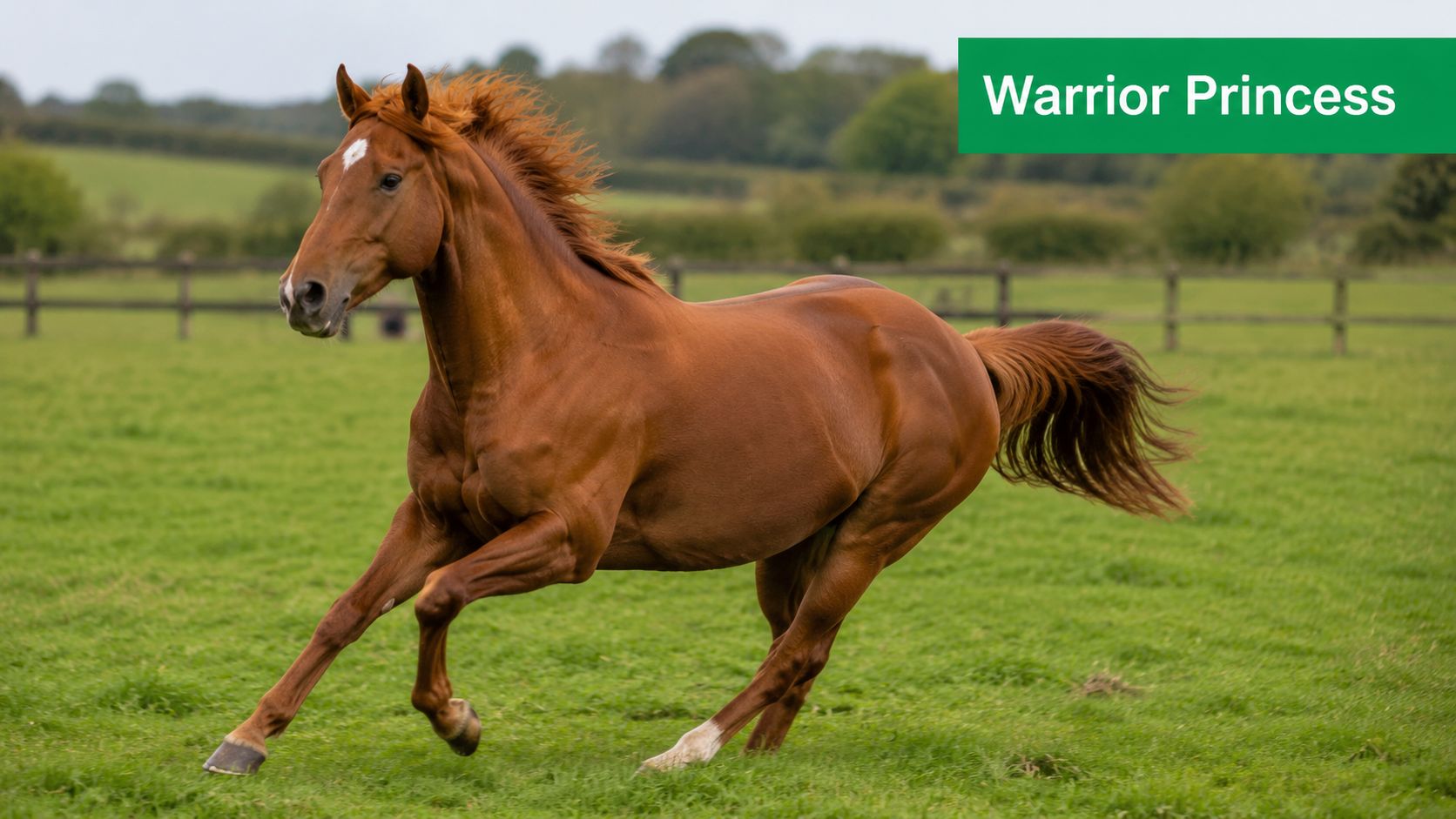
The Warrior Princess

Aoife is one of the best-known Irish girls' names, and it's easy to see why horse owners keep coming back to it. In Irish tradition, Aoife is linked with beauty and radiance, but the name also carries a warrior edge through mythic figures who were fierce, capable, and memorable. That combination makes it a natural fit for a mare with presence, quick reactions, and a little spark under saddle.

The pronunciation, EE-fa, is important. Many English speakers want to flatten it into something closer to “Ayo-fee,” but the correct sound is cleaner and softer, with two clear syllables. If you're naming a horse for the yard, the show ring, or a breeding record, that clarity helps everyone say it the same way.

A powerful sorrel chestnut horse running freely across a lush green pasture on a bright day.

Aoife works especially well for horses that look elegant but don't move gently through life. A sharp-turning show jumper, a mare with scope, or a competition horse that comes alive when the fences go up all suit the name. It also pairs neatly with Irish surnames in full registration names, which gives you a polished formal option while still keeping the everyday call name simple.

Practical rule: if the mare is brave, athletic, and quick to learn, Aoife feels stronger than a purely decorative name.

For a language-learning touch, Aoife is a useful first pronunciation win because it shows how Irish spelling often preserves older sounds rather than matching English habits. If you want more Irish girls' names with that same linguistic feel, the internal guide at Irish names for girls gives you a broader naming context without losing the pronunciation focus.

2. Cormac

The Charioteer's Choice

Cormac has a more formal, grounded feel than many pet-style names, which is exactly why it suits a horse with authority. The name comes from an old Irish tradition tied to raven imagery and nobility, and it carries a sense of leadership that feels right for a stallion, a gelding with presence, or a horse that moves through the stable like it knows the routine better than anyone else.

The pronunciation, COR-mac, is straightforward for English speakers, which makes it practical in daily use. That matters in a yard where names need to be called quickly during turnout, loading, or warm-up. A name with ancient roots but easy delivery often travels better than a more ornate choice.

Cormac also brings a strong historical atmosphere. The legendary Cormac mac Airt is remembered as a wise high king in Irish tradition, so the name suggests judgment, steadiness, and composure. Those qualities fit a horse that stays level-headed in the ring or keeps its shape under pressure.

A few good real-world fits include:

  • A dark bay or black horse that already has a serious, polished look.
  • A breeding stallion whose pedigree and demeanor both matter.
  • A calm gelding in sport work who leads the group without fuss.

For owners building a full registered name, Cormac feels especially strong paired with an Irish stable prefix or a family surname. It reads as heritage-first, not trend-first, which is useful if you want something that ages well as the horse grows into its job.

Cormac works best when the horse's manners are as good as the outline. The name sounds strongest when the animal's temperament matches its old-world weight.

For the people who are learning Irish as they name a horse, Cormac is also a good reminder that some Irish names stay close to their older roots in sound, even when English speakers assume they'll be more complicated than they are.

3. Siobhan

The Graceful Dancer

Siobhan, pronounced shiv-AWN, is one of those names that looks intimidating on paper and turns smooth once you hear it spoken. That makes it a great teaching name for stable staff, riders, and anyone who wants to get comfortable with Irish pronunciation. It also carries a soft elegance that suits a mare with expressive movement and a careful, balanced way of going.

The name's history is one reason it feels so rich. It comes through Irish adaptation from older French roots, but in Irish use it became its own distinct form with a strong identity of its own. In everyday horse naming, that gives you a name that sounds refined without feeling fragile.

Siobhan is especially good for dressage mares, show mares, and breeding mares with polished movement. A horse that reaches naturally, floats through transitions, or has a calm, attentive focus can wear the name beautifully. It also works well for horses in in-hand classes, where presentation and poise matter as much as athleticism.

The name suits owners who want a horse name with cultural depth and practical usability. You can say it in the yard without stumbling once the pronunciation is learned, and it still looks elegant on a program or passport. That balance is rare.

A few ways the name earns its place:

  • It sounds graceful without being overly delicate.
  • It has a clear pronunciation pattern, which helps non-Irish speakers.
  • It feels at home in the show ring, especially where a polished impression matters.

If you're teaching Irish to yourself or to younger riders, Siobhan is a useful spelling-and-sound example. The letters don't behave the way English readers expect, and that's exactly why it makes such a memorable Irish name for horses.

4. Fionn

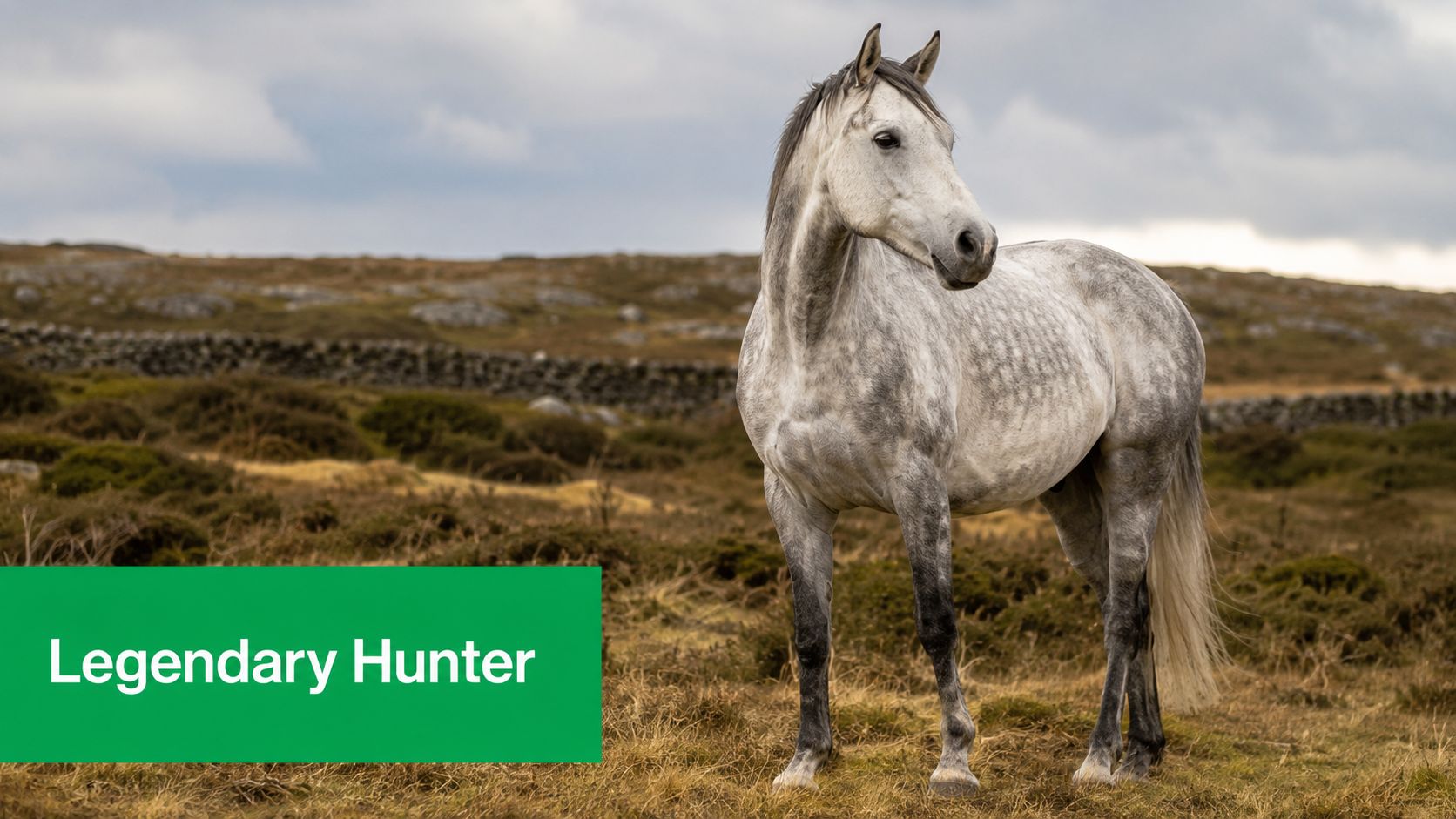
The Legendary Hunter

Fionn, pronounced FEE-un, is short, strong, and easy to remember. It's tied to the idea of fairness or whiteness in Irish, and it also carries the cultural weight of Fionn mac Cumhaill, one of the great heroic figures in Irish legend. That gives the name a mix of brightness and bravery that suits a horse with athletic drive.

The name works across sex and discipline, which makes it one of the most flexible choices on this list. A gelding who jumps cleanly, a mare that attacks cross-country with confidence, or a light-colored horse with a striking outline can all wear Fionn well. It doesn't over-explain itself, and that's part of the appeal.

If you want a name that feels energetic but not flashy, Fionn is a strong candidate. It has a clipped sound, so it comes off well in the ring and on the yard. It also avoids the pronunciation burden that sometimes comes with longer Irish names, which matters if you expect the horse's name to be called by judges, vets, grooms, and clients.

A majestic grey dapple horse standing in a vast, grassy Irish landscape under a cloudy sky.

Fionn is often a better fit than more ornate mythology names when the horse's job involves speed of communication. A hunter, eventer, or jumping school horse needs a name that lands instantly. Fionn does that without losing its Irish character.

Good naming habit: choose Fionn when you want mythic energy, but you also want a name your whole barn can say correctly on the first try.

The wider naming trends back that practical instinct. Modern Irish horse-name lists repeatedly favor short, familiar names, and that tells you a lot about what owners value in daily use (Eventing Nation's Irish horse-name roundup).

5. Aisling

The Visionary's Dream

Aisling, pronounced ASH-ling, is one of the most literary Irish names you can choose for a horse. In Irish, it means vision or dream, and it also connects to a poetic tradition that gives the word a deeper cultural charge. That makes it especially apt for a horse that seems intuitive, sensitive, or unusually tuned in to the rider.

This is a lovely name for therapy horses, endurance mares, or dressage partners where connection matters as much as performance. It also suits a mare that seems to understand the work before the rider fully asks for it. Owners often reach for Aisling when they want elegance, but the name has more substance than elegance alone.

Aisling is also useful in Irish-learning spaces because it gives you a clean pronunciation lesson with a beautiful payoff. Once the sound is learned, the name is easy to say and easy to remember. That's a real advantage if you expect friends, trainers, or show staff to use it often.

The name appears often in horse-owner naming lists, but many of those lists mix accurate Irish forms with casual Irish-inspired choices. Aisling stands out because it is a true Irish word with strong cultural resonance, not just a sound-alike label. If you're aiming for respectful naming, that distinction matters.

Use the name most confidently when the horse feels emotionally perceptive. It can suit a mare that settles anxious riders, a partner in groundwork, or a horse that seems to notice subtle body language. Those qualities line up naturally with the meaning of vision and dream.

For pronunciation practice, this is a good moment to revisit a dedicated guide like how to pronounce Aislinn, since the sound pattern helps learners stay consistent across related forms.

6. Declan

The Strong Protector

Declan, pronounced DEK-lun, has a steady, dignified sound that works especially well for horses that inspire trust. It comes from Deaglán, and the name is traditionally associated with religious dignity and a sense of goodness. For horse owners, that translates into a horse that feels reliable, calm, and hard to rattle.

That makes Declan a strong fit for lead geldings, school horses, herd stallions, and breeding horses with composed temperaments. If the horse is the one others seem to follow, the name feels natural. It also works when you want a masculine name that isn't aggressive or flashy.

Declan is one of those names that sounds good in formal settings and everyday settings alike. A trainer can call it across the arena, a vet can write it down on paperwork, and a child can say it without trouble. That kind of usability matters more than many owners expect when the horse becomes part of a public-facing barn or lesson program.

A few practical scenarios suit the name especially well:

  • A steady school horse that carries beginners with patience.
  • A herd leader that keeps order without drama.
  • A stud horse whose calm temperament is part of his value.

Declan also fits neatly into a broader Irish naming pattern. Some owners want obvious mythological references, but others want a name that feels Irish through sound and heritage rather than through legend alone. Declan gives you that middle ground.

A good horse name should match the job as much as the look. Declan is strongest when the horse's quiet confidence is the first thing people notice.

If you're comparing options for male names with stronger Celtic identity, the related resource on strong Irish male names can help you hear how Declan sits alongside other choices in tone and formality.

7. Maeve

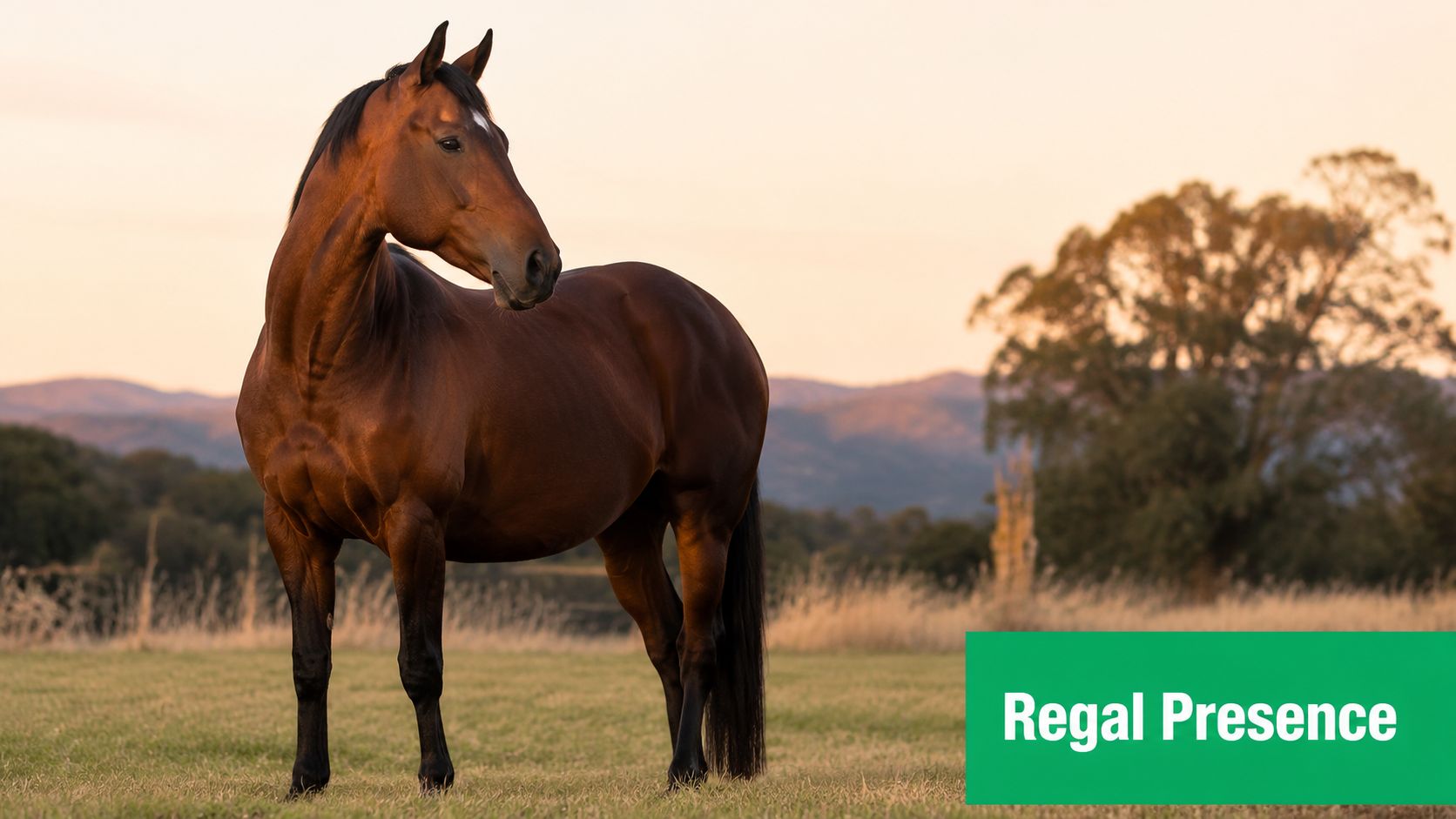
The Legendary Queen

Maeve, pronounced MAYV, is one of the most commanding names in Irish tradition. It brings to mind Queen Medb of Connacht, a famously powerful figure in Irish mythology, and that historical presence gives the name a bold, regal feel. If your mare rules the field, the herd, or the arena, Maeve makes sense immediately.

The name's meaning, often given as intoxicating, adds a layer of intensity that suits a horse with charisma. This is not a shy, background name. It works best when the mare has presence, confidence, and a tendency to get noticed the moment she walks in.

Maeve is especially strong for mares in competition or breeding. A mare that wins on attitude, leads the others, or produces strong offspring fits the name's royal weight. It also carries well in show settings because it is short, direct, and memorable.

A majestic brown horse stands in a lush green pasture at sunset with mountains in the background.

The best thing about Maeve is that it balances feminine identity with authority. It doesn't soften the horse's power, it frames it. That makes it a smart choice for owners who want a mare name that sounds graceful but still carries weight in the stable.

Here's how Maeve tends to fit in real use:

  • A competitive mare that performs with attitude and composure.
  • A herd leader that others defer to.
  • A breeding queen whose offspring matter to the program.

Irish horse-name lists often cluster around mythology and recognisable names like Maeve, which shows how often owners prefer heritage-coded clarity over obscure spellings (Bayequest's Irish horse-name discussion).

8. Liam

The Resolute Protector

Liam, pronounced LEE-um, is one of the most usable Irish names on this list because it's widely recognisable and easy to say. It comes from the Irish form of William, and its meaning points toward a strong-willed protector or resolute defender. That makes it an excellent fit for a horse that is dependable, steady, and self-assured.

Liam works especially well for stallions and geldings, but it can also suit a mare if the horse's temperament leans toward calm leadership. In practical terms, it's a name that travels well across barns, shows, and everyday conversation. People remember it quickly, and that matters when the horse is part of teaching, competition, or breeding.

This is also one of the names that shows why simple Irish names often win. The modern market tends to prefer names that are easy to read and say, and Liam delivers that without losing Irish identity. It's heritage-friendly, but it doesn't ask the listener to work hard.

If the horse is reliable under pressure, Liam feels honest. A lesson horse that keeps beginners safe, a competition gelding that stays composed in busy warm-ups, or a stud horse with a calm but strong presence all suit the name. It also feels appropriate for a horse that you want to present as trustworthy first and flashy second.

For language learners, Liam is a reminder that Irish names don't have to be difficult to be authentic. Some of the strongest choices are the ones that move naturally between tradition and daily use. That's a big reason the name remains such a popular benchmark in the wider world of Irish names for horses.

If the horse's value lies in steadiness, Liam gives you a name that sounds exactly like that value.

8 Irish Horse Names: Pronunciations & Meanings

Name (Pronunciation) 🔄 Complexity ⚡ Resource Needs 📊 Expected Outcomes Ideal Use Cases ⭐ Advantages & 💡 Tips
Aoife (EE-fa) Moderate, Irish spelling vs pronunciation; feminine tone Low, brief pronunciation note for non-Irish speakers High recognition for spirited, competitive mares Dressage, show jumping, competition mares ⭐ Distinctly Irish, strong mythic connotations. 💡 Use for courageous, agile mares.
Cormac (COR-mac) Low, clear stress pattern; masculine Low, minimal explanation; useful for stud registration Conveys nobility and breeding value Stallions, geldings, breeding and sport horses (dark coats) ⭐ Noble, historic resonance. 💡 Best for dark-colored or stud-bound males.
Siobhan (shiv-AWN) Higher, frequently mispronounced internationally Moderate, teach pronunciation to handlers and competitors Signals elegance and refined movement Dressage mares, show ring, breeding mares with finesse ⭐ Evokes grace and sophistication. 💡 Correct pronunciation early in the yard.
Fionn (FEE-un) Low, short and easy; versatile gender use Very low, minimal guidance needed Memorable, conveys strength and athleticism Hunters, jumpers, eventers, light-colored competition horses ⭐ Short, strong and versatile. 💡 Ideal for bold jumpers and hunters.
Aisling (ASH-ling) Moderate, literary/cultural nuance; feminine Moderate, may need cultural explanation for meaning Evokes sensitivity, strong rider-horse connection Therapy horses, dressage partnerships, endurance mares ⭐ Poetic and evocative. 💡 Share the literary meaning to enhance the name.
Declan (DEK-lun) Low, straightforward pronunciation; masculine Low, minimal explanation; widely familiar Conveys reliability, protection and steadiness Stallions, herd leaders, school/therapy horses ⭐ Trustworthy, calm connotations. 💡 Use for dependable, steady-tempered horses.
Maeve (MAYV) Low, clear pronunciation; commanding feminine energy Low, little training needed Strong regal presence and leadership impression Champion mares, breeding queens, herd alphas ⭐ Powerful, memorable leadership name. 💡 Reserve for naturally dominant mares.
Liam (LEE-um) Very low, simple and widely recognized; masculine Very low, internationally familiar Conveys resolute protection and approachability Stallions, geldings, reliable competition or teaching mounts ⭐ Modern yet traditional; easy to pronounce. 💡 Consider uniqueness, may be common.

Bring Your Horse's Name to Life

Can you say the name with confidence every time you use it? That is what makes an Irish horse name feel real in daily life. If you choose one, you are also choosing a small language lesson each time you call your horse, fill in a show entry, or talk about them with other riders. Gaeilgeoir AI helps make the name feel less like a label and more like part of your routine.

The best Irish horse names are the ones that fit the animal and still work in ordinary conversation. Aoife suits a bold mare, Cormac suits a horse with authority, Siobhan carries elegance, Fionn gives you speed and clarity, Aisling brings literary depth, Declan feels steady, Maeve sounds regal, and Liam stays strong and practical. Each name also gives you a chance to learn pronunciation, see how Irish spelling works, and pick up a little cultural context along the way.

Irish horse naming has long been tied to heritage, and Horse Racing Ireland still treats naming as a formal process, which shows how much weight a name can carry in the racing world (HRI naming requirements). Modern naming lists also keep returning to short, familiar, heritage-coded names, which shows that readability still matters just as much as meaning (Eventing Nation's Irish horse-name roundup). For language learners, that combination is helpful, because a name can be simple enough to use every day while still carrying a strong Irish identity.

Say your shortlisted name out loud several times, then write it in full and listen to the sound pattern. That helps when a name looks beautiful on paper but still needs to feel natural at the yard, in the ring, or on the phone. Irish names often work like a short lesson in themselves, because the spelling can teach you how sounds travel through the language. If you are learning Irish alongside the naming process, the horse's name can become one of the easiest places to practise.

Start practising at Gaeilgeoir AI and build the confidence to say your horse's name naturally every time. Use the guided practice to connect the name with real Irish speech, and make the choice feel as meaningful as the horse behind it. Protecting that horse matters too, as this New York farmer's horse insurance guide explains.

Bear in Gaelic: Irish and Scottish Translations Explained

You're probably here because you saw two different Gaelic words for “bear” and wondered which one is right. Maybe an Irish learner's app gave you béar, then a Scottish Gaelic page showed mathan, and now it feels like the languages are playing tricks on you. That confusion is normal. Closely related languages often keep old family resemblances while making different choices in everyday speech.

For beginners, bear in Gaelic is a great example of how language, history, and pronunciation all meet in one small word. If you've already been comparing Celtic languages, this short guide to the Goidelic language family gives useful background on how Irish and Scottish Gaelic relate to each other. Once that relationship clicks, the bear words make much more sense.

Table of Contents

Introduction to Bear in Gaelic

A learner opens an Irish text and finds béar. Later that same evening, they listen to Scottish Gaelic and hear mathan. Both mean “bear,” but they don't look alike, and that's where beginners often get stuck.

The good news is that both words are worth learning because they teach different lessons. Irish gives you a modern everyday form that came in from English. Scottish Gaelic keeps a native Gaelic form in daily use. That contrast makes this topic more than vocabulary practice. It shows how words change when the world around speakers changes.

Why beginners get tripped up

English speakers often expect one clean translation across related languages. Gaelic languages don't always work that way. A word can be modern in one language and old-fashioned in another. A form can also survive in names, sayings, or place names long after it stops being the usual everyday word.

Practical rule: Learn the modern everyday word first, then learn the older form as a cultural bonus.

What to focus on first

If you're brand new, keep these goals simple:

  • Know the pair: Irish uses béar and Scottish Gaelic uses mathan in ordinary speech.
  • Say them aloud: Pronunciation matters early because Gaelic spelling can feel less predictable than English.
  • Use them in short sentences: One clear sentence beats memorizing a long word list.
  • Notice history without overloading yourself: Older forms like mathúin and math-ghamhainn are useful because they explain where the modern words came from.

Irish and Scottish Gaelic Words for Bear

The most useful place to start is the side-by-side comparison. In modern Irish, the common word is béar. In Scottish Gaelic, the everyday word is mathan.

That difference isn't random. Scottish Gaelic kept a native Gaelic bear word in daily use, while Irish moved toward a loanword. The older Irish-related family of forms still matters, though, because it connects Irish mathúin, Scottish Gaelic mathan, and even Manx maghouin as related descendants of an older root, as discussed in the Scottish Gaelic toponymy study on bear terms and ursid place names.

Comparison of Bear Terms

Language Term IPA Pronunciation Tip
Irish béar /bʲeːɾˠ/ Start with a soft “b,” then say “bay,” then a light tapped r
Scottish Gaelic mathan /ma.hən/ Say “MA-ha-n,” with a clear first syllable and a light final sound

These IPA guides are learner-friendly approximations for speaking practice. If IPA is new to you, think of it as a pronunciation map rather than a test.

Older related forms

A few older or related words appear in dictionaries, names, and cultural material:

  • Irish older form: mathúin
  • Scottish Gaelic older form: math-ghamhainn
  • Archaic term: art
  • Manx related form: maghouin

One especially interesting detail is that mathan is a reduced form of math-ghamhainn, and that older form also appeared as a male given name in Ireland and Scotland, paralleling the Norse name Björn. The same source notes that art survives in Scottish Gaelic as an archaic word for “bear,” though it more often lives on with the sense of “hero.”

If you only want the everyday modern pair, memorize this: béar = Irish, mathan = Scottish Gaelic.

A quick memory trick

Use a location cue. If you're thinking of Ireland, think béar. If you're thinking of Scotland, think mathan. Then add the older native family later.

Grammar Rules for Gaelic Bear Words

Learners often ask, “Do I just memorize the word, or does it change in a sentence?” In Gaelic, the answer is yes, it changes. Not wildly at first, but enough that you should notice patterns early.

If you want a wider foundation before drilling this one noun, this Irish and Scottish Gaelic grammar comparison helps make the bigger system less mysterious.

Irish patterns with béar

Start simple. Treat béar as the dictionary form. Then practice it in short noun phrases.

  • an béar = the bear
  • béar mór = a big bear
  • na béir = the bears

The exact forms you meet can vary by teaching style and context, so beginners should focus on recognition and sentence building rather than trying to master every case ending immediately.

Scottish Gaelic patterns with mathan

In Scottish Gaelic, mathan behaves like a noun you'll place inside common patterns:

  • am mathan = the bear
  • mathan mòr = a big bear
  • mathain = bears

Notice that the plural doesn't copy English “add s” logic. Gaelic often changes the noun itself.

Where mutation and sound change matter

One thing that surprises beginners is that Gaelic grammar can change the start of a word. You won't always hear or see the bare dictionary form.

For practical early study, watch for these habits:

  1. Articles matter. “The bear” may use a different article in Irish and Scottish Gaelic.
  2. Adjectives often come after the noun. So “big bear” becomes the Gaelic order, not the usual English order.
  3. Plural forms need separate practice. Don't assume you can guess them.
  4. Spoken rhythm changes what you hear. Even when the written form looks familiar, the phrase can sound softer or more connected.

Learn nouns as mini-phrases, not as isolated labels. “The bear,” “a big bear,” and “bears” are better study units than the single word alone.

Here's a beginner-friendly way to study:

Study goal Irish Scottish Gaelic
Base word béar mathan
With “the” an béar am mathan
Plural béir mathain

Use this table as a speaking drill. Read down one column, then switch languages and read across.

Pronunciation Guide with IPA

Most beginners don't struggle with the meaning of bear in Gaelic. They struggle with saying it without freezing. IPA helps, but only if you connect the symbols to sounds you already know.

A visual guide makes this much easier.

An infographic showing how to pronounce the word for bear in Irish and Scottish Gaelic languages.

If Gaelic sound systems still feel unfamiliar, this pronunciation overview on how Gaelic is pronounced gives broader listening support.

Saying béar in Irish

Use /bʲeːɾˠ/ as your guide.

Break it into pieces:

  • /bʲ/ sounds like a softened b
  • /eː/ is close to a long bay
  • /ɾˠ/ is a tapped or light r, not a heavy English pirate-style “rrr”

Try it slowly: bay-r. Then smooth it out so it becomes one clean unit: béar.

A common mistake is turning it into plain English “bear.” That gets close in meaning, but not in sound. The Irish vowel is cleaner and the final r is lighter.

Saying mathan in Scottish Gaelic

Use /ma.hən/ as your guide.

A practical beginner cue is:

  • ma like “ma” in “mama”
  • as a soft middle syllable, similar to the weak vowel in “sofa”
  • n light at the end

Say it in rhythm: MA-hun or MA-hən. Keep the first syllable clear.

Don't chase perfection on day one. Aim for a stable version you can repeat the same way every time.

Fast correction tips

Word Common mistake Better fix
béar Saying English “bear” unchanged Lengthen the vowel and lighten the r
mathan Stressing the second syllable too much Keep the stress near the start
both Reading spelling letter by letter Practice by chunking whole syllables

Record yourself if you can. Beginners improve fastest when they hear the gap between what they intended and what they said.

Beginner Example Sentences

Short sentences help you move from recognition to use. Don't wait until you know every grammar rule. A few safe patterns will carry you far.

Irish examples with béar

Try these first:

  • Is béar é.
    It is a bear.

  • Tá an béar mór.
    The bear is big.

  • Feicim béar.
    I see a bear.

These are useful because each one teaches a different frame. The first names the animal. The second describes it. The third puts it into an action sentence.

Scottish Gaelic examples with mathan

Now compare the Scottish Gaelic side:

  • ’S e mathan a th' ann.
    It is a bear.

  • Tha am mathan mòr.
    The bear is big.

  • Chì mi mathan.
    I see a bear.

You don't need to unpack every piece immediately. At beginner level, the key is noticing repeated sentence frames.

One idiom to remember

Older bear language still lives in idioms. In Irish, one example is Chuirfeadh sé othras ar mhathúin, meaning “It would sicken a bear.” The Scottish Gaelic tradition preserves a matching expression: chuireadh e an òrrais air math-ghamhainn.

That's useful because it shows how older words survive even when the everyday modern term changes.

Build your own flashcards with whole sentences. A card that says Tá an béar mór teaches grammar, pronunciation, and vocabulary at the same time.

A simple speaking drill

Use the same sentence frame and swap one word:

  1. Tá an béar mór.
  2. Tá an béar beag.
  3. Feicim béar.
  4. Ní fheicim béar.

Do the same in Scottish Gaelic with mathan. Even if your vocabulary is small, this kind of pattern drilling builds confidence fast.

Etymology and Cultural Notes

The history behind these words is unusually vivid because ecology shaped the language directly. In modern Irish, the word for bear is béar, an English loanword that replaced the older native mathghamhain, now mathúin. That older form means “the good calf,” and the shift happened because bears became extinct in Ireland between 1000 and 500 BC, which caused the original Gaelic word to fade from everyday use as the animal disappeared from daily life, as explained in this study of Irish bear vocabulary and extinction history.

The cultural layer is just as rich. Older Irish had multiple bear words, including art, math, and beithir, which tells you the animal mattered greatly in naming and imagination before it vanished from the wild.

An infographic detailing the history and cultural legacy of bears in ancient and modern Gaelic culture.

Bears in names and heroic language

The old noun art is especially interesting. It could mean both the animal and a hero or warrior, preserving a strong link between bear imagery and human strength. The name Art became a male given name, and related traditions appear across Gaelic and Norse naming.

The same semantic pattern survives in later vocabulary too. An Omniglot note on Celtic bear words explains that in modern Irish, béar also carries a secondary sense such as “tyrant,” “invader,” or “foreigner” in some semantic extensions tied to aggressive traits in the animal image, discussed in this entry on Celtic bear terminology.

Why this matters for learners

This is one of those moments where vocabulary becomes cultural memory. Irish didn't just “change a word.” It kept traces of older belief, naming, and metaphor even after the everyday term shifted.

If you enjoy seeing how animals carry symbolic meaning across systems, Chinese astrology and its cycles offers an interesting comparison. It's a different tradition, but it shows the same broad idea: animal terms often do cultural work far beyond literal description.

Practice Activities with Gaeilgeoir AI

Knowing béar and mathan is a good start. Being able to recall them under pressure is the ultimate goal. Practice works best when you cycle through recognition, speaking, and quick sentence building instead of staring at a list.

A young woman sits at a desk while practicing conversational Gaelic using a digital tablet.

Five drills that actually stick

  • Contrast drill: Say béar and mathan back to back until you stop mixing them up.
  • Phrase ladder: Build upward from one noun. Start with “bear,” then “the bear,” then “the big bear,” then “I see the big bear.”
  • Listening echo: Hear the word, pause, repeat it aloud, and copy the rhythm rather than each letter.
  • Idiom recall: Keep one cultural phrase, such as the “sicken a bear” idiom, as a memory hook.
  • Language switch practice: Alternate Irish and Scottish Gaelic every line so your brain learns the boundary clearly.

Roleplay makes vocabulary usable

A simple roleplay works better than passive review. Pretend you're at a wildlife park, in a museum, or reading a folktale to a friend. Then force yourself to describe what you see with the target word.

If you like AI-based scenario practice, Dunia AI roleplay insights give useful ideas for making roleplay sessions more natural and less repetitive. The same principle helps with language learning. You remember words better when they appear inside a situation.

A practical weekly routine

Keep it small and repeatable:

  1. Read both words aloud.
  2. Say one sentence in Irish.
  3. Say one sentence in Scottish Gaelic.
  4. Review the pronunciation once more.
  5. Test yourself without looking.

That kind of short loop is easier to keep than a long study session you'll avoid tomorrow.


For guided conversation practice, pronunciation support, and adaptive exercises that help you remember words like béar in real use, try Gaeilgeoir AI or jump straight into practice at learn.gaeilgeoir.ai.

Master Irish Road Signs: Your 2026 Driving Guide

You've just landed in Ireland, picked up the rental car, and pulled out of the airport feeling fine until the first sign appears. It has two place names. One looks familiar. The other doesn't. A few minutes later, you see a triangle, then a red-bordered circle with km/h, then a word like Scoile or Géill Slí and suddenly the road feels harder to read than it should.

That moment catches a lot of people. It also catches learner drivers who know the theory but haven't yet connected signs on a page with signs on a real road. In Ireland, road signs do more than control traffic. They also carry language, place, and culture in everyday form. Once you understand the system, they become much easier to read, and much more interesting too.

Table of Contents

Your Guide to Navigating Ireland's Roads and Language

The first bilingual sign usually creates the same reaction. You spot the English place name, then your eyes jump to the Irish version above it, and for a second you wonder if they're two different destinations. They aren't. They're the same place shown through Ireland's two public languages.

That small moment matters because it changes how you read Irish road signs. You're not only decoding traffic instructions. You're also learning to recognize common Irish words in the wild, where they are important. That's far more useful than memorizing isolated vocabulary from a worksheet.

A gray car driving along a scenic winding road through the beautiful green Irish countryside.

Many guides treat the language side as a minor detail. That misses a big part of the full experience. One useful point from an Irish road signs cheat sheet is that over 60% of new Irish learners struggle with reading real-world text because they only practice with textbook phrases, not authentic signage like “Scoile” and “Bóthar.” That rings true on the road, where recognition has to happen quickly.

Why signs feel harder at first

A road sign asks you to do several things at once:

  • Notice the shape: Is it a warning, an order, or guidance?
  • Read the color: Red, blue, white, brown, or green each points you in a different direction mentally.
  • Process the language: You may need to match an Irish place name to the English version you expected.
  • React safely: You don't get to pause the road while you think.

That's why beginners often feel overloaded. The fix isn't to memorize hundreds of signs one by one. The fix is to learn the system.

Irish road signs become manageable when you stop reading every sign as a block of text and start reading shape, color, and context first.

A better way to learn them

I tell learners to treat Irish road signs like a set of fast clues.

A triangle means your attention should rise. A circular sign with red tells you something is restricted or prohibited. A blue circular sign tells you an instruction must be followed. Then the words add detail. If you also learn a few common Irish terms, the whole network starts to feel less foreign.

That's also what makes signs a surprisingly good language tool. They repeat key words. They connect vocabulary to place. They train your eye to recognize Irish in practical settings, not just academic ones. For anyone reconnecting with the language, that's a much friendlier entry point than formal grammar tables.

How to Read Irish Road Signs A Quick Guide

If you only remember one thing, remember this. Start with the sign's shape and color before you read the words. That habit makes Irish road signs much easier to understand at speed.

An infographic titled How to Read Irish Road Signs, categorizing traffic sign shapes into circular, triangular, and rectangular.

The broad pattern is simple. A sign's design tells you its job. According to this guide to road traffic signs in Ireland, tourist information appears on brown signs, regulatory signs use circular forms with red borders, warning signs are triangular, and informative directional guidance uses blue circular signs with white symbols.

The fastest decoding method

Use this three-step check when a sign appears:

  1. Shape first
    Triangle means warning. Circle usually means regulation or instruction. Rectangular signs usually give directions or information.

  2. Color second
    Red signals prohibition or caution depending on the sign type. Blue often signals instruction or route guidance. Brown points to tourist information.

  3. Words last
    Once you know the category, the text becomes easier to interpret.

A simple mental map

Sign clue What it usually means Your response
Triangle Warning about a hazard ahead Slow down and scan
Red-bordered circle A rule limiting or forbidding something Check what you must not do
Blue circle A required action Follow the instruction
Rectangular direction sign Route or place information Read early and plan ahead
Brown sign Tourist or heritage destination Informational, not a command

Many learners often misunderstand road signs. They see a circle and assume every circular sign means the same thing. It doesn't. The color changes the meaning.

Why this matters in practice

Suppose you're driving on a narrow rural road. A triangle appears. You don't need to read every detail immediately to know one thing. A hazard is coming. That buys you time to adjust.

Then imagine a circular blue sign. That's different. It isn't warning you about what may happen. It's telling you what action to take. This distinction matters for safe driving and for theory test preparation.

If you want a beginner-friendly comparison with broader examples, A-1 Driving School has a helpful explainer on the meaning of common road signs.

Quick rule: On Irish roads, signs work best when you read them as symbols first and language second.

Regulatory Signs What You Must and Must Not Do

Regulatory signs carry legal weight. These are the signs that set limits, ban actions, or require a specific maneuver. If warning signs tell you to be alert, regulatory signs tell you what the law expects from you right now.

An infographic explaining the differences between prohibitory and mandatory regulatory road signs with visual examples.

A useful distinction here comes from regulatory sign guidance in Ireland. Prohibitory signs are circular with a red border and white background, while mandatory signs are circular with a blue background and white symbol. Red means “must not.” Blue means “must.”

Prohibitory signs

These signs stop you from doing something. They don't suggest. They prohibit.

Common examples include:

  • No Entry: You must not enter that road from your direction.
  • Speed limit signs: The number sets the legal maximum.
  • No U-turn: You can't turn the vehicle around in that location.
  • No parking or stopping signs: Restrictions apply even if the road looks quiet.

A beginner mistake is focusing only on the icon. Train yourself to notice the border too. The red border is part of the message.

What these signs ask from you

  • Read early: Don't wait until you're beside the sign.
  • Act smoothly: Slow or change course in good time.
  • Avoid assumptions: A quiet road can still have a legal restriction.

Mandatory signs

Mandatory signs tell you what you must do. Their blue background is the clue.

Typical examples include:

  • Keep left
  • Turn left ahead
  • Pass on a particular side
  • Proceed in the direction shown

These signs matter most where traffic needs structure. Junctions, islands, split carriageways, and lane controls often rely on them.

A red circular sign closes an option. A blue circular sign leaves you with one.

Why speed signs catch visitors out

Speed signs deserve special attention because many visitors bring habits from countries using miles per hour. Ireland's system doesn't do that. Under the Road Traffic (Signs) Regulations 1997-2004, Ireland completed the transition from miles per hour to kilometres per hour, and speed limit signs explicitly use the “km/h” suffix.

That small suffix matters. A driver from the UK or US may see a familiar number and react too quickly or too slowly if they forget the unit has changed.

Here's the safe habit:

What you see What to remember
30 km/h It's a low-speed zone. Think slow streets, schools, or calm local areas
50 km/h Urban pace, not a target if conditions are poor
100 km/h A maximum, not a promise that the road is suitable for that speed

Another source of confusion is the difference between a maximum and a recommended pace. A speed limit sign sets the legal ceiling. It doesn't tell you that driving at that exact speed is always safe. Wet roads, poor visibility, sharp bends, or farm traffic can all make a lower speed the sensible choice.

A learner's legal mindset

For theory tests and real driving, it helps to sort regulatory signs into two mental drawers:

  • Forbidden actions: entering, turning, overtaking, parking, exceeding a posted speed
  • Required actions: keeping left, following a lane direction, turning as instructed

That split sounds basic, but it sharpens your reaction time. Once you know whether a sign is closing a behavior or requiring one, the road feels far less ambiguous.

Warning Signs Navigating Potential Hazards

Warning signs don't order you to do something specific. They prepare you for what's ahead. In Ireland, these are typically triangular with a red border, and they matter a lot on rural roads where conditions can change quickly.

The best way to learn them is by pattern. Hazards tend to fall into familiar groups. When you group them that way, you stop memorizing isolated signs and start recognizing families of risk.

Road layout warnings

Some warning signs tell you the road itself is about to become more demanding.

You might meet signs for:

  • Bends or a series of bends
  • Roundabouts ahead
  • Junctions
  • Road narrows
  • Steep gradients

These signs don't all require the same response, but they share one principle. You should adjust before you arrive at the hazard, not at the last second.

A bend warning on a dry open road may only call for a modest speed reduction. The same sign on a hedge-lined country road with poor visibility calls for much more caution. That's why warning signs always work together with the road around them.

Surface and roadside hazards

A second group points to the physical condition of the road or roadside.

Examples include warnings for:

  • Slippery road
  • Loose chippings
  • Falling rocks
  • Uneven surface
  • Roadworks or temporary disruption

These are easy to underestimate because the road may look normal from a distance. But the point of the sign is to tell you that conditions can change before your eyes fully confirm it.

If a warning sign feels early, that's good. It gives you time to drive deliberately instead of react suddenly.

When I coach nervous drivers, I often say this: don't argue with a warning sign. If the sign says the surface may be slippery, drive as if grip could disappear sooner than you expect.

People animals and shared spaces

This group is especially Irish in feel because rural roads often bring you into close contact with farm life and mixed road use.

Watch for signs warning about:

  • Pedestrians
  • Cyclists
  • Children near schools
  • Sheep or cattle crossing
  • Wild animals

These signs matter because the hazard moves. A bend stays where it is. A flock or a child doesn't. Your job is to lower speed, widen attention, and expect something unpredictable.

A cattle crossing sign is a good example. Even if you see no animals immediately, the right response is still caution. Farm gates, slow-moving vehicles, and animals close to the road can appear with little notice.

How to respond well

Instead of trying to memorize a separate script for every warning sign, use a short decision process:

  1. Lift your attention level
  2. Check speed
  3. Scan wider than usual
  4. Look for the hazard the sign predicts
  5. Leave extra space if the hazard can move

That's what warning signs are really for. They help you switch from ordinary driving to prepared driving.

A strong learner doesn't just identify a warning sign correctly. A strong learner shows the right change in behavior after seeing it.

Information and Directional Signs

Information and directional signs are the ones that help you get somewhere. They don't usually feel as dramatic as a warning sign or as strict as a regulatory sign, but they shape almost every journey. Read them well, and driving gets calmer. Read them late, and junctions become stressful.

What the colors tell you

Color is the first shortcut.

In Ireland, you'll commonly see directional and information signs using a road-type logic. Brown signs point toward tourist attractions and heritage destinations. White signs are commonly used for more local direction. Blue and green are widely used to separate different route contexts.

For a beginner, the exact shade matters less than the habit of noticing that background color is part of the message. Don't wait until you're close enough to read every destination. Start by asking what type of route or destination the sign is introducing.

A useful way to think about it is this:

  • Brown: places you might visit
  • White: local direction and nearby places
  • Blue or green: bigger route guidance and onward travel

How bilingual place names work

Official place names on Irish information signs are subject to a legal bilingual requirement. The statutory rule on official languages in signage requires place names on official Irish information signs to appear in both Irish and English.

That means you're often reading the same destination twice, not two separate places. For returning heritage learners, this can be surprisingly moving. For nervous drivers, it can feel like extra clutter until the pattern becomes familiar.

If you want extra help matching counties and places across English and Irish forms, this counties of Ireland guide is a useful companion while you study.

Reading route clues quickly

When you approach a sign, try this sequence:

What to notice first Why it helps
Background color Tells you the broad category
Place names Shows your intended direction
Symbols Flags services like parking or fuel
Route labels Helps confirm you're following the correct road

This approach prevents a common driving error. People often stare at the text and miss the larger clue the sign gives at a glance.

Another practical habit is to read directional signs in two passes. First pass, identify whether the sign is relevant to your route. Second pass, confirm the destination and lane or turn you need. That split-second discipline keeps your eyes moving and your steering steadier.

Understanding Bilingual Signs Gaeilge for Drivers

For many people, the bilingual element is the part that makes Irish road signs memorable. It's also the part that causes hesitation. You may know what the sign category means, but the Irish words still slow you down.

That's normal. The answer isn't to become fluent before you drive. The answer is to learn a compact set of high-frequency words that show up again and again.

A bilingual road sign in Ireland showing directions to Clifden and Fairyhill with distances in kilometers.

Common Irish words you'll meet on signs

Here are useful words to recognize on sight:

Irish English Simple pronunciation
Bóthar Road BOH-her
Scoil / Scoile School SKUL / SKUL-eh
Géill Slí Yield gale shlee
Go Mall Slow guh mahl
Lár Centre lahr
Siopa Shop SHUP-ah
Eolas Information OL-us
Páirc Park PAWRK
Bealach Way or route BYAL-akh
Baile Town or home place in many names BAL-eh

You don't need perfect pronunciation to benefit from these. Recognition is enough at first. Over time, saying them out loud helps them stick.

For extra practice with everyday Irish found in public life, this page on Irish signs and common public wording is a handy study resource.

Language shortcut: Learn the words that repeat in public spaces first. They pay off faster than rare vocabulary.

Why Irish-only signs appear in some areas

Most drivers expect bilingual signs everywhere, so an Irish-only sign can feel startling the first time it appears. On some western roads, though, that isn't a mistake. It's formal policy.

According to this guide to driving rules in Ireland, specific western roads feature Irish-only signage in Gaeltacht regions, reflecting Irish as the primary language of daily communication there. That matters because it changes how you prepare. You're not looking at a missing translation. You're entering a place where Irish has public priority.

How to stay confident in Gaeltacht areas

A few habits help immediately:

  • Match by place shape: Even if the word is unfamiliar, the overall look of the destination name becomes recognizable after a few sightings.
  • Use route planning early: Know your next major stop before you set off.
  • Expect known words in new forms: Irish place names may not resemble the English version closely.
  • Trust the system: If the sign is Irish-only, that's part of the official road environment.

Irish road signs move beyond a simple driving topic. They become a real, low-pressure form of language immersion. You see the words in place, linked to movement, geography, and memory. That's a powerful way to learn.

Practical Tips for Learners and Tourists

By the time one feels overwhelmed by Irish road signs, the issue isn't the sign itself. It's timing. They notice it late, try to read it all at once, and then make a rushed decision. Better habits solve most of that.

A smart driving checklist

Use this on every unfamiliar journey:

  • Scan early: Signs are easier to process when you spot them at a distance.
  • Read in layers: Shape first, then color, then wording.
  • Slow your eyes before your car: Mentally prepare before you brake or turn.
  • Watch for temporary wording: Roadworks may introduce terms such as Obair Bóthair, so expect local language in practical settings.
  • Don't chase a missed turn: If you miss one, continue safely and reroute.

Tourists often struggle most on narrow roads where hedges, curves, and local traffic reduce thinking time. Learners, on the other hand, often know the sign when parked but hesitate when moving. Both problems improve if you train the same habit. Read the sign category before the full detail.

Common theory-style sign questions

Learner drivers should be ready for questions like these:

Question type What you should know
What does a red-bordered circle mean It signals a prohibition or limit
What does a blue circular sign mean It gives a mandatory instruction
What shape is a warning sign Triangle
Why do some signs show Irish only Because of Gaeltacht language policy
What does km/h tell you The speed is shown in kilometres per hour

This kind of revision also helps tourists. It sharpens your reactions without requiring you to memorize a huge catalog.

One more practical idea. If you're visiting during a longer trip and want cultural context alongside navigation, this summer in Ireland guide can help you get used to travel language, place names, and seasonal movement around the country.

On unfamiliar roads, the safest driver isn't the one who knows every sign by heart. It's the one who recognizes the system quickly and stays calm.

Frequently Asked Questions About Driving in Ireland

What if I don't know the Irish word on a sign

Don't panic. Read the sign category first. Shape and color usually tell you whether it's a warning, a rule, or directional guidance. Then use nearby symbols, route context, and any familiar place names to confirm meaning.

Are road signs in Ireland hard to learn

Not once you stop treating them as isolated facts. Most confusion comes from trying to read everything as text. Irish road signs become much simpler when you learn the visual code and a small bank of common Gaeilge words.

What should I focus on first

Start with the essentials:

  • Warnings: triangles
  • Prohibitions: red-bordered circles
  • Mandatory instructions: blue circles
  • Directional signs: read color and destination together
  • Language: learn the most repeated Irish words on signs

If you master those five areas, you'll already be driving with more confidence than many first-time visitors.

Driving in Ireland gets easier when the surroundings stop feeling like a puzzle. The signs begin to repeat. The Irish words begin to look familiar. And the road starts to feel readable instead of rushed.


If you'd like to turn road-sign recognition into practical language learning, Gaeilgeoir AI is a smart next step. It helps you build real-world Irish through guided conversation, pronunciation support, and everyday scenarios like asking for directions. You can also start directly at Learn Gaeilgeoir AI.

Anamchara: The True Meaning of a Celtic Soul Friend

You may have seen Anamchara on a necklace, in a book title, on Instagram, or in a list of “beautiful Celtic words.” It tends to arrive wrapped in soft focus. “Soul friend.” “Soulmate.” “A person who just gets you.” It sounds warm, ancient, and instantly meaningful.

That reaction makes sense. It is a beautiful word. But it's also one of the most misunderstood Irish words in circulation. If you're learning Irish, reconnecting with heritage, or trying to use the word well, the surface translation won't quite carry you far enough.

Table of Contents

The Allure of the Anamchara

A learner often meets Anamchara before they meet much Irish at all. The word appears alone, polished and poetic, as if it already explains itself. You see it under a photograph of the sea. You hear it in a wellness conversation. You find it beside English phrases about deep love, fate, or belonging.

That first impression isn't wrong. It is a word with emotional weight. The trouble begins when the emotional feeling gets treated as the full definition.

Many people assume it works like a romantic label. Others use it for a best friend. Some use it as a Celtic alternative to “my person.” If you've browsed pages about Irish Gaelic terms of endearment, you'll know how easy it is to place Irish words into modern relationship categories. Sometimes that works. With Anamchara, it doesn't quite.

A word that sounds simple but isn't

The attraction comes from the literal gloss. “Soul friend” sounds immediately understandable in English. It feels tender and universal.

But Irish words often carry history inside them. A literal translation can open the door, yet it can also mislead. Anamchara is one of those cases where the dictionary-looking answer is only the beginning.

Practical rule: If a word from Irish feels unusually mystical in English, pause before assuming the modern English feeling is the original meaning.

Why people get this word wrong so often

The confusion usually comes from three habits:

  • We trust literal translations too quickly. “Soul” plus “friend” sounds transparent, so people stop there.
  • We import modern ideas. English speakers hear “soul friend” and think romance, deep friendship, or soulmate language.
  • We miss the religious context. Older Irish terms often lived inside monastic and devotional life, not self-help or relationship culture.

So yes, Anamchara is beautiful. But its beauty comes from depth, not vagueness. Once you understand what the word named, it becomes far richer than the popular version.

What Anamchara Truly Means

At the most basic level, Anamchara is built from two Irish elements: anam, meaning “soul,” and cara, meaning “friend.” That literal sense is real. But the historical use of the word is much more exact than the English phrase “soul friend” suggests.

An infographic explaining the meaning of the word Anamchara with icons for soul, friend, and connection.

The literal meaning and the real meaning

In early Irish monasticism, Anamchara had a technical meaning. It referred to a spiritual director or confessor, not to a casual friend. Dictionaries such as Ó Dónaill and De Bhaldraithe define it as “spiritual adviser,” while McKenna identifies it as the Irish term for “confessor” in Wiktionary's entry on anamchara.

That difference matters. A confessor is not merely someone you feel close to. A spiritual adviser is not just a person with whom you share a bond. The historical Anamchara had responsibility, authority, and a listening role shaped by religious life.

Think of it this way. If someone says “family doctor,” you don't focus only on the word “family” and assume it means a relative. You understand that the phrase names a specific role. Anamchara works similarly. The parts of the word are meaningful, but the whole term points to a defined relationship.

Why the direct translation causes confusion

English speakers usually hear “friend” in a broad modern sense. In the older Irish religious setting, the “friendship” in Anamchara meant profound trust in spiritual guidance.

That's why “soulmate” is a poor substitute. A soulmate suggests perfect emotional or romantic fit. Anamchara historically suggested something more demanding. This was a person to whom one revealed hidden struggles, sought correction, and entrusted the care of one's inner life.

A few distinctions help:

  • Not a casual companion. You wouldn't use it for an ordinary friend.
  • Not necessarily romantic. The term doesn't point to lovers by default.
  • Not just poetic. It names a role with religious seriousness.

The old meaning asks for depth, discipline, and guidance, not simply closeness.

That's why I encourage learners to hold two ideas at once. The literal translation helps you remember the word. The historical meaning helps you respect it. When both stay together, Anamchara becomes much clearer.

The Deep Historical Roots of the Anamchara

To understand why the word carries such gravity, you have to place it inside the world that shaped it. Anamchara emerged in ancient Celtic monasticism between the 3rd and 5th centuries, where it referred to the trusted teacher and companion to whom a monk confessed confidential aspects of life for spiritual correction, as outlined in the historical overview of Anam Cara.

A timeline graphic illustrating the historical development of the Anamchara concept through four distinct cultural periods.

A role inside early monastic life

This wasn't a decorative title. In early monastic communities, the Anamchara acted as a guide for the soul. A monk brought hidden thoughts, failings, temptations, and fears to this person in confidence. The relationship had honesty at its center.

The role also included teaching. The Anamchara oversaw initiation and tutored new monks. So when we translate the word too lightly, we lose the shape of the life around it. This was part of formation, correction, and spiritual maturity.

If you enjoy exploring words within their physical and historical settings, the places associated with Ireland's early Christian inheritance become more vivid when seen in context. Resources on self-drive Ancient East Ireland trips can help you picture the wider cultural world in which old religious traditions took root.

A relationship of discipline and trust

The concept is also linked to the Desert Fathers and Mothers of Egypt, Syria, and Palestine between the 3rd and 5th centuries, and to earlier Celtic traditions described in Jane Alton's discussion of the anamchara.pdf). In that account, the Anamchara served as confessor and prescriber of penance, a trusted guide for life.

The expectations could be rigorous. Historical descriptions say such a guide should perform two hundred genuflections daily, recite all psalms every day, and celebrate the eucharist on Sundays and Thursdays, with every day being preferable. Those details help us see that this was no loose spiritual friendship. It belonged to a demanding discipline.

Here's the heart of it:

  • Confidentiality mattered. The monk revealed inner struggles that might stay hidden from everyone else.
  • Guidance was lifelong. The relationship could endure across separation by place and time.
  • Formation was practical. The guide did not merely comfort. The guide corrected, instructed, and assigned penance.

A real Anamchara was trusted not because the title sounded lovely, but because the person carried spiritual responsibility.

There's a storytelling dimension here too. Irish tradition often preserves meaning through roles, memory, and lived practice, not through abstract definitions alone. If that side of Irish culture interests you, reflections on seanchaí Irish storytellers offer another window into how language and heritage hold onto old ways of seeing the world.

How to Pronounce Anamchara and Use It Correctly

Once learners know the meaning, they usually want to say the word aloud without freezing. That's a good instinct. Irish pronunciation can feel intimidating at first, but this word becomes manageable when you break it apart.

A simple pronunciation guide

A helpful beginner approximation is ON-um-KHA-ra.

The first part, anam, is usually the easy bit. The harder sound is the ch in chara. It's not the English “ch” in “chair.” It's the throaty Irish sound you hear in Scottish “loch” or German “Bach.”

If that sound is new to you, try this sequence:

  1. Say cara softly as a rough first attempt.
  2. Move to KHARA, letting air pass at the back of the mouth.
  3. Put the pieces together slowly: ON-um-KHA-ra.

For learners who want to train their ear, a dedicated Irish pronunciation guide is useful because Irish spelling becomes much less mysterious once you hear recurring sound patterns.

Say it slowly before you say it naturally. Accuracy comes before speed.

Pronunciation and Common Phrases

Irish Phrase Phonetic Pronunciation English Meaning & Context
Anamchara ON-um-KHA-ra A spiritual adviser or confessor in the historical sense
Mo anamchara muh ON-um-KHA-ra “My anamchara.” Best used carefully, with awareness of the word's deeper religious history
Mo chara muh KHA-ra “My friend.” This is the better everyday option for a friend
Cara KHA-ra “Friend.” A simple, broad term without the special weight of Anamchara

A few usage notes will save you trouble.

  • If you mean friend, use mo chara. It's natural and accurate.
  • If you mean partner or lover, don't reach for Anamchara automatically. Modern English-language branding may push you that way, but the older Irish meaning is different.
  • If you use mo anamchara, know that it carries historical depth. It can sound poetic in English, but it isn't just a sweet phrase.

A good learner exercise is to test the sentence you want to say. Ask yourself, “Do I mean friend, beloved, or spiritual guide?” If the answer is friend, cara is usually enough. If the answer is beloved, you'll want a different expression. If the answer is spiritual guide, then Anamchara may fit.

Modern Misconceptions and Pop Culture Usage

Today, many people meet Anamchara far from its original setting. It appears in tattoo ideas, gift copy, wellness brands, and sentimental captions. In those spaces, it often means “soulmate,” “best friend,” or “the one person who understands me completely.”

A comparison chart showing modern misconceptions versus the true historical and spiritual meaning of Anamchara.

How the meaning drifted

This shift is easy to explain. The literal gloss “soul friend” sounds like ready-made modern inspiration. Once the phrase entered English-language spiritual and lifestyle culture, the word's ecclesiastical roots faded from view.

That drift is widely noted. Popular sources often define Anamchara as a platonic or romantic “soul friend” or “soulmate,” while authoritative Irish dictionaries and linguistic experts define it as “confessor” or “spiritual adviser” with no inherent link to lovers or close friends, as discussed in this explanation of what the term anamchara means.

This doesn't mean every modern user is careless. Many are responding to the beauty of the phrase. But a learner deserves to know when a beautiful modern reading has drifted away from the older Irish meaning.

Why this matters for learners

If you're learning Irish, this is about more than pedantry. It's about cultural accuracy.

Here's where confusion tends to show up:

  • In translation choices. A learner sees “soulmate” in English and assumes Anamchara is the direct Irish equivalent.
  • In identity language. People use the word to signal Celtic feeling without realizing they've changed its meaning.
  • In teaching materials. Simplified glosses often drop the religious context because it feels less marketable.

Knowing the original meaning doesn't force you to police everyone else. It simply helps you speak with more care.

There's also a wider lesson here. Language doesn't only carry vocabulary. It carries worldview. When a word travels from monastic Ireland into modern pop culture, it may keep its emotional glow while losing its original function.

That's why I suggest a generous but clear approach. You can appreciate the modern appeal of Anamchara while also recognizing that the traditional term points to something much more specific than romance or companionship. Both facts can sit side by side. One is current usage. The other is historical meaning. For serious learners, the second one should lead.

Embracing the Spirit of Anamchara in Your Learning

The old Anamchara was a guide for the inner journey. Most of us aren't seeking a monastic confessor, but the underlying idea still speaks to language learning. Irish opens more easily when you have trustworthy guidance, regular correction, and a path you can follow.

An older mentor pointing out a mountain path to a younger man during a hiking trip.

Many learners don't struggle because they lack motivation. They struggle because they meet Irish in fragments. A few phrases here, a grammar chart there, then a long gap. Progress becomes shaky when there's no steady companion for the road.

That's why structured support matters. Gaeilgeoir AI uses an immersion-first method grounded in the 1,000 most-used Irish words, a foundation designed to help learners build functional ability quickly by prioritizing high-frequency vocabulary, as described in this overview of Gaeilgeoir AI. That kind of structure fits the spirit of good guidance. It keeps learners close to the living core of the language instead of scattering attention across rare terms too early.

A good guide doesn't remove the challenge. A good guide makes the challenge navigable. That's the enduring lesson inside Anamchara. Not vague “soul connection,” but trusted direction, honest learning, and companionship with purpose.

If you want your Irish to become something lived rather than admired from a distance, start with guidance you can return to regularly.


If you're ready to build real spoken Irish with a modern guide, explore Gaeilgeoir AI and start learning at learn Gaeilgeoir AI.

Discover the Irish Flower: Folklore & Culture

When people ask about the Irish flower, do they mean a true flower, or do they really mean the shamrock?

That small confusion trips up a lot of learners. Ireland's best-known plant symbol is so famous that it often gets treated as if it were the country's official flower, even though those aren't the same thing. If you're learning about Irish culture, reconnecting with family roots, or building your Gaeilge, that distinction matters more than it might seem.

Plant names carry stories. A word like seamróg isn't just vocabulary. It opens a door into history, seasonal life, folklore, and the way people in Ireland have named the natural world for generations.

Table of Contents

What Is the National Flower of Ireland

Ask someone to name the Irish flower, and a common reply will be the shamrock. That answer makes cultural sense, but botanically it creates a problem.

The shamrock is widely treated as Ireland's national symbol, yet it's better understood as a national plant symbol than a national flower. That's where many articles leave readers stranded. They give the symbol, but not the distinction.

Why the confusion keeps happening

Part of the trouble is that everyday language and botanical language don't always match. In ordinary conversation, people often use “flower” to mean any meaningful plant. In botany, that's much narrower.

The result is a common mix-up:

  • Symbol and species get blurred: People treat the shamrock as if it were one exact plant and one exact flower.
  • National and unofficial get merged: Cultural recognition gets mistaken for formal designation.
  • Language learning gets harder: Beginners looking for Irish plant names can end up memorizing the wrong category.

Practical rule: If you want the clearest answer, think of the shamrock as Ireland's best-known plant emblem, then look separately at Ireland's native wildflowers.

A better way to understand the Irish flower question

Instead of hunting for one perfect answer, it helps to ask three smaller questions.

  1. What plant symbolizes Ireland most strongly?
    The shamrock.

  2. Is that symbol a true national flower?
    Not in the simple way many people assume.

  3. What native flowers carry real cultural weight?
    Wildflowers such as yellow iris and flax deserve far more attention.

This matters if you're learning Gaeilge because Irish nature words often carry cultural memory with them. A learner who knows the difference between seamróg and a native flower name isn't just collecting labels. They're learning how Irish people have described land, season, and belonging.

That's why the Irish flower question is so interesting. It sounds simple, but it opens into botany, history, and language all at once.

The Shamrock Ireland's Unofficial Emblem

Why does a small three-leaved plant carry so much of Ireland's identity?

Part of the answer lies in language. The English word shamrock comes from the Irish seamróg, a diminutive form that is often explained as “little summer plant.” For anyone learning Gaeilge, that matters. Irish plant names often feel close to weather, season, and daily life, as if the land has been named by people who knew it intimately rather than from a distance.

A vibrant green shamrock leaf resting on a soft, mossy surface in a natural forest setting.

What the shamrock actually is

The shamrock is best understood as a plant emblem rather than one perfectly fixed botanical specimen. That distinction clears up a lot of confusion.
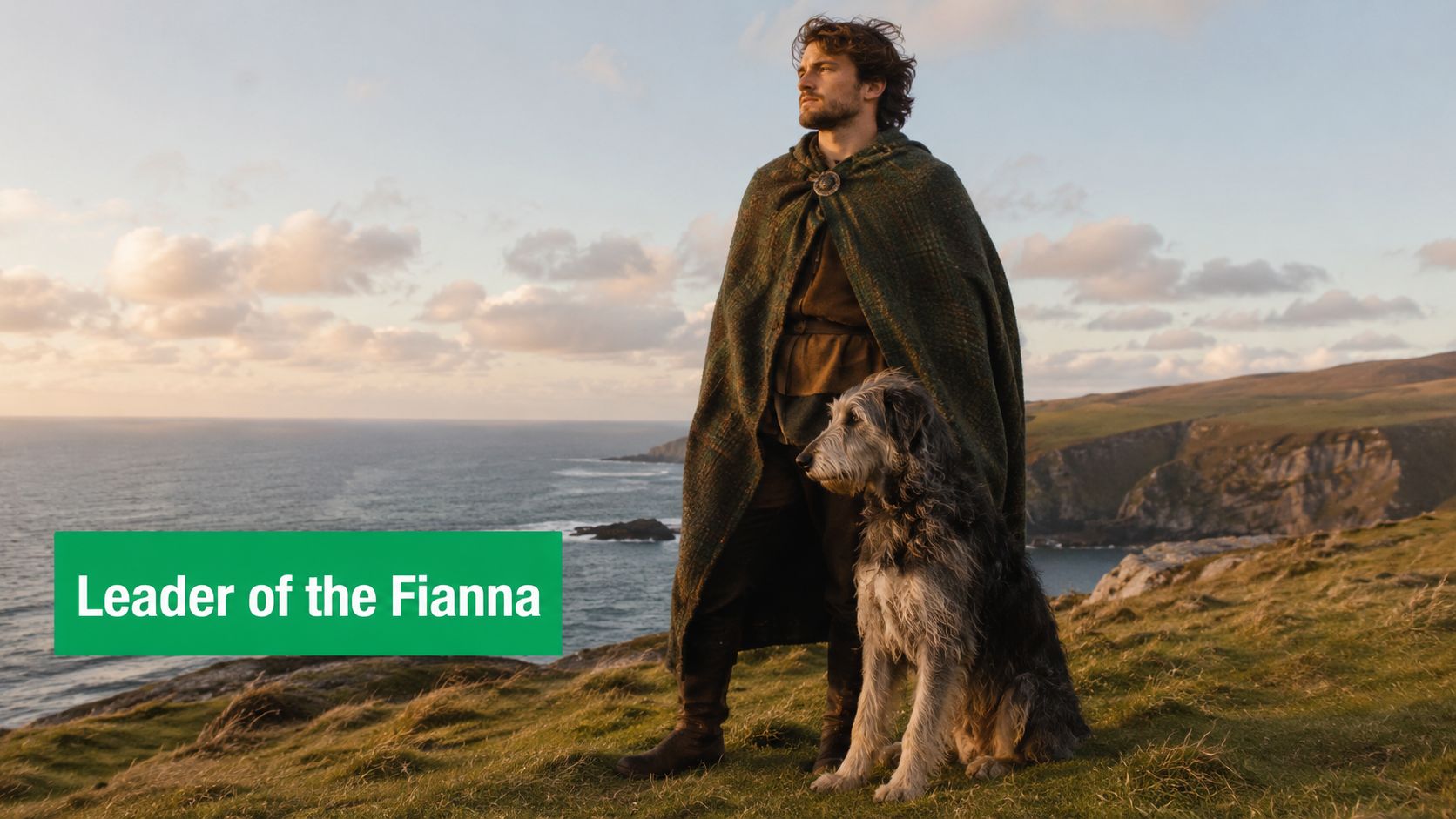
In practice, seamróg usually refers to small clovers, especially white clover (Trifolium repens) or red clover (Trifolium pratense), both familiar in Ireland's grasslands, roadsides, and damp fields. So, concerning “the Irish flower,” the shamrock works a bit like a family name. It points to a recognizable group and a shared meaning, not always to one exact species.

A 1681 account by Reverend Clements described the Irish wearing “a green Herb, called Shamrock” on St. Patrick's feast day. That detail helps us see the plant as people in earlier centuries saw it. It was something worn, shared, and recognized in public life.

Why the shamrock became such a strong symbol

Its power comes from several ideas meeting in one small plant.

  • Faith: Tradition connects the shamrock with St. Patrick and the teaching of the Holy Trinity.
  • Season: The name seamróg carries a hint of summer growth and renewal.
  • Memory: Wearing shamrock turned a common plant into a visible sign of Irish belonging.
  • Simplicity: Three green leaflets are easy to spot, draw, and remember.

That last point matters more than it may seem. National symbols often survive because they are easy to carry from one generation to the next. The shamrock can be pinned to a coat, stitched onto a badge, or taught to a child with one glance.

A useful Gaeilge word to keep

If you remember one Irish plant word from this part of the guide, keep seamróg.
A simple pronunciation guide is SHAM-rohg.

It is a small word with a large cultural reach. And it also helps correct a common mistake. The shamrock is Ireland's best-known symbolic plant, but it is not the same thing as a list of Ireland's native wildflowers. Keeping that difference clear will make the next flower names you learn in Gaeilge much easier to understand.

Does Ireland Have a National Flower

Does a country always have one official flower, the way it has a flag or an anthem?

In Ireland, the answer is no. Ireland does not have a single officially designated national flower. That is where many readers get tangled up, because the shamrock is so widely recognized that it feels official even when it is serving a different role.

A graphic comparing Ireland's plant symbol, the shamrock, to its lack of an official national flower.

A simple way to sort this out is to separate symbol from botany. The shamrock is Ireland's best-known emblem. A national flower, in the formal sense, would be an officially declared bloom. Those are not the same thing.

Why people get confused about fuchsia

One reason for the mix-up is that some flower lists name Fuchsia magellanica ‘Riccartonii’ as Ireland's national flower. It is easy to see why that idea spread. Fuchsia is familiar in Irish gardens and roadside hedges, and its pink-and-purple flowers are hard to miss.

But familiarity is not the same as nativeness, and it is not the same as official status. Fuchsia is not native to Ireland, so it does not really answer the deeper heritage question many learners are asking.

That deeper question is usually this: Which flower feels truly Irish, both in the natural world and in cultural memory?

Better contenders from Ireland's native flora

That question leads us away from a single official badge and toward flowers with roots in Irish history, place, and language.

Two strong examples are:

  • Flax
    Flax carries real historical weight, especially through linen and the public symbolism of Northern Ireland. It shows how a plant can matter nationally without being named the one official flower.

  • Yellow iris
    Often called feileastram in Irish, yellow iris grows in wet places and brings us closer to the native flora people actually meet by lakes, rivers, and marshy ground.

This is a helpful shift for Gaeilge learners. Instead of hunting for one perfect answer, you start to notice that Irish plant vocabulary grows out of lived places. Riverbank words belong near riverbank flowers. Bog words belong near bog plants. Even older writing systems can deepen that sense of connection. If you are curious about how nature and language meet in early Irish tradition, this guide to the Ogham script alphabet and its tree associations adds useful context.
What to remember

Ireland has a powerful plant symbol. It does not have one officially declared national flower.

That distinction matters because it keeps two different ideas clear. One is national identity, often carried by the shamrock. The other is Ireland's actual native wildflowers, each with its own Gaeilge name, habitat, and folklore. For heritage learners, that second path is often the richer one.

Five Native Irish Flowers and Their Names

Learning plant names is one of the nicest ways to make Gaeilge feel concrete. You can say the word, picture the flower, and connect it to a place in Ireland.

Here's one bloom many learners already recognize from country lanes and cottage gardens.

A vibrant purple foxglove flower blooming in a lush green countryside meadow under a cloudy sky.

Native Irish Flowers and Their Names in Gaeilge

English Name Irish Name (Gaeilge) Pronunciation Guide Notes
Yellow Iris feileastram FEL-ash-trum A bright waterside flower often linked with Irish wetland scenery.
Primrose sabhaircín SOW-er-keen An early spring flower with deep roots in folklore.
Heather fraoch free-ukh Common in rough ground and upland landscapes, with a strong place in Irish natural imagery.
Foxglove méaracán madaidh MAYR-uh-kawn MOD-ee Tall and striking, often seen in hedges and wild edges of the countryside.
Gorse aiteann ATCH-an Known for vivid yellow blossoms and thorny growth in open places.

How to learn these names without cramming

Don't try to memorize the whole table at once. Pick two flowers and attach each one to a mental scene.

For example:

  • feileastram for a riverbank or lakeshore
  • sabhaircín for a spring doorway or old garden
  • fraoch for a hillside or heath

That method works better than isolated repetition because Irish vocabulary tends to stick when it's tied to place, sound, and story.

If you enjoy older forms of Irish cultural expression too, this guide to the Ogham script alphabet adds another layer to how language, the land, and memory connect.

A short video can also help you hear and visualize Irish flower vocabulary in context:

A pronunciation tip that helps beginners

Irish spelling can look intimidating at first, but flower names become easier when you say them aloud slowly and often. Listen for rhythm before perfection.
Say the Irish name, picture the plant, then use it in a tiny phrase. That's how vocabulary starts to become usable language.

A simple example is: Chonaic mé sabhaircín.
“I saw a primrose.”

You don't need a huge sentence bank to begin. A handful of plant names can already make your Irish feel more rooted in the world.

The Secret Language of Flowers in Irish Folklore

Irish flowers aren't just botanical objects. In folklore, they often sit right on the edge between the ordinary world and the otherworld.

That's especially true of the primrose, or sabhaircín. In Irish folklore, certain flowers were believed to carry protective and magical force. This guide to flowers in Celtic mythology and culture notes that primroses were believed to protect people from fairies, and that a large patch could even be seen as a gateway to the faerie realm.

A flower at the threshold

That belief tells you something beautiful about Irish tradition. A flower wasn't only admired for color or scent. It could mark a threshold, guard a home, or warn that a place deserved respect.

Primroses often appear in stories as quiet protectors. Their power isn't loud. It's domestic, watchful, and tied to entrances, paths, and boundaries.

Other plants in Irish tradition also carried protective meanings. Rowan and elderflower are often remembered in that same wider circle of lore. Even when the exact customs vary from place to place, the pattern is clear. Flowers and trees were woven into how people thought about safety, luck, and unseen presence.

Why this matters for Gaeilge learners

A word learned through folklore tends to stay with you longer. Sabhaircín becomes easier to remember when it means more than “primrose.” It becomes a story-word.

If you want to keep exploring that side of Irish tradition, this introduction to Irish fairies folklore and traditions fits naturally alongside flower lore.

Folk memory also survives through craft. If remembrance symbolism interests you, especially around flowers that carry public meaning, this resource on how to create a knitted poppy offers a thoughtful example of how floral symbols can move from history into handmade practice.

Some of the best Irish vocabulary isn't practical first. It's memorable first. Folklore gives words a home.

That's one reason heritage learners often find plant names so rewarding. You aren't only learning what something is called. You're learning what people believed it could do.

Start Your Irish Language Journey Today

Learning the Irish flower names for primrose, yellow iris, heather, or shamrock does more than expand your vocabulary. It changes how you hear the language. Words stop feeling like school material and start feeling attached to fields, hedges, stories, and seasons.

That kind of learning matters because there's a real gap between recognizing Irish and using it. About 1.74 million people in Ireland claim some knowledge of Irish, yet only about 73,000 use it daily outside the education system, as noted in RTÉ Brainstorm's report on Irish, AI, and language immersion.

Screenshot from https://gaeilgeoir.ai

Passive knowledge isn't the same as speech

Many learners know that feeling. You recognize words on a page. You remember a few phrases from school. You might even understand more than you can say. But when it's time to speak, everything goes quiet.

That's why cultural learning and active practice belong together.

  • Vocabulary gains depth: A word like seamróg carries memory, not just translation.
  • Speaking becomes easier: It's simpler to talk when you can picture what you mean.
  • Motivation lasts longer: Heritage, place, and story give language study emotional weight.

If you're at the beginning, a practical starting point is to build confidence with everyday foundations first. This beginner guide to learning Irish Gaelic is a helpful place to start.

Build from meaning, not just memorization

The strongest Irish study habits usually start small. Learn a few useful words. Say them aloud. Use them in short phrases. Return often.

Nature vocabulary is ideal for this because it's concrete and rich at the same time. You can learn the Irish name, imagine the plant, remember the folklore, and then try the word in speech. That combination makes language feel lived rather than stored.

If Irish has been sitting in the background of your life, this is a good moment to bring it forward again.


If you're ready to move from recognizing words to speaking them, start with Gaeilgeoir AI. You can explore guided, real-world Irish practice and begin today at learn Gaeilgeoir AI.

Disable comments and pingbacks for this post.

Powerful Irish Warrior Names Male for 2026

You might be staring at a baby name list, sketching tattoo ideas, or trying to reconnect with family roots and realizing that most name roundups feel flat. They give you a translation, maybe a myth reference, and then move on. That's frustrating if what you want is a name with real depth, something that sounds powerful and also teaches you something about Ireland.

Male Irish warrior names do more than signal strength. They open a door into story, sound, and language. A name like Cú Chulainn carries a whole heroic world. A name like Cathal points straight back to an old Irish word for battle. Even names that look familiar in English often hide older Gaelic structures that become easier to recognize once you learn a few roots.

This guide keeps the focus practical. You'll get seven major names from Irish legend and tradition, along with simple pronunciation help, story context, and language notes you can use. If you're exploring heritage, naming a child, choosing a character name, or brainstorming a design with generate Irish tattoo ideas, these names give you more than surface-level meaning. They give you a way into Gaeilge itself.

Table of Contents

1. Cú Chulainn (Cúchulainn)

Pronounce it roughly as koo KHUL-in, though Irish sound varies by dialect and spelling tradition. Among irish warrior names male readers search for, this is often the first name that feels instantly legendary.

Why his name matters

Cú Chulainn means “the Hound of Culann.” The first element, cú, means hound, and Culann is the name of the smith whose guard dog the young hero killed before offering himself as a replacement. That act of loyalty and responsibility is why the name still carries force. It isn't just fierce. It's bound to duty.

In the Ulster Cycle, Cú Chulainn becomes the defender of Ulster and stands almost alone against the forces of Queen Medb in the Táin Bó Cúailnge. If you want a name tied to courage under pressure, few are stronger in Irish tradition. His stories also introduce terms that appear again and again in old narrative culture, including geis, a binding obligation, and riastrad, the terrifying battle distortion linked to his combat frenzy.

For a quick visual retelling, this video gives a useful entry point before reading the older tales.

A language learner's doorway into the Ulster Cycle

Cú Chulainn is one of the best mythic names for learners because his stories are so central. Once you know his name, you start recognizing connected words in summaries, children's retellings, museum materials, and classroom texts. A good next step is this guide to the Ulster Cycle and Irish myths, which gives the wider world around him.

Practical rule: Learn the name as a phrase, not as a label. Cú means hound. Once you know that, other Irish names and words become easier to remember.

A useful real-world approach is to read a simplified retelling of the Táin, then note recurring words linked to honor, kinship, and battle. If you're building pronunciation confidence, say the name aloud in two beats first, “Cú” and “Chulainn,” before trying the full form naturally. That small habit makes old Irish names feel much less intimidating.

2. Fionn mac Cumhaill

Say it roughly as fyun mak KOO-il or fin mak COOL, depending on the tradition you encounter. In modern English contexts you'll also see Finn MacCool, but the Irish form gives you more of the linguistic texture.

The name behind the legend

Fionn means fair or white, often understood as referring to bright appearance or fair hair. Mac Cumhaill means son of Cumhall. Unlike the concentrated, tragic brilliance of Cú Chulainn, Fionn's legend stretches across a lifetime of hunting, leadership, wisdom, and supernatural adventure.

He leads the Fianna, the wandering warrior bands of Ireland. That makes his name useful in a different way. Instead of one great defensive war, you get a wide array of stories: forest training, tests of wisdom, strange encounters, and tales passed down in many forms. For someone learning Irish culture step by step, that range is helpful.

This image captures the mood often associated with Fionn's world. A warrior, a hound, and the sea at the edge of the land.

An Irish warrior standing on a grassy cliff with his large wolfhound overlooking the ocean at sunset.

Why Fionn works well for learners

Fionn appears in stories connected to Oisín, the Fianna, and the wider Fenian tradition. Those episodes are often easier to approach in small pieces than the more intense heroic material around Cú Chulainn. If you want an Irish warrior name that feels noble but not severe, Fionn is a strong candidate.

Try learning his name alongside a few related words:

  • Fianna Strongly linked with warrior bands and roaming heroic company.
  • Eolas A useful Irish word for knowledge, which suits Fionn's reputation for insight.
  • Glic A word for clever or wise, fitting a hero valued for judgment as much as force.

Fionn is a good reminder that Irish warrior culture admired intelligence, memory, and decision-making, not only battlefield strength.

A practical reading path is to start with tales of Oisín and the Fianna in modern retellings, then move toward older-style language. That lets you enjoy the legend while training your ear for names, patronymics, and repeated vocabulary.

3. Balor of Tory Island

Balor is not the hero of his story. That's exactly why he belongs on this list. If you want to understand Irish warrior naming in full, you need the names of the forces heroes had to face.

A warrior name from the dark side of myth

Balor is the fearsome Fomorian king with the destructive eye, a giant whose gaze could devastate armies. He belongs to the mythological world of conflict between the Tuatha Dé Danann and older chaotic powers. In story terms, he represents danger that can't be met casually. It has to be answered with skill, timing, and destiny.

The name is often explained as carrying a sense of might or strength. Even where the exact etymology is debated, the narrative effect is clear. Balor sounds heavy, old, and threatening. That matters for learners because Irish tradition often gives names dramatic weight before you even know the full tale.

Vocabulary hidden inside Balor's world

Balor's stories help you notice words tied to conflict and fate. One especially important root in Irish warrior naming is cath, meaning battle. It is described as the clearest linguistic marker of warrior names in Irish culture, appearing in names such as Cathal, while related warrior forms like Fergus, Cathaoir, Conall Cearnach, and Fergal carry direct associations with strength, combat, victory, and valor in saga tradition (old Irish warrior name meanings and roots).

That makes Balor useful even though his own name isn't built on cath. His world teaches the vocabulary around him.

  • Cath Battle. A key root to watch for in names and old titles.
  • Fomoróg A form learners may meet when discussing Fomorian beings or giant-like figures.
  • Cinniúint Destiny or fate, a modern Irish word that helps frame prophecy themes in retellings.

If you're reading beginner materials, Balor often appears in shortened versions of Cath Maige Tuired. Read those slowly and listen for repeated place names and kinship terms. Villain names are often easier to remember than abstract vocabulary, so Balor can become an anchor point for a whole myth cluster.

4. Oisín (Ossian)

Pronounce Oisín roughly as uh-SHEEN or oh-SHEEN, depending on regional speech and teaching style. It's one of the most musical names in Irish tradition, and that sound is part of its appeal.

The poet-warrior name

Oisín is the son of Fionn mac Cumhaill, but he isn't remembered only as a fighter. He's the poet-warrior, the figure who stands between martial culture and literary memory. That double identity makes him especially valuable if you want a name that feels heroic without sounding blunt.

You'll often meet him through the tale of Oisín in Tír na nÓg, where he journeys with Niamh to the Land of Youth and later returns to an Ireland transformed by time. Even in translation, the story carries themes that are unmistakably Irish: longing, beauty, loss, and the impossibility of returning unchanged.

A gentle entry into Irish literary themes

Oisín works beautifully for learners because his stories invite softer vocabulary. Instead of only swords and battle cries, you get words for poem, music, youth, and memory. That gives balance to any search for irish warrior names male readers may be making. Not every warrior name has to feel hard-edged.

A useful mini vocabulary set around Oisín includes:

  • Dán Poem.
  • File Poet.
  • Ceol Music.

Oisín shows that in Irish tradition, eloquence could stand beside courage. A hero could be remembered for words as well as weapons.

In real-world learning, Oisín is a great name to practice because it introduces a common Irish feature. The accented vowel, the síneadh fada, changes how the word sounds and should never be ignored. If you're reading children's editions or school retellings, Oisín is often one of the first names that teaches you that spelling in Irish is highly meaningful, not decorative.

5. Lugh of the Tuatha Dé Danann

Lugh is short, striking, and powerful. It's often pronounced loo, though learners should expect some variation in explanation depending on context and dialect.

The skilled warrior

Lugh is not just a warrior. He is the many-skilled figure often associated with mastery across arts and crafts as well as battle. In myth, his most famous act is killing Balor, the giant whose fate was tied to prophecy. That victory is one of the defining moments in Irish mythic conflict.

What sets Lugh apart is his range. He doesn't symbolize brute force alone. He represents precision, intelligence, and excellence. That makes him one of the richest names in Irish tradition for people who want a heroic name with mental sharpness built into it.

This image suits that side of Lugh's identity. He belongs as much to making and skill as to war.

A skilled artisan meticulously engraving a floral design onto a small metal piece at a wooden workbench.

Lugh as a language key

Lugh helps learners connect warrior tradition to craft vocabulary. One of the most useful Irish words associated with him is ildánach, meaning many-gifted or skilled in many arts. Even if you don't use that word every day, it reveals a lot about how Irish heroic culture valued capability.

Try pairing Lugh with a few practical terms:

  • Ceárta Forge or workshop-related language, useful when thinking about making and craft.
  • Straitéis Strategy, a modern term that matches his tactical image in retelling.
  • Dia God, helpful for understanding the divine status of mythological figures.

Lugh also lives on in the festival name Lughnasadh, which ties him to season, harvest, and the rhythm of the year. That connection matters. Irish names often carry social and seasonal memory, not just personal identity. If you like names that are short but layered, Lugh is one of the strongest choices in the whole tradition.

6. Niall of the Nine Hostages

Niall feels more historical than some of the figures above, even though legend surrounds him. That mix is part of the name's power. It stands with one foot in story and one in remembered kingship.

A name between legend and history

Niall of the Nine Hostages, or Niall Noígíallach, is presented as a High King whose authority reached across rival territories. His byname suggests dominance, tribute, and political control. This is not the solitary hero type. It's the ruler type.

In modern naming, Niall is easier to carry than some longer mythic forms. It travels well into English while still feeling unmistakably Irish. That's one reason it has stayed visible for so long in Irish cultural memory.

There's also a demographic reason to notice names like Niall in the wider history of Irish naming. In the 1911 Census of Ireland naming record, John was held by 13.9% of all males, Patrick by over 10%, and the top ten male names together made up 60% of all male names recorded. That concentration shows how strongly traditional naming patterns shaped Irish society. Legendary and dynastic names sat beside firmly rooted Christian choices in a culture that valued continuity.

What Niall teaches about Irish naming

Niall is useful because it teaches you that warrior names in Ireland are not always transparent compounds like Cathal or Murchadh. Some become powerful through the people and dynasties attached to them.

Names in Irish tradition often gather force through story. A short name can carry centuries of political memory.

If you're learning Irish, Niall also gets you used to slender consonants and double letters without overwhelming spelling. It's a practical bridge name. You can read it in legends, hear it in modern life, and connect it to older ideas of rulership, trial, and legitimacy.

7. Maol Dúin (Mael Duin)

Maol Dúin doesn't usually appear at the top of popular warrior-name lists. That's a shame, because he offers something most famous heroic names don't. He shows that Irish warrior tradition also values endurance, reflection, and moral testing.

A different kind of warrior

Maol Dúin is the hero of a voyage tale rather than a straightforward battle epic. He sets out in search of his father's killer and travels through a chain of strange islands, each with its own rule, wonder, or danger. The story is adventurous, but the drama often comes from restraint, curiosity, and transformation rather than direct combat.

That makes Maol Dúin a strong choice for anyone drawn to contemplative heroism. He is not weak. He is tested in a different register. The name itself carries an old, distinctive texture that feels firmly rooted in Gaelic tradition.

This image captures the atmosphere around him better than any battlefield scene could.

A mysterious figure in a hooded cloak rows a small wooden boat across calm, foggy waters.

Why voyage tales help language learners

The voyage structure makes Maol Dúin especially useful for learners. Repeated landings, repeated encounters, repeated reactions. That pattern helps with vocabulary retention in a way many dense heroic texts don't.

You can use his story to build themed word groups:

  • Farraige Sea.
  • Oileán Island.
  • Draíocht Magic.

A more specialized naming note belongs here too. The old Irish warrior name Murchadh comes from a form meaning “sea-warrior,” historically linked to dynasties such as the O'Briens and O'Flahertys, and it is often anglicized as Morgan in modern use (old Irish Gaelic boy names and their meanings). That maritime warrior idea sits neatly beside Maol Dúin's seafaring world.

For learners, this is the practical payoff. Voyage tales train you to notice repeated sentence structures, motion verbs, and nature vocabulary. If Cú Chulainn teaches intensity, Maol Dúin teaches patience.

7 Irish Male Warrior Names Compared

Figure Complexity 🔄 Resource needs ⚡ Expected outcomes ⭐📊 Ideal use cases 💡 Key advantages
Cú Chulainn (Cúchulainn) High 🔄, dense Ulster Cycle, archaic language/pronunciation High ⚡, many primary texts, scholarly glosses, adaptations ⭐⭐⭐⭐⭐ 📊, deep cultural literacy; core heroic vocabulary and literary forms Advanced learners of Old Irish, literary analysis, cultural context Iconic name; extensive narratives; teaches core heroic values and etymology
Fionn mac Cumhaill Medium 🔄, episodic Fenian Cycle, variable versions Moderate ⚡, abundant tales, accessible retellings ⭐⭐⭐⭐ 📊, leadership, wisdom, wide lexical range across genres Intermediate learners practicing storytelling and episodic reading Diverse stories; balances strategy and heroism; good for varied practice
Balor of Tory Island Low–Medium 🔄, focused antagonist narratives Low–Moderate ⚡, shorter texts, common in introductions ⭐⭐⭐ 📊, clear myth vocabulary (fate, danger) and memorable imagery Beginners studying myth basics, phonetics, and conflict vocabulary Distinctive, memorable figure; concise narratives suitable for early study
Oisín (Ossian) Medium–High 🔄, poetic themes, time/otherworld complexity Moderate ⚡, widely translated tales (Tír na nÓg), poetic texts ⭐⭐⭐⭐ 📊, poetic/lyrical vocabulary; themes of time and otherworldliness Intermediate learners of poetry, literary translation, cultural motifs Bridges warrior and poet traditions; rich poetic examples for language study
Lugh of the Tuatha Dé Danann Medium 🔄, divine/abstract role, thematic complexity Moderate ⚡, myth cycles + festival (Lughnasadh) connections ⭐⭐⭐⭐ 📊, crafts, strategy, ritual vocabulary; cultural-calendar links Learners interested in mythology, craft vocabulary, festival culture Embodies skill/strategy; links to Lughnasadh and place-name vocabulary
Niall of the Nine Hostages Medium 🔄, historical legend with fragmentary sources Moderate–High ⚡, chronicles, genealogies, historical commentary ⭐⭐⭐ 📊, governance, social hierarchy, historical context vocabulary Students of early Irish history, kingship, and socio-political language Bridges myth and history; dynasty relevance enhances cultural context
Maol Dúin (Mael Duin) Low–Medium 🔄, voyage/episodic structure; repetitive patterns Moderate ⚡, preserved immram texts; suitable retellings ⭐⭐⭐⭐ 📊, travel, nature, and supernatural vocabulary; strong repetition for retention Beginner–intermediate learners focusing on vocabulary acquisition via narrative Voyage structure offers repetition; diverse vocabulary domains and moral lessons

Start Your Own Language Adventure

These names aren't just relics from old manuscripts. They still work as living entry points into Irish sound, story, and identity. If you've spent time looking up irish warrior names male lists, you've probably noticed that many articles stop at quick translations. But the full significance becomes apparent when you slow down and ask what the parts of the name mean, what story made it memorable, and what words around it keep appearing in Gaeilge.

Cú Chulainn gives you loyalty, oath, and heroic duty. Fionn opens the world of the Fianna and wisdom-led leadership. Balor teaches you the language of conflict by showing the darkness heroes must overcome. Oisín brings poetry into the warrior tradition. Lugh joins skill to courage. Niall brings political memory and dynastic weight. Maol Dúin reminds you that Irish heroism also includes wonder, travel, and inner change.

Some names carry very direct warrior markers. One of the clearest is Cathaoir, meaning “battle man,” a name historically given to warriors noted for combat skill and bravery (Cathaoir as an Irish warrior name). Once you learn to spot pieces like cath, you stop seeing Irish names as mysterious blocks of letters and start seeing them as meaningful constructions.

That's where language learning becomes exciting. A name turns into a root. A root turns into a family of words. A family of words turns into confidence. You begin to hear patterns. You notice how patronymics work, how spelling signals pronunciation, and how myth preserves old vocabulary that still gives modern Irish its texture.

You also don't need to learn everything at once. Pick one name that grabs you. Say it aloud. Learn the core story. Write down three related Irish words. Listen for those words again in songs, lessons, story retellings, or conversation practice. That's a much better way to build real connection than memorizing isolated name meanings.

If this world pulls you in, follow that instinct. Gaeilge becomes easier when it's attached to things you already care about, and legendary names are excellent anchors. They're memorable, emotionally charged, and tied to stories people return to again and again. Modern tools can make that journey much more manageable. With the right support, you can practice pronunciation, build everyday vocabulary, and connect the old names you love to the living language people still learn and speak today.


If you want to move from reading legendary names to speaking Gaeilge, try Gaeilgeoir AI. It's built to help beginners and returning learners start using Irish from day one through guided conversation, pronunciation support, adaptive practice, and practical scenarios that make the language feel alive instead of distant.

Start Speaking Irish Today — 25% Off
Use code START25

Learn real Irish for real life with guided practice, pronunciation support, and everyday conversations.

Get 25% off any plan with code START25

Start Speaking Irish Today — 25% Off