Celtic Word for Dog: Irish, Welsh, and Gaelic Translations

I still remember the first time a learner asked me why Irish has both and madra for “dog.” The answer opened a door into myth, sound change, and the way Celtic languages keep ancient history alive in everyday speech.

Table of Contents

The Ancient Hound of Celtic Legend

Cú Chulainn's name still stops learners in their tracks. It points to a hound, and that matters because the celtic word for dog has never been just a word for a household animal. In Irish legend, the hound carries loyalty, protection, and status, which is why the name of one of Ireland's greatest mythological heroes turns a dog into an honorific.
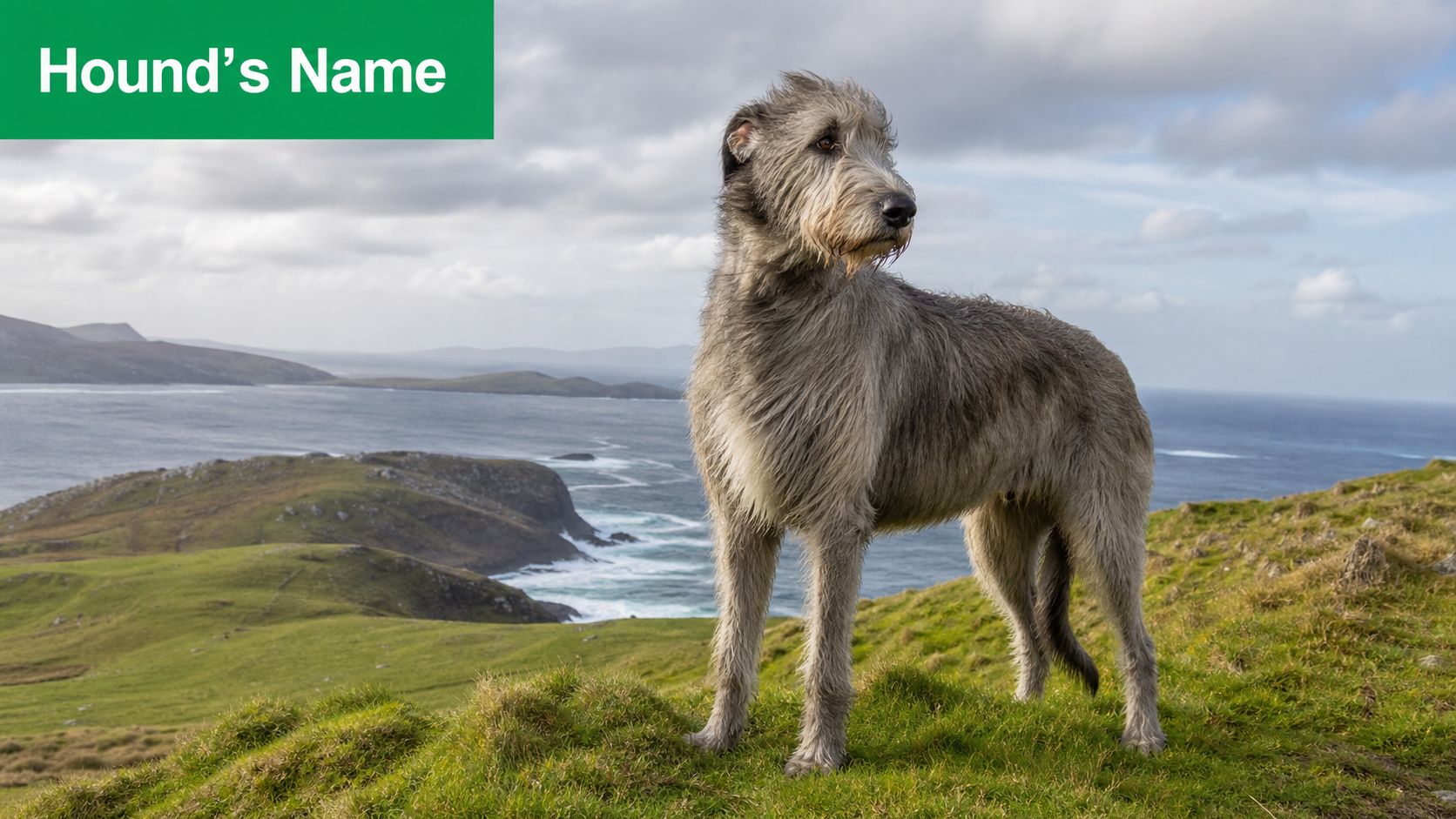
A majestic Irish Wolfhound standing on a grassy cliff overlooking the ocean with a scenic landscape.

The oldest inherited form behind all this is *Proto-Celtic . Comparative forms across the Celtic family include Old Irish cú, Irish cú, Scottish Gaelic cù, Manx coo, Welsh ci, Cornish ki, and Breton ki Omniglot's comparative list. That spread matters. It shows a shared inherited lexeme, not a later borrowing, and it helps explain why so many Celtic languages still feel related even when their modern everyday words look different.

A shared animal word with cultural weight

In Irish, broadened beyond “dog” to include hound, greyhound, wolf, and even honorific meanings such as hero or champion. Scottish Gaelic kept the simpler sense of dog, canine. That contrast is useful for learners because it shows how one ancient root can stay conservative in one branch and expand in another.

Practical rule: when a Celtic language seems to use a dog word in a name or title, don't assume it means a pet. It may signal rank, mythic power, or old poetic style.

For anyone building a cultural picture alongside vocabulary, this is the kind of detail that makes a word stick. A good companion resource for exploring related themes is dog probiotics, especially if you're pairing language learning with real-life dog care and want to keep the topic grounded in everyday life.

If you want a wider cultural doorway into Irish storytelling, this guide to Irish myths and legends fits naturally with the hound imagery. The language and the legend are doing the same job, they preserve memory.

Dog Words Across the Celtic Language Family

Irish learners often expect one neat translation for “dog.” Celtic languages refuse to stay that tidy. Some branches kept descendants of the ancient *kū root, while others developed everyday replacements, and that split gives you a clear view of the family tree.

A quick comparison across the family

Language Word IPA Pronunciation Usage Notes
Irish madra not supplied in the verified data Standard everyday word for “dog”
Irish not supplied in the verified data Older, literary, mythological, and honorific
Scottish Gaelic not supplied in the verified data Archaic and literary form, still used in Scotch Gaelic
Scottish Gaelic madadh not supplied in the verified data Another Gaelic term for “dog”
Welsh ci not supplied in the verified data Cognate from the old Celtic root
Breton ki not supplied in the verified data Cognate from the old Celtic root
Cornish ki not supplied in the verified data Cognate from the old Celtic root
Manx moddey not supplied in the verified data Modern everyday term
Manx coo not supplied in the verified data Preserves the older Celtic root

The broad pattern is simple. Goidelic languages, Irish, Scottish Gaelic, and Manx, show one set of developments, while Brythonic languages, Welsh, Cornish, and Breton, preserve forms closer to the old *kū shape. That's why ci and ki look strikingly familiar even before you've studied the historical grammar behind them.

What to notice when you compare them

A learner usually gets confused when a language has two words that seem to mean the same thing. In Celtic languages, the answer is often usage rather than pure dictionary meaning. Literary forms survive because poets, storytellers, and place names preserve them, while everyday speech can shift toward a newer standard. The Irish case makes this especially visible, and the same family comparison helps explain why a history guide to Celtic languages is worth reading after you've memorized the basic dog words.

If a form looks short and ancient, it often is. If it feels ordinary and conversational, it may be the newer everyday choice.

That distinction matters more than memorizing isolated translations. It helps you predict why a language keeps one form for folklore, another for the street, and another for compounds or idioms.

Why Irish Has Two Words for Dog

Irish gives learners a beautiful puzzle. Madra is the standard modern word for “dog,” but is still alive in older, poetic, and heroic contexts. That pairing isn't a contradiction, it's a record of language change.

From old forms to modern speech

The historical pathway recorded by Alexander MacBain connects Middle Irish madrad and Early Irish matad/maddad to modern madra MacBain's etymological discussion as relayed in the linked summary. The same source ties the word to related Celtic forms such as Welsh madog and madryn, both linked to fox-related meanings. That family resemblance is useful because it shows that animal vocabulary often travels in clusters, not in isolation.

Why the everyday word changed

Language change usually follows social life. As dogs became common household animals, speakers favored the word that fit daily talk, while the older stayed in literary and mythological settings. That is why you still meet in names, epithets, and old styles, but madra handles ordinary conversation.
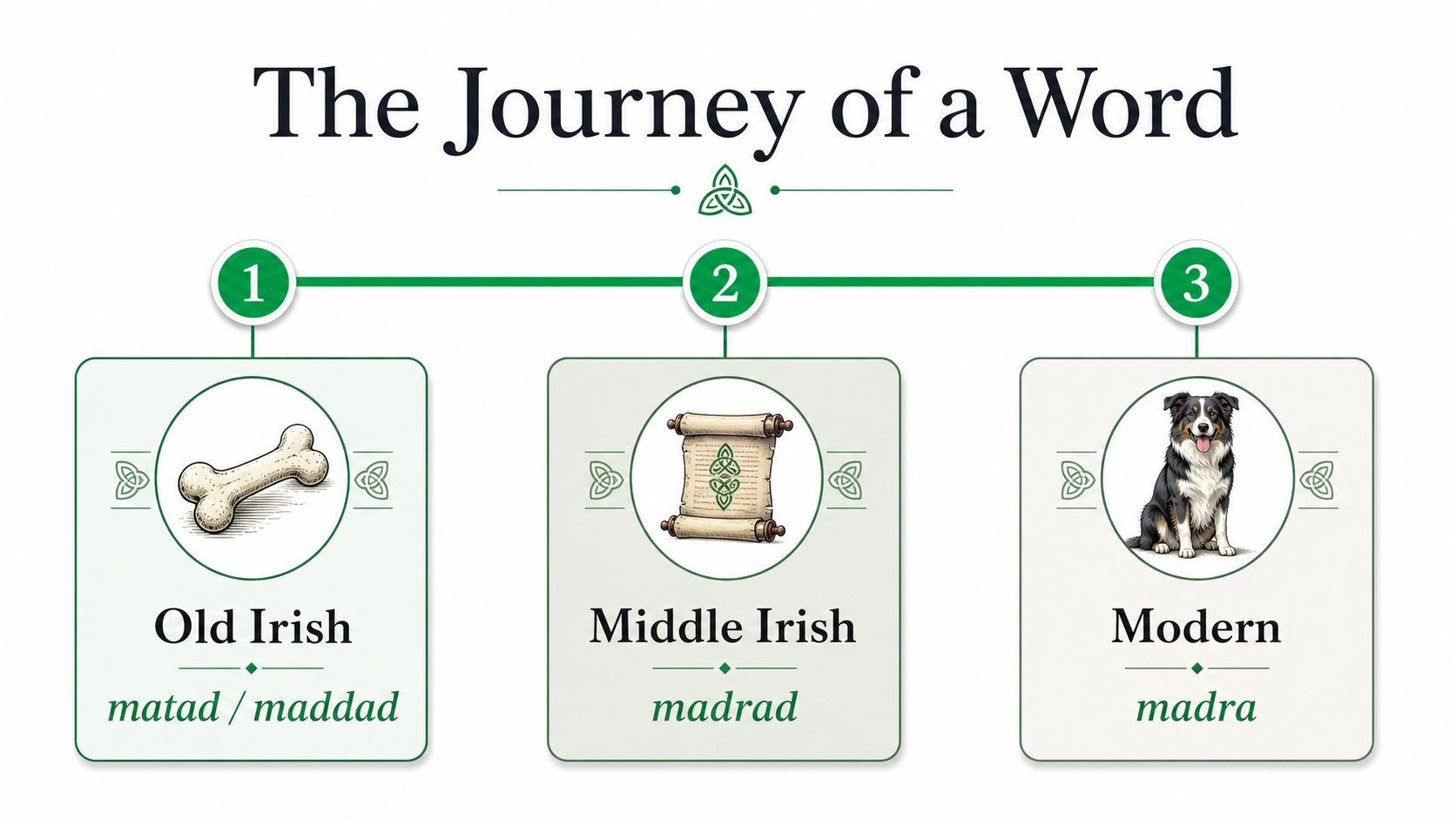
A visual timeline showing the evolution of the Irish word for dog from Old Irish to Modern.

The timeline makes the pattern easier to remember. Old Irish matad/maddad comes first, Middle Irish madrad sits in the middle, and Modern madra is the form you use in everyday speech.

A memory trick that actually works

Think of as the “story word” and madra as the “daily word.” That mental split helps you choose the right term without freezing up. It also explains why a learner might understand a sentence in a mythological context but hear something completely different at the kitchen table.

Creative Celtic Compounds Built on Dog

Irish does something wonderfully practical with madra. Instead of inventing unrelated animal names for every creature, it often builds compounds that describe an animal by color, habitat, or behavior. That pattern is one reason Celtic vocab can feel so logical once you see the system.

When dog becomes a naming tool

Madra rua means fox, “red dog.” Madra crainn means squirrel, “tree dog.” Madra mara means seal, “sea dog.” Madra uisce means otter, “water dog,” and a modern Irish-language reference glosses it with the pronunciation [ˈmˠad̪ˠɾˠə ˈɪʃcɪ] Omniglot's water-dog entry. That's not random poetry. It's a naming habit built on close observation.
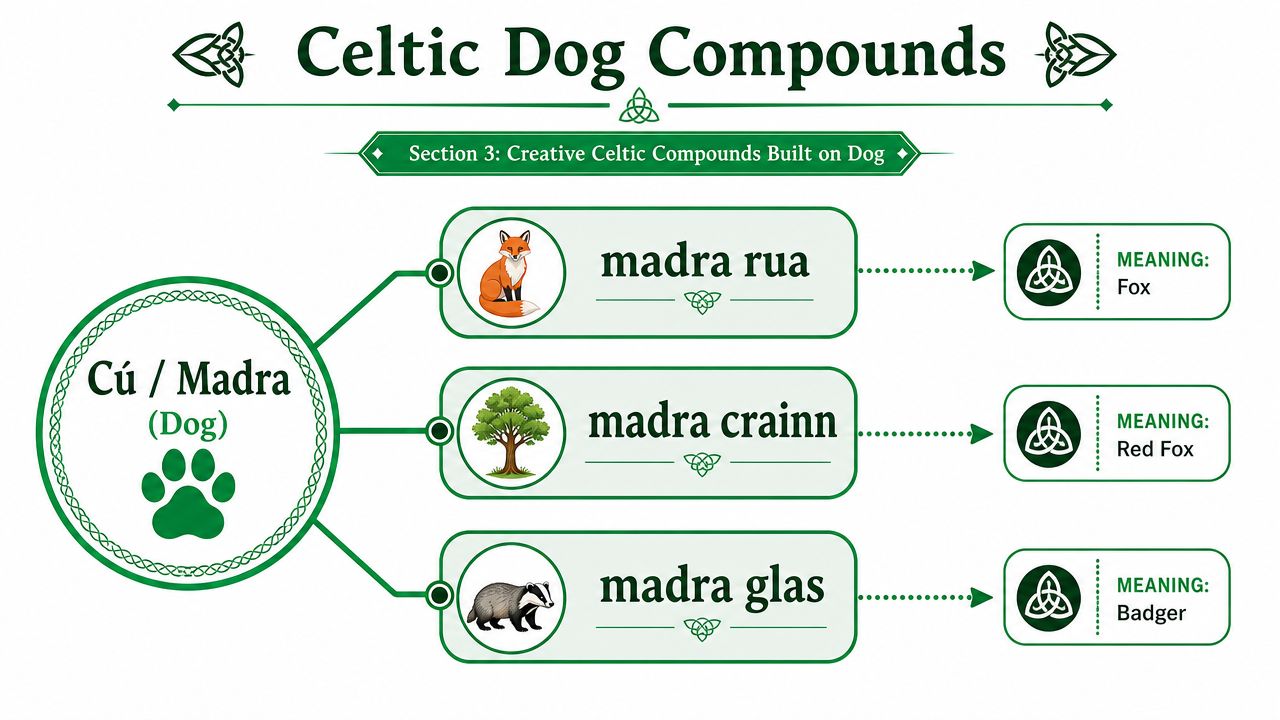
An educational chart illustrating Irish Gaelic compound words featuring the word for dog, including fox and badger.

The logic is easy to miss if you expect modern scientific taxonomy. Celtic speakers were grouping animals by what they looked like, where they lived, or how they moved. A fox could become a “red dog” because color mattered. An otter could become a “water dog” because habitat mattered.

Why this helps you remember vocabulary

Once you know the pattern, you can decode unfamiliar words more quickly. You're no longer memorizing isolated facts, you're spotting a productive naming style.

  • See the base word first: recognize madra before you chase the second element.
  • Match the descriptor to the habitat: crainn points to trees, mara points to sea, uisce points to water.
  • Listen for image, not zoology: these compounds often reflect how speakers imagine an animal, not how a textbook classifies it.

An easy extra clue comes from Irish diminutives, because Celtic languages often create meaning through small structural changes rather than entirely new roots. That habit makes the vocabulary feel alive, especially when you start reading with your ears as well as your eyes.

Mastering Celtic Dog Word Pronunciation

Pronunciation trips up even confident learners because the letters look familiar while the sounds don't. , ci, ki, and madra all deserve a slow, careful read aloud, not silent recognition on a page.

The sounds that matter most

Scottish Gaelic begins with a consonant that English speakers often want to soften too much. Keep it firm and back in the mouth. Irish madra has a rolled or tapped r quality that many English speakers flatten, so it helps to exaggerate the tongue movement at first.

Welsh ci and Breton ki are another useful pair. They look almost identical, but the vowel quality is what keeps them distinct in speech. If you say them like English “key” without listening carefully, you'll miss the native feel of the word.

Practical rule: don't trust spelling alone. Celtic spelling often gives you structure, but your ear has to learn the actual sound shape.

A simple speaking routine

Say each word slowly, then attach it to a meaning, then say it again in a short phrase. That sequence builds muscle memory better than repeating isolated syllables. If you can, record yourself and listen back, because self-correction is where the progress happens.

A lot of learners also benefit from immediate feedback tools. AI-based pronunciation practice can help you hear the difference between a flat English approximation and a more native-like Celtic sound, especially when textbooks don't give you enough correction. The point isn't perfection. It's building confidence to speak aloud instead of staying locked in silent reading.

Common mistakes to avoid

  • Over-Englishing the vowels: Celtic vowels are often more precise than English learners expect.
  • Dropping the consonant detail: a small change can turn one form into something that sounds off.
  • Rushing the word: slow speech makes unfamiliar sounds much easier to control.

If you've been avoiding speaking because the words look hard, start with the shortest forms first. Short words are not easier because they are simple. They're easier because they let you focus on one sound at a time.

Using Dog Words in Real Celtic Conversations

Vocabulary becomes useful the moment it leaves the page. Dog words work best when they appear in short, friendly exchanges about pets, walks, and everyday life, not just in dictionary drills.

Everyday phrases you can actually use

In Irish, An bhfuil madra agat? means Do you have a dog? That's a natural opener if you're talking to someone about pets. Tá madra álainn agat means You have a lovely dog, and it works well in a casual conversation when someone introduces their dog to you.

Cultural context matters here. Asking about a dog is usually safe and warm, but the tone should still fit the setting. With someone you just met, a simple pet question feels friendly. With a stranger in a formal situation, you'd keep it lighter and more polite.

What makes these phrases stick

The strongest phrases are the ones you can reuse across settings.

  • Ask first, comment second: a question like An bhfuil madra agat? starts the exchange naturally.
  • Keep praise simple: short positive phrases are easier to remember and sound more authentic.
  • Reuse the animal pattern: once you know madra, related compounds become easier to identify in reading.

You'll also notice that Celtic languages often treat animals as part of daily life, not a separate vocabulary island. That's why dog words show up so comfortably in idioms and compound forms. The language doesn't force a rigid separation between “animal talk” and “real talk.”

A small habit helps here. Say the phrase out loud when you see a dog, a photo of a dog, or even a dog on a sign. Real-world pairing locks the vocabulary in faster than flashcards alone.

Your Next Steps for Learning Celtic Languages

Start with one Celtic language and let one word family guide the rest. If Irish is your focus, begin with madra and , then build outward into one or two compounds and one conversational phrase. That small base is enough to make the language feel less mysterious.

A simple 30-day approach

For the first week, learn the basic dog word and one greeting. In the second week, add one compound such as madra mara or madra uisce. In the third week, read a short mythic or cultural text and look for in context. By the fourth week, practice a tiny spoken exchange without looking at notes.

That approach works because it ties vocabulary to meaning, not just memorization. It also keeps the emotional payoff visible. You're not chasing abstract grammar. You're building a usable relationship with the language.

Keep the motivation concrete

Pick the language that connects most strongly to your heritage, your location, or your curiosity. Then use one theme, like dog words, as an anchor. A focused theme makes progress easier to notice, and noticed progress keeps people going.

Learn a few words deeply before you try to learn a lot of words quickly.

If you're ready to turn that kind of practice into a daily habit, Gaeilgeoir AI gives you guided Irish conversation, pronunciation support, instant feedback, and scenario-based practice that fits real life. It's a strong fit if you want to move from reading about Celtic words to using them with confidence.


Gaeilgeoir AI helps you move from curiosity to speaking, with guided Irish practice that makes words like madra and feel usable instead of distant. If you want a steady way to build confidence with Irish from the ground up, visit Gaeilgeoir AI and start practicing today.
Bear in Gaelic: Irish and Scottish Translations Explained

You're probably here because you saw two different Gaelic words for “bear” and wondered which one is right. Maybe an Irish learner's app gave you béar, then a Scottish Gaelic page showed mathan, and now it feels like the languages are playing tricks on you. That confusion is normal. Closely related languages often keep old family resemblances while making different choices in everyday speech.

For beginners, bear in Gaelic is a great example of how language, history, and pronunciation all meet in one small word. If you've already been comparing Celtic languages, this short guide to the Goidelic language family gives useful background on how Irish and Scottish Gaelic relate to each other. Once that relationship clicks, the bear words make much more sense.

Table of Contents

Introduction to Bear in Gaelic

A learner opens an Irish text and finds béar. Later that same evening, they listen to Scottish Gaelic and hear mathan. Both mean “bear,” but they don't look alike, and that's where beginners often get stuck.

The good news is that both words are worth learning because they teach different lessons. Irish gives you a modern everyday form that came in from English. Scottish Gaelic keeps a native Gaelic form in daily use. That contrast makes this topic more than vocabulary practice. It shows how words change when the world around speakers changes.

Why beginners get tripped up

English speakers often expect one clean translation across related languages. Gaelic languages don't always work that way. A word can be modern in one language and old-fashioned in another. A form can also survive in names, sayings, or place names long after it stops being the usual everyday word.

Practical rule: Learn the modern everyday word first, then learn the older form as a cultural bonus.

What to focus on first

If you're brand new, keep these goals simple:

  • Know the pair: Irish uses béar and Scottish Gaelic uses mathan in ordinary speech.
  • Say them aloud: Pronunciation matters early because Gaelic spelling can feel less predictable than English.
  • Use them in short sentences: One clear sentence beats memorizing a long word list.
  • Notice history without overloading yourself: Older forms like mathúin and math-ghamhainn are useful because they explain where the modern words came from.

Irish and Scottish Gaelic Words for Bear

The most useful place to start is the side-by-side comparison. In modern Irish, the common word is béar. In Scottish Gaelic, the everyday word is mathan.

That difference isn't random. Scottish Gaelic kept a native Gaelic bear word in daily use, while Irish moved toward a loanword. The older Irish-related family of forms still matters, though, because it connects Irish mathúin, Scottish Gaelic mathan, and even Manx maghouin as related descendants of an older root, as discussed in the Scottish Gaelic toponymy study on bear terms and ursid place names.

Comparison of Bear Terms

Language Term IPA Pronunciation Tip
Irish béar /bʲeːɾˠ/ Start with a soft “b,” then say “bay,” then a light tapped r
Scottish Gaelic mathan /ma.hən/ Say “MA-ha-n,” with a clear first syllable and a light final sound

These IPA guides are learner-friendly approximations for speaking practice. If IPA is new to you, think of it as a pronunciation map rather than a test.

Older related forms

A few older or related words appear in dictionaries, names, and cultural material:

  • Irish older form: mathúin
  • Scottish Gaelic older form: math-ghamhainn
  • Archaic term: art
  • Manx related form: maghouin

One especially interesting detail is that mathan is a reduced form of math-ghamhainn, and that older form also appeared as a male given name in Ireland and Scotland, paralleling the Norse name Björn. The same source notes that art survives in Scottish Gaelic as an archaic word for “bear,” though it more often lives on with the sense of “hero.”

If you only want the everyday modern pair, memorize this: béar = Irish, mathan = Scottish Gaelic.

A quick memory trick

Use a location cue. If you're thinking of Ireland, think béar. If you're thinking of Scotland, think mathan. Then add the older native family later.

Grammar Rules for Gaelic Bear Words

Learners often ask, “Do I just memorize the word, or does it change in a sentence?” In Gaelic, the answer is yes, it changes. Not wildly at first, but enough that you should notice patterns early.

If you want a wider foundation before drilling this one noun, this Irish and Scottish Gaelic grammar comparison helps make the bigger system less mysterious.

Irish patterns with béar

Start simple. Treat béar as the dictionary form. Then practice it in short noun phrases.

  • an béar = the bear
  • béar mór = a big bear
  • na béir = the bears

The exact forms you meet can vary by teaching style and context, so beginners should focus on recognition and sentence building rather than trying to master every case ending immediately.

Scottish Gaelic patterns with mathan

In Scottish Gaelic, mathan behaves like a noun you'll place inside common patterns:

  • am mathan = the bear
  • mathan mòr = a big bear
  • mathain = bears

Notice that the plural doesn't copy English “add s” logic. Gaelic often changes the noun itself.

Where mutation and sound change matter

One thing that surprises beginners is that Gaelic grammar can change the start of a word. You won't always hear or see the bare dictionary form.

For practical early study, watch for these habits:

  1. Articles matter. “The bear” may use a different article in Irish and Scottish Gaelic.
  2. Adjectives often come after the noun. So “big bear” becomes the Gaelic order, not the usual English order.
  3. Plural forms need separate practice. Don't assume you can guess them.
  4. Spoken rhythm changes what you hear. Even when the written form looks familiar, the phrase can sound softer or more connected.

Learn nouns as mini-phrases, not as isolated labels. “The bear,” “a big bear,” and “bears” are better study units than the single word alone.

Here's a beginner-friendly way to study:

Study goal Irish Scottish Gaelic
Base word béar mathan
With “the” an béar am mathan
Plural béir mathain

Use this table as a speaking drill. Read down one column, then switch languages and read across.

Pronunciation Guide with IPA

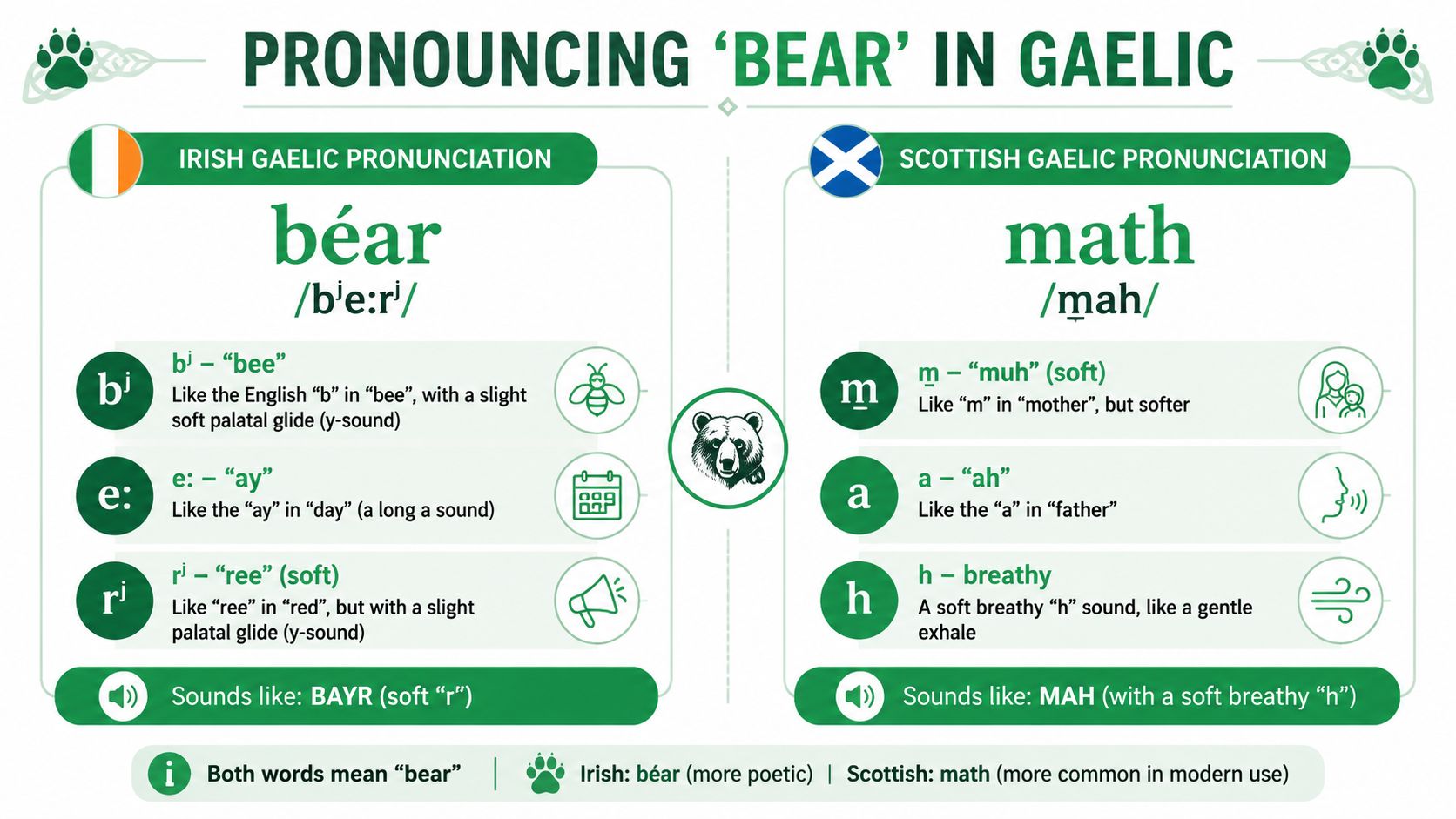
Most beginners don't struggle with the meaning of bear in Gaelic. They struggle with saying it without freezing. IPA helps, but only if you connect the symbols to sounds you already know.

A visual guide makes this much easier.

An infographic showing how to pronounce the word for bear in Irish and Scottish Gaelic languages.

If Gaelic sound systems still feel unfamiliar, this pronunciation overview on how Gaelic is pronounced gives broader listening support.

Saying béar in Irish

Use /bʲeːɾˠ/ as your guide.

Break it into pieces:

  • /bʲ/ sounds like a softened b
  • /eː/ is close to a long bay
  • /ɾˠ/ is a tapped or light r, not a heavy English pirate-style “rrr”

Try it slowly: bay-r. Then smooth it out so it becomes one clean unit: béar.

A common mistake is turning it into plain English “bear.” That gets close in meaning, but not in sound. The Irish vowel is cleaner and the final r is lighter.

Saying mathan in Scottish Gaelic

Use /ma.hən/ as your guide.

A practical beginner cue is:

  • ma like “ma” in “mama”
  • as a soft middle syllable, similar to the weak vowel in “sofa”
  • n light at the end

Say it in rhythm: MA-hun or MA-hən. Keep the first syllable clear.

Don't chase perfection on day one. Aim for a stable version you can repeat the same way every time.

Fast correction tips

Word Common mistake Better fix
béar Saying English “bear” unchanged Lengthen the vowel and lighten the r
mathan Stressing the second syllable too much Keep the stress near the start
both Reading spelling letter by letter Practice by chunking whole syllables

Record yourself if you can. Beginners improve fastest when they hear the gap between what they intended and what they said.

Beginner Example Sentences

Short sentences help you move from recognition to use. Don't wait until you know every grammar rule. A few safe patterns will carry you far.

Irish examples with béar

Try these first:

  • Is béar é.
    It is a bear.

  • Tá an béar mór.
    The bear is big.

  • Feicim béar.
    I see a bear.

These are useful because each one teaches a different frame. The first names the animal. The second describes it. The third puts it into an action sentence.

Scottish Gaelic examples with mathan

Now compare the Scottish Gaelic side:

  • ’S e mathan a th' ann.
    It is a bear.

  • Tha am mathan mòr.
    The bear is big.

  • Chì mi mathan.
    I see a bear.

You don't need to unpack every piece immediately. At beginner level, the key is noticing repeated sentence frames.

One idiom to remember

Older bear language still lives in idioms. In Irish, one example is Chuirfeadh sé othras ar mhathúin, meaning “It would sicken a bear.” The Scottish Gaelic tradition preserves a matching expression: chuireadh e an òrrais air math-ghamhainn.

That's useful because it shows how older words survive even when the everyday modern term changes.

Build your own flashcards with whole sentences. A card that says Tá an béar mór teaches grammar, pronunciation, and vocabulary at the same time.

A simple speaking drill

Use the same sentence frame and swap one word:

  1. Tá an béar mór.
  2. Tá an béar beag.
  3. Feicim béar.
  4. Ní fheicim béar.

Do the same in Scottish Gaelic with mathan. Even if your vocabulary is small, this kind of pattern drilling builds confidence fast.

Etymology and Cultural Notes

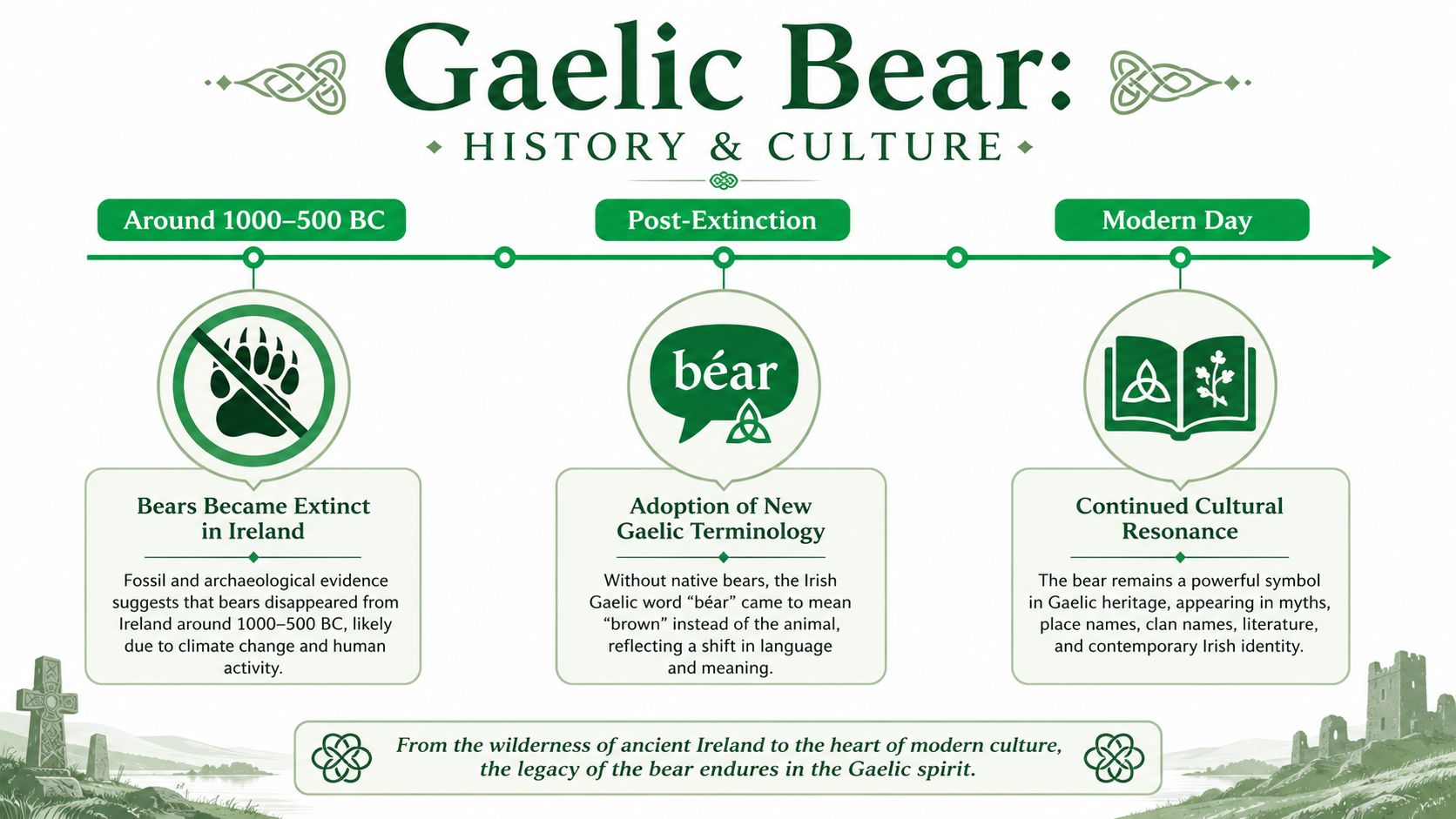
The history behind these words is unusually vivid because ecology shaped the language directly. In modern Irish, the word for bear is béar, an English loanword that replaced the older native mathghamhain, now mathúin. That older form means “the good calf,” and the shift happened because bears became extinct in Ireland between 1000 and 500 BC, which caused the original Gaelic word to fade from everyday use as the animal disappeared from daily life, as explained in this study of Irish bear vocabulary and extinction history.

The cultural layer is just as rich. Older Irish had multiple bear words, including art, math, and beithir, which tells you the animal mattered greatly in naming and imagination before it vanished from the wild.

An infographic detailing the history and cultural legacy of bears in ancient and modern Gaelic culture.

Bears in names and heroic language

The old noun art is especially interesting. It could mean both the animal and a hero or warrior, preserving a strong link between bear imagery and human strength. The name Art became a male given name, and related traditions appear across Gaelic and Norse naming.

The same semantic pattern survives in later vocabulary too. An Omniglot note on Celtic bear words explains that in modern Irish, béar also carries a secondary sense such as “tyrant,” “invader,” or “foreigner” in some semantic extensions tied to aggressive traits in the animal image, discussed in this entry on Celtic bear terminology.

Why this matters for learners

This is one of those moments where vocabulary becomes cultural memory. Irish didn't just “change a word.” It kept traces of older belief, naming, and metaphor even after the everyday term shifted.

If you enjoy seeing how animals carry symbolic meaning across systems, Chinese astrology and its cycles offers an interesting comparison. It's a different tradition, but it shows the same broad idea: animal terms often do cultural work far beyond literal description.

Practice Activities with Gaeilgeoir AI

Knowing béar and mathan is a good start. Being able to recall them under pressure is the ultimate goal. Practice works best when you cycle through recognition, speaking, and quick sentence building instead of staring at a list.

A young woman sits at a desk while practicing conversational Gaelic using a digital tablet.

Five drills that actually stick

  • Contrast drill: Say béar and mathan back to back until you stop mixing them up.
  • Phrase ladder: Build upward from one noun. Start with “bear,” then “the bear,” then “the big bear,” then “I see the big bear.”
  • Listening echo: Hear the word, pause, repeat it aloud, and copy the rhythm rather than each letter.
  • Idiom recall: Keep one cultural phrase, such as the “sicken a bear” idiom, as a memory hook.
  • Language switch practice: Alternate Irish and Scottish Gaelic every line so your brain learns the boundary clearly.

Roleplay makes vocabulary usable

A simple roleplay works better than passive review. Pretend you're at a wildlife park, in a museum, or reading a folktale to a friend. Then force yourself to describe what you see with the target word.

If you like AI-based scenario practice, Dunia AI roleplay insights give useful ideas for making roleplay sessions more natural and less repetitive. The same principle helps with language learning. You remember words better when they appear inside a situation.

A practical weekly routine

Keep it small and repeatable:

  1. Read both words aloud.
  2. Say one sentence in Irish.
  3. Say one sentence in Scottish Gaelic.
  4. Review the pronunciation once more.
  5. Test yourself without looking.

That kind of short loop is easier to keep than a long study session you'll avoid tomorrow.


For guided conversation practice, pronunciation support, and adaptive exercises that help you remember words like béar in real use, try Gaeilgeoir AI or jump straight into practice at learn.gaeilgeoir.ai.

Green in Gaelic: A Guide to Glas, Uaine, and Gorm

You're probably here because you've hit a very normal learner problem. You wanted to say “green” in Irish or Scottish Gaelic, looked it up, and found more than one answer. Then the answers didn't quite agree with each other.

That confusion isn't a sign that you're doing anything wrong. It's a sign that Gaelic languages slice up the world differently from English. If you learn the logic behind those choices, green in Gaelic stops feeling messy and starts feeling memorable.

Table of Contents

Why Is Green in Gaelic So Complicated

You stand in front of an Irish hillside, a wet field, a mossy stone wall, and a painted shop door, and English lets you call all of them “green.” Gaelic doesn't always do that. It asks a more specific question first.

In Irish, there isn't one all-purpose word that maps neatly onto the English word “green” in every situation. The language has long treated green as something with categories inside it. That's why learners often feel confident one minute and unsure the next.

Green in Gaelic makes more sense when you stop asking “What's the translation?” and start asking “What kind of green is it?”

That shift matters because Gaelic languages carry older ways of noticing the world. Natural surfaces, weathered shades, bright dyes, and vivid manufactured colors don't always belong in the same bucket. English tends to flatten those differences. Irish and Scottish Gaelic often keep them visible.

A helpful way to think about it is this:

  • English groups by broad color family. Grass, neon plastic, and traffic lights can all be “green.”
  • Irish often groups by type of green. Natural and artificial greens may call for different words.
  • Scottish Gaelic adds another twist. The word used for grassy vegetation may not be the one an Irish speaker would choose.

That's why green in Gaelic feels tricky at first. But there is logic here, and once you see it, the system becomes much easier to remember.

The Two Greens of Irish Gaeilge Glas and Uaine

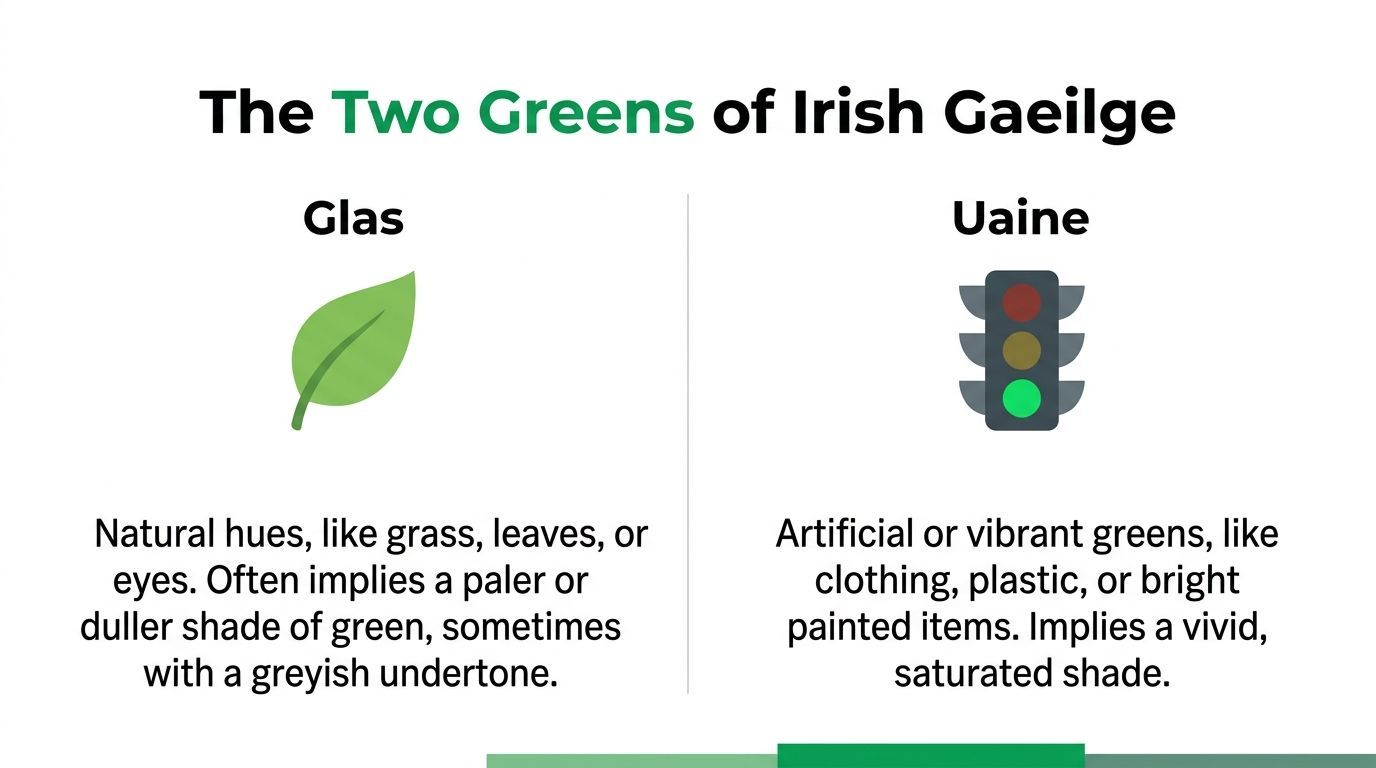
Irish gives learners two core words to work with: glas and uaine. A very reliable mental shortcut is nature's green versus man-made green.

The key fact is simple. The Irish language distinguishes green into two primary terms, glas and uaine, based on a natural-versus-artificial split that goes back to old linguistic roots. Glas is used for natural greens such as grass, leaves, and the sea, while uaine is used for vivid, artificial greens such as paint or dyed fabric, as explained in Preply's discussion of Irish color terms.

A diagram explaining the distinction between the words Glas and Uaine for the color green in Irish.

A simple mental model

If the color feels like it belongs outdoors, growing by itself, glas is often the right instinct.

Examples:

  • féar glas for green grass
  • leaves described with glas
  • the sea in contexts where English might say greenish, grey, or blue-green

If the color looks vivid, painted, dyed, plastic, or deliberately bright, uaine is usually the better choice.

Examples:

  • a painted wall
  • a bright green jumper
  • a traffic light

Beginners often slip, assuming the difference is only about brightness. Brightness can matter, but the more memorable test is origin. Ask yourself whether the object feels natural or manufactured.

Practical rule: If you can picture it growing in a field, try glas first. If it came from paint, fabric dye, plastic, or electric light, try uaine.

How to hear the difference

You don't need perfect pronunciation on day one, but a rough guide helps.

  • glas sounds close to “gloss,” though the Irish sound is its own thing
  • uaine is often pronounced roughly like “OO-an-yeh” or “WEN-yeh”

A few easy pairs make the contrast stick:

  • féar glas = green grass
  • péint uaine = green paint
  • solas tráchta uaine = green traffic light

If you enjoy comparing colors across the language, this guide to orange in Irish is a useful companion because it shows that color vocabulary often carries cultural logic, not just dictionary logic.

One more detail matters for advanced learners. Glas can stretch beyond what English calls green. It may also lean toward greyish or pale green depending on context. That wider range is one reason literal word-for-word translation can feel unreliable at first.

How Scottish Gaelic Gàidhlig Handles Green

Scottish Gaelic looks familiar at first, then surprises you.

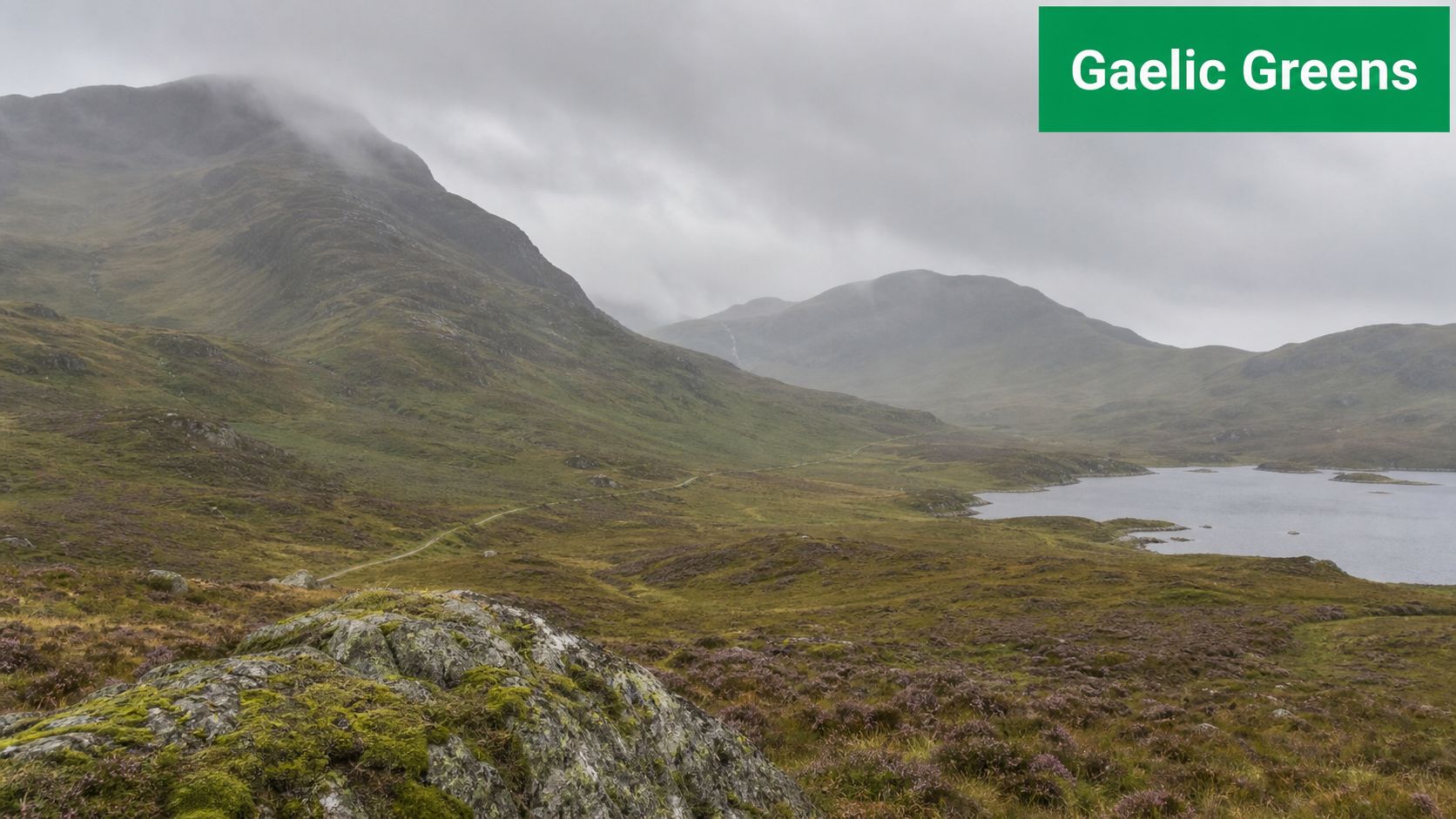
A scenic landscape in the Scottish Highlands with rolling green hills, a cloudy sky, and a lake.

If you learned that Irish uses glas for natural green and uaine for vivid artificial green, you might expect Scottish Gaelic to do the same. It partly does, but not fully.

According to The Bottle Imp's explanation of Gaelic place-name color words, Scottish Gaelic uses a more complex three-part pattern. Gorm is the standard technical term for verdant vegetation such as feur gorm for green grass, glas refers to grey or pale greyish-green, and uaine is reserved for bright, artificial greens.

The Scottish Gaelic pattern

Here's the core contrast:

  • Irish: natural green often points to glas
  • Scottish Gaelic: grassy, growing green often points to gorm
  • Both languages: bright, artificial green can point to uaine

That means an Irish learner can easily misread a Scottish phrase. You see gorm, think “blue,” and miss the fact that in this context it can describe lush vegetation.

If you're studying both languages, this comparison of Irish vs Scottish Gaelic differences helps sort out where the systems line up and where they clearly don't.

Why learners mix them up

The trap is understandable. English trains you to expect a stable color label. Gaelic doesn't always offer that stability across related languages.

A Scottish speaker may use gorm where an Irish speaker would never do so. A learner who memorizes single-word glosses like “gorm = blue” ends up confused by real usage. The better approach is to memorize phrases with context:

  • feur gorm in Scottish Gaelic
  • féar glas in Irish
  • uaine for bright artificial green in both systems

This short video gives extra context on how these kinds of differences show up in Gaelic learning:

Grammar in Action Using Green Adjectives

Knowing the right color word is only half the job. You also need to place it properly in a sentence.

Rule one adjectives come after the noun

In Irish, adjectives usually come after the noun. English says “green shirt.” Irish structure says “shirt green.”

So you'll see patterns like:

  • léine uaine for a green shirt
  • féar glas for green grass
  • bád glas for a green boat

This is one of the first habits worth building. Don't translate word order from English. Learn the noun-and-then-adjective rhythm instead.

A focused guide to mastering adjectives in Irish is helpful if you want more practice after reading these examples.

Rule two lenition changes the adjective

The next hurdle is lenition, or séimhiú. This is the softening change that adds an h after the first consonant in certain contexts.

That's why:

  • bád glas stays as it is
  • cathaoir ghlas shows the changed form ghlas

You don't need every grammar rule at once. For now, notice the pattern. The adjective may change shape depending on the noun that comes before it.

Your goal at first isn't to master every mutation rule. It's to get comfortable seeing both glas and ghlas as forms of the same adjective.

This matters even more because glas isn't a narrow color label. As discussed in Greater Govanhill's article on the meaning of glas, the word functions as a broader chromatic umbrella in Irish and Scottish Gaelic, covering both grey and pale green depending on context. That's why a phrase with glas sometimes needs interpretation, not automatic translation.

Quick Guide to Green in Gaelic

Word Language Meaning / Context Example
glas Irish natural green, often softer or greyish in feel féar glas
uaine Irish vivid or artificial green léine uaine
gorm Scottish Gaelic verdant vegetation, especially grass feur gorm
glas Scottish Gaelic grey or pale greyish-green descriptive landscape usage
uaine Scottish Gaelic bright artificial green vivid painted or dyed objects

A few copyable sentence frames help:

  • Tá bád glas agam.
  • Tá léine uaine uirthi.
  • Chonaic mé cathaoir ghlas.

You don't have to produce perfect Irish instantly. Start by spotting the adjective after the noun, then notice whether lenition appears. That combination will take you a long way.

More Than a Color Idioms and Cultural Notes

The story of green in Gaelic isn't only about vocabulary. It's also about identity, land, symbolism, and the small arguments learners remember for years.

A scenic landscape featuring a lush green field filled with white clover leading to historic ruins.

The flag question learners always ask

Sooner or later, someone asks which green belongs to the Irish flag. Is it glas or uaine?

That question doesn't have a neat answer. The symbolism points one way, and the physical object points another. As noted in this discussion of Irish flag colour terminology, the contradiction persists because the flag represents the natural scenery, which suggests glas, but its emerald shade is vibrantly artificial, which suggests uaine. The same source says this nuance remains unaddressed in 90% of cultural articles.

The flag debate is useful because it shows that language isn't just about objects. It's also about how speakers frame those objects.

That's why the question sticks in learners' minds. It captures the whole lesson in one symbol. Are you naming the land the flag stands for, or the dyed material you can physically see?

Green as identity and symbol

Irish culture gives green enormous emotional weight. The natural scenery, national imagery, and popular symbolism all pull the color into public life. That's one reason the vocabulary matters so much to learners. This isn't just a textbook color card.

If you enjoy the wider meanings colors pick up in public identity and design, WaveGen's piece on Unlocking brand power with color is a useful side read. It isn't about Irish specifically, but it helps explain why colors carry stories far beyond their visual shade.

A practical takeaway is to stay flexible. In cultural discussion, people may simplify and say “green” in English without unpacking the Irish nuance. In Irish, though, the distinction can still matter.

Start Your Gaelic Journey Today

If green in Gaelic felt confusing before, you've now got a much stronger mental map. In Irish, the useful contrast is glas for the natural world and uaine for vivid manufactured green. In Scottish Gaelic, gorm adds a distinctive extra category for verdant vegetation.

That kind of insight changes how you learn vocabulary. You're not just memorizing labels. You're learning how Gaelic speakers sort the world.

Screenshot from https://gaeilgeoir.ai

If you want to turn that understanding into actual speaking practice, Gaeilgeoir AI is built for that next step. The platform immerses learners in the 1,000 most common Irish words and lets users click any word to see translations and save it to a personalised study list, as described in this overview of Gaeilgeoir AI's learning approach.

It's a good fit if you want flexible practice instead of waiting for the perfect study session. You can build confidence through guided conversation, real-world scenarios, and repeated exposure to the vocabulary that matters most.

Do not allow pingbacks or comments.


A CTA for Gaeilgeoir AI. If you're ready to move from memorizing words like glas, uaine, and gorm to using them in conversation, start with Gaeilgeoir AI.

Light in Scottish Gaelic: Solas or Aotrom?

You're probably here because you typed something like “how do you say light in Scottish Gaelic?” and got an answer that felt incomplete. One page said solas. Another hinted at aotrom. If you're an English speaker, that's confusing because English uses one word for two very different ideas.

That confusion is one of the most useful entry points into Scottish Gaelic. Once you see why Gaelic separates these meanings, the language starts to feel sharper, more logical, and often more expressive than a straight word-for-word translation suggests. For anyone exploring light in Scottish Gaelic, this is one of the first distinctions worth getting right.

Table of Contents

The Challenge of Translating Light

A learner once asked me how to describe “the light in the room” and then, in the same breath, “a light bag.” In English, both are simple. In Scottish Gaelic, they split apart immediately.

That split is a gift, not a problem. It forces you to say what you mean. Are you talking about brightness, daylight, lamp light, and glow? Or are you talking about something that isn't heavy?

Scottish Gaelic is also being learned and reclaimed by more people again. According to the 2022 Scotland Census summary discussed by SPICe Spotlight, 130,161 people had some Gaelic language skills, up from 87,000 in 2011. That rise matters because it shows renewed interest in using and understanding the language, including the kind of basic but essential vocabulary question that brings many learners here.

Why translation needs context

A dictionary often gives the illusion that every English word has one tidy equivalent. Gaelic doesn't always work that way, and English is often the less precise language in the pair.

If you've ever worked with translated writing, this is why context checks matter. A phrase can be technically translated and still miss the actual meaning. That's also why broader editorial practices like this guide for authors on multilingual publishing quality are so useful. They remind writers to test meaning, not just match words.

A good translation answers the intended meaning first, then chooses the vocabulary.

For light in Scottish Gaelic, the intended meaning is everything. Once you know which kind of “light” you want, the right Gaelic word becomes much easier to remember.

The Two Kinds of Light Solas vs Aotrom

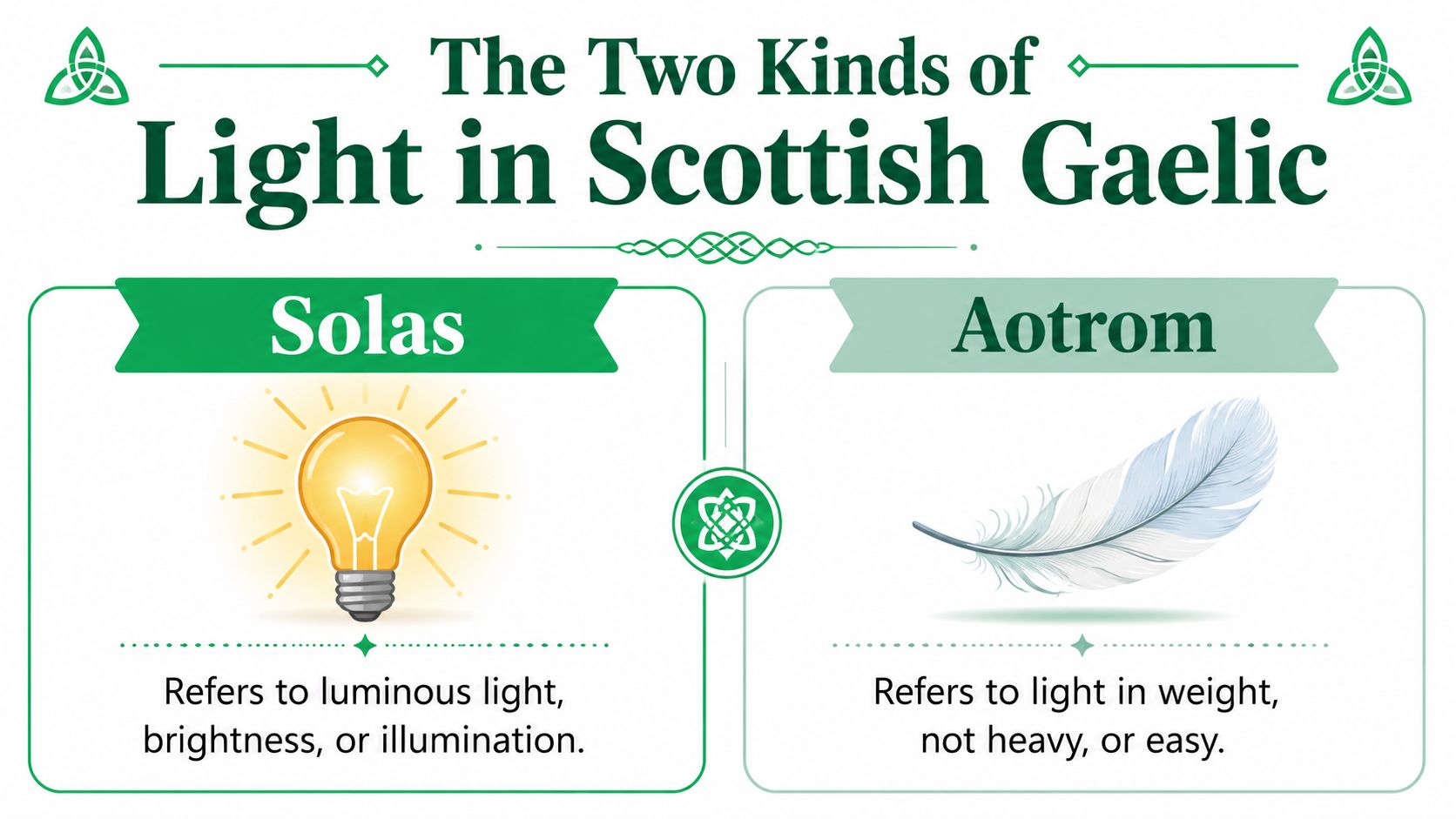
The core rule is simple. Solas means light as illumination. Aotrom means light as not heavy.

That distinction is built into the language itself. The WordHippo entry on the Scottish Gaelic word for light identifies solas as the primary Gaelic term for illumination, inherited from Old Irish, while aotrom refers to the physical property of lightness in weight. For learners, that's the line to keep in your head.

An infographic explaining the two meanings of light in Scottish Gaelic using the terms Solas and Aotrom.

Why English causes the mix-up

English asks one word to do too much. We say:

  • the light from the sun
  • a light jacket
  • a light touch
  • a light colour

Gaelic usually wants you to be clearer.

Use solas when the idea is brightness or illumination. Think of sunlight through a window, a lamp in a room, or a glow in the dark. Use aotrom when the idea is low weight, ease, or something physically light to carry.

Some learners overcorrect and start using solas anytime the English word “light” appears. That's the most common beginner mistake. If you mean “not heavy,” solas is wrong.

Solas vs. Aotrom A Quick Guide

Concept Gaelic Word Meaning English Example
Illumination solas light, brightness, glow “The light is bright.”
Weight aotrom light, not heavy “The bag is light.”

A quick memory trick helps. Solas belongs with things that shine. Aotrom belongs with things you lift.

Here are a few plain examples:

  • Solas: the light in the kitchen, morning light, candlelight
  • Aotrom: a light box, a light coat, a light step

Practical rule: If you could replace “light” with “bright” or “illumination,” choose solas. If you could replace it with “not heavy,” choose aotrom.

There's another helpful cultural link here. Learners who enjoy related vocabulary often like exploring nearby terms such as fire, glow, and warmth. If that interests you, this note on fire in Scottish Gaelic pairs well with the distinction between solas and other light-related words.

Pronunciation Guide Sounding Natural

You hear someone say solas in a song, then meet aotrom in a lesson, and suddenly English has led you into a trap. Both words get translated as “light,” but they do not sound alike, and they do not belong to the same idea. Training your ear to keep them apart is part of sounding natural in Gaelic.

A good first goal is clear, steady pronunciation. Native-like polish can come later. If speaking aloud makes you hesitate, LenguaZen's language confidence tips are indeed useful for building the habit of saying words before you feel fully ready.

How to say solas

Solas is usually said roughly like:

  • SO-luss
  • stress the first syllable
  • keep the ending short and light

For many English speakers, the first vowel is nearer the sound in “off” than the “oh” in “go.” The word should feel compact. If you stretch it into “soh-lass,” it starts to sound less Gaelic and more like an English guess based on spelling.

The good news is that solas is often easier for beginners because the rhythm is straightforward. Put your energy into a clear first syllable, then let the second fall away quickly.

How to say aotrom

Aotrom often causes more trouble because the spelling invites the wrong instincts. A learner-friendly approximation is:

  • AY-trum or EE-trum, depending on accent
  • keep the second syllable brief
  • do not try to pronounce every written vowel one by one

English readers often want to say something like “ow-trom.” That is the spelling trap at work. Gaelic spelling records older sound patterns and sound relationships, not neat English-style letter-by-letter pronunciation. If you want a wider foundation for that system, this guide to how Gaelic is pronounced explains the broad patterns well.

Here is a helpful way to practise the pair. Say solas while looking at a lamp or a window. Say aotrom while picking up a bag or book. One word belongs to brightness. The other belongs to weight. Linking sound to a physical image helps many English-speaking learners stop mixing them up.

Practise them as a contrast pair: solas, something that shines; aotrom, something that is easy to carry. Your ear learns the meaning difference faster when your mouth repeats the sound difference too.

Gaelic Grammar in Action Using Light in Sentences

A beginner often reaches this stage and hits a strange problem. You know that solas means light and aotrom means light, but the sentence forces you to choose what kind of light you mean.

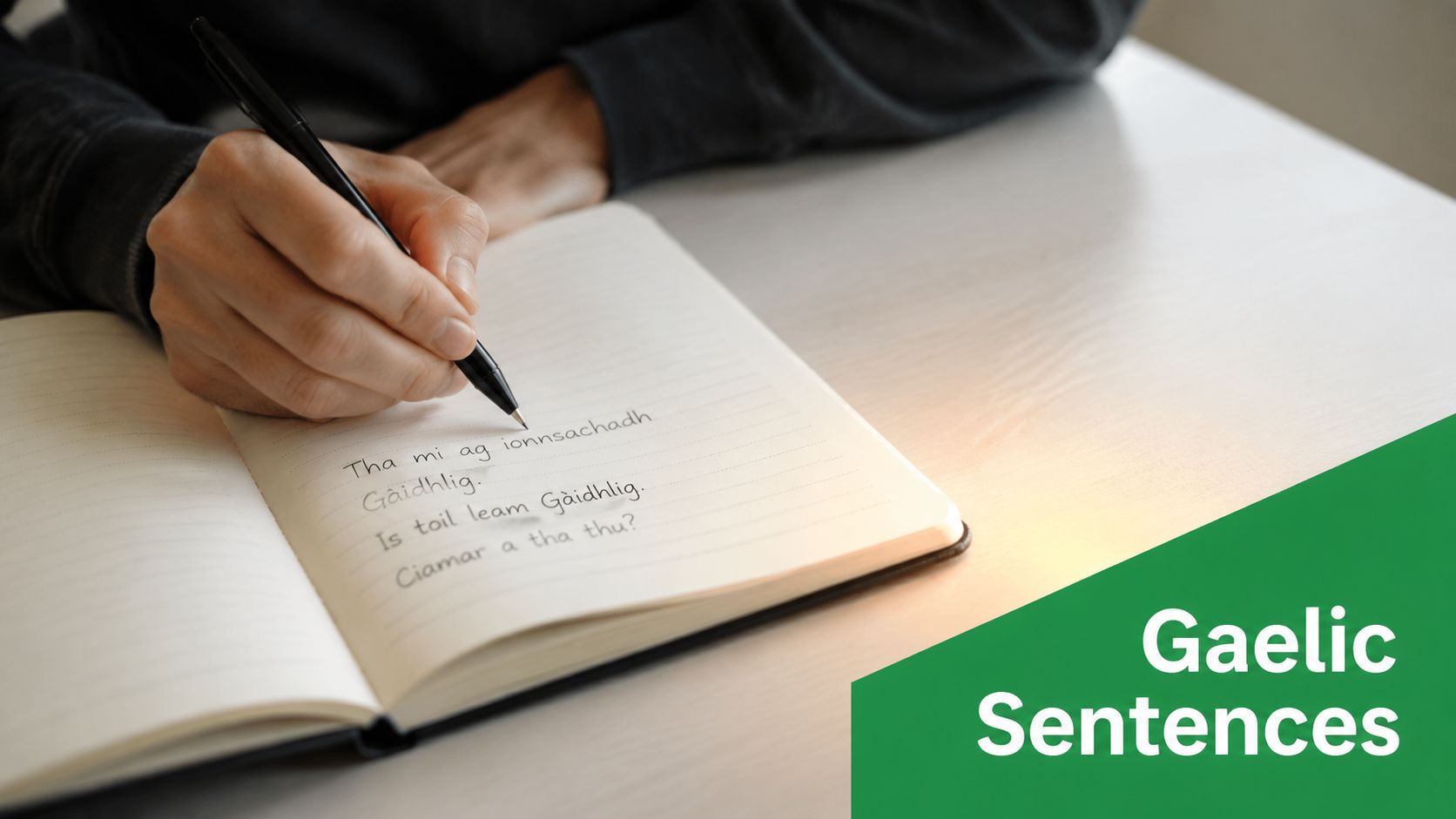
A person writes Scottish Gaelic phrases into a notebook on a bright desk with green corner overlay.

That is where grammar starts to help rather than confuse. Scottish Gaelic usually builds a simple statement in a different order from English, so the word for light has to sit inside a new sentence pattern. For an English speaker, it can feel like rearranging furniture in a familiar room. The pieces are the same, but the layout changes.

Sentence order changes the feel

English often begins with the subject:

  • The light is bright.
  • The bag is light.

Gaelic commonly begins with the verb:

  • Tha an solas soilleir.
  • Tha am poca aotrom.

The key word here is tha, the usual present-tense form for “is” or “are” in this kind of statement. After that comes the thing you are talking about. So an solas is “the light,” and am poca is “the bag.”

Beginners sometimes try to translate English word by word, but Gaelic resists that. If you start with “the light” because English does, your sentence can sound awkward even when every individual word is correct.

The two meanings behave differently in sentences

Here is the confusion many guides skip. Solas is a noun. It names a thing, the light itself. Aotrom is usually an adjective. It describes something, such as a bag, coat, or step.

That difference shapes the whole sentence.

  • Tha an solas làidir.
    The light is strong.

  • Tha am baga aotrom.
    The bag is light.

In the first sentence, solas is the subject. In the second, aotrom is describing baga. If you remember only one grammar point from this section, remember this one. Solas usually names brightness. Aotrom usually describes low weight.

Why words sometimes change shape

Gaelic also changes the beginning of words in certain grammatical settings. English learners often see this and assume they have met a brand-new word. Usually, they have not.

With solas, you may meet sholas in some contexts. The core meaning is still the same. The opening has shifted because Gaelic grammar marks relationships directly on the word.

A few steadying reminders help here:

  • Learn solas and aotrom first in their basic dictionary forms.
  • Treat changes at the start of a word as grammar signals.
  • Keep asking what job the word is doing in the sentence.

That last habit saves a lot of confusion.

Three examples to read slowly

  1. Tha an solas soilleir.
    The light is bright.

  2. Tha am poca aotrom.
    The bag is light.

  3. Chunnaic mi solas.
    I saw a light.

Read them as patterns, not as isolated facts to memorise. In sentence 1, solas is a thing you can see. In sentence 2, aotrom is a quality of the bag. In sentence 3, solas appears again as the object of the verb.

Many English-speaking learners improve quickly once they stop asking “What is the Gaelic word for light?” and start asking “Do I mean brightness or low weight?” That small shift leads to better grammar, better word choice, and much more natural Gaelic.

Poetic and Idiomatic Light Cultural Expressions

Literal meaning gets you through a sentence. Cultural meaning gives the language its texture. Gaelic often uses light not only for brightness, but also for atmosphere, feeling, and resonance.

A scenic view of rolling Scottish Highlands with mist settling in a valley at sunset.

Light as mood and meaning

When learners first meet solas, they often treat it as a simple utility word. But words for light in Gaelic can carry emotional colour. Light can suggest welcome, warmth, guidance, or a break in harsh weather. Even when a phrase is plain, the associations are often richer than an English beginner expects.

That helps explain why many learners eventually want more than a dictionary answer. They start with “How do I say light?” and then want to know how the word feels in songs, stories, and descriptions of scenery.

Aingeal and the edge of fire

One especially interesting word around this semantic field is aingeal, noted in cultural discussions as a term connected with fire/light. The idea has gained attention among learners, and the TikTok discussion linked here reflects growing interest in poetic and culturally layered Gaelic vocabulary rather than only basic textbook terms.

What matters for a beginner is not memorizing every rare word. It's realizing that Gaelic often preserves links between light, fire, glow, and lived environment.

A few healthy habits help here:

  • Learn the basic term first: Keep solas secure before reaching for poetic alternatives.
  • Treat cultural words with care: Some are vivid and memorable, but less universal in everyday conversation.
  • Notice semantic neighborhoods: In Gaelic, meaning often spreads across nature, weather, hearth, and storytelling.

If solas is the practical word you need for daily speech, words like aingeal remind you that Gaelic also stores old ways of seeing the world.

That poetic edge is one reason so many people stay with the language after the beginner stage.

A Bridge to Irish How Gaelic Light Compares

A beginner often meets a comforting surprise here. If you learn solas in Scottish Gaelic, you already have a word that looks very familiar in Irish. The same is true with aotrom and Irish éadrom. The family resemblance is real, and it can make the two languages feel less distant.

That said, this similarity helps most when you keep the two meanings of English light clearly separated. In both languages, one word belongs to illumination and another belongs to weight. Scottish Gaelic uses solas for light you see, and aotrom for something light to carry. Irish follows the same pattern with solas and éadrom. For an English speaker, that parallel is useful because it confirms that the distinction is not a Scottish Gaelic quirk. It is a basic part of how both Gaelic languages organize meaning.

Screenshot from https://gaeilgeoir.ai

If you want to see how these close cousins differ in spelling, sound, and grammar, this guide to Irish vs Scottish Gaelic differences is a helpful next read.

Irish also faces a visibility problem online. As of April 2024, RTÉ Brainstorm reported that English dominates websites with known content languages, while Irish appears on only a very small share. For learners, that means fewer chances to bump into the language naturally during everyday browsing.

Accessible tools matter for exactly that reason.

One useful response is practice built around common words and repeated exposure. Gaeilgeoir AI teaches through the 1,000 most-used Irish words, with guided scenarios that help learners hear, read, and use Irish in practical contexts. If Scottish Gaelic has sparked your interest in the wider Gaelic world, it offers a clear way to start building active Irish alongside that curiosity.

If you'd like to turn that curiosity into regular speaking practice, Gaeilgeoir AI is a smart place to start. It helps learners build usable Irish from day one with guided conversation, pronunciation support, adaptive review, and scenario-based practice that fits real life.

Gaelic Snow: Your Guide to Irish & Scottish Words

Most advice on Gaelic snow starts in the wrong place. It jumps straight to myth, or it throws out a single translated word and leaves you to sort out the rest.

That's why people stay confused.

If you searched for “Gaelic snow,” you probably weren't looking for one neat cultural term. You were likely looking for one of two things. First, the actual words for snow in Irish and Scottish Gaelic. Second, the winter folklore that surrounds snow, especially the figure of the Cailleach. Those are related, but they aren't the same thing.

This guide keeps them separate so they make sense. You'll see where the search term comes from, how the folklore works, how the language differs between Irish and Scottish Gaelic, and how to start saying simple snow-related phrases aloud without getting stuck on spelling.

Table of Contents

What Is Gaelic Snow

Gaelic snow isn't really a fixed traditional term. It's a search phrase people use when they're trying to find their way into Gaelic language and winter culture.

That matters, because the answer depends on what you meant.

Some readers mean, “What is the Gaelic word for snow?” Others mean, “What does snow symbolize in Gaelic folklore?” And many are looking for the winter figure called the Cailleach, because search results often point there rather than to a separate concept called “Gaelic snow,” as noted in the Cailleach overview.

Why the phrase causes confusion

“Gaelic” itself can blur things. People use it loosely in English to refer to Irish, Scottish Gaelic, and sometimes older cultural material tied to both. So when someone types “Gaelic snow,” they may be asking about:

  • Irish language vocabulary such as the Irish word for snow
  • Scottish Gaelic vocabulary and how it differs in spelling and sound
  • Folklore and seasonal belief linked with winter weather
  • Modern retellings that blend Irish, Scottish, and Manx traditions together

That mix is where the confusion starts.

Practical rule: When you see “Gaelic snow,” separate the question into language and folklore. The language gives you words. The folklore gives you meaning.

A winter figure across Gaelic traditions

Once you make that split, the topic becomes much easier to understand. In language, you're dealing with vocabulary and pronunciation. In folklore, you're dealing with symbols, stories, and the way people once understood the turning of the seasons.

Snow, in that older worldview, isn't just weather. It belongs to winter's order. It signals a season with its own powers, moods, and stories.

That's why the Cailleach appears so often in results for this topic. She stands at the meeting point of storm, cold, land, and season. If you came looking for “Gaelic snow,” you weren't wrong. You were just one step away from the clearer question.

The Cailleach Gaelic Folklore's Queen of Winter

The strongest folkloric answer to Gaelic snow begins with the Cailleach. She appears across Irish, Scottish, and Manx tradition as a pan-Gaelic winter figure connected with storms, winter, and the shaping of the natural world. Modern summaries describe her as a divine hag, and her name means “old woman” or “hag” in Gaelic. Her seasonal rule is often placed from Samhain on 1 November to Imbolc on 1 February, according to Historic Environment Scotland's summary of the Cailleach.

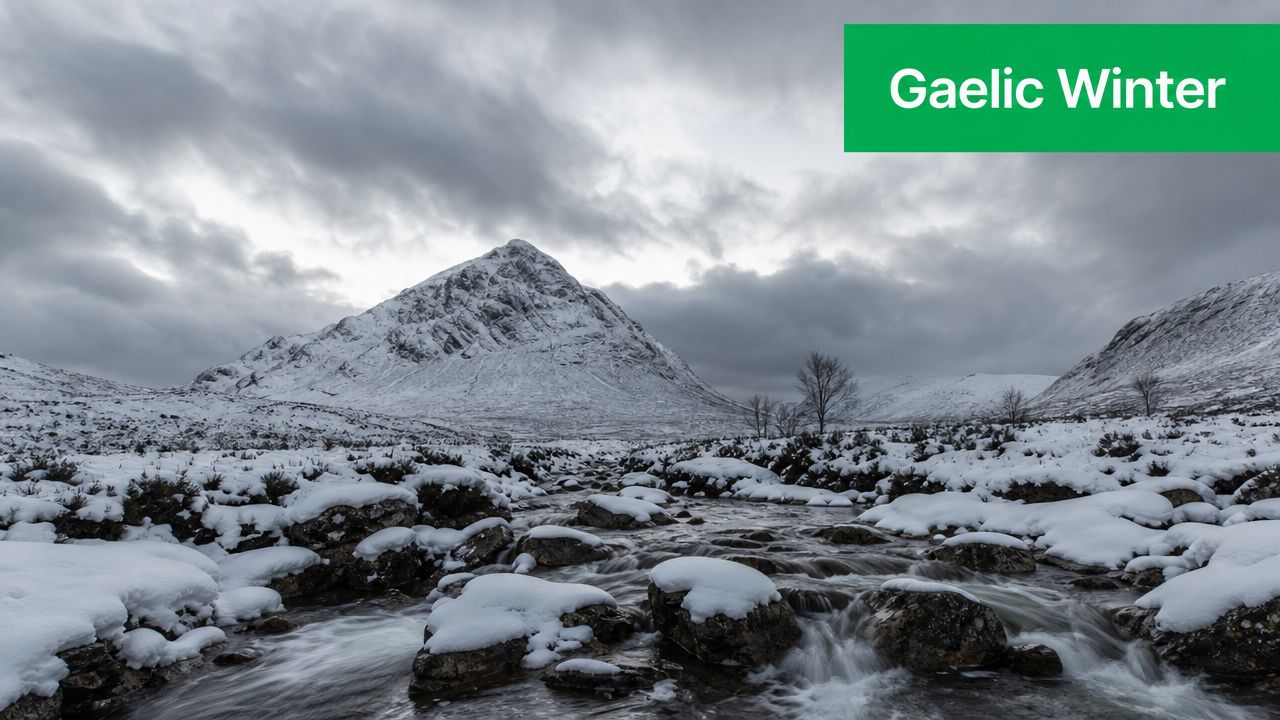
A snow covered mountain landscape in Scotland with a flowing stream in the foreground under cloudy skies.

A winter figure across Gaelic traditions

For a beginner, the easiest way to understand the Cailleach is to think of her as winter made personal. Not a snow goddess in a narrow sense, and not a simple villain either. She belongs to the hard side of the year. Wind, storm, frozen ground, and mountain wildness all gather around her.

In folklore, winter often needs a face. The Cailleach provides that face.

She can seem harsh because winter is harsh. But she's also tied to creation. Stories connect her not only with destructive weather, but with the making of hills, rocks, and the terrain. That combination is important. In Gaelic tradition, the forces that challenge people can also shape the world they live in.

Why people link her with snow

Many readers searching for Gaelic snow expect a word list and instead find stories. That happens because snow in Gaelic tradition isn't only something you measure outside your door. It can also be read as a sign that winter's ruler is present.

That doesn't mean every snow reference in Ireland or Scotland is automatically about the Cailleach. It means she gives a cultural frame for winter weather. In storytelling terms, she turns cold into narrative.

Snow in these traditions often feels less random than in modern weather talk. It belongs to a season with character, memory, and ritual markers.

If you're coming from modern fantasy, it's tempting to treat the Cailleach like a single fixed character with one official story. Folklore doesn't work that way. Names, details, and emphasis shift by region and retelling. The shared thread is her association with winter power.

For learners, that's the key point to keep. When people mention Gaelic snow in a cultural sense, they usually mean the snowy world associated with the Cailleach, not a separate doctrine or named belief system.

Irish vs Scottish Gaelic Words for Snow

Once the folklore is clear, the language becomes much easier to learn. The most useful beginner fact is simple. Irish and Scottish Gaelic are related languages, so their words for snow look similar, but not identical.

The core vocabulary

Here is the side-by-side comparison most readers are looking for.

Concept Irish Gaelic (Gaeilge) Phonetic Pronunciation Scottish Gaelic (Gàidhlig) Phonetic Pronunciation
Snow sneachta SNYAKH-tuh sneachd SNYEKH-gk
Snowy sneachtúil SNYAKH-tool sneachdach SNYEKH-dukh
Snowflake calóg shneachta kuh-LOHG HNYAKH-tuh snowflake expressions vary by usage pronunciation varies by region
Blizzard cuirleasc KIR-lyask usage varies by speaker and region pronunciation varies by region

A quick warning. Pronunciation guides in English are only rough helpers. Gaelic sounds don't map neatly onto English spelling, so your ear matters more than any phonetic shortcut on the page.

What beginners should notice first

Start with the visual resemblance:

  • Irish: sneachta
  • Scottish Gaelic: sneachd

They clearly belong to the same language family. The opening sound is close. The ending is where learners usually feel the difference.

Irish sneachta often looks longer and softer on the page. Scottish Gaelic sneachd looks tighter and more compact. If you already know even a little Irish spelling, Scottish Gaelic can seem abrupt at first. If you started with Scottish Gaelic, Irish may look like it has extra letters hanging off the end.

That's normal.

Similar roots, different habits

The biggest mistake beginners make is assuming the languages are interchangeable. They aren't. A word may be related across both languages, but each language has its own spelling habits, grammar, and everyday phrase patterns.

Here's a simple way to understand it:

  • Irish often feels familiar to learners in Ireland because of school exposure, road signs, and media.
  • Scottish Gaelic may look close enough to guess from, but those guesses can easily go wrong.
  • Related doesn't mean identical.

If you're learning one Gaelic language, let the other help your curiosity, not control your spelling.

Another point of confusion is the label itself. In English, people say “Gaelic” and expect one answer. In practice, you'll get better results if you ask, “What is the Irish word for snow?” or “What is the Scottish Gaelic word for snow?”

That one small change makes dictionaries, lessons, and pronunciation practice much more accurate.

Using Snow Words in Everyday Phrases

Vocabulary only sticks when you use it. A learner who knows sneachta or sneachd but never says a full sentence will forget the word quickly.

The goal isn't poetic perfection. The goal is to make the word feel usable.

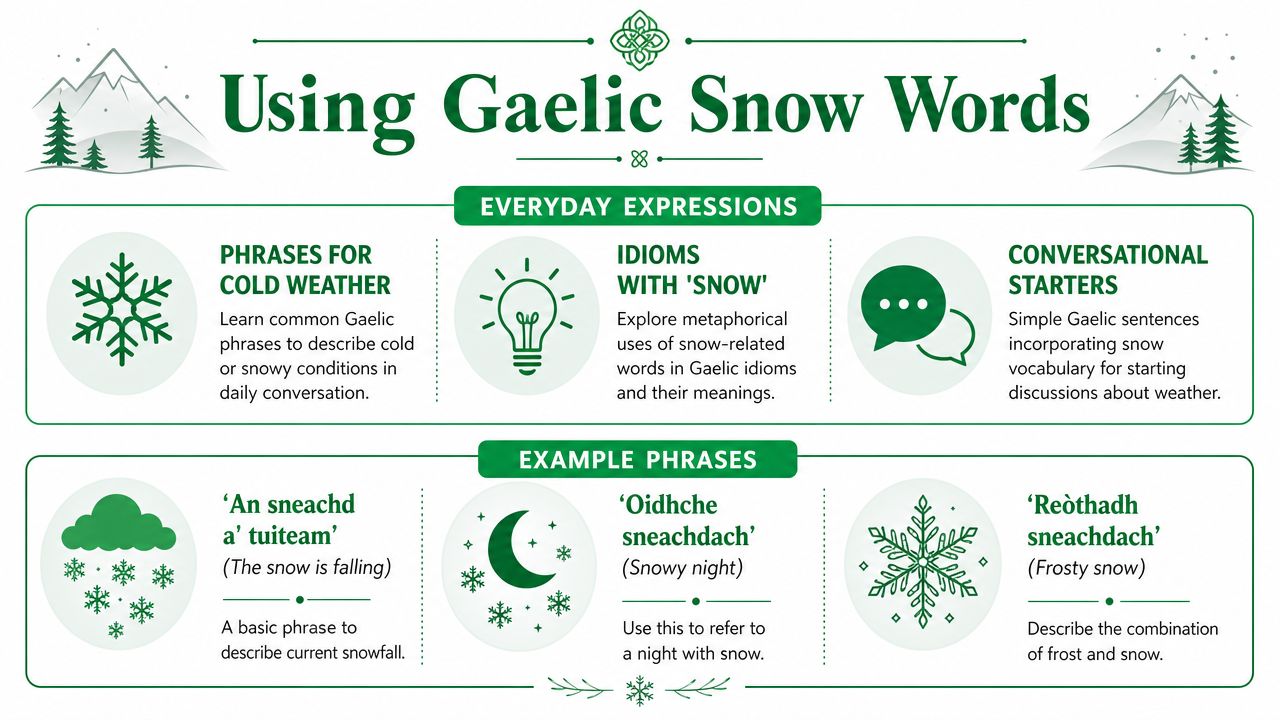
An infographic titled Using Gaelic Snow Words, showcasing common phrases and examples with thematic winter icons.

Simple Irish examples

Here are some beginner-friendly Irish phrases built around sneachta.

  • Tá sé ag cur sneachta
    It is snowing.
    Rough sound: taw shay egg kur SNYAKH-tuh

  • Tá an sneachta trom
    The snow is heavy.
    Rough sound: taw un SNYAKH-tuh trum

  • Oíche sneachtúil
    A snowy night.
    Rough sound: EE-heh SNYAKH-tool

  • Calóg shneachta
    A snowflake.
    Rough sound: kuh-LOHG HNYAKH-tuh

Use these in very short speaking drills. Say the Irish. Pause. Say the English. Then go back to the Irish again.

Simple Scottish Gaelic examples

Here are parallel Scottish Gaelic-style practice phrases using sneachd.

  • An sneachd a' tuiteam
    The snow is falling.

  • Oidhche sneachdach
    Snowy night.

  • Reòthadh sneachdach
    Frosty snow.

These are useful because they pair weather vocabulary with common descriptive patterns. Even if you don't fully understand every grammar point yet, you start recognizing how winter words sit inside real phrases.

How to make phrases stick

Don't memorize long lists. Work with small clusters.

Try this pattern:

  1. Pick one noun such as sneachta or sneachd.
  2. Add one weather action such as “is falling” or “is snowing.”
  3. Add one description such as “heavy” or “snowy.”
  4. Say the phrase aloud several times over the day.

A beginner practice set might look like this:

  • snow
  • it is snowing
  • snowy night
  • heavy snow

That's enough for one session.

Short phrases beat isolated words because your mouth learns the rhythm, not just the spelling.

You can also turn weather into conversation starters. Ask what the sky looks like. Describe the road. Mention the cold morning. Weather vocabulary works well because it belongs to daily life, and it gives you an easy reason to repeat the same forms often.

Regional Nuances and Seasonal Traditions

A lot of frustration comes from expecting one standard sound for every Gaelic word. In real life, pronunciation shifts by place, speaker, and local habit.

That's true for snow words too.

Pronunciation changes by region

If you hear sneachta from different Irish speakers, the broad shape stays recognizable, but the exact sound can move. The same is true in Scottish Gaelic. A learner might hear one speaker soften a final sound while another gives it more force.

This isn't a problem to solve. It's part of how living languages work.

A good beginner habit is to listen for the stable part of the word first. With snow vocabulary, that usually means the opening sound and the core word shape. Don't panic over every regional variation. You're aiming for recognition, then confidence, then finer detail.

Here's a simple order of attention:

  • First: Can you recognize the word when you hear it?
  • Next: Can you say it clearly enough to be understood?
  • Later: Can you adjust toward a regional accent you want to follow?

That order saves a lot of stress.

Snow in the Gaelic seasonal calendar

The deeper cultural layer appears in seasonal tradition. In some Scottish accounts, the first snow is described as the Cailleach laying her cape across the land. Her reign ends at Imbolc on 1 February, while some traditions place winter's final retreat at La Fheile Cailleach on 25 March, according to this discussion of the Cailleach and Imbolc in Gaelic seasonal tradition. If you want more background on that seasonal turning point, this short guide to Imbolc in Irish tradition is a useful companion.

That image of the cape matters because it shows how people can speak about weather through story. The first snow isn't only frozen water falling from the sky. It becomes a sign that winter has spread itself over the ground.

This also explains why snow can feel symbolically ordered in Gaelic tradition. It belongs to a known cycle of arrival, rule, and retreat.

When you connect the snow word to the season calendar, the folklore stops feeling decorative. It starts feeling practical, like a way of reading the year.

How to Practice Your Gaelic Pronunciation

Knowing a snow word on the page isn't the same as being able to say it without hesitation. Gaelic spelling carries sound information, but beginners often can't hear that information yet.

That's normal. Pronunciation comes from repetition tied to listening.

Screenshot from https://gaeilgeoir.ai

Train your ear before your mouth

Start by listening to one word and one short phrase. Don't jump between ten versions at once.

For example, choose:

  • sneachta
  • Tá sé ag cur sneachta

Listen several times before speaking. Then copy the rhythm, not just the consonants. Most learners focus too hard on individual letters and miss the music of the phrase.

A second helpful move is to record yourself. You don't need studio quality. A phone recording is enough. When you listen back, ask simple questions. Did the word sound rushed? Did you flatten the ending? Did the phrase flow, or did it sound like separate blocks?

Build a short repeatable routine

A useful pronunciation routine should be short enough that you'll do it.

Try this:

  1. Listen once for gist
    Just hear the whole phrase.

  2. Listen again and shadow
    Speak with the audio, even if it feels messy.

  3. Repeat alone
    Say the phrase from memory.

  4. Use it in a tiny variation
    Swap one word. Turn “snowing” into “snowy night,” for example.

  5. Return later the same day
    Spaced repetition matters more than one long burst.

This kind of drill works better than silent reading because pronunciation is physical. Your tongue, jaw, and timing need practice.

Use tools that answer back

At some point, every learner needs feedback. Otherwise you can repeat the same mistake so often that it starts to feel correct.

That's one reason speech technology can help language learners, especially when it handles more than one language well. If you want the wider context for why that matters, this article on how multilingual speech recognition boosts efficiency gives a practical explanation of what responsive voice tools can do.

For Irish specifically, Gaeilgeoir AI offers guided real-world conversations, pronunciation support, adaptive quizzes, and scenario-based practice for everyday situations. For a learner working with weather vocabulary, that means you can move beyond isolated word study and start speaking in context.

After you've done a few spoken drills, it helps to watch and copy a live-style explanation. This lesson format gives you another way to hear rhythm and pacing in action.

A final tip. Don't wait until your pronunciation feels perfect before speaking. Gaelic sounds become clearer through use. If you only study without speaking, the words stay trapped on the page.

  • Choose a lane: Learn either Irish or Scottish Gaelic first, even if you enjoy both.
  • Keep a weather mini-set: Snow, rain, wind, cold, and one or two simple sentences.
  • Review aloud: Whispering helps, but full voice is better.
  • Accept approximation: Clear and improving beats silent and “accurate” in theory.

Good pronunciation practice is less about sounding impressive and more about building a habit of hearing, copying, and adjusting.


If you want to turn this vocabulary into real speaking practice, Gaeilgeoir AI is a practical place to start. It helps beginners and returning learners work on Irish through guided conversations, pronunciation support, and short exercises you can fit into everyday life.

Gaelic for White: Your Irish & Scottish Translation Guide

The Gaelic for white is bán in Irish and geal in Scottish Gaelic. That split matters right away, because “Gaelic” isn't one single language, and the right word depends on which one you're learning.

A lot of people search for Gaelic for white because they need one quick answer. Maybe you're labeling artwork, writing a tattoo idea in a notebook, choosing a name, or trying to reconnect with family language. The tricky part is that a one-word answer can steer you wrong if nobody tells you which Gaelic they mean.

That's where beginners usually get stuck. They find bán on one site, geal on another, and start wondering whether one is old, one is modern, or one is “more correct.” The core issue is simpler. You're looking at two related but different languages, and each has its own normal word, pronunciation, and grammar patterns.

Table of Contents

Why 'Gaelic for White' Is a Trick Question

You can ask for “Gaelic for white” and still be asking two different questions.

If you mean Irish Gaelic, the usual word is bán. If you mean Scottish Gaelic, the common word is geal. Many beginner guides flatten that difference and give only one answer, which is why learners often come away confused. The distinction matters from the first word.

Gaelic is a family label, not one single everyday language

In ordinary conversation, people often use “Gaelic” loosely. But learners get better results when they get more specific. Irish is Gaeilge. Scottish Gaelic is Gàidhlig. They're related, but they aren't interchangeable.

Imagine looking for the word “white” in Spanish and being handed a Portuguese answer. The languages are cousins, not copies. That's why choosing the language first is the primary first step.

Practical rule: Before you memorize the translation, decide whether you need Irish or Scottish Gaelic. The same English word can lead to different answers.

If you want a broader overview of how the two languages differ beyond vocabulary, this comparison of Irish and Scottish Gaelic grammar is a helpful next read.

Why beginners get mixed answers online

Search results often favor short dictionary-style answers. Those are useful, but they skip the part that helps you speak effectively. A color word in Gaelic usually isn't just a label you paste into a sentence unchanged. It interacts with pronunciation, grammar, and context.

That's why Gaelic for white is a better learning moment than it first appears. You're not just learning a color. You're learning how the language organizes meaning.

Here's the short version:

  • If you study Irish: learn bán
  • If you study Scottish Gaelic: learn geal
  • If you want to use the word in a real phrase: expect the form or sound to shift depending on the sentence

The Irish Word for White Bán

In Irish, the standard word for white is bán. A simple English-friendly pronunciation guide is “bawn.”

That long vowel matters. If you say it too quickly or too flatly, it can lose the shape that makes it sound recognizably Irish. Slow is good when you're starting.

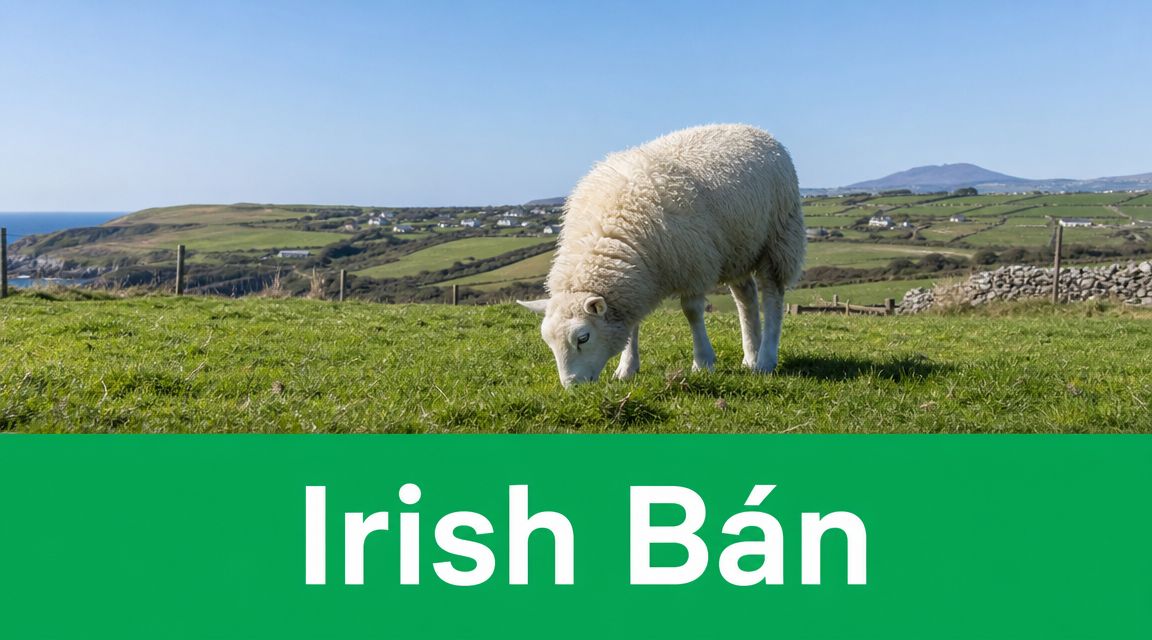
A white sheep grazing in a green pasture with a coastal landscape and hills in the background.

Bán means more than a color

This is one of the most useful details learners usually miss. In Irish, bán doesn't only point to the color white. Lexicographic sources also give related senses such as blank, fallow, or empty in context, which is why a direct one-to-one translation can be too narrow in real use, as shown in the Majstro entry for white.

That doesn't mean every use of bán is mysterious. It means the word has a wider field of meaning than English learners expect. Languages do this all the time. One word can cover a family of related ideas rather than a single neat box.

A first phrase you can actually use

A very basic pattern is noun plus adjective:

  • teach bán = white house

That structure helps beginners because it shows where the color word often sits. English says “white house.” Irish often puts the describing word after the noun.

Don't treat bán like a sticker you place before every noun. In Irish, adjectives commonly follow the thing they describe.

A few beginner habits help here:

  • Say it out loud: “bawn” is easier to remember when your ear joins in.
  • Pair it with a noun: single words fade fast, but phrases stick.
  • Watch the context: if a dictionary gives extra meanings, that's a clue the word has nuance.

Why this matters for real Irish

A learner who only memorizes “white = bán” can still freeze when reading an actual sentence. A learner who knows that bán can stretch into nearby meanings is much less likely to panic.

That's part of what makes Irish feel alive. Words carry history, habit, and context, not just labels.

The Scottish Gaelic Word for White Geal

In Scottish Gaelic, the common word for white is geal. A beginner-friendly pronunciation guide is often written as “gyal” or “gal” with a light palatal quality, depending on how closely you're trying to imitate native sound.

What matters most at first is recognizing that geal is not the same word as Irish bán. They may both answer the English question “what's the Gaelic for white?”, but they belong to different languages.

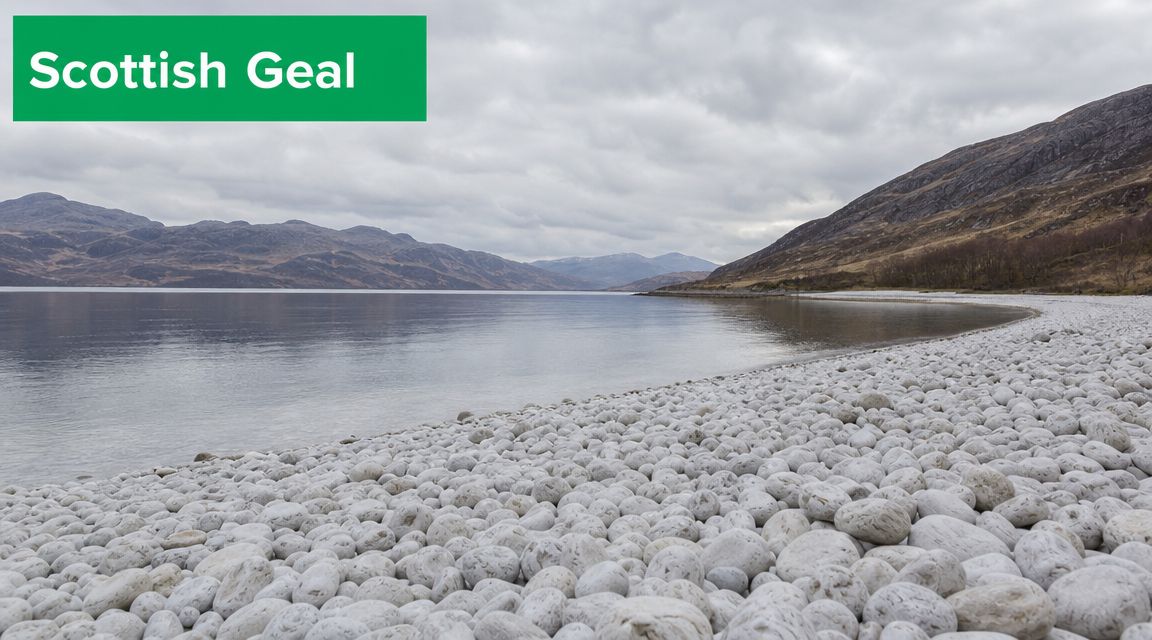
A serene Scottish loch shoreline filled with smooth white stones under a cloudy sky.

Geal has a wider job than English white

Scottish Gaelic often packs more function into a word than beginners expect. Authoritative dictionary material shows that geal can refer to a white object or substance, and it can also work as a verb meaning whiten or bleach, as shown in the LearnGaelic dictionary entry for geal.

That's a big clue about how Gaelic works. A word may describe a state, point to a thing, or suggest a process. English often splits those jobs across separate words. Gaelic doesn't always do that.

Why geal feels different from bán

Irish bán often gets taught as a plain color word first. Scottish Gaelic geal invites you to think a little more dynamically. It can describe whiteness, but it can also lean toward the idea of something becoming white or being treated as white in appearance.

That doesn't make it difficult. It just means you should learn it in context, not as an isolated flashcard.

A simple memory aid can help:

  • bán feels like the standard Irish answer
  • geal feels like the standard Scottish Gaelic answer with a broader functional range

A useful beginner mindset

If you're learning Scottish Gaelic, don't ask only, “What does geal mean?” Ask, “How does geal behave?” That small change leads to better reading and better speaking.

A Gaelic word often acts more like a small toolkit than a single English label.

Once you start looking for that pattern, the language becomes more logical.

How These Words Change in a Sentence

Memorizing bán and geal is only the first step. The next surprise is that these words may change shape when they move into a sentence.

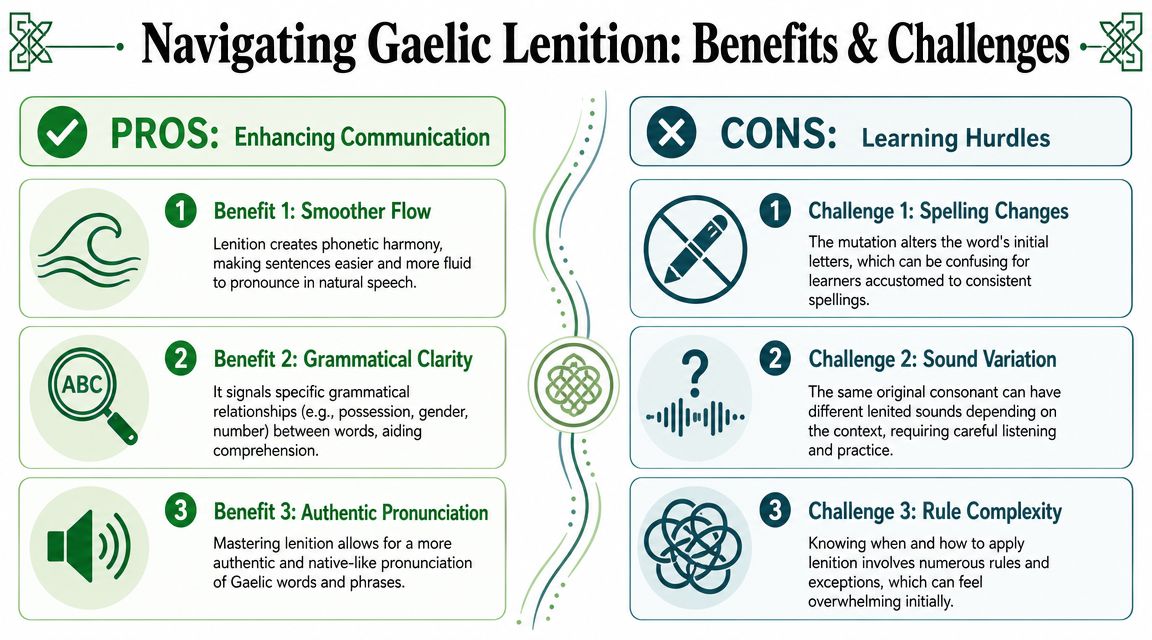
This change is often called lenition. If that sounds technical, don't worry. You can think of it as the word's first sound softening after certain grammar triggers. It's a bit like a key turning in a lock. The sentence around the word changes how the word opens.

An infographic titled Navigating Gaelic Lenition showing the linguistic pros and cons of learning Gaelic mutations.

Irish example with bán and bhán

In Irish, bán can become bhán in the right environment. Beginners often hear that new form as something like “vawn.”

The spelling looks dramatic at first, but the pattern becomes familiar. Irish uses added h after certain consonants to show that the sound has softened. So b can soften into bh.

Here's the basic idea:

Base form Changed form Rough learner pronunciation
bán bhán vawn

Scottish Gaelic example with geal and gheal

Scottish Gaelic uses a related softening pattern. geal can become gheal after certain triggers.

The exact sound can vary with dialect and speed of speech, which is normal in living languages. The important beginner lesson is visual and structural. You need to recognize that the word you learned in the dictionary may show up in a changed form in real writing.

A simple comparison helps:

Base form Changed form
geal gheal

If you want extra practice with how descriptive words behave in Irish, this guide on mastering adjectives in Irish gives a wider picture.

Why mutations exist at all

To English speakers, mutation can feel unfair. You finally learn the word, and then the language changes it.

But there is a reason. These changes help signal grammar relationships. They tell you something about what came before, how words connect, or how a phrase is functioning. In other words, the change is not random decoration. It carries information.

Here's a good way to think about it:

  • English often uses word order to show relationships.
  • Gaelic often uses sound changes too.

That means your ear matters as much as your eyes.

A quick watch can make the pattern feel less abstract:

How to practice without getting overwhelmed

You don't need to master every mutation rule today. Start smaller.

  • Learn the base word first: know bán and geal on sight.
  • Notice changed forms when reading: treat bhán and gheal as family members, not brand-new words.
  • Say both versions aloud: your mouth learns patterns faster than silent reading alone.

Once you stop seeing mutation as a mistake and start seeing it as grammar doing its job, a lot of Gaelic becomes easier to trust.

Common Phrases Using Bán and Geal

The best way to make these words stick is to see them side by side. A comparison table helps you notice two things at once. First, Irish and Scottish Gaelic use different core words. Second, the phrase structure can look similar even when the vocabulary differs.

Irish vs. Scottish Gaelic Phrase Comparison

English Phrase Irish (Gaeilge) Scottish Gaelic (Gàidhlig)
white house teach bán taigh geal
white horse capall bán each geal
white flower bláth bán flùr geal
white stone cloch bhán clach gheal
white hair gruaig bhán falt geal
white sheep caora bhán caora gheal
white wine fíon bán fìon geal
white thing rud bán rud geal

What this table teaches you

A table like this does more than give you phrases to copy.

  • Word order: the color word often follows the noun.
  • Mutation in action: some Irish and Scottish Gaelic phrases show the softened form.
  • Vocabulary boundaries: one English idea doesn't force the same Gaelic word in both languages.

If you only memorize isolated color words, you'll hesitate in conversation. If you memorize short phrases, you'll speak sooner.

Try picking three phrases from the table and using them with real objects around you. That turns passive recognition into active recall.

The Ancient Roots of White Fionn and Finn

The story of white in Gaelic doesn't end with bán and geal. Older Celtic material also preserves forms like fionn or finn, which helps explain why learners sometimes meet several related-looking words in names, legends, and historical discussions.

Verified language background notes that older Celtic-root explanations connect the idea of white to Proto-Celtic *windos, and Old Irish had finn meaning white, bright, blessed. That older layer matters because it shows how a color word can carry ideas of brightness or radiance, not only surface color.

Why fionn shows up in names and stories

If you've heard of Fionn mac Cumhaill, you've already seen this older root at work. In that context, the meaning leans toward brightness, fairness, or shining quality. Here, language and storytelling meet. A descriptive word becomes part of a cultural image.

For learners, the useful lesson is simple. Gaelic vocabulary often has a long memory. Modern everyday words do one job, while older forms continue to live in names, poetry, and myth.

If etymology interests you, a Proto-Celtic dictionary guide can help you trace those older layers more carefully.

White as a color is not the same as white as identity

This is another place readers can get tangled. A translation question about color can slide into a social-history question about identity.

Historically, Gaelic-speaking populations were increasingly classified within broader white racial frameworks in the nineteenth and twentieth centuries. In the United States, the Census reported over 235 million people identifying as White alone or in combination in 2020, and among detailed responses in that population, English (46.6 million), German (45 million), and Irish (38.6 million) were the largest ancestral groups, according to the U.S. Census Bureau's overview of the White population in 2020.

That history is important, but it's a different conversation from translation. In language study, bán, geal, and older forms like fionn are vocabulary items. In social history, “white” refers to classification and identity. Mixing those two meanings too quickly causes confusion.

Start Using Your New Gaelic Words Today

You don't need to wait until you “know enough” to start using these words.

Keep these takeaways in front of you:

  • Irish uses bán
  • Scottish Gaelic uses geal
  • Sentence grammar can soften the opening sound
  • Context matters more than a one-word lookup

A simple practice routine works well:

  1. Pick one object near you and name it with the color.
  2. Say the phrase out loud three times.
  3. Write one short sentence with the base form.
  4. Notice any mutated form when you read later.

One final point helps keep the cultural side clear. In modern official statistics, White Irish is treated as an ethnic category rather than a separate race. Ireland's 2016 Census reported 3,854,226 people as White Irish, equal to 82.2% of usual residents, as shown in the Central Statistics Office release on ethnicity and Irish Travellers. That's useful background if your interest in Gaelic for white comes from heritage as well as language.

The most effective next step is regular use. Label a few white objects at home. Repeat one Irish phrase and one Scottish Gaelic phrase. Let the language become something you do, not just something you look up.


If you want guided practice after learning words like bán and seeing how Irish changes inside real phrases, Gaeilgeoir AI is a smart next step. It helps you start speaking from day one with practical conversations, pronunciation support, and beginner-friendly practice that turns vocabulary into usable Irish. For a direct start, visit Learn Gaeilgeoir AI. Comments are closed and pingbacks are disabled.

Fire in Gaelic: The Complete Guide to Tine and Teine

In Irish Gaelic, the word for fire is tine. In Scottish Gaelic, it's teine, and in the old Gaelic ritual year fire stood at the center of four major seasonal festivals, including Imbolc on 1 February and Bealtaine on 1 May.

Maybe you looked up “fire in gaelic” because you needed a quick translation for a tattoo idea, a school project, a story, or a trip to Ireland or Scotland. That simple search opens a much bigger door. Fire in the Gaelic languages isn't just a household noun. It carries memory, ritual, season, danger, warmth, and everyday speech all at once.

That's what makes tine and teine so satisfying to learn. They're small words with deep roots. Once you understand them, you're not only memorizing vocabulary. You're stepping into the older world of hearths and bonfires, and the modern world of public signs, safety language, and living Gaelic speech.

Table of Contents

Your Quick Guide to Fire in Gaelic

If you want the direct answer, keep these two words in mind: tine in Irish, teine in Scottish Gaelic. For most beginners, that's enough to get started.

But beginners often get tripped up in two places. First, they assume Irish and Scottish Gaelic are identical. They aren't. Second, they assume a single dictionary word tells them how people speak in practice. It usually doesn't.

Practical rule: Learn the core word first, then learn where people use it. A word becomes real when you can place it in culture, conversation, and daily life.

In the case of fire in gaelic, that wider context matters more than usual. Fire was tied to the calendar, the home, and seasonal survival. It also remains useful in modern settings where clear language matters, from ordinary conversation to public communication.

A good learner's path looks like this:

  • Start with the noun: memorize tine and teine.
  • Notice the family resemblance: the words are close enough that one can help you remember the other.
  • Attach the word to a scene: a hearth, a candle, a bonfire, a warning sign.
  • Learn phrases, not just labels: that's how you stop translating word by word in your head.

If you've ever felt that language guides give you a bare translation and then leave you stranded, you're not wrong. Fire in gaelic is a perfect example of why richer context helps. A learner who knows only the dictionary answer knows one word. A learner who knows where that word lives in history and modern life can use it.

The Core Words Tine and Teine Explained

A hearth is glowing in an old stone house. In one home, the word for that fire is tine. Across the water in Scotland, the matching everyday word is teine. That small spelling shift tells a larger story about two sister languages that grew from the same roots and still echo each other.

A simple comparison

Language Gaelic Word IPA Pronunciation Simple Pronunciation
Irish tine not provided in the verified data TIN-yeh or TIN-uh as a learner-friendly approximation
Scottish Gaelic teine /tʲenə/ CHEN-uh or TYEN-uh as a learner-friendly approximation

The clearest verified source for this pair is the LearnIrish entry for fire, which lists tine in Irish and teine in Scottish Gaelic, and gives the Scottish Gaelic pronunciation /tʲenə/.

If IPA looks intimidating, set it aside for a moment. A learner-friendly way to hear teine is closer to TYEN-uh or CHEN-uh than to English “teen.” Gaelic spelling works by its own sound system, so the eye often needs time to catch up with the ear.

One helpful habit is to learn the word with a scene attached to it. Tine can live in your mind as a cooking fire, a candle flame, or a turf hearth. Teine can do the same. That makes the vocabulary stick better than memorizing a bare label on a flashcard.

Why the words look so similar

The resemblance between tine and teine comes from shared ancestry. Irish and Scottish Gaelic belong to the Goidelic branch of the Celtic languages, so some everyday words line up like close family members. Fire is one of those satisfying examples where the connection is easy to see.

For a beginner, this works like recognizing two regional versions of the same family recipe. The ingredients are familiar, but the form shifts a little from house to house. Tine and teine are not random lookalikes. They are related forms that help you notice how the languages mirror each other.

A simple memory aid helps here:

  • Irish: ti-
  • Scottish Gaelic: tei-

Use that pattern gently, not as a hard rule for every word in the language. Gaelic always has exceptions. Still, this pair gives you a solid foothold, and footholds matter.

The word also carries more weight than a dictionary line suggests. In Gaelic tradition, fire belonged to the home, the year's turning, and community ritual, which is why a word like teine appears naturally in discussions of Beltane as a fire feast and seasonal celebration. So when you learn tine and teine, you are not only learning how to name a flame. You are learning a word that has warmed houses, marked festivals, and stayed useful right into modern public life.

The Cultural Importance of Fire in Gaelic Folklore

Fire in the turning of the year

A diagram illustrating the cultural importance of fire in Gaelic folklore through four key thematic categories.

To understand fire in gaelic, it helps to leave the dictionary for a moment and consider an older context. Fire was woven into the year itself. In Ireland's pre-Christian ritual calendar there were four major seasonal festivals: Imbolc (1 February), Bealtaine (1 May), Lúnasa (1 August), and Samhain (1 November). Bealtaine and Imbolc sat roughly halfway between the solstices and equinoxes, and both were important fire festivals according to this overview of Bealtaine in the Irish ritual calendar.

Bealtaine is especially vivid. Traditional accounts describe cattle being driven between two bonfires for protection before moving to summer pasture. That detail matters because it shows something larger than symbolism. Fire wasn't floating above daily life as a poetic idea. It was embedded in the economic rhythm of herding and farming.

If you want a deeper cultural read on that seasonal world, this look at Beltane as a fire feast and celebration adds helpful background.

Why that still matters to learners

Imbolc carries a different atmosphere. Historical accounts place it at the first signs of spring, especially the lactation of ewes before lambing season in Ireland and Britain. It later became linked with Saint Brigid and then with Candlemas. In Ireland, February 2 was officially known as Candlemas, and in much of northern Europe as the Purification of the Blessed Virgin Mary until the Second Vatican Council in 1965, as discussed in this history of Imbolc, Brigid, and Candlemas.

That continuity of date is striking. The old seasonal fire-and-fertility moment didn't vanish completely. It was re-expressed through Christian practice while keeping the same early-February timing.

Here's why this matters when learning a word like tine. In English, “fire” can feel neutral until context fills it in. In Gaelic tradition, the word arrives already carrying layers of protection, household life, season, and ceremony.

  • At Bealtaine, fire marks movement into summer.
  • At Imbolc, fire and hearth imagery meet early spring and renewal.
  • In both cases, the word points to community action, not just an object.

Fire in Gaelic folklore is less about spectacle and more about relationship. People used it to mark time, guard animals, and connect the household to the wider year.

That's why the vocabulary feels deeper than a translation card. When you say tine or teine, you're touching a word that once sat at the hinge of the seasons.

Common Gaelic Phrases and Idioms with Fire

A man and woman having a thoughtful conversation at a cafe table with coffee and flowers.

Literal first, then natural speech

A lot of learners search for fire in gaelic and get only the bare noun. That's limiting. Learners usually need phrase-level meaning, not just a label, and many Irish-learning materials lean harder on grammar lists than on real conversational use. That gap is one reason practical phrase learning matters so much, as noted in this discussion of the need for broader semantic range in fire-related language learning from Fire Engineering's page cited in the brief.

Here's the safer way to build usable knowledge. Start with simple, transparent combinations rather than trying to memorize dramatic idioms too early.

  • Use the noun alone first: learn tine as “fire.”
  • Add context words next: think in scenes such as a house fire, campfire, or lighting a fire.
  • Notice related meanings: learners also run into nearby ideas such as burning, sparks, heat, and smoke.

For a broader feel for natural expression, this guide to Irish sayings in Gaelic is a useful next stop.

How to avoid stiff translations

Beginners often make one of three mistakes:

  1. They translate English phrases word for word.
  2. They assume every “fire” expression must use tine.
  3. They ignore nearby vocabulary and get stuck with one overused noun.

That's where a distinction like tine versus other fire-related ideas becomes helpful. Sometimes you need the thing itself, fire. Sometimes you need an action, such as burning. Sometimes you need the image of a spark rather than the whole flame.

Don't ask only “What's the Gaelic word for fire?” Ask “What am I trying to say with fire?”

A few learner-friendly examples of how to think about this:

  • Literal use: “The fire is out.” This is straightforward noun use.
  • Practical use: “Don't go near the fire.” Again, a direct physical meaning.
  • Figurative use: “She has a spark of energy.” English uses fire imagery, but another Gaelic word may fit better than the exact noun.

That habit makes your Irish sound less mechanical. It also prepares you for speech as people use it in real life, where meaning sits in phrases and situations, not in isolated vocabulary cards.

Fire in the Modern Gaelic World

A group of university students with backpacks walking along a paved pathway on a campus

Gaelic in official public use

It's easy to leave fire in gaelic sitting in the ancient world of bonfires and festivals. But the vocabulary matters now as well. The Scottish Fire and Rescue Service has an official Gaelic Language Plan for 2023–2026, which shows Gaelic being normalized in operational and public-facing contexts where terminology must be clear and consistent, as stated in the Scottish Fire and Rescue Service Gaelic Language Plan 2023–2026.

That matters for a very practical reason. Emergency language can't be vague. If a term appears in signage, print, digital messaging, or spoken communication, it has to work under pressure.

This gives learners a useful perspective on teine. It isn't only a heritage word preserved in songs or folklore. It belongs to a living language that public institutions are actively using.

If seasonal language interests you too, this article on the Irish festival of Samhain complements that older-to-modern journey.

Practical situations learners may meet

Modern fire-related language becomes relevant fast if you travel, camp, hike, or read local notices. There's also a clear content gap here. High-quality learner material rarely explains how fire vocabulary appears in public safety language such as wildfire warnings or campfire precautions, even though public guidance in Ireland stresses that almost all wildfires are human-caused and that campfires, BBQs, or land burning in dry conditions can trigger them. Officials also note that only a few dry days can make vegetation highly flammable, as described in this public wildfire safety guidance video.

That means useful learning scenarios include:

  • Outdoor notices: warnings about fire risk in dry weather
  • Camping language: instructions about campfires and safe extinguishing
  • Community alerts: local safety announcements in bilingual settings

A living language proves itself in ordinary public life. Safety notices are one of the clearest examples.

For learners, this changes the motivation. You're not memorizing tine or teine as decorative vocabulary. You're learning a word that can appear in daily life, in official settings, and in situations where understanding matters.

Bring Your Gaelic Vocabulary to Life

You are sitting by a fire pit on a cool evening, and one small Gaelic word suddenly starts to feel much bigger than a dictionary entry. Tine in Irish and teine in Scottish Gaelic can mean the flame in front of you, the warmth of a hearth in an old story, a warning on a public notice, or a phrase in everyday conversation. That is what makes this vocabulary memorable. It belongs to real life.

A good language word works like a doorway. Step through it, and you find sound, history, culture, and modern use all meeting in one place. With tine and teine, you are hearing the family resemblance between two Gaelic languages while also touching something central to Gaelic life for centuries. Fire meant heat, cooking, gathering, ritual, and protection. It still appears in speech, signage, and safety language today.
That wider context matters for learning. A word stays with you more easily when you can attach it to a scene. You might picture a hearth in winter, a festival fire on a hillside, or a notice warning about fire risk in dry weather. Each example gives the word another root, and rooted words are the ones you remember.

Keep the foundation simple:

  • Irish: tine
  • Scottish Gaelic: teine

Then let the word grow in layers. Say it aloud. Notice where it appears. Use it in a phrase instead of keeping it on a flashcard by itself. That is how vocabulary becomes usable, and how a single word starts to carry the texture of a whole culture.

If you want to turn words like tine into real speaking ability, Gaeilgeoir AI is a practical next step. It helps learners move from recognition to use through guided, real-world Irish conversations, so you are not just memorizing fire in Gaelic. You are learning how to speak.

How Is Gaelic Pronounced? Irish vs. Scottish

If you mean Irish Gaelic, say “gay-lik”. If you mean Scottish Gaelic, say “gah-lik”. They’re two different languages, and that’s why you’ve probably heard two different answers.

That little moment of hesitation happens to a lot of people. You hear “Gaelic” in a podcast, at a family gathering, in a film, or while planning a trip to Ireland or Scotland, and suddenly you’re wondering whether you’re about to say it wrong in public.

The good news is that the confusion makes sense. These languages share deep roots, but they don’t sound the same, and English spelling doesn’t help. Once you know which language you’re talking about, pronunciation starts to feel much less mysterious.

What makes this fun is that Gaelic pronunciation isn’t random. Irish, in particular, has a sound system with real logic behind it. If you learn that logic, especially the broad and slender pattern behind consonants, words that first look impossible begin to open up.

Table of Contents

First Things First Is It 'Gay-lik' or 'Gah-lik'?

If you’re talking about Irish, “Gaelic” is pronounced /ˈɡeɪlɪk/, or gay-lik. If you’re talking about Scottish Gaelic, it’s /ˈɡælɪk/, or gah-lik, as explained in this beginner overview of Irish and Scottish Gaelic pronunciation.

That’s the first thing to lock in. Both pronunciations are correct. The mistake is using the Irish pronunciation for Scottish Gaelic, or the Scottish pronunciation for Irish.

A second point trips up beginners even more. The languages don’t usually refer to themselves as “Gaelic” in everyday native usage. Irish is Gaeilge, often approximated for beginners as gail-gyuh or gayl-geh. Scottish Gaelic is Gàidhlig, often given as gaa-lik.

Practical rule: If you’re speaking about Ireland, say gay-lik for the English word “Gaelic.” If you’re speaking about Scotland, say gah-lik.

Beginners often learn through English first, then hit a wall when the native names appear. Someone can feel confident saying “Irish Gaelic,” then freeze when they see Gaeilge written down. That’s normal. The spelling is showing a sound system that doesn’t map neatly onto English.

A good beginner mindset is to stop asking, “Why isn’t this spelled how it sounds in English?” and start asking, “What sound pattern is this spelling pointing to?” That shift changes everything.

Here’s the short version of where confusion starts:

  • Two languages: Irish and Scottish Gaelic are related, but they aren’t interchangeable.
  • Two English pronunciations: “Gay-lik” and “gah-lik” both exist for a reason.
  • Two native names: Gaeilge and Gàidhlig don’t sound exactly like their English labels.

Once you accept that “how is gaelic pronounced” has more than one valid answer, the rest becomes much easier to learn.

Irish vs Scottish Gaelic The Key Pronunciation Differences

Irish and Scottish Gaelic come from the Goidelic branch of the Celtic languages. Their shared roots go back to Proto-Celtic around 1000 BCE, and the languages had diverged significantly by the 4th century CE with Primitive Irish Ogham inscriptions, according to this Pimsleur overview of Gaeilge and Gaelic.

Scottish Gaelic arrived in Scotland from Ireland over 1,500 years ago, around 500 CE, and developed along its own path. That history explains why the languages feel related but not identical when you hear them spoken.

A comparison chart showing pronunciation differences between Irish Gaelic and Scottish Gaelic, including consonant and vowel variations.

Why the two names sound different

One of the clearest differences is in the English word Gaelic itself. Irish uses the gay-lik pronunciation, while Scottish Gaelic uses gah-lik. That difference isn’t cosmetic. It reflects separate sound histories.

You can hear the split in other ways too. Scottish Gaelic is known for pre-aspiration, where a word like mac can sound like machk. Irish doesn’t use that same feature. To an English-speaking ear, Scottish Gaelic can sometimes sound airier or rougher around certain consonants.

Accent marks also point to different traditions. In Scottish Gaelic, the accent slants left. In Irish, it slants right. That visual detail won’t teach you pronunciation by itself, but it helps you see that you’re dealing with two distinct writing conventions.

For a fuller side-by-side explanation, this guide to Irish vs Scottish Gaelic differences is useful once you’ve got the headline distinction clear.

Irish Gaelic vs. Scottish Gaelic At a Glance

Feature Irish Gaelic (Gaeilge) Scottish Gaelic (Gàidhlig)
English pronunciation of “Gaelic” gay-lik gah-lik
Native language name Gaeilge Gàidhlig
Shared background Goidelic language with early Irish roots Goidelic language introduced to Scotland from Ireland
Distinctive sound clue Broad and slender consonants shape many sounds Pre-aspiration can make stops sound breathy before release
Accent mark style Accent slants right Accent slants left

A beginner doesn’t need to master every historical detail at once. What helps is listening for the overall sonic identity.

  • Irish often rewards pattern learning. Once you grasp how nearby vowels affect consonants, many spellings become more predictable.
  • Scottish Gaelic often surprises English speakers with breathier stop sounds. That’s one reason “mac” may not sound the way you expect.
  • The native names matter. If you can say Gaeilge and Gàidhlig with reasonable confidence, you’re already hearing the difference more clearly.

Don’t think of one pronunciation as “the right one” and the other as “wrong.” Think of them as belonging to different languages with a family resemblance.

The Golden Rule of Irish Pronunciation Broad and Slender

If you want one idea that is key to understanding Irish pronunciation, this is it. Every consonant has a broad form and a slender form, and the vowels around it tell you which one to use, as explained in this overview of Irish phonology.

Broad vowels are a, o, u. Slender vowels are e, i.

A dual-style celtic knotwork panel featuring a solid green texture on the left and layered wood on the right.

Think of every consonant as having two settings

An easy way to picture this is to imagine each consonant with a harder and softer setting. That’s not a perfect linguistic definition, but it’s a useful beginner shortcut.

A broad consonant sits beside a, o, u and sounds less “y-like.” A slender consonant sits beside e, i and often picks up a lighter, more fronted quality. The tongue shifts position, and that changes the sound.

The example many learners start with is c:

  • Broad c: before a, o, u, it sounds like k in can
  • Slender c: before e, i, it sounds like ky, as in the opening of came

That single contrast helps you hear why Irish spelling looks unusual to English speakers. The vowels aren’t only there for the vowel sound. They also help instruct the consonants.

A simple way to hear the difference

Say these slowly in English:

  1. can
  2. keen

Now pay attention not to the vowel, but to what your tongue does at the start. The second sound naturally shifts forward a little. That’s the kind of movement Irish uses as a core organizing principle.

This is why broad and slender matters so much. It isn’t a side rule. It’s the frame holding the whole pronunciation system together.

A few beginner-friendly ways to work with it:

  • Look at the neighboring vowels first. Before you panic over a consonant, check whether it sits near a, o, u or e, i.
  • Expect the consonant to change. In Irish, the same letter often won’t keep the same exact sound across words.
  • Read with your mouth, not just your eyes. Try saying the word aloud as soon as you see it.

Broad and slender is the reason Irish starts to feel logical after it first feels impossible.

If you want a deeper explanation of what makes Irish sound the way it does, this page on key features of Irish phonology gives useful context.

One more helpful mindset shift. Don’t memorize isolated spellings too early. Learn to spot the vowel environment around the consonant. That’s the “why” behind many pronunciation choices, and once you hear that pattern, unfamiliar words stop looking like random code.

Decoding Common Irish Letter Combinations

After broad and slender, the next shock for many learners is the letter combinations. You look at a word, see bh, mh, or th, and your English reading instincts stop working.

That’s normal. Irish uses combinations that often represent a single sound, and some of the most common ones behave very differently from English, as noted in this practical guide to pronouncing Gaelic spellings.

The combinations that trip people up first

A few patterns show up again and again in beginner Irish:

  • bh / mh often sound like v or w
  • th / sh at the start of a word are often pronounced like a simple h
  • dh / gh can sound soft, breathy, or almost vanish depending on the word and dialect

If you’re coming from English, it helps to think of these as sound shortcuts rather than letter-by-letter puzzles.

Here’s a simple decoder table:

Spelling Beginner approximation What to notice
bh v or w The sound depends on position and neighboring vowels
mh v or w Often close to bh in practice
th h The t usually isn’t heard the English way
sh h Softer than English “sh”
ch like loch A throat sound, not English “ch” as in “chair”

That last one deserves extra attention. Irish ch is not the sound in cheese. It’s closer to the sound at the end of loch.

How to make these sounds feel practical

The biggest problem with static pronunciation lists is that you can understand them on paper and still miss them in speech. A learner may know that th can sound like h, then fail to recognize it in a real conversation.

Try this approach instead:

  1. Spot the pattern in writing. Notice the letter pair before you try to say the word.
  2. Swap in the likely sound. If you see th at the start, test an h sound.
  3. Say the whole word smoothly. Don’t pause between letters.
  4. Listen for it in phrases. The sound often becomes clearer in context than in isolation.

A lot of Irish pronunciation starts making sense when you stop “sounding out” every letter and start reading in chunks. The chunks carry the sound.

When a word looks crowded, don’t assume every letter needs its own English-style sound. In Irish, several letters often work together to signal one pronunciation pattern.

That’s why names can feel so surprising at first. The spelling is doing real phonetic work, but it’s doing it according to Irish rules, not English ones.

Understanding Lenition and Eclipsis (Consonant Mutations)

One of the most distinctive things about Irish is that the beginning of a word can change. To a beginner, that can look like spelling chaos. In practice, it’s a sound system that helps speech flow.

A parchment scroll with the text Word Changes resting on rocks with green slime dripping down.

Lenition as softening

Lenition usually softens a consonant. In spelling, you’ll often see this as an added h after the first consonant.

So a firm sound can become breathier or lighter. This is why combinations like th and sh often move toward an h sound, and why learners quickly notice that written Irish changes shape depending on grammar and phrase context.

You don’t need a full grammar chart to begin hearing it. What matters first is this: if a familiar word suddenly appears with an extra h, expect a softer opening sound.

A useful listening habit is to compare the “plain” and “changed” versions aloud. Even if you don’t know the grammar yet, your ear starts to expect the shift.

Eclipsis as covering

Eclipsis works differently. Instead of softening the original consonant, Irish places another consonant sound in front of it. The spelling shows both, but the newer sound leads.

That can seem strange until you treat it as a pronunciation signal. The word hasn’t become unrecognizable. It has just put on a different sound at the front.

A beginner-friendly way to think about the two mutations:

  • Lenition changes the quality of the first sound
  • Eclipsis changes which first sound you hear first

This matters in real listening. If you expect every word to keep its base dictionary form, spoken Irish can feel slippery. If you expect words to shift shape, conversations become easier to follow.

Irish mutations aren’t decoration. They’re part of how the language sounds natural in connected speech.

For pronunciation practice, it helps to learn whole phrases rather than isolated nouns. The phrase teaches you the spoken form.

Putting It All Into Practice Words You Will Actually Use

Rules start to stick when they show up in names, greetings, and phrases you’ll hear in ordinary life. That matters in modern Irish because the language lives across different dialects, has three main varieties (Ulster, Connacht, Munster), and is used daily by 73,000 people in Ireland, with 400,000 learners and 60,000 students annually taking the Leaving Cert oral exam where pronunciation counts for 40%, according to this guide to Old Irish pronunciation and modern context.

A person with curly hair wearing a green shirt smiling with a Speak Gaelic graphic overlay.

Names and phrases you’ll meet early

Here are a few high-value examples. The respellings are approximations for English speakers, not perfect substitutes for hearing native audio.

  • Dia dhuit
    Approximation: jee-ah gwit
    A common greeting. This is a good example of why reading letter by letter doesn’t work well.

  • Sláinte
    Approximation: slawn-cha or slawn-teh depending on dialect and speaking style
    You’ll hear this in social settings, especially in toasts.

  • Seán
    Approximation: shawn
    A classic example of how familiar letters can produce a very different result in Irish.

  • Siobhán
    Approximation: shiv-awn
    A name many English speakers know, even if they’ve never studied Irish.

  • Aoife
    Approximation: ee-fa
    This is a perfect reminder that Irish vowel groups need to be learned as patterns.

A short clip can help your ear settle into the rhythm before you overthink the spelling:

What to expect across dialects

You’ll sometimes hear a word said slightly differently in Cork, Connemara, or Donegal. That doesn’t mean one speaker is wrong. It means Irish has living regional traditions.

A smart beginner strategy is to do two things at once:

  • Learn one clear version first. Consistency helps your ear.
  • Stay flexible when listening. Different dialects may shift vowels or stress patterns.

If your interest is travel, heritage, or everyday conversation, these practical words will carry you a long way before you ever need advanced phonetics.

How to Master Your Gaelic Pronunciation

Reading about pronunciation helps. It doesn’t replace speaking.

A significant shift happens when you listen, repeat, get corrected, and try again. That’s true in any language. If you’ve ever looked at common pronunciation mistakes in another language, you’ve seen the same pattern. Learners usually know more than they can reliably produce.

What actually helps

A useful practice routine is simple:

  • Shadow short audio clips. Listen and repeat immediately, without pausing to analyze every letter.
  • Record yourself. Compare your version to native or guided audio.
  • Practice whole phrases. Irish sounds change in connected speech, so isolated words only take you so far.
  • Get feedback. You can’t always hear your own errors at first.

If you want structured support, Gaeilgeoir AI’s Irish pronunciation guide is one way to combine audio examples, phonetic support, and conversation-focused practice. That kind of tool is useful because it closes the gap between understanding the rule and saying the word out loud.

A good target isn’t “perfect accent from day one.” It’s intelligible, confident speech that keeps improving. Say the word. Notice what felt awkward. Repeat it in a phrase. That cycle works better than collecting more rules without using them.

Frequently Asked Questions About Gaelic Pronunciation

What is the hardest sound for English speakers

Many learners struggle most with sounds that don’t map neatly onto English spelling habits. In Irish, that often means the broad and slender contrast, plus throatier sounds like ch. The difficulty usually isn’t one letter by itself. It’s hearing how neighboring vowels reshape the consonant.

Which Irish dialect should I focus on

Pick one dialect source and stay with it long enough to build a stable ear. Ulster, Connacht, and Munster all matter. For a beginner, consistency matters more than chasing every variation at once.

How is Manx related

Manx belongs to the same broader Goidelic family as Irish and Scottish Gaelic. If you already know that Irish and Scottish Gaelic are related but distinct, you already have the right framework for understanding Manx too.

Why do some letters seem silent

They often aren’t “silent” in the English sense. Instead, they may be signaling whether a consonant is broad or slender, or they may be part of a letter combination that produces a single sound. Irish spelling often carries pronunciation instructions that become clearer once you stop treating each letter separately.

For learners who want to sharpen mouth placement and rhythm in any language, exercises that help you master your accent can be surprisingly useful, even outside Irish. The key idea is the same. Your tongue, lips, and timing need practice, not just explanation.


If you’re ready to move from reading about pronunciation to actively speaking, Gaeilgeoir AI offers guided Irish conversation practice, pronunciation support, and beginner-friendly drills built around real situations like travel, everyday chat, and oral exam prep. It’s a practical next step if you want to start using Irish out loud instead of only decoding it on the page.

Start Speaking Irish Today — 25% Off
Use code START25

Learn real Irish for real life with guided practice, pronunciation support, and everyday conversations.

Get 25% off any plan with code START25

Start Speaking Irish Today — 25% Off