If you mean Irish Gaelic, say “gay-lik”. If you mean Scottish Gaelic, say “gah-lik”. They’re two different languages, and that’s why you’ve probably heard two different answers.
That little moment of hesitation happens to a lot of people. You hear “Gaelic” in a podcast, at a family gathering, in a film, or while planning a trip to Ireland or Scotland, and suddenly you’re wondering whether you’re about to say it wrong in public.
The good news is that the confusion makes sense. These languages share deep roots, but they don’t sound the same, and English spelling doesn’t help. Once you know which language you’re talking about, pronunciation starts to feel much less mysterious.
What makes this fun is that Gaelic pronunciation isn’t random. Irish, in particular, has a sound system with real logic behind it. If you learn that logic, especially the broad and slender pattern behind consonants, words that first look impossible begin to open up.
Table of Contents
- First Things First Is It 'Gay-lik' or 'Gah-lik'?
- Irish vs Scottish Gaelic The Key Pronunciation Differences
- The Golden Rule of Irish Pronunciation Broad and Slender
- Decoding Common Irish Letter Combinations
- Understanding Lenition and Eclipsis (Consonant Mutations)
- Putting It All Into Practice Words You Will Actually Use
- How to Master Your Gaelic Pronunciation
- Frequently Asked Questions About Gaelic Pronunciation
First Things First Is It 'Gay-lik' or 'Gah-lik'?
If you’re talking about Irish, “Gaelic” is pronounced /ˈɡeɪlɪk/, or gay-lik. If you’re talking about Scottish Gaelic, it’s /ˈɡælɪk/, or gah-lik, as explained in this beginner overview of Irish and Scottish Gaelic pronunciation.
That’s the first thing to lock in. Both pronunciations are correct. The mistake is using the Irish pronunciation for Scottish Gaelic, or the Scottish pronunciation for Irish.
A second point trips up beginners even more. The languages don’t usually refer to themselves as “Gaelic” in everyday native usage. Irish is Gaeilge, often approximated for beginners as gail-gyuh or gayl-geh. Scottish Gaelic is Gàidhlig, often given as gaa-lik.
Practical rule: If you’re speaking about Ireland, say gay-lik for the English word “Gaelic.” If you’re speaking about Scotland, say gah-lik.
Beginners often learn through English first, then hit a wall when the native names appear. Someone can feel confident saying “Irish Gaelic,” then freeze when they see Gaeilge written down. That’s normal. The spelling is showing a sound system that doesn’t map neatly onto English.
A good beginner mindset is to stop asking, “Why isn’t this spelled how it sounds in English?” and start asking, “What sound pattern is this spelling pointing to?” That shift changes everything.
Here’s the short version of where confusion starts:
- Two languages: Irish and Scottish Gaelic are related, but they aren’t interchangeable.
- Two English pronunciations: “Gay-lik” and “gah-lik” both exist for a reason.
- Two native names: Gaeilge and Gàidhlig don’t sound exactly like their English labels.
Once you accept that “how is gaelic pronounced” has more than one valid answer, the rest becomes much easier to learn.
Irish vs Scottish Gaelic The Key Pronunciation Differences
Irish and Scottish Gaelic come from the Goidelic branch of the Celtic languages. Their shared roots go back to Proto-Celtic around 1000 BCE, and the languages had diverged significantly by the 4th century CE with Primitive Irish Ogham inscriptions, according to this Pimsleur overview of Gaeilge and Gaelic.
Scottish Gaelic arrived in Scotland from Ireland over 1,500 years ago, around 500 CE, and developed along its own path. That history explains why the languages feel related but not identical when you hear them spoken.
Why the two names sound different
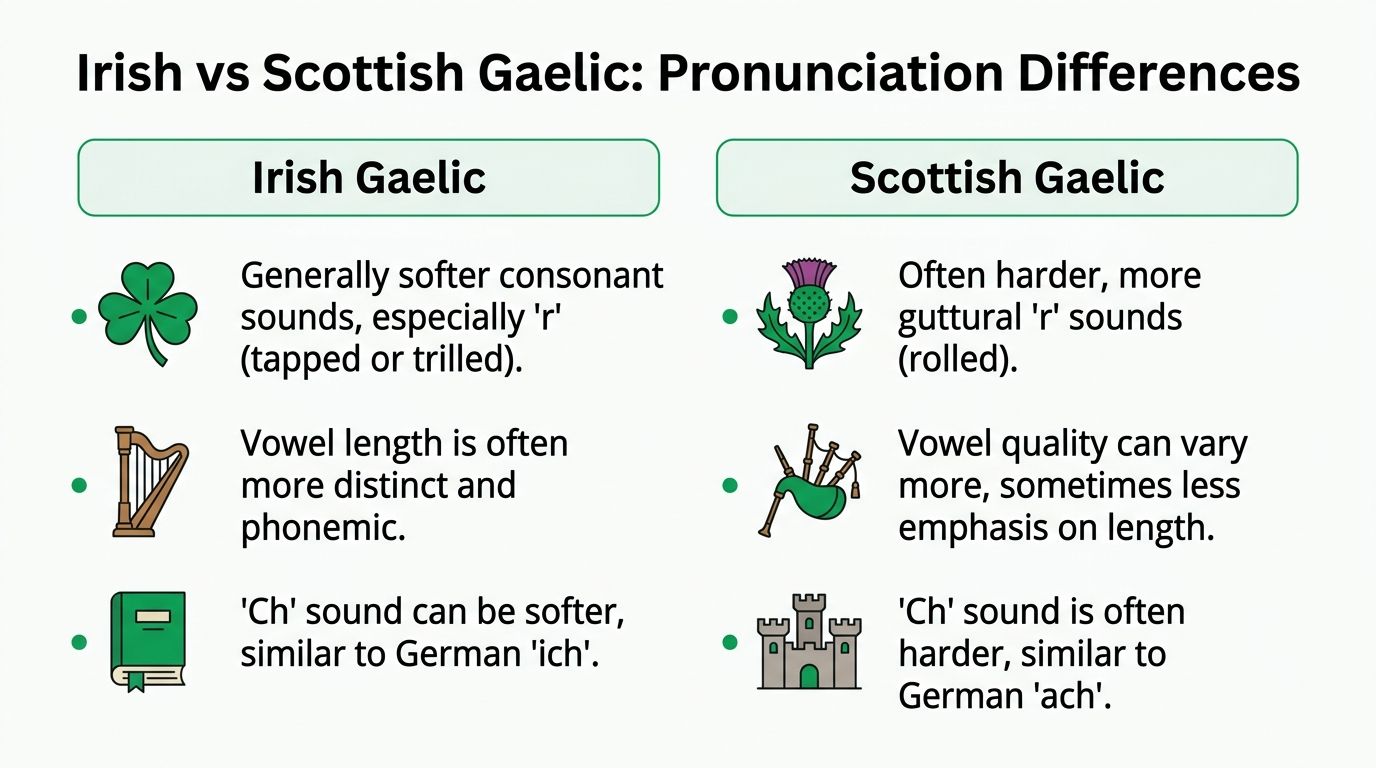
One of the clearest differences is in the English word Gaelic itself. Irish uses the gay-lik pronunciation, while Scottish Gaelic uses gah-lik. That difference isn’t cosmetic. It reflects separate sound histories.
You can hear the split in other ways too. Scottish Gaelic is known for pre-aspiration, where a word like mac can sound like machk. Irish doesn’t use that same feature. To an English-speaking ear, Scottish Gaelic can sometimes sound airier or rougher around certain consonants.
Accent marks also point to different traditions. In Scottish Gaelic, the accent slants left. In Irish, it slants right. That visual detail won’t teach you pronunciation by itself, but it helps you see that you’re dealing with two distinct writing conventions.
For a fuller side-by-side explanation, this guide to Irish vs Scottish Gaelic differences is useful once you’ve got the headline distinction clear.
Irish Gaelic vs. Scottish Gaelic At a Glance
| Feature | Irish Gaelic (Gaeilge) | Scottish Gaelic (Gàidhlig) |
|---|---|---|
| English pronunciation of “Gaelic” | gay-lik | gah-lik |
| Native language name | Gaeilge | Gàidhlig |
| Shared background | Goidelic language with early Irish roots | Goidelic language introduced to Scotland from Ireland |
| Distinctive sound clue | Broad and slender consonants shape many sounds | Pre-aspiration can make stops sound breathy before release |
| Accent mark style | Accent slants right | Accent slants left |
A beginner doesn’t need to master every historical detail at once. What helps is listening for the overall sonic identity.
- Irish often rewards pattern learning. Once you grasp how nearby vowels affect consonants, many spellings become more predictable.
- Scottish Gaelic often surprises English speakers with breathier stop sounds. That’s one reason “mac” may not sound the way you expect.
- The native names matter. If you can say Gaeilge and Gàidhlig with reasonable confidence, you’re already hearing the difference more clearly.
Don’t think of one pronunciation as “the right one” and the other as “wrong.” Think of them as belonging to different languages with a family resemblance.
The Golden Rule of Irish Pronunciation Broad and Slender
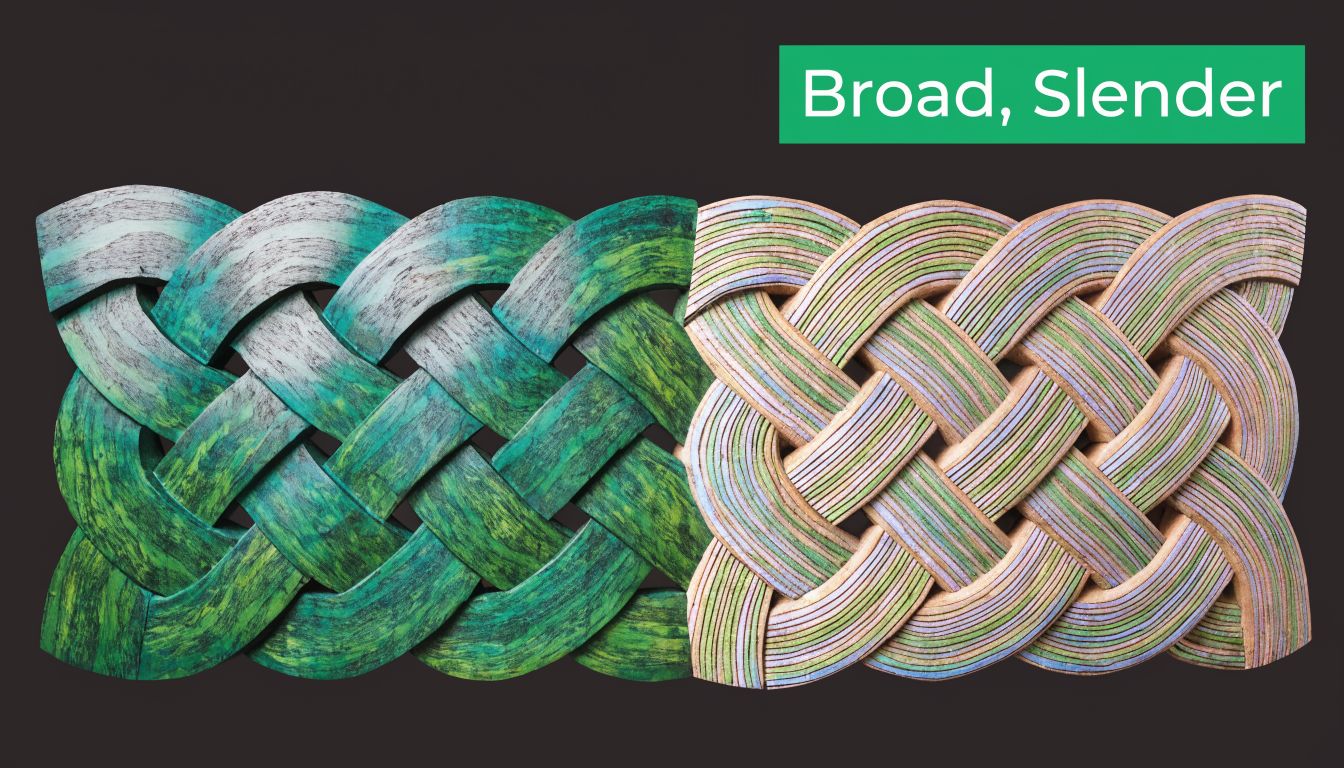
If you want one idea that is key to understanding Irish pronunciation, this is it. Every consonant has a broad form and a slender form, and the vowels around it tell you which one to use, as explained in this overview of Irish phonology.
Broad vowels are a, o, u. Slender vowels are e, i.
Think of every consonant as having two settings
An easy way to picture this is to imagine each consonant with a harder and softer setting. That’s not a perfect linguistic definition, but it’s a useful beginner shortcut.
A broad consonant sits beside a, o, u and sounds less “y-like.” A slender consonant sits beside e, i and often picks up a lighter, more fronted quality. The tongue shifts position, and that changes the sound.
The example many learners start with is c:
- Broad c: before a, o, u, it sounds like k in can
- Slender c: before e, i, it sounds like ky, as in the opening of came
That single contrast helps you hear why Irish spelling looks unusual to English speakers. The vowels aren’t only there for the vowel sound. They also help instruct the consonants.
A simple way to hear the difference
Say these slowly in English:
- can
- keen
Now pay attention not to the vowel, but to what your tongue does at the start. The second sound naturally shifts forward a little. That’s the kind of movement Irish uses as a core organizing principle.
This is why broad and slender matters so much. It isn’t a side rule. It’s the frame holding the whole pronunciation system together.
A few beginner-friendly ways to work with it:
- Look at the neighboring vowels first. Before you panic over a consonant, check whether it sits near a, o, u or e, i.
- Expect the consonant to change. In Irish, the same letter often won’t keep the same exact sound across words.
- Read with your mouth, not just your eyes. Try saying the word aloud as soon as you see it.
Broad and slender is the reason Irish starts to feel logical after it first feels impossible.
If you want a deeper explanation of what makes Irish sound the way it does, this page on key features of Irish phonology gives useful context.
One more helpful mindset shift. Don’t memorize isolated spellings too early. Learn to spot the vowel environment around the consonant. That’s the “why” behind many pronunciation choices, and once you hear that pattern, unfamiliar words stop looking like random code.
Decoding Common Irish Letter Combinations
After broad and slender, the next shock for many learners is the letter combinations. You look at a word, see bh, mh, or th, and your English reading instincts stop working.
That’s normal. Irish uses combinations that often represent a single sound, and some of the most common ones behave very differently from English, as noted in this practical guide to pronouncing Gaelic spellings.
The combinations that trip people up first
A few patterns show up again and again in beginner Irish:
- bh / mh often sound like v or w
- th / sh at the start of a word are often pronounced like a simple h
- dh / gh can sound soft, breathy, or almost vanish depending on the word and dialect
If you’re coming from English, it helps to think of these as sound shortcuts rather than letter-by-letter puzzles.
Here’s a simple decoder table:
| Spelling | Beginner approximation | What to notice |
|---|---|---|
| bh | v or w | The sound depends on position and neighboring vowels |
| mh | v or w | Often close to bh in practice |
| th | h | The t usually isn’t heard the English way |
| sh | h | Softer than English “sh” |
| ch | like loch | A throat sound, not English “ch” as in “chair” |
That last one deserves extra attention. Irish ch is not the sound in cheese. It’s closer to the sound at the end of loch.
How to make these sounds feel practical
The biggest problem with static pronunciation lists is that you can understand them on paper and still miss them in speech. A learner may know that th can sound like h, then fail to recognize it in a real conversation.
Try this approach instead:
- Spot the pattern in writing. Notice the letter pair before you try to say the word.
- Swap in the likely sound. If you see th at the start, test an h sound.
- Say the whole word smoothly. Don’t pause between letters.
- Listen for it in phrases. The sound often becomes clearer in context than in isolation.
A lot of Irish pronunciation starts making sense when you stop “sounding out” every letter and start reading in chunks. The chunks carry the sound.
When a word looks crowded, don’t assume every letter needs its own English-style sound. In Irish, several letters often work together to signal one pronunciation pattern.
That’s why names can feel so surprising at first. The spelling is doing real phonetic work, but it’s doing it according to Irish rules, not English ones.
Understanding Lenition and Eclipsis (Consonant Mutations)
One of the most distinctive things about Irish is that the beginning of a word can change. To a beginner, that can look like spelling chaos. In practice, it’s a sound system that helps speech flow.
Lenition as softening
Lenition usually softens a consonant. In spelling, you’ll often see this as an added h after the first consonant.
So a firm sound can become breathier or lighter. This is why combinations like th and sh often move toward an h sound, and why learners quickly notice that written Irish changes shape depending on grammar and phrase context.
You don’t need a full grammar chart to begin hearing it. What matters first is this: if a familiar word suddenly appears with an extra h, expect a softer opening sound.
A useful listening habit is to compare the “plain” and “changed” versions aloud. Even if you don’t know the grammar yet, your ear starts to expect the shift.
Eclipsis as covering
Eclipsis works differently. Instead of softening the original consonant, Irish places another consonant sound in front of it. The spelling shows both, but the newer sound leads.
That can seem strange until you treat it as a pronunciation signal. The word hasn’t become unrecognizable. It has just put on a different sound at the front.
A beginner-friendly way to think about the two mutations:
- Lenition changes the quality of the first sound
- Eclipsis changes which first sound you hear first
This matters in real listening. If you expect every word to keep its base dictionary form, spoken Irish can feel slippery. If you expect words to shift shape, conversations become easier to follow.
Irish mutations aren’t decoration. They’re part of how the language sounds natural in connected speech.
For pronunciation practice, it helps to learn whole phrases rather than isolated nouns. The phrase teaches you the spoken form.
Putting It All Into Practice Words You Will Actually Use
Rules start to stick when they show up in names, greetings, and phrases you’ll hear in ordinary life. That matters in modern Irish because the language lives across different dialects, has three main varieties (Ulster, Connacht, Munster), and is used daily by 73,000 people in Ireland, with 400,000 learners and 60,000 students annually taking the Leaving Cert oral exam where pronunciation counts for 40%, according to this guide to Old Irish pronunciation and modern context.
Names and phrases you’ll meet early
Here are a few high-value examples. The respellings are approximations for English speakers, not perfect substitutes for hearing native audio.
Dia dhuit
Approximation: jee-ah gwit
A common greeting. This is a good example of why reading letter by letter doesn’t work well.Sláinte
Approximation: slawn-cha or slawn-teh depending on dialect and speaking style
You’ll hear this in social settings, especially in toasts.Seán
Approximation: shawn
A classic example of how familiar letters can produce a very different result in Irish.Siobhán
Approximation: shiv-awn
A name many English speakers know, even if they’ve never studied Irish.Aoife
Approximation: ee-fa
This is a perfect reminder that Irish vowel groups need to be learned as patterns.
A short clip can help your ear settle into the rhythm before you overthink the spelling:
What to expect across dialects
You’ll sometimes hear a word said slightly differently in Cork, Connemara, or Donegal. That doesn’t mean one speaker is wrong. It means Irish has living regional traditions.
A smart beginner strategy is to do two things at once:
- Learn one clear version first. Consistency helps your ear.
- Stay flexible when listening. Different dialects may shift vowels or stress patterns.
If your interest is travel, heritage, or everyday conversation, these practical words will carry you a long way before you ever need advanced phonetics.
How to Master Your Gaelic Pronunciation
Reading about pronunciation helps. It doesn’t replace speaking.
A significant shift happens when you listen, repeat, get corrected, and try again. That’s true in any language. If you’ve ever looked at common pronunciation mistakes in another language, you’ve seen the same pattern. Learners usually know more than they can reliably produce.
What actually helps
A useful practice routine is simple:
- Shadow short audio clips. Listen and repeat immediately, without pausing to analyze every letter.
- Record yourself. Compare your version to native or guided audio.
- Practice whole phrases. Irish sounds change in connected speech, so isolated words only take you so far.
- Get feedback. You can’t always hear your own errors at first.
If you want structured support, Gaeilgeoir AI’s Irish pronunciation guide is one way to combine audio examples, phonetic support, and conversation-focused practice. That kind of tool is useful because it closes the gap between understanding the rule and saying the word out loud.
A good target isn’t “perfect accent from day one.” It’s intelligible, confident speech that keeps improving. Say the word. Notice what felt awkward. Repeat it in a phrase. That cycle works better than collecting more rules without using them.
Frequently Asked Questions About Gaelic Pronunciation
What is the hardest sound for English speakers
Many learners struggle most with sounds that don’t map neatly onto English spelling habits. In Irish, that often means the broad and slender contrast, plus throatier sounds like ch. The difficulty usually isn’t one letter by itself. It’s hearing how neighboring vowels reshape the consonant.
Which Irish dialect should I focus on
Pick one dialect source and stay with it long enough to build a stable ear. Ulster, Connacht, and Munster all matter. For a beginner, consistency matters more than chasing every variation at once.
How is Manx related
Manx belongs to the same broader Goidelic family as Irish and Scottish Gaelic. If you already know that Irish and Scottish Gaelic are related but distinct, you already have the right framework for understanding Manx too.
Why do some letters seem silent
They often aren’t “silent” in the English sense. Instead, they may be signaling whether a consonant is broad or slender, or they may be part of a letter combination that produces a single sound. Irish spelling often carries pronunciation instructions that become clearer once you stop treating each letter separately.
For learners who want to sharpen mouth placement and rhythm in any language, exercises that help you master your accent can be surprisingly useful, even outside Irish. The key idea is the same. Your tongue, lips, and timing need practice, not just explanation.
If you’re ready to move from reading about pronunciation to actively speaking, Gaeilgeoir AI offers guided Irish conversation practice, pronunciation support, and beginner-friendly drills built around real situations like travel, everyday chat, and oral exam prep. It’s a practical next step if you want to start using Irish out loud instead of only decoding it on the page.