Most advice on Irish vowel sounds starts in the wrong place. It tells learners to memorize letter-to-sound pairs, as if Irish worked like a neat code where each vowel always delivers one fixed result. Irish doesn't work that way, and that's exactly why so many beginners get stuck.
The better way to read Irish vowels is as a system shaped by stress, surrounding consonants, and dialect. Irish orthography marks broad and slender consonants with nearby vowels, the síneadh fada marks long vowels, and unstressed vowels often weaken in everyday speech. Once you start listening for those three forces together, pronunciation stops feeling random and starts feeling logical.
Table of Contents
- Why Irish Vowels Are Not What You Expect
- The Core Irish Vowel Inventory Explained
- How Broad and Slender Vowels Shape Pronunciation
- Dialect Differences That Change Vowel Sounds
- Common Vowel Mistakes Learners Make
- Practice Exercises and Tools for Real Progress
- Your Path Forward with Irish Vowel Mastery
Why Irish Vowels Are Not What You Expect
The first mistake is treating Irish vowels like English vowels. In Irish, the written vowel often carries more than one job, because spelling helps show how the consonants around it should be read, and it can also signal vowel length. A letter on the page is only part of the story. The full sound depends on the surrounding consonants, the stress in the word, and, in some cases, the dialect.
The pattern behind the spelling
Irish spelling works by context. Broad consonants sit beside a, o, u, while slender consonants sit beside i, e. That means a vowel letter can change how it behaves depending on the consonants next to it, which is why fixed letter-to-sound memorising often leads beginners into trouble. If you read each vowel in isolation, you miss the pattern the language is giving you.
Practical rule: in Irish, vowel letters often tell you as much about the surrounding consonants as they do about the vowel itself.
Stress adds another layer. A vowel in a stressed syllable can sound fuller and clearer than the same spelling in an unstressed one, so two words with similar letters may still sound quite different. Dialect matters too, because the sound value of a vowel can shift from one variety of Irish to another. Irish orthography and pronunciation basics gives a plain explanation of how the spelling clues work together.
The vowel system is also wider than a simple English-style chart. Irish phonology is commonly analysed as having 11 monophthong vowel qualities in Connacht and Munster, plus 4 diphthongs, with nearby broad and slender consonants shaping how those vowels are heard (Irish phonology overview). That matters because the learner's job is not to force every written vowel into one fixed English equivalent. The job is to read the whole sound pattern, the vowel, the stress, and the consonant setting around it.
Why this helps you learn faster
Once you stop expecting one vowel letter to give you one stable sound, pronunciation gets easier to handle. You can ask better questions. Is the syllable stressed, are the consonants broad or slender, and is the vowel long or short? Those checks explain far more than a page of memorised sound pairs.
That shift also reduces guesswork. Instead of treating spelling as a set of exceptions, you start hearing it as a guide that is pointing you toward the correct vowel quality. For learners, that is usually the turning point, because Irish becomes less like a list of surprises and more like a pattern you can read with confidence.
The Core Irish Vowel Inventory Explained
Irish vowel learning becomes easier once you separate short vowels, long vowels, and diphthongs. The language also uses the síneadh fada to mark long vowels, and the standard set is á, é, í, ó, ú. Unaccented vowels are short, while an accented vowel in a combination carries the long sound.
Here's the core inventory learners usually need first.
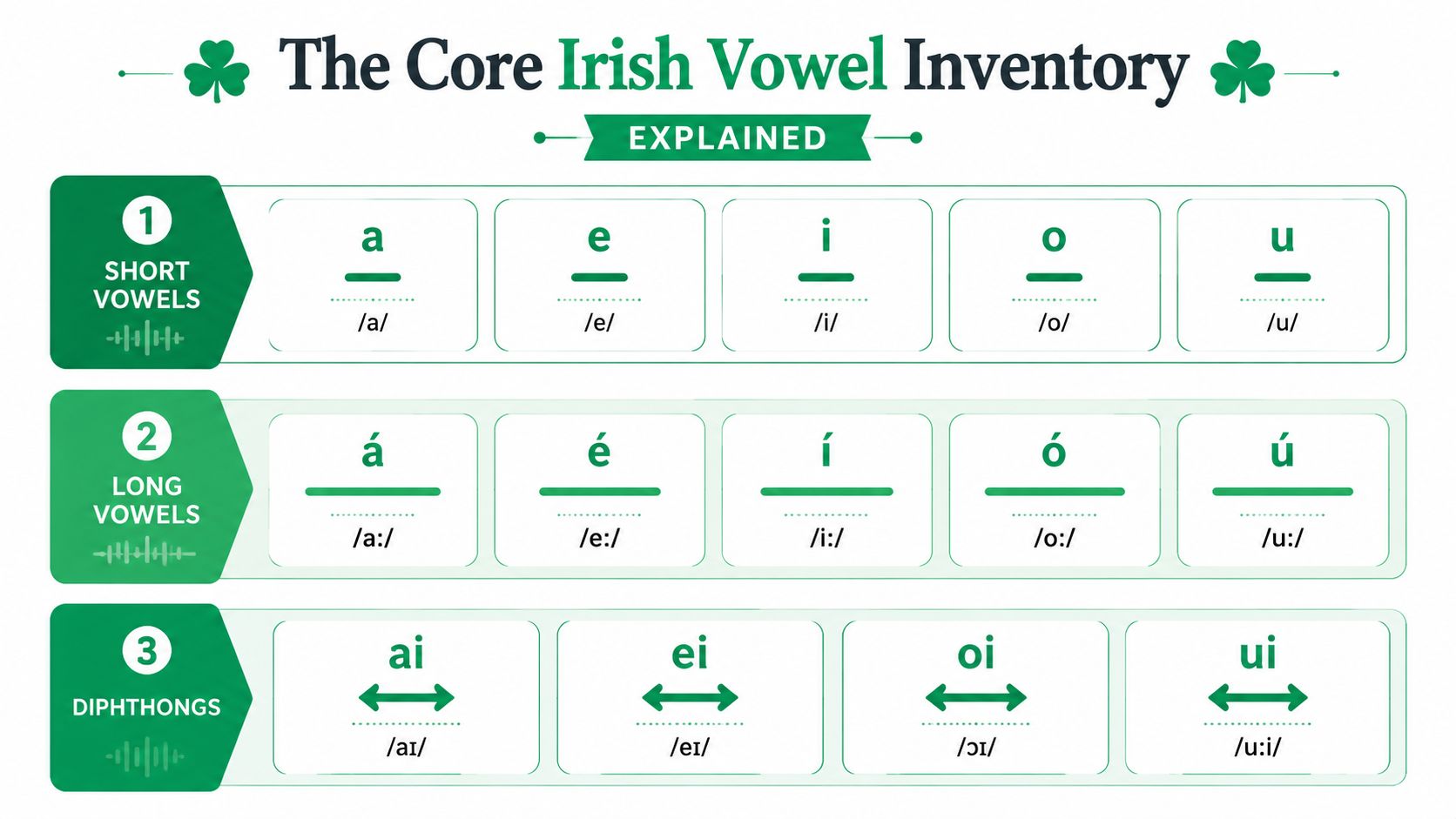
Short vowels and long vowels
The core Irish vowel system is best understood as a set of sound patterns shaped by stress and the consonants around them. A useful summary in Key features of Irish phonology shows why the same written vowel can behave differently depending on its phonetic setting.
The commonly analysed monophthongs in Connacht and Munster include /iː, ɪ, uː, ʊ, eː, ɛ, oː, ɔ, aː, a, ə/, alongside 4 diphthongs: /əi, əu, iə, uə/. You do not need to master every IPA symbol on day one, but you do need to know how the system is organised.
A simple learner-friendly way to approach it is this.
- á is long, often an open ah-like sound.
- é and í are long, with a stretched quality that is not the same as English's “ay” or “ee.”
- ó and ú are long, rounded vowels.
- unaccented vowels stay shorter and more clipped.
A pronunciation guide notes that Irish has two basic vowel types, long and short, with the fada marking the long vowels. Another spelling rule matters too. If one vowel in a combination carries the acute accent, that accented vowel is the one pronounced long, while the surrounding unaccented vowels often serve mainly to shape the neighbouring consonants (Bitesize Irish on sounds and fada).
Reading a word without guessing
The first thing to check is the accented vowel. That is usually the sound you are meant to hold. Then look at the nearby vowels and ask whether they are carrying their own sound or doing spelling work around the consonants.
Learners often rush past this and try to pronounce every written vowel. That creates extra syllables that Irish does not want, and it can make a word sound much less natural. The spelling is giving you a map, but it is a map of the whole sound pattern, not a one-letter, one-sound code.
The core habit to build is simple: read the stressed vowel first, then listen for the consonant setting around it. Once you do that, the vowel inventory stops feeling random and starts behaving like a system you can follow with confidence.
How Broad and Slender Vowels Shape Pronunciation
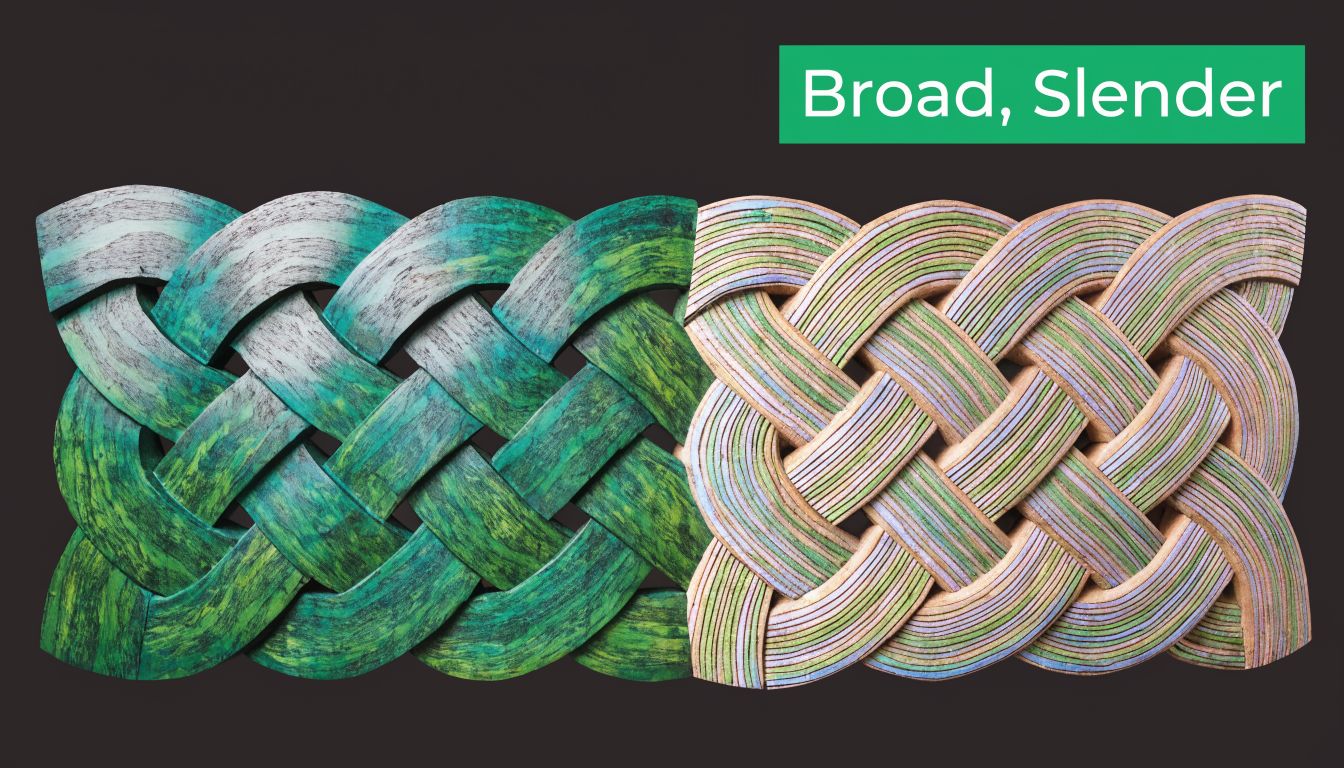
Irish spelling uses vowels to signal whether a consonant is broad or slender, and that changes pronunciation in a noticeable way. Broad consonants sit beside a, o, u, while slender consonants sit beside i, e. One spelling guide explains that, with a few older exceptions, if an i or e appears on one side of a consonant cluster, it will usually appear on the other side as well, because the spelling is framing the consonant rather than adding a separate vowel sound (Bitesize Irish on the sounds of Irish Gaelic).
Read the vowels as signals around the consonant
That framing is the part learners often miss. In words like beir or bain, the written vowels are doing more than sitting on the page. They tell you what kind of consonant shape to make, and that shape changes how the word comes out.
Broad consonants are usually darker and farther back in the mouth. Slender consonants are palatalised and lighter. The spelling is giving you that mouth position before you even speak.
The same written vowel can behave differently depending on its neighbours. Irish vowel quality is strongly shaped by consonant environment. Every consonant except /h/ has both a velarised, broad form and a palatalised, slender form, and those consonant types affect the vowels beside them (Grammar.ie phonology guide).
A useful rule for beginners
Do not read each vowel letter as if it were standing alone. Read the vowel group as a cue for the consonants around it.
That is the part that helps pronunciation start making sense. A broad consonant and a slender consonant are not just different spellings. They are different mouth settings, a bit like two camera angles on the same scene. The vowel letters tell you which angle to use.
A simple way to test yourself
When you meet a word, ask three quick questions:
- Which consonants sit beside the vowel?
- Are those consonants broad or slender?
- Is the written vowel making its own sound, or marking the consonant quality?
That third question matters more than beginners expect. In Irish, some written vowels are there to show consonant quality rather than create a new syllable. Once you accept that, the spelling starts to look less like a puzzle and more like a set of instructions.
For a fuller look at how these patterns work in real speech, this guide on dialectal differences in Irish is a useful companion. It shows why the same spelling can behave differently once stress and regional pronunciation come into play.
Dialect Differences That Change Vowel Sounds
Irish vowel pronunciation changes across Ulster, Connacht, and Munster, and that variation is part of the language in speech. A spelling can point in one direction on the page and still shift once dialect, stress, and vowel reduction enter the picture. That is why a fixed letter-to-sound chart only gets you so far.
Why one spelling can sound like more than one thing
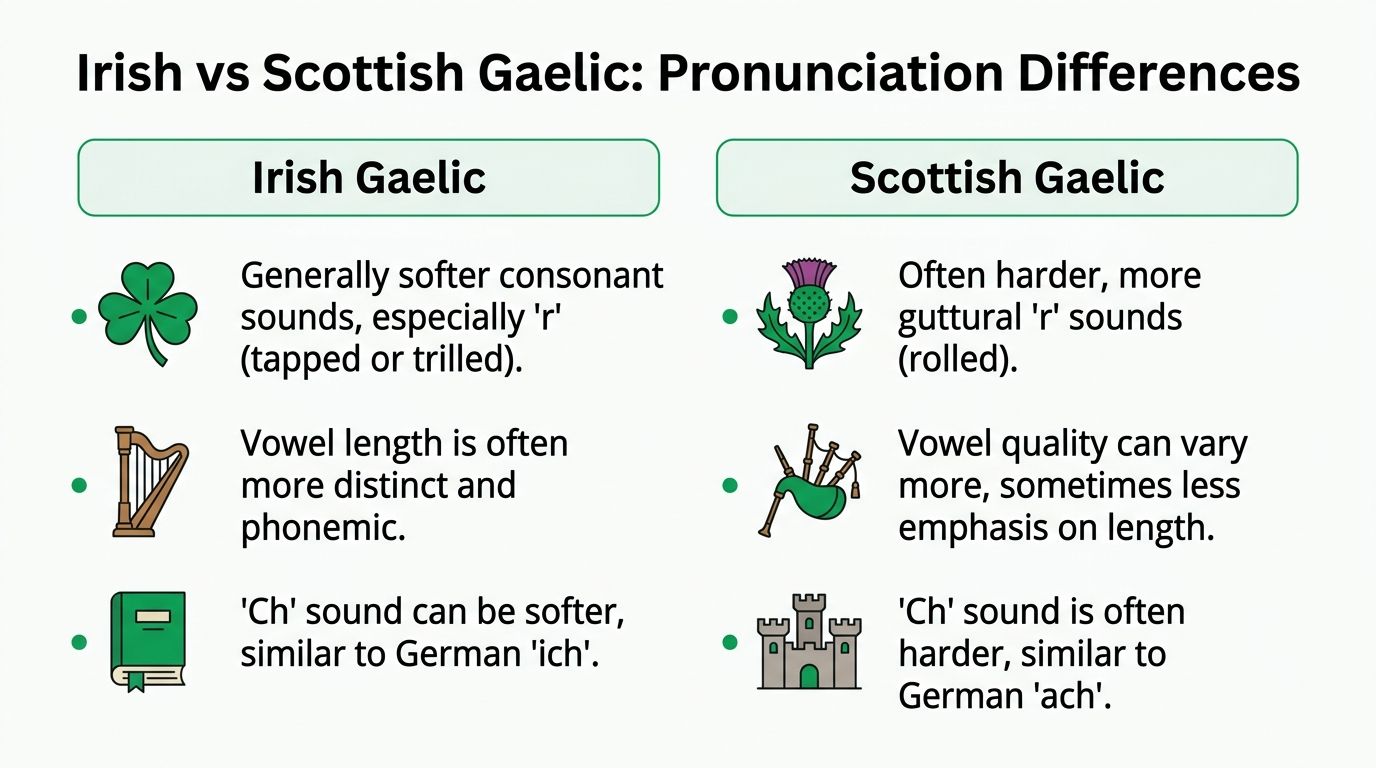
The sequence ao gives beginners a clear example. In some descriptions it is pronounced roughly like /iː/, while in others it is closer to /eː/. The point is not that one speaker is careless, it is that Irish spelling often carries more than one possible sound path, depending on dialect and the consonants around it.
Unstressed vowels also change the picture. Outside the first syllable, vowels are often reduced to schwa-like sounds, so the word on the page can be lighter and less fully spoken than a learner expects. A useful overview of these patterns appears in Irish speech features and dialect notes, which shows how real speech can trim down vowels that look full in print.
Stress changes the whole vowel pattern
Stress does more than make one syllable louder. It shifts how the nearby vowels behave, almost like pressing one key on a piano and hearing nearby strings vibrate in response. Irish vowel learning works better when you track stress + surrounding consonants + dialect together, instead of trying to force each letter into a single permanent sound.
That matters for pronunciation-first learners who need to hear patterns, not memorize isolated spellings. Dialectal differences in Irish helps with that shift in listening, because it shows why the same spelling can sound different in different regions. Once you start listening this way, the dialect becomes a clue rather than a problem. You stop asking which version is correct and start asking which dialect you are hearing, and how stress is changing the vowels around it.
Common Vowel Mistakes Learners Make
Most vowel mistakes come from good intentions. A learner sees a word, trusts the letters too much, and applies English habits without noticing. The result is usually over-pronounced vowels, the wrong vowel length, or a stressed syllable that sounds unnatural.
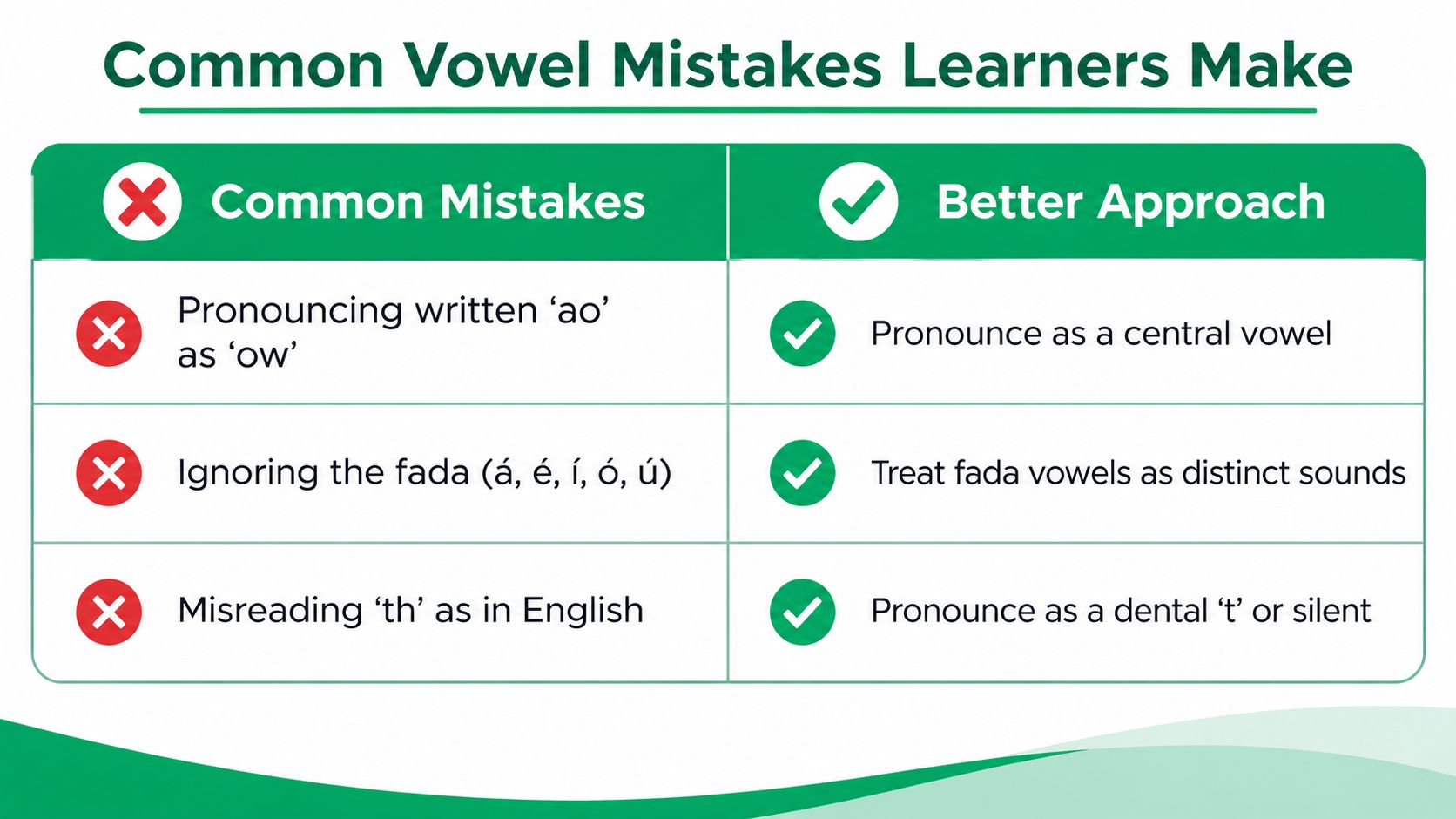
The errors that show up most often
Here are the patterns I see again and again:
- Pronouncing every written vowel separately. Irish often uses vowel letters to shape consonants, so adding an extra syllable can distort the word.
- Applying English vowel values. English habits make learners turn Irish vowels into familiar sounds that don't belong there.
- Ignoring the fada. The fada marks long vowels, so treating á, é, í, ó, ú as if they were short changes the word.
- Forgetting to reduce unstressed vowels. Outside the first syllable, many vowels lose their full weight in natural speech.
A learner may also get tripped up by epenthetic vowels, the brief inserted sounds between certain consonant clusters. Acoustic work on Irish schwa epenthesis found that, for the first five speakers in the study, epenthetic vowels averaged 0.059 seconds while underlying vowels averaged 0.069 seconds, a difference of about 10 milliseconds, and the authors reported that the duration gap was statistically significant (schwa epenthesis study). That's a small but real timing difference, which helps explain why these inserted sounds don't behave exactly like full vowels.
A better correction for each mistake
If you're reading too many vowels, slow down and mark the stressed syllable first. If you're using English vowel values, mute that instinct and listen for the Irish consonant environment around the vowel. If you're ignoring the fada, train yourself to circle it before you say the word.
Practical rule: if a vowel feels “too obvious,” check whether Irish is using it as spelling support rather than as a full sound.
For learners who want help turning audio into something they can review, accuracy tips for transcription can be surprisingly useful as a listening discipline. Careful transcription makes you notice where the vowel starts, ends, and weakens.
Practice Exercises and Tools for Real Progress
Pronunciation improves fastest when you connect what you know to active speaking. Start with tiny drills, then move into words you'll commonly hear in conversations, directions, food, and everyday greetings. The point isn't perfection on day one, it's building a reliable ear for vowel quality, stress, and consonant environment.

Three drills that actually build skill
Try this sequence:
- Broad versus slender contrast. Say paired words slowly and notice how the consonant changes the vowel feel. Don't rush the letter, focus on the mouth shape.
- Fada recognition. Read short lists and mark every accented vowel before speaking. Train your eye to spot length immediately.
- Stress pattern practice. Say multi-syllable words with the stress in the right place, then reduce the unstressed vowels so they don't all sound equal.
A listening drill helps too. Pick one dialect at a time, then replay the same word until you can hear whether the vowel is full, reduced, or shaped by the surrounding consonants. That single habit prevents a lot of confusion when you move between recordings.
Tools that support repetition
For guided practice, Gaeilgeoir AI offers conversation-based Irish learning with pronunciation support, adaptive quizzes with instant feedback, and scenario-based practice for everyday situations. Its immersion-first approach is grounded in the 1,000 most-used Irish words, which keeps practice close to the language people use. You can click any word to see translations and save items to a personalized study list, which makes revision more targeted and less random.
If you want a platform that turns pronunciation into a habit instead of a one-off lesson, Gaeilgeoir AI is one option to look at. It also uses points and leaderboards to keep repetition from feeling dull, which matters when you're drilling sounds that only become natural after a lot of reuse. Its pronunciation guide, “Mastering Irish with Our Pronunciation Guide,” is built around hearing the language clearly, not just reading about it.
Your Path Forward with Irish Vowel Mastery
The fastest way to improve Irish vowel sounds is to stop treating them as isolated letters. Think in layers. First, identify the fada and the long/short contrast. Then read for broad and slender consonant context. After that, listen for dialect and for the way stress changes the vowel shape.
A practical roadmap you can keep using
Start with these milestones:
- Phase one, length. Spot every fada automatically and hear the difference between long and short vowels.
- Phase two, consonant environment. Notice whether the surrounding consonants are broad or slender before you pronounce the vowel.
- Phase three, real speech. Listen across dialects and adjust for stress, reduced vowels, and natural timing.
That sequence keeps you from memorizing fragments that don't hold up in conversation. It also gives you a way to measure progress without chasing perfection. If you can read a word, identify the stressed syllable, and explain why a vowel sounds the way it does, you're already moving like a real learner.
The big shift is mental. Irish vowels aren't a pile of exceptions to survive. They're a pattern you can learn to hear.
If you want structured practice that connects pronunciation, listening, and speaking in one place, visit Gaeilgeoir AI. It gives you guided conversation practice, instant feedback, and word-level study tools that fit this exact problem, learning to hear Irish vowels in real speech.