
You've probably heard Óró, sé do bheatha ’bhaile in a pub, a film soundtrack, a session clip online, or from someone who seemed to sing it effortlessly. Then you tried to join in and hit the same wall most beginners hit. The spelling looks beautiful, but it doesn't sound the way an English speaker expects.
That's exactly why this phrase is such a good place to begin. It gives you a short, memorable line, a strong rhythm, and a chorus that repeats enough times to let your ear settle in. If you're searching for oro se do bheatha bhaile phonetic, you likely don't want a dictionary entry. You want to say it out loud, and maybe even sing it without tripping over every syllable.
This guide takes the phrase slowly, then puts it back into musical time so it feels natural in the mouth. Think of it as the kind of help a patient Irish tutor would give beside you at the table, one sound at a time.
Table of Contents
- Why This Famous Irish Song is a Gateway to Gaeilge
- What Óró, Sé do Bheatha Bhaile Actually Means
- How to Pronounce Óró, Sé do Bheatha Bhaile
- Breaking Down Each Syllable and Sound
- Common Pronunciation Mistakes and How to Fix Them
- How to Practice and Master the Rhythm
Why This Famous Irish Song is a Gateway to Gaeilge

You hear the chorus once at a session, in a video, or from a friend singing along, and suddenly you want to join in. The problem is familiar to many beginners. You can copy a rough phonetic spelling, but the line still feels stiff in your mouth and late against the beat.
That is why Óró, sé do bheatha ’bhaile is such a good doorway into Gaeilge. It gives you more than a set of sounds to copy. It gives you a short, memorable line with a pulse. You start to feel how Irish pronunciation lives inside rhythm, not only on the page.
Songs help beginners for a simple reason. Repetition does part of the teaching for you. A chorus comes back again and again, so your ear gets several chances to notice the same vowel length, the same soft consonants, and the same rise and fall of the phrase. In spoken drills, beginners often stop after every word. In singing, the phrase has to keep moving.
That movement matters.
Irish pronunciation can seem tricky at first because English-trained eyes expect letters to behave in English ways. A song loosens that habit. Instead of staring at spelling and trying to force each word out one by one, you listen for the shape of the whole line. Music works like a guide rope here. It carries you through the phrase at the right speed.
For many learners, this is the first time Gaeilge stops looking like a puzzle and starts sounding like a living language.
There is also a cultural reason this song stays with people. Óró, sé do bheatha ’bhaile is not just a classroom example. It is a traditional song with emotional force, public memory, and a chorus made to be voiced together. That gives the phrase a different kind of staying power. You are not only practicing pronunciation. You are stepping into a piece of Irish musical history.
If you want to connect the sound to the sense of the line, this guide to the meaning of Óró, sé do bheatha bhaile helps place the phrase in context.
A useful way to approach the chorus is to treat it like a small melody first and a reading exercise second. The goal is not perfect control of every letter on the first try. The goal is to say, then sing, the line in a way that feels natural and steady. Once the rhythm settles into your ear, the pronunciation becomes much easier to hold onto.
What Óró, Sé do Bheatha Bhaile Actually Means
Someone starts the chorus in a crowded room, and even if you do not know every word yet, you can feel what it is doing. It reaches outward. It sounds like a welcome given with feeling, not a flat label from a phrasebook.
At the simplest level, “Óró, sé do bheatha bhaile” means “oh-ro, you are welcome home” or more naturally, “welcome home.” For a beginner, that core meaning is enough. You are singing a greeting, and a warm one.
A phrase you can feel before you analyze it
The line carries warmth because of what it does, not only what it translates to. It calls someone in. It suggests return, belonging, and recognition. If you have ever heard a chorus where the whole room seems to open up on the same words, that is the effect this phrase has.
Óró works like a vocal call, the kind of opening sound that gathers energy before the rest of the line arrives. Then sé do bheatha bhaile gives the welcome itself. A learner does not need to master every grammar point on day one to hear the shape of that meaning.
If you want a fuller explanation of the wording and cultural background, this guide on the meaning of Óró, sé do bheatha bhaile is a useful companion read.
Why the meaning feels bigger than a literal translation
A literal translation gives you the doorway. The song gives you the room.
This refrain has lasted because it is more than a set of dictionary meanings. Over time, singers have used it in domestic, communal, and political settings. Earlier tradition connects it with welcoming someone home, and later versions gave that same chorus a broader public force. The words stayed simple enough to sing together, but rich enough to carry memory with them.
That helps explain a common beginner experience. You may understand “welcome home” quickly, yet still feel that the line means more when it is sung than when it is printed on a page. That is normal. Songs often hold emotion in their rhythm and repetition, and this one is a strong example.
So as you learn the phrase, keep both layers in mind. The plain meaning is “welcome home.” The lived meaning is a shared call of return, belonging, and celebration.
How to Pronounce Óró, Sé do Bheatha Bhaile
You hear the chorus start in a session, you know the words on the page, and then the line arrives too quickly to catch. That is the usual beginner problem with Óró, Sé do Bheatha Bhaile. The challenge is not only the sounds. It is getting the sounds to sit inside the tune.
A good learner version is:
The quick phonetic answer
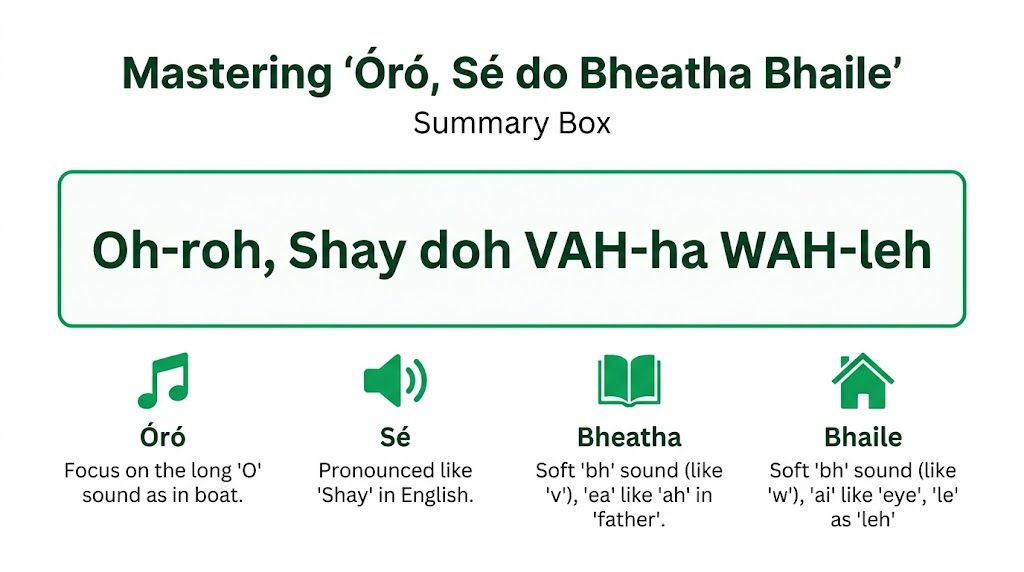
oh-roh shey duh VAH-ha WOL-yah
Use that as a starting point, not a final exam answer. Irish song pronunciation often becomes clearer when you say the line in one gentle sweep, almost like clapping a rhythm before learning all the notes.
For learners who want help hearing the wider sound patterns behind this refrain, this Irish pronunciation guide gives useful background. If you have learned sounds from other language traditions, even resources like K-12 Te Reo Māori learning materials can remind you that sound systems make more sense when you listen for rhythm, vowel length, and flow rather than forcing English spelling rules onto them.
Pronunciation guide table
| Irish Phrase | Simplified Phonetic Spelling | IPA Notation |
|---|---|---|
| Óró | oh-roh | /oːˈɾˠoː/ |
| sé | shey | /ʃeː/ |
| do | duh | /d̪ˠə/ |
| bheatha | VAH-ha | /vʲahə/ approximation |
| 'bhaile | WOL-yah | [w]-like opening in casual pronunciation |
The musical shape matters as much as the phonetic spelling. Óró usually feels like the lift at the start. Sé do moves more lightly. Bheatha bhaile carries the weight of the phrase, with VAH giving you the strongest landing point before the line releases at WOL-yah.
If it helps, treat it like a wave. The voice rises on oh-roh, settles briefly on shey duh, then rolls forward through VAH-ha WOL-yah without chopping each word apart.
A few habits make the line sound more natural:
- Keep it connected: say the whole phrase in one breath if you can.
- Hold the long vowels: oh and shey need a little space.
- Let VAH lead the phrase: this is often the clearest stress point for beginners.
- Finish with a glide: WOL-yah should taper off, not stop sharply.
First speak it slowly in time. Then repeat it with a gentle pulse, as if you are already joining the chorus.
Breaking Down Each Syllable and Sound
You may know the rough phonetic spelling already, then still freeze when the song starts. That happens because pronunciation on the page and pronunciation in rhythm are not quite the same skill. Irish song asks you to feel the phrase as a chain of small sound-units that travel together.
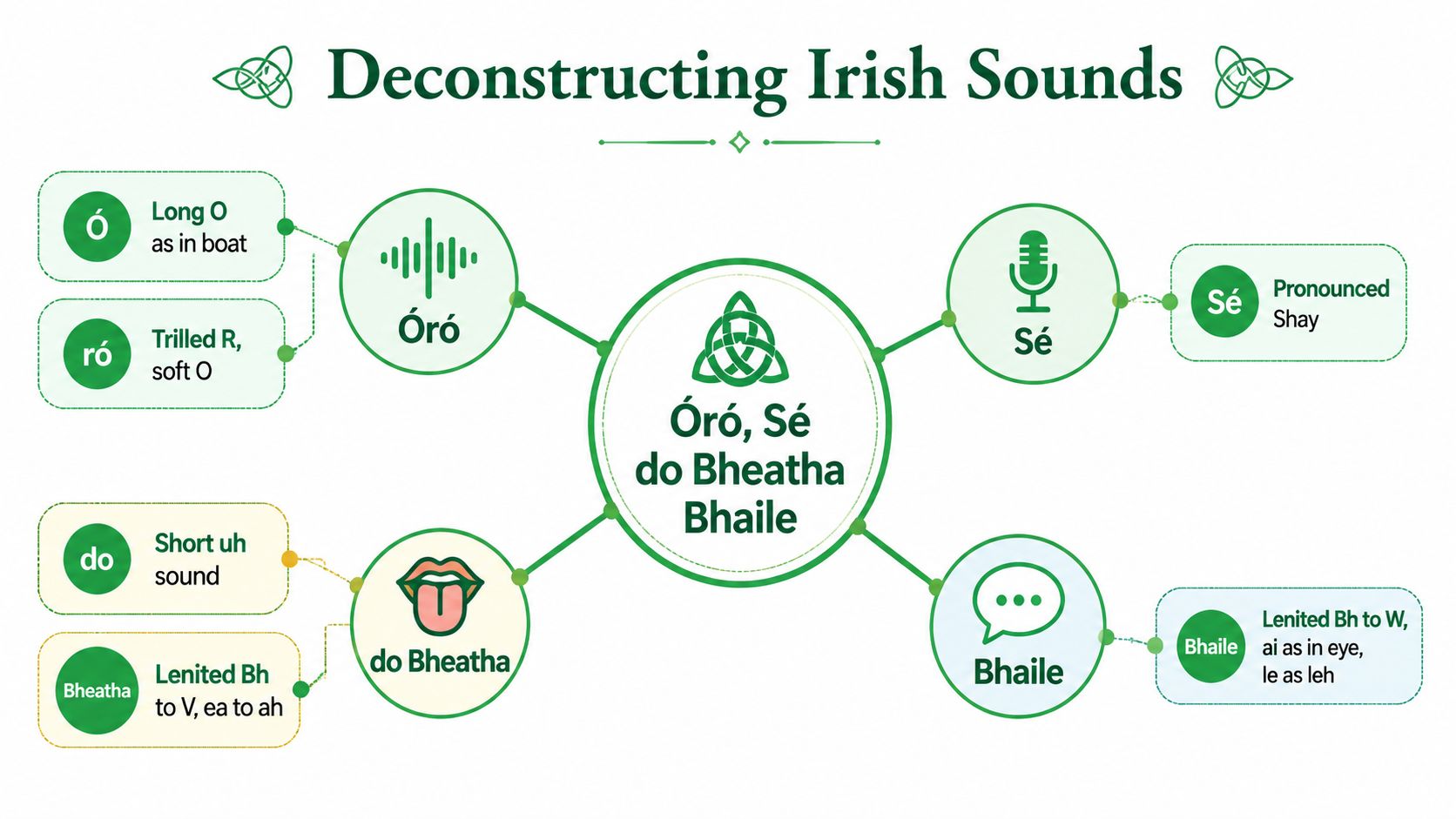
A good starting point is to hear the line in four musical chunks, not five separate words: Óró | sé do | bheatha | bhaile. Once those chunks feel steady, the spelling stops looking so intimidating.
Word by word breakdown
Óró
Give both syllables space. Ó is a long oh, and ró answers it with another rounded roh. Singers often give this pair a lifted, calling quality, almost like the phrase is opening a door.
Sé
Say shey, with a soft sh at the front. The vowel is held a touch longer than an English speaker might expect, which helps it sit properly in the tune.
do
Keep this one light and quick. It works like a passing note in music. You touch it and move on.
bheatha
Here the spelling looks heavy, but the sound is gentler. bh softens into a v-like opening, so the shape is closer to VAH-ha. Let the first syllable carry the weight, then let the second fall away lightly.
’bhaile
This is the part many beginners need to hear several times before it clicks. The apostrophe marks a shortened form of abhaile, and the opening sound can glide in with a w-like feel. A learner-friendly target is WOL-yah or WUH-lya, depending on the singer. The exact shade can vary, but the important thing is the movement. It should flow forward, not land like a hard English word ending.
Why these sounds are easier in rhythm than in isolation
Irish songs often teach pronunciation better than a printed guide does. The melody tells your mouth how long to hold a vowel, where to relax, and which syllable carries the phrase.
That is why many beginners improve faster when they clap or tap the line first. Teachers using K-12 Te Reo Māori learning materials often teach sound patterns through beat, repetition, and grouped syllables. The same habit helps here. Your ear learns the pattern before your eyes fully trust the spelling.
Try this practice ladder:
Speak the chunks on a steady pulse
oh-roh | shey-duh | VAH-ha | WOL-yahTap once per chunk
This keeps the phrase from turning into a string of separate English-style words.Stretch the long vowels slightly
Give Ó and sé a little room, like notes that need time to ring.Sing the last two chunks together
VAH-ha WOL-yah should feel like one flowing release, not two disconnected pieces.
One small tip helps a lot. If the full line feels too fast, loop only sé do bheatha until it feels natural in time, then add Óró at the front and bhaile at the end.
Learn the phrase like a melody first, then like a spelling pattern. For this song, the rhythm often teaches the sounds more clearly than the letters do.
Common Pronunciation Mistakes and How to Fix Them
Most pronunciation problems with this line are completely normal. They usually come from English reading habits, not from lack of ability.
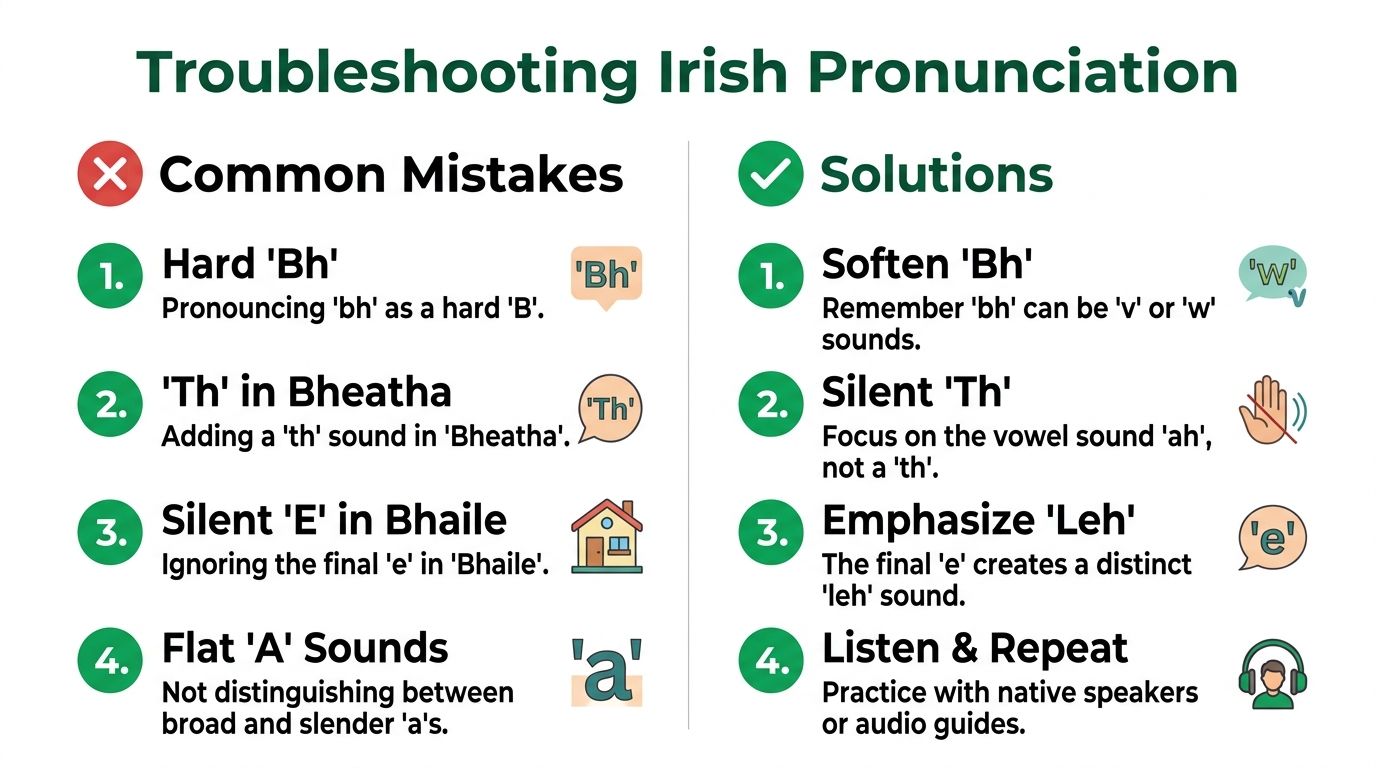
Four mistakes beginners make
Hard B in bheatha
Don't say beh-ha.
Say VAH-ha with a softened opening.See instead of shey
Don't flatten sé into an English long e.
Give it that sh quality: shey.Over-pronouncing each word
Don't speak it like a list: oh-roh / shay / doh / vah-ha / wah-lee.
Let it run together as one musical phrase.Dropping the final movement
Don't chop ’bhaile short.
Let it travel. The end should glide, not stop dead.
A simple self-check routine
Use this quick check after each practice round:
| If you hear this | Try this instead |
|---|---|
| A hard b sound | Soften the opening to v or w-like |
| A heavy English doh | Reduce it to a light duh |
| A stiff, word-by-word rhythm | Group the phrase into sound chunks |
| A clipped ending | Let ’bhaile flow forward |
One more fix helps almost everyone. Record yourself once speaking the phrase and once singing it. If the sung version sounds better, that's a clue that rhythm is helping you stop overthinking the spelling.
How to Practice and Master the Rhythm
A lot of guides stop once they've given you the phonetic spelling. That leaves out the part learners often need most. Existing coverage often treats the song as a lyric or translation problem, but there is little practical help for learners who want to sing it correctly and confidently in real time, especially around breathing, pace, and keeping rhythm while respecting Irish vowel length, as noted in this discussion of the pronunciation gap in song learning.
From speaking to singing
Start by speaking the chorus in a steady pulse. Don't rush because the song is often sung with energy. Fast versions only work if the vowels stay clear.
Then mark a tiny breath after each full line, not in the middle of sé do bheatha ’bhaile. If you breathe inside the phrase, the rhythm falls apart and the words start to sound choppy.
If you want to record your own repetitions cleanly on a phone or laptop, this elearning video audio recorder guide gives useful basics for setting up simple practice recordings. It's handy if you're comparing spoken and sung attempts side by side.
A short practice routine that works
Try this routine for a few minutes at a time:
Speak on the beat
Tap your hand on the table and say the phrase once per pulse group.Hum the contour first
Hum the shape of the chorus before adding words. This reduces tension.Add the lyric in chunks
Start with Óró. Then sé do bheatha. Then the final ’bhaile.Record one clean repetition
Listen back for flow, not just individual sounds.Sing with context
Reading about traditional Irish music culture and the seisiún can help you hear why this phrase is often carried with lift, energy, and communal timing instead of textbook neatness.
If you want structured speaking practice after working on this chorus, Gaeilgeoir AI offers guided Irish conversation practice, pronunciation support, and short interactive exercises that suit learners who want to move from memorized phrases into everyday spoken Gaeilge.
If you want a place to keep practicing after this phrase, try Gaeilgeoir AI. It's a simple next step for turning one famous chorus into real spoken Irish you can use again and again.