BOW-rawn is the most common and useful way to say bodhrán, and the d is silent. The instrument is a traditional Irish frame drum, usually 35–45 cm (14–18 in) across, though bodhráns can range from 25–65 cm in diameter.
You've probably seen the word in a tune list, on a festival poster, in a pub session, or in an article about Irish music and paused for a second. That hesitation is normal. Irish spelling follows its own sound system, so if you try to read bodhrán with English rules, your mouth usually goes in the wrong direction.
The good news is that this word becomes much easier once you know why it sounds the way it does. When learners understand the silent d, the long vowel marked by the fada, and where the stress falls, the pronunciation stops feeling random. It starts to feel learnable.
Table of Contents
- Why Getting Bodhrán Right Matters
- The Correct Bodhran Pronunciation Explained
- A Syllable-by-Syllable Sound Guide
- Common Bodhran Pronunciation Mistakes to Avoid
- Simple Exercises to Practice Your Pronunciation
- The Cultural Heartbeat Behind the Word
Why Getting Bodhrán Right Matters
A lot of learners meet bodhrán before they study much Irish. They hear it in a song introduction, see it on a workshop flyer, or notice it in a session lineup and think, “I know what that is, but I've no idea how to say it.” Then they avoid saying it out loud at all.
That small moment matters more than it seems. When you can say a cultural word confidently, you join the conversation instead of standing just outside it. If you're exploring Irish music for the first time, resources like Encore Academy for beginner music students can help you compare instruments and get your bearings, but pronunciation gives you the language to talk about what you're hearing.
There's also a deeper reason to care. Irish musical terms carry history, and the sound of the word is part of that history. If you're reading about sessions, festivals, or traditional events, a guide like this beginner-friendly overview of Fleadh Cheoil na hÉireann helps place the instrument in the wider world of Irish culture.
Practical rule: If a word feels intimidating, don't try to “sound Irish” all at once. Learn one reliable version first, then refine it.
For bodhran drum pronunciation, that reliable version is simple enough to use straight away. Once you've got that foundation, the rest becomes a matter of listening and fine-tuning rather than guessing.
The Correct Bodhran Pronunciation Explained
Say it as BOW-rawn.
Use bow like “bow and arrow,” not like “take a bow.” Then add rawn, with an open vowel sound that's close to the sound in “dawn” for many English speakers. Put the main stress on the first syllable.
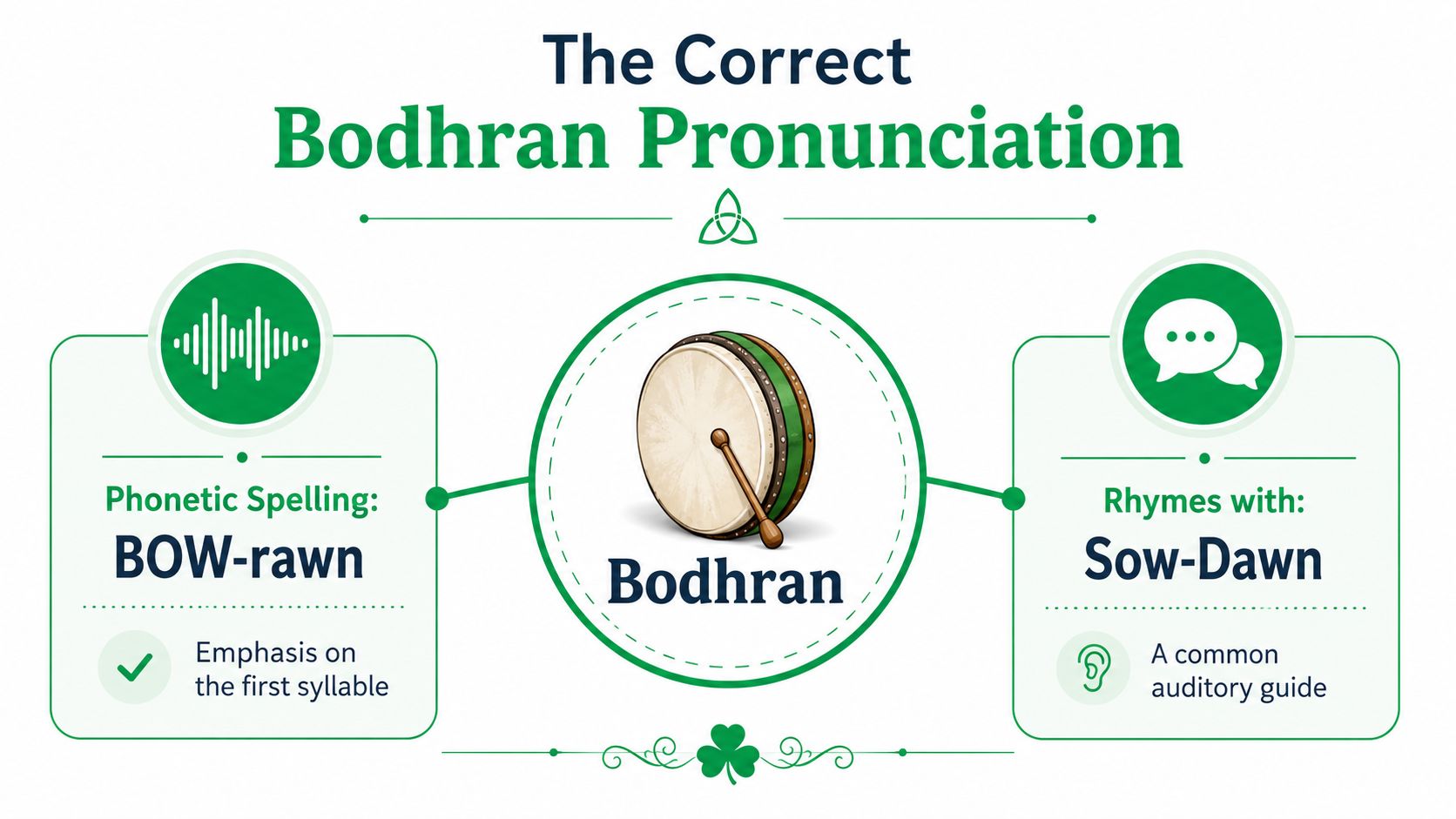
One point helps nearly everyone: don't pronounce the d. Mainstream instructional guidance describes bodhrán as “bow-rawn,” with the d silent, and identifies the instrument as an Irish frame drum whose name appears in writing as far back as the 15th century (Wikipedia on the bodhrán).
A quick mouth-feel check
If you say BOD-ran, your tongue is doing too much.
If you say bo-DRAN, your stress has shifted the wrong way.
If you say BOW-rawn, you're very close to what you want.
Here's a simple way to test yourself:
- First syllable: Start strong with BOW
- Second syllable: Keep rawn lighter and smoother
- Whole word: Say it in one flowing motion, not as two chopped pieces
Don't force the second half. Learners often overdo it because they can see the accent mark and assume that means “stress this part hard.” It doesn't.
That's the key to clear bodhran drum pronunciation. You're aiming for a word that lands firmly at the start and then relaxes.
A Syllable-by-Syllable Sound Guide
Irish words often make more sense when you stop treating every letter like an English letter. Bodhrán is a good example. The spelling looks dense, but the sound is much lighter than many learners expect.
Start with the first beat
The opening part is often written out for learners in a way that points toward BOW. That surprises people because they expect the visible d to produce a hard sound. In practice, it doesn't.
What matters most for a beginner is this: the cluster in the middle does not behave like ordinary English spelling. That's why trying to sound out each letter separately leads you off course. If you'd like a broader sense of why Irish words work this way, this overview of key features of Irish phonology gives useful context.
A good learner's approach is to hear the first part as one unit, not as b-o-d plus something else. Think of it as a sound pattern to copy, not a puzzle to solve letter by letter.
Let the fada do its job
The second part, -rán, contains the clue that many learners miss. Expert guidance commonly gives pronunciations such as BOW-rawn or boh-RAHN, while also noting that the fada on á marks a long vowel, not stress. Native-speaker guidance cautions against giving the second syllable heavy emphasis because that produces a nonstandard, anglicized pattern (Brenda Sutton's bodhrán pronunciation guide).
That means the fada changes the quality and length of the vowel. It does not tell you to punch the second syllable harder.
Try these contrasts out loud:
- Wrong instinct: bod-RAN
- Better shape: BOW-rawn
- Also useful as a guide: boh-RAHN, if it helps you hear the long vowel without over-stressing it
The accent mark is about vowel length. Your voice doesn't need to leap upward on the second syllable.
If you're learning Irish more broadly, this is a helpful habit to build early. When you see a fada, ask, “What is this doing to the vowel?” before asking, “Where should I stress the word?” That one shift in thinking clears up a lot of confusion.
Common Bodhran Pronunciation Mistakes to Avoid
Some mistakes happen because English reading habits are strong. You look at the letters, your brain reaches for familiar rules, and out comes something that sounds tidy in English but off in Irish.
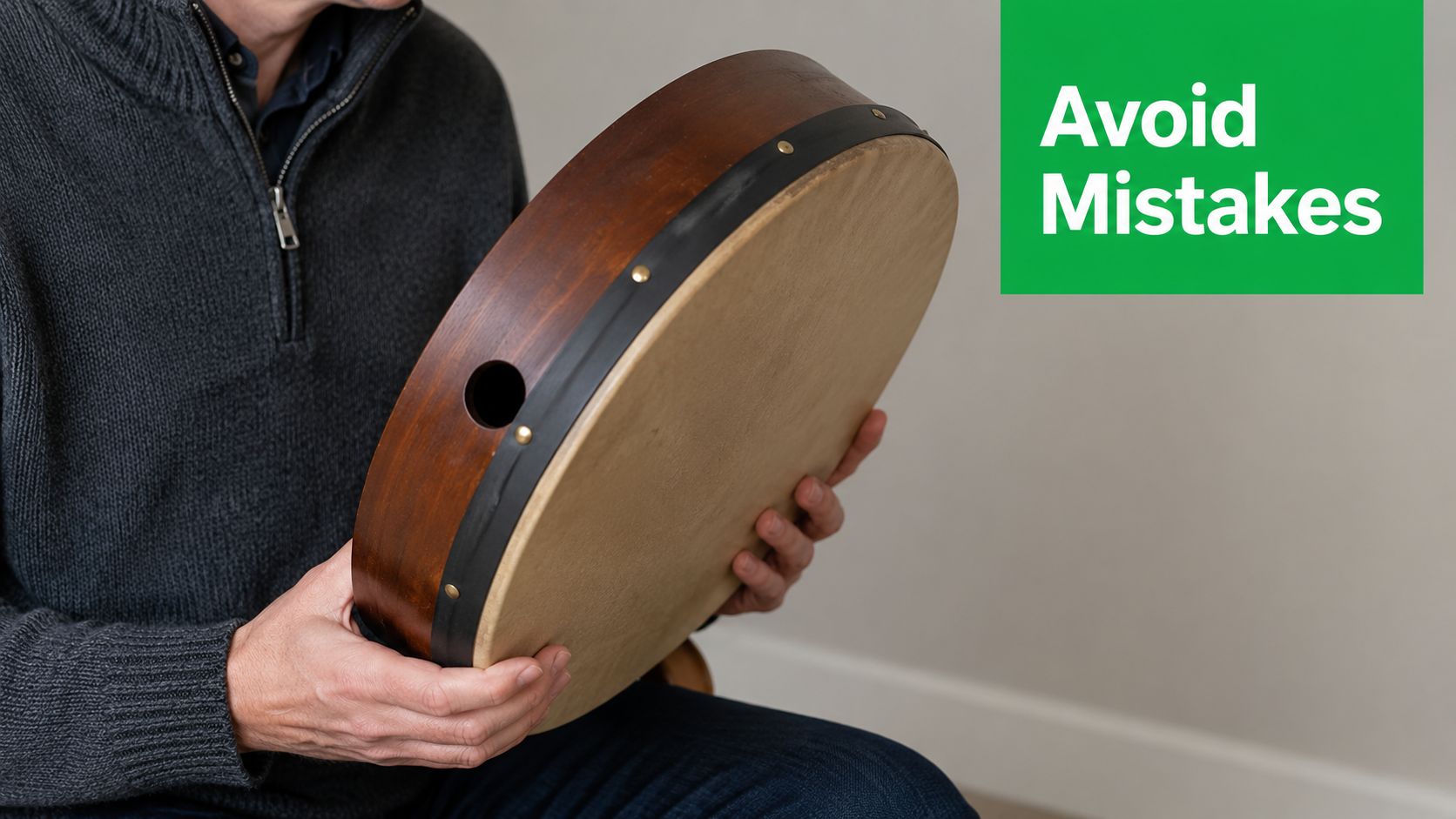
Where English habits trip people up
The easiest way to fix your pronunciation is to know what to listen for. Use this table as a self-check.
| Common Mistake | What It Sounds Like | The Correct Way | Why It's Correct |
|---|---|---|---|
| Pronouncing the d | BOD-ran | BOW-rawn | The d isn't sounded in the common learner pronunciation |
| Using a short a | BOW-ran with a flat, short ending | BOW-rawn | The á has a long vowel quality |
| Stressing the second syllable too hard | bo-DRAN or bo-RAHN with heavy emphasis | BOW-rawn with the main stress at the start | The first syllable carries the primary stress in the common guidance |
| Chopping the word into separate bits | BOW…RAN | Smooth BOW-rawn | The word flows better as one connected sound |
| Over-anglicizing the ending | BOW-rin or BOW-rən | BOW-rawn | The ending needs an open, longer vowel sound |
A practical fix is to compare your version against a known bad version. Say the wrong one on purpose, then correct it. That contrast trains your ear faster than repeating the right form without noticing the difference.
Try this mini-drill:
- Say the mistake: BOD-ran
- Pause
- Say the correction: BOW-rawn
Then repeat with the stress error:
- Say the mistake: bo-DRAN
- Pause
- Say the correction: BOW-rawn
If your version sounds more “English neat” than “musical and open,” relax the word and bring the stress back to the front.
That's often enough to clean up most pronunciation issues in a few minutes.
Simple Exercises to Practice Your Pronunciation
Pronunciation sticks when your mouth repeats the right pattern often enough. You don't need long study sessions. You need short, focused reps.
Short drills that work
Start with rhythm and rhyme. These drills are simple, but they train the exact parts learners usually miss.
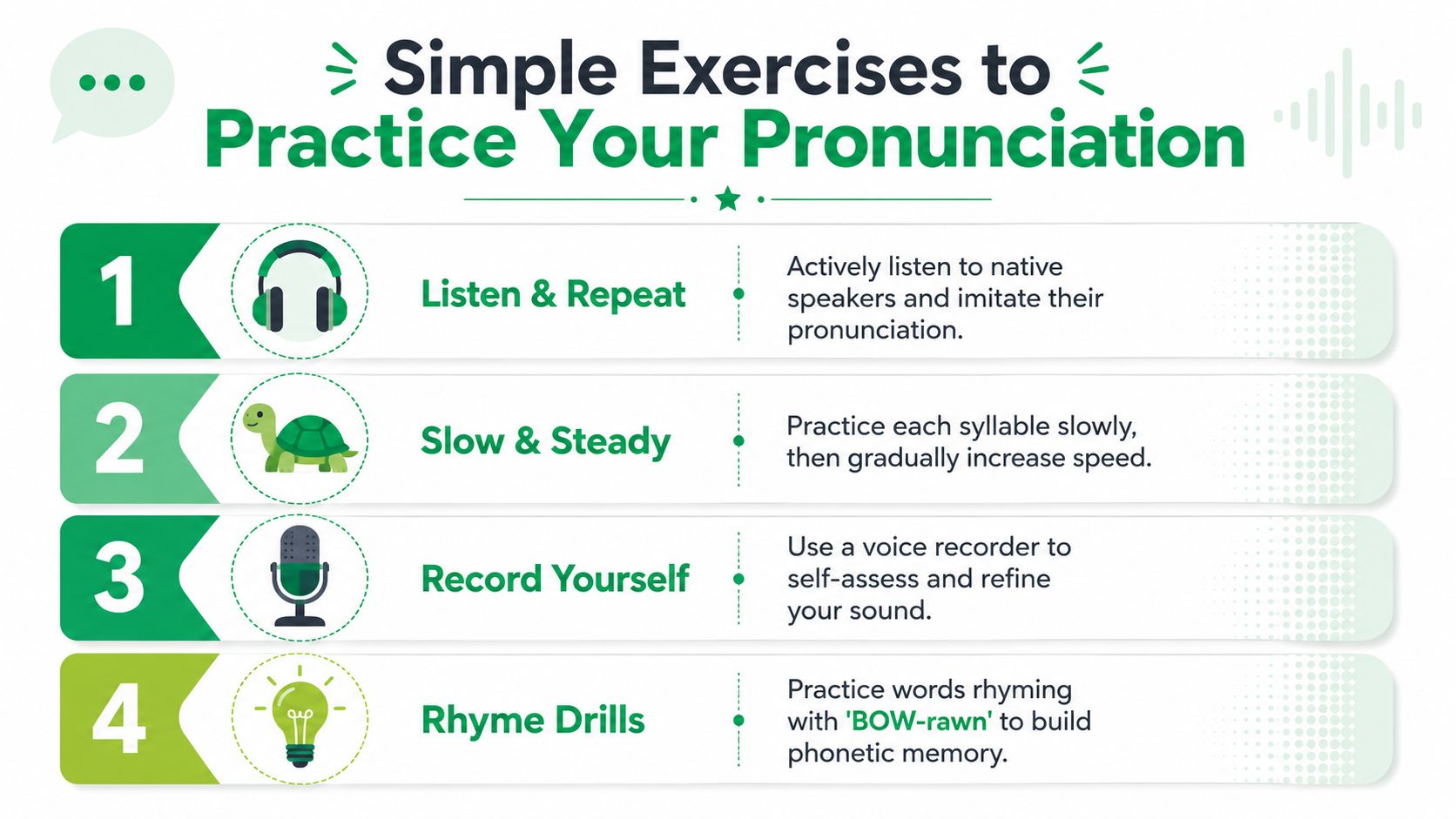
- Rhyme chain: Say BOW-rawn, then pair it with words like dawn, drawn, fawn, and prawn. Don't worry if your accent makes the rhyme imperfect. The goal is the long open vowel.
- Slow build: Say BOW. Then rawn. Then join them: BOW-rawn.
- Record and compare: Use your phone's voice recorder. Speak the word three times. Listen back for a pronounced d or a heavy stress on the end.
If you like voice training in general, even outside Irish, guidance on finding adult vocal instructors can be useful because many of the same listening habits apply. You're training ear, breath, and repeatable sound patterns.
Here's a clip you can listen to and imitate:
Use the word in real speech
The next step is putting the word into sentences so it stops feeling isolated.
Try saying these out loud:
- He plays the bodhrán.
- I heard a bodhrán in the session.
- The bodhrán gives the tune a strong pulse.
Keep the word natural inside the sentence. Don't slow down too much just because it's the “special” word.
One useful tool for this kind of practice is Gaeilgeoir AI, which offers guided Irish speaking practice with pronunciation support and scenario-based exercises. If you're trying to move from single-word accuracy into actual spoken confidence, that kind of structured repetition can help.
The Cultural Heartbeat Behind the Word
Pronouncing bodhrán well isn't only about avoiding mistakes. It changes how you hear the instrument itself. Once the word feels natural in your mouth, it stops being a strange label and starts to feel like part of a living tradition.
A word with a long memory
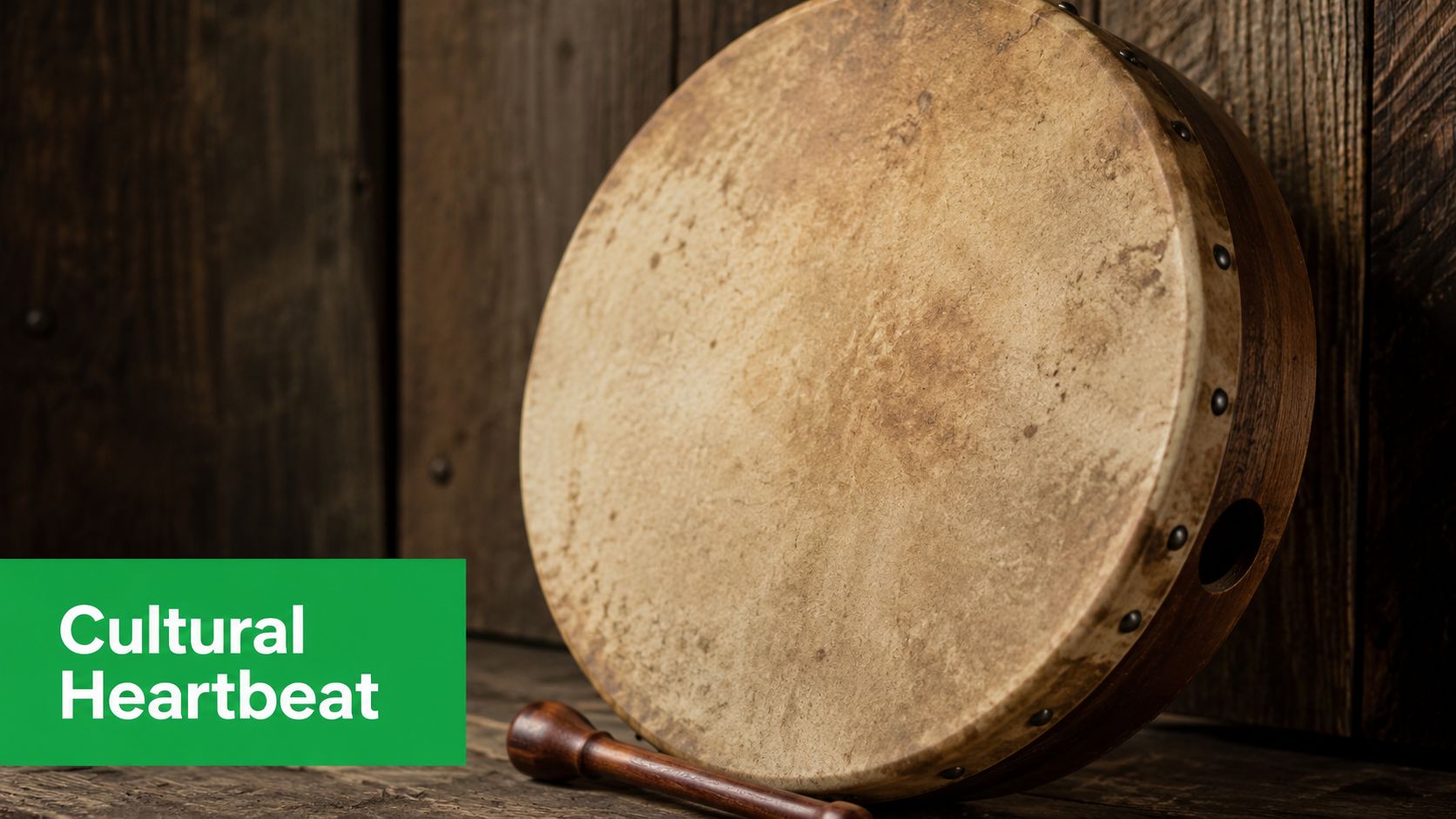
The bodhrán's story stretches well beyond modern stage performance. Its modern popularity rose in the 1950s and 1960s, with a broader folk revival in the 1960s, while older custom links it to St. Stephen's Day (26 December) and the Hunting the Wren tradition. Combined with written evidence from the 15th century and later 18th-century descriptions, that gives the word and the instrument a long cultural life (history of the Irish bodhrán drum).
That long life is part of why pronunciation matters. You're not just naming an object. You're speaking a word that has moved through ritual, daily life, and music across centuries.
For a wider sense of where the instrument sits in traditional music, this guide to the Irish seisiún and traditional music culture is a helpful next read.
Pronunciation as cultural respect
Learners sometimes worry that caring about pronunciation is fussy or performative. It isn't. It's a basic form of attention. When you say a cultural word carefully, you show that you're listening, not just consuming.
And you don't need perfection. You need willingness. If you can say BOW-rawn, keep the d silent, and let the vowel stay long and open, you're already treating the word with more respect than many people do on first encounter.
If learning one word properly has made Irish feel a little more approachable, Gaeilgeoir AI is a practical next step. It helps beginners and returning learners build spoken confidence through guided conversations, pronunciation support, and everyday Irish practice that fits around real life.