I still remember the first time a learner asked me why Irish has both cú and madra for “dog.” The answer opened a door into myth, sound change, and the way Celtic languages keep ancient history alive in everyday speech.
Table of Contents
- The Ancient Hound of Celtic Legend
- Dog Words Across the Celtic Language Family
- Why Irish Has Two Words for Dog
- Creative Celtic Compounds Built on Dog
- Mastering Celtic Dog Word Pronunciation
- Using Dog Words in Real Celtic Conversations
- Your Next Steps for Learning Celtic Languages
The Ancient Hound of Celtic Legend
Cú Chulainn's name still stops learners in their tracks. It points to a hound, and that matters because the celtic word for dog has never been just a word for a household animal. In Irish legend, the hound carries loyalty, protection, and status, which is why the name of one of Ireland's greatest mythological heroes turns a dog into an honorific.
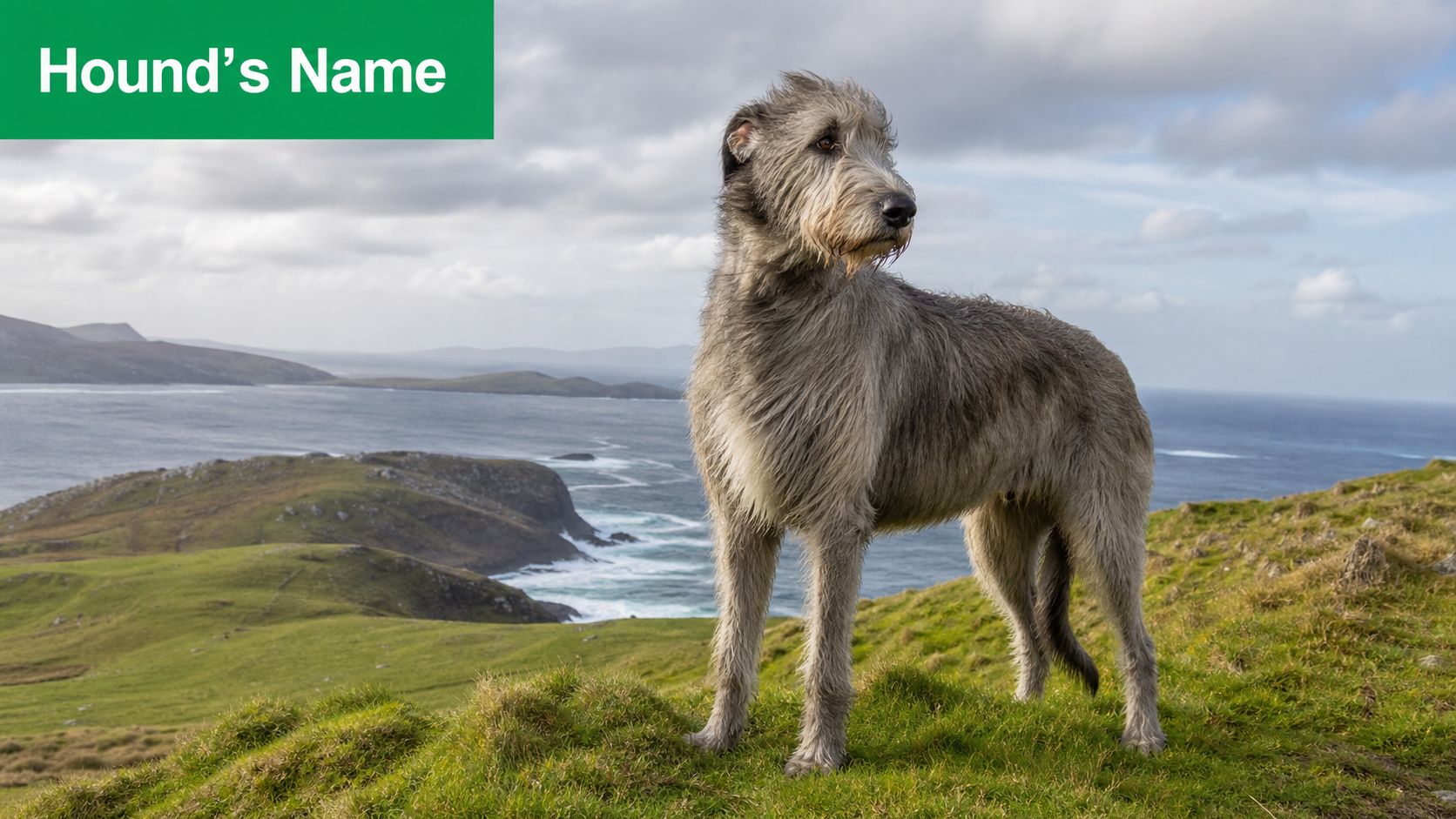
The oldest inherited form behind all this is *Proto-Celtic kū. Comparative forms across the Celtic family include Old Irish cú, Irish cú, Scottish Gaelic cù, Manx coo, Welsh ci, Cornish ki, and Breton ki Omniglot's comparative list. That spread matters. It shows a shared inherited lexeme, not a later borrowing, and it helps explain why so many Celtic languages still feel related even when their modern everyday words look different.
A shared animal word with cultural weight
In Irish, cú broadened beyond “dog” to include hound, greyhound, wolf, and even honorific meanings such as hero or champion. Scottish Gaelic kept the simpler sense of dog, canine. That contrast is useful for learners because it shows how one ancient root can stay conservative in one branch and expand in another.
Practical rule: when a Celtic language seems to use a dog word in a name or title, don't assume it means a pet. It may signal rank, mythic power, or old poetic style.
For anyone building a cultural picture alongside vocabulary, this is the kind of detail that makes a word stick. A good companion resource for exploring related themes is dog probiotics, especially if you're pairing language learning with real-life dog care and want to keep the topic grounded in everyday life.
If you want a wider cultural doorway into Irish storytelling, this guide to Irish myths and legends fits naturally with the hound imagery. The language and the legend are doing the same job, they preserve memory.
Dog Words Across the Celtic Language Family
Irish learners often expect one neat translation for “dog.” Celtic languages refuse to stay that tidy. Some branches kept descendants of the ancient *kū root, while others developed everyday replacements, and that split gives you a clear view of the family tree.
A quick comparison across the family
| Language | Word | IPA Pronunciation | Usage Notes |
|---|---|---|---|
| Irish | madra | not supplied in the verified data | Standard everyday word for “dog” |
| Irish | cú | not supplied in the verified data | Older, literary, mythological, and honorific |
| Scottish Gaelic | cù | not supplied in the verified data | Archaic and literary form, still used in Scotch Gaelic |
| Scottish Gaelic | madadh | not supplied in the verified data | Another Gaelic term for “dog” |
| Welsh | ci | not supplied in the verified data | Cognate from the old Celtic root |
| Breton | ki | not supplied in the verified data | Cognate from the old Celtic root |
| Cornish | ki | not supplied in the verified data | Cognate from the old Celtic root |
| Manx | moddey | not supplied in the verified data | Modern everyday term |
| Manx | coo | not supplied in the verified data | Preserves the older Celtic root |
The broad pattern is simple. Goidelic languages, Irish, Scottish Gaelic, and Manx, show one set of developments, while Brythonic languages, Welsh, Cornish, and Breton, preserve forms closer to the old *kū shape. That's why ci and ki look strikingly familiar even before you've studied the historical grammar behind them.
What to notice when you compare them
A learner usually gets confused when a language has two words that seem to mean the same thing. In Celtic languages, the answer is often usage rather than pure dictionary meaning. Literary forms survive because poets, storytellers, and place names preserve them, while everyday speech can shift toward a newer standard. The Irish case makes this especially visible, and the same family comparison helps explain why a history guide to Celtic languages is worth reading after you've memorized the basic dog words.
If a form looks short and ancient, it often is. If it feels ordinary and conversational, it may be the newer everyday choice.
That distinction matters more than memorizing isolated translations. It helps you predict why a language keeps one form for folklore, another for the street, and another for compounds or idioms.
Why Irish Has Two Words for Dog
Irish gives learners a beautiful puzzle. Madra is the standard modern word for “dog,” but cú is still alive in older, poetic, and heroic contexts. That pairing isn't a contradiction, it's a record of language change.
From old forms to modern speech
The historical pathway recorded by Alexander MacBain connects Middle Irish madrad and Early Irish matad/maddad to modern madra MacBain's etymological discussion as relayed in the linked summary. The same source ties the word to related Celtic forms such as Welsh madog and madryn, both linked to fox-related meanings. That family resemblance is useful because it shows that animal vocabulary often travels in clusters, not in isolation.
Why the everyday word changed
Language change usually follows social life. As dogs became common household animals, speakers favored the word that fit daily talk, while the older cú stayed in literary and mythological settings. That is why you still meet cú in names, epithets, and old styles, but madra handles ordinary conversation.
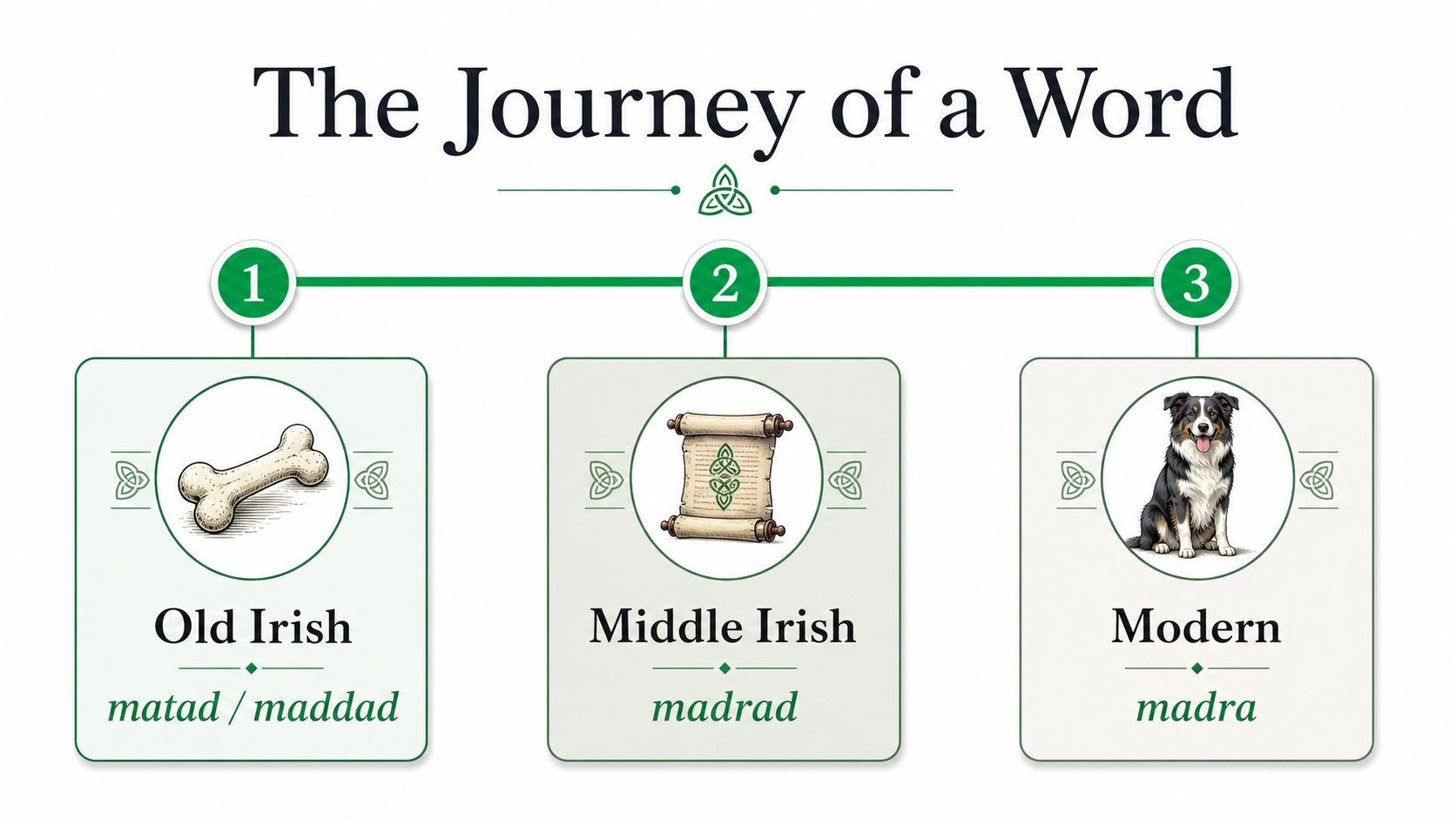
The timeline makes the pattern easier to remember. Old Irish matad/maddad comes first, Middle Irish madrad sits in the middle, and Modern madra is the form you use in everyday speech.
A memory trick that actually works
Think of cú as the “story word” and madra as the “daily word.” That mental split helps you choose the right term without freezing up. It also explains why a learner might understand a sentence in a mythological context but hear something completely different at the kitchen table.
Creative Celtic Compounds Built on Dog
Irish does something wonderfully practical with madra. Instead of inventing unrelated animal names for every creature, it often builds compounds that describe an animal by color, habitat, or behavior. That pattern is one reason Celtic vocab can feel so logical once you see the system.
When dog becomes a naming tool
Madra rua means fox, “red dog.” Madra crainn means squirrel, “tree dog.” Madra mara means seal, “sea dog.” Madra uisce means otter, “water dog,” and a modern Irish-language reference glosses it with the pronunciation [ˈmˠad̪ˠɾˠə ˈɪʃcɪ] Omniglot's water-dog entry. That's not random poetry. It's a naming habit built on close observation.
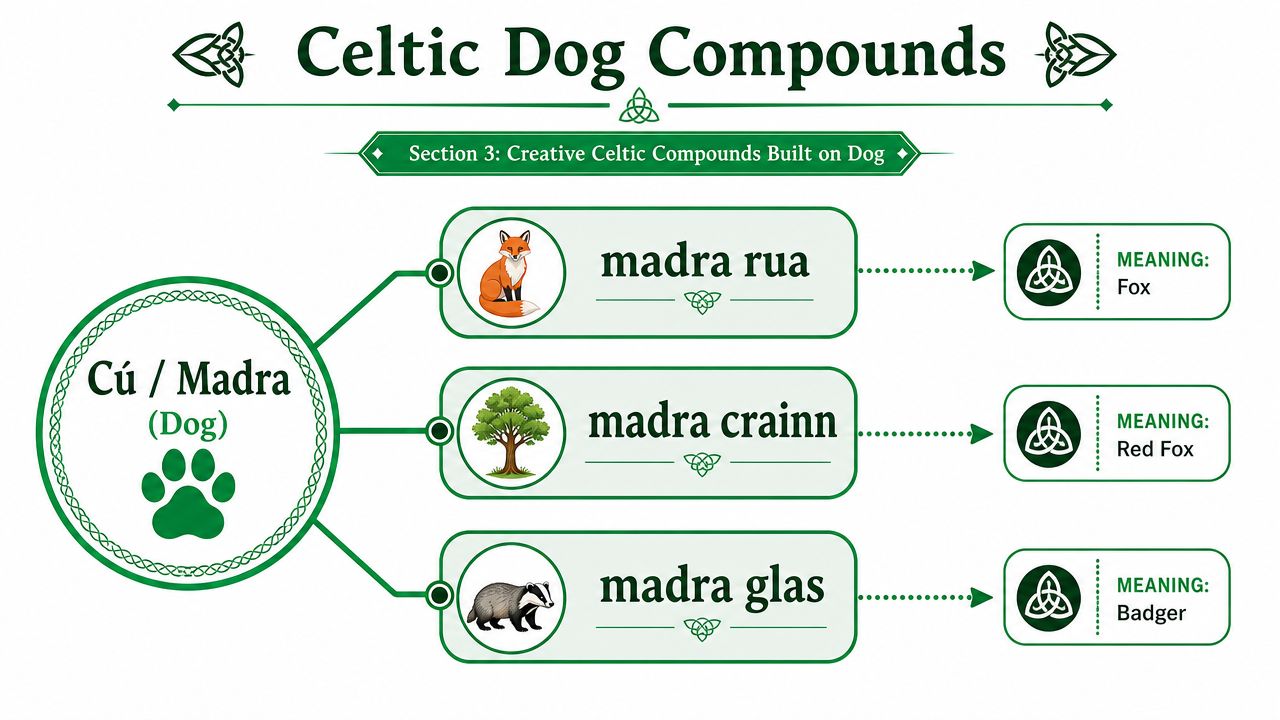
The logic is easy to miss if you expect modern scientific taxonomy. Celtic speakers were grouping animals by what they looked like, where they lived, or how they moved. A fox could become a “red dog” because color mattered. An otter could become a “water dog” because habitat mattered.
Why this helps you remember vocabulary
Once you know the pattern, you can decode unfamiliar words more quickly. You're no longer memorizing isolated facts, you're spotting a productive naming style.
- See the base word first: recognize madra before you chase the second element.
- Match the descriptor to the habitat: crainn points to trees, mara points to sea, uisce points to water.
- Listen for image, not zoology: these compounds often reflect how speakers imagine an animal, not how a textbook classifies it.
An easy extra clue comes from Irish diminutives, because Celtic languages often create meaning through small structural changes rather than entirely new roots. That habit makes the vocabulary feel alive, especially when you start reading with your ears as well as your eyes.
Mastering Celtic Dog Word Pronunciation
Pronunciation trips up even confident learners because the letters look familiar while the sounds don't. Cù, ci, ki, and madra all deserve a slow, careful read aloud, not silent recognition on a page.
The sounds that matter most
Scottish Gaelic cù begins with a consonant that English speakers often want to soften too much. Keep it firm and back in the mouth. Irish madra has a rolled or tapped r quality that many English speakers flatten, so it helps to exaggerate the tongue movement at first.
Welsh ci and Breton ki are another useful pair. They look almost identical, but the vowel quality is what keeps them distinct in speech. If you say them like English “key” without listening carefully, you'll miss the native feel of the word.
Practical rule: don't trust spelling alone. Celtic spelling often gives you structure, but your ear has to learn the actual sound shape.
A simple speaking routine
Say each word slowly, then attach it to a meaning, then say it again in a short phrase. That sequence builds muscle memory better than repeating isolated syllables. If you can, record yourself and listen back, because self-correction is where the progress happens.
A lot of learners also benefit from immediate feedback tools. AI-based pronunciation practice can help you hear the difference between a flat English approximation and a more native-like Celtic sound, especially when textbooks don't give you enough correction. The point isn't perfection. It's building confidence to speak aloud instead of staying locked in silent reading.
Common mistakes to avoid
- Over-Englishing the vowels: Celtic vowels are often more precise than English learners expect.
- Dropping the consonant detail: a small change can turn one form into something that sounds off.
- Rushing the word: slow speech makes unfamiliar sounds much easier to control.
If you've been avoiding speaking because the words look hard, start with the shortest forms first. Short words are not easier because they are simple. They're easier because they let you focus on one sound at a time.
Using Dog Words in Real Celtic Conversations
Vocabulary becomes useful the moment it leaves the page. Dog words work best when they appear in short, friendly exchanges about pets, walks, and everyday life, not just in dictionary drills.
Everyday phrases you can actually use
In Irish, An bhfuil madra agat? means Do you have a dog? That's a natural opener if you're talking to someone about pets. Tá madra álainn agat means You have a lovely dog, and it works well in a casual conversation when someone introduces their dog to you.
Cultural context matters here. Asking about a dog is usually safe and warm, but the tone should still fit the setting. With someone you just met, a simple pet question feels friendly. With a stranger in a formal situation, you'd keep it lighter and more polite.
What makes these phrases stick
The strongest phrases are the ones you can reuse across settings.
- Ask first, comment second: a question like An bhfuil madra agat? starts the exchange naturally.
- Keep praise simple: short positive phrases are easier to remember and sound more authentic.
- Reuse the animal pattern: once you know madra, related compounds become easier to identify in reading.
You'll also notice that Celtic languages often treat animals as part of daily life, not a separate vocabulary island. That's why dog words show up so comfortably in idioms and compound forms. The language doesn't force a rigid separation between “animal talk” and “real talk.”
A small habit helps here. Say the phrase out loud when you see a dog, a photo of a dog, or even a dog on a sign. Real-world pairing locks the vocabulary in faster than flashcards alone.
Your Next Steps for Learning Celtic Languages
Start with one Celtic language and let one word family guide the rest. If Irish is your focus, begin with madra and cú, then build outward into one or two compounds and one conversational phrase. That small base is enough to make the language feel less mysterious.
A simple 30-day approach
For the first week, learn the basic dog word and one greeting. In the second week, add one compound such as madra mara or madra uisce. In the third week, read a short mythic or cultural text and look for cú in context. By the fourth week, practice a tiny spoken exchange without looking at notes.
That approach works because it ties vocabulary to meaning, not just memorization. It also keeps the emotional payoff visible. You're not chasing abstract grammar. You're building a usable relationship with the language.
Keep the motivation concrete
Pick the language that connects most strongly to your heritage, your location, or your curiosity. Then use one theme, like dog words, as an anchor. A focused theme makes progress easier to notice, and noticed progress keeps people going.
Learn a few words deeply before you try to learn a lot of words quickly.
If you're ready to turn that kind of practice into a daily habit, Gaeilgeoir AI gives you guided Irish conversation, pronunciation support, instant feedback, and scenario-based practice that fits real life. It's a strong fit if you want to move from reading about Celtic words to using them with confidence.
Gaeilgeoir AI helps you move from curiosity to speaking, with guided Irish practice that makes words like madra and cú feel usable instead of distant. If you want a steady way to build confidence with Irish from the ground up, visit Gaeilgeoir AI and start practicing today.