You can know the grammar, remember the vocabulary, and still freeze the moment you have to speak. That's a familiar place for Irish learners, especially when a teacher, examiner, or conversation partner hears the words, but still asks you to repeat them. The problem usually isn't effort, it's pronunciation practice online that doesn't focus on the sounds and patterns that carry meaning in real speech.
The good news is that online practice can close that gap when it is structured properly. Short, focused speaking sessions, clear feedback, and repeated correction can move pronunciation from theory into habit, which matters for learners returning to Irish, beginners building confidence, and students preparing for oral exams. A 2024 study on online pronunciation tutors found that 80% of learners used online pronunciation platforms regularly and 85% rated them effective or very effective, while 60% showed significant improvement after four weeks of guided practice, especially on difficult phonemes such as /θ/ and /ð/, a useful benchmark for what consistent practice can do in a month rather than over a vague long-term horizon (study on online pronunciation tutors).
Table of Contents
- Why Online Pronunciation Practice Works for Irish Learners
- The Core Mechanics of Effective Pronunciation Drills
- Building Your Daily Pronunciation Practice Routine
- Choosing the Right AI Pronunciation Tools for Irish
- Prioritizing Intelligibility Over Accent Perfection
- Leaving Cert Oral Exam Preparation Strategies
- Troubleshooting Common Pronunciation Plateaus
Why Online Pronunciation Practice Works for Irish Learners
You may know exactly what you want to say, then still see the listener lean in and ask for it again. That moment is frustrating because the problem is often narrow, one vowel, one consonant, or a stress pattern that blurs the message. Pronunciation practice online helps you isolate those weak points and test them quickly, instead of leaving you to guess what went wrong.
From knowing words to being understood
A learner can know grammar and vocabulary well enough, yet still be hard to follow if the sounds are not clear. Pronunciation belongs in speaking practice, but it needs its own method, because people do not usually hear their own errors clearly enough to correct them in the moment. Online practice changes that by letting you record, replay, and refine your speech in a short cycle.
That matters for Irish learners who need speech that works in real conversations, not just textbook knowledge. Cambridge's pronunciation activity library is organised by skill and level, which shows that online pronunciation work is often matched to learner stage rather than presented as one generic lesson stream (Cambridge English learner activities). British Council guidance recommends choosing two or three pronunciation areas at a time, then working on them until they feel natural before adding more, which is a far steadier path than trying to fix every sound at once (British Council pronunciation advice).
Practical rule: if a short answer is hard to understand, do not start by chasing a full accent change. Start with the sound that most affects meaning.
Why digital feedback helps faster
Online systems work best when the correction comes back immediately. Many pronunciation tools use a record, analyse, review, and re-record loop, which mirrors the move from tutor-only correction toward self-paced feedback. ScreenApp's pronunciation checker describes that cycle directly, recording speech, analysing sounds, stress, and intonation, then offering feedback before the learner tries again (ScreenApp pronunciation checker).
That repeated loop is especially useful for heritage learners who may already know many Irish words but still carry older pronunciation habits that need reshaping. It also suits oral exam preparation, because exam confidence grows when you can rehearse the same speaking task in a low-pressure setting, then tighten the weak spots before the next attempt.
The Core Mechanics of Effective Pronunciation Drills
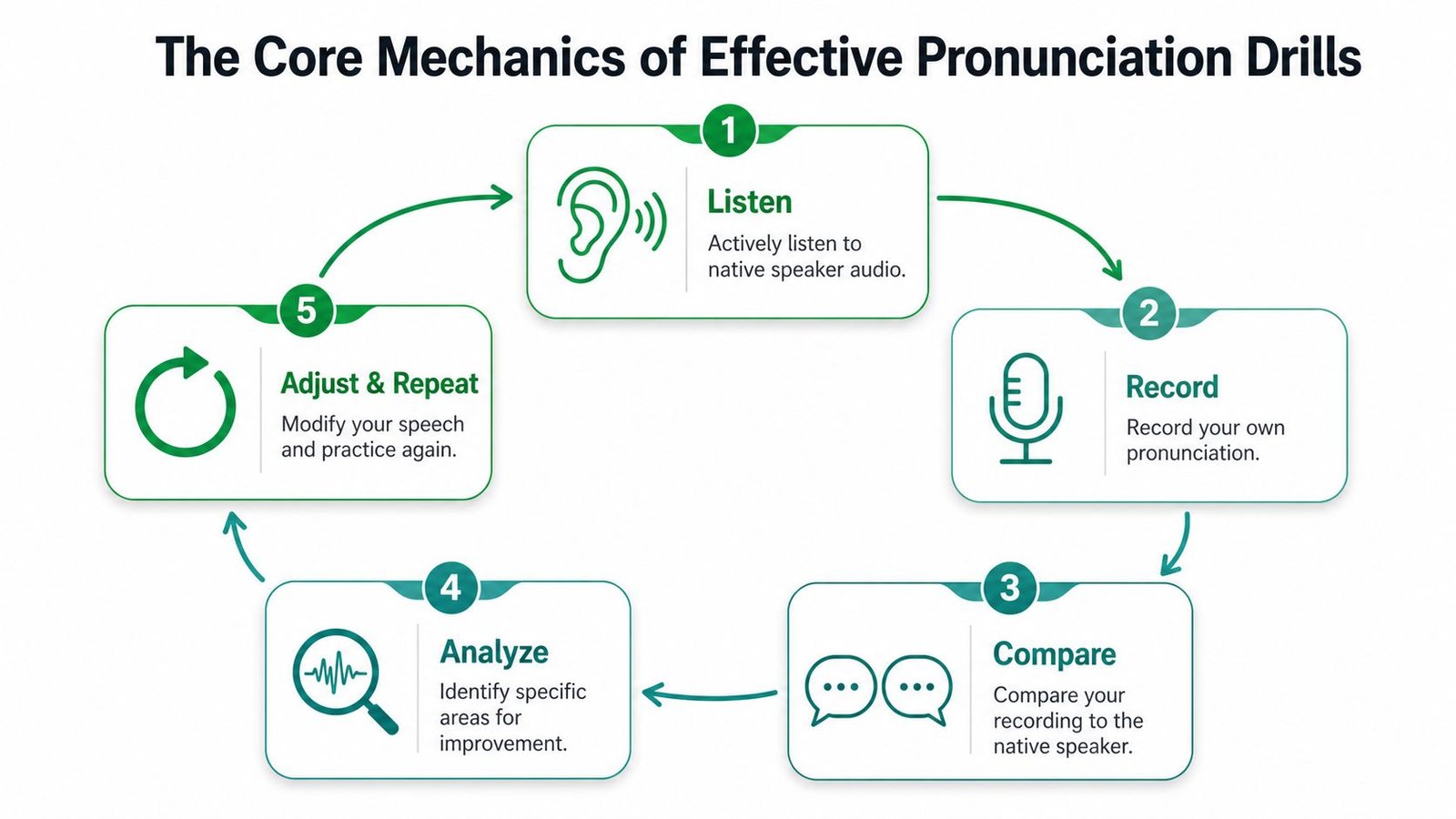
A learner sitting with headphones on can still make very little progress if the practice stays passive. Pronunciation improves when the loop is tight, hear the model, produce a version yourself, compare the two, then adjust the next attempt. Short, focused repetitions give the ear a clearer contrast and give the mouth enough chances to form the new movement.
What the five-step loop looks like
The sequence is straightforward. You listen to a model, record your own speech, compare the two, analyze the difference, then adjust and repeat. That structure helps because it gives you something specific to react to, instead of a vague feeling that your pronunciation is “off.”
Computer-assisted pronunciation training has shown a medium-to-large overall benefit for pronunciation learning, and one meta-analysis reported an effect size of d = 0.68 (CAPT meta-analysis). That review also found benefits for both younger and adult learners, with stronger gains for beginner and intermediate learners than for advanced learners. In practice, that fits what tutors see every day, because early learners usually need clearer correction on basic sound contrasts, while advanced learners need finer listening and more speaking in context.
What to focus on first
Start with a narrow target. A limited set of segmental features is easier to hear, easier to repeat, and easier to correct than a broad “sound better” goal. The CAPT evidence also points to explicit corrective feedback, segmental focus, and medium-to-long treatment duration as stronger choices than indirect feedback, suprasegmental-only work, or short exposure.
Practical rule: one clean correction repeated well beats ten different corrections that never stick.
Many learners rush toward rhythm or “sounding native” before the core sounds are steady. That order often creates frustration, because the sounds that block understanding stay in place while the learner works on style. Segmental accuracy comes first for communicative intelligibility, then stress and intonation can be trained with better results.
For Irish learners, this matters in a particular way. Heritage speakers may already have a large vocabulary and strong listening familiarity, but still need careful feedback on sound distinctions that have settled into family speech habits. Oral exam preparation needs the same kind of focus, because the goal is not just to sound pleasant, it is to make each word clear under pressure.
Why repetition beats random practice
Controlled repetition works better than scattered exposure. A learner tries a sound, gets a cue, tries again, and the brain starts linking the mouth movement with the correct acoustic result. One focused session can do more than a long stretch of unfocused listening because the correction stays active in memory.
There is also a simple reason this helps in oral exam work. Repeated practice lets you stabilise one correction before moving to the next task, which is much closer to how real speaking improves than trying to fix everything at once. In a lesson room or on a screen, the same pattern keeps appearing, hear, adjust, try again, until the sound becomes dependable enough to use in actual speech.
Building Your Daily Pronunciation Practice Routine
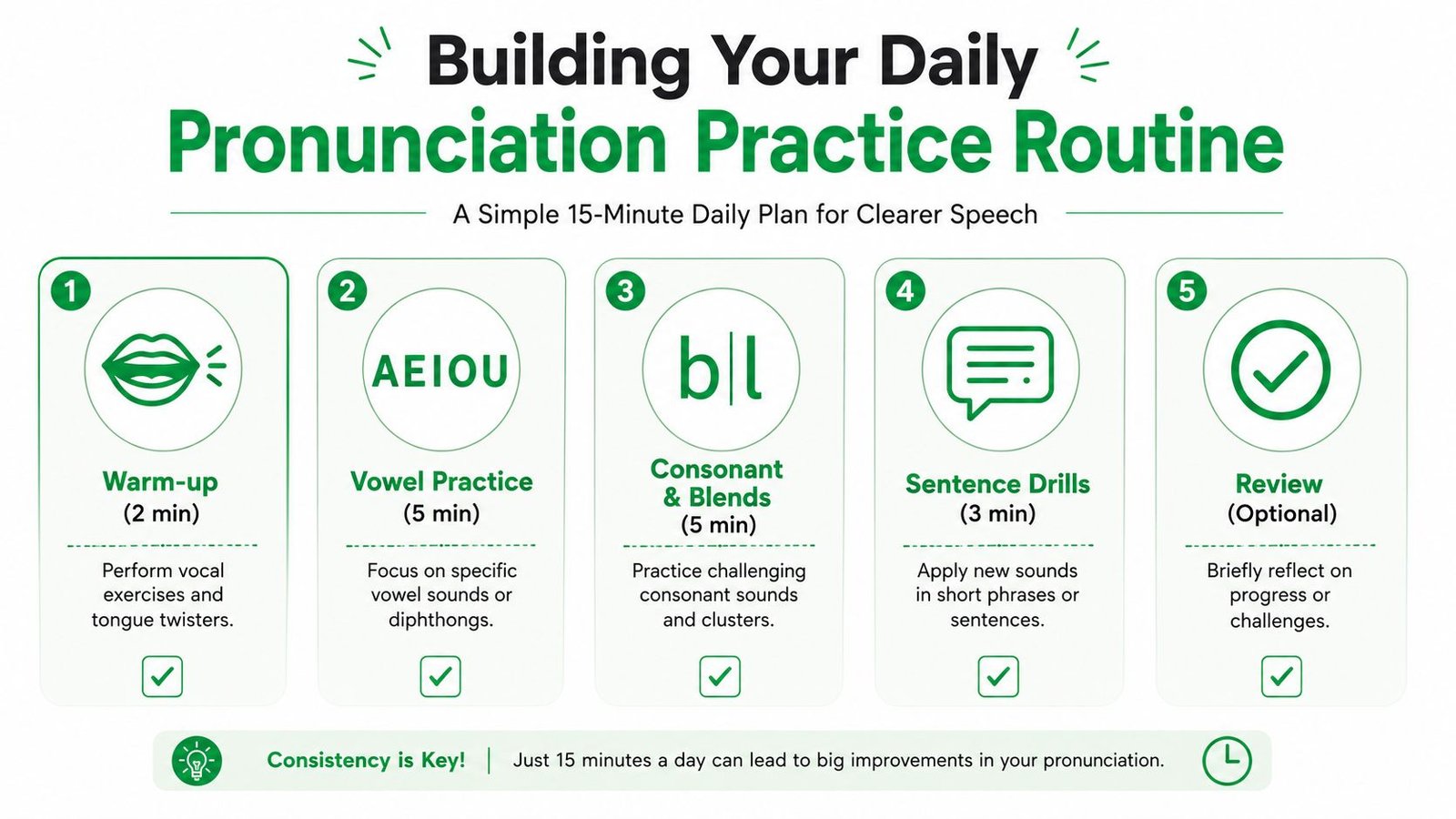
A workable routine has to be small enough that you can repeat it tomorrow without dreading it. That is usually what separates useful pronunciation practice from vague review. Fifteen minutes can be enough if you give one sound a clear target, speak out loud, and stay active from start to finish. The Preply pronunciation practice guide makes the same point in a practical way, with short daily habits such as vowel work, holding a vowel long enough to hear it, and checking mouth shape in a mirror.
A fifteen-minute structure that stays realistic
Start with two minutes of warm-up. Loosen the jaw, read a short line aloud, or run through a brief tongue-twister so the mouth is already moving before the harder work begins. Then spend five minutes on one vowel or diphthong. Watch how the lips and jaw move, because copying a sound in your head is not the same as shaping it with the mouth.
Use the next five minutes for consonants and blends. Minimal-pair practice is useful here, especially for sounds that tend to merge in fast speech. If a sound is hard to hear clearly, slow the model to 0.75x or 0.5x speed, then compare it with your own recording. That kind of close listening is often the fastest way to notice whether the problem sits in the sound itself, the stress pattern, or the way the word is linked to the next one.
A final three minutes should go to sentence drills. Read a short phrase, record it, and listen back once without editing the result in your head. If you want a starting point for shaping the day's work, the daily Irish practice plan gives a sensible rhythm for combining speaking and review, and the structure can also sit alongside the use of AI language tutors when you want feedback between lessons.
How to rotate focus without overload
Keep to two or three pronunciation targets at a time. That keeps the ear and mouth focused. One day can centre on a vowel, a consonant contrast, and a short sentence pattern. The next day can keep the vowel and change the consonant set, so the work builds on what you already corrected instead of starting again from zero.
A simple weekly rotation can look like this:
- Monday: one vowel contrast, one tricky consonant, one short sentence
- Tuesday: repeat the same vowel, add connected speech in a short phrase
- Wednesday: minimal pairs and one recorded self-check
- Thursday: slow playback at 0.75x and correction
- Friday: sentence-level shadowing and review
- Weekend: light recap, then rest
Keep the routine short enough that you'll finish it on a tired day, because the routine that survives busy weeks is the one that changes speech.
For learners preparing for exams, the sentence stage is where confidence starts to grow. For heritage learners, it is where old habits start to loosen, because the work moves from isolated sounds into real speech. Oral exam preparation also needs a different kind of feedback from generic drills. A learner may produce a sound correctly in isolation and still lose clarity under pressure, so the routine has to test the sound inside phrases, not only on its own. That is the gap the daily plan is meant to close.
Why this format sticks
The body remembers repeated motor patterns better than occasional intense effort. A steady fifteen-minute routine usually does more than a long session that appears only once in a while. The exact sounds will differ from learner to learner, but the shape of the practice should stay the same. Use one narrow focus, record your voice, listen back quickly, and make the next attempt with the correction still fresh.
Choosing the Right AI Pronunciation Tools for Irish
A learner can spend time on a pronunciation app and still finish the session unsure what changed. The score looked tidy, the practice felt active, and the speech in real conversation still sounded unclear. For Irish learners, the better test is simpler: does the tool improve communicative intelligibility, or does it only produce a polished rating?
What to look for in a tool
A useful pronunciation platform should tell you what to change, not only that something was wrong. The feedback needs to point to a specific vowel, consonant, stress pattern, or connected speech problem, then let you try again straight away. If a system only gives a score, it may help motivation, but it does very little for correction.
That distinction matters for multilingual learners and heritage learners, because feedback can behave differently depending on first-language habits and long-set patterns of speech. Some systems promise instant scoring or model matching, yet they do not explain how they handle those cases. The wider market shows the same gap, with many tools still presented as accent or pronunciation training without much clarity on scoring validity or learner fit, as noted in the PronounceLive overview of the market gap.
If you want a more structured route into speaking feedback, the AI language tutors at Gaeilgeoir AI are a useful example of how pronunciation support can be tied to learner response rather than treated as a standalone rating exercise. That matters because Irish learners often need to hear exactly where clarity breaks down, not just whether a model approves of the attempt.
Comparing generic tools with Irish-focused practice
A general English pronunciation app can still be useful for practice structure, but it will not always answer the questions Irish learners have. Does it catch vowel length issues, connected speech problems, or the gap between a sound that works in isolation and a sound that holds up in conversation? Those are the details that matter when you need to be understood by a tutor, examiner, or community speaker.
A helpful comparison point is a language learning app with RapidNative, which shows how modern speaking tools often place pronunciation inside broader language learning rather than treating it as a separate accent drill. That kind of setup can be helpful, but the core question is still feedback quality, not presentation.
If you are trying Gaeilgeoir AI as part of your routine, check whether it gives immediate correction, whether the speaking task feels close to a real exchange, and whether you can re-record after hearing the feedback. Compare your own output with a model, too. That comparison turns “I got a score” into “I know what to adjust,” which is the shift that matters before an oral exam or a real conversation.
A simple test before you commit
Start with one short phrase, then move to one sentence, then give one unscripted response. If the platform improves all three, it is helping transfer. If it only improves the scripted line, it may be rewarding repetition more than actual pronunciation growth.
Prioritizing Intelligibility Over Accent Perfection
A lot of pronunciation advice still treats sounding native-like as the goal. That sets up the wrong target for most Irish learners, because the core question isn't whether your speech sounds polished in every detail, it's whether people understand you quickly and naturally. The strongest practice plan starts by asking which errors block comprehension.
What matters most in real conversation
Sound-by-sound drills can be useful, but they're not the whole picture. Mainstream resources such as Cambridge and BBC Learning English put heavy emphasis on specific sounds, stress, and exercises, which is helpful for building awareness, but they don't fully answer the learner's central question, which errors most affect being understood? That gap matters because pronunciation research and teaching guidance increasingly separate accent reduction from intelligibility.
If the listener understands you, the pronunciation job is working, even if your accent remains clearly yours.
For beginners, this usually means focusing first on the sounds that cause breakdowns, rather than trying to remove every trace of an original accent. For heritage learners, that means protecting an authentic voice while tightening the pronunciations that create confusion in community settings. The goal is not imitation, it's communication.
How to choose your priorities
Start with one of three categories. First, the problem sounds that regularly get misunderstood. Second, stress and rhythm when they change meaning or make speech hard to follow. Third, a small set of phrases that come up constantly in your speaking life, so the improvements transfer into real conversations.
That order helps because it saves time. You don't need to solve every pronunciation issue before speaking, and you don't need a native-like accent to sound clear. You need the parts of pronunciation that carry the biggest communicative load, then enough repetition to make them automatic.
This is also where self-study can go wrong. If every practice session becomes an accent chase, learners often lose confidence and stop speaking. If the session focuses on intelligibility, the feedback feels more practical, and progress is easier to notice in daily conversation.
Leaving Cert Oral Exam Preparation Strategies
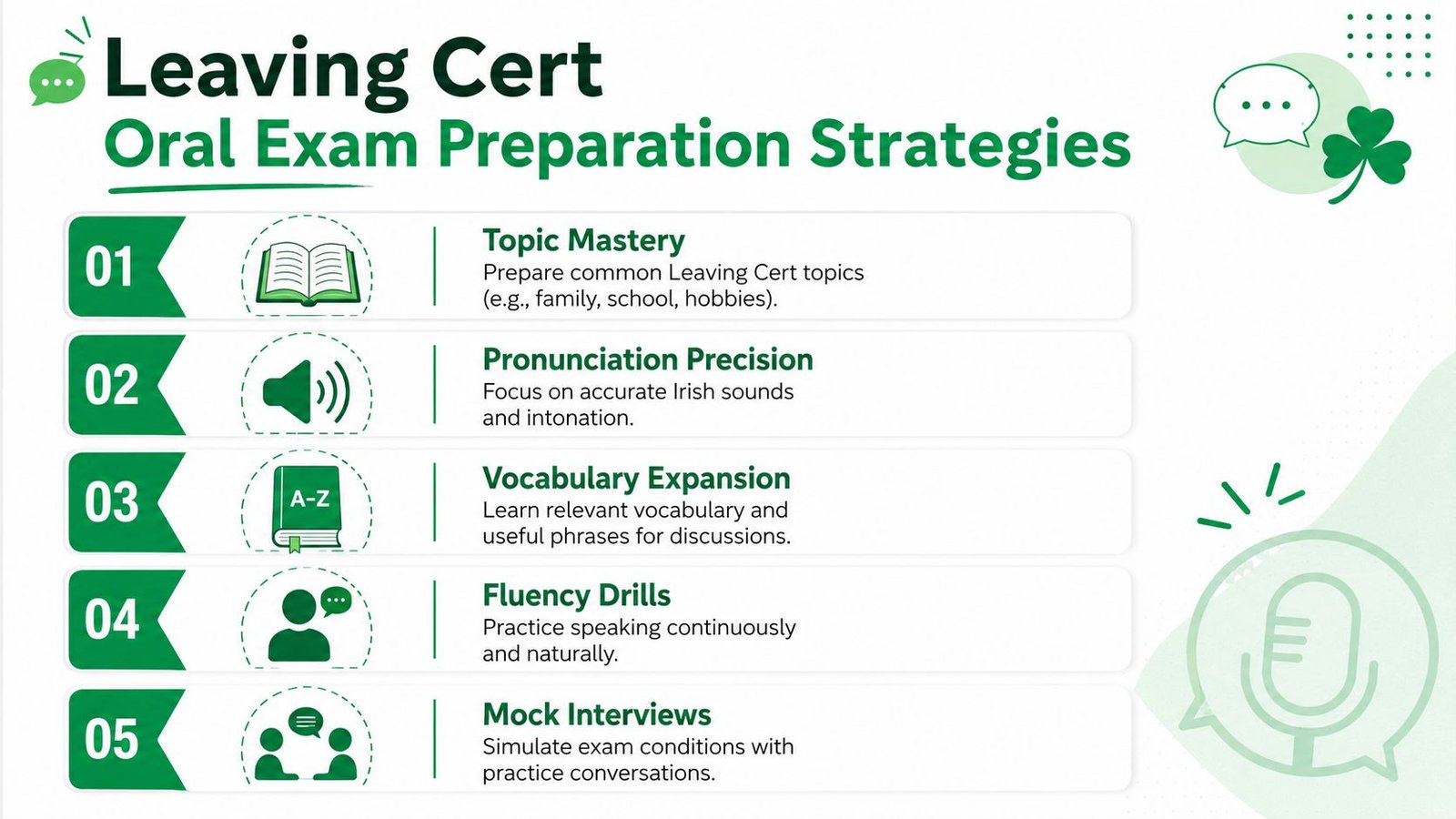
The Leaving Cert oral exam rewards clear, flexible speaking, not just memorized lines. Students who prepare only general pronunciation often struggle when the examiner moves the conversation in an unexpected direction or asks the same topic in a different way. The smarter move is to combine pronunciation work with exam-style content, so the speech pattern and the topic knowledge grow together.
Prepare the exam shape, not just the answers
The oral exam usually moves through familiar territory, then shifts into follow-up questions. Practicing only one polished answer leaves you exposed when the examiner changes the angle. A better approach is to rehearse common topics, then answer them in slightly different forms, so your mouth and mind learn to stay steady under pressure.
Here's a practical topic checklist:
- Family and home: describe people, routines, and relationships clearly
- School and subjects: explain what you study and why
- Hobbies and sport: speak in full sentences, not single-word replies
- Holidays and travel: keep the story moving with time markers
- Current events: use simple opinions and short reasons
- Social issues: practice calm, clear phrasing
- Pictures: describe what you see before you interpret it
- Stories: keep sequence words ready
- Future plans: use confident, simple structures
- Part-time work: speak about responsibility and routine
- Technology: explain habits and preferences
- Music: give examples and reasons
- Sporting events: describe what happened, not just what you liked
- Town or area: name places and directions
- Health and lifestyle: keep vocabulary practical
- Weather: use it as a conversation bridge
- Food and cooking: rehearse ingredients and actions
- Irish culture: know a few personal examples
- Friends and social life: sound natural, not over-scripted
- Unexpected questions: practice staying calm when you need a second
The dedicated Leaving Cert preparation mode inside Gaeilgeoir AI is designed for this kind of work, because it lets you rehearse typical Irish oral exam topics in a speaking format rather than only reading notes. For fillers and hesitation management, the filler phrases guide for the oral Irish exam can help you keep the flow when you lose a word.
How to handle nerves and lost words
Keep your answers slightly flexible. If you forget a word, move around it with a simpler phrase instead of stopping the sentence completely. That matters more than sounding perfect, because oral examiners respond well to continuity and clarity.
Time management also helps. If you spend too long on the opening answer, you'll rush later. Practice with a timer, answer aloud, and leave a little space for follow-up questions so the exam feels more familiar on the day.
Troubleshooting Common Pronunciation Plateaus
Progress rarely moves in a straight line. You can sound better one week, then feel stuck the next, even when you're still practicing. That usually means the problem is not lack of effort, it's that the next barrier is different from the last one.
When the issue is perception
Sometimes you can't hear the difference between your version and the target sound. In that case, no amount of repetition will fully solve the problem, because the ear needs training before the mouth can copy anything accurately. Slow playback, contrastive listening, and minimal pairs are the right tools here, because they sharpen your perception before you try to produce the sound again.
When the issue is production
Other times you can hear the difference, but your mouth keeps defaulting to the old habit. That usually calls for slower, more deliberate speech, a mirror for mouth shape, and short re-recording loops. If a sound works in isolation but falls apart in connected speech, the fix is to practice it inside phrases, not to keep drilling it alone.
When correction isn't sticking, change the unit of practice, not just the volume of practice.
If you've reached a plateau and want a cleaner feedback loop, use AI for repetition and then bring in a tutor or conversation partner for human judgment. The human listener catches whether the speech feels natural in real interaction, while the tool helps you isolate the sound that keeps slipping. That combination is usually stronger than either one by itself.
Gaeilgeoir AI gives Irish learners guided speaking practice, pronunciation feedback, and exam-focused oral preparation in one place, so you can work on clarity without guessing what to fix next. If you want a practical way to build better pronunciation habits and rehearse real Irish conversations, visit Gaeilgeoir AI and start with a speaking routine that fits your day.