
Only about 10% of 9,000 learners came back the next day, and roughly 1 in 6 did anything in the first week after day zero, which is a blunt reminder that daily language practice fails when it relies on goodwill alone rather than habit design (daily speaking practice data). The same dataset showed that learners who reached 20 to 49 conversation turns on day one returned within a week at 39.9%, compared with 8.1% for those who stopped after 1 to 4 turns. That gap changes the whole conversation for Irish learners, because the first day isn't about proving fluency, it's about creating a routine your brain is willing to repeat.
Learners don't quit because they hate languages. They quit because their practice plan is too heavy, too passive, or too easy to postpone. Short, active, repeated speaking sessions fit what cognitive science says about retention and habit formation, and they also match what real learners sustain over time. If you want Irish to stick, you need a routine that makes speaking feel normal on ordinary days, not heroic on rare good ones.
Table of Contents
- Why Most Daily Language Practice Fails (And What Works Instead)
- Building Your Daily Irish Practice Routine
- Using AI Tools to Maximize Your Practice Sessions
- Gamification and Motivation Strategies That Stick
- Overcoming Real-World Practice Obstacles
- Daily Practice Strategies for Leaving Cert Exam Prep
- Your Personalized Daily Irish Practice Action Plan
Why Most Daily Language Practice Fails (And What Works Instead)
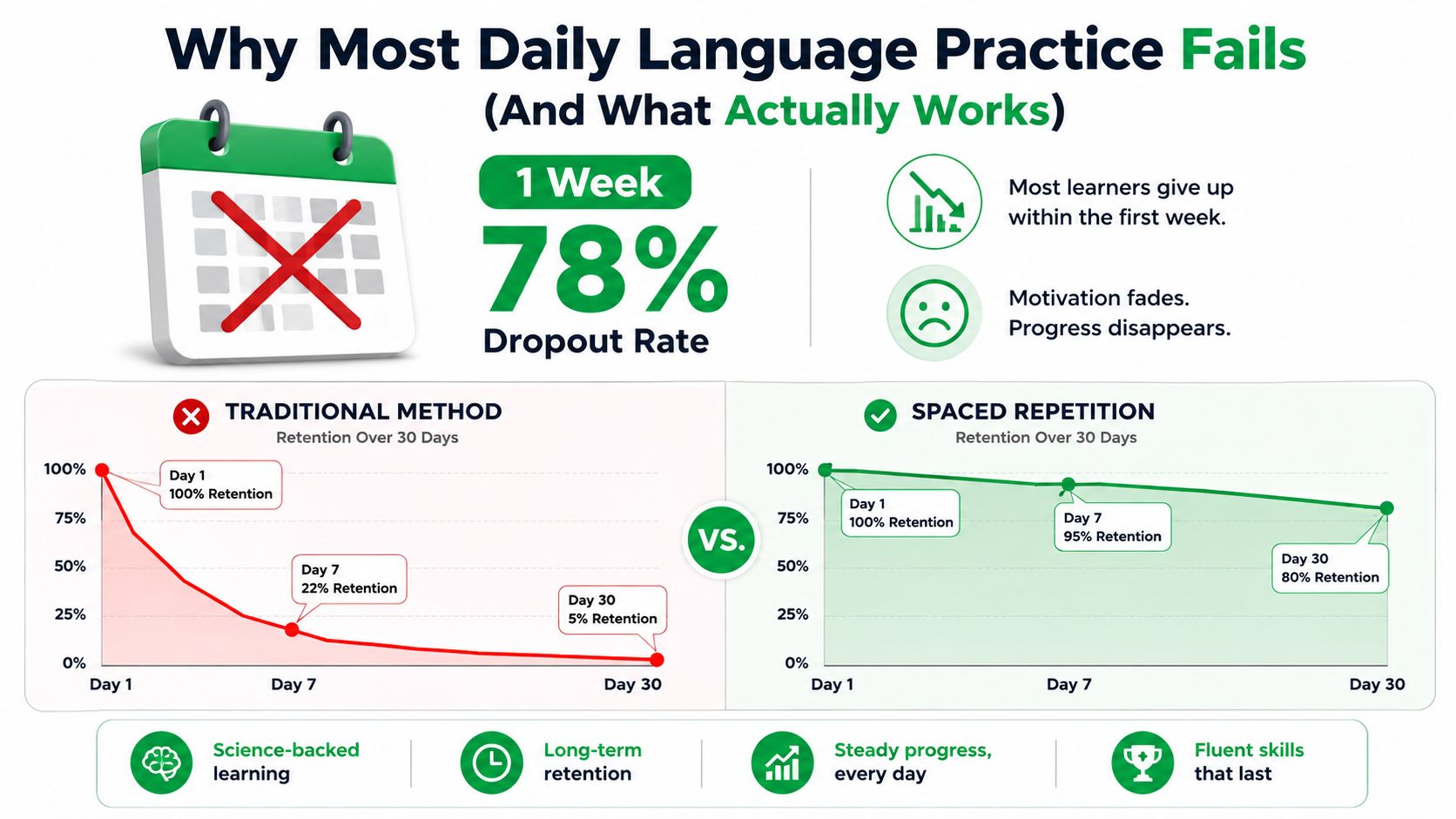
The hard truth is that most learners do not lose interest first, they lose momentum. In a large 2026 learner analysis, only about 10% returned the next day, and only about 1 in 6 did anything in the first week after day zero (daily speaking practice data). That pattern shows a design problem, not a motivation problem.
The first day matters more than the streak
The strongest signal in the data is not streak length, it is depth on day one. Learners who reached 20+ conversational exchanges on day one came back within a week at 39.9%, while those who stopped after 1 to 4 turns returned at just 8.1% (daily speaking practice data). For Irish learners, that gap matters because the first session is where the habit gets its shape. If day one is thin and passive, day two feels optional. If day one includes real back-and-forth, the next session feels like a return, not a fresh start.
That is why a short session can still fail. Ten quiet minutes spent arranging notes, tapping through menus, or waiting to feel ready does not build the same memory trace as active speaking. The learner finishes the session, but the brain has little to come back to.
Practical rule: if the first session feels too easy, it usually will not survive day three.
A simple daily check-in also correlated with 32.9% week-one return and 23.6% in weeks 2 to 4, which is about 2 to 3 times baseline (daily speaking practice data). That fits what experienced teachers see in real classrooms. The learners who return are usually the ones who can begin quickly, speak early, and finish with a clear next step.
Short practice beats cramming
Independent guidance grounded in spaced-practice research points to 15 to 30 minutes of daily study as more effective than 3-hour weekly marathon sessions, and even 10 to 15 minutes a day can be enough to maintain progress and habit formation (minutes per day guidance; effective language study routines). The reason is simple. Memory strengthens through repeated retrieval, not through one long block of exposure.
For Irish, that means daily language practice should behave like brushing your teeth, not like preparing for an exam. You want a routine that fits an ordinary evening, a crowded morning, or a day when your energy is low. The better plan is active speaking, review, and correction in small doses, because those are the parts learners can repeat.
Building Your Daily Irish Practice Routine
A good Irish routine doesn't need to be dramatic. It needs to be specific enough that you know what to do when you're tired, busy, or half paying attention. The best routines also change by energy level, because an exhausted day and a free evening are not the same learning problem.
Three routines that cover most real life
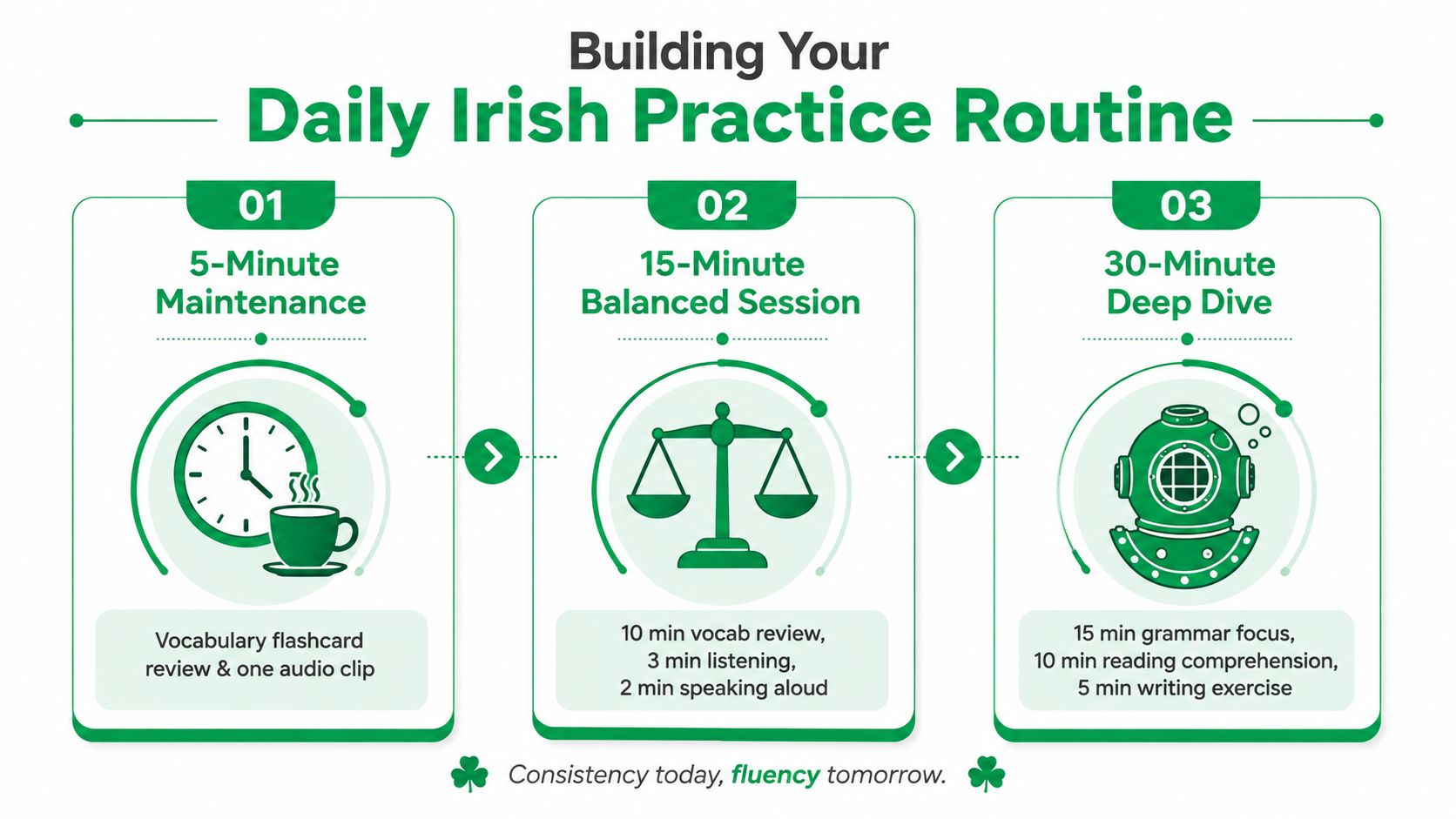
A 5-minute maintenance routine works on overloaded days. Use 3 minutes for flashcards in small sets, then 2 minutes to listen to one short audio clip and repeat one line aloud. The point is to keep contact with the language, not to force progress when your head's elsewhere.
A 15-minute balanced session suits most weekdays. Spend 5 minutes reviewing known words, 5 minutes listening or reading something short, and 5 minutes speaking aloud from prompts or a scenario. That mix keeps the session active without feeling like a second job.
A 30-minute deep practice session is for days when you've got room to think. Use 10 minutes for new vocabulary or grammar, 10 minutes for reading or listening at the right challenge level, and 10 minutes for speaking or writing from memory. The key is that each segment builds on the last one, instead of scattering your attention.
Here's a useful comparison for planning.
| Duration | Activities | Best For |
|---|---|---|
| 5 minutes | Flashcard review, one short audio clip, one spoken sentence | Survival on busy days |
| 15 minutes | Review, listening, speaking aloud | Steady habit building |
| 30 minutes | New material, comprehension, production | Faster progress and deeper recall |
Make the week rotate, not repeat
If every day looks identical, boredom creeps in. A better weekly pattern is to keep the routine length stable while rotating focus. One day can lean toward vocabulary, the next toward listening, then speaking, then review.
For conversation practice, it helps to use real world conversation strategies rather than isolated sentence drilling, because Irish needs to feel useful in ordinary life, not only in a notebook. A practical guide to that mindset is real world conversation strategies, especially the parts on active engagement and speaking under pressure.
Useful anchor: review the same small set of words several times before you try to expand it.
If you want a simple structure for spaced review, keep your first round small and revisit it soon after. The spaced repetition guide for Gaeilgeoir users fits neatly into that rhythm, because it keeps review compact instead of letting it sprawl.
Using AI Tools to Maximize Your Practice Sessions
AI works best when it removes the awkward parts of practice. It gives you something to answer, something to correct, and something to repeat without waiting for a partner to be free. That matters for Irish learners who need speaking opportunities but don't always have access to them in daily life.
Use each feature for a different job
When you need vocabulary support, click-to-translate is useful because it keeps you inside the conversation instead of sending you off to a separate dictionary hunt. Save the word, read it in context, and come back to it later, because vocabulary sticks better when you meet it in a sentence rather than as a lonely list item.
Scenario-based practice is where confidence grows. If you can rehearse greetings, asking for directions, ordering food, or making small talk in a controlled setting, the same words feel less fragile in real life. The practice is still simple, but it's anchored in situations learners face.
Adaptive quizzes with instant feedback are the right place for correction. They're not glamorous, but they stop errors from hardening into habits. If your pronunciation or word choice is off, immediate correction gives you a second attempt while the mistake is still fresh.
For pronunciation support and voice practice, a helpful companion reference is AI chat with voice guide, especially if you want to see how spoken exchanges can feel more natural in a digital setting. Used well, voice practice turns hesitation into repetition.
Match the tool to your level
Beginners need fewer moving parts. Start with short guided conversations, quick translations, and simple prompts you can answer without freezing. Intermediate learners can handle longer scenario chains, more correction, and more recall from memory.
The internal practice library at Gaeilgeoir AI tutors fits that progression because it pairs guided conversation with instant feedback instead of asking you to improvise too early. In a daily language practice routine, that kind of structure reduces the friction that usually breaks consistency.
One thing to avoid is using AI as a passive chat window. If you only read responses, you're not building spoken recall. Make yourself answer aloud first, then check, correct, and repeat.
Gamification and Motivation Strategies That Stick
Motivation is unstable, so good habits need better scaffolding than enthusiasm. Points, streaks, and visible progress work because they give the brain a clear reason to return, especially on days when the language itself doesn't feel urgent. That's not childish, it's practical.
Reward the act of showing up
A streak is useful only if it lowers the odds of skipping tomorrow. The learner data above already showed that a daily check-in correlated with stronger return rates, which lines up with the basic psychology of consistency. If you log practice every day, even briefly, the habit starts to feel real.
Micro-goals help because they make success visible. Finish one review set. Complete one speaking prompt. Revisit one old phrase. The win has to be small enough that you can repeat it on an ordinary Tuesday, not just on a motivated Sunday.
Don't reward perfection. Reward return.
That matters after a missed day too. The fast way back is to do one tiny session the next day, not to punish yourself with a “catch-up” marathon. People often drop the habit after a gap because they think the streak is broken, but the actual loss is the silence that follows.
Track the right signal
A streak counter is useful, but it isn't the only measure that matters. Track whether you spoke, whether you reviewed, and whether you used the language on a day you wouldn't have otherwise. Those are the behaviors that build the habit underneath the habit.
If you like social accountability, share the goal with someone who won't overcomplicate it. You don't need a crowd. You need one person who notices when you show up and doesn't turn one missed day into a lecture.
Overcoming Real-World Practice Obstacles
Real life doesn't care about your study plan. Shifts run late, kids get sick, energy disappears, and the day gets away from you. The wrong response is to treat that as failure. The better response is to have a smaller version of the habit ready for exactly those days.
What to do when the day goes sideways
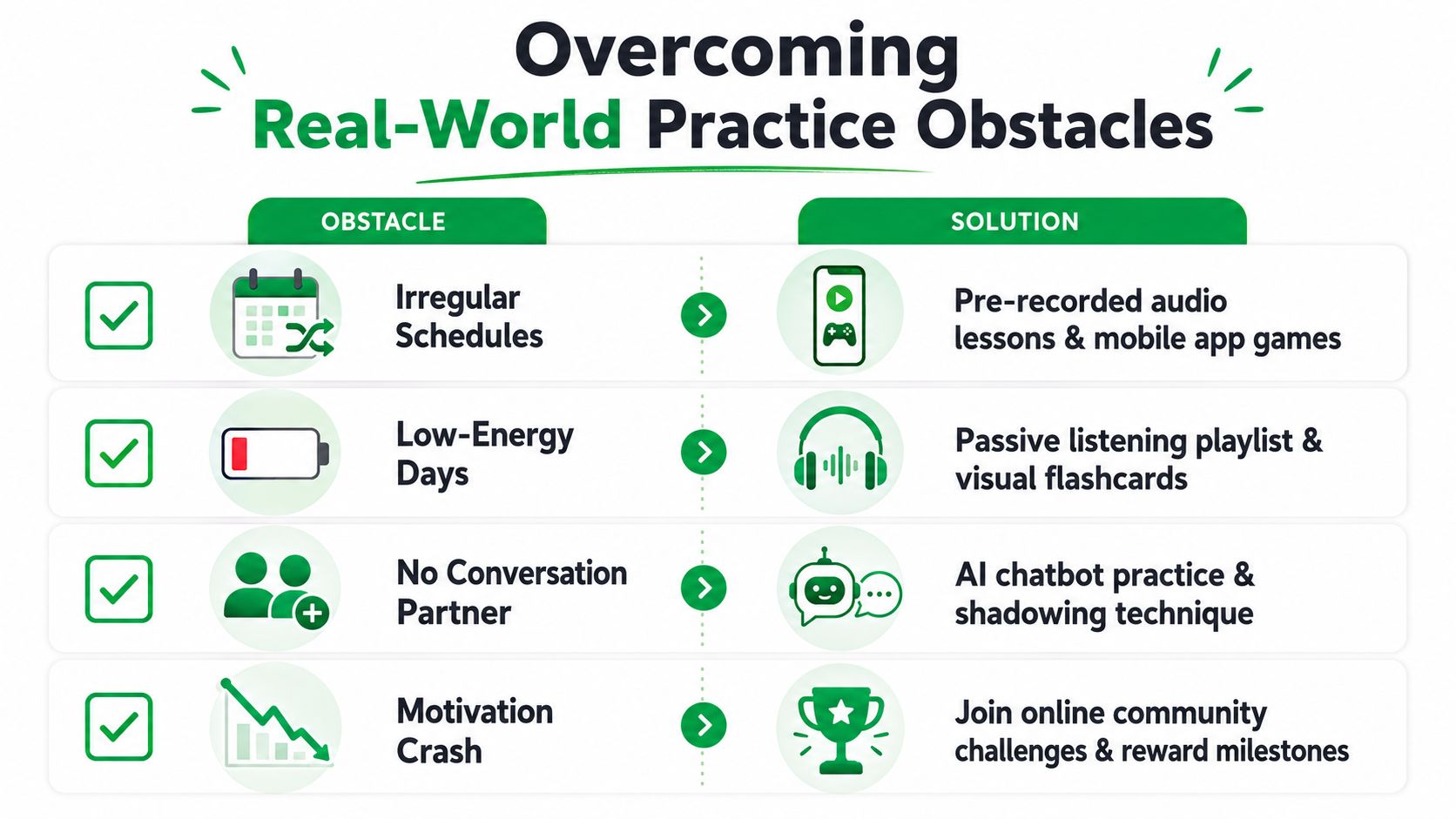
If your schedule is irregular, stop trying to assign practice to one perfect time slot. Tie it to a stable anchor instead, like coffee, lunch, or the last thing you do before bed. That way, the habit survives even when the clock doesn't cooperate.
On low-energy days, use maintenance practice. Listen, repeat one line, review a tiny set of words, and leave it there. Maintenance keeps the language warm without demanding full concentration, which is exactly what tired learners need.
If you don't have a conversation partner, don't wait for one. Use AI conversation practice, shadowing, and short spoken responses to create output anyway. The goal is not to mimic a perfect classroom setup, it's to keep your mouth working in Irish every day.
For learners who deal with anxiety around speaking, the language learning anxiety guide is worth reading because it addresses the mental block that often shows up right before practice starts.
Maintenance practice and progress practice are different
Maintenance practice protects the habit. Progress practice stretches it. Both matter, but they serve different days.
When life is crowded, maintenance is enough. When you've got room, add new material, longer speaking, and harder review. That distinction keeps you from burning out by trying to make every session count the same way.
If you're rebuilding after a break, don't ask for perfection on day one. Ask for contact. One short session creates the next one, and that's how momentum returns.
Daily Practice Strategies for Leaving Cert Exam Prep
Leaving Cert Irish oral prep works best when the practice mirrors the exam without becoming exam-shaped all the time. You need fluency, but you also need enough repetition that common topics don't blank your mind under pressure. Daily work should make those topics feel ordinary.
Build the answer before you build the script
Spend 20 to 30 minutes on a focused daily session, with one part for theme vocabulary, one part for oral responses, and one part for speaking under pressure. Keep the topics close to the exam, such as family, school, hobbies, local area, future plans, and current routine. That way, your daily language practice reinforces what you're most likely to need.
A useful method for learners who freeze at the start is to reduce task paralysis before the session begins. The advice in how to overcome task paralysis maps neatly here, because oral prep often fails at the starting line rather than halfway through.
Practice like someone will ask follow-up questions
Don't stop at memorised answers. Say your answer once, then answer it again in a slightly different way, because examiners can steer the conversation in directions you didn't plan for. That second version matters more than polishing a perfect script.
Use self-check questions after each response. Did you speak clearly. Did you stay on topic. Did you use enough detail to avoid sounding like a list. Those checks are simple, but they train the habits that matter in the room.
If you're short on time, use one daily prompt and recycle it across several days. Familiarity lowers panic, and panic is often the obstacle in oral prep.
Your Personalized Daily Irish Practice Action Plan
A first session that goes well is usually small, specific, and spoken. One learner may only manage a few short turns, another may complete a longer exchange, but the point is the same, get Irish out of the notebook and into your mouth on day one. If you wait until you feel ready, the habit often stays theoretical.
Choose a routine that matches your real week, then give it a shape that is hard to misunderstand. The 5-minute routine works well for a true beginner who needs a clear starting line. The 15-minute routine suits someone returning to Irish who wants structure without too much load. The 30-minute routine helps if you already have some stamina and need enough time for a proper spoken cycle. A flowchart showing a personalized daily Irish language practice plan with options for five, fifteen, or thirty minutes.
Plan the first week before you start. Day 1 can be a self-introduction using An lá atá inniu ann, with your name, where you are from, and one thing you are doing today. Day 2 can focus on family. Day 3 can cover school or work. Day 4 can be hobbies. Day 5 can be the weather and the time of day. Day 6 can be your local area. Day 7 can return to the self-introduction and compare it with Day 1. That repetition matters because the first week is where many learners discover whether the topic is too broad, too hard, or just right.
Keep the routine simple enough that you can repeat it on a tired day. A useful first-week pattern is speaking first, then correcting one mistake, then saying the same answer again with that correction built in. For example, if you say Tá mé ag déanamh mo dhícheall and your pronunciation of the ending feels unclear, repeat the sentence slowly, then once more at normal speed. That gives the brain one clear target instead of a pile of notes.
Use a short checklist instead of a full tracking sheet.
- Did I speak Irish today?
- Did I stay with one topic?
- Did I repeat one answer after correction?
- Did I leave with one phrase I can reuse tomorrow?
If you are coming back to Irish after a long break, this kind of checklist helps you see progress without turning practice into paperwork. If you are starting from zero, it also stops the common mistake of collecting ideas faster than you can use them. The goal is not a perfect record. The goal is to notice whether today's session gave you one better sentence than yesterday.
A learner who has a rough first week should not abandon the plan. Short sessions often fail for practical reasons, not because the method is wrong. The topic may have been too wide, the speaking target too ambitious, or the session may have started with reading instead of speaking. Tighten one part, keep the rest the same, and try again tomorrow.
That is usually enough for the first stretch. If the routine survives a week, it becomes much easier to keep it going when motivation drops and life gets busy.