
Most advice on Gaelic snow starts in the wrong place. It jumps straight to myth, or it throws out a single translated word and leaves you to sort out the rest.
That's why people stay confused.
If you searched for “Gaelic snow,” you probably weren't looking for one neat cultural term. You were likely looking for one of two things. First, the actual words for snow in Irish and Scottish Gaelic. Second, the winter folklore that surrounds snow, especially the figure of the Cailleach. Those are related, but they aren't the same thing.
This guide keeps them separate so they make sense. You'll see where the search term comes from, how the folklore works, how the language differs between Irish and Scottish Gaelic, and how to start saying simple snow-related phrases aloud without getting stuck on spelling.
Table of Contents
- What Is Gaelic Snow
- The Cailleach Gaelic Folklore's Queen of Winter
- Irish vs Scottish Gaelic Words for Snow
- Using Snow Words in Everyday Phrases
- Regional Nuances and Seasonal Traditions
- How to Practice Your Gaelic Pronunciation
What Is Gaelic Snow
Gaelic snow isn't really a fixed traditional term. It's a search phrase people use when they're trying to find their way into Gaelic language and winter culture.
That matters, because the answer depends on what you meant.
Some readers mean, “What is the Gaelic word for snow?” Others mean, “What does snow symbolize in Gaelic folklore?” And many are looking for the winter figure called the Cailleach, because search results often point there rather than to a separate concept called “Gaelic snow,” as noted in the Cailleach overview.
Why the phrase causes confusion
“Gaelic” itself can blur things. People use it loosely in English to refer to Irish, Scottish Gaelic, and sometimes older cultural material tied to both. So when someone types “Gaelic snow,” they may be asking about:
- Irish language vocabulary such as the Irish word for snow
- Scottish Gaelic vocabulary and how it differs in spelling and sound
- Folklore and seasonal belief linked with winter weather
- Modern retellings that blend Irish, Scottish, and Manx traditions together
That mix is where the confusion starts.
Practical rule: When you see “Gaelic snow,” separate the question into language and folklore. The language gives you words. The folklore gives you meaning.
A winter figure across Gaelic traditions
Once you make that split, the topic becomes much easier to understand. In language, you're dealing with vocabulary and pronunciation. In folklore, you're dealing with symbols, stories, and the way people once understood the turning of the seasons.
Snow, in that older worldview, isn't just weather. It belongs to winter's order. It signals a season with its own powers, moods, and stories.
That's why the Cailleach appears so often in results for this topic. She stands at the meeting point of storm, cold, land, and season. If you came looking for “Gaelic snow,” you weren't wrong. You were just one step away from the clearer question.
The Cailleach Gaelic Folklore's Queen of Winter
The strongest folkloric answer to Gaelic snow begins with the Cailleach. She appears across Irish, Scottish, and Manx tradition as a pan-Gaelic winter figure connected with storms, winter, and the shaping of the natural world. Modern summaries describe her as a divine hag, and her name means “old woman” or “hag” in Gaelic. Her seasonal rule is often placed from Samhain on 1 November to Imbolc on 1 February, according to Historic Environment Scotland's summary of the Cailleach.
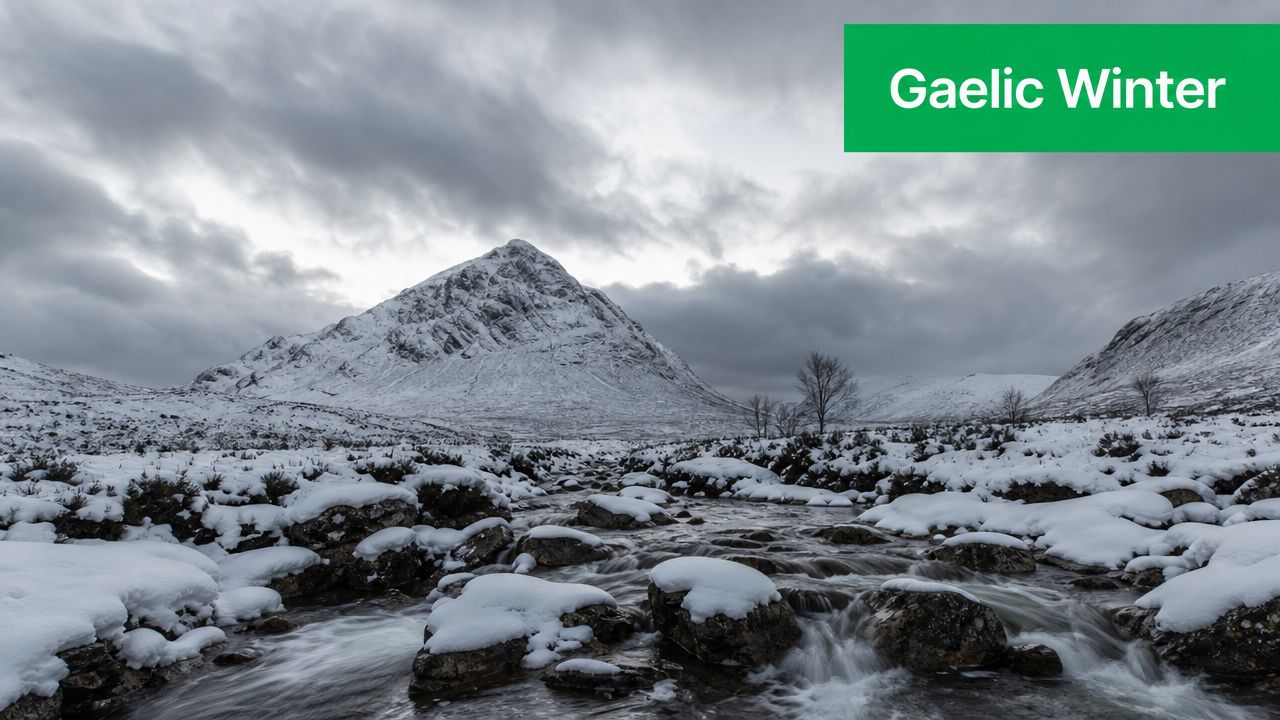
A winter figure across Gaelic traditions
For a beginner, the easiest way to understand the Cailleach is to think of her as winter made personal. Not a snow goddess in a narrow sense, and not a simple villain either. She belongs to the hard side of the year. Wind, storm, frozen ground, and mountain wildness all gather around her.
In folklore, winter often needs a face. The Cailleach provides that face.
She can seem harsh because winter is harsh. But she's also tied to creation. Stories connect her not only with destructive weather, but with the making of hills, rocks, and the terrain. That combination is important. In Gaelic tradition, the forces that challenge people can also shape the world they live in.
Why people link her with snow
Many readers searching for Gaelic snow expect a word list and instead find stories. That happens because snow in Gaelic tradition isn't only something you measure outside your door. It can also be read as a sign that winter's ruler is present.
That doesn't mean every snow reference in Ireland or Scotland is automatically about the Cailleach. It means she gives a cultural frame for winter weather. In storytelling terms, she turns cold into narrative.
Snow in these traditions often feels less random than in modern weather talk. It belongs to a season with character, memory, and ritual markers.
If you're coming from modern fantasy, it's tempting to treat the Cailleach like a single fixed character with one official story. Folklore doesn't work that way. Names, details, and emphasis shift by region and retelling. The shared thread is her association with winter power.
For learners, that's the key point to keep. When people mention Gaelic snow in a cultural sense, they usually mean the snowy world associated with the Cailleach, not a separate doctrine or named belief system.
Irish vs Scottish Gaelic Words for Snow
Once the folklore is clear, the language becomes much easier to learn. The most useful beginner fact is simple. Irish and Scottish Gaelic are related languages, so their words for snow look similar, but not identical.
The core vocabulary
Here is the side-by-side comparison most readers are looking for.
| Concept | Irish Gaelic (Gaeilge) | Phonetic Pronunciation | Scottish Gaelic (Gàidhlig) | Phonetic Pronunciation |
|---|---|---|---|---|
| Snow | sneachta | SNYAKH-tuh | sneachd | SNYEKH-gk |
| Snowy | sneachtúil | SNYAKH-tool | sneachdach | SNYEKH-dukh |
| Snowflake | calóg shneachta | kuh-LOHG HNYAKH-tuh | snowflake expressions vary by usage | pronunciation varies by region |
| Blizzard | cuirleasc | KIR-lyask | usage varies by speaker and region | pronunciation varies by region |
A quick warning. Pronunciation guides in English are only rough helpers. Gaelic sounds don't map neatly onto English spelling, so your ear matters more than any phonetic shortcut on the page.
What beginners should notice first
Start with the visual resemblance:
- Irish: sneachta
- Scottish Gaelic: sneachd
They clearly belong to the same language family. The opening sound is close. The ending is where learners usually feel the difference.
Irish sneachta often looks longer and softer on the page. Scottish Gaelic sneachd looks tighter and more compact. If you already know even a little Irish spelling, Scottish Gaelic can seem abrupt at first. If you started with Scottish Gaelic, Irish may look like it has extra letters hanging off the end.
That's normal.
Similar roots, different habits
The biggest mistake beginners make is assuming the languages are interchangeable. They aren't. A word may be related across both languages, but each language has its own spelling habits, grammar, and everyday phrase patterns.
Here's a simple way to understand it:
- Irish often feels familiar to learners in Ireland because of school exposure, road signs, and media.
- Scottish Gaelic may look close enough to guess from, but those guesses can easily go wrong.
- Related doesn't mean identical.
If you're learning one Gaelic language, let the other help your curiosity, not control your spelling.
Another point of confusion is the label itself. In English, people say “Gaelic” and expect one answer. In practice, you'll get better results if you ask, “What is the Irish word for snow?” or “What is the Scottish Gaelic word for snow?”
That one small change makes dictionaries, lessons, and pronunciation practice much more accurate.
Using Snow Words in Everyday Phrases
Vocabulary only sticks when you use it. A learner who knows sneachta or sneachd but never says a full sentence will forget the word quickly.
The goal isn't poetic perfection. The goal is to make the word feel usable.
Simple Irish examples
Here are some beginner-friendly Irish phrases built around sneachta.
Tá sé ag cur sneachta
It is snowing.
Rough sound: taw shay egg kur SNYAKH-tuhTá an sneachta trom
The snow is heavy.
Rough sound: taw un SNYAKH-tuh trumOíche sneachtúil
A snowy night.
Rough sound: EE-heh SNYAKH-toolCalóg shneachta
A snowflake.
Rough sound: kuh-LOHG HNYAKH-tuh
Use these in very short speaking drills. Say the Irish. Pause. Say the English. Then go back to the Irish again.
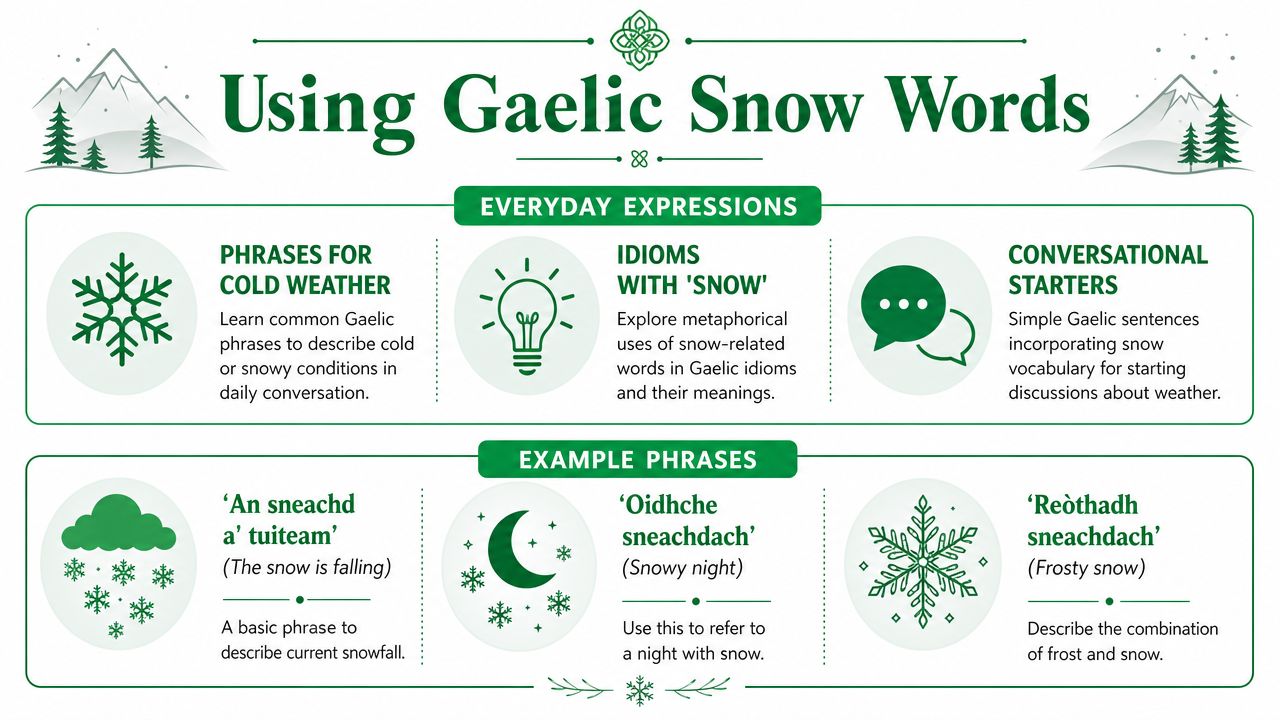
Simple Scottish Gaelic examples
Here are parallel Scottish Gaelic-style practice phrases using sneachd.
An sneachd a' tuiteam
The snow is falling.Oidhche sneachdach
Snowy night.Reòthadh sneachdach
Frosty snow.
These are useful because they pair weather vocabulary with common descriptive patterns. Even if you don't fully understand every grammar point yet, you start recognizing how winter words sit inside real phrases.
How to make phrases stick
Don't memorize long lists. Work with small clusters.
Try this pattern:
- Pick one noun such as sneachta or sneachd.
- Add one weather action such as “is falling” or “is snowing.”
- Add one description such as “heavy” or “snowy.”
- Say the phrase aloud several times over the day.
A beginner practice set might look like this:
- snow
- it is snowing
- snowy night
- heavy snow
That's enough for one session.
Short phrases beat isolated words because your mouth learns the rhythm, not just the spelling.
You can also turn weather into conversation starters. Ask what the sky looks like. Describe the road. Mention the cold morning. Weather vocabulary works well because it belongs to daily life, and it gives you an easy reason to repeat the same forms often.
Regional Nuances and Seasonal Traditions
A lot of frustration comes from expecting one standard sound for every Gaelic word. In real life, pronunciation shifts by place, speaker, and local habit.
That's true for snow words too.
Pronunciation changes by region
If you hear sneachta from different Irish speakers, the broad shape stays recognizable, but the exact sound can move. The same is true in Scottish Gaelic. A learner might hear one speaker soften a final sound while another gives it more force.
This isn't a problem to solve. It's part of how living languages work.
A good beginner habit is to listen for the stable part of the word first. With snow vocabulary, that usually means the opening sound and the core word shape. Don't panic over every regional variation. You're aiming for recognition, then confidence, then finer detail.
Here's a simple order of attention:
- First: Can you recognize the word when you hear it?
- Next: Can you say it clearly enough to be understood?
- Later: Can you adjust toward a regional accent you want to follow?
That order saves a lot of stress.
Snow in the Gaelic seasonal calendar
The deeper cultural layer appears in seasonal tradition. In some Scottish accounts, the first snow is described as the Cailleach laying her cape across the land. Her reign ends at Imbolc on 1 February, while some traditions place winter's final retreat at La Fheile Cailleach on 25 March, according to this discussion of the Cailleach and Imbolc in Gaelic seasonal tradition. If you want more background on that seasonal turning point, this short guide to Imbolc in Irish tradition is a useful companion.
That image of the cape matters because it shows how people can speak about weather through story. The first snow isn't only frozen water falling from the sky. It becomes a sign that winter has spread itself over the ground.
This also explains why snow can feel symbolically ordered in Gaelic tradition. It belongs to a known cycle of arrival, rule, and retreat.
When you connect the snow word to the season calendar, the folklore stops feeling decorative. It starts feeling practical, like a way of reading the year.
How to Practice Your Gaelic Pronunciation
Knowing a snow word on the page isn't the same as being able to say it without hesitation. Gaelic spelling carries sound information, but beginners often can't hear that information yet.
That's normal. Pronunciation comes from repetition tied to listening.

Train your ear before your mouth
Start by listening to one word and one short phrase. Don't jump between ten versions at once.
For example, choose:
- sneachta
- Tá sé ag cur sneachta
Listen several times before speaking. Then copy the rhythm, not just the consonants. Most learners focus too hard on individual letters and miss the music of the phrase.
A second helpful move is to record yourself. You don't need studio quality. A phone recording is enough. When you listen back, ask simple questions. Did the word sound rushed? Did you flatten the ending? Did the phrase flow, or did it sound like separate blocks?
Build a short repeatable routine
A useful pronunciation routine should be short enough that you'll do it.
Try this:
Listen once for gist
Just hear the whole phrase.Listen again and shadow
Speak with the audio, even if it feels messy.Repeat alone
Say the phrase from memory.Use it in a tiny variation
Swap one word. Turn “snowing” into “snowy night,” for example.Return later the same day
Spaced repetition matters more than one long burst.
This kind of drill works better than silent reading because pronunciation is physical. Your tongue, jaw, and timing need practice.
Use tools that answer back
At some point, every learner needs feedback. Otherwise you can repeat the same mistake so often that it starts to feel correct.
That's one reason speech technology can help language learners, especially when it handles more than one language well. If you want the wider context for why that matters, this article on how multilingual speech recognition boosts efficiency gives a practical explanation of what responsive voice tools can do.
For Irish specifically, Gaeilgeoir AI offers guided real-world conversations, pronunciation support, adaptive quizzes, and scenario-based practice for everyday situations. For a learner working with weather vocabulary, that means you can move beyond isolated word study and start speaking in context.
After you've done a few spoken drills, it helps to watch and copy a live-style explanation. This lesson format gives you another way to hear rhythm and pacing in action.
A final tip. Don't wait until your pronunciation feels perfect before speaking. Gaelic sounds become clearer through use. If you only study without speaking, the words stay trapped on the page.
- Choose a lane: Learn either Irish or Scottish Gaelic first, even if you enjoy both.
- Keep a weather mini-set: Snow, rain, wind, cold, and one or two simple sentences.
- Review aloud: Whispering helps, but full voice is better.
- Accept approximation: Clear and improving beats silent and “accurate” in theory.
Good pronunciation practice is less about sounding impressive and more about building a habit of hearing, copying, and adjusting.
If you want to turn this vocabulary into real speaking practice, Gaeilgeoir AI is a practical place to start. It helps beginners and returning learners work on Irish through guided conversations, pronunciation support, and short exercises you can fit into everyday life.