Light in Scottish Gaelic: Solas or Aotrom?

You're probably here because you typed something like “how do you say light in Scottish Gaelic?” and got an answer that felt incomplete. One page said solas. Another hinted at aotrom. If you're an English speaker, that's confusing because English uses one word for two very different ideas.

That confusion is one of the most useful entry points into Scottish Gaelic. Once you see why Gaelic separates these meanings, the language starts to feel sharper, more logical, and often more expressive than a straight word-for-word translation suggests. For anyone exploring light in Scottish Gaelic, this is one of the first distinctions worth getting right.

Table of Contents

The Challenge of Translating Light

A learner once asked me how to describe “the light in the room” and then, in the same breath, “a light bag.” In English, both are simple. In Scottish Gaelic, they split apart immediately.

That split is a gift, not a problem. It forces you to say what you mean. Are you talking about brightness, daylight, lamp light, and glow? Or are you talking about something that isn't heavy?

Scottish Gaelic is also being learned and reclaimed by more people again. According to the 2022 Scotland Census summary discussed by SPICe Spotlight, 130,161 people had some Gaelic language skills, up from 87,000 in 2011. That rise matters because it shows renewed interest in using and understanding the language, including the kind of basic but essential vocabulary question that brings many learners here.

Why translation needs context

A dictionary often gives the illusion that every English word has one tidy equivalent. Gaelic doesn't always work that way, and English is often the less precise language in the pair.

If you've ever worked with translated writing, this is why context checks matter. A phrase can be technically translated and still miss the actual meaning. That's also why broader editorial practices like this guide for authors on multilingual publishing quality are so useful. They remind writers to test meaning, not just match words.

A good translation answers the intended meaning first, then chooses the vocabulary.

For light in Scottish Gaelic, the intended meaning is everything. Once you know which kind of “light” you want, the right Gaelic word becomes much easier to remember.

The Two Kinds of Light Solas vs Aotrom

The core rule is simple. Solas means light as illumination. Aotrom means light as not heavy.

That distinction is built into the language itself. The WordHippo entry on the Scottish Gaelic word for light identifies solas as the primary Gaelic term for illumination, inherited from Old Irish, while aotrom refers to the physical property of lightness in weight. For learners, that's the line to keep in your head.
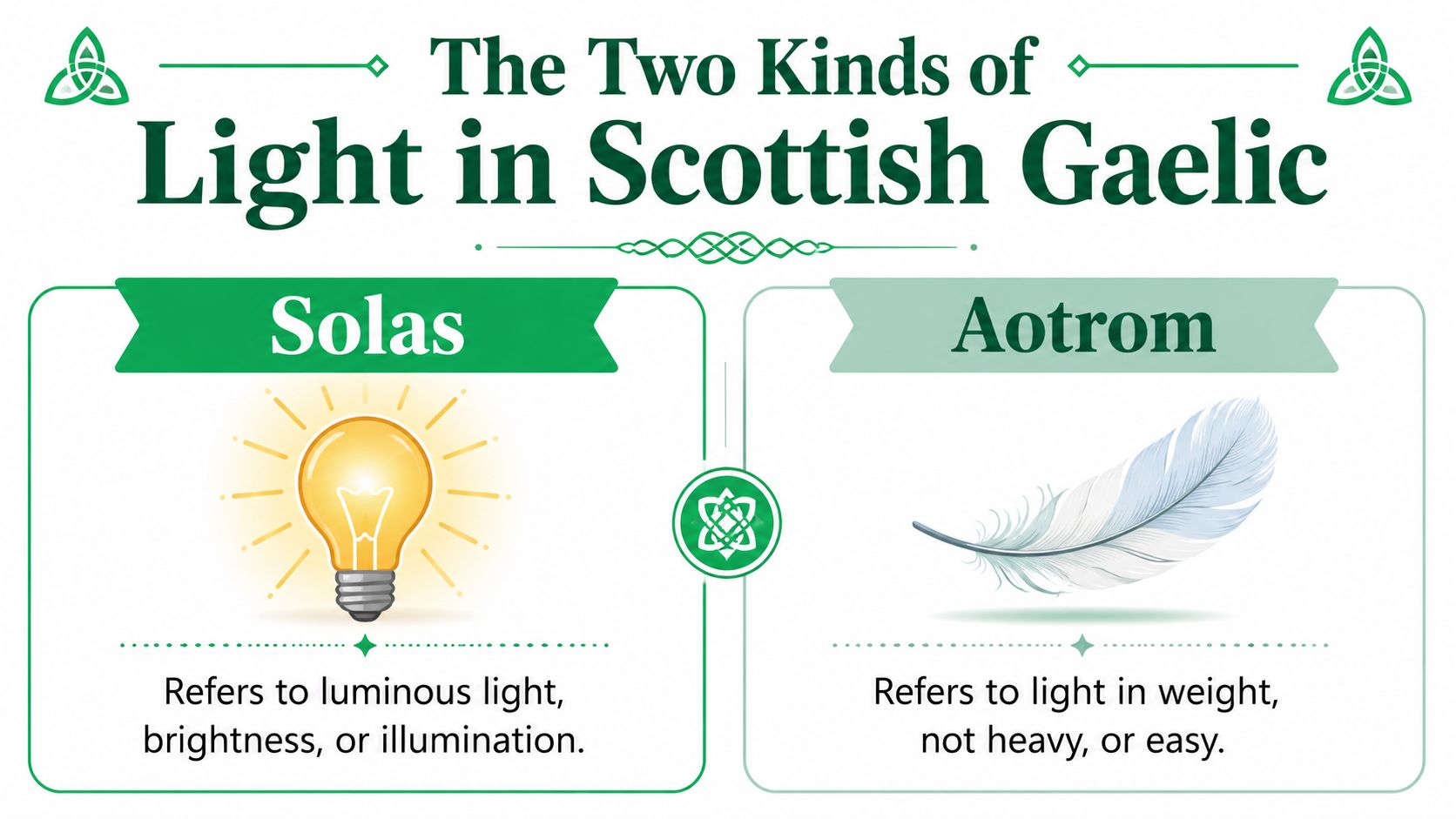
An infographic explaining the two meanings of light in Scottish Gaelic using the terms Solas and Aotrom.

Why English causes the mix-up

English asks one word to do too much. We say:

  • the light from the sun
  • a light jacket
  • a light touch
  • a light colour

Gaelic usually wants you to be clearer.

Use solas when the idea is brightness or illumination. Think of sunlight through a window, a lamp in a room, or a glow in the dark. Use aotrom when the idea is low weight, ease, or something physically light to carry.

Some learners overcorrect and start using solas anytime the English word “light” appears. That's the most common beginner mistake. If you mean “not heavy,” solas is wrong.

Solas vs. Aotrom A Quick Guide

Concept Gaelic Word Meaning English Example
Illumination solas light, brightness, glow “The light is bright.”
Weight aotrom light, not heavy “The bag is light.”

A quick memory trick helps. Solas belongs with things that shine. Aotrom belongs with things you lift.

Here are a few plain examples:

  • Solas: the light in the kitchen, morning light, candlelight
  • Aotrom: a light box, a light coat, a light step

Practical rule: If you could replace “light” with “bright” or “illumination,” choose solas. If you could replace it with “not heavy,” choose aotrom.

There's another helpful cultural link here. Learners who enjoy related vocabulary often like exploring nearby terms such as fire, glow, and warmth. If that interests you, this note on fire in Scottish Gaelic pairs well with the distinction between solas and other light-related words.

Pronunciation Guide Sounding Natural

You hear someone say solas in a song, then meet aotrom in a lesson, and suddenly English has led you into a trap. Both words get translated as “light,” but they do not sound alike, and they do not belong to the same idea. Training your ear to keep them apart is part of sounding natural in Gaelic.

A good first goal is clear, steady pronunciation. Native-like polish can come later. If speaking aloud makes you hesitate, LenguaZen's language confidence tips are indeed useful for building the habit of saying words before you feel fully ready.

How to say solas

Solas is usually said roughly like:

  • SO-luss
  • stress the first syllable
  • keep the ending short and light

For many English speakers, the first vowel is nearer the sound in “off” than the “oh” in “go.” The word should feel compact. If you stretch it into “soh-lass,” it starts to sound less Gaelic and more like an English guess based on spelling.

The good news is that solas is often easier for beginners because the rhythm is straightforward. Put your energy into a clear first syllable, then let the second fall away quickly.

How to say aotrom

Aotrom often causes more trouble because the spelling invites the wrong instincts. A learner-friendly approximation is:

  • AY-trum or EE-trum, depending on accent
  • keep the second syllable brief
  • do not try to pronounce every written vowel one by one

English readers often want to say something like “ow-trom.” That is the spelling trap at work. Gaelic spelling records older sound patterns and sound relationships, not neat English-style letter-by-letter pronunciation. If you want a wider foundation for that system, this guide to how Gaelic is pronounced explains the broad patterns well.

Here is a helpful way to practise the pair. Say solas while looking at a lamp or a window. Say aotrom while picking up a bag or book. One word belongs to brightness. The other belongs to weight. Linking sound to a physical image helps many English-speaking learners stop mixing them up.

Practise them as a contrast pair: solas, something that shines; aotrom, something that is easy to carry. Your ear learns the meaning difference faster when your mouth repeats the sound difference too.

Gaelic Grammar in Action Using Light in Sentences

A beginner often reaches this stage and hits a strange problem. You know that solas means light and aotrom means light, but the sentence forces you to choose what kind of light you mean.
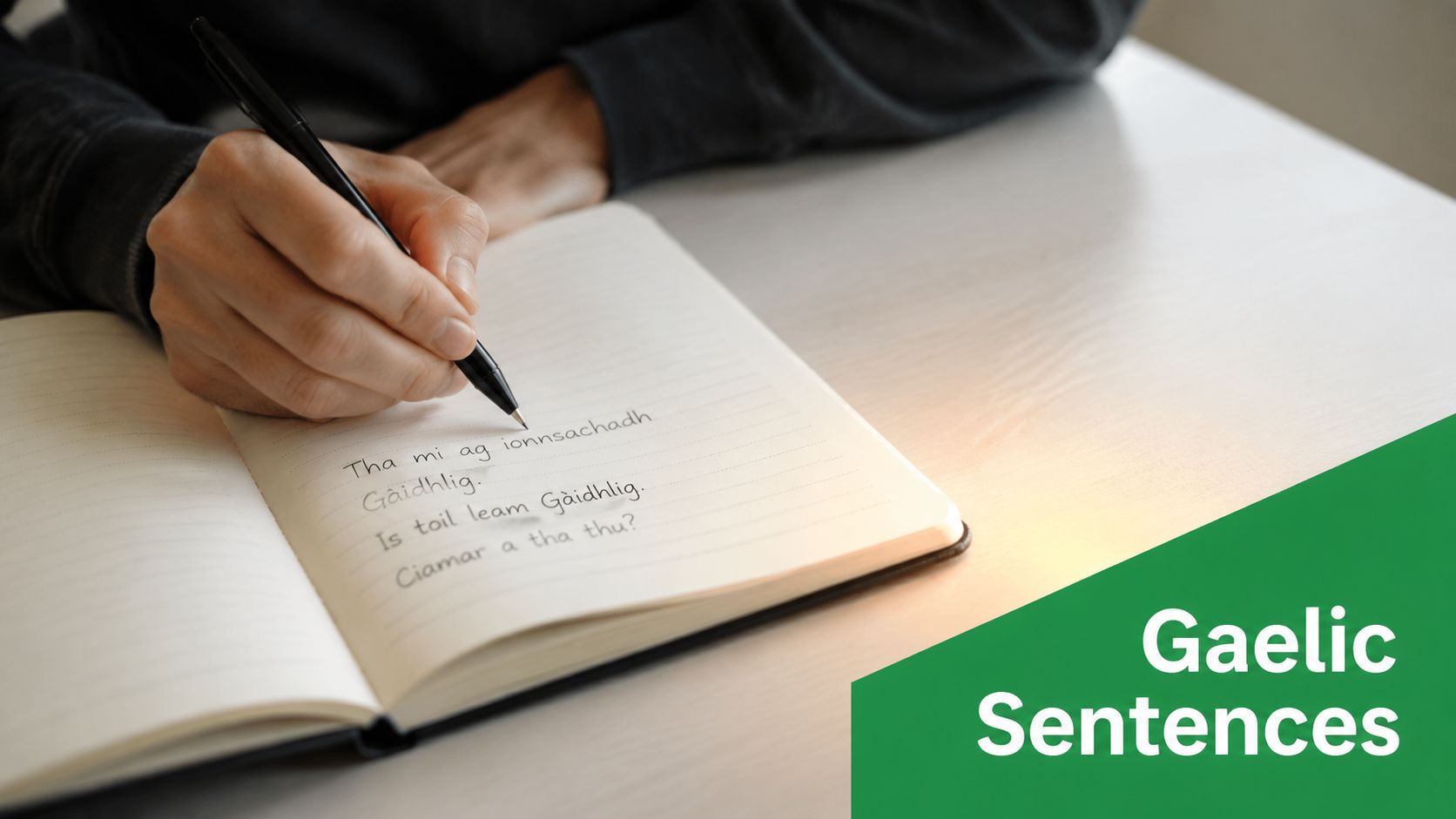
A person writes Scottish Gaelic phrases into a notebook on a bright desk with green corner overlay.

That is where grammar starts to help rather than confuse. Scottish Gaelic usually builds a simple statement in a different order from English, so the word for light has to sit inside a new sentence pattern. For an English speaker, it can feel like rearranging furniture in a familiar room. The pieces are the same, but the layout changes.

Sentence order changes the feel

English often begins with the subject:

  • The light is bright.
  • The bag is light.

Gaelic commonly begins with the verb:

  • Tha an solas soilleir.
  • Tha am poca aotrom.

The key word here is tha, the usual present-tense form for “is” or “are” in this kind of statement. After that comes the thing you are talking about. So an solas is “the light,” and am poca is “the bag.”

Beginners sometimes try to translate English word by word, but Gaelic resists that. If you start with “the light” because English does, your sentence can sound awkward even when every individual word is correct.

The two meanings behave differently in sentences

Here is the confusion many guides skip. Solas is a noun. It names a thing, the light itself. Aotrom is usually an adjective. It describes something, such as a bag, coat, or step.

That difference shapes the whole sentence.

  • Tha an solas làidir.
    The light is strong.

  • Tha am baga aotrom.
    The bag is light.

In the first sentence, solas is the subject. In the second, aotrom is describing baga. If you remember only one grammar point from this section, remember this one. Solas usually names brightness. Aotrom usually describes low weight.

Why words sometimes change shape

Gaelic also changes the beginning of words in certain grammatical settings. English learners often see this and assume they have met a brand-new word. Usually, they have not.

With solas, you may meet sholas in some contexts. The core meaning is still the same. The opening has shifted because Gaelic grammar marks relationships directly on the word.

A few steadying reminders help here:

  • Learn solas and aotrom first in their basic dictionary forms.
  • Treat changes at the start of a word as grammar signals.
  • Keep asking what job the word is doing in the sentence.

That last habit saves a lot of confusion.

Three examples to read slowly

  1. Tha an solas soilleir.
    The light is bright.

  2. Tha am poca aotrom.
    The bag is light.

  3. Chunnaic mi solas.
    I saw a light.

Read them as patterns, not as isolated facts to memorise. In sentence 1, solas is a thing you can see. In sentence 2, aotrom is a quality of the bag. In sentence 3, solas appears again as the object of the verb.

Many English-speaking learners improve quickly once they stop asking “What is the Gaelic word for light?” and start asking “Do I mean brightness or low weight?” That small shift leads to better grammar, better word choice, and much more natural Gaelic.

Poetic and Idiomatic Light Cultural Expressions

Literal meaning gets you through a sentence. Cultural meaning gives the language its texture. Gaelic often uses light not only for brightness, but also for atmosphere, feeling, and resonance.
A scenic view of rolling Scottish Highlands with mist settling in a valley at sunset.

Light as mood and meaning

When learners first meet solas, they often treat it as a simple utility word. But words for light in Gaelic can carry emotional colour. Light can suggest welcome, warmth, guidance, or a break in harsh weather. Even when a phrase is plain, the associations are often richer than an English beginner expects.

That helps explain why many learners eventually want more than a dictionary answer. They start with “How do I say light?” and then want to know how the word feels in songs, stories, and descriptions of scenery.

Aingeal and the edge of fire

One especially interesting word around this semantic field is aingeal, noted in cultural discussions as a term connected with fire/light. The idea has gained attention among learners, and the TikTok discussion linked here reflects growing interest in poetic and culturally layered Gaelic vocabulary rather than only basic textbook terms.

What matters for a beginner is not memorizing every rare word. It's realizing that Gaelic often preserves links between light, fire, glow, and lived environment.

A few healthy habits help here:

  • Learn the basic term first: Keep solas secure before reaching for poetic alternatives.
  • Treat cultural words with care: Some are vivid and memorable, but less universal in everyday conversation.
  • Notice semantic neighborhoods: In Gaelic, meaning often spreads across nature, weather, hearth, and storytelling.

If solas is the practical word you need for daily speech, words like aingeal remind you that Gaelic also stores old ways of seeing the world.

That poetic edge is one reason so many people stay with the language after the beginner stage.

A Bridge to Irish How Gaelic Light Compares

A beginner often meets a comforting surprise here. If you learn solas in Scottish Gaelic, you already have a word that looks very familiar in Irish. The same is true with aotrom and Irish éadrom. The family resemblance is real, and it can make the two languages feel less distant.

That said, this similarity helps most when you keep the two meanings of English light clearly separated. In both languages, one word belongs to illumination and another belongs to weight. Scottish Gaelic uses solas for light you see, and aotrom for something light to carry. Irish follows the same pattern with solas and éadrom. For an English speaker, that parallel is useful because it confirms that the distinction is not a Scottish Gaelic quirk. It is a basic part of how both Gaelic languages organize meaning.

Screenshot from https://gaeilgeoir.ai

If you want to see how these close cousins differ in spelling, sound, and grammar, this guide to Irish vs Scottish Gaelic differences is a helpful next read.

Irish also faces a visibility problem online. As of April 2024, RTÉ Brainstorm reported that English dominates websites with known content languages, while Irish appears on only a very small share. For learners, that means fewer chances to bump into the language naturally during everyday browsing.

Accessible tools matter for exactly that reason.

One useful response is practice built around common words and repeated exposure. Gaeilgeoir AI teaches through the 1,000 most-used Irish words, with guided scenarios that help learners hear, read, and use Irish in practical contexts. If Scottish Gaelic has sparked your interest in the wider Gaelic world, it offers a clear way to start building active Irish alongside that curiosity.

If you'd like to turn that curiosity into regular speaking practice, Gaeilgeoir AI is a smart place to start. It helps learners build usable Irish from day one with guided conversation, pronunciation support, adaptive review, and scenario-based practice that fits real life.

Fire in Scottish Gaelic: Your Complete Guide to Teine

You're probably here because you saw teine somewhere, or because you typed “fire in Scottish Gaelic” and got a confusing mix of dictionary entries, folklore, and Irish spellings that don't quite match.

That confusion is normal. Scottish Gaelic and Irish are related languages, so their fire words look similar, sound related, and sometimes appear in the same cultural discussions. But if you're learning carefully, the differences matter. So does the context. Sometimes people want the plain translation for “fire.” Sometimes they want the older cultural meaning tied to seasonal festivals, hearth customs, and ritual language.

This guide keeps those threads separate. You'll learn the basic word, how to say it, how it changes in real use, where learners mix it up with Irish, and why fire has such a strong place in Scottish Gaelic tradition.

Table of Contents

The main word you need

You are reading a Scottish Gaelic phrase, you spot a word that looks a bit like Irish, and suddenly you are not sure how to say it. For this article, the word to anchor first is teine. It means fire in Scottish Gaelic.

For a beginner, that one word does a lot of work. If you want to refer to a fire, whether a hearth fire, a bonfire, or fire in a simple vocabulary list, teine is the form to learn first.

Pronunciation and basic meaning

The spelling can mislead English speakers. Many learners see teine and guess something like “tee-nee” or “ten.” Scottish Gaelic spelling does not map neatly onto English sound patterns, so that instinct usually sends you off course.

A practical learner approximation is “TYEN-uh.” The first part has a y-sound built into it, and the last vowel is light. It is only a guide, but it points you in the right direction.

Practical rule: Learn the sound and spelling together. Memorizing only the written form of Gaelic words often creates bad pronunciation habits.

That habit is especially useful in Celtic languages, where familiar letters can behave in unfamiliar ways. A word can look simple on the page and still sound quite different from what an English speaker expects.

Why learners miss related forms

Teine is the main dictionary form, but real language use rarely stays frozen in one neat shape. As noted earlier, learner resources also show related forms such as teineadh and teinid, along with compounds like teine bras (“vigorous fire”) and teine leathann (“signal fire”).

A good way to understand this is to treat teine as the trunk of a small word family. Once you know the trunk, the branches start to make more sense.

Beginners often miss those branches for a few practical reasons:

  • they search for one exact word and stop there
  • they start from English and miss longer Gaelic phrases
  • they read only the surface form and do not notice grammar changes
  • they copy a phrase from a folklore or culture page without knowing whether it sounds everyday, literary, or ceremonial

This point is especially helpful if you also study Irish. Similar-looking words across the Gaelic languages can tempt learners to assume that every related form works the same way. Building a clear base around teine first makes later comparisons much easier.

Scottish Gaelic and Irish are not the same

Many readers of articles about fire in Scottish Gaelic are Irish learners, heritage learners, or people moving between both languages. That's why this point needs to be clear.

Scottish Gaelic and Irish are close relatives. They share deep historical roots, and many words resemble each other. But they are not interchangeable.

The easy confusion

The most common mix-up is this: someone learns an Irish form, then assumes it applies directly to Scottish Gaelic. Or they learn teine in Scottish Gaelic and treat every similar-looking Irish phrase as identical in meaning, pronunciation, or grammar.

Sometimes the overlap helps. Sometimes it creates false confidence.

If you already study Irish, think of Scottish Gaelic as a close cousin, not a regional accent of the same language.

That mindset prevents a lot of frustration.

A quick comparison

Meaning Scottish Gaelic Irish
fire teine tine
language name Scottish Gaelic Irish / Gaeilge
learner risk assuming shared spelling rules assuming shared pronunciation rules

The table is simple on purpose. The point isn't to turn this into a full comparison lesson. It's to help you stop one very common error: using Irish spellings or pronunciation habits when you mean Scottish Gaelic.

If your main interest is Irish but you enjoy comparing Gaelic languages, that can be useful. You just need a clean mental label for each one.

How fire appears in real Scottish Gaelic use

A word becomes easier to remember when you see where it is found. Teine isn't only a dictionary item. It also appears in formal, public-facing language.

The Scottish Fire and Rescue Service has a Gaelic Language Plan 2023–2026 issued under the Gaelic Language (Scotland) Act 2005, which shows that Gaelic fire-related terminology is being standardized in an official service context. You can see that in the Scottish Fire and Rescue Service Gaelic Language Plan.

Everyday word versus formal language

This is useful for learners because it shows two layers of vocabulary:

  1. Basic learner vocabulary, where teine means fire.
  2. Institutional Gaelic, where fire-related language needs to be precise for public communication.

That distinction matters. A folklore phrase, a poetic expression, and a safety message may all involve fire, but they won't always sound the same or use language in the same way.

Here's the practical takeaway:

  • At home study level, start with teine
  • In cultural reading, expect older expressions and compounds
  • In official contexts, expect standardized wording and careful terminology

Practical learner examples

You don't need a huge phrasebook to get started. What you need is comfort with recognition.

Try reading these as vocabulary chunks rather than full grammar lessons:

  • teine
    The core noun, “fire.”

  • teintean
    The plural form listed by LearnGaelic.

  • teine bras
    A stronger descriptive phrase, glossed as “vigorous fire.”

  • teine leathann
    A phrase glossed as “signal fire.”

That last point is worth pausing on. Many learners think they're failing because a word seems to “change shape.” Often they're just seeing compounds, description, or grammar doing normal Celtic-language work.

Fire in Scottish Gaelic culture

If you only learn teine as a dictionary item, you'll miss why fire is so culturally loaded in Gaelic tradition. In Scottish Gaelic life and memory, fire belongs to the home, the season, the community, and ritual practice.

Two major seasonal festivals show this especially well.

Beltane and the beginning of summer

The Beltane Fire Festival is historically celebrated on May 1st to mark the symbolic beginning of summer in the Gaelic calendar. Beltane, meaning “bright fire,” is one of four major seasonal festivals alongside Samhuinn, Imbolc, and Lughnasadh. Historical accounts describe fire-lighting on that date as a ritual act tied to the growing power of the sun and the cleansing of communities after the dark winter months. The tradition is summarized in this verified background on Beltane in Scottish Gaelic fire tradition.

That helps explain why “fire” in Gaelic culture isn't only physical flame. It can also signal renewal, cleansing, and seasonal transition.

Modern celebrations on Edinburgh's Calton Hill are widely known, but the tradition itself reaches back to pre-Christian Celtic practice. In teaching and cultural memory, Beltane still functions as an important marker of gathering and shared identity.

Samhuinn and the turning into winter

The balancing festival is Samhuinn, celebrated on October 31st. It marks the transition from summer to winter and is historically linked with the roots of modern Halloween. The festival includes fire-dancing, drumming, processions, and the symbolic overthrowing of Summer by Winter. The verified summary of this tradition appears in this background on the Samhuinn Fire Festival and Gaelic custom.

One especially striking custom tied to fire is the practice of smooring, covering the hearth so it smoulders through the night. In Gaelic cultural terms, that moves us from public festival fire to domestic fire.

Fire in Gaelic tradition isn't just spectacle. It's also continuity, care, and protection inside the household.

Traditional expressions around the hearth

A lot of learner confusion comes from meeting fire words in cultural writing before meeting them in plain vocabulary study. That's why hearth language deserves its own place.

The strongest overlooked distinction is between the noun itself and fire-related practices.

Smooradh an teine

One phrase you may come across is smooradh an teine, often explained as banking or smothering the hearth fire overnight. That wording appears in discussion of Scottish Gaelic fire customs in this note on smuradh an teine and related practice.

This is a great example of why direct translation only gets you so far. If you only know teine = fire, you understand the object, but not the action, household rhythm, or cultural meaning.

Historically, the related practice of smooring was tied to nightly protection of the hearth. In accounts associated with Samhuinn, the hearth fire was covered with ashes to reduce oxygen and keep it smouldering gently through the night.

Ceremonial and descriptive fire terms

You may also encounter terms that belong more to ritual, folklore, or older descriptive language than to daily beginner conversation.

A few examples already noted in learner-facing material include:

  • teine bras for a strong or vigorous fire
  • teine leathann for a signal fire
  • teine éiginn for a fire made by friction, mentioned in the verified cultural brief

These terms don't mean you need to memorize a giant list at once. They show that fire vocabulary branches into domains:

Domain What learners tend to see
Basic dictionary use teine
Household custom expressions around banking or tending the hearth
Ceremonial language named ritual or descriptive fire phrases
Historical reading older or regionally marked wording

Once you see those domains, the material feels less random.

Common mistakes beginners make

Some mistakes come from language learning. Others come from culture content online. Both are fixable.

Translation mistakes

The first problem is treating every fire-related phrase as if it were just another way to say “fire.” It isn't.

A beginner should separate these categories:

  • Single noun
    Teine means “fire.”

  • Related form
    A form like teintean is not a new word with a new core meaning. It's part of the same word family.

  • Compound or descriptive phrase
    Something like teine bras adds description.

  • Custom or ritual expression
    A phrase like smooradh an teine carries cultural practice, not just raw vocabulary.

That simple sorting habit saves a lot of confusion.

Pronunciation and lookup mistakes

The second problem is searching badly. Learners often type an English phrase into a search engine, click a folklore page, and assume they've found the standard modern word.

A better process looks like this:

  1. Check a dictionary first for the base form.
  2. Listen or note pronunciation right away.
  3. Watch for plurals and variants.
  4. Only then read cultural uses and idioms.

A good learner habit: Don't memorize an isolated translation without checking whether it has a common plural, a pronunciation guide, or a known compound form.

There's also the Irish issue again. If you study both languages, keep separate notes. One page for Scottish Gaelic. One page for Irish. Shared roots are helpful, but mixed notes create mixed recall.

A simple way to remember teine

A learner often remembers teine better after meeting it in a real scene: a hearth fire at night, a festival fire on a hillside, or a simple sentence in a lesson. That is the trick. The word sticks when it has a place to live in your memory.

A good method is to treat teine as a small cluster rather than a single translation on a flashcard. Your brain handles related pieces more easily when they belong together, much like keeping cups, plates, and bowls in the same cupboard instead of scattering them around the house.

Build a small word family

Keep the set small at first:

  • teine
    fire

  • teintean
    fires

  • smooradh an teine
    banking or smothering the fire overnight

  • one cultural anchor
    Beltane or Samhuinn, whichever helps you picture the word clearly

That combination gives you a base noun, a related form, a traditional phrase, and a cultural memory point. For many learners, that works better than memorizing one bare English-to-Gaelic pair.

Study tools that help

Different study tools help with different parts of learning.

Need Useful approach
Pronunciation dictionary audio or pronunciation-focused practice
Word-family memory handwritten notes or spaced repetition cards
Culture context reading about hearth customs and seasonal festivals
Related Gaelic learning structured practice in the other Gaelic language, with clear notes kept separate

If you also study Irish, Gaeilgeoir AI can still be useful as an Irish practice tool with pronunciation support and guided exercises. The important point is comparison, not mixing. Scottish Gaelic teine and Irish tine are close relatives, but they belong in separate mental folders if you want clean recall.

One teacherly rule helps here: do not wait for perfect grammar before learning a word with cultural weight. Teine becomes easier to remember when it is tied to daily life, older customs, and the sound of the language itself.

Learn the base word first. Add one related form. Attach one strong image. That simple routine gives teine a much better chance of staying with you.

Start Speaking Irish Today — 25% Off
Use code START25

Learn real Irish for real life with guided practice, pronunciation support, and everyday conversations.

Get 25% off any plan with code START25

Start Speaking Irish Today — 25% Off