Bear in Gaelic: Irish and Scottish Translations Explained

You're probably here because you saw two different Gaelic words for “bear” and wondered which one is right. Maybe an Irish learner's app gave you béar, then a Scottish Gaelic page showed mathan, and now it feels like the languages are playing tricks on you. That confusion is normal. Closely related languages often keep old family resemblances while making different choices in everyday speech.

For beginners, bear in Gaelic is a great example of how language, history, and pronunciation all meet in one small word. If you've already been comparing Celtic languages, this short guide to the Goidelic language family gives useful background on how Irish and Scottish Gaelic relate to each other. Once that relationship clicks, the bear words make much more sense.

Table of Contents

Introduction to Bear in Gaelic

A learner opens an Irish text and finds béar. Later that same evening, they listen to Scottish Gaelic and hear mathan. Both mean “bear,” but they don't look alike, and that's where beginners often get stuck.

The good news is that both words are worth learning because they teach different lessons. Irish gives you a modern everyday form that came in from English. Scottish Gaelic keeps a native Gaelic form in daily use. That contrast makes this topic more than vocabulary practice. It shows how words change when the world around speakers changes.

Why beginners get tripped up

English speakers often expect one clean translation across related languages. Gaelic languages don't always work that way. A word can be modern in one language and old-fashioned in another. A form can also survive in names, sayings, or place names long after it stops being the usual everyday word.

Practical rule: Learn the modern everyday word first, then learn the older form as a cultural bonus.

What to focus on first

If you're brand new, keep these goals simple:

  • Know the pair: Irish uses béar and Scottish Gaelic uses mathan in ordinary speech.
  • Say them aloud: Pronunciation matters early because Gaelic spelling can feel less predictable than English.
  • Use them in short sentences: One clear sentence beats memorizing a long word list.
  • Notice history without overloading yourself: Older forms like mathúin and math-ghamhainn are useful because they explain where the modern words came from.

Irish and Scottish Gaelic Words for Bear

The most useful place to start is the side-by-side comparison. In modern Irish, the common word is béar. In Scottish Gaelic, the everyday word is mathan.

That difference isn't random. Scottish Gaelic kept a native Gaelic bear word in daily use, while Irish moved toward a loanword. The older Irish-related family of forms still matters, though, because it connects Irish mathúin, Scottish Gaelic mathan, and even Manx maghouin as related descendants of an older root, as discussed in the Scottish Gaelic toponymy study on bear terms and ursid place names.

Comparison of Bear Terms

Language Term IPA Pronunciation Tip
Irish béar /bʲeːɾˠ/ Start with a soft “b,” then say “bay,” then a light tapped r
Scottish Gaelic mathan /ma.hən/ Say “MA-ha-n,” with a clear first syllable and a light final sound

These IPA guides are learner-friendly approximations for speaking practice. If IPA is new to you, think of it as a pronunciation map rather than a test.

Older related forms

A few older or related words appear in dictionaries, names, and cultural material:

  • Irish older form: mathúin
  • Scottish Gaelic older form: math-ghamhainn
  • Archaic term: art
  • Manx related form: maghouin

One especially interesting detail is that mathan is a reduced form of math-ghamhainn, and that older form also appeared as a male given name in Ireland and Scotland, paralleling the Norse name Björn. The same source notes that art survives in Scottish Gaelic as an archaic word for “bear,” though it more often lives on with the sense of “hero.”

If you only want the everyday modern pair, memorize this: béar = Irish, mathan = Scottish Gaelic.

A quick memory trick

Use a location cue. If you're thinking of Ireland, think béar. If you're thinking of Scotland, think mathan. Then add the older native family later.

Grammar Rules for Gaelic Bear Words

Learners often ask, “Do I just memorize the word, or does it change in a sentence?” In Gaelic, the answer is yes, it changes. Not wildly at first, but enough that you should notice patterns early.

If you want a wider foundation before drilling this one noun, this Irish and Scottish Gaelic grammar comparison helps make the bigger system less mysterious.

Irish patterns with béar

Start simple. Treat béar as the dictionary form. Then practice it in short noun phrases.

  • an béar = the bear
  • béar mór = a big bear
  • na béir = the bears

The exact forms you meet can vary by teaching style and context, so beginners should focus on recognition and sentence building rather than trying to master every case ending immediately.

Scottish Gaelic patterns with mathan

In Scottish Gaelic, mathan behaves like a noun you'll place inside common patterns:

  • am mathan = the bear
  • mathan mòr = a big bear
  • mathain = bears

Notice that the plural doesn't copy English “add s” logic. Gaelic often changes the noun itself.

Where mutation and sound change matter

One thing that surprises beginners is that Gaelic grammar can change the start of a word. You won't always hear or see the bare dictionary form.

For practical early study, watch for these habits:

  1. Articles matter. “The bear” may use a different article in Irish and Scottish Gaelic.
  2. Adjectives often come after the noun. So “big bear” becomes the Gaelic order, not the usual English order.
  3. Plural forms need separate practice. Don't assume you can guess them.
  4. Spoken rhythm changes what you hear. Even when the written form looks familiar, the phrase can sound softer or more connected.

Learn nouns as mini-phrases, not as isolated labels. “The bear,” “a big bear,” and “bears” are better study units than the single word alone.

Here's a beginner-friendly way to study:

Study goal Irish Scottish Gaelic
Base word béar mathan
With “the” an béar am mathan
Plural béir mathain

Use this table as a speaking drill. Read down one column, then switch languages and read across.

Pronunciation Guide with IPA

Most beginners don't struggle with the meaning of bear in Gaelic. They struggle with saying it without freezing. IPA helps, but only if you connect the symbols to sounds you already know.

A visual guide makes this much easier.
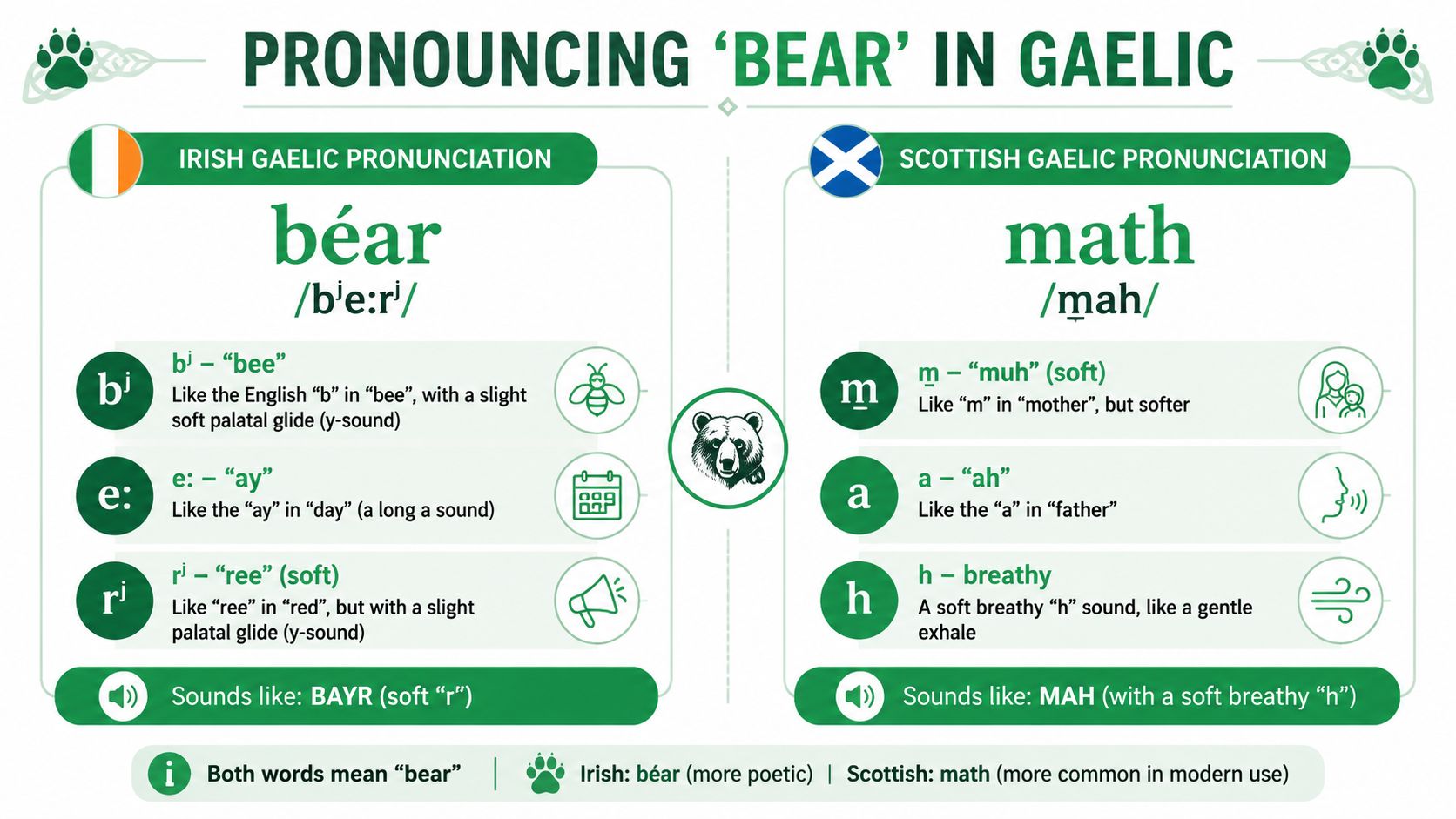
An infographic showing how to pronounce the word for bear in Irish and Scottish Gaelic languages.

If Gaelic sound systems still feel unfamiliar, this pronunciation overview on how Gaelic is pronounced gives broader listening support.

Saying béar in Irish

Use /bʲeːɾˠ/ as your guide.

Break it into pieces:

  • /bʲ/ sounds like a softened b
  • /eː/ is close to a long bay
  • /ɾˠ/ is a tapped or light r, not a heavy English pirate-style “rrr”

Try it slowly: bay-r. Then smooth it out so it becomes one clean unit: béar.

A common mistake is turning it into plain English “bear.” That gets close in meaning, but not in sound. The Irish vowel is cleaner and the final r is lighter.

Saying mathan in Scottish Gaelic

Use /ma.hən/ as your guide.

A practical beginner cue is:

  • ma like “ma” in “mama”
  • as a soft middle syllable, similar to the weak vowel in “sofa”
  • n light at the end

Say it in rhythm: MA-hun or MA-hən. Keep the first syllable clear.

Don't chase perfection on day one. Aim for a stable version you can repeat the same way every time.

Fast correction tips

Word Common mistake Better fix
béar Saying English “bear” unchanged Lengthen the vowel and lighten the r
mathan Stressing the second syllable too much Keep the stress near the start
both Reading spelling letter by letter Practice by chunking whole syllables

Record yourself if you can. Beginners improve fastest when they hear the gap between what they intended and what they said.

Beginner Example Sentences

Short sentences help you move from recognition to use. Don't wait until you know every grammar rule. A few safe patterns will carry you far.

Irish examples with béar

Try these first:

  • Is béar é.
    It is a bear.

  • Tá an béar mór.
    The bear is big.

  • Feicim béar.
    I see a bear.

These are useful because each one teaches a different frame. The first names the animal. The second describes it. The third puts it into an action sentence.

Scottish Gaelic examples with mathan

Now compare the Scottish Gaelic side:

  • ’S e mathan a th' ann.
    It is a bear.

  • Tha am mathan mòr.
    The bear is big.

  • Chì mi mathan.
    I see a bear.

You don't need to unpack every piece immediately. At beginner level, the key is noticing repeated sentence frames.

One idiom to remember

Older bear language still lives in idioms. In Irish, one example is Chuirfeadh sé othras ar mhathúin, meaning “It would sicken a bear.” The Scottish Gaelic tradition preserves a matching expression: chuireadh e an òrrais air math-ghamhainn.

That's useful because it shows how older words survive even when the everyday modern term changes.

Build your own flashcards with whole sentences. A card that says Tá an béar mór teaches grammar, pronunciation, and vocabulary at the same time.

A simple speaking drill

Use the same sentence frame and swap one word:

  1. Tá an béar mór.
  2. Tá an béar beag.
  3. Feicim béar.
  4. Ní fheicim béar.

Do the same in Scottish Gaelic with mathan. Even if your vocabulary is small, this kind of pattern drilling builds confidence fast.

Etymology and Cultural Notes

The history behind these words is unusually vivid because ecology shaped the language directly. In modern Irish, the word for bear is béar, an English loanword that replaced the older native mathghamhain, now mathúin. That older form means “the good calf,” and the shift happened because bears became extinct in Ireland between 1000 and 500 BC, which caused the original Gaelic word to fade from everyday use as the animal disappeared from daily life, as explained in this study of Irish bear vocabulary and extinction history.

The cultural layer is just as rich. Older Irish had multiple bear words, including art, math, and beithir, which tells you the animal mattered greatly in naming and imagination before it vanished from the wild.
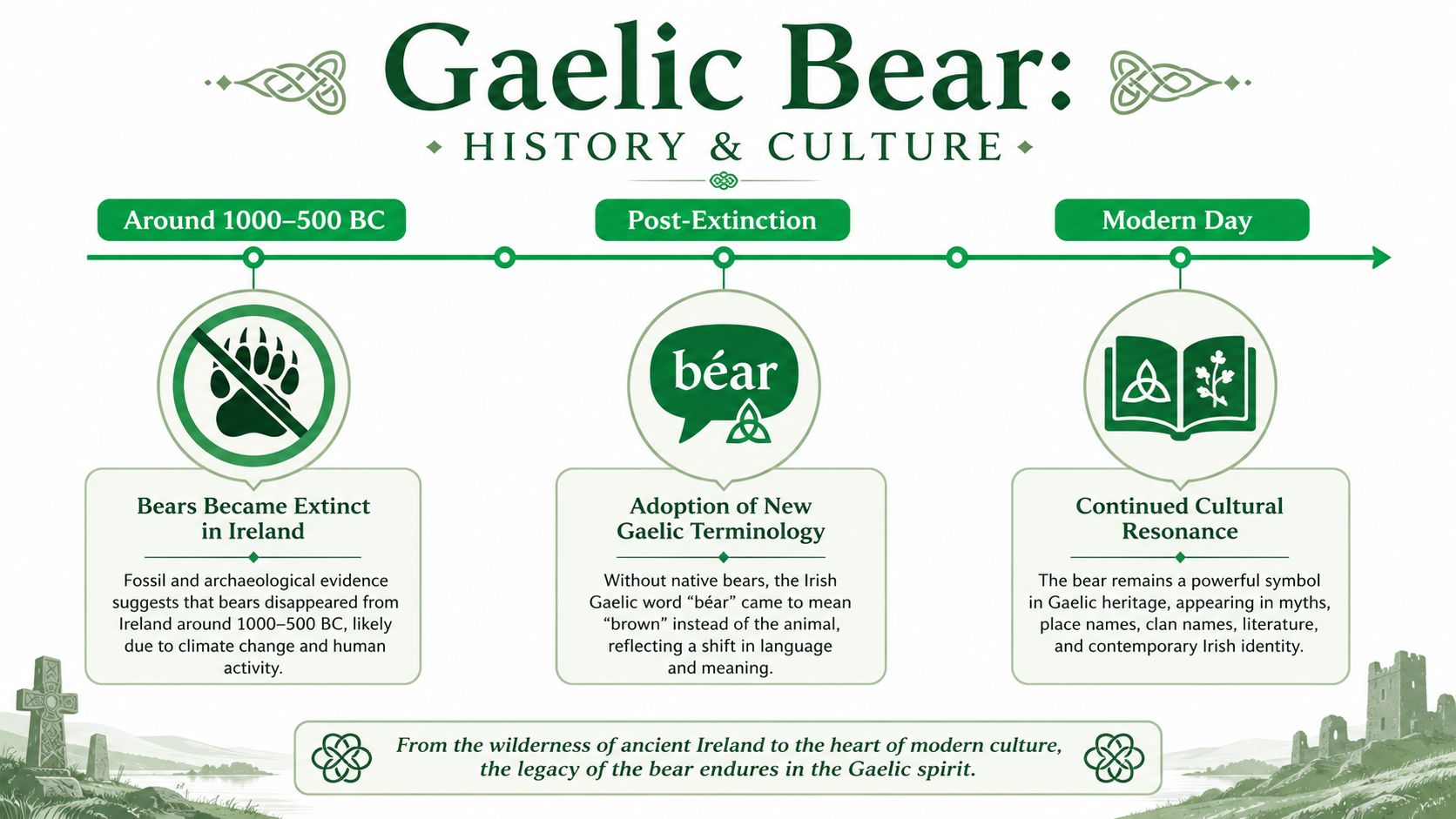
An infographic detailing the history and cultural legacy of bears in ancient and modern Gaelic culture.

Bears in names and heroic language

The old noun art is especially interesting. It could mean both the animal and a hero or warrior, preserving a strong link between bear imagery and human strength. The name Art became a male given name, and related traditions appear across Gaelic and Norse naming.

The same semantic pattern survives in later vocabulary too. An Omniglot note on Celtic bear words explains that in modern Irish, béar also carries a secondary sense such as “tyrant,” “invader,” or “foreigner” in some semantic extensions tied to aggressive traits in the animal image, discussed in this entry on Celtic bear terminology.

Why this matters for learners

This is one of those moments where vocabulary becomes cultural memory. Irish didn't just “change a word.” It kept traces of older belief, naming, and metaphor even after the everyday term shifted.

If you enjoy seeing how animals carry symbolic meaning across systems, Chinese astrology and its cycles offers an interesting comparison. It's a different tradition, but it shows the same broad idea: animal terms often do cultural work far beyond literal description.

Practice Activities with Gaeilgeoir AI

Knowing béar and mathan is a good start. Being able to recall them under pressure is the ultimate goal. Practice works best when you cycle through recognition, speaking, and quick sentence building instead of staring at a list.

A young woman sits at a desk while practicing conversational Gaelic using a digital tablet.

Five drills that actually stick

  • Contrast drill: Say béar and mathan back to back until you stop mixing them up.
  • Phrase ladder: Build upward from one noun. Start with “bear,” then “the bear,” then “the big bear,” then “I see the big bear.”
  • Listening echo: Hear the word, pause, repeat it aloud, and copy the rhythm rather than each letter.
  • Idiom recall: Keep one cultural phrase, such as the “sicken a bear” idiom, as a memory hook.
  • Language switch practice: Alternate Irish and Scottish Gaelic every line so your brain learns the boundary clearly.

Roleplay makes vocabulary usable

A simple roleplay works better than passive review. Pretend you're at a wildlife park, in a museum, or reading a folktale to a friend. Then force yourself to describe what you see with the target word.

If you like AI-based scenario practice, Dunia AI roleplay insights give useful ideas for making roleplay sessions more natural and less repetitive. The same principle helps with language learning. You remember words better when they appear inside a situation.

A practical weekly routine

Keep it small and repeatable:

  1. Read both words aloud.
  2. Say one sentence in Irish.
  3. Say one sentence in Scottish Gaelic.
  4. Review the pronunciation once more.
  5. Test yourself without looking.

That kind of short loop is easier to keep than a long study session you'll avoid tomorrow.


For guided conversation practice, pronunciation support, and adaptive exercises that help you remember words like béar in real use, try Gaeilgeoir AI or jump straight into practice at learn.gaeilgeoir.ai.
Irish Language Translator: A Guide to Getting It Right

You're probably here because you typed a phrase into an irish language translator, got something back, and still weren't sure if it was right. Maybe it looked formal when you wanted conversational. Maybe it looked word-for-word English dressed up as Irish. Or maybe you needed something simple like “Can I order a coffee?” and the result felt oddly stiff.

That confusion is normal. Irish isn't a language where you can always swap one English word for one Irish word and expect a natural sentence. Grammar shifts, dialect choices matter, and small spelling changes can carry real meaning. For beginners, that makes translation feel harder than it should be.

A good irish language translator can still be useful. The trick is knowing which kind of help you need. Sometimes a machine tool is enough. Sometimes you need a human translator. Sometimes what you really need isn't translation at all, but guided practice so you can say the phrase yourself with confidence.

Table of Contents

Why Using an Irish Language Translator Can Be Tricky

Irish sits in an unusual position. A lot of people in Ireland have some relationship with the language, but far fewer use it actively every day. According to Ireland's 2022 census data on Irish language use, 1,873,997 people aged three and over said they could speak Irish, while 71,968 reported speaking it daily. That gap explains why so many people reach for translation tools. They know some Irish, recognize some Irish, but need help turning that into natural wording.

That's where the trouble starts. Many tools are built for major world languages with huge amounts of training material. Irish has less of that material available, so machine output can sound shaky, too literal, or strangely formal. If you're a learner, you may not spot the mistake until a teacher, fluent speaker, or friend says, “That's not how we'd say it.”

There's another source of confusion. People often search for an irish language translator when they need different things. One person wants a sentence for a holiday. Another needs help with pronunciation. Another needs an official document translated properly. If you're still sorting out whether you need translation, dictation, or text conversion, this guide on choosing between transcription and translation services can help clarify the difference.

What people usually mean by translator

When learners say “translator,” they often mean one of three things:

  • A machine translator: A quick online tool for turning English into Irish, or Irish into English.
  • A human translator: A qualified person for official, professional, or sensitive content.
  • An interactive learning tool: Something that helps you build phrases, hear pronunciation, and understand why a sentence works.

Practical rule: If the sentence has to be legally correct, publicly published, or culturally polished, don't trust a first-pass machine output on its own.

Irish also changes by region in ways that can surprise beginners. A phrase that sounds natural in one dialect may feel unusual in another. If you've ever wondered why two Irish speakers give slightly different versions of the “same” sentence, this overview of dialectal differences in Irish is worth reading.

How Machine Translators Process the Irish Language

Machines don't “understand” Irish the way a teacher or native speaker does. They look for patterns. Some systems do that in an older, more piecemeal way. Newer ones handle larger chunks of language at once and usually sound smoother.

Abstract visualization of colorful flowing fiber structures with digital symbols floating in a dark background space.

Two different ways machines translate

A simple analogy helps here.

Statistical Machine Translation, often shortened to SMT, works a bit like a student who has memorized lots of bilingual phrase cards. It looks at many examples and guesses which words or short chunks usually match. This can produce usable results, but it often sounds patchy because the system is assembling a sentence from parts.

Neural Machine Translation, or NMT, is more like a student trying to understand the whole sentence before answering. According to research on Irish machine translation systems, Irish Neural Machine Translation systems use deep learning to process whole sentences, which usually gives more fluent output than older phrase-based SMT systems. That's why newer tools often sound less robotic.

Still, smoother isn't the same as correct. A sentence can sound elegant and still be wrong in grammar, register, or meaning.

Why Irish is harder for AI tools

Irish is often described as a low-resource language in language technology. That doesn't mean the language is weak or less expressive. It means AI systems have fewer high-quality bilingual examples to learn from than they do for languages like English, Spanish, or French.

That matters because Irish has features machines often mishandle:

  • Initial mutations: Small spelling shifts at the start of a word can change after certain grammar triggers.
  • Flexible phrasing: The most natural Irish version of an idea may not mirror English structure.
  • Dialect variation: Ulster, Connacht, and Munster Irish don't always line up neatly.
  • Register: Schoolbook Irish, official Irish, and spoken everyday Irish can feel quite different.

A machine translator is a shortcut for pattern matching, not a substitute for judgment.

If you want to see how AI can be more useful when it supports learning instead of pretending to replace it, this guide to learning Gaelic language with AI gives a practical view of where these tools fit.

Common Errors and What to Watch Out For

The most common Irish translation mistakes aren't random. They follow patterns. Once you know those patterns, you'll start spotting bad output much faster.

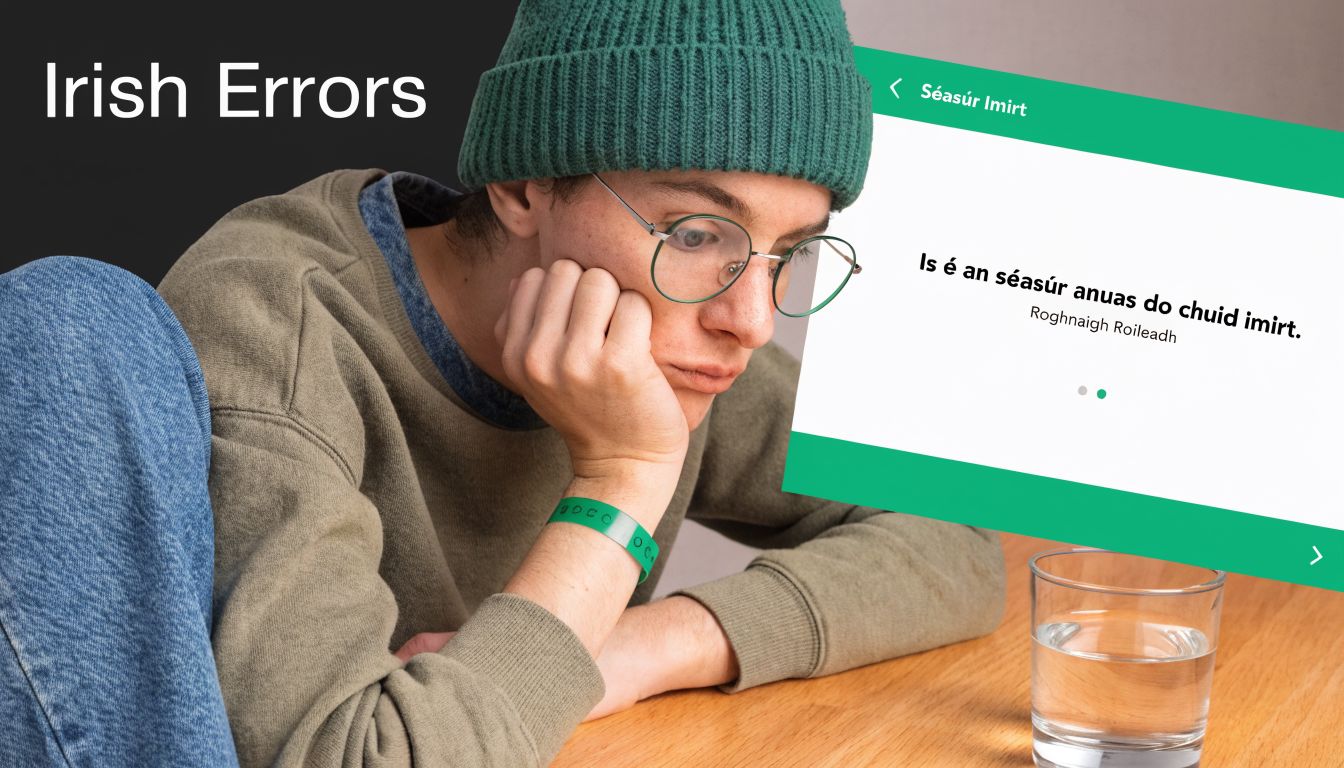
A person in a beanie and glasses looking thoughtfully at an Irish language learning app interface.

Literal translation traps

English idioms are a minefield. If you feed an idiom into a generic translator, it may produce a sentence that is technically word-shaped but culturally bizarre. That's because the system often chases the surface meaning rather than the underlying idea.

For example, learners often expect a translator to convert an English phrase piece by piece. Irish doesn't always work that way. A natural Irish sentence may completely reorganize the thought.

Watch out for these warning signs:

  • It sounds overly English: The sentence follows English word order too neatly.
  • It feels too formal for the situation: You wanted a casual phrase and got something stiff.
  • Each word seems translated separately: That usually means the tool didn't catch the idiom.
  • You can't explain why the grammar works: If the system can't show its reasoning, treat the output as a draft.

This problem shows up in other language workflows too. If you work with multilingual apps or websites, the discussion of fixing machine translation errors in Django is useful because it highlights how machine output often needs review before people rely on it.

Grammar and dialect problems

Irish grammar has little switches that machines often miss. A common one is the change at the beginning of a word after certain particles or possessives. Beginners know these as lenition and eclipsis, and they matter more than many translators admit.

A machine may also mix dialects in a single result. That can leave you with a sentence that isn't clearly wrong to a beginner, but doesn't sound fully natural to a speaker from any one region.

If a translation looks polished but you wouldn't know how to say it out loud, pause before using it.

For learners, guided correction proves beneficial. A page on common mistakes in Irish can train your eye to notice the kinds of errors machines slip into everyday phrases.

Here's a short explainer that shows why these small issues matter in practice:

A quick way to sanity-check a translation

When you get Irish output from a tool, ask yourself three simple questions:

  1. Would I hear this in conversation?
  2. Is this for understanding, or for sending to another person?
  3. Can I verify it with a teacher, dictionary, or learning context?

If the answer to the second question is “I'm sending it,” you need a higher standard than if you're just trying to understand a sign or headline.

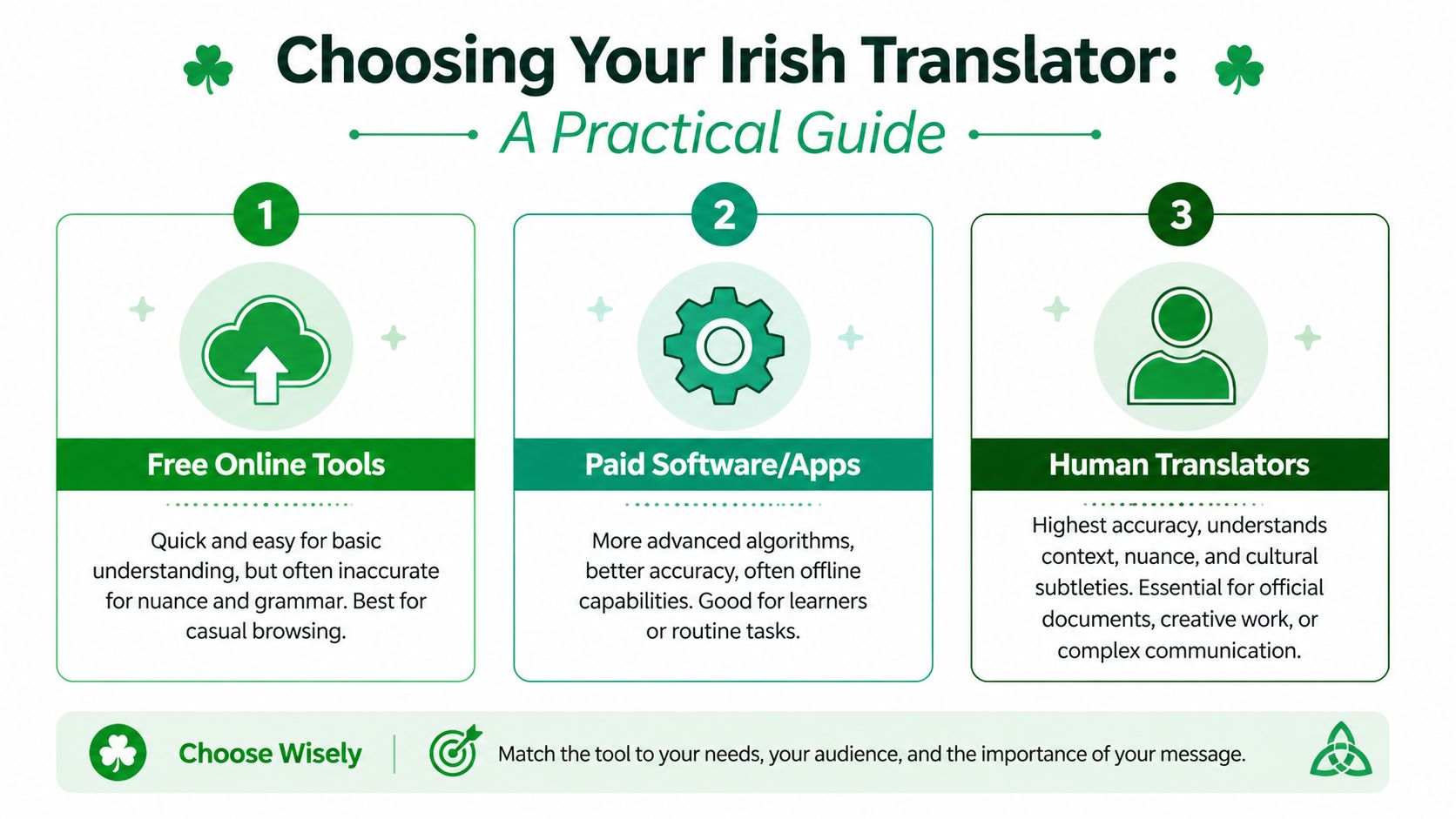
A Practical Guide to Choosing Your Translator

Choosing the right irish language translator is less about finding one perfect tool and more about matching the tool to the task. A rough draft, a study aid, and an official translation are three different jobs.

A guide illustrating the three types of Irish translators, comparing online tools, software, and professional human services.

When a free tool is enough

Free online tools are fine for low-risk tasks. Think reading a menu item, getting the gist of a sentence, or testing vocabulary. They're fast, and for casual browsing that speed matters more than polish.

Use them when:

  • You need rough meaning: Signs, short posts, basic phrases.
  • You're brainstorming: You want a starting point, not a final answer.
  • You're checking vocabulary: One word or a short phrase at a time.

Don't use them as your final step for anything formal, public, or emotionally important.

When you need a human translator

For official content, accuracy is a process, not a guess. According to guidance on Irish translation accreditation and workflow, professional translators in Ireland often hold accreditation such as Séala an Aistriúcháin from Foras na Gaeilge, and their workflow includes a primary translator and a secondary linguist reviewer. That's a very different standard from copying and pasting a machine result.

Choose a human translator for:

  • Official documents
  • Legal or medical material
  • Business content
  • Published writing
  • Anything where tone and nuance matter

If your project also includes media, subtitles, or visual storytelling, tools outside pure translation may come into the workflow. For example, a cinematic AI video generator can help create visuals around content, but it doesn't replace linguistic review. The language still needs a qualified human when accuracy matters.

When a learning tool makes more sense

A lot of people searching for an irish language translator are not trying to outsource the language. They're trying to use it. That's a different need.

Here's a quick comparison:

Option Best for Main strength Main risk
Free online tool Quick gist Speed Weak nuance
Learning app or guided AI tool Study and speaking practice Feedback and repetition Not for certified translation
Human translator Official or polished content Context and review Slower, more involved

One learning-focused option is Gaeilgeoir AI, which offers guided Irish conversation practice, pronunciation support, and instant phrase help for learners. That makes it more useful than a plain translator when your real goal is to speak, prepare for class, or build confidence in everyday situations.

Suggested Workflows for Common Scenarios

A tool becomes easier to choose when you attach it to a real situation. The need isn't for “translation” in the abstract. They need a phrase for travel, support for study, or a trustworthy version of a document.

A person using a smartphone and another person learning Irish on a tablet, showcasing modern language learning.

For a traveler

If you're visiting Ireland and want to interact respectfully with the language, keep your workflow light.

Start with a free translator for signs or simple lookups. Then practice a handful of spoken essentials like greetings, ordering food, or asking directions in a learning environment where you can hear and repeat the phrase. Don't rely on a copied machine sentence for a full conversation.

A small, usable phrase set beats a huge list you can't pronounce.

For a student preparing for oral Irish

Students often make the mistake of collecting model answers they don't fully understand. That usually backfires in conversation.

A better workflow looks like this:

  1. Draft the idea in simple English
  2. Build the Irish version in short chunks
  3. Check vocabulary and grammar
  4. Practice speaking it aloud
  5. Get feedback on pronunciation and phrasing

Learn sentences the way you'd learn music. Don't just read the notes. Say them, hear them, and repeat them until they feel natural.

For a heritage learner

Heritage learners often want more than correctness. They want connection. That means the “best” translation isn't always the most literal one. It's the one that sounds like something a real person would say.

Try this rhythm:

  • Collect family words and phrases: Even partial memories matter.
  • Check whether they're dialect-specific: Some family expressions may reflect a region.
  • Use translation as a clue, not a verdict: Let it point you toward meaning.
  • Practice in conversation: That's where the language becomes personal again.

For professional or official use

For professional work, start with the assumption that machine tools are only drafting aids. Public-facing or formal Irish needs review by someone qualified.

That matters even more now because the demand for strong Irish translation has grown in institutional settings. As reported by The Irish Times on the rise of Irish translators in EU institutions, Irish became a full official and working EU language in 2022, and the number of Irish-language translators across EU institutions rose from 58 to over 200, with translation volume reaching tens of thousands of pages annually. Irish isn't only symbolic. It's working language territory now.

That raises the bar. If your translation represents an organization, treat it that way.

Beyond Translation From Words to Conversation

Starting with translation often feels safe. You put words in, you get words out. That's helpful at the beginning, especially when Irish still feels unfamiliar.

But translation is only a bridge.

If your real goal is to travel, reconnect with family history, pass an oral exam, or speak even a little Irish with confidence, then word conversion won't get you all the way there. You need to know when a phrase sounds natural, when a sentence feels too English, and how to say the thing you mean without waiting for a machine to guess it for you.

That's why the most useful question isn't “What's the best irish language translator?” It's “What kind of support helps me communicate?” Sometimes that support is a professional human translator. Sometimes it's a quick machine tool for rough understanding. Often, for learners, it's guided practice that turns passive recognition into active use.

Irish rewards that shift. The language becomes much less intimidating when you stop treating it like a code to crack and start treating it like a conversation to join.


If you want to move beyond copying translations and start using Irish, try Gaeilgeoir AI. It's built for guided, real-world practice so you can work on everyday phrases, pronunciation, and speaking confidence at your own pace.

Start Speaking Irish Today — 25% Off
Use code START25

Learn real Irish for real life with guided practice, pronunciation support, and everyday conversations.

Get 25% off any plan with code START25

Start Speaking Irish Today — 25% Off