Best Ancient Celtic Names Male: Meanings & Origins

A grandfather in County Clare once corrected his grandson's pronunciation of an old family name before telling the story behind it. In that moment, the name stopped being a word on paper and became a living piece of memory.

In ancient Celtic lands, a name was more than a label. It carried ancestry, status, hope, and character. Many of the most enduring male names in Ireland survived for centuries, even through major cultural change. In the 1911 Census of Ireland, John accounted for 13.9% of all males recorded, Patrick was held by over 10%, and the top ten male names together made up 60% of all male names. That concentration shows how strongly old naming traditions held on, even when language and spelling shifted over time.

That's part of why ancient Celtic names still matter. They connect modern learners to old stories, to sound patterns in Irish, and to the way identity was once expressed through the natural world, lineage, and legend. If you're exploring ancient Celtic names male lists for a child, a character, or your own family history, the richest names are the ones that come with context. The meaning matters, but so do the people who carried it, the myths around it, and the Irish forms that shaped it.

Table of Contents

1. Conn

A short name can carry a long history. Conn does that almost better than any other early Irish name.

A kingly name with a sharp sound

Conn is usually linked with sense, reason, or wisdom in Old Irish tradition. That helps explain why the name feels so weighty despite its size. It is only one syllable, but it has the same effect as a carved stone marker. Brief, clear, and hard to miss.

The best-known bearer is Conn Cétchathach, remembered in legend as Conn of the Hundred Battles. He stands among the great High King figures of Irish story. The historical details are difficult to separate from legend, and that is part of the lesson here. Ancient Celtic names often survive not because every fact is certain, but because communities keep telling the story.

Conn also appears in royal genealogies and early dynastic memory. That gives the name a kind of continuity. It does not feel revived from a museum shelf. It feels transmitted, like a word passed from teacher to student across generations.

Practical rule: Say Conn with a firm K sound at the start, close to /kɔn/. Keep it short and steady.

For anyone learning Irish heritage through names, Conn is a useful starting point. It shows how an ancient name can be simple in form but dense with cultural meaning. A learner begins with one syllable and soon meets bigger subjects: kingship, oral tradition, and the way Old Irish words gather power through repeated use.

How to use Conn well today

For those who want a direct name from ancient Celtic male collections, Conn is one of the easiest to carry into modern life. It is brief, recognizable, and still distinctly Irish.

It also offers more than a basic meaning. Conn comes with a miniature biography built into the tradition. Its linguistic root points toward intelligence or judgment. Its legendary bearer adds rulership and martial fame. Its modern advantage is practicality. You can say it easily in English, but it still opens a door into older Irish pronunciation and history.

A few useful ways to approach it:

  • Start with the figure behind the name: Read about Conn Cétchathach and notice how often authority and wisdom appear together.
  • Practice the sound carefully: Short names are often harder than they look. With Conn, the value is in getting the crisp opening and clean ending right.
  • Use it as a language lesson: Names like Conn help beginners see that Irish learning is not only grammar and vocabulary. It is also memory, lineage, and story.

Conn works well for a child, a fictional character, or a family heritage project. Its strength comes from restraint. Nothing extra is needed.

2. Cormac

A child is given the name Cormac. At first it may sound strong and familiar. Then you trace it backward through old stories and manuscripts, and the name starts to feel like a small doorway into the Irish past.

A kingly name with a scholarly side

Cormac is usually explained from Old Irish elements, though scholars do not all agree on a single neat meaning. You will often see interpretations such as “son of the chariot,” while some traditions connect part of the name with the raven. That uncertainty can confuse beginners, but it is a useful lesson. Early Irish names often come down to us through layers of spelling, oral tradition, and later commentary, so one name can carry more than one credible explanation.

The best-known bearer is Cormac mac Airt, the legendary High King remembered for judgment, order, and wisdom. He is the kind of figure who gives a name its atmosphere. Even before you sort out every linguistic detail, you can feel what the tradition is doing with Cormac. It points toward authority shaped by intelligence.

A second major bearer sharpens that picture. Cormac mac Cuileannáin was both king and bishop, and he is linked with learning as well as rule. That matters because it shows a very old Irish ideal. The admired man was not only a fighter or ruler. He also understood law, memory, genealogy, and sacred learning, rather like a person expected to lead a community and preserve its library at the same time.

That blend helps explain why Cormac still feels alive in modern use. It sounds distinguished, but not remote.

What Cormac can teach you about Irish names

Cormac is a helpful name for learners because it shows how Irish naming works below the surface. Many names are built from older parts that have lives of their own, and once you start noticing those parts, other names become easier to recognize.

Cormac shows how an ancient name can act like a compact history lesson. Sound, status, and story all sit inside it.

A practical way to study Cormac is to treat it like a pattern, not just a label:

  • Look at the elements: If you come across explanations involving mac (son) and older roots such as corb, you begin to see how name pieces reappear across Irish tradition.
  • Compare historical bearers: Cormac mac Airt and Cormac mac Cuileannáin give you two different lenses, legendary kingship and learned authority.
  • Study it with recall tools: If you use Gaeilgeoir AI in your Irish study routine, make a flashcard deck for recurring name elements such as mac and corb, then add related names as you meet them. That gives you a clearer sense of how old forms echo through the language.

Cormac suits parents, writers, and heritage learners who want a name with depth rather than just a pleasant sound. It carries the memory of rule, learning, and language all at once.

3. Aedh (Aed)

Aedh is one of the oldest-feeling names in the Irish tradition. It burns with symbolic meaning even before you learn the history.

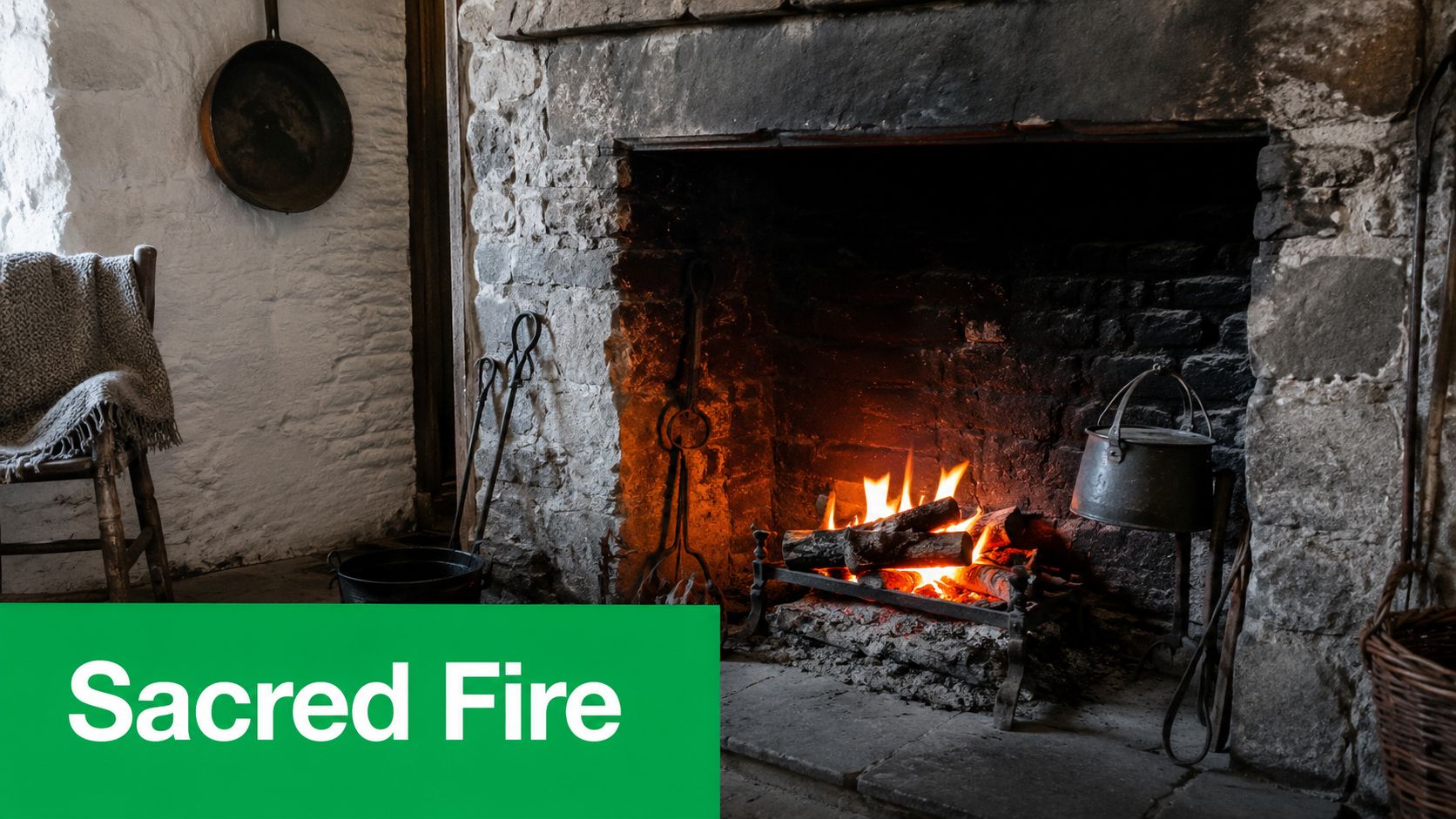
A rustic stone fireplace with a glowing fire, cast iron pots, and ancient interior decor.

The old fire at the center of the name

Aedh, also written Aed, means “fire” in Old Irish. That single image gives the name enormous power. Fire in Celtic tradition wasn't just a practical element. It suggested life, ritual, protection, brilliance, and sacred force. Aedh belongs to that older symbolic world, where a name could point to a quality people hoped to see in the child who carried it.

The name appears again and again in Irish genealogies and medieval records. You encounter kings, dynasts, and rulers with this name, which tells you how firmly rooted it was. It didn't belong to one isolated legend. It spread broadly through elite and regional traditions.

The modern learner can also place Aedh alongside related names. Aedan and Aodhán show how the older root kept generating new forms over time. That's useful if you're trying to understand why some modern Irish names feel connected even when they don't look identical at first glance.

Why the spelling matters

One of the biggest frustrations for heritage learners is the gap between the ancient form and the familiar modern spelling. In fact, 90% of popular articles surveyed in search results present modernized spellings like Aidan without explaining older forms such as Áedán or their historical pronunciation context. That's exactly where learners lose confidence.

Aedh helps fix that problem because it forces you to see the older orthography directly. The spelling may look unfamiliar, but that's part of the lesson.

  • Learn both forms: Aedh and Aed point to the same old root.
  • Connect it to meaning: Fire is easy to remember, which makes the name a strong anchor for vocabulary.
  • Trace the family: Moving from Aedh to Aodhán shows how Irish diminutives grow from older names.

For anyone exploring ancient Celtic names male options with real historical texture, Aedh is one of the best examples of how language, symbolism, and continuity come together.

4. Lugh

Lugh carries myth with it more openly than almost any other name on this list. Even before you know the details, it sounds bright and old.

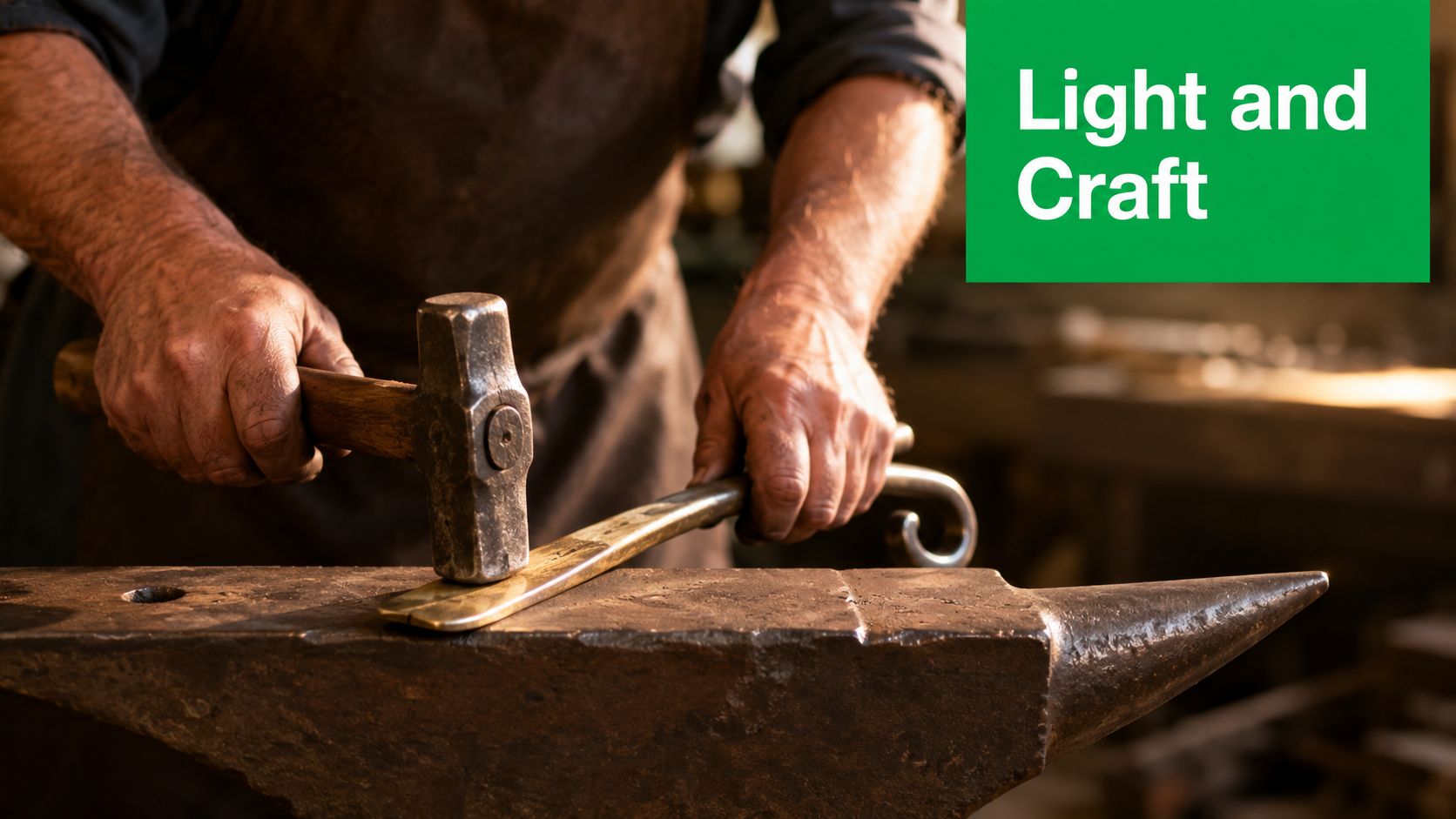
A blacksmith shaping a piece of metal on an anvil with a hammer in a workshop.

A divine name that became a human one

Lugh comes from the older Celtic divine name Lugus and is linked in Irish tradition with light, craft, skill, and warrior excellence. In mythology, Lugh is not narrow in talent. He is a many-sided figure, the kind of hero-god who can fight, create, and lead. That breadth is what gives the name its special force.

Because of that background, Lugh is distinct from names signifying mere strength or bravery. It suggests mastery. A person carrying the name stands in the shadow of a figure known for intelligence as much as power.

If you want the mythic background in more depth, this guide to the Celtic god Lugh is a useful next step. It helps place the name inside the wider framework of Irish myth rather than treating it as an isolated label.

A practical way to remember Lugh

Say it like /luː/, close to “loo.” The spelling can make learners hesitate, but the spoken form is straightforward once you hear it a few times.

There's also a wider cultural gap around names like this. A review of existing content found that 95% of it fails to connect male Celtic names to specific mythological archetypes, usually stopping at surface meanings instead of explaining the stories behind them. Lugh is the perfect example of why that deeper layer matters. Without the mythology, you miss the true personality of the name.

Here's a simple way to remember Lugh in study:

  • Link the name to craft: Think of smithwork, skill, and trained hands.
  • Link it to festival culture: Lughnasadh preserves the memory of the same mythic world.
  • Link it to story: Read one episode from Irish mythology and attach the name to an action, not just a definition.

A short visual introduction can help fix the character in your mind.

Lugh suits parents, writers, and learners who want a name with mythic brightness and strong Irish identity.

5. Eoghan (Euan/Owen)

Eoghan is a classic example of a name that changes shape as it travels. The Irish form is old, but many people first meet it through Owen or Euan.

A name with branches across the Celtic world

Eoghan is often linked to meanings such as “born of the yew tree” or ideas related to youthful warriorhood. The uncertainty is part of what makes old names interesting. Ancient naming traditions weren't always preserved with a neat modern dictionary entry. What did survive is the sense that Eoghan belongs to a natural and ancestral world.

The name appears across history, legend, and family tradition. Saints, rulers, and dynastic founders carried related forms, and that long survival gave it unusual flexibility. It can feel aristocratic, pastoral, or stoic depending on context.

That's why Eoghan remains so attractive to modern families reconnecting with Irish roots. It has depth, but it's still usable. It also shows how one name can branch into several familiar English-facing forms without losing its Gaelic center.

Pronunciation first, spelling second

If you're new to Irish, start by hearing the name before memorizing the letters. Many learners do better when they treat Eoghan as a spoken pattern first. The sound is often rendered close to “O-wan,” though regional and related forms vary.

Learn Eoghan by ear, then return to the spelling. Irish often becomes easier when sound leads the way.

This is also one of the best names for comparing Celtic traditions across regions. Irish, Scottish, and Anglicized forms all reveal something about migration and adaptation.

  • Use audio support: Hearing the name repeatedly builds confidence fast.
  • Compare forms: Eoghan, Euan, and Owen belong in the same family conversation, but they're not identical in feel.
  • Study the Irish form directly: The guide to Irish for Owen is especially useful if you want to understand how the English form relates back to Irish.

For people searching ancient Celtic names male lists that still work smoothly in modern life, Eoghan is one of the strongest choices.

6. Aodhán (Aidan)

Aodhán is a small, bright name with a long religious and cultural life. It's one of the clearest examples of how Irish diminutives work.

A small name with a long life

Aodhán comes from Aedh and means “little fire” or “small fire.” That gives it immediate warmth. It keeps the energy of the older root while softening it into something affectionate and personal. In many naming traditions, that's exactly what a diminutive does. It narrows the scale without reducing the dignity.

Saint Aodhán of Lindisfarne helped make the name famous well beyond Ireland. Through the saint, the name became associated not only with brightness and vitality but also with learning, mission, and spiritual influence. Other rulers and nobles also carried related forms, which kept the name moving through medieval records.

This combination is part of Aodhán's appeal. It sounds gentle, but it has historical weight.

Modern popularity and old form

Aodhán also matters because it shows how an ancient name can remain visibly alive. The available name data notes that Aidan remains a regular top 100 name in Ireland and sometimes appears inside the top 50 in the United States, showing sustained cultural relevance rather than any measurable tool adoption trend. That persistence says a lot. The old fire never fully went out.

For learners, Aodhán is an ideal bridge between ancient and modern usage.

  • Start with the root: Learn Aedh first, then Aodhán makes more sense.
  • Notice the suffix: The ending -án appears in many Irish names and often adds a diminutive sense.
  • Compare forms carefully: Aodhán and Aidan are related, but the Irish spelling carries more historical texture.

If you want an ancient Celtic male name that still feels familiar in contemporary life, Aodhán is one of the easiest to love.

7. Fionn

Few names in Irish tradition are as instantly evocative as Fionn. Say it, and story enters the room.

The hero behind the name

Fionn means “fair” or “white,” and its most famous bearer is Fionn mac Cumhaill, the great hero of the Fenian Cycle. He isn't memorable only because he fights well. He's also clever, perceptive, and tied to supernatural knowledge. That balance is important. In Irish tradition, the ideal hero often combines physical courage with insight.

Because of Fionn mac Cumhaill, the name became one of Ireland's iconic heroic names. It suggests command without stiffness and nobility without ceremony. For many readers and parents, that's the appeal. Fionn feels legendary, but still human.

A man in a green cloak stands with a large dog overlooking a misty ocean cliff.

Reading Fionn through story

Fionn is one of the best names to learn through narrative rather than etymology alone. If you only memorize “fair” or “white,” you miss the lived meaning the stories gave the name. The Fenian world filled it with leadership, loyalty, wilderness, poetry, and danger.

A good next step is exploring Irish mythology names, where Fionn sits among other figures whose names carry whole narrative worlds with them.

Some names are best understood in motion. Fionn is one of them. Read one tale, and the meaning deepens immediately.

A few practical notes help:

  • Practice the sound: Fionn is often pronounced close to “Fyunn” or “Finn,” depending on context and anglicization.
  • Follow the family line: Oisín, son of Fionn, opens the door to later Fenian stories.
  • Use translations wisely: English retellings are a fine beginning, especially if they lead you back to Irish names and forms.

Among ancient Celtic names male lists, Fionn stands out because the name still carries a complete heroic atmosphere.

8. Dáithí

Dáithí has the sound of a royal name. It feels bold without being heavy.

A royal name with an old edge

Dáithí is often linked to an old sense connected with allotting or sharing, though, as with many early names, the path from root to accepted meaning isn't always perfectly clear. The figure most associated with it is Dáithí mac Murchada, remembered in tradition as a High King. Whether one approaches him through legend, medieval narrative, or historical memory, the name took on the aura of command and ambition.

That older kingly association stayed with the name. Dáithí sounds like someone meant to act, decide, and lead. It has none of the softness of later sentimental naming fashions. It belongs to the world of chiefs, rivalries, and dynastic aspiration.

For modern readers, that makes it compelling. It's recognizably Irish, rich in history, and less internationally flattened than some more familiar forms.

Using Dáithí as a language bridge

Dáithí is also good for pronunciation practice because the spelling teaches you to respect Irish sound patterns. Learners who rush it usually anglicize it immediately. Learners who slow down begin to hear why the written accents matter.

Try approaching it in layers:

  • Start with the stress: Put the emphasis early and keep the flow smooth.
  • Compare variants: Anglicized forms can help you trace adaptation, but the Irish original carries more cultural precision.
  • Pair the name with story study: A legendary king's name becomes easier to remember when attached to deeds and place.

Dáithí works especially well for heritage learners who want a name that feels authentically Gaelic rather than merely Celtic in a broad, decorative sense. It has sharp edges, and that's part of its charm.

Comparison of 8 Ancient Celtic Male Names

Name 🔄 Pronunciation / Complexity ⚡ Resources & Speed to Learn 📊 Expected Outcomes (cultural & linguistic impact) ⭐ Key Advantages 💡 Tips / Ideal Use Cases
Conn Low, one syllable; /kɔn/ Minimal, quick to master Improves basic Irish phonetics and leadership vocabulary Strong historical resonance; easy recall Use for beginners; link to Conn Cétchathach myths
Cormac Moderate, compound structure (cor+mac) Moderate, benefits from etymology study Teaches compound-name formation and dual warrior-scholar themes Versatile literary and historical references across periods Break into elements; compare diminutives (Cormacán)
Aedh (Aed) Low–moderate, short but variant spellings (/eː/ or /eɪ/) Moderate, learn spelling/pronunciation variants and symbolism Deepens understanding of Celtic spiritual symbolism (fire) Ubiquitous in genealogies; strong symbolic weight Note Aedh vs Aed; connect to fire motifs and Aedan variants
Lugh Low, short, /luː/; mythological feel Moderate, requires mythological context (Lughnasadh) Opens study of deity names secularized in mortal genealogies Cross-Celtic presence; links craft, warfare, and festivals Explore Lughnasadh and Lugh's crafts-forces associations
Eoghan (Euan/Owen) Moderate, pronunciation tricky ('O-wan'); multiple spellings Moderate, study phonetic evolution and anglicizations Illustrates language change (Irish → English/Scottish forms) Wide regional variants; continuity across centuries Use pronunciation tools; compare Owen/Euan forms
Aodhán (Aidan) Moderate, diminutive morphology (-án) and pronunciation variations (/ˈiːdən/ or /ˈeɪdən/) Moderate, benefits from historical/saint context Teaches diminutive formation and Christianization of names Familiar anglicized form (Aidan); saintly associations Compare with Aedh; study -án suffix pattern
Fionn Low, one syllable; lenition nuance (/fʲɪn/) Moderate, requires reading Fenian Cycle for full context Rich literary insight into hero archetypes and oral tradition High cultural impact and recognizability (Finn variants) Read Fenian tales; explore Finn/Finlay variants
Dáithí Moderate, diacritics and pronunciation (/ˈdaːhiː/) Moderate, requires genealogical/myth study Provides access to High King legends and medieval annals Strong kingly/legendary association; distinctive modern form Practice pronunciation; compare anglicized Davy/Davey forms

Carry the Legacy Forward

Ancient names endure because they do more than identify a person. They preserve a way of seeing the world. In Irish and wider Celtic tradition, a male name could hint at fire, brightness, intellect, kingship, battle skill, or a bond with the natural world. Even when spellings shifted and stories changed in retelling, the names themselves kept carrying those older ideas forward.

That's why exploring ancient Celtic names male traditions can become much more than a naming exercise. A name like Conn brings you toward legendary kingship and questions of wisdom. Cormac points toward scholarship as well as rule. Aedh and Aodhán open the door to old imagery around fire and sacred brightness. Lugh leads into myth, craft, and festival memory. Eoghan shows how names travel across regions and forms. Fionn reveals how a single hero can shape the emotional life of a name for centuries. Dáithí reminds you that some names still carry the ring of sovereignty.

For learners of Irish, these names are especially valuable because they make language feel personal. You're not memorizing abstract vocabulary. You're meeting the sounds, symbols, and social values that shaped Irish-speaking communities over generations. Old names teach pronunciation, spelling habits, and cultural memory all at once. They also help returning learners reconnect with heritage in a way that feels concrete. A family tree, a saint's life, a heroic tale, or a local legend can suddenly become easier to approach when the names stop looking strange.

There's also a practical lesson here. Modern lists often flatten these names into quick meanings and easy English spellings. That may be convenient, but it strips away much of what makes them worth studying. The older forms matter. Their stories matter. Their place in Irish speech matters. When you learn the name with its history, you're not only choosing a beautiful word. You're keeping a chain of memory intact.

If these names have stirred your curiosity, the natural next step is the language itself. Learning even a little Irish changes how these names sound, feel, and live in the mind. You start to hear patterns. You notice connections. You understand why one spelling carries more history than another. That's where cultural reconnection becomes something active rather than symbolic.


If you want to move from admiring Irish names to understanding and speaking the language behind them, try Gaeilgeoir AI. It helps beginners, returning learners, and Leaving Cert students build real spoken confidence through guided conversations, pronunciation support, and everyday Irish you can use right away.

English to Irish Names: A Complete Gaelic Guide 2026

You've probably done this already. You typed your surname into a search bar, found three different Irish spellings, and closed the tab more confused than when you started. One site says Kelly is Ceallaigh. Another says Kelley. A third gives no Irish form at all. If your first name is John, matters get even messier. Are you Seán, Eoin, or something else entirely?

That confusion isn't your fault. A lot of advice about English to Irish names gives you a quick list but skips the part that matters most. It doesn't tell you why the forms changed, which version is historical, and which spellings were shaped by English record-keeping rather than Irish usage. Few resources address the question of why common English spellings of Irish names such as Shannon and Sionann can be phonetically misleading or historically inaccurate because of transcription errors by English speakers with no Irish knowledge, or how to work backward toward the original Irish form through the Anglicization Error Gap discussion.

Names carry grammar, family history, and sometimes a small record of colonisation and recovery. When someone discovers that Sullivan points back to Ó Súilleabháin, or that Kelly reflects Ó Ceallaigh, they're not just finding a translation. They're uncovering an older naming world.

Table of Contents

From English Name to Irish Soul

A man named Sullivan finds Ó Súilleabháin and suddenly the name stops feeling flat. It has shape. It has rhythm. It sounds like it belongs to a language with its own rules instead of looking like a neat English label in a register. The same happens when a Kelly meets Ó Ceallaigh for the first time. You don't just see a different spelling. You feel a line stretching backward.

That emotional jolt matters because names were often flattened for convenience. English clerks wrote what they heard. Families adapted to administration, school, church records, migration, and social pressure. Over time, many people inherited an English surface form without the tools to recover the Irish one underneath.

Practical rule: An English-looking Irish name often isn't a translation at all. It's usually an anglicised echo of an older Irish form.

That's why quick lists can mislead. They often treat names as if every English form maps neatly onto one Irish equivalent. Real usage is messier. One English form may point to several Irish roots, and one Irish name may produce several English spellings. If you're trying to reconnect with heritage, that difference matters.

A better approach starts with three questions:

  • What was the older Irish form behind the surname or given name?
  • Was the English form phonetic, meaning someone wrote down what they thought they heard?
  • Is the Irish version historical or modern, especially with first names?

You don't need fluent Irish to begin answering those questions. You need patience, a feel for patterns, and a willingness to let the Irish form lead. That's where English to Irish names become more than a lookup exercise. They become a way back into language, family memory, and place.

The History Behind Your Irish Name

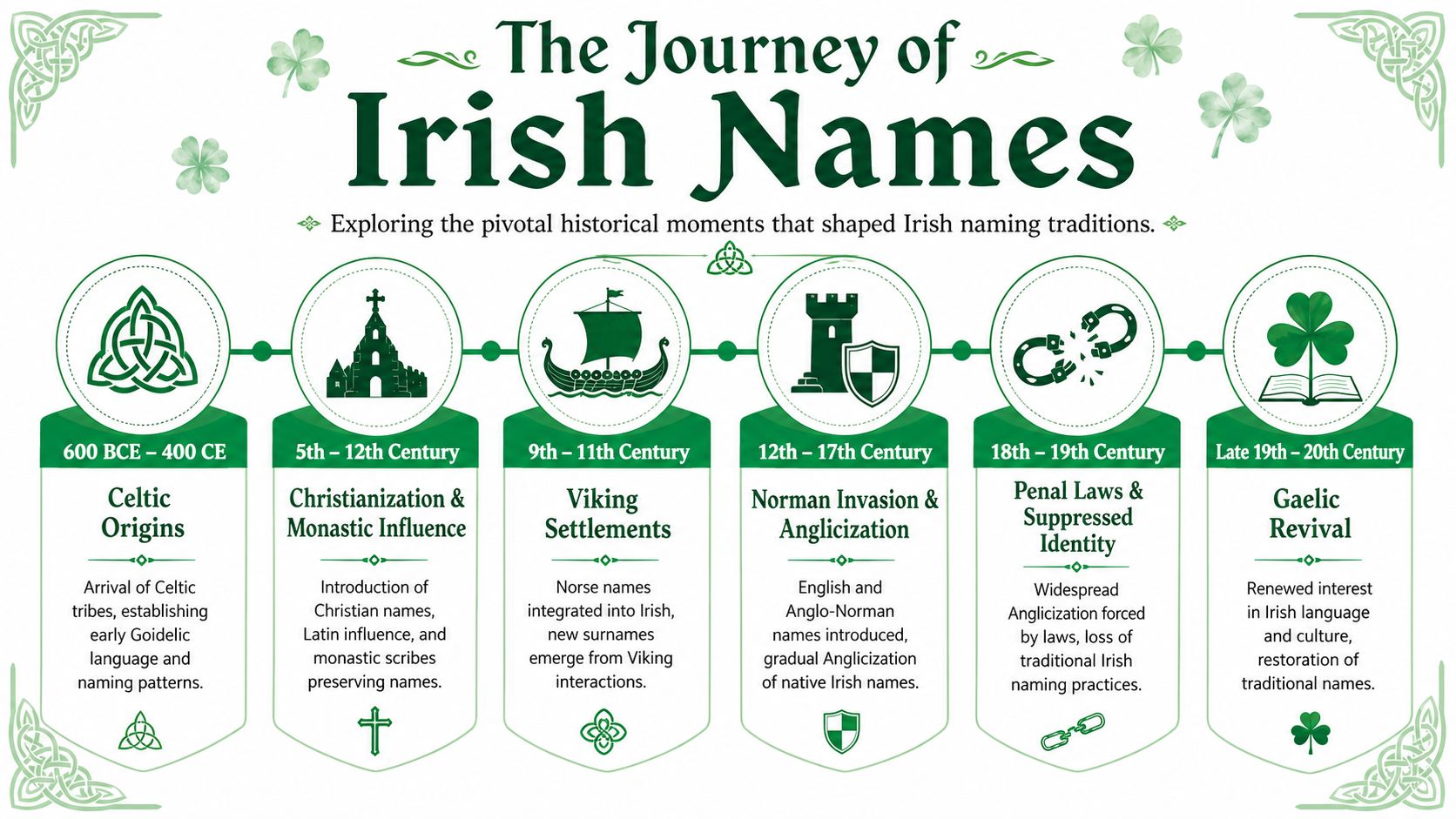
Irish names didn't become English by accident. Power shaped them. Law shaped them. Administration shaped them. Once you know that, the odd jumps between English and Irish spellings stop looking random.

An infographic titled The Journey of Irish Names showing a timeline of historical naming influences on Ireland.

A name can change without losing its root

In 1462, King Edward IV of England enacted a Penal Law declaring that Irish people must adopt English surnames, a mandate tied directly to anglicisation and still echoed in later legal efforts to restore Irish forms through a historical note on the 1462 law. Once names entered English-controlled systems, many lost visible Irish markers such as Ó and Mac, or had those markers altered, dropped, or inconsistently restored.

The result wasn't pure translation. It was often morphological change. The Gaois surname database shows that Irish surnames are grouped into bilingual clusters linking Irish forms with English counterparts, and that approximately 90% of the Top 10 most common Irish surnames have documented Irish-English clusters in data integrated from the CSO. The same resource maps examples such as Ó Súilleabháin to Stephen or Sullivan, and Mac Dónaill to Donald or McDonald, showing how anglicisation followed structured genealogical patterns rather than guesswork in the Gaois surname information database.

That matters for heritage learners because it means your English surname often still preserves the Irish root, even if the route is crooked.

The revival didn't invent Irish names

The return of Irish forms in public life didn't come from nowhere. It was a recovery. Historical records tied to the Census of Ireland show a striking shift in which a given name recorded in English in the 1901 Census often appeared in Irish or an alternative Gaelic spelling in the 1911 Census, reflecting a cultural turn within a single decade. Material compiled into the dúchas.ie Irish Surname Index also documents over 1,000 distinct surname variations linking English forms such as Ahearn and Atkins to Gaelic origins such as Ó hEachairn and Mac Aidicín in a summary of surname variation evidence.

A family name on paper can tell two histories at once. One is the history of the family. The other is the history of who was allowed to write it down.

By the late nineteenth and early twentieth centuries, many families were reclaiming Irish spellings as part of a broader cultural revival. That doesn't mean every restored form was perfect or uniform. It means people were trying to bring names back into the language that had shaped them first.

The Core Principles of Gaelicising Names

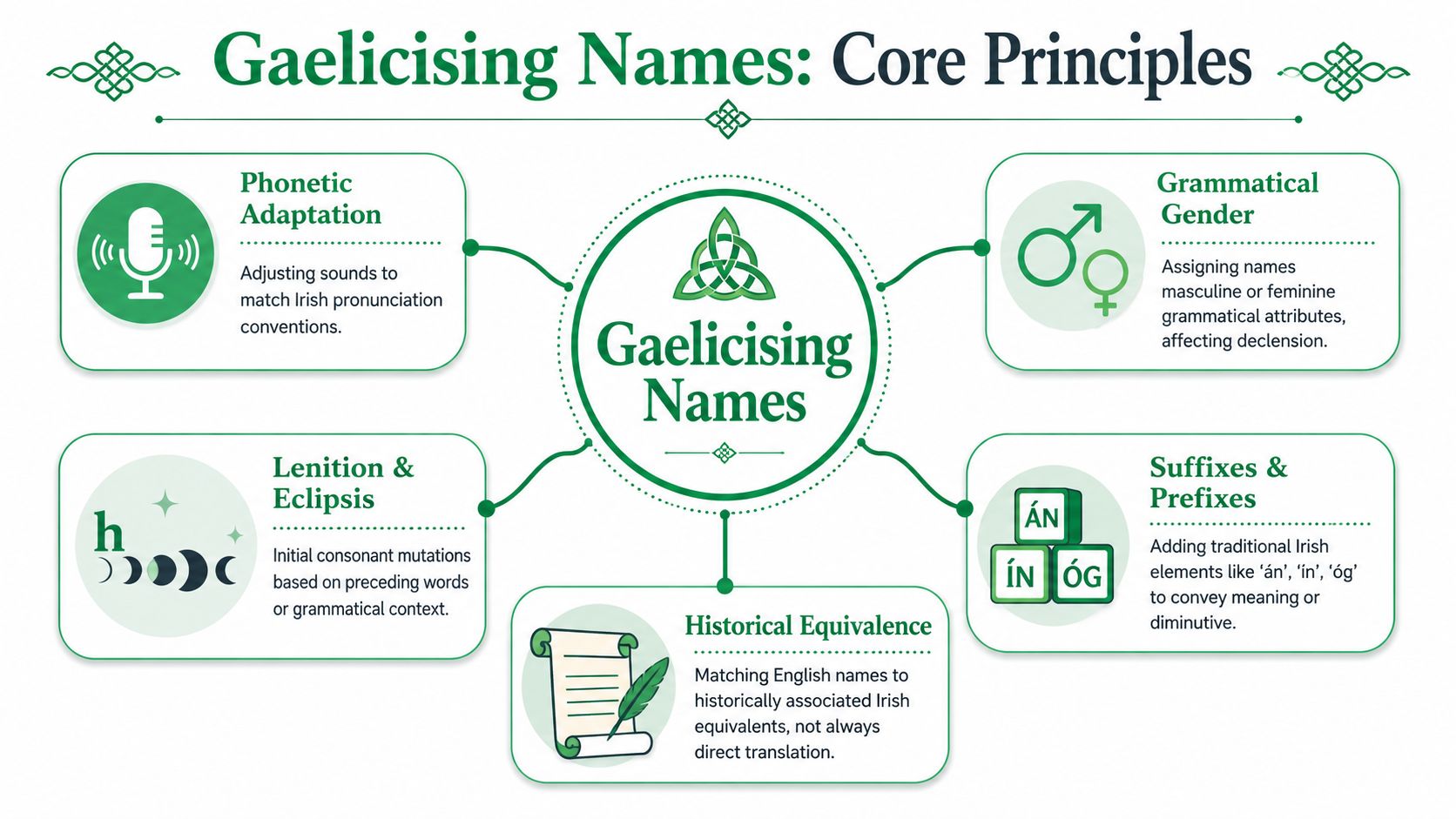
Finding an Irish form isn't just about swapping letters. Irish names follow sound patterns and grammar. If you miss those, the result may look Irish without behaving like Irish.

A diagram illustrating the core principles of Gaelicising names, including phonetic adaptation, grammatical gender, mutations, and historical equivalence.

Sound comes before spelling

Irish spelling is rule-governed, but the rules aren't English ones. That's why two names can look far apart on the page while sounding close enough to reveal a historical link. In many cases, an English form is a rough attempt to capture an Irish sound.

A few pronunciation guides help at once. The verified guidance on Irish given names notes these vowel patterns:

  • Ao is pronounced like the e in “tree”
  • Ai is pronounced like ah in “mat”
  • Io is pronounced like ih in “mist”

Those aren't full pronunciation lessons, but they show why English spellings often fail to preserve the original shape of a name. The same source also notes that there's no universal standard for translating English names into Irish, and that many English names are not technically translatable, with some modern equivalents being constructed rather than inherited in the discussion of Irish and English name forms.

Mutation changes the shape of a name

Irish uses initial mutations. These are grammar-driven changes at the beginning of a word. The most common one learners notice in names is lenition, called séimhiú. In writing, it often adds an h after the first consonant.

You'll see patterns like these:

  • B can become Bh
  • C can become Ch
  • M can become Mh
  • S can become Sh in some phonetic environments

That doesn't mean you insert an h wherever you like. Mutation depends on grammar, surrounding words, and naming structure.

Name lesson: If two forms of a surname differ by a single added h, they may still be the same family name in different grammatical contexts.

Eclipsis, or urú, is another mutation where a consonant is covered by another consonant sound at the front. It appears less often in the basic forms learners first meet with names, but it belongs to the same system. Irish doesn't treat the first letter of a name as fixed in every context.

The genitive case matters in family naming

Irish also changes words for grammatical case. One case you'll meet in names is the genitive, often used to show relationship. In older patronymic naming, a person could be identified through the father's name in the genitive form. That's one reason direct word-for-word conversion from English can miss the mark.

Here's the simplest working method for English to Irish names:

  1. Find the historical root first. Don't start by respelling the English version.
  2. Check whether the Irish form is inherited or modern. Some are ancient. Some are recent adaptations.
  3. Watch for mutation and case. The surname you use after a prefix may not stay in its base form.

A name in Irish is part vocabulary, part grammar, and part memory. You need all three to make sense of it.

Understanding Surnames and Patronymics

Irish surnames make more sense when you stop treating them like frozen labels. Traditionally, many of them described descent. They told listeners whose line you belonged to.

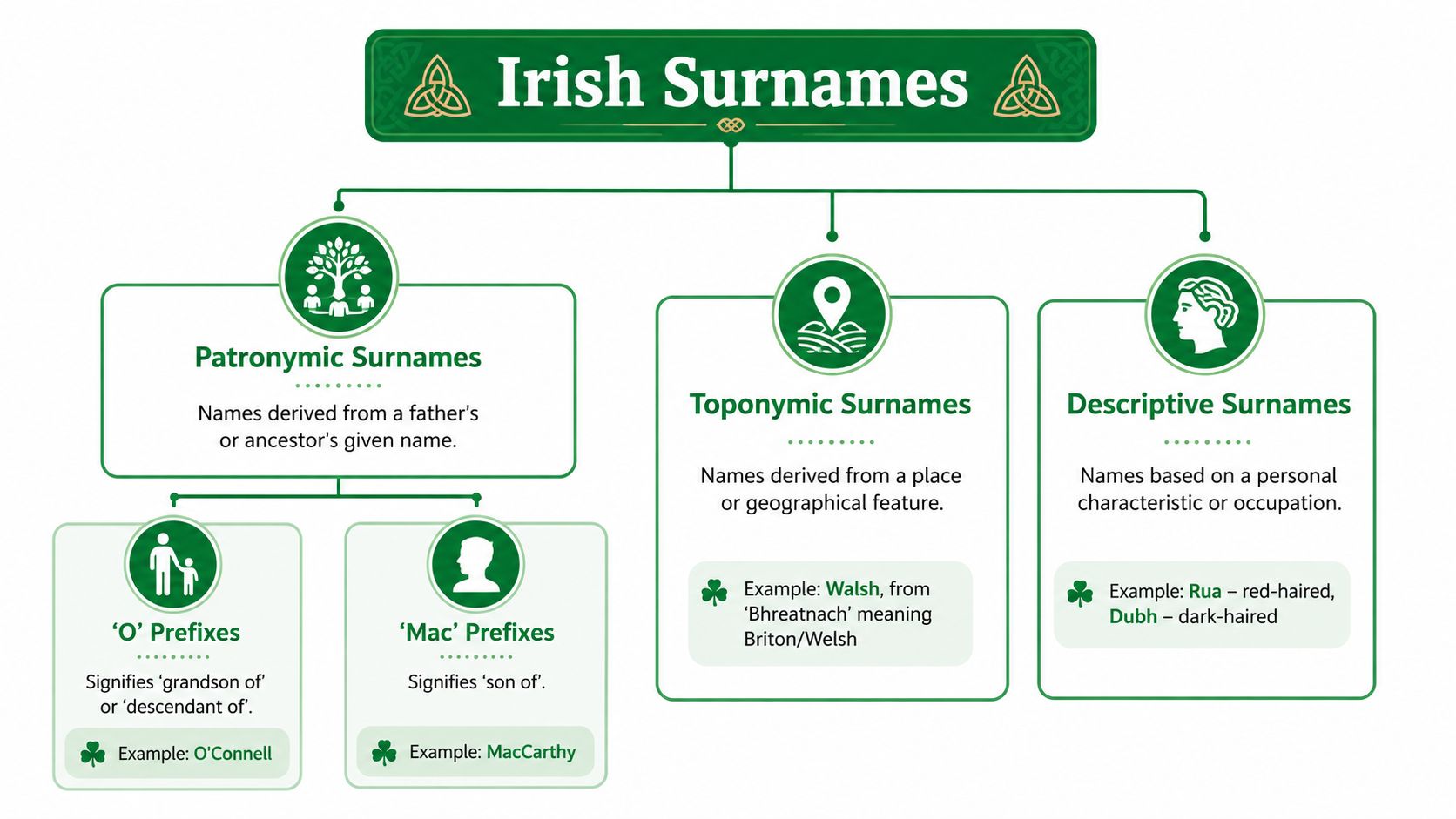
A flowchart infographic explaining the origins and categories of Irish surnames including patronymic, toponymic, and descriptive names.

What Ó and Mac actually tell you

In Irish surname formation, Ó means “grandson of” or “descendant of,” while Mac means “son of.” That's the backbone of many well-known surnames. These prefixes aren't decorative. They carry genealogy.

In Gaeltacht naming customs, the older pattern often followed [first name] + [father's name in the genitive case] rather than relying consistently on fixed hereditary surnames with Ó or Mac. Historical English law also temporarily forbade the use of O' and Mac, allowing only Fitz, which added further instability to naming records in the FamilySearch guide to Ireland naming customs.

Some practical consequences follow:

  • Dropped prefixes abroad often hide Irish roots. A family that appears as Kelly or Sullivan in one generation may connect to a longer Irish form.
  • Restored prefixes aren't always straightforward. Families sometimes re-added them later, and not always consistently.
  • Patronymic logic still helps even when the paper trail is messy.

Why women's surname forms differ

This is one of the places learners get stuck, and fairly so. A man and his sister may not use identical Irish surname forms.

Verified usage rules note that males use Ó with no lenition if the first letter is a consonant, while females use , and requires lenition if the following surname begins with a consonant but remains unchanged before a vowel in the Daltaí discussion of surname mechanics.

So the structure changes with gender. The name is still recognisably connected, but its form shifts because Irish grammar is doing real work.

If a woman's Irish surname looks different from her father's, that doesn't mean one of them is wrong. It usually means the grammar is alive.

A note on living surname research

Surname recovery often works best when you compare family usage with established databases rather than relying on a single list. If you want a broader reference point for family-name roots, variants, and meanings, this guide to Irish surnames and meanings is a helpful companion.

English to Irish names make the most sense when you treat the surname as a living structure. It may encode descent, grammar, and history all at once.

A Quick Guide to Irish Pronunciation

You can find the right Irish name and still feel shy about using it if you don't know how to say it. That's normal. Irish spelling is logical, but it's logical in Irish, not English.

Start with vowel groups

Some of the biggest pronunciation surprises come from vowel combinations. If you learned to read through English first, your instincts will often misfire.

Use these as starting points:

  • Ao often sounds like the e in “tree”
  • Ai often sounds like ah
  • Io often sounds like ih

That won't solve every name, but it will stop a lot of common mistakes. If you're serious about hearing these patterns more clearly, a focused guide on Irish pronunciation helps you connect spelling to sound in a more systematic way.

Use slender and broad consonants

One of the key Irish pronunciation principles is caol le caol, part of the larger broad-and-slender system. Verified guidance explains that an S beside broad vowels such as A or O sounds like plain s, but beside a narrow vowel such as I it becomes sh, which is one reason forms like Pádraig can't be pronounced by English instinct alone in the CNN guide to Irish name pronunciation.

That broad-and-slender contrast affects far more than s. It changes the feel of whole names. Compare the texture of these on the tongue:

  • Seán
  • Siobhán
  • Pádraig
  • Niamh

Their spellings aren't arbitrary. The vowels around the consonants help tell you how those consonants should behave.

Say the vowels first in your head. Then let the consonants follow them. Irish names become easier once you stop reading them as English.

If you'd like extra help hearing and producing those differences, this article on mastering your accent gives useful general pronunciation practice ideas that carry over well into Irish name work.

The Big List of English to Irish Names

Lists are useful, but only if you read them with care. Some English names have one strong historical Irish equivalent. Others have more than one accepted Irish form. A few are best treated as gaelicisations rather than strict translations.

How to read the list well

The notes column matters as much as the name itself.

  • Pronunciation clues help you avoid English guesses.
  • Origin notes tell you whether a form is traditional, borrowed, or modernised.
  • Variants warn you when more than one Irish form may fit.

If you want a larger companion reference focused on personal names, this collection of Irish first names and meanings is worth keeping beside you.

English names and their Irish equivalents

English Name Irish Equivalent(s) Notes
John Seán, Eoin Two common Irish equivalents. Choice depends on family use, region, and personal preference.
James Séamus Very widely used Irish form. Often one of the first names learners recognise.
Patrick Pádraig Pronunciation depends on Irish sound rules, not English spelling instincts.
Jack Seán, Eoin Can follow the same official change pattern mentioned later for legal use.
Owen Eoin, Eoghan English Owen can connect to more than one Irish form. Check family history if possible.
Hugh Aodh A classic case where the English and Irish forms look far apart.
Donald Dónaill, Mac Dónaill Often appears in surname structures rather than as a simple first-name swap.
Stephen Stiofán Distinct from the surname mapping seen with Ó Súilleabháin in some anglicised contexts.
Mary Máire, Muire Form depends on context and tradition.
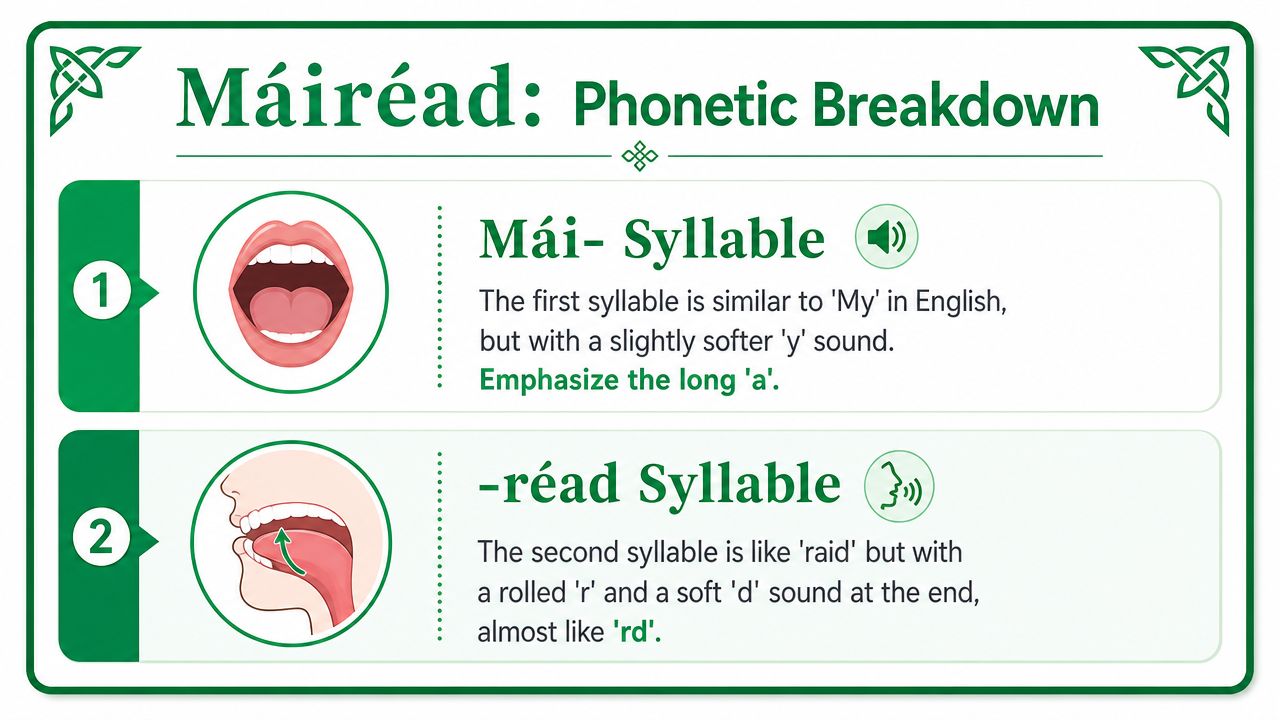
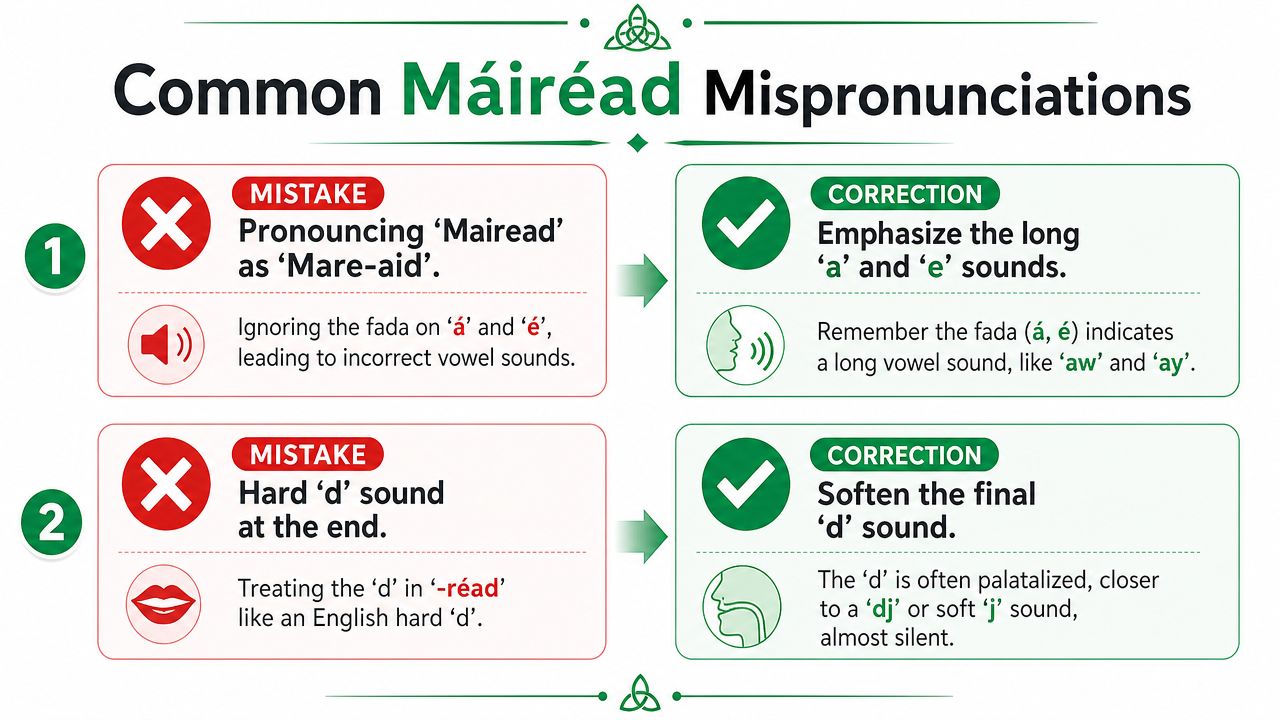
Margaret Máiréad A well-established Irish equivalent.
Catherine Caitríona, Cáit Formal and shorter forms both appear.
Bridget Bríd Traditional and strongly rooted in Irish usage.
Nora Nóra Often a straightforward adaptation.
Anne Áine, Anna Not always a direct one-to-one match. Family tradition matters.
Helen Eibhlín One of several examples where Irish spelling can look very different at first glance.
Kevin Caoimhín A good example of Irish consonant and vowel patterns diverging from English.
Liam Liam Already widely used in Irish and English contexts.
Aidan Aodhán A familiar name with an older Irish shape.
Declan Déaglán Usually treated as a direct Irish form already.
Niall Niall Shared across English and Irish with little visible change.
Rory Ruairí English form reflects an anglicised sound path.
Kieran Ciarán English K often maps back to Irish C in established forms.
Dermot Diarmaid English and Irish forms differ significantly in spelling.
Conor Conor, Conchúr Modern and older literary forms may both appear.
Erin Éirinn, Ériu Context matters. One may be poetic, another historical or mythic.
Shannon Sionann A key example of the Anglicization Error Gap. The English form can hide the Irish spelling logic.
Eileen Eibhlín A common anglicised pathway from an Irish original.
Fiona Fíona Often used as a close adaptation.
Maeve Méabh, Medb Both spellings appear. Historical and modern preferences differ.
Aoife Aoife Already Irish. English speakers often need pronunciation help rather than translation.
Niamh Niamh Another name that is already Irish but often mispronounced by learners.
Sullivan Ó Súilleabháin Verified Gaois example showing direct linkage between Irish and English surname forms.
Kelly Ó Ceallaigh A common surname whose Irish root is older than the familiar English spelling.
Murphy Ó Murchú One of the dominant names in Irish demographic records per the verified Gaois summary.
Sweeney Ó Suibhne English form often obscures the older Irish spelling.
Farrell Ó Faircheallaigh Explicitly linked in surname-variation records.
Hughes Ó Maol Aodha A strong example of an English surname masking a very different Irish structure.
Ahearn Ó hEachairn Explicitly documented as an English-Gaelic pairing in verified surname variation records.
Atkins Mac Aidicín Shows that some English surnames map to a clear Gaelic patronymic root.
McDonald Mac Dónaill Prefix and root both matter. Don't strip the surname down too quickly.
Donald Mac Dónaill In surname context, English Donald may reflect a patronymic line.
Walsh Breathnach A classic surname with ethnic or geographic meaning rather than a direct first-name origin.
O'Connell Ó Conaill Familiar prefix structure.
MacCarthy Mac Cárthaigh Keeps the patronymic logic visible.
O'Brien Ó Briain One of the best-known preserved prefix surnames.
O'Neill Ó Néill English apostrophe form reflects the Irish Ó prefix.

A list like this is a starting point, not a verdict. If your family used one form for generations, that usage deserves respect even if the older Irish root looks different. Heritage work is strongest when it balances evidence with lived family memory.

How to Choose and Use Your Irish Name

Choosing an Irish name is partly linguistic and partly personal. Some people want the most historically grounded form. Others want a name they can use comfortably in class, in community, or at home.

Screenshot from https://gaeilgeoir.ai

Choose for history, family, or daily use

If your name has more than one Irish equivalent, start with the question that matters most to you.

A family historian may prefer the form that best matches parish records or older surname roots. A learner returning to Irish after school may choose the form most widely used in conversation. Someone reclaiming identity may want the version that feels strongest emotionally.

These are all valid approaches if you stay honest about what you're choosing.

  • Historical fit means you look for the oldest attested family or naming form you can identify.
  • Practical fit means you choose the form you'll use and pronounce.
  • Cultural fit means you choose a name that reconnects you with Irish-language life, even if the form is a later standardisation.

Using your Irish name officially

Irish citizens may use either the Irish or English version of their name, but only one version is officially recorded on a birth certificate in the verified discussion cited earlier. If you want to change an English name to its Irish equivalent for official use, the process described in the verified data requires a deed poll, an updated birth certificate, and presentation of those documents to registered bodies such as HMRC, dentists, and banks in the discussion of changing a name from English to Irish.

That's the legal side. The daily side is simpler and harder at once. Simpler, because you can begin using your Irish name in speech right away. Harder, because confidence takes repetition.

A short practice clip helps before you commit to introducing yourself with a new form:

Practice it until it feels like yours

Say your name aloud in full. Then say it in a sentence. Then say it as if someone just asked, “Cad is ainm duit?” If the sound still feels unfamiliar, that doesn't mean the name is wrong. It means you're building a new habit.

Use the name before it feels perfect. Fluency often follows usage, not the other way around.

Some learners keep the English form in legal settings and use the Irish form socially. Others switch fully. Either way, a name begins to feel real when you hear yourself answer to it without hesitation.

Frequently Asked Questions About Irish Names

Can I invent an Irish version of my name

Sometimes, but do it carefully. Not every English name has a historical Irish equivalent. Some modern Irish forms are constructed rather than inherited. If you choose one of those, it's better to call it a modern Irish adaptation than to present it as an ancient family form.

What if my name has more than one Irish equivalent

That's common. John can become Seán or Eoin, for example. If family records exist, start there. If they don't, choose based on pronunciation, usage, and the kind of connection you want. A liturgical, historical, or everyday spoken preference can all lead to different choices.

Should I translate my middle name too

You can, but you don't have to. Some people convert only the name they use daily. Others want the full set to match. If you're aiming for official consistency, keep your documents, signatures, and regular usage aligned.

Are anglicised family spellings still valid

Yes. An anglicised form is still part of your family's story. It may record migration, schooling, bureaucracy, or survival. Reclaiming an Irish form doesn't erase the English one. It gives you a fuller picture of where the name has been.


If you want to move from recognising Irish names to using them in speech, Gaeilgeoir AI is a practical place to start. It helps learners build confidence through guided Irish conversation, pronunciation support, and real-world practice, so your name becomes something you can say naturally, not just something you've looked up once.

Irish for Owen: The True Meaning of Eoghan and Owain

While Owen is primarily Welsh, the true Irish equivalent is Eoghan, and many readers land here because they want to know which name carries Irish roots. That question matters in a country where 1,873,997 people aged three and over reported they could speak Irish in the 2022 Census of Population for Ireland, representing 40% of those who completed the Irish language question.

Maybe you're choosing a baby name, tracing family roots, or trying to work out whether the “Irish for Owen” you saw online is accurate. A lot of name guides blur together Welsh Owain, English Owen, and Irish Eoghan, so it's easy to come away more confused than when you started.

The good news is that the answer is clearer than many sites make it seem. Owen and Eoghan are closely associated in modern use, but they are not the same name historically. If you want the authentic Irish form, the one tied to Gaelic language, place, and tradition, you're looking for Eoghan.

Table of Contents

Is Owen an Irish Name

If you searched “Irish for Owen,” you were probably hoping for a neat one-word answer. The honest answer is a little more nuanced. Owen is usually treated as a Welsh name in origin, while Eoghan is the authentic Irish equivalent.

That distinction matters because names carry history, not just sound. In everyday English, people often treat Owen as automatically Irish because it feels at home in Irish families and Irish diaspora communities. But language history is stricter than family habit. If you want the Gaelic form that belongs inside Irish, it's Eoghan.

Irish still has deep cultural reach across the island. The 2022 Irish language census profile reports that 1,873,997 people aged three and over could speak Irish, which was 40% of those who completed the language question. So when people look for the Irish version of a name, they're not chasing a museum piece. They're trying to connect with a living language.

A practical way to think about it

Here's the simplest way to sort the names in your head:

  • Owen is the familiar English spelling many people know.
  • Owain is the Welsh form connected to that English spelling.
  • Eoghan is the Irish Gaelic name people usually mean when they want the Irish form.

Practical rule: If your goal is authentic Irish heritage rather than a loosely Celtic feel, choose Eoghan, not Owen.

If you enjoy tracing names through Irish tradition, this guide to strong Irish male names is a helpful next stop too.

The True Irish Equivalent Eoghan and its History

The biggest mistake most name guides make is treating Owen and Eoghan as if one is a tidy spelling update of the other. That flattens two different naming traditions into one. The result is confusion about family heritage, pronunciation, and meaning.

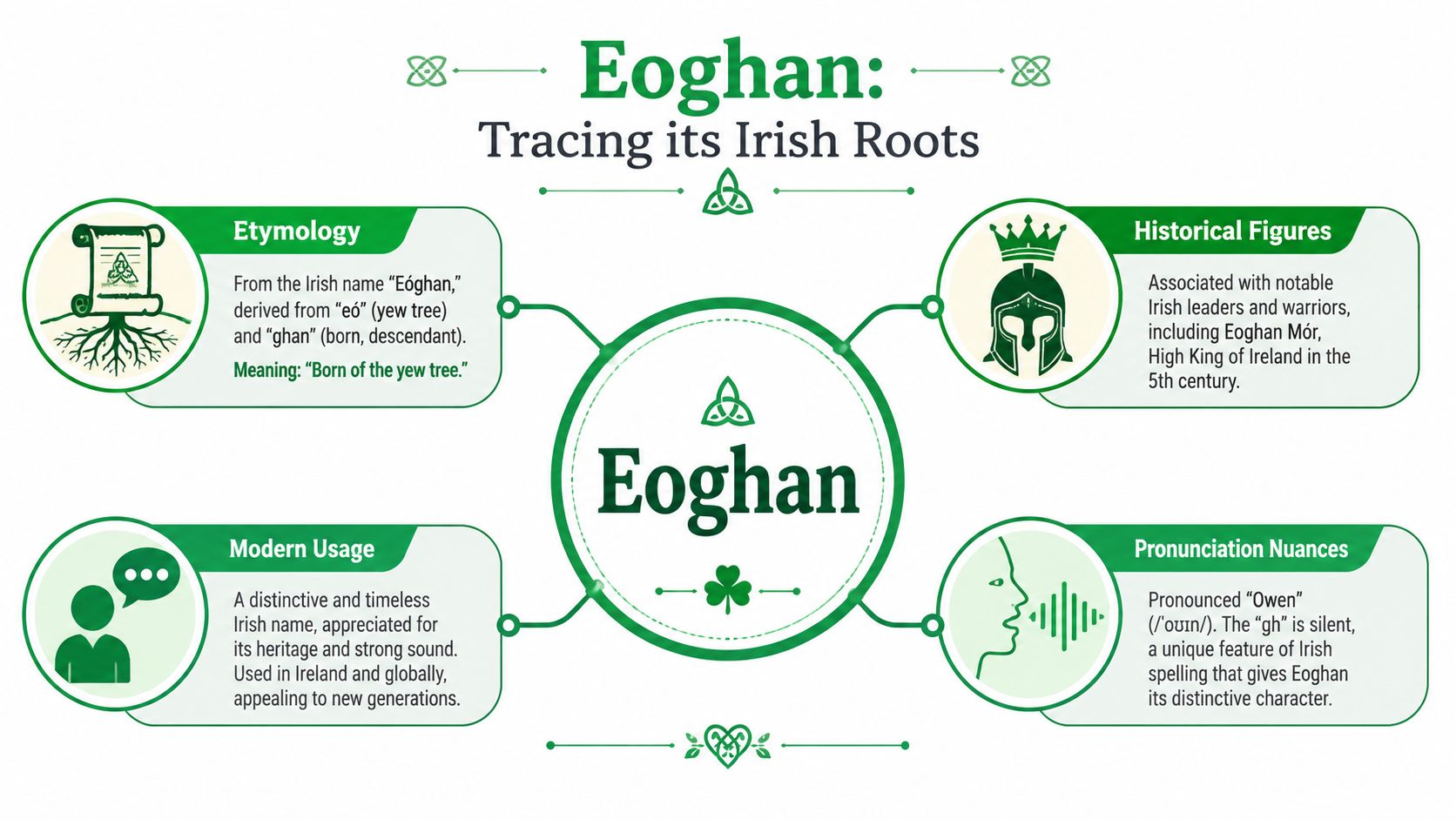
An infographic detailing the Irish name Eoghan, including its etymology, historical context, modern usage, and pronunciation.

Why the confusion keeps happening

A lot of modern readers meet the name through English first, so they assume the English form tells the full story. But the Owen name entry on Wikipedia) notes a key problem in current content: 68% of modern parents choose Owen for perceived Irish roots, even though historical usage shows it is primarily an anglicized form of the Welsh Owain.

That explains why so many people ask the same question. They aren't being careless. They're responding to a real gap in popular naming guides.

Many families inherit a name through English and only later discover that the Gaelic form behind their cultural identity is a different word entirely.

What makes Eoghan distinctly Irish

Eoghan has its own Irish history, not just an “Irish-sounding” spelling. Linguistic analysis identifies it as deriving from Old Irish Éoghan, and it is etymologically distinct from Welsh Owain. Its meanings are given as “youth” or “born of the yew tree.” That second meaning gives the name a very Irish texture, because trees, the natural environment, and lineage are firmly embedded in Gaelic tradition.

The name also carries a strong northern resonance through Tír Eoghain, the Irish name behind County Tyrone. Even if you first arrived here searching for a baby name, that place connection matters. Irish names often live in story, territory, and family memory all at once.

A few details make Eoghan stand out:

  • Its language home is Irish: This is the form that belongs inside Irish spelling and sound patterns.
  • Its meaning is rooted in Gaelic tradition: “Youth” and “born of the yew tree” both feel older and more layered than the flattened meanings you often see on naming sites.
  • Its history reaches into place names: Tír Eoghain preserves the name in the physical environment itself.

If you're looking for the true Irish for Owen, this is the point to hold onto. Owen may be the familiar English name, but Eoghan is the authentic Irish one.

How to Pronounce Eoghan Like a Native Speaker

Spelling is where many learners freeze. Eoghan looks intimidating if you're used to English, but the sound is much friendlier than the spelling suggests.

A young man wearing headphones listening intently while looking down, next to the green text Pronounce Eoghan.

Start with the core sound

The standard Irish pronunciation is given as /oːn̪ˠ/ in this pronunciation discussion of Eoghan. If that notation looks unfamiliar, don't worry. The easiest beginner approach is this:

  1. Start with a long “oh” sound.
  2. Move straight into an n sound.
  3. Keep it smooth. Don't force a strong English w in the middle.

For many English speakers, that lands somewhere near “O-in” or a very light “Owen” without the heavy glide.

Regional pronunciation in the north

Irish isn't one flat accent. In Northern Irish dialects, including County Tyrone, Eoghan is often heard as “o-in” or “owe-en” in a way that reflects the historical link to Tír Eoghain. So if you hear more than one version, that doesn't mean one speaker is wrong. It means the language is alive in different regions.

That's one of the lovely things about Irish names. A name can carry geography in its sound.

Here's a simple listening guide:

  • Standard benchmark: think long oh plus n
  • Northern flavour: you may hear o-in
  • English habit: many speakers shift toward Owen, especially outside Irish-speaking settings

If you want a deeper ear for the sound patterns behind names like Eoghan, this guide to what makes Irish sound unique is worth reading.

Say it slowly first. Irish pronunciation gets easier when you stop trying to force English spelling rules onto Irish words.

It helps to hear the name spoken in real time before trying it aloud yourself:

A good first practice line is: Is mise Eoghan. That means “I am Eoghan.” Even if you're not named Eoghan yourself, it gives you a natural rhythm to rehearse.

Using Eoghan in a Sentence Irish Grammar Basics

Once you move from name meaning to actual Irish, a useful shift happens. Eoghan stops being a label and starts behaving like a word inside the grammar. That's where Irish gets fun.

The linguistic analysis linked above gives two pronunciation benchmarks for the name, /oːnʲ/ in Southern or Central speech and /oːn̪ˠ/ in Northern speech, and it also notes that Eoghan is treated as a masculine noun in Irish. That matters because names can change form depending on how you use them in a sentence.

How names change in Irish

Two forms are especially useful for beginners.

First, there's the vocative, used when you're directly addressing someone. In Irish, you often place a before the name and may adjust the form. With Eoghan, you'll commonly see a Eoghain.

Second, there's the genitive, used to show possession. If you want to say “Eoghan's book,” you can say leabhar Eoghain.

Small grammar habit: In Irish, names often change shape when the sentence changes shape.

Grammatical Forms of Eoghan

Case Irish Form Example Sentence (Irish) Example Sentence (English)
Nominative Eoghan Tá Eoghan anseo. Eoghan is here.
Vocative a Eoghain A Eoghain, tar anseo. Eoghan, come here.
Genitive Eoghain Seo leabhar Eoghain. This is Eoghan's book.

A few beginner notes help:

  • Nominative: This is the basic dictionary form. It's the one you use when naming the person.
  • Vocative: You'll hear this in speech more than beginners expect, especially in family settings.
  • Genitive: This appears often in ordinary possession, family names, and set phrases.

If you want more confidence with possession patterns like leabhar Eoghain, this explainer on how to use the genitive case in Irish makes the pattern much easier to spot.

Try these aloud:

  • Tá Eoghan ag teacht.
  • A Eoghain, cá bhfuil tú?
  • Sin cara Eoghain.

You don't need to master all Irish grammar at once. Learning one name well can teach you more than memorising a page of abstract rules.

Practice Your Pronunciation and Conversation with AI

The hardest part of learning Irish usually isn't reading about a name. It's saying it out loud with confidence, then hearing whether it sounds natural.

Screenshot from https://gaeilgeoir.ai

Why Irish learners need spoken feedback

Irish learners often practice alone. That creates a problem with names like Eoghan, where a tiny sound change can make you sound more English than Irish. According to this report on Irish-learning technology, advanced speech recognition technology that provides real-time feedback on pronunciation is essential for Irish language learning platforms because it helps remote learners who don't have easy access to native speakers.

That makes sense. Reading phonetics helps. Listening helps more. But speaking and getting feedback is what turns recognition into skill.

If you like low-friction speaking tools in general, resources about secure AI chat without signups can also be useful when you want a private, simple way to experiment with language prompts and practice habits.

A simple practice routine

Try a short loop rather than a long study session:

  • Say the name alone: Eoghan.
  • Use it in one sentence: Tá Eoghan anseo.
  • Call to the person: A Eoghain.
  • Repeat after audio: Match rhythm before you worry about perfection.

Keep it light. Names are one of the best entry points into Irish because they connect sound, grammar, and identity all at once.

Embracing Your Connection to an Authentic Irish Name

By now, the key distinction should feel much cleaner. Owen belongs mainly to the Welsh line through Owain, while Eoghan is the authentic Irish equivalent with its own Gaelic meaning, history, and sound.

That difference isn't just academic. It changes how you understand your own heritage, how you introduce a child's name, and how you hear Irish on its own terms. Eoghan carries more than a translation. It carries a sense of youth, the image of the yew tree, and a living connection to Irish speech and place.

If you came here searching for “Irish for Owen,” you weren't just looking for a spelling. You were probably looking for something that felt true. In Irish, truth often lives in the details. A letter changes. A sound softens. A familiar English name opens into a much older Gaelic one.

And that's a good way into the language itself. You don't need to begin with a full grammar course. You can begin with one name, one sound, one phrase spoken carefully.


If you want to keep going from names into real spoken Irish, Gaeilgeoir AI is a practical place to start. It's built to help learners speak from day one with guided conversations, pronunciation support, and everyday Irish you can use.

Tracing Irish Last Names Mc: Mac vs. Mc Explained

You've probably seen your surname on a form, a family tree, or a message from a relative and paused on those first two letters: Mc. Maybe it's McCarthy, McGrath, McDonnell, or another name that feels familiar but slightly out of reach. You know it's Irish, or maybe Irish and Scottish somewhere in the mix, but the story behind it feels blurred by time, spelling changes, and generations of migration.

That moment of curiosity matters. A surname isn't just a label. It's often the oldest piece of language a family carries forward, even when the language itself was lost somewhere along the journey. For many people exploring Irish heritage, “Mc” is the doorway. Behind it sit family memory, Gaelic naming patterns, old clan identities, and the question a lot of people wonder: What was our name before it was written this way?

That's where many guides stop too soon. They tell you that Mc means “son of,” which is true, but they don't always explain how Mac, Mc, and sometimes Mag connect, or how to work backward from a modern English spelling to an older Irish form you can use, pronounce, and understand.

Table of Contents

Your Name Is a Story Waiting to Be Told

A lot of people begin with a small family mystery. A grandparent always said, “We're from Cork,” but nobody knew the townland. An old letter spelled the name one way, a census image another. A cousin adds a Gaelic form to social media, and suddenly you're wondering if your own surname has an older version waiting behind the English spelling.

Names like McCarthy, McMahon, and McGee feel modern because we see them every day. But they were shaped by older speech, by scribes, by priests, by clerks, and by families who moved between Irish and English. If you're searching for Irish last names Mc, you're often searching for more than a definition. You're trying to connect the version you live with now to the version your ancestors may have known in Irish.

That connection can feel surprisingly personal. When someone learns that a family name once had a fuller Gaelic form, it often changes how they hear it. The name stops feeling like a fixed English label and starts feeling like inherited language.

Some people inherit stories. Others inherit only a surname. In Irish family history, that surname can still carry the story.

The good news is that you don't need a shelf of specialist books to begin. You do need patience, a willingness to look at spelling variants, and a clear understanding of one basic truth. Mc is usually not the beginning of the story. It's a shortened written form of something older.

That's why this topic matters. Once you understand how Mac, Mc, and sometimes Mag relate to one another, family records start making more sense. You can read names more confidently, pronounce them more closely to their roots, and decide whether you want to reclaim an older Irish form in your own life.

The Story of a Name Mac Mc and Mag

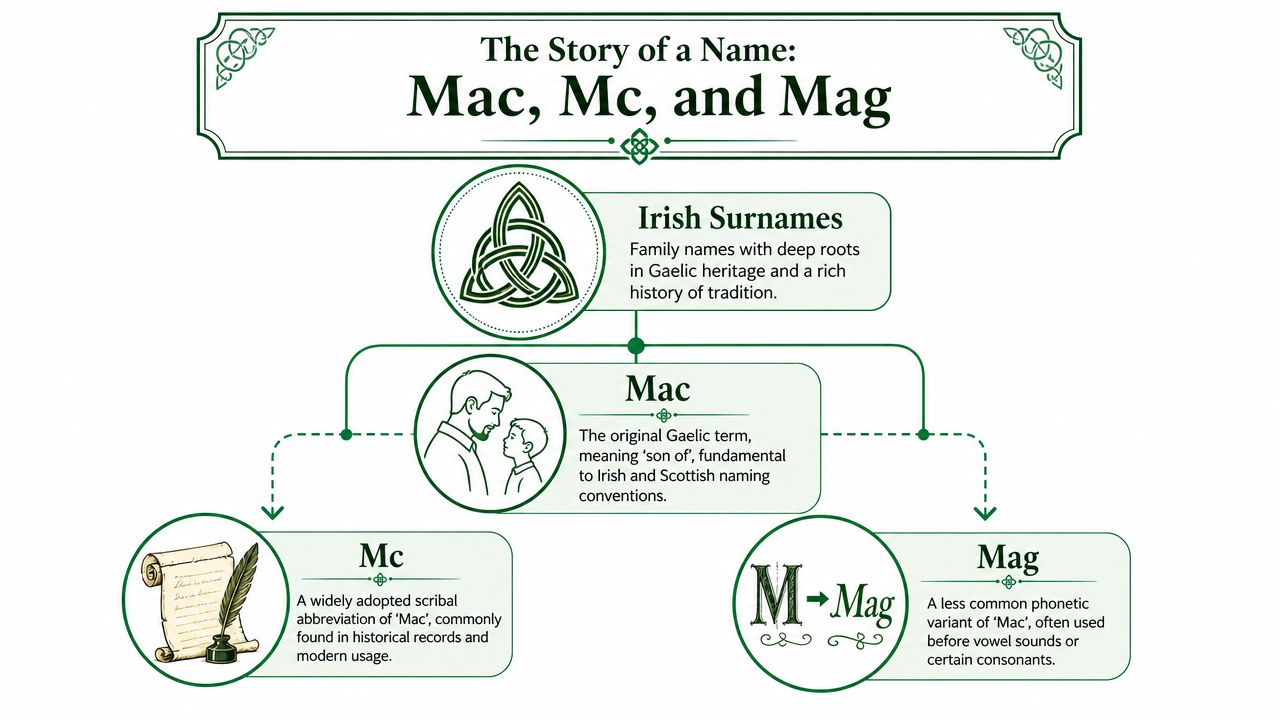
The heart of the matter is simple. Mac comes from the Old Irish mac, meaning “son of.” In both Irish and Scottish Gaelic, it works as a patronymic marker in surnames. The shorter written form Mc developed later as a scribal contraction in Anglicized records, and historical registers show clerks often shortened Mac to Mc for brevity without changing the meaning, as noted in this explanation of the meaning of Mac and Mc in Irish family names.

An infographic detailing the history and meaning of Irish surnames starting with Mac, Mc, and Mag.

Why Mc is not a different name from Mac

A helpful way to think about it is abbreviation. Mc is to Mac a bit like St. is to Saint. The shorter form doesn't create a new identity. It just compresses the writing.

That matters because many people were taught a rough rule that Mac is Scottish and Mc is Irish or vice versa. Real records are messier than that. In many family lines, the two spellings appear interchangeably. The underlying name can stay the same even when the first two letters shift on paper.

Practical rule: If you see Mc in a family name, start by treating it as a contracted form of Mac, not as proof of a separate origin.

For readers who enjoy digging into word histories, surname change, and linguistic drift, it's worth taking time to discover the best etymology reads. Etymology won't solve your family tree by itself, but it sharpens your eye for how names travel and change.

If you want a broader orientation before narrowing to your own surname, this guide to Gaelic last names is a useful companion.

Where Mag fits in

This is the nuance many simple guides miss. Some surnames that appear today with Mc may connect to older Mag forms in Irish. Under English administrative spelling, names could be flattened into more familiar-looking patterns. So a modern Mc spelling doesn't always point neatly back to a visible Mac in older Irish.

That can confuse learners. You might find a modern surname in one record, a different-looking Gaelic form in another, and assume they belong to different families. Sometimes they don't. Sometimes they're different written outcomes of the same naming tradition passing through Irish speech and English record-keeping.

A few checkpoints help:

  • Look past modern spelling: Today's Mc form may not preserve the older Irish prefix exactly.
  • Expect variant records: One family line can leave behind multiple spellings across church, civil, and migration documents.
  • Focus on the root personal name: The second part of the surname often gives the clearest clue to the older form.

This is why Irish surname research can feel alive rather than mechanical. You're not translating a fixed code. You're tracing how language was written by different hands in different times.

A Roll Call of Clans Common Mc Surnames

Once the structure clicks, real names become easier to read. Many people searching Irish last names Mc want one thing first. They want to spot their own surname, see the Irish form, and finally know what it means.

Irish patronymic surnames typically use Ó for “descendant of” and Mac/Mc for “son of,” while the Mac prefix is more strongly associated with northern Irish and Scottish usage. Immigration records in the United States also show that many Mac forms were written as Mc by clerks unfamiliar with Irish spelling, which helps explain why diaspora families often carry the shorter version, as described in this discussion of Mac and Mc in Irish family names.

Common Irish Mc surnames and their Gaelic roots

Modern 'Mc' Name Original Gaelic Form Simplified Pronunciation Meaning
McCarthy Mac Cárthaigh mak CAR-hee son of Cárthach
McMahon Mac Mathghamhna mak MAH-una son of Mathghamhain
McNeill Mac Néill mak NAYL son of Niall
McLaughlin Mac Lochlainn mak LOCKH-lin son of Lochlann
McShane Mac Seáin mak SHAWN son of Seán
McGee Mac Aodha mak EE-a son of Aodh
McManus Mac Mághnais mak MAWG-nish son of Magnus
McKeogh Mac Eochaidh mak YOH-hee son of Eochaidh
McDonnell Mac Domhnaill mak DOH-nil son of Domhnall
McSweeney Mac Suibhne mak SWEE-nee son of Suibhne

The pronunciation column is simplified on purpose. It won't capture every regional sound, but it gives a beginner a way in. The full Irish forms often look intimidating at first because English spelling habits don't prepare us for them.

When you meet the Irish form of your surname for the first time, don't judge it by English spelling rules. It belongs to a different sound system.

Many of these names carry the memory of powerful kin groups. Some are linked to well-known clans. Others survived through local family continuity rather than famous political history. Either way, the pattern is the same. The surname points back to an ancestor's personal name and then outward to a wider lineage.

For readers who want more context on clan history and how surnames connect to older family groupings, this Irish clans guide adds helpful background.

Why the same family name may appear in different forms

People often get stuck when they find more than one version of a surname and assume one must be wrong. Usually, the safer starting point is that variation is normal.

Here are a few common scenarios:

  • A shorter English record: A clerk writes McCarthy where an older Irish form would be Mac Cárthaigh.
  • A diaspora spelling: A family in America keeps Mc even if earlier records in Ireland show Mac.
  • A hidden older variant: A modern Mc surname may connect to an earlier Mag form that isn't obvious at first glance.

That's why surname tables are guides, not final verdicts. They help you recognize likely roots. Your own family line still deserves its own paper trail.

Mapping the Clans Regional Roots of Mc Surnames

A surname doesn't only tell you who your people were. It can also hint at where their story held ground.

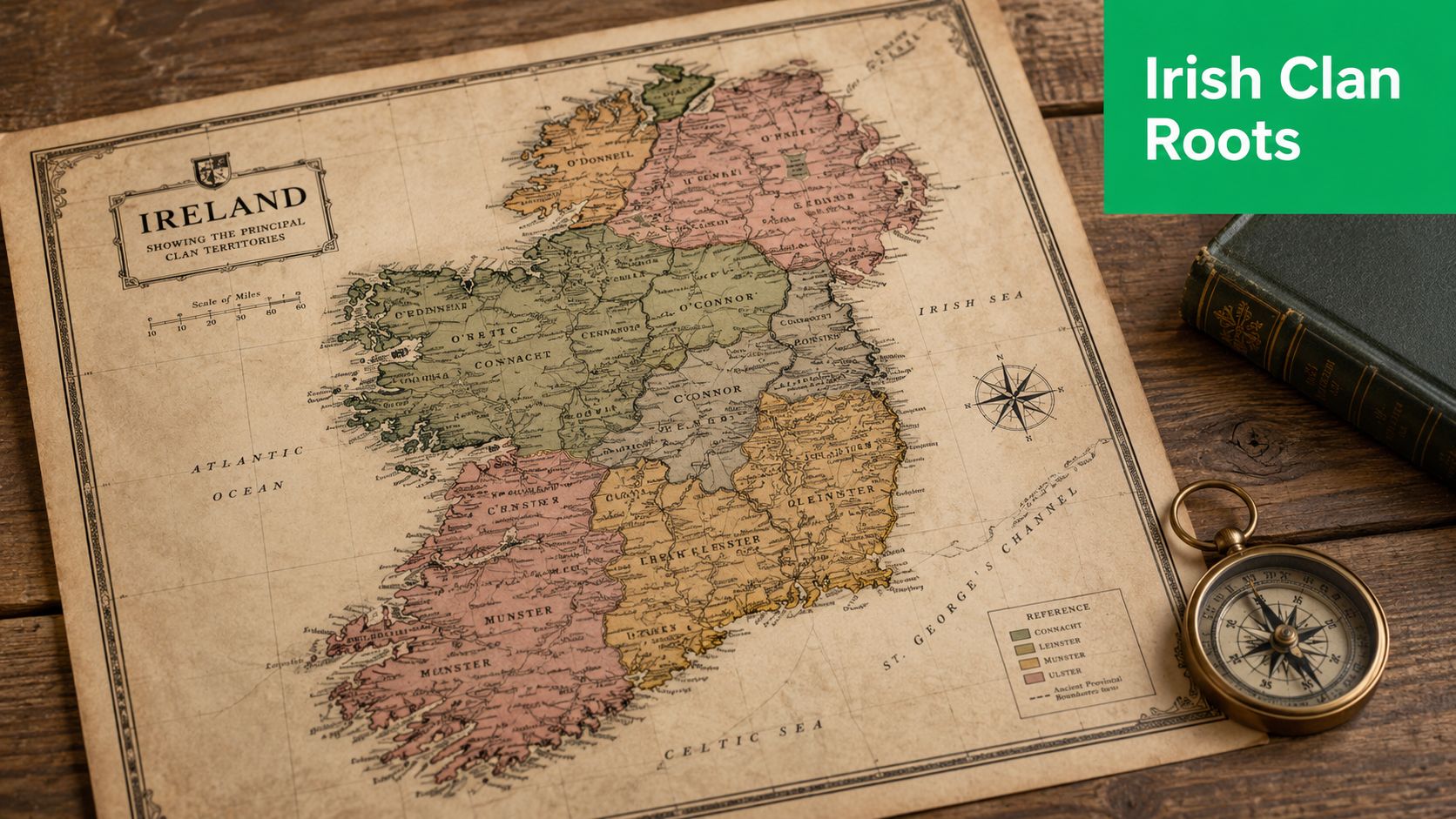
In the 1911 Ireland surname data, McCarthy had over 19,000 bearers, making it one of the most common surnames in the country at the time. The same data show that surnames beginning with Mc or Mac had strong concentrations in Cork, Kerry, Limerick, and Clare, patterns tied to the endurance of medieval Gaelic kinship structures.

An antique-style map of Ireland on a wooden table, depicting historical clan territories and provinces.

Munster and the strong McCarthy footprint

McCarthy is one of the clearest examples of a surname carrying a regional echo. In the southwest, especially in Munster, the name reflects the long influence of the Mac Cárthaigh dynasty. When you see the surname clustered in Cork and Kerry, you're not just looking at repetition on a census page. You're seeing the afterimage of a political and kin-based world that lasted for centuries.

That's one reason surnames feel so rooted in Ireland. A county isn't merely a place on a map. For many names, it's where a lineage held authority, farmed land, married neighboring families, and passed the name on long after the old Gaelic order had changed.

What regional patterns can tell you

Regional concentration doesn't prove that every modern bearer descends from one neat line. Family history is never that tidy. But it can help you ask better questions.

A place-based reading of Mc surnames can help you:

  • Narrow research paths: If a surname is strongly associated with one part of Ireland, that region deserves attention first.
  • Interpret family lore: A story about “people from Kerry” becomes more meaningful when the surname itself has a historical foothold there.
  • Understand migration within Ireland: Some surnames spread outward while still retaining a recognizable home region.

If your family has kept almost no records, regional surname history can be the first solid clue. It doesn't replace certificates, parish entries, or oral history, but it offers a context for your search. That alone can make a name feel less abstract and more local, more human, more real.

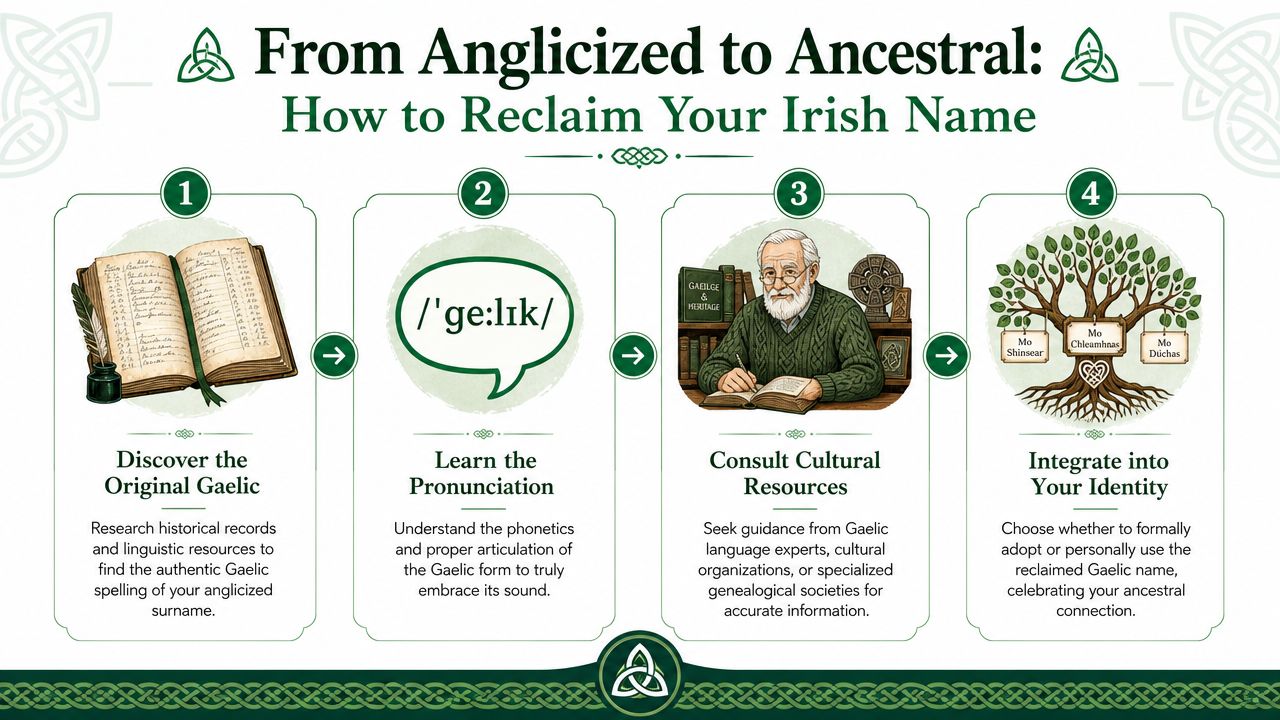
From Anglicized to Ancestral How to Reclaim Your Irish Name

A lot of heritage learners eventually ask the same question. If my surname is written as Mc now, what was its attested Irish form, and can I use it?

That question comes up often in Irish-heritage spaces. Discussions there show recurring interest in “re-Gaelicizing” surnames such as McCarthy to Mac Cárthaigh, but many public explanations stop at general history and don't give people a usable method, as noted in these Irish-heritage forum discussions about reclaiming Irish surname forms.

An infographic titled From Anglicized to Ancestral explaining four steps to reclaiming an authentic Irish surname.

A practical path back to the Irish form

Start with your current surname, but don't stop there.

  1. Search for an attested Irish form
    Look for a documented Gaelic version used in surname references, family records, or established Irish-language materials. Avoid generic “name translators” that force English names into guesswork spellings.

  2. Check for variant pathways
    If you have a modern Mc name, test whether it may connect to Mac or Mag in older forms. That single step can prevent you from choosing a neat-looking Irish spelling that isn't tied to your line.

  3. Listen before you adopt
    Many learners choose a written form before they know how it sounds. That often creates distance instead of connection. Learn the pronunciation with care, even if you only use it privately at first.

Research habit: Write down every spelling you encounter for your surname in one place. The pattern across versions is often more revealing than any single record.

  1. Use specialist help when the trail gets tangled
    If records are scattered or the name branches in multiple directions, a guide to professional genealogy services can help you understand when expert family-history research may be worth considering.

  2. Use language tools, not just genealogy tools
    Reclaiming a name isn't only about documents. It's also about sound and usage. One option is Irish language learning resources that help learners hear Irish forms, practice pronunciation, and build comfort with the language that surnames come from.

How to use your reclaimed name thoughtfully

There isn't one correct level of use. Some people add the Irish form to a family tree. Others use it in email signatures, social profiles, or personal projects. Some keep the legal English spelling and use the Irish form as a cultural name. That's all valid.

A good rule is to be accurate first, expressive second. If you're reclaiming a form, try to use one that is historically grounded rather than invented for style. The point isn't to sound more Irish than someone else. The point is to come closer to your own inheritance.

A few grounded ways to begin:

  • In family history work: Add the Irish form in parentheses beside the modern surname.
  • In conversation practice: Introduce yourself with both versions so the connection becomes natural.
  • In personal heritage projects: Use the Irish form on a family booklet, reunion notes, or ancestry archive.

Some people feel shy about this at first. That's understandable. But using an ancestral form can change the relationship you have with your own name. It stops being only something you sign. It becomes something you understand.

Bringing Your Heritage to Life with Gaeilge

A surname comes alive when you can hear it as part of the language that shaped it.

Screenshot from https://gaeilgeoir.ai

Knowing that Mc is linked to an older Mac form is valuable. Knowing that some modern names may hide earlier Mag forms is even more useful. But the deepest shift often happens when you stop treating the name as a museum object and start treating it as part of living Irish.

A name sounds different when you know the language

When you learn even a little Gaeilge, surnames stop looking decorative. You begin to hear patterns. You notice how sounds soften, how vowels lengthen, how the old structure of a name still carries meaning. That makes heritage feel less abstract.

A practical next step is to spend time with spoken Irish, pronunciation support, and beginner-friendly conversation work. That's where a platform like Gaeilgeoir AI fits naturally. It helps learners practice Irish through guided conversations, pronunciation support, and clickable vocabulary, which can make surname forms feel less intimidating and more usable in real life.

After you've heard your own name spoken in Irish, this video is a good way to keep that momentum going:

A family name can open the door, but language is what lets you walk through it. If you've started with curiosity about Irish last names Mc, the next meaningful step is learning enough Irish to recognize, pronounce, and enjoy the world your surname came from.


If you want to take that next step, start learning with Gaeilgeoir AI and explore the platform directly at Learn Gaeilgeoir AI. Comments and pingbacks are closed.

10 Common Irish Nicknames and Their Meanings

Beyond “Paddy”: A Guide to Real Irish Nicknames

Have you ever heard an Irish person called Seánie or Máirín and wondered what exactly happened to the original name? In Ireland, a nickname often does more than shorten a name. It adds warmth, signals closeness, hints at family habit, and sometimes carries traces of the Irish language even when the conversation is mostly in English.

That's why Irish nicknames are so interesting for learners and heritage seekers. They sit at the meeting point of language and daily life. A tiny ending like -ín can soften a name. A word like beag can mark someone as “little” or younger. And an English-looking form such as Paddy can open up a much bigger story about bilingual naming, migration, and, in some contexts, prejudice.

There's also a practical reason to learn them. Modern Irish naming isn't a museum piece. The Central Statistics Office keeps an Irish Babies' Names tool and county breakdowns, and Nameberry notes that Irish charts are “peppered heavily” with Irish-language names such as Oisín, Sadhbh, Croía, Bláithín, Saoirse, and Síofra. So when you learn these patterns, you're not learning old curiosities. You're learning living forms.

If you're coming to this topic through family history, you may also enjoy seeing your name in Korean as 김지훈, just for fun and comparison.

Table of Contents

1. Seán (John) – Seánie or Seánín

A middle-aged man with short brown hair and a beard standing against a beige wall.

Seán is one of the names many learners meet early, and it gives you a clean introduction to how Irish nicknames are built. In ordinary speech, Seánie feels friendly and familiar. Seánín feels even more intimate, with that small affectionate Irish ending doing a lot of work.

You can hear the shift in social distance right away. Seán suits formal introduction. Seánie sounds like family, neighbours, or old friends. Seánín often feels especially tender, playful, or local.

How the nickname works

The easiest pattern to notice is the move from the base name to an affectionate form. English in Ireland often adds -ie or -y. Irish often adds -ín, which usually carries a sense of “little” or “dear.”

Say them out loud in order:

  • Seán for the plain full name
  • Seánie for an everyday friendly call
  • Seánín for a warmer, more Irish-coded diminutive

A useful practice line is: “Seánie, an bhfuil tú ann?” That means, “Seánie, are you there?” Even if you're new to Irish, this kind of sentence helps you connect the nickname to real use instead of memorizing it as a list item.

Practical rule: If you hear -ín on a person's name, don't assume it's childish. In Irish, it often signals affection more than age.

For heritage learners, Seán also points toward the bigger Irish naming world where a name can exist in Irish, English, and nickname form at the same time. That flexibility is part of why Irish nicknames feel so alive. They're not just labels. They're social signals.

2. Síle (Sheila) – Síleáinín or Síle Bheag

Síle is a lovely example of how Irish nicknames can become more elaborate and musical than their English equivalents. Where English often shortens, Irish sometimes softens and expands. That's how you get forms like Síleáinín, which can feel almost songlike.

Another route is Síle Bheag, meaning “little Síle.” This is the sort of phrase that can distinguish a younger daughter from an older namesake, or express fondness inside a family.

A layered Irish diminutive

The form Síleáinín shows a stacked pattern that learners often find surprising. Instead of one neat ending, Irish can build affection in layers. You don't need to become a grammarian to appreciate it. You only need to hear that each added piece makes the name feel more intimate.

If you want a more approachable way to remember it, think of the nickname as moving through these stages:

  • Síle as the base form
  • Síle Bheag when “little” helps identify or soften the name
  • Síleáinín when the nickname becomes thoroughly familiar and very personal

This kind of layering tells you something important about Irish. It likes nuance. People don't only choose between “formal” and “short.” They often choose among shades of closeness.

A good practice sentence is: “Síleáinín, an dtuigeann tú?” That means, “Síleáinín, do you understand?” It sounds natural in a teaching, family, or playful setting.

Listen for rhythm here as much as pronunciation. Irish nicknames often carry their emotional meaning in the sound shape itself. If Seánie feels brisk and easy, Síleáinín feels softer and more wrapped in affection.

Some Irish nicknames make most sense when you hear them spoken by family. On paper they can look complex. In conversation they often feel perfectly natural.

3. Pádraig (Patrick) – Pádraigín or Paddy

A traveler with a backpack walking through a grassy field towards the ocean at sunrise.

If one name sits at the center of many conversations about Irish nicknames, it's Pádraig. You'll meet both Pádraigín and Paddy, but they don't carry the same tone or history. That distinction matters.

Pádraigín is the straightforward Irish affectionate form. Paddy is the familiar anglicized nickname many people recognize instantly. In real life, families and communities may move between Irish and English forms without thinking much about it. That kind of code-switching is normal in Ireland.

The nickname and the warning label

The complication is cultural history. Tenon Tours notes that “Paddy” was used as a shorthand for an Irishman, and it also warns that some such labels, including terms like “Micks,” were derogatory and shouldn't be used in polite company in those senses, as explained in its piece on Irish nicknames and their social context.

So what should a learner do? Keep the distinction clear.

  • Pádraig is safe and formal.
  • Pádraigín is affectionate in an Irish-language pattern.
  • Paddy can be fine as a personal nickname if that's the person's own form.
  • Paddy should not be used as a generic label for Irish people.

That's one of the best lessons in this whole topic. A nickname can be friendly in one setting and loaded in another.

For pronunciation and naming context, it also helps to compare Pádraig with other traditional men's names in this guide to strong Irish male names.

Try the line “Pádraigín, ar mhaith leat tae?” That means, “Pádraigín, would you like tea?” It sounds domestic, warm, and unmistakably personal.

4. Máire (Mary) – Máirín or Máire Bheag

Máire gives you one of the clearest and most useful patterns in Irish nicknames. If you learn Máire and Máirín, you've learned a structure you can recognize in many other names too.

Máirín is the classic “little Mary” form, but “little” in Irish naming doesn't always mean physically small. It can mean younger, dearer, more familiar, or loved. That flexibility is why the ending matters so much.

A classic little-name pattern

There are two easy affectionate routes here. One is morphological, with -ín attached to the name. The other is descriptive, with beag added after it. So you may hear Máirín or Máire Bheag depending on family habit and region.

This is the kind of nickname pattern you can reuse in your own learning:

  • Formal setting: Máire
  • Warm family setting: Máirín
  • Distinguishing younger from older: Máire Bheag

A line like “Dia duit, a Mháirín!” feels especially useful because it lets you practice both nickname and greeting at once.

Irish naming today also sits inside a living public record, not just oral tradition. For wider context on how Irish names continue in modern use, the Irish Post reports that Murphy is the most popular Irish surname and says that position has remained unchanged for more than a century, which shows how durable recognizable Irish naming patterns can be in public life and identity, as outlined in its article on popular Irish surnames.

If you're collecting related women's names, this broader guide to Irish names for girls pairs well with Máire and its variants.

5. Liam – Liamh or Liamhín

Liam feels simple at first glance, and that simplicity is exactly why it's useful. It doesn't look intimidating, and most learners can say it with confidence early on. But once nicknames enter the picture, even this short name shows how Irish affection can stretch a familiar form into something softer, like Liamh or Liamhín.

This is also a good reminder that Irish nickname habits aren't always frozen into one official set. Some forms are strongly established. Others live more in speech, family practice, or local preference. That's normal.

Why this one feels modern

Liam often feels more modern and internationally mobile than some older Irish forms. It travels easily, but in Ireland it can still take on a very local warmth through nickname use. Liamhín sounds more intimate than the base name, and that's the key thing to hear.

A few useful learner cues:

  • Say the opening clearly so the “Lee” sound stays clean.
  • Notice the emotional shift between Liam and Liamhín.
  • Use it in action-based practice such as games, family talk, or invitations.

A sentence like “Liam, ar mhaith leat imirt?” works well because it's natural and easy to repeat. Once that feels comfortable, you can imagine the same scene with the softer nickname.

Liam also helps learners understand a wider truth about Irish nicknames. Not every affectionate form is famous outside Ireland. Some make sense only once you've heard how Irish households speak to one another. That's part of the charm. The nickname isn't always there to impress strangers. Often it exists to show belonging.

6. Caoimhe (Keeva) – Caoimhe Bheag or Caoimi

Caoimhe is one of the best names for teaching a beginner that Irish spelling and Irish sound don't map neatly onto English expectations. You look at Caoimhe and, if you're new, you probably won't hear Keeva in your head right away. That gap is normal.

Once you accept that Irish orthography follows its own logic, the name becomes much less scary. Then the nickname forms, such as Caoimhe Bheag or a clipped familiar form like Caoimi, start to feel approachable too.

Spelling, sound, and learner confidence

The first job is pronunciation. Get Keeva into your ear before you worry about every letter. After that, you can begin to hear how a nickname changes social tone rather than just structure.

This name is especially relevant because Irish-language forms are firmly part of current naming culture. As noted earlier, public naming data and popular coverage both show that Irish-language names are mainstream in Ireland, not fringe choices.

Try these habits when working with Caoimhe:

  • Learn the sound first by saying Keeva several times.
  • Treat the spelling as a pattern rather than a puzzle.
  • Use the nickname in family scenes where warmth makes sense.

For extra support with affectionate language around names and relationships, this guide to Irish Gaelic terms of endearment is a helpful companion.

When an Irish name looks difficult, pronunciation usually unlocks it faster than spelling study does.

A line like “Caoimhe, tar anseo!” (“Caoimhe, come here!”) gives you a natural everyday context. Once the base name feels comfortable, Caoimhe Bheag becomes much easier to understand as a real social form rather than a grammar exercise.

7. Saoirse (Freedom) – Saoirsín

Saoirse is one of those names that many people meet before they understand why it feels so distinctly Irish. Part of the answer is that it comes from a regular Irish word, saoirse, meaning “freedom.” That gives the name an immediate cultural resonance before any nickname is added.

Then comes Saoirsín, which applies the old affectionate pattern to a comparatively modern-feeling name. The result is a lovely mix of tradition and newness.

A word-name that became personal

For learners, Saoirse teaches two lessons at once. First, Irish can turn meaningful everyday vocabulary into personal names. Second, once a word becomes a name, it can still behave like other names and take an affectionate ending.

The main challenge here is pronunciation. Many learners know the spelling before they know the sound. In common guidance, you'll usually hear something close to SER-sha.

Use the name in a simple spoken frame: “Saoirsín, ar bhreá leat imirt?” The emotional effect is gentle and playful. The nickname makes the abstract meaning of “freedom” feel personal and domestic.

This is also where cultural story matters. Names like Saoirse show that Irish naming isn't only about preserving the old. It can also express ideals, memory, and identity through the language itself. That's part of why these names resonate with heritage learners. They feel rooted, but not dusty.

If you struggle with Saoirse at first, that's fine. It's one of the names that often clicks suddenly. After enough listening, your eyes stop fighting the spelling.

8. Cormac – Cormacín or Cormac Beag

Cormac carries weight. Even before you learn any legend attached to it, the name sounds old, grounded, and unmistakably Irish. Yet the nickname forms Cormacín and Cormac Beag show how even a grand old name can become warm and local in ordinary conversation.

That contrast is one of the pleasures of Irish nicknames. A name with royal or mythic associations doesn't stay on a pedestal. People still pull it into family life.

Ancient name, everyday warmth

When a learner meets Cormac, it helps to hold two images at once. One is the literary or historical one. The other is the kitchen-table one, where someone is calling a child in for dinner.

That dual life is part of Irish naming culture. A traditional name can remain fully usable without losing its depth.

You might think of the nickname choices this way:

  • Cormac when you want the full, steady form
  • Cormacín when affection is built into the name
  • Cormac Beag when “little Cormac” distinguishes one person from another

A heritage learner can get a lot from pairing the name with myth and storytelling. Cormac appears in older Irish tradition, and even if you only know that in broad outline, it can help the name stick in memory.

Old Irish names often survive because families keep using them naturally, not because museums protect them.

A sentence such as “Cormacín, come over here a second” in your own practice routine can be enough. You don't need a full saga every time. The point is to let the old name live in modern speech.

9. Aoife (Eva) – Aoifín or Aoife Bheag

Aoife is one of the best examples of an Irish name that looks difficult until you know the key. Once you learn that it's pronounced EE-fa, the whole thing opens up. Then the affectionate forms Aoifín and Aoife Bheag make sense as extensions of a living sound, not strange spellings on a page.

Aoife also carries mythological associations, which gives it extra depth for learners who enjoy cultural context. But it works perfectly well even if you meet it first in a modern classroom, family, or friend group.

The myth behind the softness

There's a pleasing contrast in Aoife. The name can be linked to strong mythic figures, yet the nickname forms often sound very gentle. That combination is common in Irish naming. Strength in story doesn't cancel tenderness in speech.

Practice helps most if you keep it simple:

  • Master EE-fa first
  • Then add Aoifín
  • Use Aoife Bheag when you want the “little Aoife” sense

A sample sentence like “Aoifín, an dtuigeann tú?” makes the nickname feel useful right away. It sounds like something a teacher, sibling, or parent might say.

Aoife is also a good reminder that Irish nicknames aren't only cute add-ons. They often tell you how speakers position someone socially. Are they close? Is this the younger one? Is the mood playful? The nickname reveals the answers to those questions.

For language learners, that's valuable. You're not only learning vocabulary. You're learning how warmth gets built into speech.

10. Tadhg (Timothy) – Tadhgán or Taddy

You spot Tadhg on a family tree, then hear someone say it out loud and realize the spelling and sound are not close in the English way. That moment teaches an important lesson about Irish nicknames. You often have to learn the spoken form first, then build the nickname from the sound you hear.

In many contexts, Tadhg is pronounced close to Tige. Once that clicks, the nickname forms stop looking random. They become easier to remember because you are no longer reading letter by letter through English habits.

The name itself has deep roots in Irish tradition and is often associated with a poet or storyteller. That cultural layer matters because nicknames are not only shorter versions of names. They carry tone, family feeling, and sometimes a hint of history.

How the two nickname paths work

Tadhgán follows an Irish pattern. The ending -án works as a diminutive, much like a smaller or more affectionate form. It gives the name warmth while keeping it clearly Irish in structure.

Taddy shows a different path. It reflects anglicized speech habits, where a name is reshaped to fit English sound patterns more comfortably. For language learners, this is a useful example of code-switching in everyday life. One family may prefer the Irish-shaped form, while another uses the English-friendly one without seeing any contradiction.

That is what makes Tadhg so helpful to study.

It brings together three common challenges at once:

  • Pronunciation, because the spelling can mislead new learners
  • Nickname formation, because Tadhgán uses a recognizably Irish suffix
  • Code-switching, because Taddy shows how names shift across Irish and English settings

A sentence like “Tá Tadhgán ag léamh arís” lets you hear the affectionate form in a natural way. It sounds like the kind of line you might hear at home or in a classroom, not just in a word list.

Tadhg is also useful for heritage research. In older records, the same person might appear under an Irish form, an English substitute such as Timothy, or a household nickname. That can make one individual look like several different people until you learn the naming patterns behind the shift.

For everyday use, the safest rule is simple. Start with the form the person introduces. Then listen to what family and friends call them. In Irish naming, that choice often tells you as much about relationship and setting as it does about the name itself.

10 Irish Nicknames Compared

Name Formation Complexity 🔄 Resources Required ⚡ Expected Outcomes 📊 Ideal Use Case & Key Advantage ⭐ Top Tip 💡
Seán (Seánie / Seánín) Low, common -ie / -ín patterns Minimal: audio clips + dialogue practice High familiarity; teaches basic nickname formation Beginners; everyday social interaction, highly frequent name Practice formal and two diminutive forms in greetings
Síle (Síleáinín / Síle Bheag) Moderate, layered diminutive compounds Audio, etymology notes, traditional texts Improved understanding of advanced suffixation and intimacy Intermediate learners; folklore and literary contexts Break down base + suffixes (Síle + áin + ín)
Pádraig (Pádraigín / Paddy) Moderate, Irish diminutive + anglicized variant Audio, bilingual examples, cultural history Teaches code-switching and historical naming patterns All levels in authentic Irish settings; links to culture/history Recognize and practice both Pádraig and Paddy forms
Máire (Máirín / Máire Bheag) Low, straightforward -ín diminutive Songs, media examples, pronunciation audio Solid foundation in diminutive rules and literary usage Beginners to intermediate; literary and folk material Use songs and greetings to hear natural usage
Liam (Liamh / Liamhín) Low–Moderate, modern diminutives, less standardised Contemporary media and conversational audio Familiarity with modern naming conventions and usage Modern conversational contexts; youth-oriented language Emphasize clear "Lee" sound at word start
Caoimhe (Caoimhe Bheag / Caoimi) Low, diminutives regular but orthography tricky Focused pronunciation audio and repetition drills Strengthens orthography ↔ pronunciation mapping Intermediate learners; phonetics and orthography practice Prioritise pronunciation ('KEE-va') before spelling
Saoirse (Saoirsín) Low, vocabulary→name with -ín diminutive Audio, cultural context (modern history) Demonstrates living language evolution and identity Learners exploring modern Irish naming and culture Practice 'SER-sha' with native audio and cultural notes
Cormac (Cormacín / Cormac Beag) Moderate, ancient roots, standard diminutive Historical texts, literary readings Deep cultural and mythological insight; heritage link Heritage learners and literature/history study Read Cormac mac Airt sources to contextualise usage
Aoife (Aoifín / Aoife Bheag) Low, simple diminutive; spelling ≠ pronunciation Pronunciation audio, mythological texts Improves pronunciation skills and mythic literacy Intermediate learners; cultural enrichment through sagas Master 'EE-fa' with native audio and compare myths
Tadhg (Tadhgán / Taddy) Low, diminutive standard but spelling unusual Audio, poetry/literary resources Connects language learning to poetic tradition; pronunciation skill Learners focused on poetry, literary culture, and heritage Learn pronunciation first ('Tig') and study literary examples

Bringing Irish Nicknames into Your Gaeilge

You hear a grandmother call across the kitchen, “A Mháirín, tar anseo,” and suddenly the name on the family tree is no longer abstract. It has shrunk, softened, and become social. That is the shift learners need to notice. Irish nicknames are not random extras attached to formal names. They follow patterns you can hear, recognize, and use.

A good starting rule is this: many Irish nicknames work by changing scale or tone. The suffix -ín often makes a name smaller, younger, or more affectionate. Beag means “small,” but in names it can also separate one person from another, much like “junior,” “little Mary,” or “the younger Seán” in English-speaking families. Then there are mixed forms such as Paddy or Seánie, where Irish and English habits meet in everyday speech. That code-switching matters because it reflects real bilingual life, not sloppy usage.

Context does a lot of the work.

The same nickname can feel warm in one setting and awkward in another. A family pet name may sound natural at home and too intimate in a classroom. A local English form may be common in one county and barely used in the next. Some labels linked to Irish identity also carry a history of mockery or exclusion, so respectful use depends on speaker preference, audience, and setting as much as dictionary meaning.

Regional habits add another layer. Ireland does not run on one fixed nickname system. County identity, family tradition, schoolyard speech, and Gaeltacht usage can all shape what sounds normal. The overview of Irish county nicknames gives a useful glimpse of that variation. It shows why “What does it mean?” is only half the question. “Who says it, and where?” often matters just as much.

Names also carry social weight outside the home. A recent Eurofound summary of an ESRI field experiment on hiring found that Irish and non-Irish names did not receive the same treatment from employers in Ireland, as described in its report on discrimination against job applicants with non-Irish names. For language learners, that is a reminder that names are never only about sound. They also signal belonging, assumptions, and social history.

For practice, treat nicknames as a small grammar system. Listen for the pattern first, then test it with names you already know. Say Seán, then Seánín. Say Máire, then Máirín. Compare Aoife Bheag with Aoifín. One uses an added descriptive word. The other uses a suffix. Once you hear that difference a few times, Irish nicknames start to feel less like a memorization task and more like a set of building blocks.

Genealogy can complicate this, because old records often mix formal names, household nicknames, anglicized spellings, and local labels. A person may appear under more than one version of the same name depending on who was speaking and what language they were writing in. Heritage learners often find this confusing at first. It helps to treat each form as a clue about social context rather than as a mistake that needs correcting.

Gaeilgeoir AI is one option for learners who want guided speaking practice with names in realistic social situations. Used that way, nicknames stop being items on a list and become part of how Irish is spoken.

10 Celtic Baby Girl Names: Meanings & Pronunciation 2026

A friend once told me she fell in love with the name Saoirse, then froze when she realized she wasn't sure how to say it out loud. That moment is common with Celtic baby girl names. The beauty is immediate, but the language behind the beauty deserves care.

If you're choosing among Celtic baby girl names, it helps to think beyond “meaning.” A name like Aoife, Niamh, or Róisín carries sound patterns, spelling rules, myth, and living culture. In Ireland, names such as Fiadh have become highly visible in recent baby-name rankings, while the broader top girls' names list also includes Grace, Emily, Sophie, Ava, Amelia, Ella, Hannah, Lucy, and Mia, which shows Irish names now sit comfortably beside international favorites in everyday family life (recent Irish baby-name reporting summarized from Irish statistics). If you're in the thick of early parenthood, this guide to support for new parents may help too.

The practical question isn't only which name sounds lovely. It's whether you'll feel confident saying it, teaching it to others, and honoring where it comes from. That's why Irish names can become a gateway to language learning. Even one name can teach you how slender and broad consonants work, why mh often sounds like v, or how a fada changes rhythm and stress.

Table of Contents

1. Aoife

A happy baby girl wrapped in a green Celtic-patterned blanket while sitting on a rugged coastal cliff.

Aoife is one of the names people remember after hearing it once. The spelling looks mysterious to many English speakers, but once you learn the sound, it feels graceful and direct. It's commonly explained as meaning beauty or radiance, and it has deep roots in Irish story tradition.

In Irish mythology, Aoife appears as a warrior woman in the Ulster Cycle. That gives the name a different texture from names chosen only for softness. It can feel elegant and strong at the same time.

Why Aoife matters

Aoife is a good example of why Celtic baby girl names are worth learning properly instead of anglicizing by guesswork. You may hear different attempts from people seeing it for the first time, but careful pronunciation shows respect both to the child and to the language.

Aoife also works well as a first pronunciation lesson. Learners can practice it in a simple Irish sentence such as “Is mise Aoife,” meaning “I am Aoife.” That turns a baby name into a doorway into spoken Gaeilge.

Practical rule: If a name matters to your family, learn how it sounds from Irish first, then decide how you'll help others say it.

Real-world examples help make the name feel lived-in rather than museum-like. You might know the musician Aoife O'Donovan or the actor Aoife Hinds. Names like this stay current because people continue to use them in modern life, not because they survive only in legends.

2. Saoirse

Saoirse is one of the clearest examples of a name that is also an Irish word. It means freedom, which gives it emotional force before you even get to its sound. For many families, that makes it memorable in a way that more decorative names aren't.

The name became widely recognizable outside Ireland through actress Saoirse Ronan, and many people first encounter it there. That visibility matters because it shows how an Irish-language name can stay culturally specific while moving confidently into global use.

Why freedom matters in this name

Saoirse connects personal identity with Irish history and language in a very direct way. Parents who choose it often aren't just picking a pretty sound. They're choosing a word with values attached to it.

There is one practical wrinkle. Pronunciation can vary by accent and familiarity, so it's worth listening to native or Irish-informed models rather than relying on a single guess from English spelling.

  • Say the meaning too: When you introduce the name, explaining that it means freedom often helps people remember it.
  • Practice the word on its own: Because saoirse is also ordinary vocabulary, it teaches more than a label.
  • Use it in context: Try simple introductions or greetings so the pronunciation sticks naturally.

Some Celtic baby girl names carry a story. Saoirse carries a whole idea.

If you want a name that sounds distinctly Irish but still feels contemporary, Saoirse sits in that sweet spot. It shows how a traditional language can sound modern without giving up its roots.

3. Siobhan

Siobhan often surprises people because it doesn't look anything like its common English pronunciation clues. That's part of its value. It teaches, right away, that Irish spelling follows Irish rules.

The name is the Irish form of Joan or Jeanne. That history makes it a useful reminder that names travel, adapt, and settle differently in different languages.

What Siobhan teaches about Irish spelling

If you're curious about Celtic baby girl names as a language-learning path, Siobhan is a strong study piece. The bh in Irish often produces a v sound. Once you learn that, many other names and words become less intimidating.

This is also a name with broad real-world recognition. You might know Siobhan Fahey or Siobhán McSweeney, and because the name appears often in public life, it gives learners repeated exposure.

A good next step is to compare it with other Irish girls' names and notice shared spelling patterns in this Irish names for girls guide. Looking at names as a group often makes the system click faster than studying one in isolation.

  • Focus on one sound rule: Learn bh as v first.
  • Say it slowly: Break the name into manageable sound parts before speaking it naturally.
  • Expect variation in English-speaking spaces: Many people know the name, but not everyone knows the Irish spelling logic behind it.

Siobhan is especially useful if you want a name that is unmistakably Irish yet familiar in many English-speaking communities. It bridges heritage and everyday usability well.

4. Aisling

A peaceful baby girl sleeping soundly in a crib while holding a stuffed animal next to a book.

Aisling has literary depth that many names never get. It usually means dream or vision, and in Irish literary tradition an aisling is also a poetic form. That gives the name a special richness. It isn't only a personal name. It's also a cultural concept.

For parents who love poetry, language, or symbolism, Aisling feels grounded without sounding heavy. It has softness, but also history.

A literary name with everyday warmth

In Irish literature, the aisling tradition often presents Ireland in symbolic female form. You don't need to know the whole tradition to use the name, but knowing that background makes it more meaningful and respectful.

You'll also hear Aisling in contemporary life through figures such as Aisling Bea and Aisling Loftus. That balance between old literature and modern recognizability is one reason the name travels well.

If you want help hearing the shape of the word clearly, this pronunciation of Aislinn resource is useful because it keeps the focus on sound rather than guesswork from spelling alone.

Naming insight: Aisling is a good choice for families who want a name with cultural depth that still feels gentle and everyday.

The name can also invite a child into literature later on. Few names open such a direct path from family naming to poetry, language, and identity.

5. Orla

Orla is short, bright, and easy to carry into daily life. It's often explained as meaning golden princess, with roots in Irish elements related to gold. Even people who are unsure about longer Irish spellings usually find Orla approachable.

That simplicity is part of its appeal. Not every Celtic name needs to be orthographically complex to be culturally real.

Short, bright, and easy to carry

Parents sometimes want a name that feels distinctly Irish without requiring a pronunciation lesson every single day. Orla meets that need well. It keeps Irish identity visible while remaining easy to read in many English-speaking settings.

The sound is clear and warm. It also works well in spoken Irish practice, especially in short phrases and introductions. Because it's compact, learners can focus on rhythm and vowel quality instead of wrestling with many letters at once.

A few practical reasons people like Orla:

  • Strong first impression: It sounds complete and confident in only two syllables.
  • Easy classroom use: Teachers and relatives usually have fewer hurdles with it.
  • Clear Irish link: It feels rooted rather than generic.

Orla is a helpful reminder that Celtic baby girl names aren't all challenging to pronounce. Some are simple enough for everyday ease while still carrying unmistakable cultural character.

6. Caoimhe

Caoimhe is the kind of name that makes people pause, then smile once they learn it. It's often explained as meaning beautiful, gentle, or precious. The spelling can look formidable if you haven't met Irish orthography before, but that challenge is exactly what makes it such a good teacher.

This name shows the gap between Irish spelling and English expectations. If you can learn Caoimhe patiently, many other Irish names become less intimidating.

A name that rewards patience

Pronunciation is commonly given as KEE-va or sometimes KWEE-va, depending on accent and regional habit. That variation is normal. What's important is learning that the spelling belongs to a real system, not to randomness.

For learners, Caoimhe is excellent practice because it highlights recurring sound patterns. The ao vowel group and mh consonant pair show up elsewhere in Irish too. Once you hear them enough, your eyes stop fighting the spelling.

Before the video below, one simple tip helps. Practice the name out loud separately from its spelling, then reconnect the two after your ear gets comfortable.

In the United States, Irish-origin girl names that perform best in mainstream ranking lists tend to be forms such as Harper, Nora, Riley, Maeve, Kennedy, Quinn, Hailey, Rylee, Sloane, and Reagan, while faster climbers include Elowyn, Rowyn, Kiera, Ayleen or Aileen, Eileen, Murphy, Bridget, Darcy, Delaney, and Rory. That pattern suggests many U.S. parents choose names that feel easier to normalize in English spelling, which helps explain why a name like Caoimhe may need pronunciation support more often than Maeve or Nora (Good Housekeeping summary of SSA-based rankings).

Caoimhe is a strong choice for families who don't mind teaching others. In return, they get a name that feels distinctly Irish and linguistically beautiful.

7. Niamh

Niamh is compact, luminous, and closely tied to Irish myth. It's commonly glossed as bright or radiant, and that sense of light fits both the sound and the stories around it.

In legend, Niamh is linked with the tale of Oisín and Tír na nÓg. That makes the name feel mythic without becoming unusable in present-day life.

Myth and modern life in one syllable

Niamh is one of the best examples of how much Irish can hide inside a short name. To an English-speaking eye, the final mh may not suggest the usual spoken form at all. To an Irish learner, though, it becomes another useful clue.

You may know the name from public figures such as Niamh Cusack or Niamh Kavanagh. Modern use keeps it grounded. Myth gives it color.

Niamh is a good reminder that Irish names don't separate folklore from ordinary life. They often carry both at once.

If you're using names to learn language, Niamh works well alongside Oisín because both appear in the same legendary orbit. Studying them together can make cultural memory feel less abstract and much more conversational.

8. Róisín

A cute baby girl in a pink dress holding a single red rose, reflecting sweetness and innocence.

Róisín is tender without being flimsy. It means little rose, and that small ending carries a language lesson with it. In Irish, the suffix can create a diminutive form that adds affection or smallness.

This is one of those names where grammar, feeling, and culture meet. A parent may choose it for sweetness, while a learner notices how the language builds meaning.

A small ending with a big lesson

The traditional song “Róisín Dubh” gives the name an extra cultural echo. Even if someone first picks it because it sounds beautiful, they'll soon find it connected to music and literary symbolism too.

The fada over the ó matters. It changes the vowel quality and reminds learners that Irish spelling marks sound more carefully than English often does.

A few ways Róisín teaches beyond itself:

  • Base word awareness: Rós means rose.
  • Suffix awareness: The ending helps show how Irish forms affectionate diminutives.
  • Accent awareness: The fada isn't decorative. It guides pronunciation.

Róisín Murphy is a familiar modern example, and that kind of visibility helps keep the name contemporary. Róisín is ideal for families who want softness, artistry, and a direct lesson in how Irish builds meaning.

9. Maeve

Maeve is one of the most accessible entries on many lists of Celtic baby girl names. It's familiar, short, and easy for many English speakers to pronounce on sight. Yet behind that simplicity stands one of the strongest figures in Irish mythology.

The legendary Queen Medb of Connacht gives Maeve its force. The name is often connected with the sense of intoxicating, but in modern use many people respond just as strongly to the aura of leadership and independence around it.

Strength in a familiar form

Maeve is a useful example of a name that has crossed over successfully without losing its Irish core. In current U.S. popularity discussions of Irish-origin names, Maeve appears among the strongest mainstream choices, which helps explain why many families meet it before they meet more orthographically demanding forms such as Meadhbh or Caoimhe.

That broad familiarity can be a benefit if you want an Irish name that travels smoothly across schools, workplaces, and countries. But the mythological background keeps it from feeling generic.

If the warrior-queen dimension appeals to you, these Irish goddess names offer a wider cultural backdrop for similarly powerful choices.

Maeve works well for parents who want a name that sounds polished in modern life while still opening the door to the Ulster Cycle and older Irish storytelling. It's proof that accessibility doesn't have to mean cultural thinning.

10. Ciara

Ciara is often one of the easier Irish names for English speakers to approach. It's usually explained as meaning dark or dark-haired, from the Irish root ciar. The sound is straightforward enough that many people feel comfortable with it quickly, even if spellings and pronunciations can vary by region.

That makes Ciara a good beginner's name. It still teaches something real about Irish, but it doesn't ask families to climb the steepest hill first.

A clear starting point for beginners

One useful lesson here is that Irish c is pronounced like k. That's a basic pronunciation principle with wide value beyond this one name. Learn it through Ciara, and you'll spot it elsewhere.

The name also shows how forms shift across borders. In the United States, faster-climbing Irish-origin names in one ranking summary include Kiera, which reflects how some families prefer spellings that feel more transparent in English, while still keeping an Irish link. Ciara and Kiera can therefore open a good conversation about authenticity, adaptation, and what matters most to your family.

For parents reconnecting with heritage, Ciara is often a comfortable first step. It feels recognizably Irish, still works internationally, and can lead naturally into broader language learning once curiosity grows.

Top 10 Celtic Baby Girl Names Comparison

Name 🔄 Pronunciation Complexity ⚡ Resource Requirements 📊 Expected Outcomes & Cultural Impact 💡 Ideal Use Cases ⭐ Key Advantages
Aoife Medium, "EE-fa" / "AY-fa" Audio guide + repetition Strong practice of Irish vowels; mythological context Learners practicing vowel sounds and cultural names Authentically Irish; rich narrative; increasingly international
Saoirse High, "SIR-sha" / "SER-sha" Focused audio + phonetic explanation of "ao" Teaches challenging vowel combinations; conveys value of "freedom" Advanced learners; cultural/political name discussions Powerful meaning; celebrity familiarity; distinct identity
Siobhan High, "Shiv-AWN" Orthography lessons + audio practice Demonstrates consonant clusters and orthographic evolution Study of Irish spelling rules and historical forms Internationally recognized; rich historical depth
Aisling Medium-High, "ASH-ling" / "AYS-ling" Audio + literary/context study Entry to Aisling poetry tradition; poetic vocabulary Learners interested in Irish literature and symbolism Lyrical meaning; strong literary connections
Orla Low, "OR-la" Minimal (basic pronunciation + word break-down) Teaches compound word formation ("or" + "flann") Beginners; families wanting simple authentic names Simple, memorable, modern while traditional
Caoimhe Very High, "KEE-va" / "KWE-va" Repeated audio + phonetic rule drills Mastery of orthography vs pronunciation; key phonetic patterns Learners tackling Irish orthography and phonetics Exemplifies Irish phonetic rules; elegant sound
Niamh Medium, "NEEV" Audio + myth retelling Connects learners to Irish mythology and storytelling Culture-focused learners and storytelling practice Mythological resonance; relatively accessible pronunciation
Róisín Low-Medium, "RO-sheen" / "ROW-sheen" Basic audio + diminutive grammar notes Teaches diminutive suffix (-ín) and folk traditions Grammar lessons on diminutives; music/folk contexts Teaches grammatical suffixes; strong folkloric ties
Maeve Low, "MAYV" Minimal (pronunciation + legend overview) Introduces legendary Queen Medb; leadership symbolism Learners exploring mythic names and cultural narratives Strong feminine leadership symbolism; easy pronunciation
Ciara Low-Medium, "KEER-a" / "KEE-ra" Basic audio + practice with "C" = "K" Builds confidence with approachable Irish pronunciation Beginner learners and multicultural families Accessible pronunciation; historically rooted and popular

Final Thoughts

Choosing among Celtic baby girl names isn't only a style decision. It's often a small cultural decision too. A name can connect a child to family roots, to story, to music, and to the sound system of a living language.

That matters because Irish names aren't frozen artifacts. In Ireland, current naming patterns show that Irish-language names sit alongside international favorites in everyday use, and reporting based on recent statistics also notes that Síofra rose from 157th to 100th in 2023, a jump of 57 places in a single year, while Fiadh has been reported as the most popular girls' name in Ireland (discussion of recent Irish naming trends). That kind of movement suggests parents are actively choosing names from Irish, not treating them as distant heritage pieces.

The respectful way to use these names is simple. Learn the pronunciation. Understand the meaning as well as you can. If a name comes from mythology, literature, or ordinary Irish vocabulary, take a little time to know that context. You don't need to become a scholar before naming a child, but curiosity and care go a long way.

It's also fine to be practical. Some families want names like Maeve, Orla, or Ciara because they travel easily. Others want names like Caoimhe, Saoirse, or Aoife because the Irish spelling itself is part of the value. Neither instinct is wrong. What matters is choosing consciously rather than flattening the language to make other people comfortable.

If you're still undecided, say each name out loud in everyday situations. Imagine calling it across a room, writing it on a school form, hearing a grandparent say it, or helping a child explain it proudly. A good name should feel usable, not just admirable.

One more thing is worth remembering. A baby name can be the beginning of language learning for the whole family. Many parents start with one name, then become curious about the fada, about a myth, or about how to say “my name is” in Irish. That's a lovely path to follow. If you're also preparing for your baby's arrival, these newborn announcement tips from InchBug may give you ideas for sharing the name once you've chosen it.


If you want help saying Celtic baby girl names correctly and understanding the Irish behind them, Gaeilgeoir AI is a smart next step. It gives you guided pronunciation support, real-world speaking practice, and a simple way to turn a beautiful name into the start of genuine Irish learning.

Learn How Do You Pronounce Mairead: A Quick Guide

Máiréad is most commonly pronounced “muh-RAID”, and major pronunciation references render it approximately as /məˈrɛːd/. If you've landed here because you've seen the name written down and don't want to stumble over it out loud, that simple version will serve you well.

But there's a reason this beautiful Irish name can feel harder than it looks. English spelling habits don't help much here, and many quick pronunciation pages stop at a rough guess without explaining how the spelling creates the sound. If you want to know not just how do you pronounce Máiréad, but why it sounds that way, you're in the right place.

Irish names often reward a slower, more curious approach. Once you learn how to hear the vowel patterns and where the stress falls, a name like Máiréad stops looking intimidating and starts feeling musical.

Table of Contents

Why Pronouncing Máiréad Matters

You are introducing someone named Máiréad, and there is that brief pause before you say her name out loud. That pause is familiar to many English speakers because Irish spelling follows its own sound system, not English letter-by-letter habits.

Getting the name right shows care. It also opens a small door into Irish itself.

Máiréad is commonly described as the Irish form of Margaret, a name long linked with the meaning “pearl,” with variant spellings such as Máiréad, Mairéad, and Maighread listed in this pronunciation reference for Máiréad. So this is more than a pronunciation puzzle. It is a name with history, family connection, and a place in Irish naming tradition.

The difference between guessing and understanding

English speakers often try to sound out Máiréad using English rules and end up with forms like “May-read,” “My-read,” or “Marry-aid.” Those attempts are understandable. The letters look familiar, but they are working by Irish rules.

A quick, polite learner version is muh-RAID.

That helps in the moment, but real confidence comes from knowing why the sounds fall that way. In Irish, accent marks change vowel quality, vowel pairs work together, and stress patterns shape the rhythm of the whole name. Once you start noticing those patterns, names like Máiréad stop feeling random and start feeling learnable.

This is one reason Irish names are so rewarding to study. You are not just memorizing a sound. You are learning the logic behind it.

A small name lesson with a bigger cultural payoff

Names are often a first meeting point with a language. For many learners, Máiréad becomes an early lesson in how Irish sound patterns differ from English ones. That lesson carries over. After you understand one name properly, others begin to look less intimidating.

That is the essential value here. Clear pronunciation helps you speak to a person respectfully, and it also helps you hear Irish with better ears.

The Standard Pronunciation A Phonetic Breakdown

A clear learner starting point is:

Máiréad = muh-RAID

Use that as your foundation, but do not treat it as a random English shortcut. It reflects how Irish sound patterns shape the name. Once you see the pattern, the pronunciation becomes easier to remember and easier to apply to other Irish names too.

A phonetic breakdown guide showing how to pronounce the Irish name Máiréad using two distinct syllables.

Break it into two parts

Máiréad has two main sound units:

Mái = a light opening, often heard by learners as “muh”
réad = “RAID”

The important point is not just the rough English spelling. It is the job each part does in the word. The first syllable stays light. The second carries the stress.

Irish often asks you to listen for vowel groups as a team, rather than sounding out each letter one by one like English learners often try to do. In Máiréad, the written parts ái and éa are signals that the vowels are working together. You do not need full phonetics to say the name well, but it helps to know that Irish spelling is patterned, not chaotic.

What the stress is doing

English speakers often give both syllables equal force, or they over-pronounce the opening so it sounds like “MY-raid.” That shifts the rhythm away from the usual learner model.

A better rhythm is:

  • Light beat: muh
  • Strong beat: RAID

This stress pattern creates a more natural-sounding pronunciation.

Clapping can help here. Give the first syllable a soft tap and the second a firmer one. You are teaching your ear that the name rises toward the end.

Why the phonetic shortcut works

The spelling muh-RAID is only an approximation, but it is useful because it points you toward the correct rhythm and away from common English guesses. The first part is reduced in everyday learner practice, while the second part opens up and carries the emphasis.

That is the difference between copying a sound and understanding it. You are not memorizing a strange exception. You are noticing an Irish habit: vowel combinations shape the sound, and stress gives the word its music.

A quick memory aid

Part Say it like What to remember
Mái muh Keep it brief and light
réad RAID Put the stress here

If the second syllable is clear and stronger than the first, you are already very close.

Mastering the Sounds A Step-by-Step Mouth Guide

Many pronunciation guides give you a rough English approximation and stop there. That's useful at first, but it leaves a gap. A common problem with guides for this name is that they give forms like “Muh-raid” without explaining why the spelling Máiréad produces that sound, which makes it harder to apply the same logic to other Irish names, as noted in this discussion of the Máiréad pronunciation gap.

A close up view of a woman's mouth as she demonstrates proper tongue placement for pronunciation.

How to shape the first syllable

Start with Mái.

Don't attack it like the English word “my.” That often comes out too broad and too sharp. Instead, let it be shorter and less dramatic. Your lips open gently, the sound begins with m, and the vowel glides quickly forward without demanding much stress.

Try this progression:

  1. Say “my” once.
  2. Say it again, but lighter.
  3. Reduce the force so it becomes a softer lead-in to the next syllable.

That's why many learners hear the first part as closer to muh in the full name, even if the spelling looks as though it should be stronger.

How to shape the second syllable

The second part, réad, carries the emphasis. Consequently, the name opens up.

For many English speakers, “RAID” is the most helpful starting point. Raise the tongue slightly for the vowel, and let the syllable ring more clearly than the first. The r should be clean, not overdone, and the final d shouldn't feel heavy or slammed shut.

Say the first syllable as a lead-in. Say the second as the destination.

If you pronounce the end too harshly, the whole name starts sounding English in the wrong way. A softer ending usually sounds better.

Put the pieces together

Use this practice ladder:

  • Step one: muh
  • Step two: RAID
  • Step three: muh-RAID
  • Step four: Máiréad, with a smooth flow and no pause between syllables

If you want to sound more natural, speak it in one breath rather than as two separate chunks. Irish names often become easier when you stop over-pronouncing every letter.

A good learner mindset

You don't need a perfect accent to say Máiréad respectfully. You need a decent vowel shape, the right stress, and a willingness to listen and adjust. That's how real progress happens.

Common Mispronunciations and How to Fix Them

Most mistakes with Máiréad come from perfectly normal English reading habits. Once you know the traps, they're easy to avoid.

An infographic detailing two common mispronunciations of the Irish name Mairead and how to correct them.

Three pronunciations to watch out for

  • “May-read”
    This happens when someone reads the ending as though it were the English word “read.” The fix is simple. Make the second syllable sound like RAID, not “reed.”

  • “My-read”
    This version gives the first syllable too much independence. It sounds logical from the spelling, but it misses the smoother, lighter opening. Keep the first part softer.

  • “Marry-aid” or “Mare-aid”
    This happens when the name is forced through familiar English vowel patterns. It breaks the rhythm and turns the name into something more awkward than it needs to be.

A correction method that works

When you catch yourself using one of those forms, don't restart from the full name immediately. Go back to the stressed syllable first.

If you said Replace it with
May-read muh-RAID
My-read muh-RAID
Mare-aid muh-RAID

Try this reset: Say only RAID three times. Then add the light opening syllable back in.

What matters most

You don't need to chase perfection. You do want to avoid turning the name into a fully English-looking word. If your version keeps the light first syllable and the stronger RAID sound at the end, you're on solid ground.

Understanding Regional Irish Variations

Irish names are particularly interesting because there isn't always one single, rigid pronunciation that every Irish or Gaelic speaker uses in exactly the same way.

Long-running community discussion around the name records regional and dialect-influenced variants approximating “maRAYd” and “maREED,” and even mentions more unusual attempts shaped by local speech habits. That same discussion also points to Mairéad Ní Mhaonaigh as a well-known pronunciation reference point, showing how the written form can map differently across Irish and Scottish Gaelic contexts. You can see that variation in this community discussion of Máiréad pronunciations.

A simple way to think about dialect differences

Irish spelling doesn't always map neatly onto English sound rules. Local accent, family tradition, and Gaelic background all influence what you hear.

Here's a simple comparison:

Region (Dialect) Phonetic Approximation Key Difference
Ulster maREED The ending may sound narrower or closer to “reed”
Connacht muh-RAID Often closer to the broad learner version
Munster maRAYd The first syllable may sound fuller

These are approximations, not rigid rules. Real speakers may land somewhere between them.

Why this matters for learners

If you hear one speaker say muh-RAID and another say something closer to maREED, that doesn't mean one of them is careless. It means you're hearing living language.

That's also why recorded speech helps so much. If you work with interviews, oral histories, or songs, tools that show how to get flawless transcriptions can make repeated listening easier while you compare pronunciation patterns. For a cultural example tied to the Irish calendar and language tradition, you might also enjoy reading about Imbolc in Irish tradition, where names, pronunciation, and seasonal vocabulary all meet.

Practice Phrases and Next Steps in Your Irish Journey

The fastest way to make a name feel natural is to say it inside real phrases. Once Máiréad stops being a standalone puzzle and becomes part of a greeting or sentence, your mouth relaxes.

Screenshot from https://gaeilgeoir.ai

Short phrases to practise aloud

Try these slowly first, then at a conversational pace:

  • Dia duit, a Mháiréad.
    Hello, Máiréad.

  • Conas atá tú, a Mháiréad?
    How are you, Máiréad?

  • Is ainm di Máiréad.
    Her name is Máiréad.

  • Seo í Máiréad.
    This is Máiréad.

Read each phrase once with full attention on the name, then once with attention on the whole sentence. That shift matters. It trains you to pronounce the name naturally, not as an isolated performance.

How to build confidence after one article

A helpful next step is to record yourself, listen back, and compare your rhythm. Some learners also like dictation tools because speaking into a microphone forces clearer articulation. If that suits your style, you can explore tools that help you write with your voice anywhere and use them for short pronunciation drills.

If you want structured Irish practice beyond a single name, Gaeilgeoir AI offers guided pronunciation support, real-world conversation practice, and study tools built around everyday Irish use. That kind of repeated, low-pressure speaking practice is often what helps a pronunciation move from “I know it” to “I can speak it.”


If you'd like to keep building your Irish with guided speaking practice, pronunciation help, and everyday conversation exercises, take a look at Gaeilgeoir AI.

Start Speaking Irish Today — 25% Off
Use code START25

Learn real Irish for real life with guided practice, pronunciation support, and everyday conversations.

Get 25% off any plan with code START25

Start Speaking Irish Today — 25% Off