While Owen is primarily Welsh, the true Irish equivalent is Eoghan, and many readers land here because they want to know which name carries Irish roots. That question matters in a country where 1,873,997 people aged three and over reported they could speak Irish in the 2022 Census of Population for Ireland, representing 40% of those who completed the Irish language question.
Maybe you're choosing a baby name, tracing family roots, or trying to work out whether the “Irish for Owen” you saw online is accurate. A lot of name guides blur together Welsh Owain, English Owen, and Irish Eoghan, so it's easy to come away more confused than when you started.
The good news is that the answer is clearer than many sites make it seem. Owen and Eoghan are closely associated in modern use, but they are not the same name historically. If you want the authentic Irish form, the one tied to Gaelic language, place, and tradition, you're looking for Eoghan.
Table of Contents
- Is Owen an Irish Name
- The True Irish Equivalent Eoghan and its History
- How to Pronounce Eoghan Like a Native Speaker
- Using Eoghan in a Sentence Irish Grammar Basics
- Practice Your Pronunciation and Conversation with AI
- Embracing Your Connection to an Authentic Irish Name
Is Owen an Irish Name
If you searched “Irish for Owen,” you were probably hoping for a neat one-word answer. The honest answer is a little more nuanced. Owen is usually treated as a Welsh name in origin, while Eoghan is the authentic Irish equivalent.
That distinction matters because names carry history, not just sound. In everyday English, people often treat Owen as automatically Irish because it feels at home in Irish families and Irish diaspora communities. But language history is stricter than family habit. If you want the Gaelic form that belongs inside Irish, it's Eoghan.
Irish still has deep cultural reach across the island. The 2022 Irish language census profile reports that 1,873,997 people aged three and over could speak Irish, which was 40% of those who completed the language question. So when people look for the Irish version of a name, they're not chasing a museum piece. They're trying to connect with a living language.
A practical way to think about it
Here's the simplest way to sort the names in your head:
- Owen is the familiar English spelling many people know.
- Owain is the Welsh form connected to that English spelling.
- Eoghan is the Irish Gaelic name people usually mean when they want the Irish form.
Practical rule: If your goal is authentic Irish heritage rather than a loosely Celtic feel, choose Eoghan, not Owen.
If you enjoy tracing names through Irish tradition, this guide to strong Irish male names is a helpful next stop too.
The True Irish Equivalent Eoghan and its History
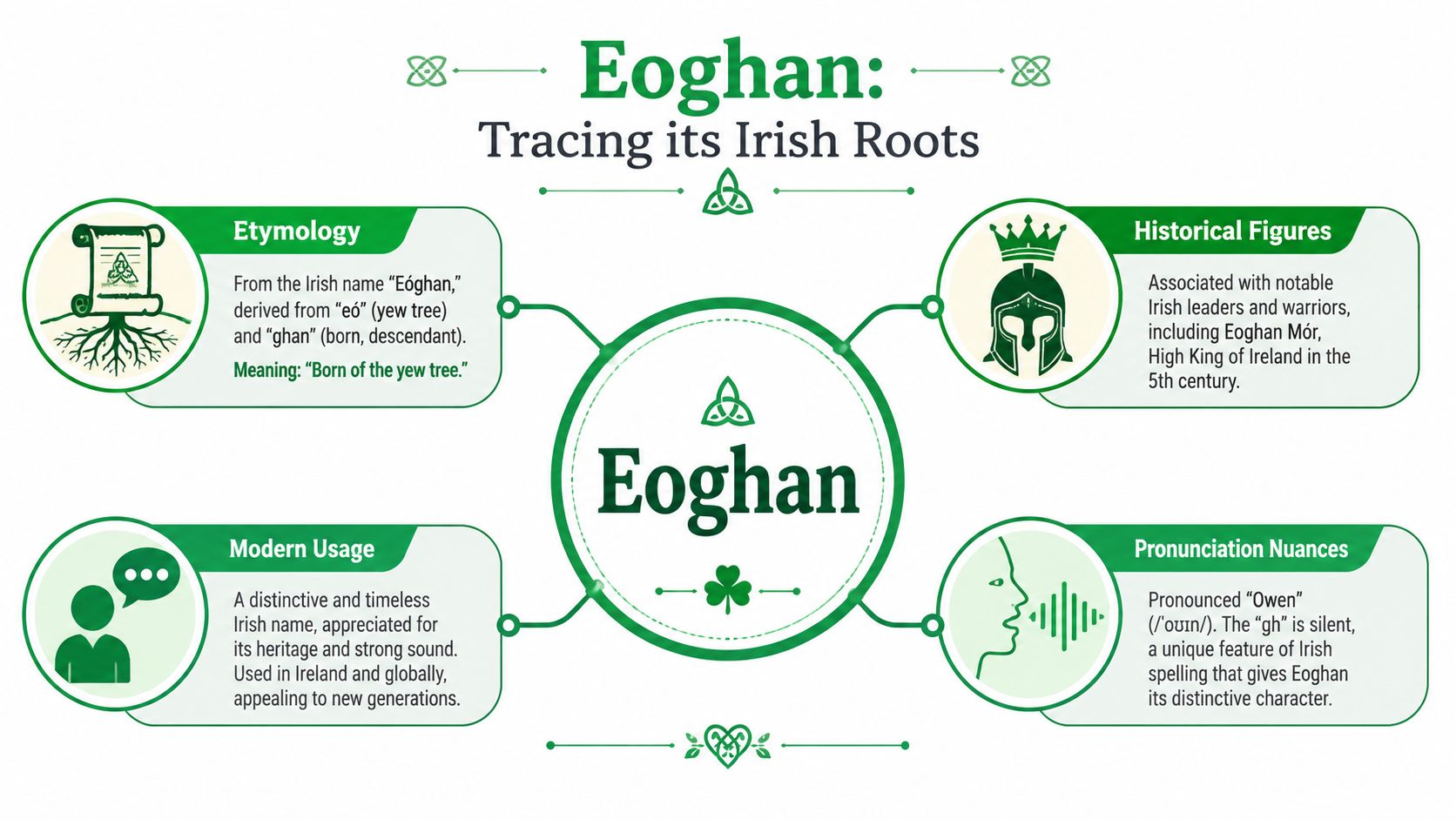
The biggest mistake most name guides make is treating Owen and Eoghan as if one is a tidy spelling update of the other. That flattens two different naming traditions into one. The result is confusion about family heritage, pronunciation, and meaning.
Why the confusion keeps happening
A lot of modern readers meet the name through English first, so they assume the English form tells the full story. But the Owen name entry on Wikipedia) notes a key problem in current content: 68% of modern parents choose Owen for perceived Irish roots, even though historical usage shows it is primarily an anglicized form of the Welsh Owain.
That explains why so many people ask the same question. They aren't being careless. They're responding to a real gap in popular naming guides.
Many families inherit a name through English and only later discover that the Gaelic form behind their cultural identity is a different word entirely.
What makes Eoghan distinctly Irish
Eoghan has its own Irish history, not just an “Irish-sounding” spelling. Linguistic analysis identifies it as deriving from Old Irish Éoghan, and it is etymologically distinct from Welsh Owain. Its meanings are given as “youth” or “born of the yew tree.” That second meaning gives the name a very Irish texture, because trees, the natural environment, and lineage are firmly embedded in Gaelic tradition.
The name also carries a strong northern resonance through Tír Eoghain, the Irish name behind County Tyrone. Even if you first arrived here searching for a baby name, that place connection matters. Irish names often live in story, territory, and family memory all at once.
A few details make Eoghan stand out:
- Its language home is Irish: This is the form that belongs inside Irish spelling and sound patterns.
- Its meaning is rooted in Gaelic tradition: “Youth” and “born of the yew tree” both feel older and more layered than the flattened meanings you often see on naming sites.
- Its history reaches into place names: Tír Eoghain preserves the name in the physical environment itself.
If you're looking for the true Irish for Owen, this is the point to hold onto. Owen may be the familiar English name, but Eoghan is the authentic Irish one.
How to Pronounce Eoghan Like a Native Speaker
Spelling is where many learners freeze. Eoghan looks intimidating if you're used to English, but the sound is much friendlier than the spelling suggests.
Start with the core sound
The standard Irish pronunciation is given as /oːn̪ˠ/ in this pronunciation discussion of Eoghan. If that notation looks unfamiliar, don't worry. The easiest beginner approach is this:
- Start with a long “oh” sound.
- Move straight into an n sound.
- Keep it smooth. Don't force a strong English w in the middle.
For many English speakers, that lands somewhere near “O-in” or a very light “Owen” without the heavy glide.
Regional pronunciation in the north
Irish isn't one flat accent. In Northern Irish dialects, including County Tyrone, Eoghan is often heard as “o-in” or “owe-en” in a way that reflects the historical link to Tír Eoghain. So if you hear more than one version, that doesn't mean one speaker is wrong. It means the language is alive in different regions.
That's one of the lovely things about Irish names. A name can carry geography in its sound.
Here's a simple listening guide:
- Standard benchmark: think long oh plus n
- Northern flavour: you may hear o-in
- English habit: many speakers shift toward Owen, especially outside Irish-speaking settings
If you want a deeper ear for the sound patterns behind names like Eoghan, this guide to what makes Irish sound unique is worth reading.
Say it slowly first. Irish pronunciation gets easier when you stop trying to force English spelling rules onto Irish words.
It helps to hear the name spoken in real time before trying it aloud yourself:
A good first practice line is: Is mise Eoghan. That means “I am Eoghan.” Even if you're not named Eoghan yourself, it gives you a natural rhythm to rehearse.
Using Eoghan in a Sentence Irish Grammar Basics
Once you move from name meaning to actual Irish, a useful shift happens. Eoghan stops being a label and starts behaving like a word inside the grammar. That's where Irish gets fun.
The linguistic analysis linked above gives two pronunciation benchmarks for the name, /oːnʲ/ in Southern or Central speech and /oːn̪ˠ/ in Northern speech, and it also notes that Eoghan is treated as a masculine noun in Irish. That matters because names can change form depending on how you use them in a sentence.
How names change in Irish
Two forms are especially useful for beginners.
First, there's the vocative, used when you're directly addressing someone. In Irish, you often place a before the name and may adjust the form. With Eoghan, you'll commonly see a Eoghain.
Second, there's the genitive, used to show possession. If you want to say “Eoghan's book,” you can say leabhar Eoghain.
Small grammar habit: In Irish, names often change shape when the sentence changes shape.
Grammatical Forms of Eoghan
| Case | Irish Form | Example Sentence (Irish) | Example Sentence (English) |
|---|---|---|---|
| Nominative | Eoghan | Tá Eoghan anseo. | Eoghan is here. |
| Vocative | a Eoghain | A Eoghain, tar anseo. | Eoghan, come here. |
| Genitive | Eoghain | Seo leabhar Eoghain. | This is Eoghan's book. |
A few beginner notes help:
- Nominative: This is the basic dictionary form. It's the one you use when naming the person.
- Vocative: You'll hear this in speech more than beginners expect, especially in family settings.
- Genitive: This appears often in ordinary possession, family names, and set phrases.
If you want more confidence with possession patterns like leabhar Eoghain, this explainer on how to use the genitive case in Irish makes the pattern much easier to spot.
Try these aloud:
- Tá Eoghan ag teacht.
- A Eoghain, cá bhfuil tú?
- Sin cara Eoghain.
You don't need to master all Irish grammar at once. Learning one name well can teach you more than memorising a page of abstract rules.
Practice Your Pronunciation and Conversation with AI
The hardest part of learning Irish usually isn't reading about a name. It's saying it out loud with confidence, then hearing whether it sounds natural.
Why Irish learners need spoken feedback
Irish learners often practice alone. That creates a problem with names like Eoghan, where a tiny sound change can make you sound more English than Irish. According to this report on Irish-learning technology, advanced speech recognition technology that provides real-time feedback on pronunciation is essential for Irish language learning platforms because it helps remote learners who don't have easy access to native speakers.
That makes sense. Reading phonetics helps. Listening helps more. But speaking and getting feedback is what turns recognition into skill.
If you like low-friction speaking tools in general, resources about secure AI chat without signups can also be useful when you want a private, simple way to experiment with language prompts and practice habits.
A simple practice routine
Try a short loop rather than a long study session:
- Say the name alone: Eoghan.
- Use it in one sentence: Tá Eoghan anseo.
- Call to the person: A Eoghain.
- Repeat after audio: Match rhythm before you worry about perfection.
Keep it light. Names are one of the best entry points into Irish because they connect sound, grammar, and identity all at once.
Embracing Your Connection to an Authentic Irish Name
By now, the key distinction should feel much cleaner. Owen belongs mainly to the Welsh line through Owain, while Eoghan is the authentic Irish equivalent with its own Gaelic meaning, history, and sound.
That difference isn't just academic. It changes how you understand your own heritage, how you introduce a child's name, and how you hear Irish on its own terms. Eoghan carries more than a translation. It carries a sense of youth, the image of the yew tree, and a living connection to Irish speech and place.
If you came here searching for “Irish for Owen,” you weren't just looking for a spelling. You were probably looking for something that felt true. In Irish, truth often lives in the details. A letter changes. A sound softens. A familiar English name opens into a much older Gaelic one.
And that's a good way into the language itself. You don't need to begin with a full grammar course. You can begin with one name, one sound, one phrase spoken carefully.
If you want to keep going from names into real spoken Irish, Gaeilgeoir AI is a practical place to start. It's built to help learners speak from day one with guided conversations, pronunciation support, and everyday Irish you can use.