I first heard Aithne when a learner pointed to it in a list of Irish names and asked, “Is this said the way it’s spelled?” We both laughed, because with Irish, that question is often the doorway into something much richer than pronunciation.
Table of Contents
- Discovering the Beauty of an Irish Word
- The Meaning and Myth Behind Aithne
- How to Pronounce Aithne Correctly
- Understanding the Grammar of Aithne
- Aithne in Everyday Irish Sentences
- Tips to Practice and Remember Aithne
- Bring Your Irish Learning to Life
Discovering the Beauty of an Irish Word
Some Irish words catch your attention because they look unfamiliar. Others stay with you because they seem to hold a whole world inside them. Aithne does both.
A beginner often meets a word like this in a poem, a song title, a baby-name list, or a myth retold online. At first glance, it can feel slippery. Is it a name? A vocabulary word? Something from folklore? The honest answer is that confusion is normal, because Irish carries sound, grammar, and cultural memory very closely together.
Aithne is a good example of why Irish words are often easier to understand in context rather than through a single English translation. Its meaning can shift depending on how it is used in a phrase or sentence. If you’re building your Gaeilge word by word, explore our Irish vocabulary guide for more useful words, meanings and vocabulary-building strategies.
Why this word feels different
English speakers are used to seeing letters map fairly directly onto sound. Irish doesn’t always do that in a way that feels obvious at first. So when learners see Aithne, they often pause at the middle consonants and the ending. That pause is useful. It means you’ve noticed that Irish asks you to listen differently.
There’s another layer too. Some words are easy to translate but hard to feel. Aithne isn’t one of them. It carries ideas connected with recognition, acquaintance, and knowing. It also appears in mythic and name traditions, which gives it a second life beyond everyday vocabulary.
Irish gets easier when you stop treating words as isolated labels and start meeting them as parts of stories.
That’s why this word is such a rewarding one for learners. It invites you to do three things at once:
- Hear it as spoken Irish, not as English spelling.
- Understand it as a meaningful word connected to knowing.
- Remember it through myth, image, and conversation.
A small word with a long echo
Many learners want a quick definition and move on. But with Aithne, the more helpful approach is slower. If you take time with it, you begin to see how one word can connect language, literature, and worldview.
That’s where Irish becomes exciting for beginners. You’re not just memorizing vocabulary. You’re learning how a culture stores meaning inside sound.
The Meaning and Myth Behind Aithne
A learner often meets Aithne the way you might meet a character in an old story. First you hear the name. Then you ask what it means. Then, a page or two later, you realize the answer is not just one neat English word.
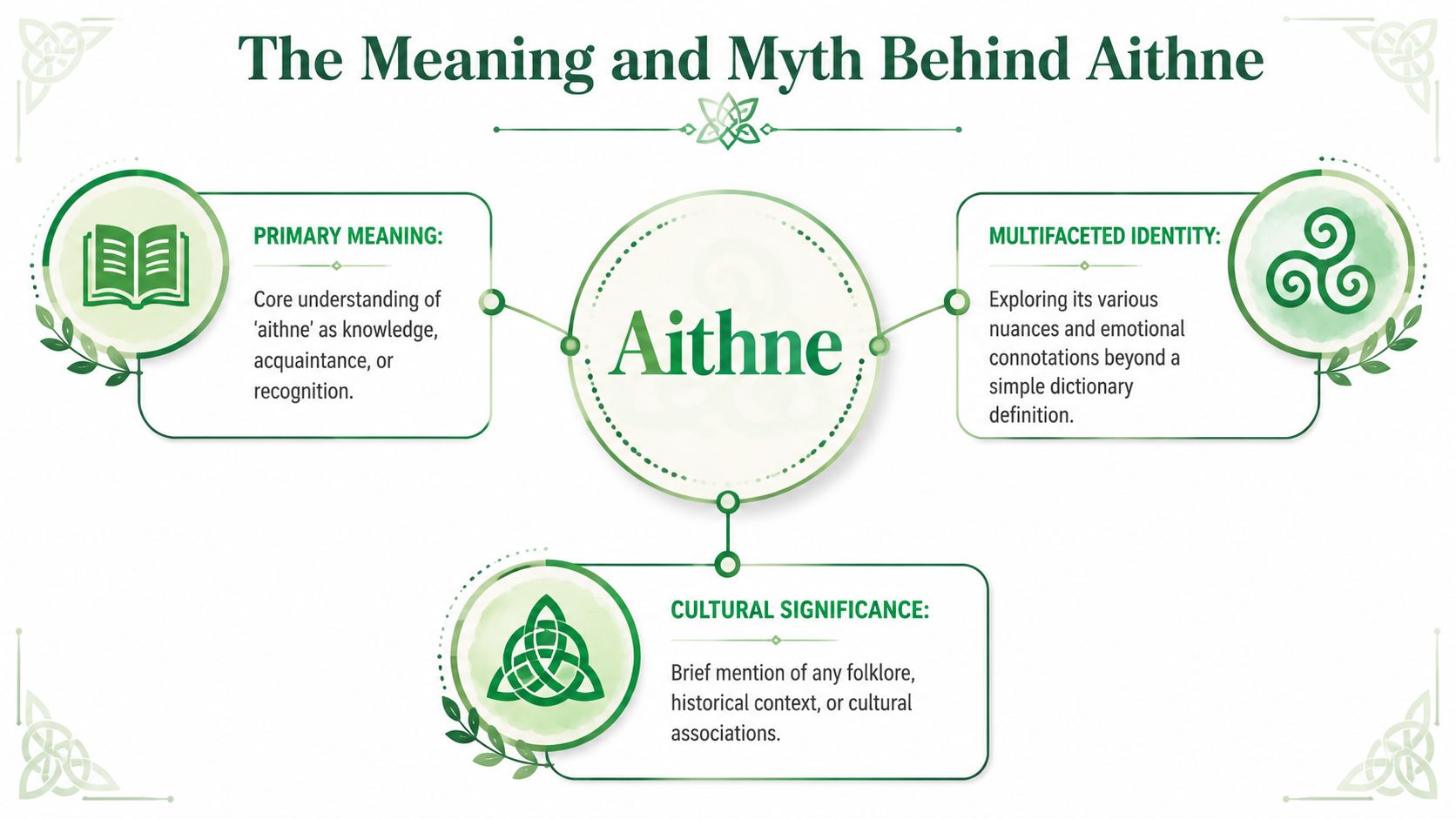
Aithne is usually explained through ideas of knowing, recognition, or acquaintance. Some name traditions also connect it with fire or brightness. That can feel messy at first, especially if you are used to vocabulary lists where one word equals one definition. Irish does not always work that way. Names and old words often carry a small cluster of meanings, and that cluster is part of what makes them memorable. A short guide to Irish spelling and sound patterns also helps explain why a name like this can hold history, sound, and meaning so tightly together.
A meaning you can actually remember
For a beginner, the easiest way to hold Aithne in your mind is this. It belongs to a family of ideas around knowing someone, recognizing something, and carrying a kind of inner brightness.
Those ideas are not identical. They sit beside each other, the way colors blend at sunset. One shade suggests familiarity. Another suggests light, heat, or presence. Together they give the name its depth.
That matters for language learning. If you remember only a dictionary gloss, the word may slip away. If you connect it with a vivid image, such as a spark of recognition or a bright moment of knowing, it tends to stay.
More than a name in a baby list
Modern name sites sometimes present Aithne as a feminine Irish name and note that it can be linked, or confused, with Eithne, which carries its own set of meanings and traditions, as discussed in this overview of the name Aithne. For learners, the useful lesson is not to flatten those forms into one thing too quickly.
Irish names often travel through spelling variation, regional habit, and long manuscript histories. So if you see slightly different meanings attached to Aithne, that does not always mean one source is wrong and another is right. Sometimes it means you are looking at several layers of tradition at once.
Aithne in mythic tradition
The mythological side makes the name even more interesting. Some traditions place Aithne in a royal and symbolic setting, including accounts that describe her as a daughter of King Fachu of Ulster and link her with wisdom and noble lineage, as noted in this entry on the name Aithne.
You may also run into a nearby strand involving Áine, a much better-known figure associated with summer, fertility, wealth, sovereignty, and brightness in Irish tradition. Irish Pagan School’s account of Áine gives a clear overview of that tradition. A beginner can easily assume Aithne and Áine are the same figure in every context. The safer approach is more careful. Treat them as related mythic territory, not as automatic one-to-one matches.
That distinction helps. It keeps the mythology exciting without turning it into a blur.
Why this myth matters to a learner
Irish mythology is useful here because it gives you a memory hook. Aithne is easier to retain when it feels like part of a living web of ideas. Knowledge. Light. Royal lineage. Seasonal power. Presence.
That web also reflects something important about Irish as a language. Words are often easier to learn when you meet them in culture, not in isolation. Aithne is a strong example because it can live in several worlds at once. It can be a name, a piece of tradition, and a cue for a core meaning tied to knowing.
If you are learning Irish for real conversation, that is good news. You are not memorizing a museum label. You are building associations that help the word stay with you when you hear it, say it, or meet it again in a story.
How to Pronounce Aithne Correctly
Pronunciation is where many learners tense up. The spelling looks dense if you’re coming from English, but Aithne becomes much easier once you stop trying to sound out every letter.
A simple learner-friendly approximation
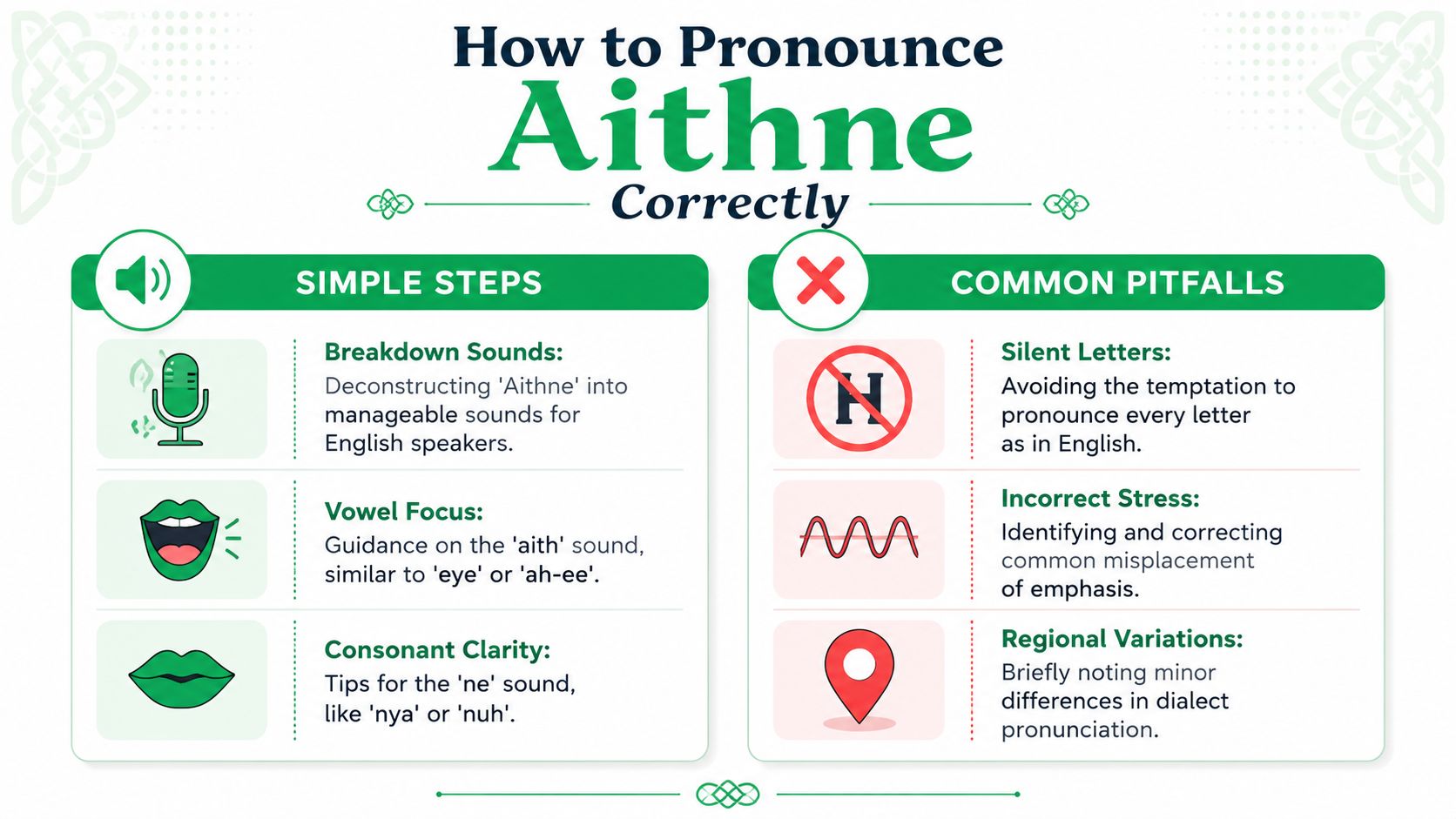
For an English speaker, a useful first approximation is “AHN-ya” or “AHN-yuh.” You may also hear slightly different local or personal realizations. That’s normal in Irish names.
What matters at the beginner stage is that you don’t read it like English. The th here is not the English sound in think or this. And the final part doesn’t sound like a hard English “nee.”
If Irish spelling still feels mysterious, a guide to the Irish alphabet and sound patterns helps make names like this much less intimidating.
Break it into two parts
Try it in steps.
- Start with Aith as a broad opening sound. For many learners, aiming for “ahn” works better than overthinking the letters.
- Add the ending as a soft “ya” or “yuh.”
- Put them together without stressing the second part too hard: AHN-ya.
Say it slowly first. Then say it as if you were introducing someone: “Seo Aithne.” The rhythm of a phrase often helps more than repeating the name alone.
Here’s a quick audio aid you can use:
Common mistakes beginners make
A few errors show up again and again:
- Reading every letter in English: This usually produces something like “Ayth-nee,” which doesn’t sound natural in Irish.
- Overpronouncing the th: In Irish names, familiar letter groups often behave differently from English expectations.
- Making the ending too sharp: Keep the final sound light and flowing.
Say the word as a shape, not as a spelling puzzle.
One last tip. Don’t wait until you feel certain before saying it aloud. Irish pronunciation becomes clearer through repetition. A good first version spoken confidently is better than a perfect version you never attempt.
Understanding the Grammar of Aithne
A learner often meets aithne in two different worlds at once. In stories and names, it feels old and poetic. In everyday Irish, it becomes wonderfully practical, because it helps you say whether you know someone or are familiar with something.
That double life can feel confusing at first. It also makes the word memorable.
In grammar terms, aithne is a feminine noun. You will commonly see it in phrases about acquaintance, recognition, or familiarity, and you may also meet Aithne as a proper name in literary or mythological settings, as noted earlier.
What to notice first
Irish often shows meaning through relationships between words, not only through word order. English usually leans on position. Irish also uses cases, prepositions, and sound changes to show who belongs to what, who is connected to whom, and what role a word is playing.
One early pattern that helps here is the genitive case, or an tuiseal ginideach. This is the form often used for “of,” as in “the story of Aithne.”
Sound changes matter too. If terms like lenition and eclipsis still feel slippery, this guide to urú and séimhiú rules in Irish explains the patterns clearly.
A simple declension table
With Aithne, the encouraging news is that the spelling often stays the same across cases. The grammar is still there. You just learn to read it from the surrounding words, a bit like recognizing a person by the company they keep.
| Case | Form | Example Phrase (Irish) | Example Translation |
|---|---|---|---|
| Nominative | Aithne | Tá Aithne sa scéal. | Aithne is in the story. |
| Genitive | Aithne | scéal Aithne | the story of Aithne |
| Dative | Aithne | le hAithne | with Aithne |
| Vocative | Aithne | A Aithne | O Aithne |
How to read these forms without panic
The table looks tidy because Aithne does not show a dramatic ending change here. That is good news for a beginner. Instead of memorizing several new spellings, you can focus on the job the word is doing in the phrase.
A few examples make that clearer:
- Scéal Aithne means “the story of Aithne.”
- Solas Aithne means “the light of Aithne.”
- Le hAithne means “with Aithne.”
Notice what is carrying the grammar. In scéal Aithne, the noun relationship tells you “story of Aithne.” In le hAithne, the preposition le triggers the form you hear after it. So the grammar does not disappear. It sits around the word, not always inside the word itself.
That is a useful lesson for modern Irish learning in general. Many beginners expect every grammar point to show up as a big spelling change. Irish often proceeds less overtly than that. Once you start spotting phrase patterns, words like aithne become much easier to recognize, use, and remember in real conversation.
Aithne in Everyday Irish Sentences
A word starts to stick when you meet it in living language. So let's move Aithne out of the dictionary and into sentences that sound like something a learner might say.
In everyday Irish, aithne often appears in the sense of acquaintance, familiarity, or knowing someone. This is one of the most practical ways to remember it, because it connects directly to real conversations.

Useful sentence patterns
Here are some beginner-friendly examples:
-
Tá aithne agam air.
I know him. -
Tá aithne agam uirthi.
I know her. -
An bhfuil aithne agat air?
Do you know him? -
An bhfuil aithne agat uirthi?
Do you know her? -
Níl aithne mhaith agam air fós.
I don't know him well yet.
These are excellent early phrases because they're social and flexible. You can use them when talking about family, classmates, neighbors, or people in a story.
Aithne as a name
When Aithne is a person's name, the feeling changes slightly. Then you're using it like any proper name in Irish.
For example:
| Irish sentence | English translation | Context |
|---|---|---|
| Is ainm álainn é Aithne. | Aithne is a beautiful name. | Talking about names |
| Chuala mé scéal faoi Aithne. | I heard a story about Aithne. | Myth or literature |
| Bhí Aithne luaite sa rang. | Aithne was mentioned in class. | Learning context |
Notice the difference. In the first group, aithne means knowing or acquaintance. In the second, Aithne is a name. Irish often asks you to let context guide you.
A short dialogue you can borrow
Try this tiny exchange:
A: An bhfuil aithne agat uirthi?
B: Tá beagán aithne agam uirthi. Chonaic mé í an tseachtain seo caite.
In English:
A: Do you know her?
B: I know her a little. I saw her last week.
That kind of exchange helps the word settle into your active vocabulary. It’s no longer an abstract cultural term. It becomes something you can use at a café, in class, or while talking about people you’ve met.
The more often you place Aithne inside whole sentences, the less likely you are to freeze when you meet it again.
Tips to Practice and Remember Aithne
Many Irish-language learners struggle to connect mythological names like Aithne with real-world pronunciation and usage. When learning materials treat names as static vocabulary instead of putting them into conversational settings, learners can lose interest, as noted in this discussion of mythology and learner engagement.
That’s why memory work matters. You don’t just want to recognize Aithne on a page. You want to hear it, say it, and recall it when you need it.
Build a memory hook that has meaning
Simple memorization works better when the word has a strong image attached to it. For Aithne, you already have several memory anchors:
- Knowledge: connect it with knowing someone.
- Brightness: connect it with light, summer, or glow.
- Story: connect it with Irish myth and old tales.
Write those three words on a card, then put Aithne in the center. That turns the word into a small map rather than a loose fact.
If you like structured review, this guide to spaced repetition for language learning can help you turn one memorable word into long-term recall.
Use short active exercises
Passive rereading doesn’t do much. These simple tasks work better:
- Say An bhfuil aithne agat uirthi? out loud three times.
- Write one sentence where aithne means acquaintance.
- Write one sentence where Aithne is a mythological name.
- Record yourself saying the name and compare it with a model pronunciation.
- Retell the meaning in plain English without checking your notes.
Each task trains a different skill. Speaking, writing, listening, and recall support one another.
Create one personal connection
This is the part learners often skip. Make the word belong to your own life.
You might say:
- “I’ll remember Aithne as the word that reminds me of knowing and brightness.”
- “I connect Aithne with summer fields and old Irish stories.”
- “I use aithne when I talk about whether I know someone.”
A word becomes easier to remember when it stops feeling borrowed.
You don’t need a big study session for this. A few focused minutes, repeated over several days, usually work better than one long cram. If you can say the word, explain its meaning, and use it in two natural sentences, it’s already becoming part of your Irish.
Bring Your Irish Learning to Life
A word like Aithne can start on the page and stay there. Or it can begin to live in your mouth, your memory, and your conversations.
That shift matters in Irish. Words are easier to keep when they come with more than a translation. Aithne gives you a sound pattern to practise, a grammar structure to notice, and a thread that leads back into Irish story and tradition. It works a bit like a meeting point where language and culture greet each other.
Keep the word active
The next step is to keep Aithne in motion. Say it aloud when you review. Use it in a real question. Notice it when a mythological reference appears. Each small encounter tells your brain, “keep this one.”
That is how Irish stops feeling like a set of notes and starts feeling like a language you can use.
Many learners run into the same problem at this stage. They understand a word when they read it, but speaking it in the moment feels slower and less certain. AI tools can help with practice, though general platforms are often uneven with Irish and may produce awkward grammar or overly confident translations.
To address that gap, Gaeilgeoir AI offers an interactive platform with a friendly AI conversation partner for spoken Irish practice, designed for beginner to intermediate learners, according to Gaeilgeoir AI’s company overview.
Guided dialogue is useful for this purpose. It gives you a place to try sentences, hear patterns again, and make mistakes without pressure. If you want to turn recognition into real spoken confidence, try Gaeilgeoir AI for guided Irish conversation practice, then explore the full learning experience at Learn Gaeilgeoir AI.
Build Your Irish Vocabulary
Learning words like aithne in context helps you understand not only what they mean, but how Irish actually uses them. Continue with our Irish vocabulary guide to discover more useful Gaeilge words and build a stronger everyday vocabulary.