You've probably done this already. You typed your surname into a search bar, found three different Irish spellings, and closed the tab more confused than when you started. One site says Kelly is Ceallaigh. Another says Kelley. A third gives no Irish form at all. If your first name is John, matters get even messier. Are you Seán, Eoin, or something else entirely?
That confusion isn't your fault. A lot of advice about English to Irish names gives you a quick list but skips the part that matters most. It doesn't tell you why the forms changed, which version is historical, and which spellings were shaped by English record-keeping rather than Irish usage. Few resources address the question of why common English spellings of Irish names such as Shannon and Sionann can be phonetically misleading or historically inaccurate because of transcription errors by English speakers with no Irish knowledge, or how to work backward toward the original Irish form through the Anglicization Error Gap discussion.
Names carry grammar, family history, and sometimes a small record of colonisation and recovery. When someone discovers that Sullivan points back to Ó Súilleabháin, or that Kelly reflects Ó Ceallaigh, they're not just finding a translation. They're uncovering an older naming world.
Table of Contents
- From English Name to Irish Soul
- The History Behind Your Irish Name
- The Core Principles of Gaelicising Names
- Understanding Surnames and Patronymics
- A Quick Guide to Irish Pronunciation
- The Big List of English to Irish Names
- How to Choose and Use Your Irish Name
- Frequently Asked Questions About Irish Names
From English Name to Irish Soul
A man named Sullivan finds Ó Súilleabháin and suddenly the name stops feeling flat. It has shape. It has rhythm. It sounds like it belongs to a language with its own rules instead of looking like a neat English label in a register. The same happens when a Kelly meets Ó Ceallaigh for the first time. You don't just see a different spelling. You feel a line stretching backward.
That emotional jolt matters because names were often flattened for convenience. English clerks wrote what they heard. Families adapted to administration, school, church records, migration, and social pressure. Over time, many people inherited an English surface form without the tools to recover the Irish one underneath.
Practical rule: An English-looking Irish name often isn't a translation at all. It's usually an anglicised echo of an older Irish form.
That's why quick lists can mislead. They often treat names as if every English form maps neatly onto one Irish equivalent. Real usage is messier. One English form may point to several Irish roots, and one Irish name may produce several English spellings. If you're trying to reconnect with heritage, that difference matters.
A better approach starts with three questions:
- What was the older Irish form behind the surname or given name?
- Was the English form phonetic, meaning someone wrote down what they thought they heard?
- Is the Irish version historical or modern, especially with first names?
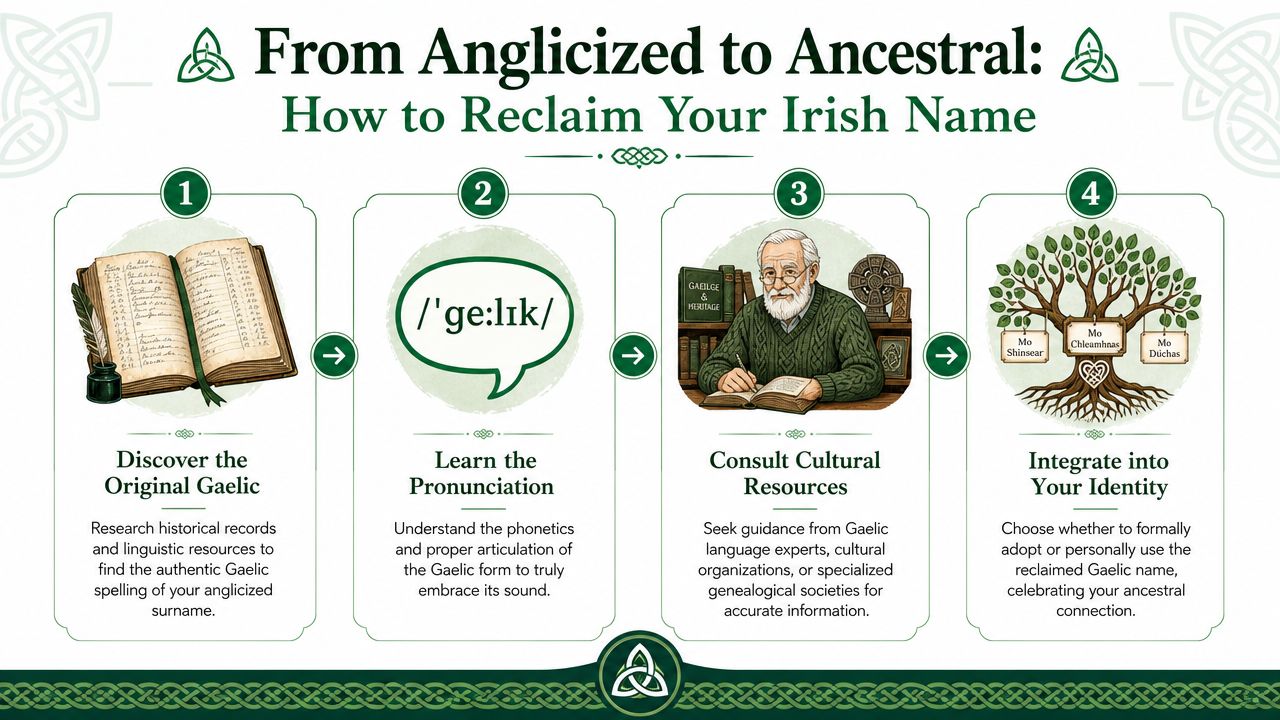
You don't need fluent Irish to begin answering those questions. You need patience, a feel for patterns, and a willingness to let the Irish form lead. That's where English to Irish names become more than a lookup exercise. They become a way back into language, family memory, and place.
The History Behind Your Irish Name
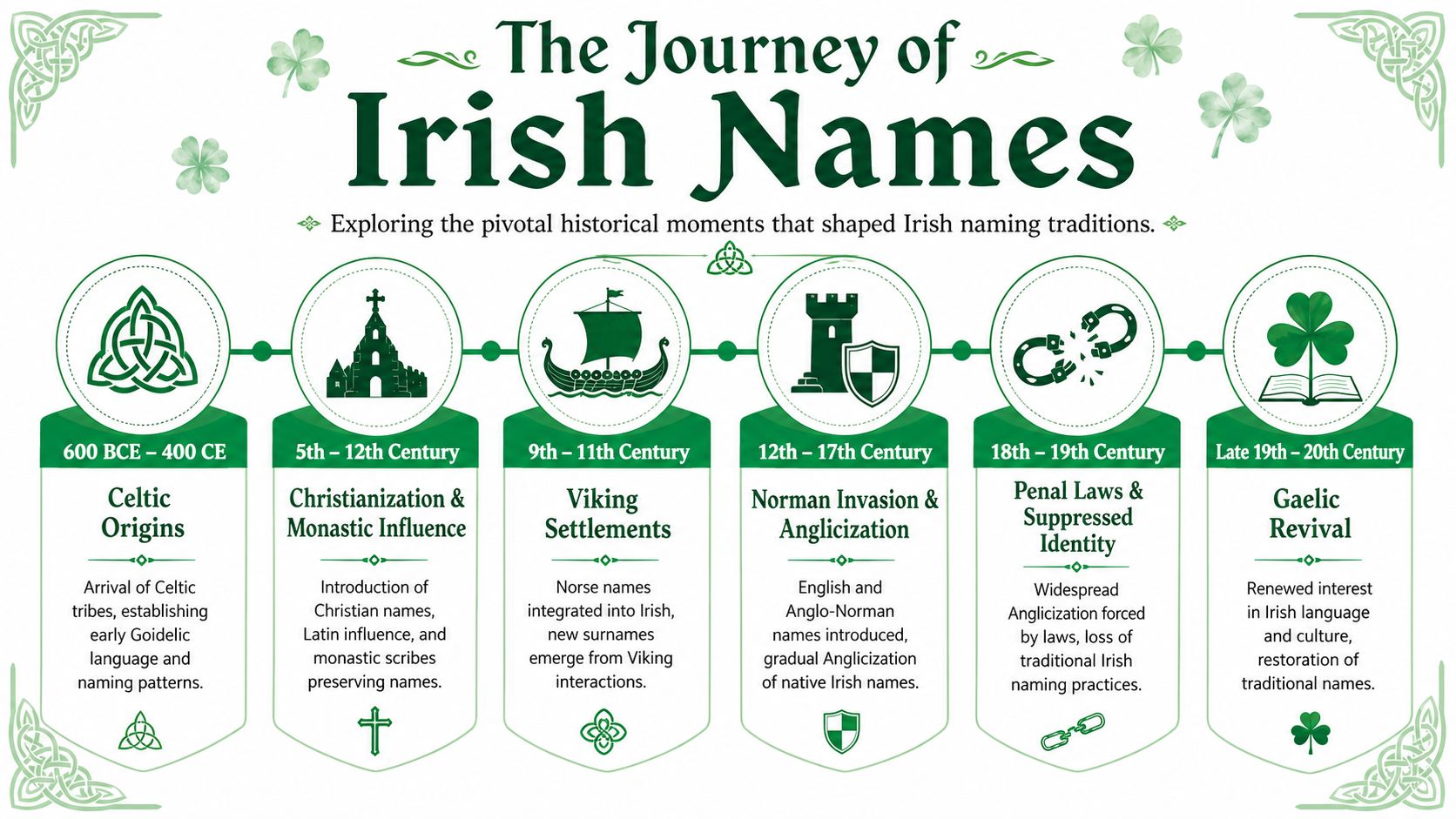
Irish names didn't become English by accident. Power shaped them. Law shaped them. Administration shaped them. Once you know that, the odd jumps between English and Irish spellings stop looking random.
A name can change without losing its root
In 1462, King Edward IV of England enacted a Penal Law declaring that Irish people must adopt English surnames, a mandate tied directly to anglicisation and still echoed in later legal efforts to restore Irish forms through a historical note on the 1462 law. Once names entered English-controlled systems, many lost visible Irish markers such as Ó and Mac, or had those markers altered, dropped, or inconsistently restored.
The result wasn't pure translation. It was often morphological change. The Gaois surname database shows that Irish surnames are grouped into bilingual clusters linking Irish forms with English counterparts, and that approximately 90% of the Top 10 most common Irish surnames have documented Irish-English clusters in data integrated from the CSO. The same resource maps examples such as Ó Súilleabháin to Stephen or Sullivan, and Mac Dónaill to Donald or McDonald, showing how anglicisation followed structured genealogical patterns rather than guesswork in the Gaois surname information database.
That matters for heritage learners because it means your English surname often still preserves the Irish root, even if the route is crooked.
The revival didn't invent Irish names
The return of Irish forms in public life didn't come from nowhere. It was a recovery. Historical records tied to the Census of Ireland show a striking shift in which a given name recorded in English in the 1901 Census often appeared in Irish or an alternative Gaelic spelling in the 1911 Census, reflecting a cultural turn within a single decade. Material compiled into the dúchas.ie Irish Surname Index also documents over 1,000 distinct surname variations linking English forms such as Ahearn and Atkins to Gaelic origins such as Ó hEachairn and Mac Aidicín in a summary of surname variation evidence.
A family name on paper can tell two histories at once. One is the history of the family. The other is the history of who was allowed to write it down.
By the late nineteenth and early twentieth centuries, many families were reclaiming Irish spellings as part of a broader cultural revival. That doesn't mean every restored form was perfect or uniform. It means people were trying to bring names back into the language that had shaped them first.
The Core Principles of Gaelicising Names
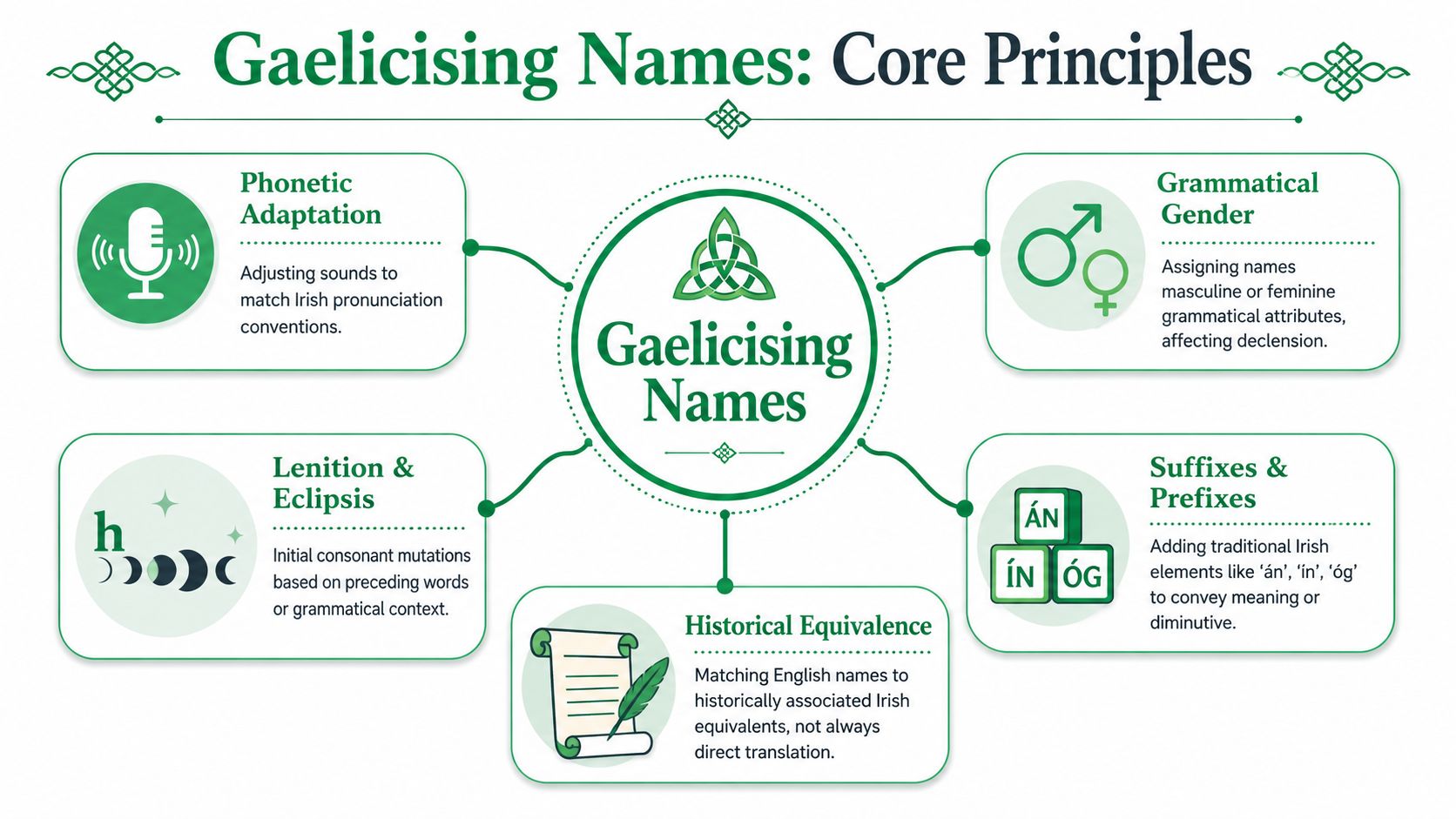
Finding an Irish form isn't just about swapping letters. Irish names follow sound patterns and grammar. If you miss those, the result may look Irish without behaving like Irish.
Sound comes before spelling
Irish spelling is rule-governed, but the rules aren't English ones. That's why two names can look far apart on the page while sounding close enough to reveal a historical link. In many cases, an English form is a rough attempt to capture an Irish sound.
A few pronunciation guides help at once. The verified guidance on Irish given names notes these vowel patterns:
- Ao is pronounced like the e in “tree”
- Ai is pronounced like ah in “mat”
- Io is pronounced like ih in “mist”
Those aren't full pronunciation lessons, but they show why English spellings often fail to preserve the original shape of a name. The same source also notes that there's no universal standard for translating English names into Irish, and that many English names are not technically translatable, with some modern equivalents being constructed rather than inherited in the discussion of Irish and English name forms.
Mutation changes the shape of a name
Irish uses initial mutations. These are grammar-driven changes at the beginning of a word. The most common one learners notice in names is lenition, called séimhiú. In writing, it often adds an h after the first consonant.
You'll see patterns like these:
- B can become Bh
- C can become Ch
- M can become Mh
- S can become Sh in some phonetic environments
That doesn't mean you insert an h wherever you like. Mutation depends on grammar, surrounding words, and naming structure.
Name lesson: If two forms of a surname differ by a single added h, they may still be the same family name in different grammatical contexts.
Eclipsis, or urú, is another mutation where a consonant is covered by another consonant sound at the front. It appears less often in the basic forms learners first meet with names, but it belongs to the same system. Irish doesn't treat the first letter of a name as fixed in every context.
The genitive case matters in family naming
Irish also changes words for grammatical case. One case you'll meet in names is the genitive, often used to show relationship. In older patronymic naming, a person could be identified through the father's name in the genitive form. That's one reason direct word-for-word conversion from English can miss the mark.
Here's the simplest working method for English to Irish names:
- Find the historical root first. Don't start by respelling the English version.
- Check whether the Irish form is inherited or modern. Some are ancient. Some are recent adaptations.
- Watch for mutation and case. The surname you use after a prefix may not stay in its base form.
A name in Irish is part vocabulary, part grammar, and part memory. You need all three to make sense of it.
Understanding Surnames and Patronymics
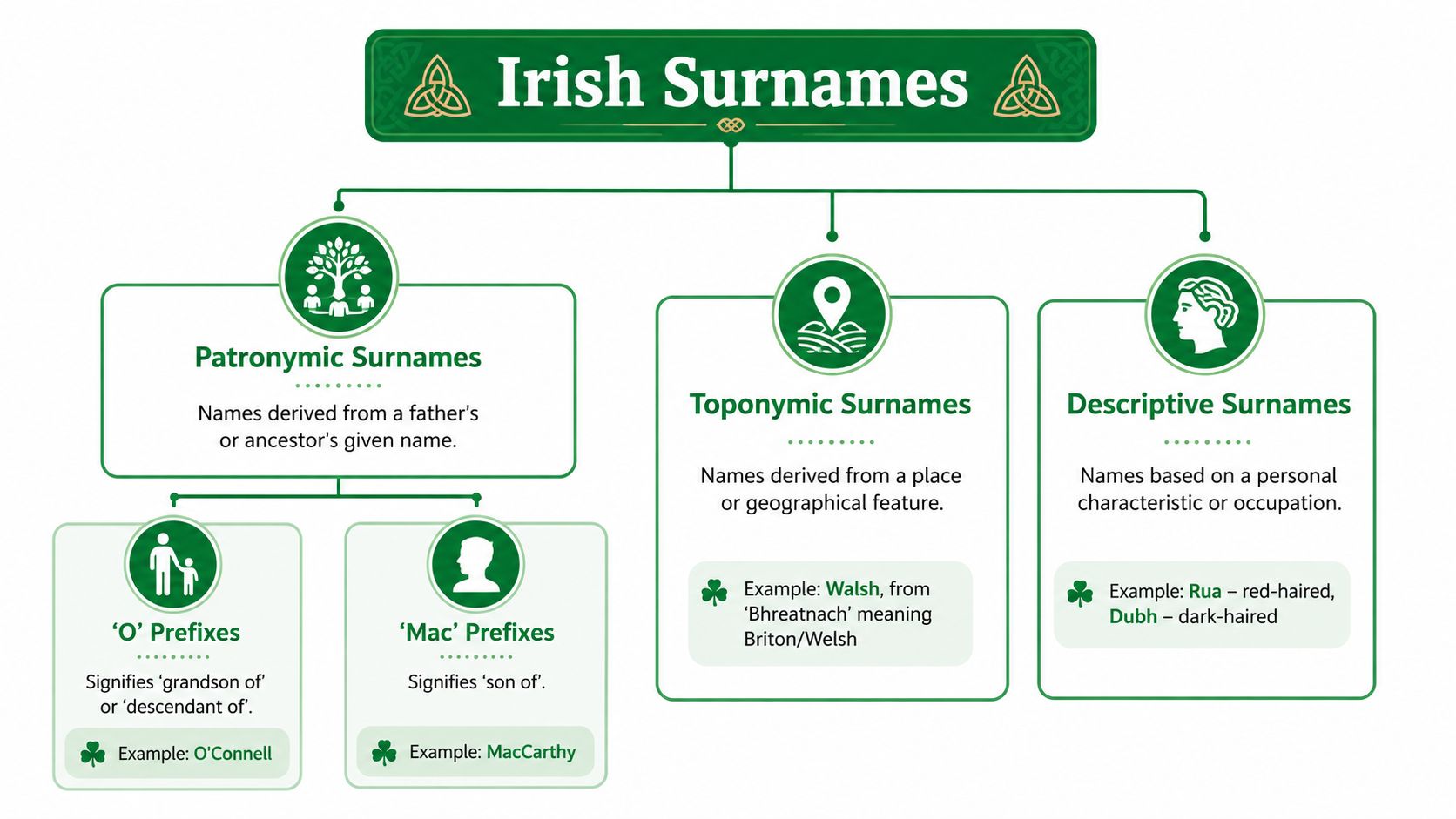
Irish surnames make more sense when you stop treating them like frozen labels. Traditionally, many of them described descent. They told listeners whose line you belonged to.
What Ó and Mac actually tell you
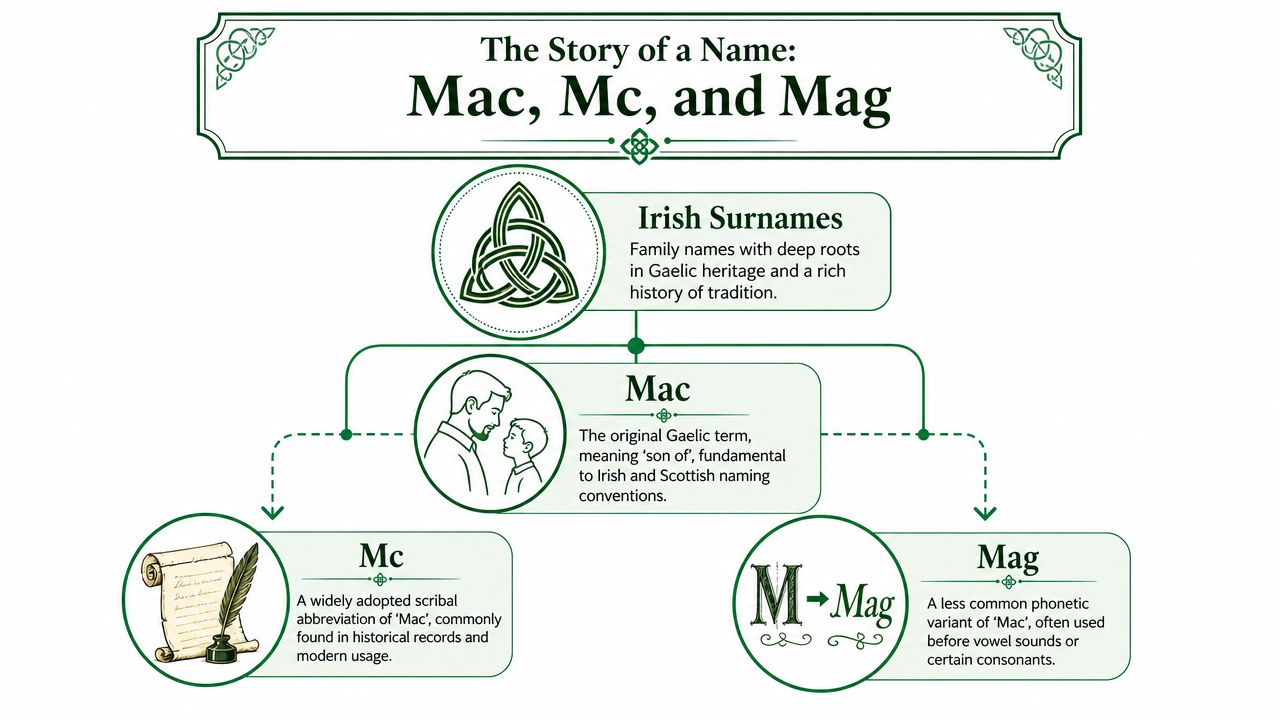
In Irish surname formation, Ó means “grandson of” or “descendant of,” while Mac means “son of.” That's the backbone of many well-known surnames. These prefixes aren't decorative. They carry genealogy.
In Gaeltacht naming customs, the older pattern often followed [first name] + [father's name in the genitive case] rather than relying consistently on fixed hereditary surnames with Ó or Mac. Historical English law also temporarily forbade the use of O' and Mac, allowing only Fitz, which added further instability to naming records in the FamilySearch guide to Ireland naming customs.
Some practical consequences follow:
- Dropped prefixes abroad often hide Irish roots. A family that appears as Kelly or Sullivan in one generation may connect to a longer Irish form.
- Restored prefixes aren't always straightforward. Families sometimes re-added them later, and not always consistently.
- Patronymic logic still helps even when the paper trail is messy.
Why women's surname forms differ
This is one of the places learners get stuck, and fairly so. A man and his sister may not use identical Irish surname forms.
Verified usage rules note that males use Ó with no lenition if the first letter is a consonant, while females use Ní, and Ní requires lenition if the following surname begins with a consonant but remains unchanged before a vowel in the Daltaí discussion of surname mechanics.
So the structure changes with gender. The name is still recognisably connected, but its form shifts because Irish grammar is doing real work.
If a woman's Irish surname looks different from her father's, that doesn't mean one of them is wrong. It usually means the grammar is alive.
A note on living surname research
Surname recovery often works best when you compare family usage with established databases rather than relying on a single list. If you want a broader reference point for family-name roots, variants, and meanings, this guide to Irish surnames and meanings is a helpful companion.
English to Irish names make the most sense when you treat the surname as a living structure. It may encode descent, grammar, and history all at once.
A Quick Guide to Irish Pronunciation
You can find the right Irish name and still feel shy about using it if you don't know how to say it. That's normal. Irish spelling is logical, but it's logical in Irish, not English.
Start with vowel groups
Some of the biggest pronunciation surprises come from vowel combinations. If you learned to read through English first, your instincts will often misfire.
Use these as starting points:
- Ao often sounds like the e in “tree”
- Ai often sounds like ah
- Io often sounds like ih
That won't solve every name, but it will stop a lot of common mistakes. If you're serious about hearing these patterns more clearly, a focused guide on Irish pronunciation helps you connect spelling to sound in a more systematic way.
Use slender and broad consonants
One of the key Irish pronunciation principles is caol le caol, part of the larger broad-and-slender system. Verified guidance explains that an S beside broad vowels such as A or O sounds like plain s, but beside a narrow vowel such as I it becomes sh, which is one reason forms like Pádraig can't be pronounced by English instinct alone in the CNN guide to Irish name pronunciation.
That broad-and-slender contrast affects far more than s. It changes the feel of whole names. Compare the texture of these on the tongue:
- Seán
- Siobhán
- Pádraig
- Niamh
Their spellings aren't arbitrary. The vowels around the consonants help tell you how those consonants should behave.
Say the vowels first in your head. Then let the consonants follow them. Irish names become easier once you stop reading them as English.
If you'd like extra help hearing and producing those differences, this article on mastering your accent gives useful general pronunciation practice ideas that carry over well into Irish name work.
The Big List of English to Irish Names
Lists are useful, but only if you read them with care. Some English names have one strong historical Irish equivalent. Others have more than one accepted Irish form. A few are best treated as gaelicisations rather than strict translations.
How to read the list well
The notes column matters as much as the name itself.
- Pronunciation clues help you avoid English guesses.
- Origin notes tell you whether a form is traditional, borrowed, or modernised.
- Variants warn you when more than one Irish form may fit.
If you want a larger companion reference focused on personal names, this collection of Irish first names and meanings is worth keeping beside you.
English names and their Irish equivalents
| English Name | Irish Equivalent(s) | Notes |
|---|---|---|
| John | Seán, Eoin | Two common Irish equivalents. Choice depends on family use, region, and personal preference. |
| James | Séamus | Very widely used Irish form. Often one of the first names learners recognise. |
| Patrick | Pádraig | Pronunciation depends on Irish sound rules, not English spelling instincts. |
| Jack | Seán, Eoin | Can follow the same official change pattern mentioned later for legal use. |
| Owen | Eoin, Eoghan | English Owen can connect to more than one Irish form. Check family history if possible. |
| Hugh | Aodh | A classic case where the English and Irish forms look far apart. |
| Donald | Dónaill, Mac Dónaill | Often appears in surname structures rather than as a simple first-name swap. |
| Stephen | Stiofán | Distinct from the surname mapping seen with Ó Súilleabháin in some anglicised contexts. |
| Mary | Máire, Muire | Form depends on context and tradition. |
| Margaret | Máiréad | A well-established Irish equivalent. |
| Catherine | Caitríona, Cáit | Formal and shorter forms both appear. |
| Bridget | Bríd | Traditional and strongly rooted in Irish usage. |
| Nora | Nóra | Often a straightforward adaptation. |
| Anne | Áine, Anna | Not always a direct one-to-one match. Family tradition matters. |
| Helen | Eibhlín | One of several examples where Irish spelling can look very different at first glance. |
| Kevin | Caoimhín | A good example of Irish consonant and vowel patterns diverging from English. |
| Liam | Liam | Already widely used in Irish and English contexts. |
| Aidan | Aodhán | A familiar name with an older Irish shape. |
| Declan | Déaglán | Usually treated as a direct Irish form already. |
| Niall | Niall | Shared across English and Irish with little visible change. |
| Rory | Ruairí | English form reflects an anglicised sound path. |
| Kieran | Ciarán | English K often maps back to Irish C in established forms. |
| Dermot | Diarmaid | English and Irish forms differ significantly in spelling. |
| Conor | Conor, Conchúr | Modern and older literary forms may both appear. |
| Erin | Éirinn, Ériu | Context matters. One may be poetic, another historical or mythic. |
| Shannon | Sionann | A key example of the Anglicization Error Gap. The English form can hide the Irish spelling logic. |
| Eileen | Eibhlín | A common anglicised pathway from an Irish original. |
| Fiona | Fíona | Often used as a close adaptation. |
| Maeve | Méabh, Medb | Both spellings appear. Historical and modern preferences differ. |
| Aoife | Aoife | Already Irish. English speakers often need pronunciation help rather than translation. |
| Niamh | Niamh | Another name that is already Irish but often mispronounced by learners. |
| Sullivan | Ó Súilleabháin | Verified Gaois example showing direct linkage between Irish and English surname forms. |
| Kelly | Ó Ceallaigh | A common surname whose Irish root is older than the familiar English spelling. |
| Murphy | Ó Murchú | One of the dominant names in Irish demographic records per the verified Gaois summary. |
| Sweeney | Ó Suibhne | English form often obscures the older Irish spelling. |
| Farrell | Ó Faircheallaigh | Explicitly linked in surname-variation records. |
| Hughes | Ó Maol Aodha | A strong example of an English surname masking a very different Irish structure. |
| Ahearn | Ó hEachairn | Explicitly documented as an English-Gaelic pairing in verified surname variation records. |
| Atkins | Mac Aidicín | Shows that some English surnames map to a clear Gaelic patronymic root. |
| McDonald | Mac Dónaill | Prefix and root both matter. Don't strip the surname down too quickly. |
| Donald | Mac Dónaill | In surname context, English Donald may reflect a patronymic line. |
| Walsh | Breathnach | A classic surname with ethnic or geographic meaning rather than a direct first-name origin. |
| O'Connell | Ó Conaill | Familiar prefix structure. |
| MacCarthy | Mac Cárthaigh | Keeps the patronymic logic visible. |
| O'Brien | Ó Briain | One of the best-known preserved prefix surnames. |
| O'Neill | Ó Néill | English apostrophe form reflects the Irish Ó prefix. |
A list like this is a starting point, not a verdict. If your family used one form for generations, that usage deserves respect even if the older Irish root looks different. Heritage work is strongest when it balances evidence with lived family memory.
How to Choose and Use Your Irish Name
Choosing an Irish name is partly linguistic and partly personal. Some people want the most historically grounded form. Others want a name they can use comfortably in class, in community, or at home.

Choose for history, family, or daily use
If your name has more than one Irish equivalent, start with the question that matters most to you.
A family historian may prefer the form that best matches parish records or older surname roots. A learner returning to Irish after school may choose the form most widely used in conversation. Someone reclaiming identity may want the version that feels strongest emotionally.
These are all valid approaches if you stay honest about what you're choosing.
- Historical fit means you look for the oldest attested family or naming form you can identify.
- Practical fit means you choose the form you'll use and pronounce.
- Cultural fit means you choose a name that reconnects you with Irish-language life, even if the form is a later standardisation.
Using your Irish name officially
Irish citizens may use either the Irish or English version of their name, but only one version is officially recorded on a birth certificate in the verified discussion cited earlier. If you want to change an English name to its Irish equivalent for official use, the process described in the verified data requires a deed poll, an updated birth certificate, and presentation of those documents to registered bodies such as HMRC, dentists, and banks in the discussion of changing a name from English to Irish.
That's the legal side. The daily side is simpler and harder at once. Simpler, because you can begin using your Irish name in speech right away. Harder, because confidence takes repetition.
A short practice clip helps before you commit to introducing yourself with a new form:
Practice it until it feels like yours
Say your name aloud in full. Then say it in a sentence. Then say it as if someone just asked, “Cad is ainm duit?” If the sound still feels unfamiliar, that doesn't mean the name is wrong. It means you're building a new habit.
Use the name before it feels perfect. Fluency often follows usage, not the other way around.
Some learners keep the English form in legal settings and use the Irish form socially. Others switch fully. Either way, a name begins to feel real when you hear yourself answer to it without hesitation.
Frequently Asked Questions About Irish Names
Can I invent an Irish version of my name
Sometimes, but do it carefully. Not every English name has a historical Irish equivalent. Some modern Irish forms are constructed rather than inherited. If you choose one of those, it's better to call it a modern Irish adaptation than to present it as an ancient family form.
What if my name has more than one Irish equivalent
That's common. John can become Seán or Eoin, for example. If family records exist, start there. If they don't, choose based on pronunciation, usage, and the kind of connection you want. A liturgical, historical, or everyday spoken preference can all lead to different choices.
Should I translate my middle name too
You can, but you don't have to. Some people convert only the name they use daily. Others want the full set to match. If you're aiming for official consistency, keep your documents, signatures, and regular usage aligned.
Are anglicised family spellings still valid
Yes. An anglicised form is still part of your family's story. It may record migration, schooling, bureaucracy, or survival. Reclaiming an Irish form doesn't erase the English one. It gives you a fuller picture of where the name has been.
If you want to move from recognising Irish names to using them in speech, Gaeilgeoir AI is a practical place to start. It helps learners build confidence through guided Irish conversation, pronunciation support, and real-world practice, so your name becomes something you can say naturally, not just something you've looked up once.