You've probably seen your surname on a form, a family tree, or a message from a relative and paused on those first two letters: Mc. Maybe it's McCarthy, McGrath, McDonnell, or another name that feels familiar but slightly out of reach. You know it's Irish, or maybe Irish and Scottish somewhere in the mix, but the story behind it feels blurred by time, spelling changes, and generations of migration.
That moment of curiosity matters. A surname isn't just a label. It's often the oldest piece of language a family carries forward, even when the language itself was lost somewhere along the journey. For many people exploring Irish heritage, “Mc” is the doorway. Behind it sit family memory, Gaelic naming patterns, old clan identities, and the question a lot of people wonder: What was our name before it was written this way?
That's where many guides stop too soon. They tell you that Mc means “son of,” which is true, but they don't always explain how Mac, Mc, and sometimes Mag connect, or how to work backward from a modern English spelling to an older Irish form you can use, pronounce, and understand.
Table of Contents
- Your Name Is a Story Waiting to Be Told
- The Story of a Name Mac Mc and Mag
- A Roll Call of Clans Common Mc Surnames
- Mapping the Clans Regional Roots of Mc Surnames
- From Anglicized to Ancestral How to Reclaim Your Irish Name
- Bringing Your Heritage to Life with Gaeilge
Your Name Is a Story Waiting to Be Told
A lot of people begin with a small family mystery. A grandparent always said, “We're from Cork,” but nobody knew the townland. An old letter spelled the name one way, a census image another. A cousin adds a Gaelic form to social media, and suddenly you're wondering if your own surname has an older version waiting behind the English spelling.
Names like McCarthy, McMahon, and McGee feel modern because we see them every day. But they were shaped by older speech, by scribes, by priests, by clerks, and by families who moved between Irish and English. If you're searching for Irish last names Mc, you're often searching for more than a definition. You're trying to connect the version you live with now to the version your ancestors may have known in Irish.
That connection can feel surprisingly personal. When someone learns that a family name once had a fuller Gaelic form, it often changes how they hear it. The name stops feeling like a fixed English label and starts feeling like inherited language.
Some people inherit stories. Others inherit only a surname. In Irish family history, that surname can still carry the story.
The good news is that you don't need a shelf of specialist books to begin. You do need patience, a willingness to look at spelling variants, and a clear understanding of one basic truth. Mc is usually not the beginning of the story. It's a shortened written form of something older.
That's why this topic matters. Once you understand how Mac, Mc, and sometimes Mag relate to one another, family records start making more sense. You can read names more confidently, pronounce them more closely to their roots, and decide whether you want to reclaim an older Irish form in your own life.
The Story of a Name Mac Mc and Mag
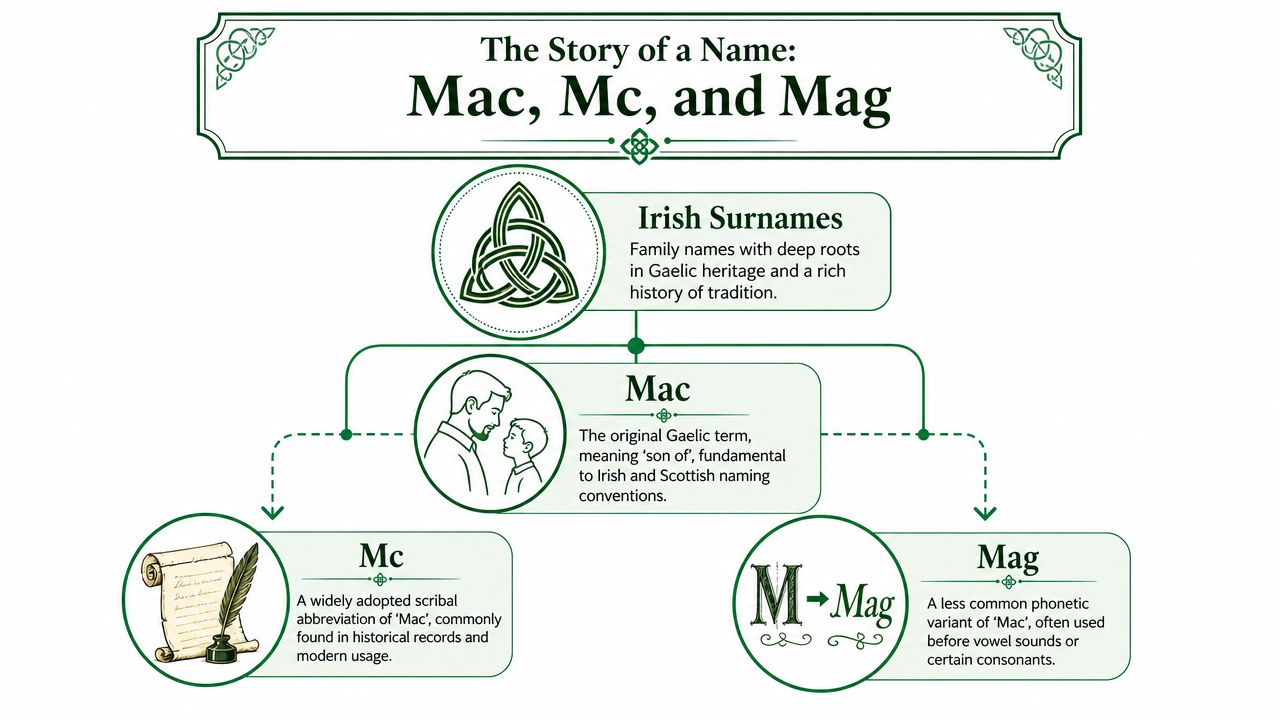
The heart of the matter is simple. Mac comes from the Old Irish mac, meaning “son of.” In both Irish and Scottish Gaelic, it works as a patronymic marker in surnames. The shorter written form Mc developed later as a scribal contraction in Anglicized records, and historical registers show clerks often shortened Mac to Mc for brevity without changing the meaning, as noted in this explanation of the meaning of Mac and Mc in Irish family names.
Why Mc is not a different name from Mac
A helpful way to think about it is abbreviation. Mc is to Mac a bit like St. is to Saint. The shorter form doesn't create a new identity. It just compresses the writing.
That matters because many people were taught a rough rule that Mac is Scottish and Mc is Irish or vice versa. Real records are messier than that. In many family lines, the two spellings appear interchangeably. The underlying name can stay the same even when the first two letters shift on paper.
Practical rule: If you see Mc in a family name, start by treating it as a contracted form of Mac, not as proof of a separate origin.
For readers who enjoy digging into word histories, surname change, and linguistic drift, it's worth taking time to discover the best etymology reads. Etymology won't solve your family tree by itself, but it sharpens your eye for how names travel and change.
If you want a broader orientation before narrowing to your own surname, this guide to Gaelic last names is a useful companion.
Where Mag fits in
This is the nuance many simple guides miss. Some surnames that appear today with Mc may connect to older Mag forms in Irish. Under English administrative spelling, names could be flattened into more familiar-looking patterns. So a modern Mc spelling doesn't always point neatly back to a visible Mac in older Irish.
That can confuse learners. You might find a modern surname in one record, a different-looking Gaelic form in another, and assume they belong to different families. Sometimes they don't. Sometimes they're different written outcomes of the same naming tradition passing through Irish speech and English record-keeping.
A few checkpoints help:
- Look past modern spelling: Today's Mc form may not preserve the older Irish prefix exactly.
- Expect variant records: One family line can leave behind multiple spellings across church, civil, and migration documents.
- Focus on the root personal name: The second part of the surname often gives the clearest clue to the older form.
This is why Irish surname research can feel alive rather than mechanical. You're not translating a fixed code. You're tracing how language was written by different hands in different times.
A Roll Call of Clans Common Mc Surnames
Once the structure clicks, real names become easier to read. Many people searching Irish last names Mc want one thing first. They want to spot their own surname, see the Irish form, and finally know what it means.
Irish patronymic surnames typically use Ó for “descendant of” and Mac/Mc for “son of,” while the Mac prefix is more strongly associated with northern Irish and Scottish usage. Immigration records in the United States also show that many Mac forms were written as Mc by clerks unfamiliar with Irish spelling, which helps explain why diaspora families often carry the shorter version, as described in this discussion of Mac and Mc in Irish family names.
Common Irish Mc surnames and their Gaelic roots
| Modern 'Mc' Name | Original Gaelic Form | Simplified Pronunciation | Meaning |
|---|---|---|---|
| McCarthy | Mac Cárthaigh | mak CAR-hee | son of Cárthach |
| McMahon | Mac Mathghamhna | mak MAH-una | son of Mathghamhain |
| McNeill | Mac Néill | mak NAYL | son of Niall |
| McLaughlin | Mac Lochlainn | mak LOCKH-lin | son of Lochlann |
| McShane | Mac Seáin | mak SHAWN | son of Seán |
| McGee | Mac Aodha | mak EE-a | son of Aodh |
| McManus | Mac Mághnais | mak MAWG-nish | son of Magnus |
| McKeogh | Mac Eochaidh | mak YOH-hee | son of Eochaidh |
| McDonnell | Mac Domhnaill | mak DOH-nil | son of Domhnall |
| McSweeney | Mac Suibhne | mak SWEE-nee | son of Suibhne |
The pronunciation column is simplified on purpose. It won't capture every regional sound, but it gives a beginner a way in. The full Irish forms often look intimidating at first because English spelling habits don't prepare us for them.
When you meet the Irish form of your surname for the first time, don't judge it by English spelling rules. It belongs to a different sound system.
Many of these names carry the memory of powerful kin groups. Some are linked to well-known clans. Others survived through local family continuity rather than famous political history. Either way, the pattern is the same. The surname points back to an ancestor's personal name and then outward to a wider lineage.
For readers who want more context on clan history and how surnames connect to older family groupings, this Irish clans guide adds helpful background.
Why the same family name may appear in different forms
People often get stuck when they find more than one version of a surname and assume one must be wrong. Usually, the safer starting point is that variation is normal.
Here are a few common scenarios:
- A shorter English record: A clerk writes McCarthy where an older Irish form would be Mac Cárthaigh.
- A diaspora spelling: A family in America keeps Mc even if earlier records in Ireland show Mac.
- A hidden older variant: A modern Mc surname may connect to an earlier Mag form that isn't obvious at first glance.
That's why surname tables are guides, not final verdicts. They help you recognize likely roots. Your own family line still deserves its own paper trail.
Mapping the Clans Regional Roots of Mc Surnames
A surname doesn't only tell you who your people were. It can also hint at where their story held ground.
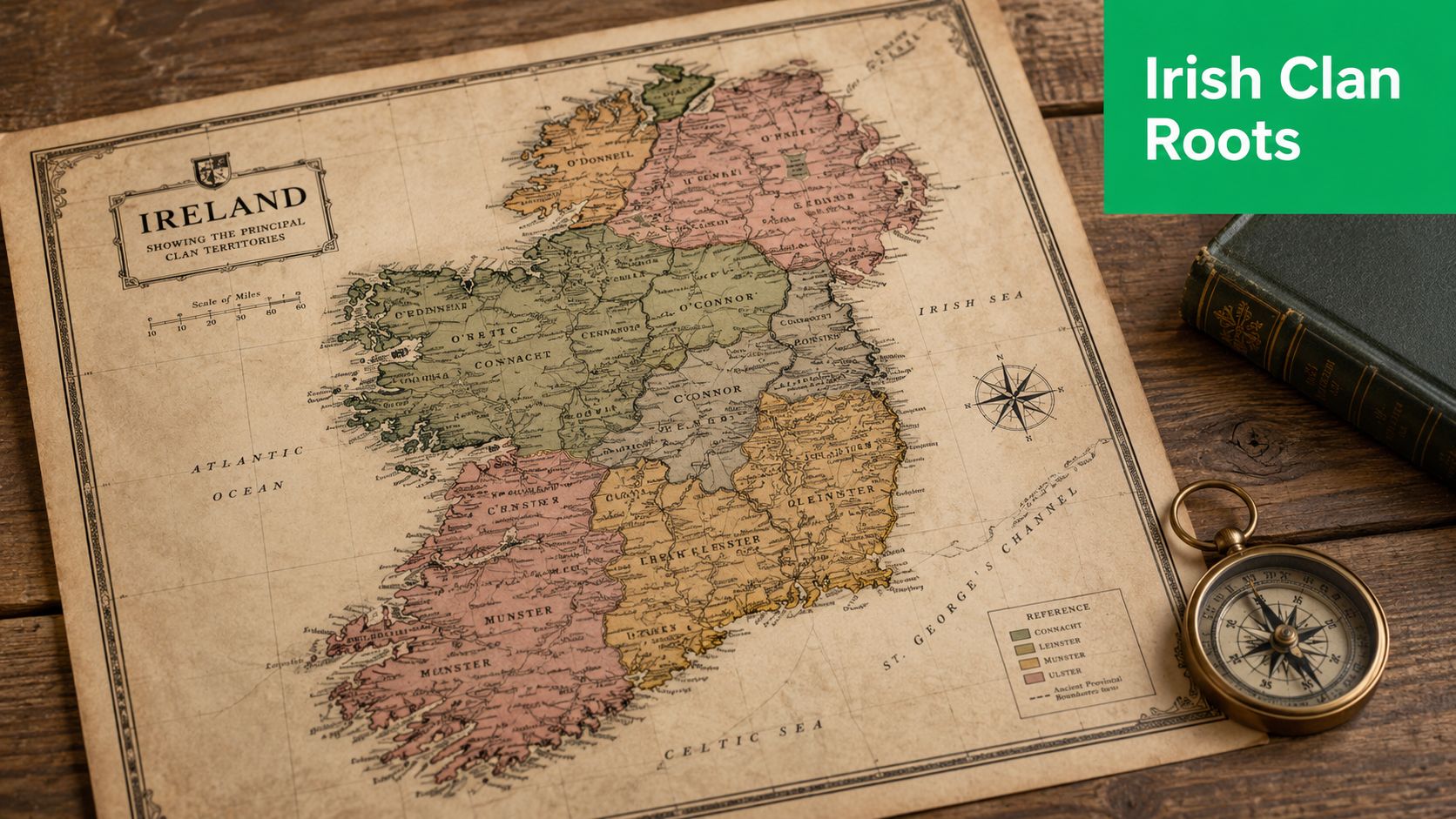
In the 1911 Ireland surname data, McCarthy had over 19,000 bearers, making it one of the most common surnames in the country at the time. The same data show that surnames beginning with Mc or Mac had strong concentrations in Cork, Kerry, Limerick, and Clare, patterns tied to the endurance of medieval Gaelic kinship structures.
Munster and the strong McCarthy footprint
McCarthy is one of the clearest examples of a surname carrying a regional echo. In the southwest, especially in Munster, the name reflects the long influence of the Mac Cárthaigh dynasty. When you see the surname clustered in Cork and Kerry, you're not just looking at repetition on a census page. You're seeing the afterimage of a political and kin-based world that lasted for centuries.
That's one reason surnames feel so rooted in Ireland. A county isn't merely a place on a map. For many names, it's where a lineage held authority, farmed land, married neighboring families, and passed the name on long after the old Gaelic order had changed.
What regional patterns can tell you
Regional concentration doesn't prove that every modern bearer descends from one neat line. Family history is never that tidy. But it can help you ask better questions.
A place-based reading of Mc surnames can help you:
- Narrow research paths: If a surname is strongly associated with one part of Ireland, that region deserves attention first.
- Interpret family lore: A story about “people from Kerry” becomes more meaningful when the surname itself has a historical foothold there.
- Understand migration within Ireland: Some surnames spread outward while still retaining a recognizable home region.
If your family has kept almost no records, regional surname history can be the first solid clue. It doesn't replace certificates, parish entries, or oral history, but it offers a context for your search. That alone can make a name feel less abstract and more local, more human, more real.
From Anglicized to Ancestral How to Reclaim Your Irish Name
A lot of heritage learners eventually ask the same question. If my surname is written as Mc now, what was its attested Irish form, and can I use it?
That question comes up often in Irish-heritage spaces. Discussions there show recurring interest in “re-Gaelicizing” surnames such as McCarthy to Mac Cárthaigh, but many public explanations stop at general history and don't give people a usable method, as noted in these Irish-heritage forum discussions about reclaiming Irish surname forms.
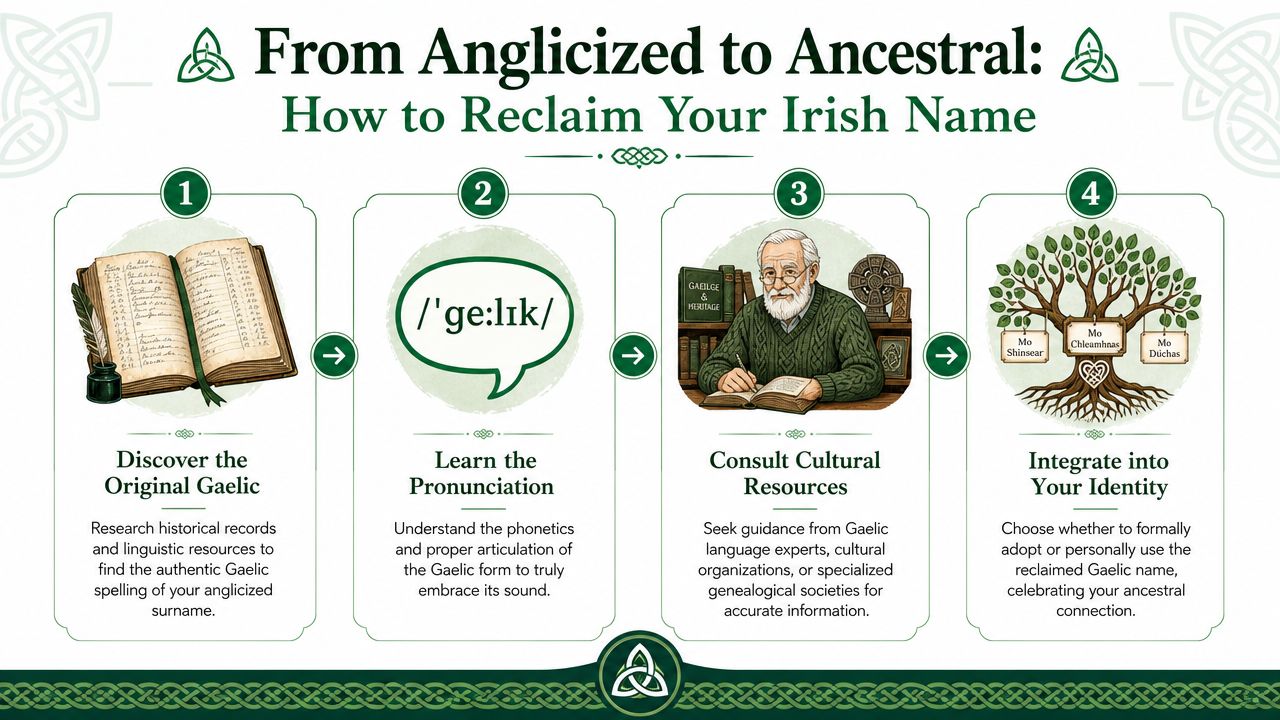
A practical path back to the Irish form
Start with your current surname, but don't stop there.
Search for an attested Irish form
Look for a documented Gaelic version used in surname references, family records, or established Irish-language materials. Avoid generic “name translators” that force English names into guesswork spellings.Check for variant pathways
If you have a modern Mc name, test whether it may connect to Mac or Mag in older forms. That single step can prevent you from choosing a neat-looking Irish spelling that isn't tied to your line.Listen before you adopt
Many learners choose a written form before they know how it sounds. That often creates distance instead of connection. Learn the pronunciation with care, even if you only use it privately at first.
Research habit: Write down every spelling you encounter for your surname in one place. The pattern across versions is often more revealing than any single record.
Use specialist help when the trail gets tangled
If records are scattered or the name branches in multiple directions, a guide to professional genealogy services can help you understand when expert family-history research may be worth considering.Use language tools, not just genealogy tools
Reclaiming a name isn't only about documents. It's also about sound and usage. One option is Irish language learning resources that help learners hear Irish forms, practice pronunciation, and build comfort with the language that surnames come from.
How to use your reclaimed name thoughtfully
There isn't one correct level of use. Some people add the Irish form to a family tree. Others use it in email signatures, social profiles, or personal projects. Some keep the legal English spelling and use the Irish form as a cultural name. That's all valid.
A good rule is to be accurate first, expressive second. If you're reclaiming a form, try to use one that is historically grounded rather than invented for style. The point isn't to sound more Irish than someone else. The point is to come closer to your own inheritance.
A few grounded ways to begin:
- In family history work: Add the Irish form in parentheses beside the modern surname.
- In conversation practice: Introduce yourself with both versions so the connection becomes natural.
- In personal heritage projects: Use the Irish form on a family booklet, reunion notes, or ancestry archive.
Some people feel shy about this at first. That's understandable. But using an ancestral form can change the relationship you have with your own name. It stops being only something you sign. It becomes something you understand.
Bringing Your Heritage to Life with Gaeilge
A surname comes alive when you can hear it as part of the language that shaped it.

Knowing that Mc is linked to an older Mac form is valuable. Knowing that some modern names may hide earlier Mag forms is even more useful. But the deepest shift often happens when you stop treating the name as a museum object and start treating it as part of living Irish.
A name sounds different when you know the language
When you learn even a little Gaeilge, surnames stop looking decorative. You begin to hear patterns. You notice how sounds soften, how vowels lengthen, how the old structure of a name still carries meaning. That makes heritage feel less abstract.
A practical next step is to spend time with spoken Irish, pronunciation support, and beginner-friendly conversation work. That's where a platform like Gaeilgeoir AI fits naturally. It helps learners practice Irish through guided conversations, pronunciation support, and clickable vocabulary, which can make surname forms feel less intimidating and more usable in real life.
After you've heard your own name spoken in Irish, this video is a good way to keep that momentum going:
A family name can open the door, but language is what lets you walk through it. If you've started with curiosity about Irish last names Mc, the next meaningful step is learning enough Irish to recognize, pronounce, and enjoy the world your surname came from.
If you want to take that next step, start learning with Gaeilgeoir AI and explore the platform directly at Learn Gaeilgeoir AI. Comments and pingbacks are closed.