You're probably here because you've seen the phrase Irish signs used in different ways and it's not clear what people mean. Maybe you noticed a road sign in Ireland with two place names on it. Maybe you searched for Irish sign language and got results about road markings. Or maybe you were reading Irish history and came across phrases or symbols that seemed to carry more weight than ordinary signage.
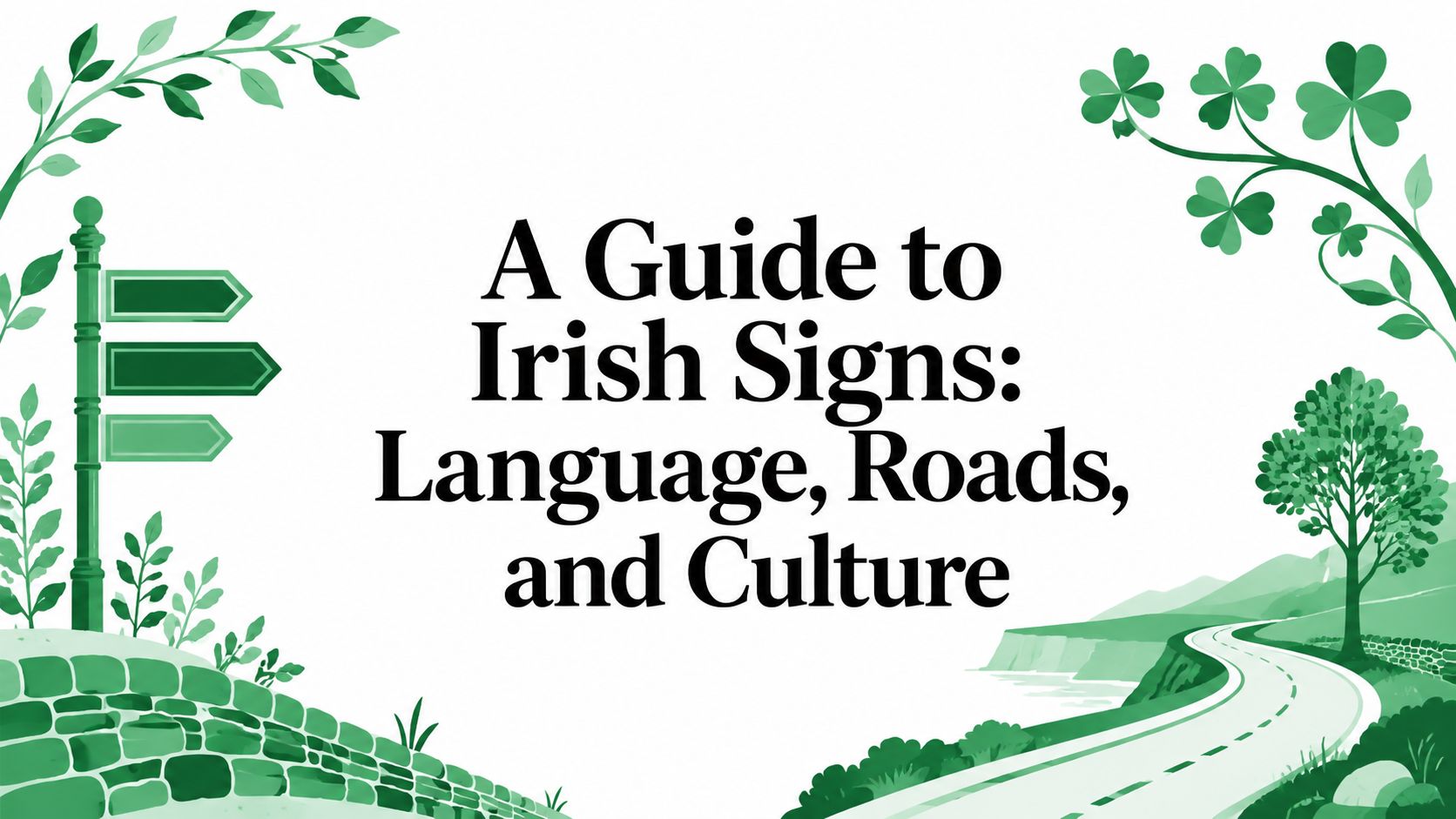
That confusion makes sense. In Ireland, “Irish signs” can point to written signs in Gaeilge, Irish Sign Language, or cultural signs and symbols that tell a wider story about identity, exclusion, and belonging. Once you separate those meanings, the whole topic becomes much easier to read.
Table of Contents
- What Exactly Are Irish Signs
- The Three Meanings of Irish Signs Explained
- Navigating Irelands Bilingual Road Signs
- An Introduction to Irish Sign Language
- Decoding Irelands Cultural and Historical Signs
- From Signs to Speaking Your Next Steps in Irish
What Exactly Are Irish Signs
A visitor lands in Kerry, rents a car, and starts driving west. The road sign ahead says An Daingean and Dingle. A little later, a museum display mentions the tricolour. That evening, they look up Irish signs online and find results about hand gestures and Deaf culture. Same phrase. Three different meanings.
That's why this topic trips people up so often. Irish signs can mean the signs you physically read, the signs people make with their hands, or the symbols and phrases that signal something important about Irish life and history.
The written kind is the one most travelers meet first. In many places, public signs include Irish and English together, especially on roads, official buildings, and heritage sites. These signs are practical, but they're also cultural. They tell you that language itself is an integral element of the area.
Practical rule: If a sign in Ireland seems unfamiliar, first ask what kind of “sign” you're dealing with. Is it written language, a visual language used by people, or a symbol carrying historical meaning?
Then there's Irish Sign Language, often shortened to ISL. That's a full language used by members of Ireland's Deaf community. It isn't just English acted out with the hands, and it isn't the same thing as written Irish on a street sign.
The third meaning is broader and often the most powerful. A flag, a harp, an old slogan, or even a remembered phrase can function like a sign. It points beyond itself. It tells people who belongs, who was excluded, what was valued, and what still matters.
When you sort Irish signs into those three groups, the subject becomes far less muddy. You stop treating everything as one category and start seeing a connected picture of language, access, and identity.
The Three Meanings of Irish Signs Explained
The easiest way to make sense of Irish signs is to split them into three clear buckets. Once you do that, the overlaps become interesting instead of confusing.
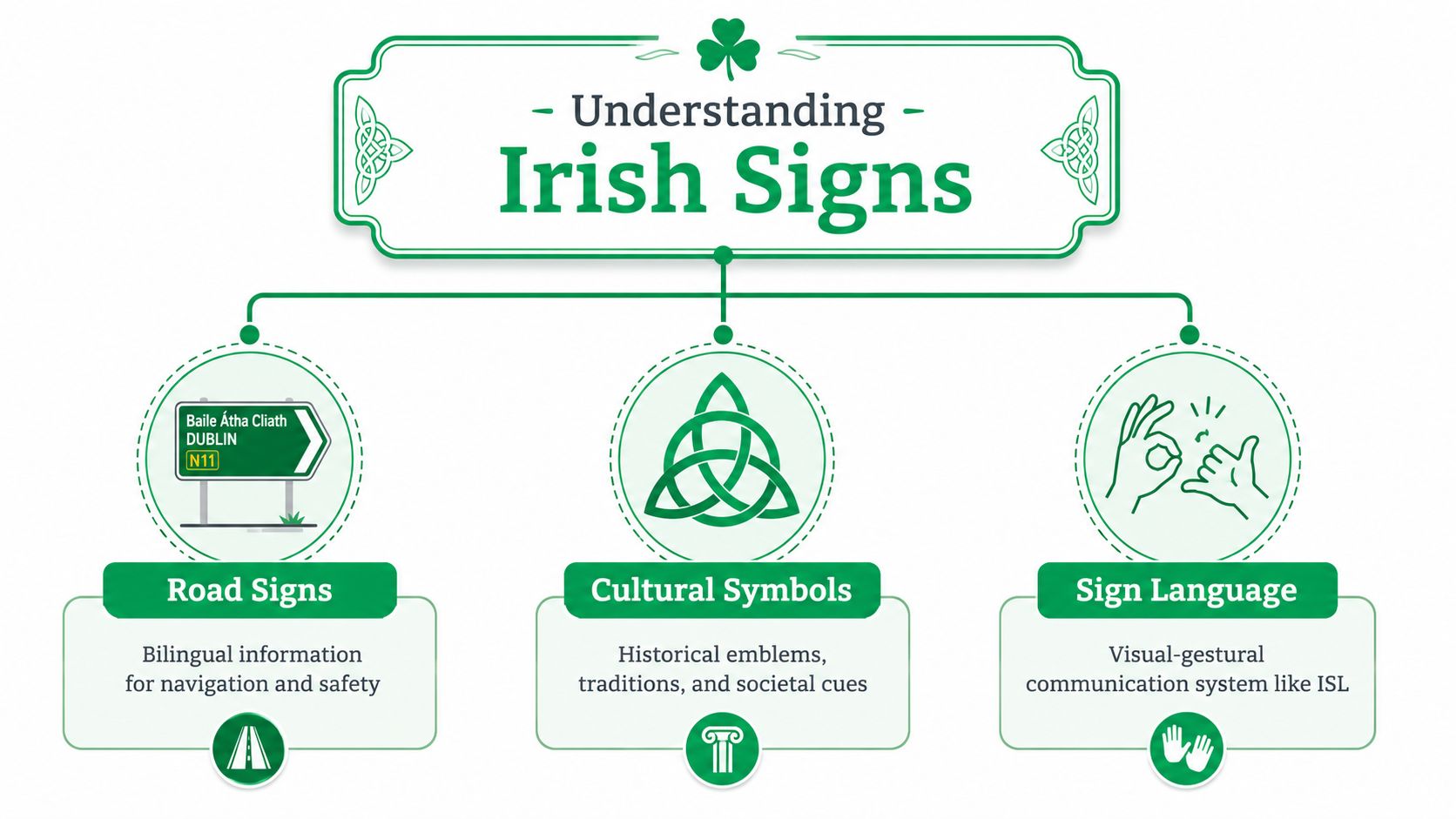
Written signs in Irish and English
These are the signs commonly intended when discussing signs in Ireland. Think of road signs, town names, public notices, and directional markers. You may see an Irish place name above or alongside the English version, or sometimes only the Irish form in particular areas.
For a learner, these signs are useful because they repeat common words in real situations. You don't study them in isolation. You meet them while driving, walking, or trying to find a train station.
Hand signs in Irish Sign Language
This meaning belongs to ISL, a visual language used in daily communication. It has its own structure and belongs to the lived experience of the Deaf community in Ireland. If someone says they're learning Irish signs in the context of communication or accessibility, they may be referring to ISL rather than written Gaeilge.
A common mistake is to bundle spoken Irish, written Irish, and ISL together as if they're versions of the same system. They aren't. They sit beside one another in Irish life, but each works differently.
Cultural signs and symbols
Some Irish signs aren't language lessons or traffic tools at all. They're symbols that communicate memory, allegiance, struggle, or belonging. The tricolour is one example. So are historical phrases associated with exclusion.
Here's a quick way to tell these meanings apart:
| Meaning | What it looks like | What it does |
|---|---|---|
| Written signs | Place names, road signs, notices | Helps people navigate and read public space |
| Sign language | Handshapes, movement, facial expression | Lets people communicate in a visual language |
| Cultural signs | Flags, symbols, loaded historical phrases | Signals identity, history, and social meaning |
If you're unsure which meaning someone intends, look at the setting. Roads suggest written signage. Accessibility and Deaf culture suggest ISL. History or identity usually points to cultural symbols.
People often blur these categories because all three are visible. You can see them. But visibility doesn't make them the same thing. One helps you find a town, one helps people converse, and one carries a message about Ireland's past and present.
Navigating Irelands Bilingual Road Signs
If you want the most practical part of Irish signs first, start on the road. Ireland's bilingual signs can look intimidating at speed, especially if you're new to Irish spelling. In practice, they follow patterns, and patterns are your friend.
A quick visual guide helps before you get into details.
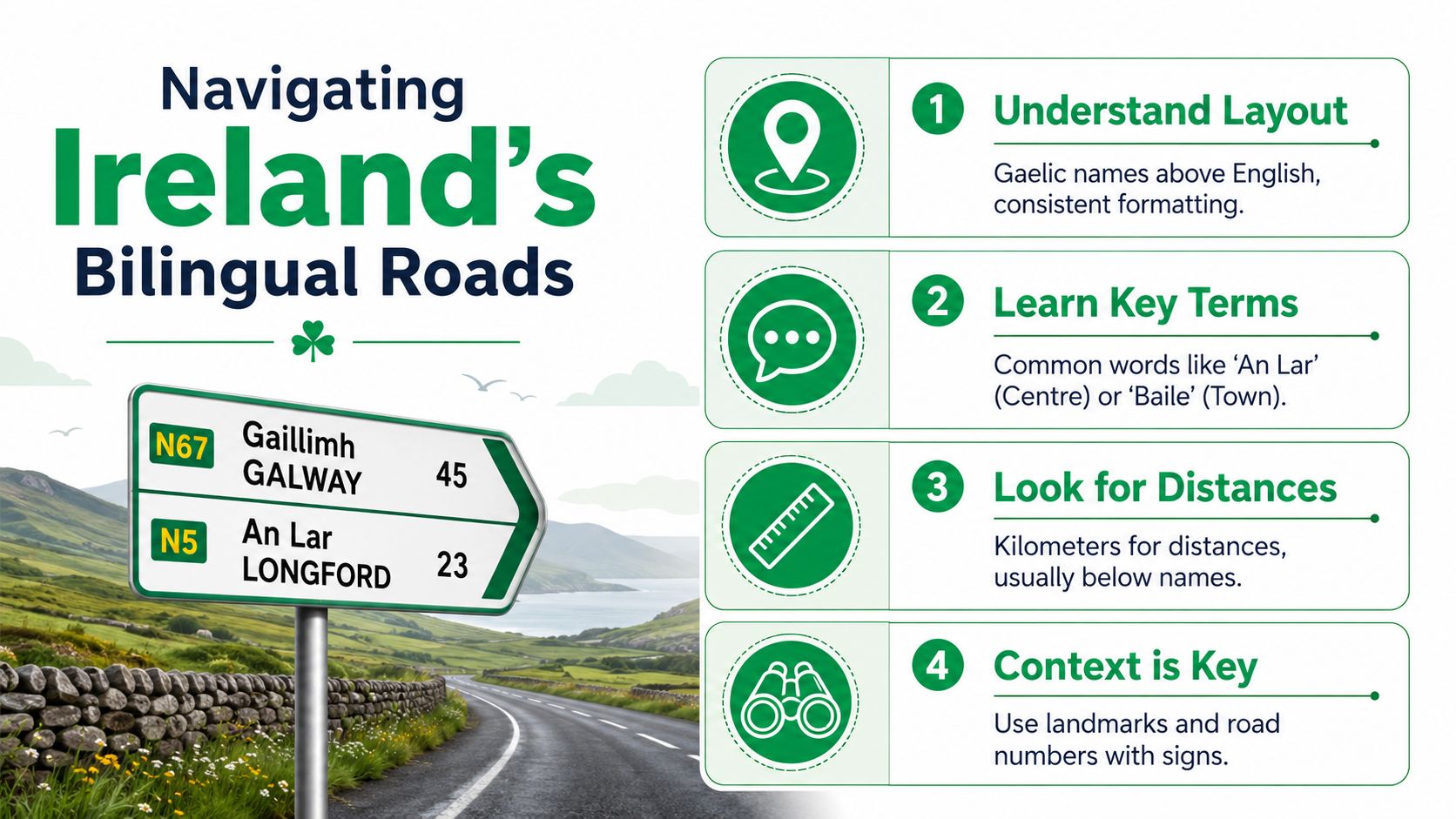
How to read the layout quickly
Start with the road number and destination, not with perfect pronunciation. That keeps you oriented. Then notice whether the sign is presenting the Irish and English forms of a place name, or giving you a term like “centre” or “yield” in Irish.
Color and shape matter too. One useful point to know is that regulatory road traffic signs in Ireland are defined by their circular shape with a red border, black or white symbols, and a white background, and prohibitions are shown with a red diagonal bar. Circular signs showing “30” or “50” with red borders indicate speed limits in km/h (guide to Irish road traffic signs).
That matters because beginners sometimes focus so hard on the language that they miss the sign category. Safety first. Language second.
Later in the drive, this video helps make the visual system feel more familiar.
Common Irish words you'll meet on signs
Some words come up often enough that they're worth learning early. You don't need to memorize long lists. A small working set goes a long way.
| Irish word | Plain meaning | Where you may notice it |
|---|---|---|
| Baile | Town | Place names and directional signs |
| Lár | Centre | Town centre signage |
| Slí | Way or route | Walking routes, directions, marked paths |
| Géill Slí | Yield | Traffic instruction |
A helpful habit is to treat these words like landmarks rather than test material. If you keep seeing Lár, your brain starts attaching it to the centre of a place. That kind of recognition grows naturally.
For learners who want a closer look at everyday Irish phrasing, this short guide to as Gaeilge meaning and usage helps explain a phrase you'll often see in language-related contexts.
Don't try to decode every letter
Irish spelling can feel unfamiliar at first, but road signs don't ask you to become fluent on day one. They ask you to recognize patterns. Focus on these cues:
- Place pairing: The sign may show the Irish and English forms of the same destination.
- Repeated terms: Words like Baile and Lár become easier each time you pass them.
- Road context: Junction layout, arrows, and road numbers often tell you as much as the words.
- Legal shapes: A circular red-bordered sign gives a command, no matter what language you speak.
Read the whole sign as a package. Color, shape, arrows, and road numbers usually give you the answer before your vocabulary does.
If you're interested in the wider challenge of navigating in more than one language, Waymap's insights on language support are worth reading. They highlight why clear multilingual design matters for real users, especially when people need to process information quickly.
An Introduction to Irish Sign Language
When people first hear “Irish signs,” some think of road signs. Others mean Irish Sign Language, or ISL. That second meaning deserves care, because it isn't a side note or a visual version of something else. It's a language in its own right.
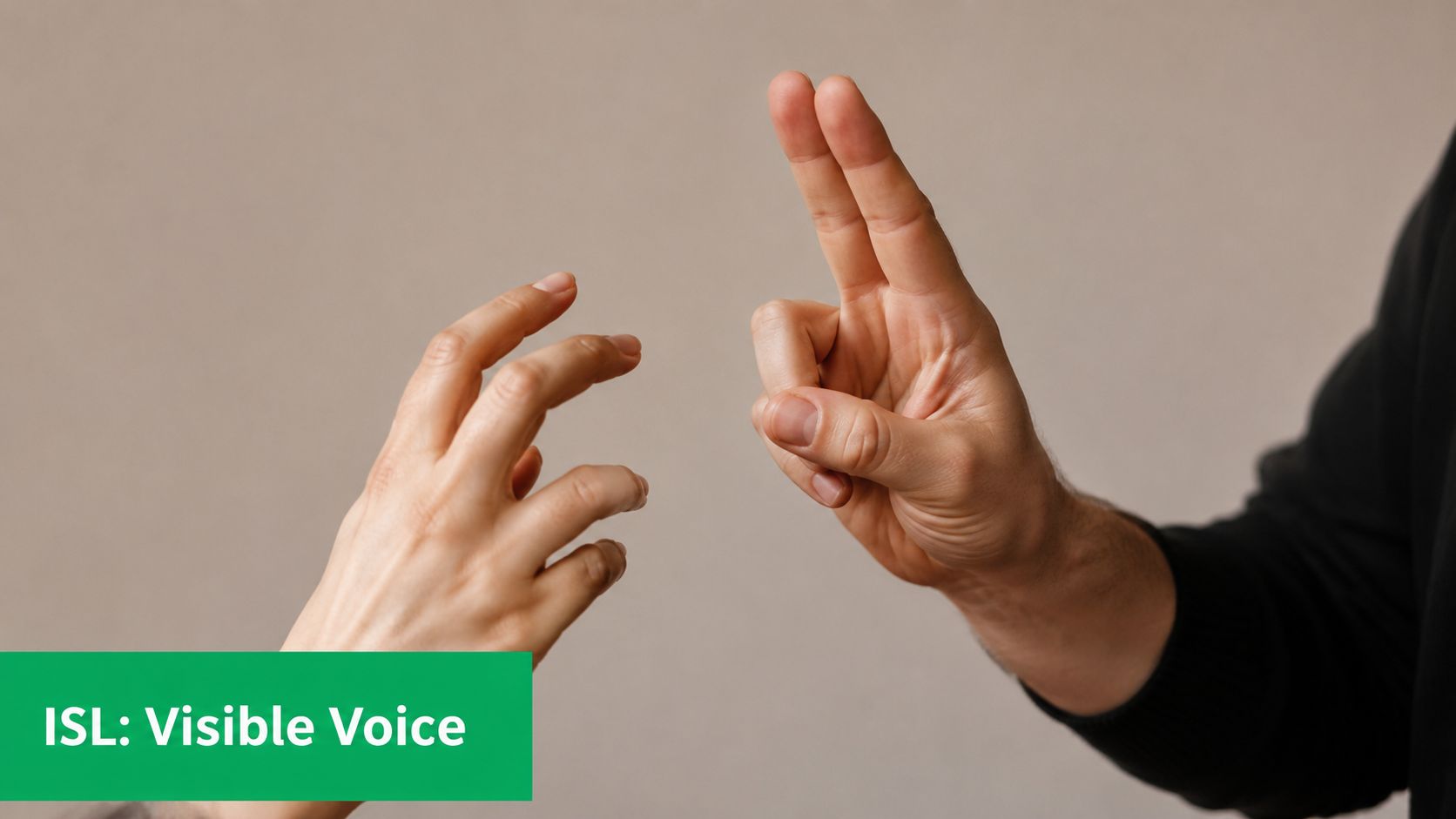
ISL is not signed English
This is the point readers often miss. ISL is its own language, with its own grammar, rhythm, and cultural context. If you know spoken English or spoken Irish, that doesn't mean you already understand ISL. The channel is visual, but the language is not directly borrowed from writing on a page.
That distinction matters because language and identity are closely tied. For members of the Deaf community, ISL isn't just a communication aid. It's part of community life, culture, and self-expression.
A good way to think about it is this. Written Irish on a sign helps you read public space. ISL helps people communicate with one another directly.
Why visibility matters
Language recognition is also about what people are allowed to see in public life. The challenge isn't limited to speech. A 2025 European body report noted that many Northern Ireland councils make approval for Irish-language street signage “too difficult,” creating barriers to visible inclusion for 60% of Irish speakers who want it, according to BBC reporting on Irish-language signage in Northern Ireland. That broader struggle over linguistic visibility mirrors the ongoing effort to secure resources and equal status for ISL.
That parallel is worth sitting with. One group asks to see their language on the street. Another asks for their language to be fully supported in institutions and services. Both are questions of dignity.
Visibility changes how a language feels in daily life. When people can see it, use it, and expect it, the language stops feeling peripheral.
If you're new to ISL, the most respectful starting point is curiosity paired with humility. Learn that it exists as its own system. Learn that the Deaf community in Ireland has its own history and priorities. Then seek out learning spaces that treat the language as living culture, not just a list of gestures.
Decoding Irelands Cultural and Historical Signs
Some of the most important Irish signs aren't for navigation at all. They're symbols, phrases, and remembered markers that tell you how people in Ireland have understood belonging, conflict, and solidarity. You don't drive past these signs in the same way you pass a speed limit sign. You inherit them, debate them, and sometimes carry them across generations.
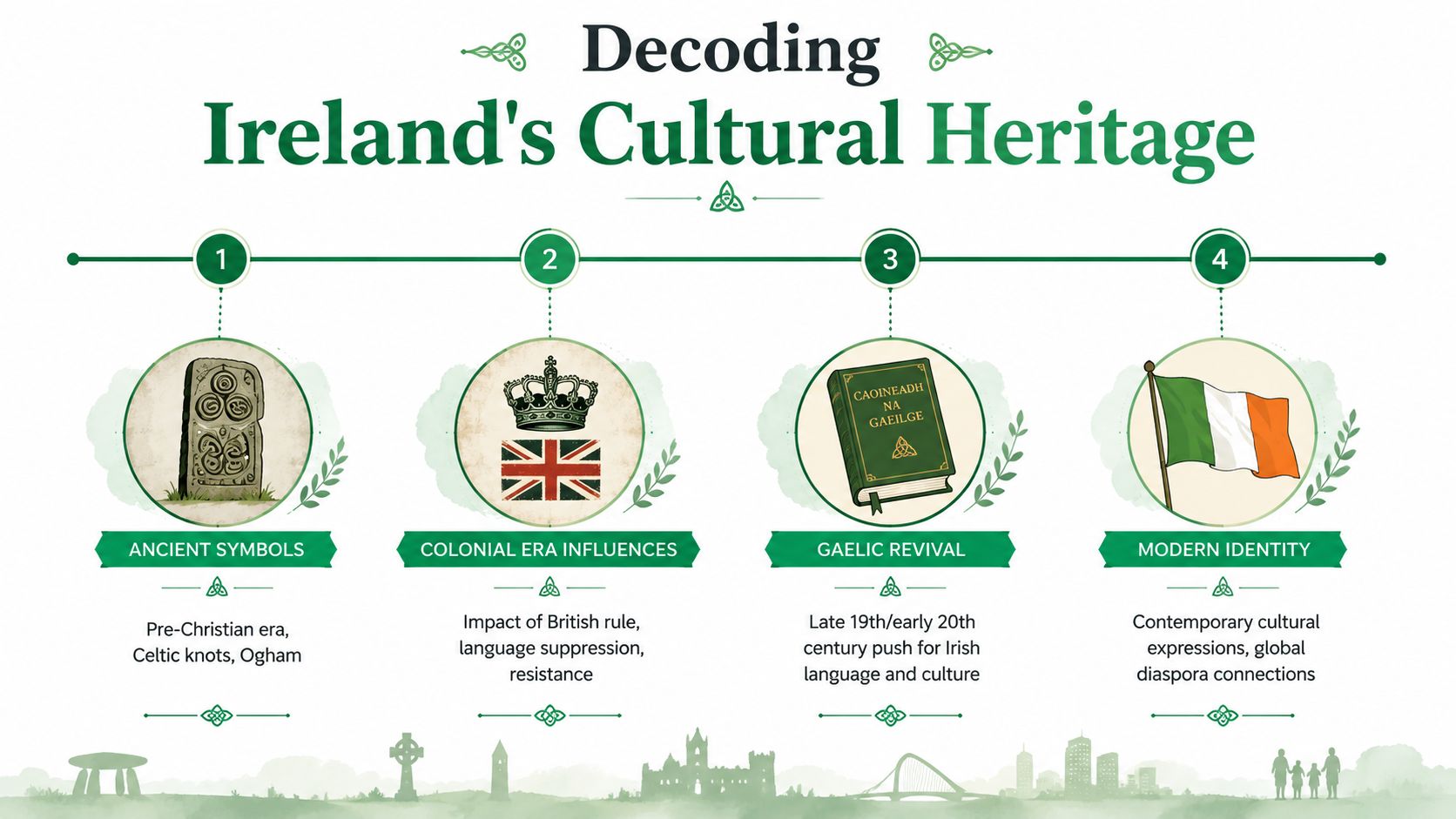
Symbols that carry national meaning
Take the Irish tricolour. It's easy to reduce a flag to color recognition, but this one was built to communicate an idea. On December 6, 1922, a treaty established Southern Ireland and Northern Ireland as independent self-governing states, and that political moment shaped the symbolism of the tricolour. Green represents Ireland's older Gaelic tradition, orange represents Protestant supporters of William of Orange after the Battle of the Boyne, and white symbolizes peace between the two traditions. The inclusion of orange was a deliberate effort toward reconciliation, as described in this account of the history and symbolism of Ireland's tricolour.
That makes the flag a sign in a deeper sense. It doesn't just identify a nation. It proposes a relationship among people within it.
The same applies to older cultural forms such as Ogham. Even when modern readers can't decode it at a glance, it signals antiquity, language, and continuity. If you'd like to understand that script without getting lost in jargon, this Ogham script alphabet guide is a useful primer.
Painful signs of exclusion
Not every cultural sign is celebratory. Some are warnings from the past.
One of the strongest examples is “No Irish Need Apply”, often shortened to NINA. Public debate has sometimes treated these signs as exaggerated memory or folklore. That claim doesn't hold up well against evidence. A 14-year-old student discovered over 69 documented cases of anti-Irish job discrimination in 19th-century America, directly challenging the myth that NINA signs were fictional, as highlighted in this discussion of documented anti-Irish cases.
That matters because denial can do a second layer of damage. First a group experiences exclusion. Then later, people suggest the exclusion never really happened.
A separate phrase, “No Irish, No Blacks, No Dogs,” occupies a different place in memory. It refers to alleged signs said to have appeared in lodgings across Britain more than 50 years ago. Historians still debate their actual existence and prevalence, and there are no confirming contemporary or retrospective accounts showing widespread use. The phrase remains culturally powerful because it captures real patterns of exclusion faced by Irish immigrants, but scholars have described it as a “curious historical puzzle” rather than a verified widespread fact, as summarized by The Irish Times post discussing the debate.
Some signs matter even when historians are still debating the exact object. The memory itself can reveal what a community lived through and how it remembers exclusion.
Reading these signs well
Cultural signs ask more of us than road signs do. They require context, not just recognition.
Here are three good habits when you meet them:
- Separate symbol from slogan: A national emblem and a hostile notice don't function in the same way, even though both are “signs.”
- Check the historical status: Some phrases are well documented; others are remembered powerfully but debated in the archive.
- Notice who is being included or excluded: That question often reveals its true meaning.
If you're planning to explore Ireland in person, local context makes these signs easier to notice. A practical route guide like travel like a local in Ireland can help you move beyond famous stops and into places where language, symbols, and history feel rooted in the location itself.
From Signs to Speaking Your Next Steps in Irish
Once you start seeing the three meanings of Irish signs clearly, something shifts. A bilingual road sign stops being visual noise. A discussion of ISL stops being mixed up with spelling. A flag or historical phrase starts to read as part of a larger story.
That's the payoff. You don't just recognize signs. You understand what kind of sign you're looking at, and why it matters.
Why language learning changes what you notice
Learning even a little Irish changes your experience of Ireland quickly. Place names begin to feel less opaque. Repeated public words start making sense. You become less dependent on translation and more alert to the shape of the language around you.
For travelers, students, and returning heritage learners, that kind of shift is practical as well as emotional. If you're preparing for a trip, broad planning advice like these important tips for 2025 abroad trips can help with logistics, but language adds a different layer. It helps you read the place from within rather than only moving through it.
If you want more ways to build that habit, this collection of Irish language learning resources gives you a solid place to keep going.
A simple next step
The next logical move is to go from recognizing signs to understanding and using the language itself. That doesn't mean chasing perfection. It means building a foundation you can use.
One detail makes that easier than many beginners expect. Gaeilgeoir AI's immersion content is based on the 1,000 most commonly used Irish words, allowing learners to build a strong foundation quickly while clicking any word across the platform to see translations and save items to a personalized study list, as shown in this overview video of the platform.
That approach fits the topic well. Real language learning often starts the same way real-world signs do. You notice a small set of repeated words. You connect them to situations. Then the bigger picture becomes clear.
Irish signs can be your entry point. A place name. A public notice. A cultural symbol. A conversation about visibility. All of them point toward the same thing. Language is not extra decoration in Ireland. It's part of how the country speaks about itself.
If you want to move from spotting Irish signs to understanding and speaking the language, Gaeilgeoir AI is a smart place to begin. It offers real-time pronunciation feedback through advanced speech recognition, a freemium model for easy access, and guided immersion built around high-frequency Irish. You can explore more and get started at Learn Gaeilgeoir AI.