Knowing an Irish translation is only the first step. You also need to recognize the word in speech, pronounce it clearly, retrieve it without looking, and use it naturally when ordering food, asking for directions, discussing work, or preparing Leaving Cert oral topics.
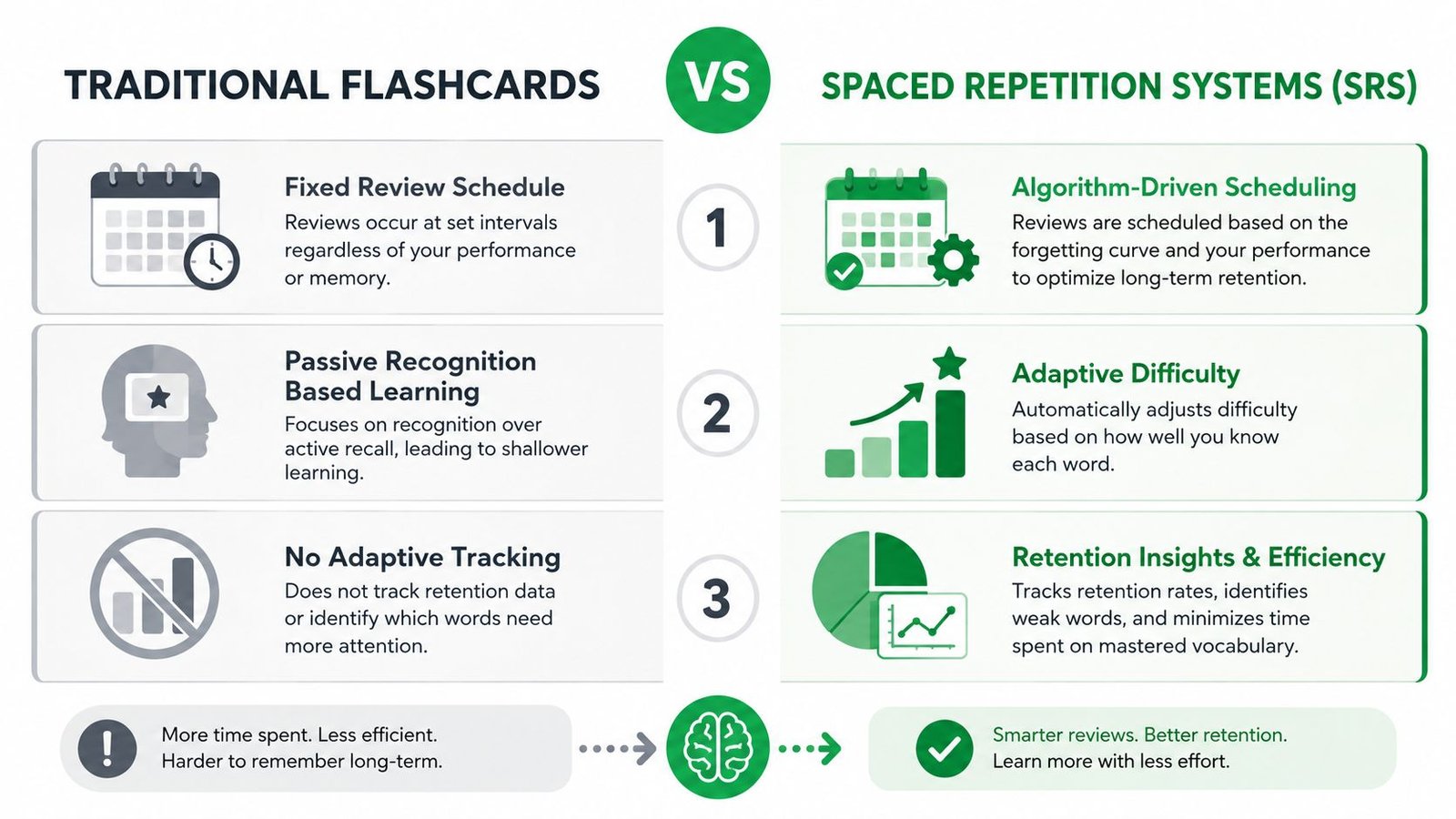
The most reliable vocabulary acquisition strategies don't treat words as isolated facts. They build repeated contact through context, retrieval, sound, conversation, feedback, and carefully timed review. Research on effective learning identifies spaced practice and retrieval practice as especially dependable for long-term retention, with spacing outperforming massed study and retrieval strengthening memory over extended periods in a major review of learning science.
Meaningful use beats passive word-list review.
The ten strategies below form a coordinated system for beginners through intermediate Irish learners. You can combine them with Gaeilgeoir AI's guided conversations, adaptive quizzes, pronunciation support, and personalized study lists. Start with the strategy that addresses your biggest obstacle, then turn it into a repeatable weekly routine rather than trying to use everything at once.
Table of Contents
- 1. Spaced Repetition Systems
- 2. Immersion-Based Contextual Learning
- 3. Active Recall and Retrieval Practice
- 4. Gamification and Motivation Systems
- 5. Personalized Learning Paths and Adaptive Systems
- 6. Multi-Sensory and Multimodal Learning
- 7. Semantic Clustering and Word Families
- 8. Elaboration and Deep Processing
- 9. Frequency-Based Vocabulary Prioritization
- 10. Pronunciation and Phonetic Awareness Integration
- Vocabulary Acquisition: 10-Strategy Comparison
- Turn Ten Strategies Into One Irish Practice Loop
1. Spaced Repetition Systems
Spaced repetition turns vocabulary review into a timed cycle, not a cramming session. You meet a word again after an interval that grows when recall is strong and shortens when recall is weak. A major review of learning research found that practice spread across one to seven days supports durable learning, while retrieval can preserve memory for up to nine months and repeated retrieval effects have been observed for at least eight years in the research review.
For Irish, you can use Anki, Memrise, or Gaeilgeoir AI's adaptive quiz system with instant feedback. The platform matters less than the schedule. Difficult words should return sooner, while words you recall confidently can wait longer.
Make each card richer than a translation
Build a card around a useful speaking situation. For a word used when ordering food, include its Irish spelling, an audio model, a short phrase, and a prompt that makes you produce the word aloud. This connects vocabulary with pronunciation and conversation instead of leaving it as a translation pair.
Review high-frequency words first, then add terms connected to situations you expect to handle. Save a phrase from a Gaeilgeoir AI conversation, practise saying it, and place it into your review cycle.
A 2024 study reported recall of about 79.77% after ten days, about 79.57% after eighteen days, and about 75.27% after a sixty-day lapse for target words studied with spaced repetition in the vocabulary study. These results will not be identical for every learner, but they illustrate why scheduled retrieval can serve you better than repeatedly rereading a list.
Use Irish language flashcards to practise spelling, pronunciation, translation, and usage from several angles. Review existing cards before adding many new ones, and let real conversations supply vocabulary with cultural and personal relevance.
2. Immersion-Based Contextual Learning
A translation tells you what a word can mean. Context teaches you when it belongs in a sentence, what usually appears beside it, and how a conversation moves around it. Immersion-based learning places vocabulary inside practical situations such as cafés, workplaces, travel, family conversations, and social events.
Suppose your target is food vocabulary. A word list might help you recognize a noun, but a café exchange forces you to greet someone, ask for an item, respond to a question, and manage a misunderstanding. That chain gives the word a role. You remember not only its definition, but also the intention, tone, and conversational pattern attached to it.
Choose situations that matter now
Gaeilgeoir AI provides guided, real-world conversation practice and scenario-based activities for travel, work, social interaction, ordering food, and asking directions. Leaving Cert learners can use oral-exam simulations built around typical topics, while heritage learners can select situations connected with family, place, or identity.
Start with one scenario and repeat it with small changes. Order a different food, ask for directions to another location, or describe a different aspect of your work. After each conversation, save unfamiliar words and review them later rather than trying to memorize everything immediately.

Practical rule: If you can't imagine a situation in which you'd say a word, give it lower priority until your immediate communication needs are covered.
Context also makes cultural knowledge visible. A phrase may sound appropriate in a textbook but feel unnatural in a particular exchange. Guided practice gives you a place to notice that difference, test a sentence, and try again. Learners interested in an extended beginner experience can also explore Irish immersion for beginners as a way to connect vocabulary with sustained communication.
3. Active Recall and Retrieval Practice
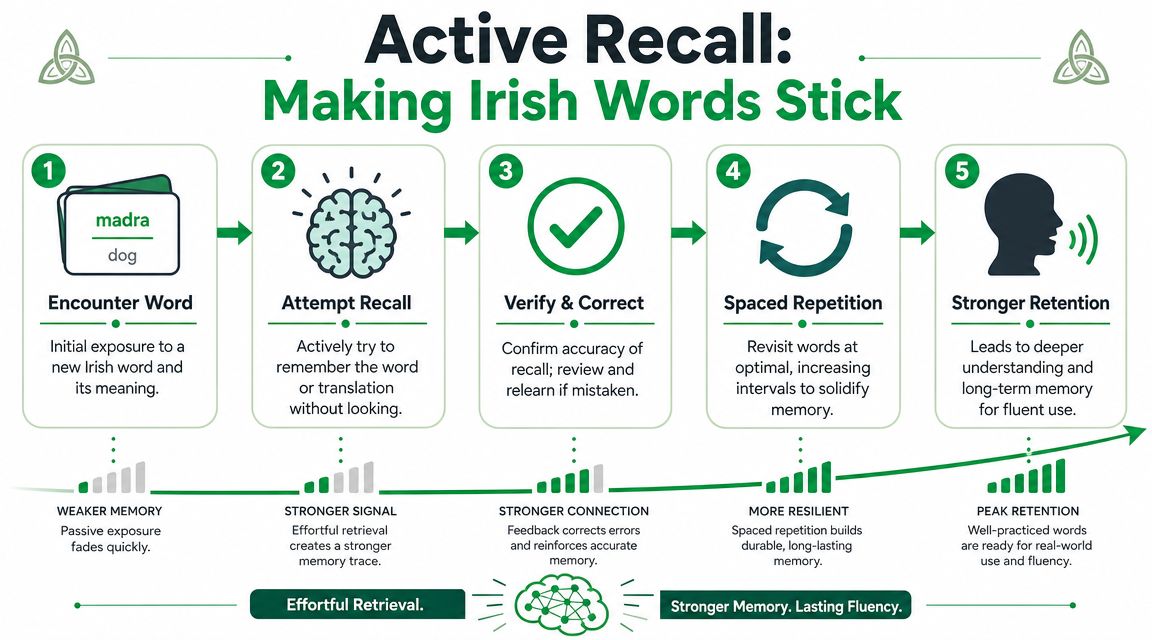
Active recall turns vocabulary from recognition into usable speech. Instead of looking at an Irish word and thinking it seems familiar, produce it before checking the answer. That brief search strengthens access to the word, making it easier to retrieve during a real conversation.
Use retrieval in several directions. Read an English prompt and say the Irish word. Hear Irish and explain its meaning. Complete a sentence, answer a question, or pronounce a phrase aloud. These tasks work like different routes to the same destination, so each one reveals a separate gap in vocabulary, meaning, or pronunciation.
A pause is useful feedback. If you cannot remember a word, adjust the support around it: shorten the review interval, add a clearer example, or practise its sound. Gaeilgeoir AI's adaptive quizzes can give immediate feedback, while flashcard apps let you mark recall as easy, uncertain, or absent.
Research on second-language vocabulary found that learners who studied with spacing recalled more in a delayed test than learners who practised in a single concentrated session. A controlled comparison also found spaced practice stronger than massed practice for flashcards and fill-in-the-blanks on a two-week delayed posttest in the vocabulary research. The practical rule is simple: retrieve Irish after time has passed, not only while the answer is still fresh.
Try this Irish exercise:
- Prompt first: Hide the Irish side and produce the word from an English meaning or picture.
- Change the task: Use the word in a multiple-choice question, a gap-fill, and a spoken sentence.
- Add conversation: Ask Gaeilgeoir AI to use the word in a short exchange, then answer without looking at your notes.
- Notice the gap: Mark words you recognize but cannot produce, and schedule them for another review.
- Correct aloud: Check the answer promptly, repeat the corrected phrase, and listen for its pronunciation.
This sequence connects memory, sound, context, and conversation. It also shows which words deserve more recycling in your Irish practice loop.
4. Gamification and Motivation Systems
Vocabulary practice needs continuity, and motivation systems can make continuity easier. Points, badges, progress bars, streaks, multipliers, and leaderboards turn an invisible process into visible movement. For a busy adult, opening a short lesson after work can feel more manageable when the session contributes to a clear record of progress.
Gamification works best when it supports a personal purpose. A leaderboard might encourage you to practise, but your real target could be ordering lunch confidently, speaking with relatives, or answering Leaving Cert oral questions without freezing. Track both kinds of progress. External rewards can start the routine, while successful communication gives it meaning.
Protect motivation from comparison
A missed day doesn't erase what you've learned. Nor does another learner's pace define yours. Use streaks as reminders rather than moral judgments, and treat points as evidence of participation rather than proof of fluency.
Gaeilgeoir AI uses points, multipliers, and a leaderboard system to make practice more interactive. Duolingo offers streak and level-based progression, and other language platforms use achievement badges. These systems differ in design, so choose the features that encourage useful practice rather than frantic tapping.
Build a small Irish challenge around a real task. Earn progress by completing a food-ordering dialogue, retrieving difficult travel phrases, recording a pronunciation attempt, or answering an oral-exam prompt. Celebrate a word that works in a sentence, not only a completed screen.
Progress is the habit you can repeat, not a perfect score you can protect.
5. Personalized Learning Paths and Adaptive Systems
A beginner learning Irish for travel doesn't need the same vocabulary path as a student preparing an oral exam or an adult reconnecting with family heritage. Personalized learning responds to that difference by using your performance, saved items, preferences, and goals to shape what appears next.
Adaptive systems can alter difficulty, activity type, and pacing when your answers show that a word is secure or uncertain. That keeps review relevant. You spend less time polishing words you already control and more time working on items that repeatedly interrupt your speech.
Build a personal problem list
Gaeilgeoir AI lets learners click to save words from platform content and conversations, creating a study list that reflects actual encounters. Save a word because you couldn't recognize it, pronounced it uncertainly, forgot its grammatical form, or couldn't use it quickly enough. Those are different problems, and your notes should identify which one occurred.
You can also use training for adults to think about how your goals and preferred practice conditions affect your study choices. Don't treat a supposed learning style as a fixed limit. Use it as a prompt to vary activities and discover which combinations help you stay attentive.
A practical Irish learning path might begin with everyday greetings and food, move into directions and transport, then add work or school vocabulary. Leaving Cert learners can save words from oral simulations and group them by topic. Returning learners might prioritize family expressions and place-related language. Review saved items regularly, and let repeated errors determine what deserves another conversation.
6. Multi-Sensory and Multimodal Learning
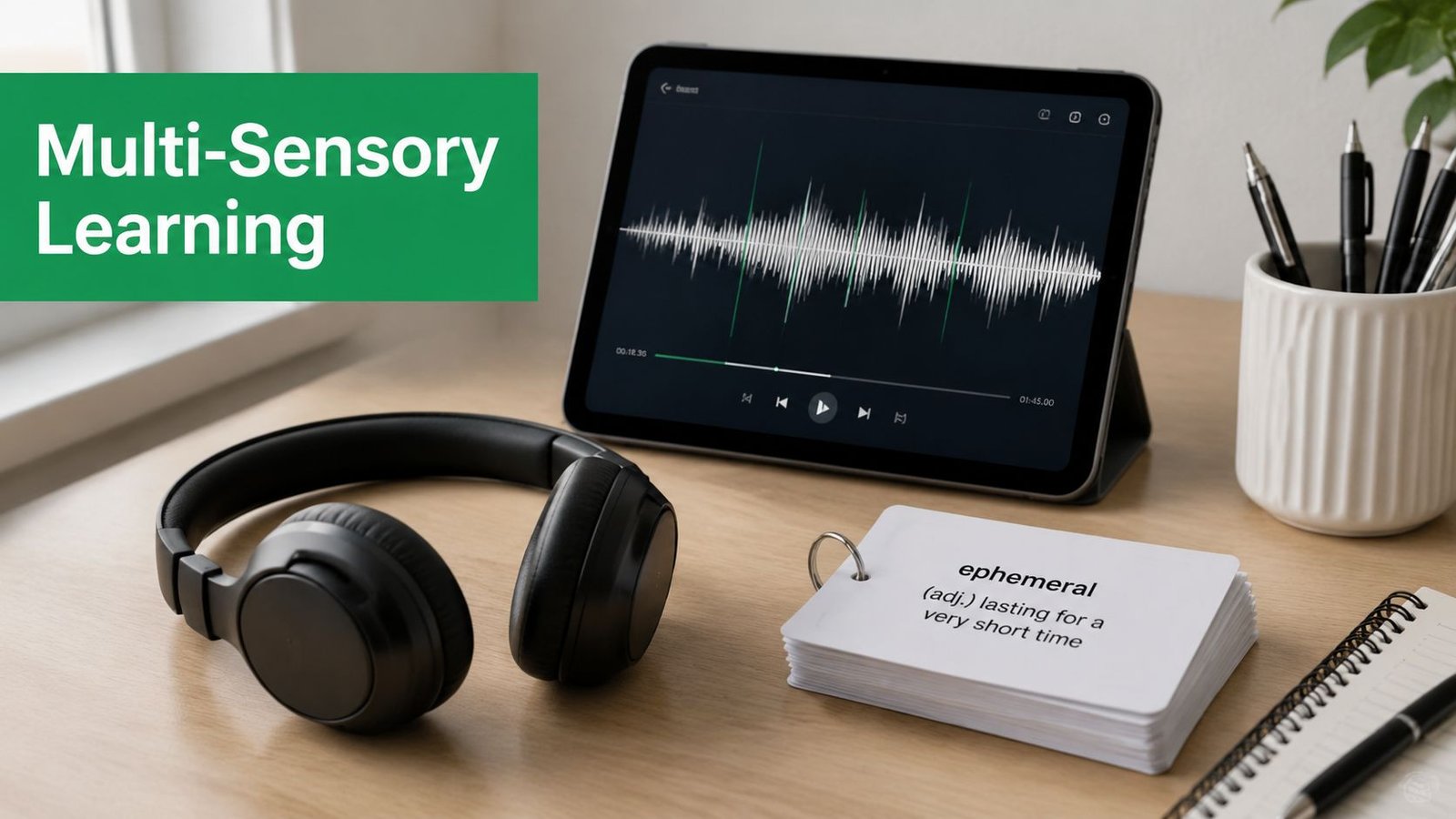
A word becomes easier to access when several cues lead to it. You might see its spelling, hear its pronunciation, read it in a sentence, connect it with an image, and say it while carrying out a meaningful task. Multimodal learning combines these routes instead of asking a single written translation to do all the work.
The evidence doesn't support treating multimodal input as universally superior. A 2025 study found audiovisual input improved delayed vocabulary retention more than audio-only or visual-only input, but beginners benefited more than intermediate learners. The same research also reported that caption format and working-memory capacity changed outcomes, while multimodal flashcards outperformed text-only cards for concrete nouns in the study of audiovisual vocabulary learning.
Match the mode to the word
Concrete words, such as food or objects, may respond well to images and spoken labels. Abstract words may need a dialogue, an example sentence, and a brief explanation of how the idea works in Irish. Pronunciation requires active listening and speaking, not just visual exposure.
Gaeilgeoir AI combines pronunciation support with guided conversations, while language apps may combine images, audio, text, and interaction. Try a simple sequence for an Irish word related to travel:
- See it: Read the spelling and a short phrase.
- Hear it: Listen for the sound pattern and stress.
- Say it: Repeat aloud without rushing.
- Use it: Put it into a question about your own journey.
- Recall it: Answer a later prompt without viewing the model.
7. Semantic Clustering and Word Families
Irish vocabulary becomes easier to organize when related words share a learning space. Grouping terms by food, travel, work, weather, or family lets one word cue another. You can then build a usable network rather than a long sequence of unrelated translations.
Semantic clustering is useful for a conversation such as ordering food. You might group words for the menu, asking politely, choosing an item, responding to a question, and paying. The cluster should reflect the actions of the scenario, not only a dictionary category.
Look beyond the base word
Word families add depth. In Irish, related forms can include verbal nouns, conjugated verbs, gender variations, and other grammatical forms. The exact relationships need careful checking, so learn each form in a phrase rather than assuming that a familiar-looking word behaves exactly as its relative does.
Create a topic map with a central situation. For directions, branch into places, movement, questions, distance, and confirmation. For work, branch into roles, tasks, schedules, opinions, and requests. Then practise moving between branches in a short exchange.
A useful exercise is to take one known word and ask:
- What belongs beside it? Find a phrase or collocation from a dialogue.
- What changes its form? Notice related grammatical forms in context.
- What situation needs it? Connect it to food, travel, work, family, or study.
- What can I say next? Add a follow-up question or response.
This structure supports both breadth and depth. You learn more words, but you also learn how they cooperate inside real Irish sentences.
8. Elaboration and Deep Processing
Elaboration means giving a new word more connections than its translation alone. Ask when you'd use it, why that situation calls for it, what other words surround it, and how its grammar or cultural meaning affects your sentence. The deeper question isn't “What does this mean?” but “What can I do with it?”
Suppose you meet a phrase for asking directions. Write a sentence about a place you know. Then imagine the listener doesn't understand and rephrase the request. Finally, use the phrase in a short dialogue. Each step links the vocabulary to personal experience, communicative purpose, and flexible production.
Add personal notes that change recall
Your notes don't need to be long. Record a pronunciation reminder, a phrase from a conversation, a connection to a family story, or a distinction between two words that seemed similar. If you're preparing Leaving Cert oral topics, write a sentence about your own school, hobbies, home, or plans instead of copying a generic model.
Cultural context can make vocabulary more memorable, but avoid treating one explanation as a complete account of Irish usage. Ask how a phrase sounds in a particular exchange, whether it suits a formal or informal setting, and what a native speaker might say next. Guided conversation gives you a practical way to test those questions.
Use a three-part Irish reflection after each session:
- Meaning: What idea does the word express?
- Situation: When would I say or hear it?
- Connection: What person, place, memory, or known word helps me remember it?
Then retrieve the word later without reading your note. If you can use it in an original sentence, the vocabulary has begun moving from recognition toward communication.
9. Frequency-Based Vocabulary Prioritization
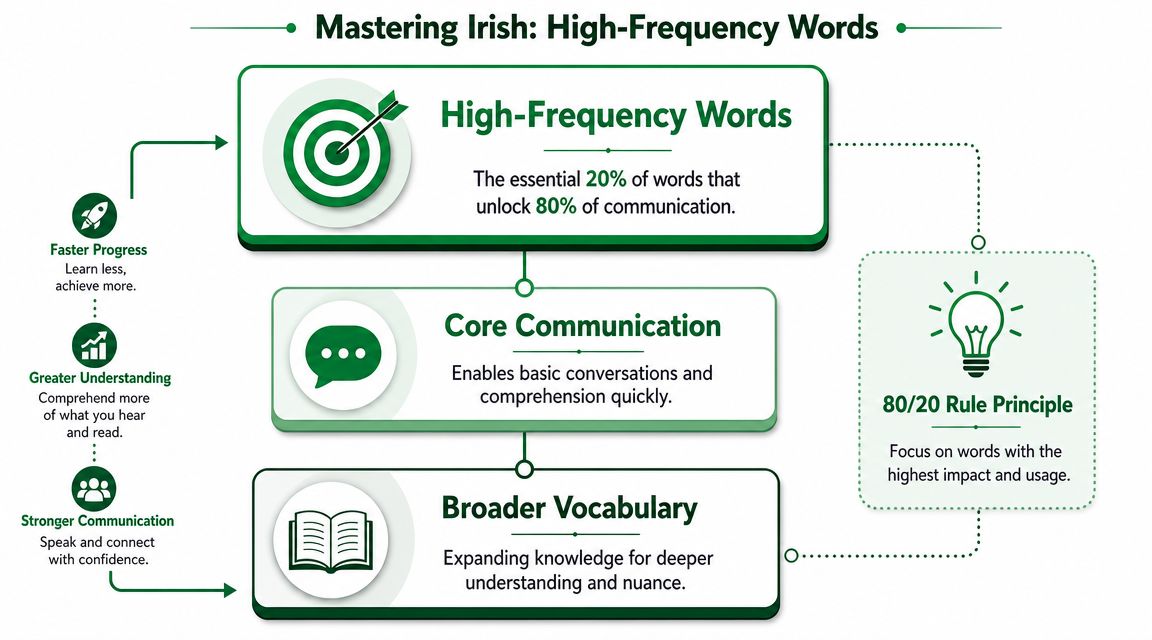
You don't need to learn every Irish word before you start speaking. Prioritization helps you spend early study time on vocabulary that supports common interactions and the situations you care about most. High-frequency words form a practical foundation, while specialized terms can be added when your goals demand them.
Gaeilgeoir AI describes an immersion-first approach grounded in the 1,000 most-used Irish words, giving learners a clear starting point for foundational communication. Frequency lists and dictionaries can also guide selection, but a general ranking shouldn't override your life. A less frequent word may be essential if you work in a particular field, travel to a specific place, or need it for an oral topic.
Combine frequency with purpose
Start with common vocabulary for greetings, questions, time, people, places, food, movement, and everyday actions. Then filter that foundation through one priority scenario. A learner preparing to travel needs directions and service interactions. A student preparing for Leaving Cert needs topic vocabulary and flexible opinions. A heritage learner may prioritize family and regional connections.
Use this selection process:
- Choose a scenario: Food, travel, work, social conversation, or an oral-exam topic.
- Select useful high-frequency words: Prefer terms that help you form many sentences.
- Add essential scenario words: Include items that may be less common but matter to your goal.
- Practise combinations: Learn phrases and questions, not isolated entries.
- Revisit the foundation: Keep common words active while adding specialized vocabulary.
Measure progress by what you can accomplish. Can you ask for clarification, describe a preference, answer a follow-up question, or recover when you forget a word? Recognition matters, but successful use tells you more about practical acquisition.
10. Pronunciation and Phonetic Awareness Integration
A vocabulary item you can't recognize in speech or produce clearly remains difficult to use. Irish spelling and sound patterns deserve attention from the moment you meet a word. Listen to a reliable model, notice stress and intonation, and connect the written form to the sound rather than making an internal guess.
Pronunciation practice also supports listening. When you learn to produce a sound distinction yourself, you become more prepared to notice it in another speaker's sentence. Speaking aloud may feel uncomfortable at first, but silent familiarity won't develop the same control.
Use a short sound-to-conversation cycle
Choose one word from a food, travel, work, or Leaving Cert topic. First listen to the model several times. Then say it slowly, place it in a phrase, record yourself, and compare your attempt with the model. Finish by using it in a question and a response, because natural pronunciation includes rhythm, emphasis, and connected speech.
Gaeilgeoir AI offers pronunciation support within guided conversations, and online pronunciation practice can help you work on production while using vocabulary in context. Ask for correction when available, but don't chase an abstract perfect accent. Aim for clear, intelligible speech that lets the conversation continue.
Look for patterns across related words. When several items share a sound or spelling feature, practise them together, then test each one separately. This combines phonetic awareness with retrieval, so pronunciation isn't an isolated warm-up. It becomes part of knowing the word.
Vocabulary Acquisition: 10-Strategy Comparison
| Approach | 🔄 Implementation Complexity | ⚡ Resource Requirements | ⭐ Expected Outcomes | 📊 Ideal Use Cases | 💡 Key Advantages |
|---|---|---|---|---|---|
| Spaced Repetition Systems (SRS) | Moderate, algorithm + deck creation | Low–Moderate, apps/software, initial content | ⭐⭐⭐⭐ High long‑term retention; efficient review | Foundations: high‑frequency vocabulary, daily self‑study | 💡 Very time‑efficient; adaptive scheduling; proven by research |
| Immersion‑Based Contextual Learning | High, authentic scenarios & scaffolding | High, native content, tutors or curated media | ⭐⭐⭐⭐ Strong communicative competence & contextual use | Conversational fluency, travel, cultural immersion | 💡 Teaches pragmatic use; highly motivating and contextual |
| Active Recall & Retrieval Practice | Moderate, design of tests/feedback loops | Moderate, quiz interfaces, instant feedback | ⭐⭐⭐⭐ Robust memory formation; gap detection | Exam prep, strengthening weak items, retention boosting | 💡 Forces retrieval; quickly reveals and remediates gaps |
| Gamification & Motivation Systems | Moderate, game mechanics + UX design | Moderate–High, tracking, UI, community features | ⭐⭐⭐ Increases engagement and consistency (variable depth) | Habit formation, busy adults, sustained practice | 💡 Boosts motivation and daily practice; measurable progress |
| Personalized Learning Paths & Adaptive Systems | High, adaptive algorithms & analytics | High, learner data, backend, dynamic content | ⭐⭐⭐⭐ Optimized individual progress; efficient pacing | Tailored curricula, diverse learner profiles, efficiency focus | 💡 Targets weaknesses, maintains flow, maximizes time use |
| Multi‑Sensory & Multimodal Learning | High, integrate audio/video/interaction | High, multimedia assets, production resources | ⭐⭐⭐⭐ Better recall via multiple cues; pronunciation gains | Learners with varied styles; pronunciation and retention focus | 💡 Multiple retrieval cues; inclusive; increases engagement |
| Semantic Clustering & Word Families | Moderate, taxonomy and mapping design | Low–Moderate, curated thematic lists | ⭐⭐⭐ Organized knowledge; aids inference and transfer | Thematic learning, morphology, expanding related vocabulary | 💡 Builds networks of meaning; accelerates productive use |
| Elaboration & Deep Processing | Moderate–High, prompts, guided reflection | Low–Moderate, prompts, tutor or scaffolding materials | ⭐⭐⭐⭐ Deep, meaningful retention and flexible use | Advanced learners, nuance, cultural and grammatical depth | 💡 Encourages meaningful connections; improves transferability |
| Frequency‑Based Vocabulary Prioritization | Low, apply frequency lists to curriculum | Low, word lists, simple sequencing | ⭐⭐⭐ High immediate communicative ROI for beginners | Beginners with limited time; foundational vocabulary sets | 💡 Maximizes early communication; reduces overwhelm |
| Pronunciation & Phonetic Awareness Integration | Moderate, phonetic guidance + feedback | Moderate–High, native audio, recording/feedback tech | ⭐⭐⭐⭐ Improved listening comprehension and spoken accuracy | Languages with complex phonology (e.g., Irish); speaking focus | 💡 Builds accurate production and listening skills; early correction |
Turn Ten Strategies Into One Irish Practice Loop
The ten vocabulary acquisition strategies work best as a loop. You don't need to run ten separate lessons, and trying to do so can create unnecessary cognitive load. Instead, let each strategy solve a different part of the same problem: choosing useful words, understanding them, remembering them, saying them, and using them with another person.
Begin with frequency and purpose. Select a small group of useful words for one priority scenario, such as ordering food, asking directions, discussing work, or answering a Leaving Cert oral question. Add the words you need, even when a general frequency list doesn't place them at the top. Your first measure of progress should be communicative: can you complete the task, ask a follow-up question, or repair a misunderstanding?
Next, meet the vocabulary in a realistic context. Use a guided dialogue, a short scenario, or a conversation prompt rather than studying translations alone. Notice the words that appear together, the grammatical forms that change, and the cultural details that affect how the exchange sounds. Semantic clustering and elaboration become practical here. You're building connections around each item.
Then focus on sound. Listen to the Irish pronunciation, repeat the word, and place it in a complete phrase. Record yourself if that helps you notice unclear sounds or misplaced stress. Follow the pronunciation work with active retrieval. Hide the answer, complete a gap, respond to a spoken prompt, and say the phrase without reading a model.
A repeatable weekly rhythm
A flexible routine might look like this:
- Choose: Select vocabulary for one real-life scenario.
- Encounter: Meet it in a dialogue or guided activity.
- Notice: Record pronunciation, related forms, and useful combinations.
- Retrieve: Test yourself with an adaptive quiz, flashcard, or spoken prompt.
- Save: Add difficult words to a personalized study list.
- Space: Revisit those items at increasingly separated intervals.
- Use: Finish with a short spoken exchange that requires spontaneous production.
A computer-based CALL study found that learners who spent an average of three minutes per day on automatically generated vocabulary activities increased long-term vocabulary knowledge, showing why short, consistent micro-sessions can suit busy learners in the study of computer-based spaced repetition. The point isn't that every learner should copy that exact schedule. The point is to make practice small enough to repeat and rich enough to include retrieval, feedback, and use.
Self-regulation matters too. Recent synthesis on adult and ESP learners frames vocabulary growth as a systems problem, while mobile-assisted research with software-engineering students found benefits from combining adaptive spaced repetition with virtual flashcards for vocabulary, grammar accuracy, retention, and motivation in the recent synthesis and mobile-assisted study. For Irish learners, that means pairing a review tool with a clear goal, manageable sessions, and deliberate attention to mental effort.
Choose one scenario for a week instead of constantly switching topics. Use the vocabulary in a conversation, retrieve it later, and return to the words that remain difficult. At the end of the week, judge progress by successful use, not simple recognition. A word counts as useful when you can hear it, say it, adapt it, and bring it into a meaningful exchange.
Visit Gaeilgeoir AI's learning platform to practise Irish through guided conversations, adaptive quizzes, pronunciation support, and saved vocabulary. The published page should also have pingbacks and comments disabled, because those are WordPress post-level discussion controls rather than learning-content mechanics, as explained in WordPress discussion documentation.
Use Gaeilgeoir AI to meet Irish vocabulary in real conversations, test recall with adaptive quizzes, practise pronunciation, and save difficult words for spaced review. Choose one situation today, complete a short guided exchange, and start building a personal vocabulary routine you can repeat.