You're probably here because you've seen Irish on a road sign, heard a phrase in a song, or felt that tug to reconnect with something older and more rooted. Then you try to learn a few words and hit a wall. One site gives you a translation, another gives you a different spelling, and suddenly a simple word like “beautiful” seems less simple than it should be.
That confusion is normal. Learning Gaelic, especially Irish Gaelic, gets much easier when you stop treating it like a word-for-word code and start hearing it as a living language with patterns, texture, and mood. Irish rewards curiosity. A small grammar rule can completely change how natural you sound, and a single adjective can tell you a lot about tone, context, and even culture.
Table of Contents
- More Than a Word An Introduction to Beauty in Irish
- The Main Word for Beautiful Álainn
- Exploring Other Shades of Beautiful
- Making It Sound Right Grammar and Agreement
- From Beautiful to Most Beautiful
- Putting It All Together Real Phrases and Examples
- Practice Speaking with Your AI Gaeilgeoir
More Than a Word An Introduction to Beauty in Irish
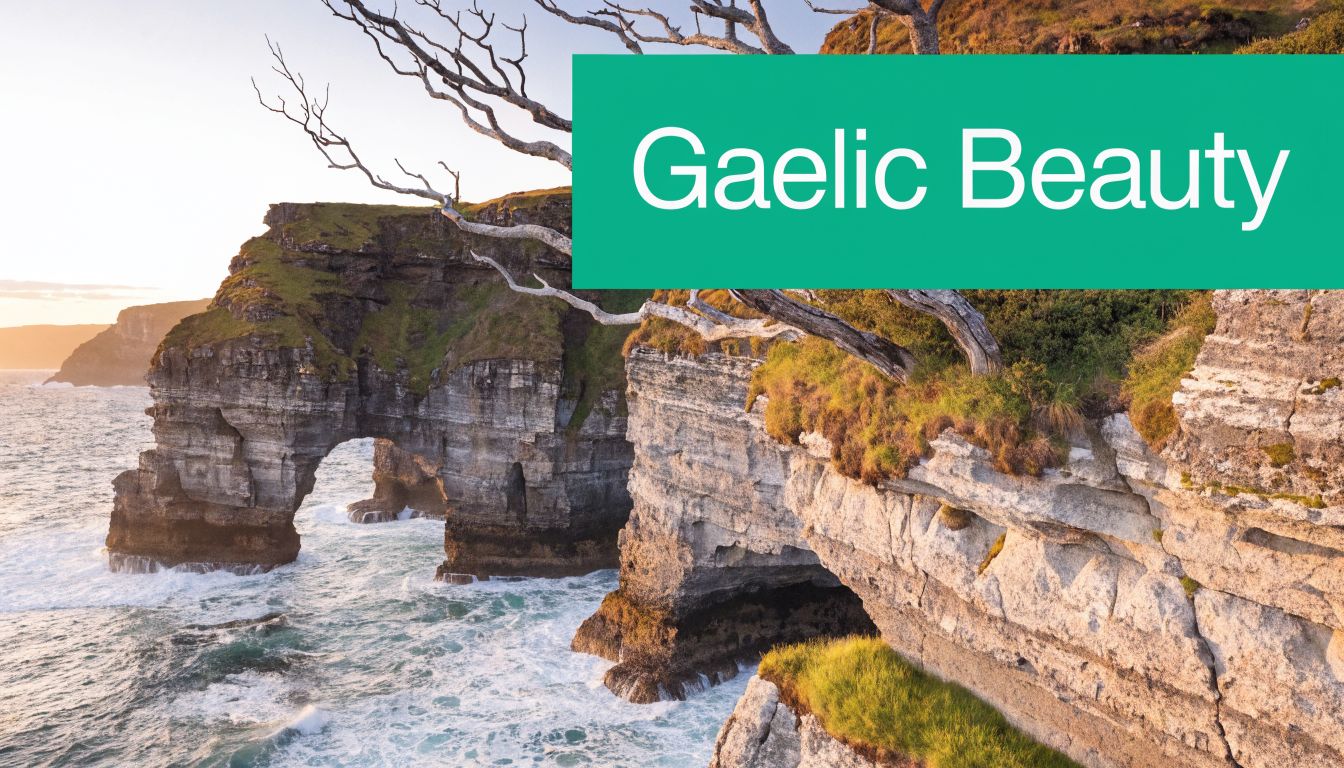
You stand on the west coast, the wind is loud, the sea is grey-blue, and the cliffs look almost unreal. In English, “beautiful” does the job. In Irish, you quickly notice that one English word opens into several choices, each with its own shade of meaning.
That's one of the joys of learning Gaelic. Irish often asks you to be a little more precise. Is something grand and striking? Soft and pleasant? Fine and elegant? The language nudges you to notice more.
That sensitivity to detail is part of what makes Irish feel so expressive. It doesn't just label the world. It colours it. When learners first meet words like álainn, deas, or breá, they're not just memorising synonyms. They're learning how Irish speakers shape feeling and description.
Irish is also very much alive now, not locked away in old books. The language has seen a 71% increase in speakers in Ireland since 1991, and digital tools like Duolingo have over 1 million active learners at any given time, which helps explain why Irish is now one of the world's most actively studied minority languages, as noted in this overview of the growing Gaeilge opportunity.
If you're curious about why Irish sounds the way it does, this guide to what makes Irish sound unique is a helpful companion. Pronunciation and meaning are tightly linked in Irish, so the sound system matters from the start.
Irish often feels poetic because it asks you to choose words by situation, not just by dictionary match.
That can seem like extra work at first. It's a gift. Once you understand the pattern, the language starts to feel warmer, richer, and much more human.
The Main Word for Beautiful Álainn
If you learn only one word for “beautiful” today, make it álainn.
This is the broad, dependable word you can use in many situations. You can use it for a person, a place, a day, a song, a memory, or a piece of art. It carries the sense of real beauty, not just “nice enough.”
How to say álainn
A simple pronunciation clue is AWL-inn.
Say the first part gently, with an “awl” sound. Then finish with a short “inn.” Don't worry if it isn't perfect on day one. Irish pronunciation becomes clearer when you repeat whole phrases, not isolated syllables.
Try these:
- bean álainn = a beautiful woman
- áit álainn = a beautiful place
- lá álainn = a beautiful day
Notice how useful this is already. With one adjective, you can start describing the world around you.
When álainn fits best
Think of álainn as your “full beauty” word. If deas is like “nice” or “pretty,” álainn is stronger and deeper. It suits moments when you want to say something moved you.
A few easy examples:
Tá an áit seo álainn.
This place is beautiful.Bhí lá álainn againn.
We had a beautiful day.Is amhrán álainn é sin.
That is a beautiful song.
The exact sentence structure can wait. What matters first is confidence. You want a word you can reach for quickly.
Practical rule: If you're unsure which Irish word for “beautiful” to use, start with álainn. It's the safest and most flexible choice.
A memory trick that helps
Link álainn to moments with emotional weight. A coastline. A singer's voice. A child asleep. A sky after rain. The word sticks better when it's tied to an image.
Many learners make the mistake of building long vocabulary lists too early. A better start is to take one strong word and use it in five or six real phrases. That's how language becomes available in conversation, not just visible on a flashcard.
Exploring Other Shades of Beautiful
Once álainn feels comfortable, your Irish becomes more natural when you add a few nearby words. English leans heavily on “beautiful.” Irish spreads that meaning across different everyday choices.
The key is not to ask, “Which word is the direct translation?” Ask, “What kind of beauty do I mean?”
Three common choices
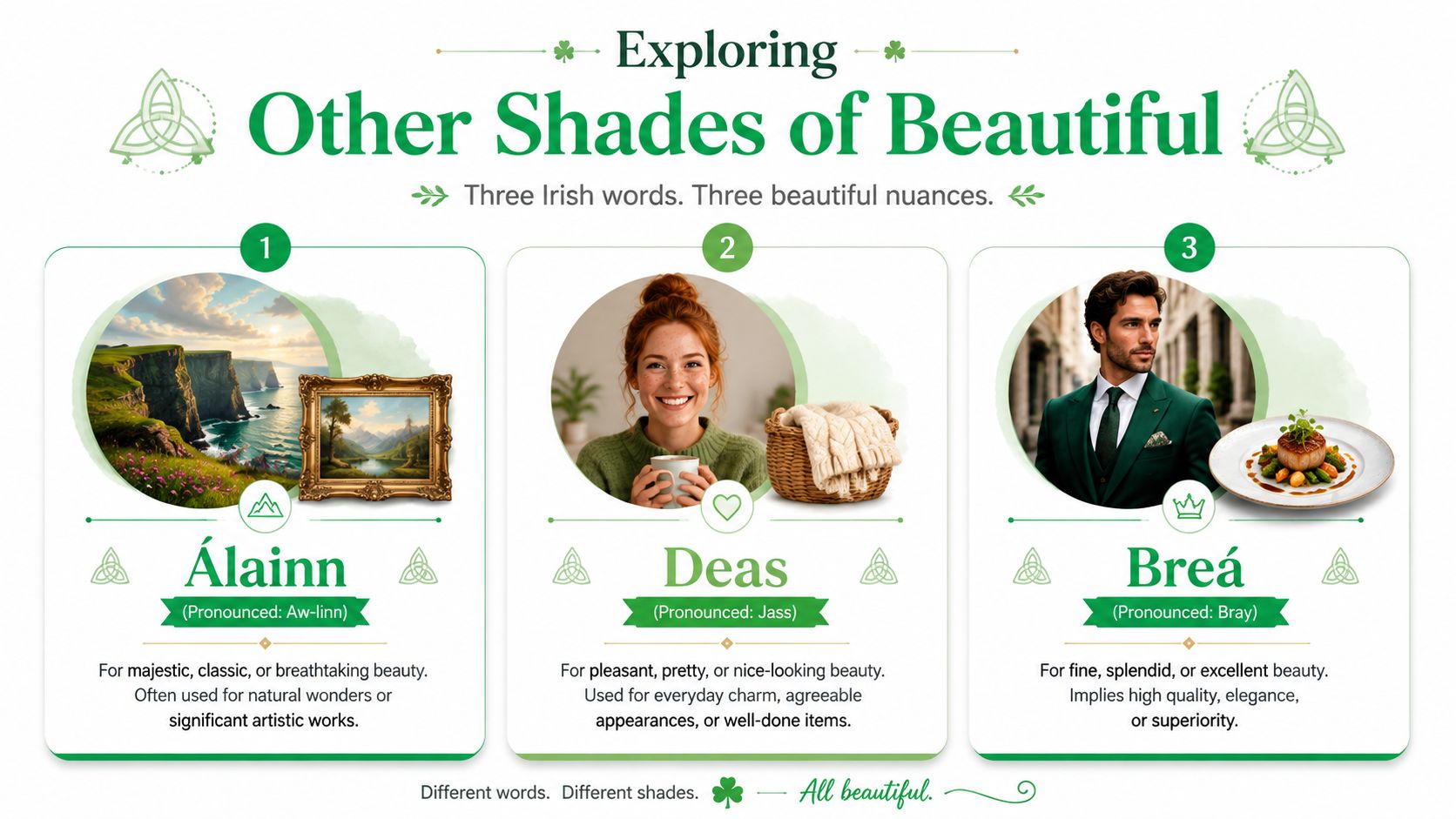
Here's a practical way to separate them in your mind:
Álainn
This is the strongest all-purpose choice for beauty. Use it when something feels striking, moving, or deeply lovely.Deas
This often means “nice,” “pleasant,” or “pretty.” It can describe a person, weather, clothing, or a friendly atmosphere. It's lighter than álainn.Breá
This can suggest “fine,” “splendid,” or “lovely.” It often has a polished feel, and you'll hear it in phrases about weather, appearance, and quality.
If you're building a study habit, the same approach used in daily English vocabulary routines works well here too. Don't collect ten near-synonyms at once. Learn three words, compare them, then use each in a sentence you'd genuinely say.
How the tone changes
Think of these words like paint shades.
Álainn is the deep, rich colour you use for something memorable.
Deas is the bright everyday shade that makes speech sound friendly and natural.
Breá has a neat, finished quality, like complimenting something for being both lovely and well put together.
Here are simple examples:
- cailín deas = a nice or pretty girl
- lá breá = a fine day
- pictiúr álainn = a beautiful picture
You may also meet dathúil, often used for “handsome” or “good-looking,” especially for a person. It's more specific than álainn and less general than deas.
Context matters more than dictionaries
A bilingual dictionary can tell you what a word can mean. It usually can't tell you what feels natural in the moment.
That's why collections of cool Irish words to know can be useful when you're learning Gaelic. They expose you to mood and context, not just bare translations.
A learner who knows one word in ten real situations usually speaks better than a learner who knows ten words in no situation at all.
When you're choosing among álainn, deas, and breá, don't chase perfection. Pick the one that matches the feeling best. Native-like precision grows through exposure and repetition.
Making It Sound Right Grammar and Agreement
Irish gets its music from small changes. One of the biggest is that words often shift depending on what comes before them. At first this feels strange. After a while, it starts to feel elegant.
Two ideas matter early on. First, every noun in Irish is masculine or feminine. Second, the adjective that follows it may change sound or spelling. This is why Learning Gaelic is not just about storing vocabulary. It's about noticing relationships between words.
Why Irish changes words at the beginning
One of the most famous Irish grammar features is lenition, or séimhiú. In writing, this often means adding an h after the first consonant. In speech, it softens the beginning of the word.
You can think of lenition like a dimmer switch instead of an on-off switch. The word is still the same word, but the opening becomes gentler.
For example, with some feminine nouns, an adjective beginning with certain consonants lenites:
- bean deas can become a form where the adjective softens after the noun
- deas may appear as dheas in the right grammatical setting
Not every adjective changes in the same visible way, and not every learner needs every rule on the first day. What matters is hearing that Irish often prefers flow over rigidity.
Gaelic's grammatical structure, including lenition, is one reason regular study matters. According to this discussion of how hard Gaelic is to learn, daily sessions of at least 30 minutes strengthen long-term retention by 50-200% compared with infrequent longer sessions. That fits what most teachers see in practice. Irish settles into memory through contact, not cramming.
A small table that makes this easier
Here's a beginner-friendly snapshot. The examples focus on the pattern, not on memorising every exception at once.
| Adjective | Example Noun (Feminine) | Resulting Phrase | Pronunciation Clue |
|---|---|---|---|
| deas | bean | bean dheas | the dh is softened, almost like a light glide |
| beag | fuinneog | fuinneog bheag | bh is softened |
| mór | oíche | oíche mhór | mh sounds softened at the front |
The exact sound of lenited consonants varies, and dialect affects how strong that change is. But the main idea stays the same. Irish smooths transitions between words.
A simple way to think about agreement
Try this three-step check when making a phrase:
Find the noun
Is the thing you're describing a woman, place, day, song, or something else?Learn its gender
You won't always guess correctly at first, and that's fine. Gender is part memory, part exposure.Notice whether the adjective changes
Sometimes it won't. Sometimes the beginning softens.
If this feels technical, keep it grounded in sound. Language learners often freeze because they think grammar is a list of punishments. In Irish, grammar is often just a set of habits that make speech flow better.
For a fuller walkthrough of these patterns, mastering adjectives in Irish is worth reading alongside your phrase practice.
Don't try to master every mutation rule in one sitting. Learn one pattern, hear it in a phrase, then reuse it until it feels ordinary.
That's when grammar starts helping instead of intimidating.
From Beautiful to Most Beautiful
Once you can say something is beautiful, the next useful step is comparison. You want to say one place is more beautiful than another, or that a certain song is the most beautiful one you know.
Irish gives you a neat pattern for this.
The comparison pattern
For more beautiful, use níos plus the comparative form.
For most beautiful, use is plus the comparative form in the right structure.
With álainn, the form you'll often meet is áille.
So you get:
- níos áille = more beautiful
- is áille = most beautiful
That spelling shift can surprise beginners, but it's normal. English does this too in its own way. We say “good, better, best,” not “good, gooder, goodest.” Irish also changes form rather than adding one fixed ending every time.
What changes in álainn
The jump from álainn to áille is one of those forms you should learn as a chunk. Don't overanalyse it too early.
Use it in clear comparisons:
Tá an pictiúr seo níos áille.
This picture is more beautiful.Is í seo an áit is áille.
This is the most beautiful place.Tá an leagan sin níos deise.
That version is nicer.
You can already hear how your Irish becomes more expressive here. You're no longer just naming qualities. You're weighing, comparing, and reacting.
A good habit is to compare things around you:
- this room and that room
- today and yesterday
- one song and another song
- two photos from a trip
That turns grammar into opinion, and opinion is where real conversation begins.
Once you can compare, you stop sounding like you're pointing at objects and start sounding like you have a voice.
If the forms feel slippery, repeat whole sentences instead of isolated adjective charts. Your ear will often learn the pattern before your conscious mind can explain it.
Putting It All Together Real Phrases and Examples
Vocabulary and grammar begin to function like a genuine language here. You are not simply memorizing terms for “beautiful.” You are discovering how Irish speakers use them in praise, description, and everyday reaction.
Useful phrases you can actually say
Try these out loud:
Tá an radharc álainn.
The view is beautiful.Lá breá deas atá ann.
It's a lovely, nice day.Tá gúna deas uirthi.
She's wearing a nice dress.Is amhrán álainn é.
It is a beautiful song.Is í an bhean is áille ar domhan í.
She is the most beautiful woman in the world.
Notice the spread of tone. Álainn lifts the sentence. Deas keeps it conversational. Breá adds a smooth, pleasant note.
If you want to build fluency, don't memorise these in your head. Say them while looking at something real. A window view. A jacket. A painting. A person in a photograph. Irish sticks when the phrase has a target.
A quick note on dialects
Irish has regional varieties, and pronunciation can shift from one area to another. That means a word you learned from a teacher in Munster may sound a little different in Connacht or Ulster.
This isn't a problem. It's part of the life of the language.
A few things beginners notice:
- Deas may sound sharper or softer depending on the speaker.
- Vowel length can feel different across regions.
- Some everyday phrasing choices vary by dialect, even when the grammar is still recognisably the same.
Treat dialect like accent, not like contradiction. English speakers don't panic when Dublin, Glasgow, and Toronto sound different. Irish works the same way.
A mini phrase bank for practice
Use these as short drills:
Áit álainn
a beautiful placeBean dheas
a nice womanLá breá
a fine dayNíos áille
more beautifulIs áille
most beautiful
Read the phrase, look away, then say it from memory. After that, swap in a new noun. Change áit to teach, or lá to maidin. That small act of substitution is where passive knowledge turns active.
Some of the best Irish practice is ordinary. Describe your tea, your street, your weather, your music, and your mood.
That may sound humble, but it's how people begin speaking.
Practice Speaking with Your AI Gaeilgeoir
Reading examples helps, but speaking is where most learners stall. You know the word on the page, then your mouth hesitates when it's time to use it. That's especially common with Irish because pronunciation, mutations, and sentence rhythm all meet at once.
A useful first step is to give yourself tiny speaking tasks each day:
A simple practice routine
- Describe one object with deas or álainn.
- Compare two things using níos áille or níos deise.
- Say one full sentence aloud about the weather, a place, or a photo.
- Repeat after audio and notice where your pronunciation drifts.
That last part matters. A simple explanation of AI transcription engine basics can help you understand how speech tools detect what you said and where your pronunciation may differ from the target.
Traditional study often under-serves speaking. A 2025 study found that 62% of Gaelic learners abandon traditional methods within 3 months because they lack speaking practice, while gamified apps with AI feedback and scenario-based learning retain 35% more users, according to SpeakGaelic's referenced discussion of this learning gap.
That's why tools built around conversation can help busy adults more than static word lists. Gaeilgeoir AI is one example. It offers guided Irish conversations, pronunciation support, and scenario-based practice for situations like travel, social interaction, or asking for directions.
When you want a quick speaking model, this video is a useful addition to your practice session:
The actual goal isn't perfect performance. It's regular output. A few spoken lines every day will take you farther than long silent study sessions once a week.
If you want to turn these phrases into real conversation practice, try Gaeilgeoir AI. It gives you guided Irish speaking practice with pronunciation support and everyday scenarios, so words like álainn, deas, and breá move from recognition into active use.