You're probably here because a plain translation doesn't feel like enough.
Maybe you want to write a card for your mum. Maybe you're reconnecting with Irish family roots and want the right word, not just any word. Maybe you learned a bit of Irish in school, forgot most of it, and now you'd like to say “mother” in a way that sounds natural and respectful.
In Irish, that little word carries more than dictionary meaning. It sits inside family life, memory, tone, and grammar. If you've searched for mother in irish gaelic, you've already noticed the confusing part. You'll find máthair, but you'll also see mamaí, mam, and forms that seem to change once you put them into a sentence.
That's normal. Irish does that. The good news is that the patterns are learnable, and once you see them clearly, they start to feel satisfying rather than intimidating.
Table of Contents
- Connecting with Your Roots Through Language
- Understanding the Core Term Máthair
- How to Say Mom Informally in Irish
- Mastering the Grammar of Máthair
- Using Mother in Irish Phrases and Sayings
- Practice Makes Perfect Your Next Steps
Connecting with Your Roots Through Language
You are writing a card for Mother's Day, ordering a piece of jewellery, or trying to say one Irish phrase out loud at a family gathering. Then a simple question appears: what is the right word for “mother,” and which form would an Irish speaker use?
That question matters because Irish family words carry both feeling and grammar. A learner often starts with emotion first. You want something that sounds like home, something that connects you to parents, grandparents, and place. Then the grammar appears a moment later, usually when you try to say “my mother” or call directly to your mum.
That is why this topic is more than a straight translation exercise. Irish gives you a formal word, máthair, and an everyday family word, mamaí. Both are useful, but they do different jobs. Learning that difference early saves a lot of hesitation later.
If your interest in Irish comes from family history, a quick look at the origins of the Irish language helps explain why even one household word can feel so loaded with memory. For many learners, this is not only about vocabulary. It is about hearing a thread of identity again.
There is cultural weight here too. In Irish life, words for close family are rarely cold labels. They sit inside stories, habits, and relationships. “Mother” can sound formal, affectionate, respectful, or very personal depending on the word you choose and the grammar around it.
A useful way to approach this is to treat the vocabulary and the grammar as a pair. The word is only the starting point. Irish then asks a few follow-up questions. Are you naming your mother in a sentence? Are you saying “my mother”? Are you calling out “Mam!” to get her attention? Those small shifts change the form, and they are exactly the kind of details that help your Irish sound natural rather than translated.
You do not need perfect Irish to begin well.
You need the right base word, a feel for when formal or informal speech fits, and a little guidance on the grammar patterns that appear in real conversation. That is how a single family word starts to feel living and usable, not just memorised.
Understanding the Core Term Máthair
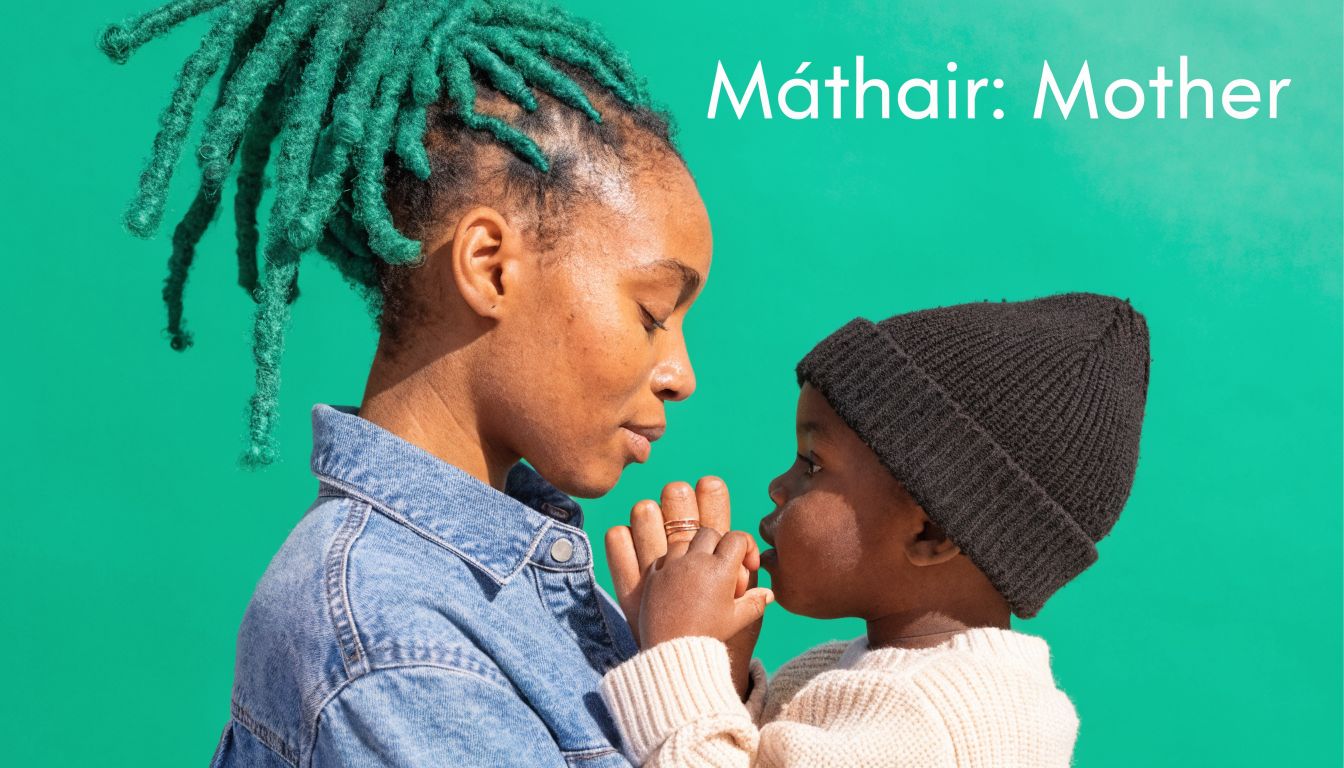
Máthair is the standard Irish word for mother. If you see the word in a dictionary, a school text, or a formal sentence, this is usually the form you will meet.
How to pronounce máthair
A useful beginner guide is MAW-hir. That spelling is only an approximation, but it gives you a workable starting point while your ear adjusts to Irish sounds.
Irish pronunciation often feels unfamiliar at first because the spelling and the sound do not always line up the way they do in English. For that reason, it helps to listen as well as read. This Irish pronunciation guide is a good support if you want to hear how broad and slender sounds shape words like máthair.
The word itself is old. It comes from Old Irish máthair, and it belongs to the same wider language family as English mother and Latin mater. If you have ever noticed that these words feel faintly related, you are hearing a real historical connection.
What máthair does in a sentence
The easiest way to learn máthair is to treat it as your base form. It works like the dictionary version of the word. You use it when you are naming the role itself, not necessarily speaking to your own mum in a warm, everyday way.
For example:
- Is máthair í. = She is a mother.
- Tá an mháthair sa teach. = The mother is in the house.
- Is í mo mháthair í. = She is my mother.
That last example matters. Learners often know the word máthair, but hesitate once grammar starts changing the shape around it. Irish does that often with family terms. The core word stays important because other common forms grow from it.
When máthair sounds natural
Use máthair when the tone is neutral, descriptive, or formal.
That includes contexts such as:
- dictionary learning and vocabulary study
- schoolwork and careful writing
- describing someone as a mother
- phrases where grammar builds on the base noun
If you are reconnecting with family heritage through Irish, this distinction helps a lot. Máthair gives you the formal root of the idea. It is the word you build from. Later, when you say “my mother” or call out directly to your mum, Irish changes form and tone. Those changes are where learners start to sound natural instead of translated.
So keep máthair in your mind as the anchor word. It is the steady, formal form. Once that feels familiar, the grammar around it becomes much easier to follow.
How to Say Mom Informally in Irish
You are writing a card to your mum, or maybe rehearsing what you would say if you greeted her in Irish. In that moment, máthair can feel a little distant. The warmer everyday choice is often mamaí.

The everyday word many learners need
Omniglot's Irish kinship terms list mamaí as a common informal family term. That matches what learners quickly notice. The dictionary word is useful, but the home word is often different.
A simple way to hear the contrast is this:
- máthair = mother
- mamaí = mum, mammy, or mommy, depending on family tone and local habit
The English match is never perfect. Family words carry feeling as much as meaning, and that feeling changes from house to house.
You may also hear mam and sometimes mom in Ireland, especially in English speech. Regional habits shape those choices. For learning Irish, though, mamaí is a safe and familiar informal form to recognize.
Choosing the right tone
Learners often ask which word is "correct." Both are correct. The fundamental question is which one fits the relationship and the setting.
Use mamaí if you are speaking with affection, talking at home, or practicing the kind of Irish you would use with family. Use máthair if you are writing formally, studying vocabulary, or describing someone in a neutral way.
That difference is a bit like clothing. Máthair works like the formal outfit you wear when you need to be careful and precise. Mamaí is the comfortable everyday version that belongs in ordinary conversation.
For related affectionate family vocabulary, this guide to Irish Gaelic terms of endearment helps show how tone shifts across close relationships.
If you want your Irish to sound loving and natural at home, mamaí is often the better choice.
One detail catches many learners by surprise. The word can still change when you speak directly to your mum. Casual language in Irish still follows grammar, and that matters a lot with family words.
Mastering the Grammar of Máthair
Knowing the word isn't enough. To use mother in irish gaelic confidently, you need a few grammar patterns that show up right away in real speech.
The two that matter most are possession and direct address. In plain English, that means learning how to say things like your mother and O mother or Mam!
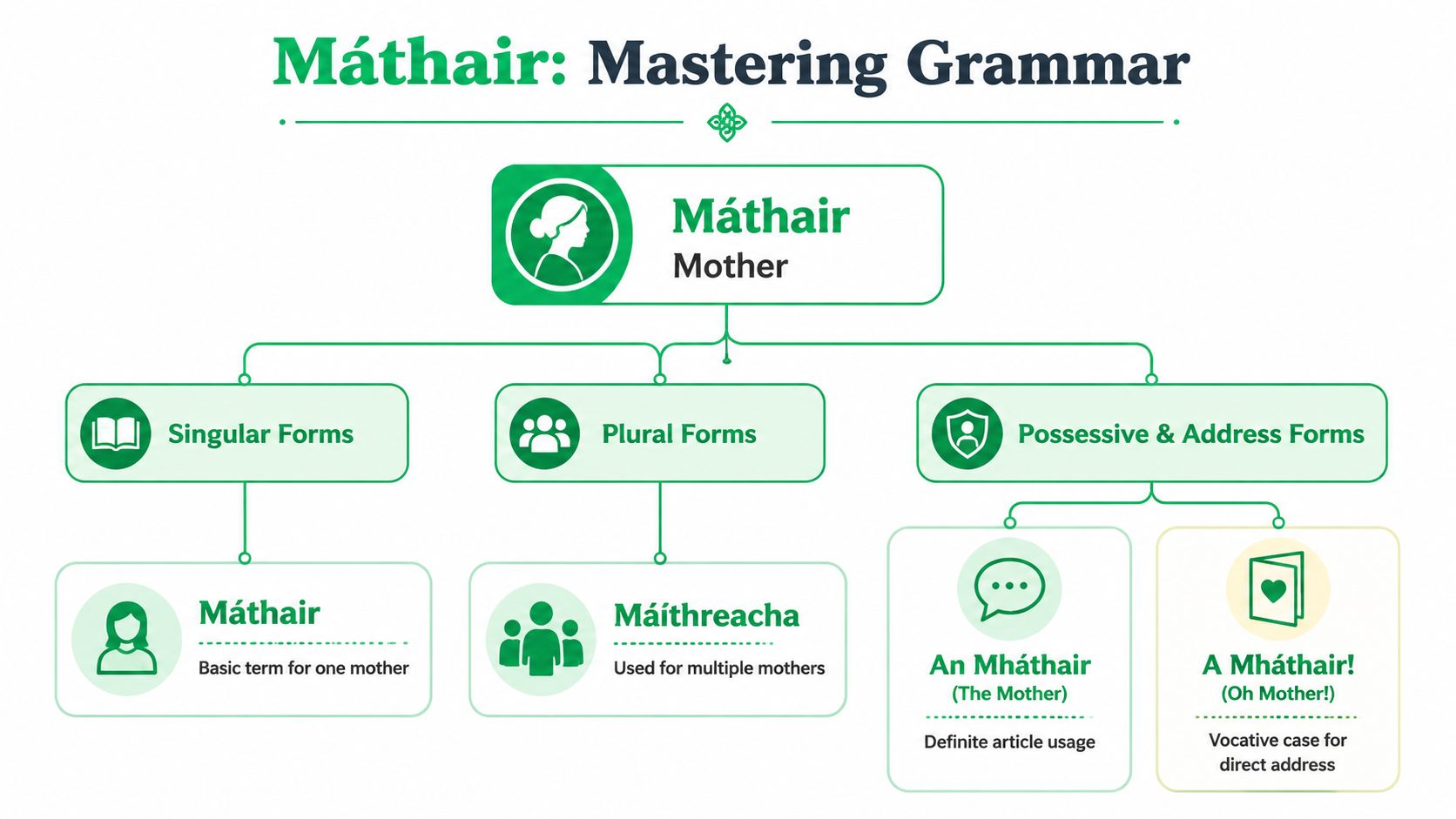
The forms learners meet first
One of the most helpful beginner explanations comes from Bitesize Irish on “the mother”, which notes forms such as do mháthair for your mother, and the vocative forms a Mháthair and a Mhamaí for direct address.
Here are the first forms worth learning:
- máthair = mother
- an mháthair = the mother
- do mháthair = your mother
- a Mháthair = O mother, used when addressing directly
- a Mhamaí = Mam, used when addressing directly in a casual way
The little h that appears after the first consonant is part of a common Irish change called lenition. You don't need to master every grammar rule at once. You just need to notice that certain words trigger a spelling and sound change.
Formal vs informal forms for mother
| Situation | Formal (Máthair) | Informal (Mamaí) |
|---|---|---|
| Naming the word | máthair | mamaí |
| Talking about “the mother” | an mháthair | usually less common in this formal structure |
| Saying “your mother” | do mháthair | your casual phrase will depend on household usage |
| Calling out directly | a Mháthair | a Mhamaí |
| School or formal writing | preferred | usually not preferred |
| Home or affectionate speech | can sound formal | preferred |
A few things confuse learners again and again:
Why does the word change after “do”?
Irish possessives often trigger lenition. So máthair becomes mháthair.Why does the word change when I call someone directly?
Irish uses the vocative case for direct address. That's why you get a Mháthair or a Mhamaí.Can I just avoid the changes?
You can, but your Irish will sound unfinished. These are not fancy extras. They're everyday forms.
Speak to your mother directly, and Irish usually marks that relationship in the word itself.
If you want one memory trick, use this: the base word is what you learn first, but the changed forms are what make you sound like you're using Irish rather than reciting it.
Using Mother in Irish Phrases and Sayings
You are writing a Mother's Day card, telling a story about your family, or calling into the next room. That is where these forms stop being vocabulary items and start doing real work.
A small set of phrases will carry you a long way. The goal here is not to collect dozens of examples. It is to get comfortable with forms you could genuinely use.
Simple phrases you can start using
Start with these short, usable examples:
Is í mo mháthair í.
She is my mother.Tá mo mháthair sa bhaile.
My mother is at home.Do mháthair
Your mother.An mháthair
The mother.A Mhamaí!
Mam!
Read them as a set, not as isolated lines. You are seeing the word in different jobs. Sometimes it names a person, sometimes it shows possession, and sometimes it is used to call directly to someone. That is how Irish family vocabulary works in real life.
A helpful exercise is to practice close comparisons, because small changes in Irish often carry a big difference in meaning or tone:
- mo mháthair
- do mháthair
- a Mháthair
- a Mhamaí
Those four forms are like four doors into the same room. The core idea stays the same, but the relationship changes. One means my mother, one means your mother, and two are forms of direct address, with a more formal or more affectionate feel.
Learn phrases you could say at home, in a message, or in conversation. They stay in your memory better than word lists.
The cultural weight of the Irish mammy
These words also carry a lot of feeling in Irish culture. The language of mothers reaches beyond the family home, from Mother Ireland in political and literary imagery to the familiar figure of the Irish mammy, described in this overview of the Irish mammy as a touchstone for the worldwide Irish diaspora, often estimated at over 70 million people.
That cultural weight matters because it helps explain why learners often feel unusually connected to this vocabulary. Máthair can sound formal, respectful, even ceremonial. Mamaí often feels closer, warmer, and more immediate. The choice is not only about translation. It is also about tone, relationship, and context.
That is why phrases matter so much here. If you only memorize the dictionary form, you know the label. If you practice short expressions such as mo mháthair or A Mhamaí!, you start to hear how Irish carries affection, respect, and family closeness inside the grammar itself.
For many heritage learners, this is one of the first places where Irish feels personal. You are no longer learning an abstract word for mother. You are speaking about your own family, your own memories, and the women who shaped your life.
Practice Makes Perfect Your Next Steps
If you remember three things, you're in a strong place.
First, máthair is the formal Irish Gaelic word for mother. Second, mamaí is often the warmer, everyday choice in family speech. Third, the grammar matters. Forms like do mháthair, a Mháthair, and a Mhamaí are the difference between recognizing a word and properly using it.
That's where learners usually make the leap. Not when they memorize more lists, but when they practice the same small set of words in realistic situations until the forms start to feel natural.
Keep your next step simple:
- Say the forms aloud so your mouth gets used to them
- Write one short sentence using máthair
- Write one affectionate direct address using a Mhamaí
- Notice the tone difference between formal and informal Irish
If you can do that comfortably, you're no longer just looking up mother in irish gaelic. You're beginning to use Irish as a living language.
If you want guided practice with real conversation prompts, pronunciation help, and beginner-friendly Irish from day one, try Gaeilgeoir AI. You can start learning and practicing at Gaeilgeoir AI.