
You've probably met the Irish blessing already, even if you didn't know its history. It shows up in wedding speeches, sympathy cards, graduation gifts, church programs, and framed prints in family kitchens. Many people know the opening by heart, yet still wonder what it means, where it came from, and whether they're using it in the right setting.
That uncertainty makes sense. The Irish blessing feels familiar, but it also carries real cultural weight. If you want to share it at a funeral, include it in a toast, or say part of it in Gaeilge, a little context helps. The words become richer when you understand them as part of a living tradition rather than a decorative quote.
Table of Contents
- A Timeless Wish for a Modern World
- The Full Irish Blessing Text and Gaeilge Translation
- Uncovering the Origins and Cultural Significance
- How to Use the Blessing for Any Occasion
A Timeless Wish for a Modern World
A family gathers after a graduation. Someone raises a glass. Another person reaches for words that sound warm, hopeful, and a little wiser than everyday speech. That's often when the Irish blessing appears. It fits moments when people are moving from one chapter to another, and that's part of why it has lasted.

People also meet it in quieter ways. You might see it engraved on a keepsake, printed inside a condolence card, or read aloud at a wedding by someone honoring Irish family roots. In each case, the words do the same job. They offer goodwill without sounding stiff or formal.
That's one reason the Irish blessing travels so well across generations and across countries. It speaks plainly, but it doesn't sound plain. The images of road, wind, sun, rain, and hand create a feeling of movement, shelter, and companionship.
The Irish blessing endures because it gives people language for uncertain moments, when ordinary conversation doesn't quite feel enough.
Irish blessings are commonly described as short poems or prayers used at key life moments, especially weddings, funerals, home blessings, travel, and seasonal gatherings, which helps explain why this one became so widely recognized in practice and memory (Irish blessing background and uses).
If you're here because you need the text for an event, you'll find it below. If you're here because you want to understand whether it's traditional, how to pronounce the Gaeilge, or which version fits a wedding better than a funeral, you're in the right place too.
The Full Irish Blessing Text and Gaeilge Translation
The version generally understood when searching for the Irish blessing is the familiar one that begins with “May the road rise to meet you.” It's usually shared in English, but many readers also want at least one line in Gaeilge to honor the language behind the tradition.
May the road rise to meet you.
May the wind be always at your back.
May the sun shine warm upon your face.
The rains fall soft upon your fields.
And until we meet again,
May God hold you in the palm of His hand.
A well-known Gaeilge form of the opening line is Go n-éirí an bóthar leat, often given as the Irish equivalent people learn first when they want to speak the blessing aloud.
Why this wording feels so memorable
Irish blessings are structurally different from formal prayers. They're usually addressed to another person, not directly to God, and the repeated opening word “May” signals benevolent wishing rather than command. That pattern is part of what makes the language feel gentle, ceremonial, and easy to remember in spoken settings (Irish blessing form and function).
The wording also works well aloud because the lines are short and balanced. You can hear the rhythm even when reading to yourself.
Irish Blessing Text Translation and Pronunciation
| Gaeilge (Irish) | Phonetic Pronunciation | English Translation |
|---|---|---|
| Go n-éirí an bóthar leat | guh NAY-ree on BOH-her lat | May the road rise to meet you |
| Go raibh an ghaoth go deo ag do chúl | guh rev on GHEE goh joh egg duh khool | May the wind be always at your back |
| Go lonraí an ghrian go te ar d'aghaidh | guh LUN-ree on GHREE-un go teh er DYE | May the sun shine warm upon your face |
| Go dtite an bháisteach go mín ar do chuid páirceanna | guh DIT-eh on WAW-shtekh go meen er duh khid PAWRK-yuh-nuh | May the rains fall soft upon your fields |
| Agus go mbuaile muid le chéile arís | AH-gus guh MOO-il mid leh KHAY-leh ah-REESH | And until we meet again |
| Go gcoinní Dia i mbos a láimhe thú | guh GWIN-ee DEE-uh ihm-bus uh LAW-veh hoo | May God hold you in the palm of His hand |
Use the phonetic guide as a starting point, not as perfect linguistic transcription. Gaeilge sounds don't always map neatly onto English spelling, so your accent won't be flawless on the first try. That's normal.
For a card or printed program, the English text is often the most practical choice. For a toast, memorial, or family gathering, adding the first Gaeilge line can make the blessing feel more rooted and personal.
Uncovering the Origins and Cultural Significance
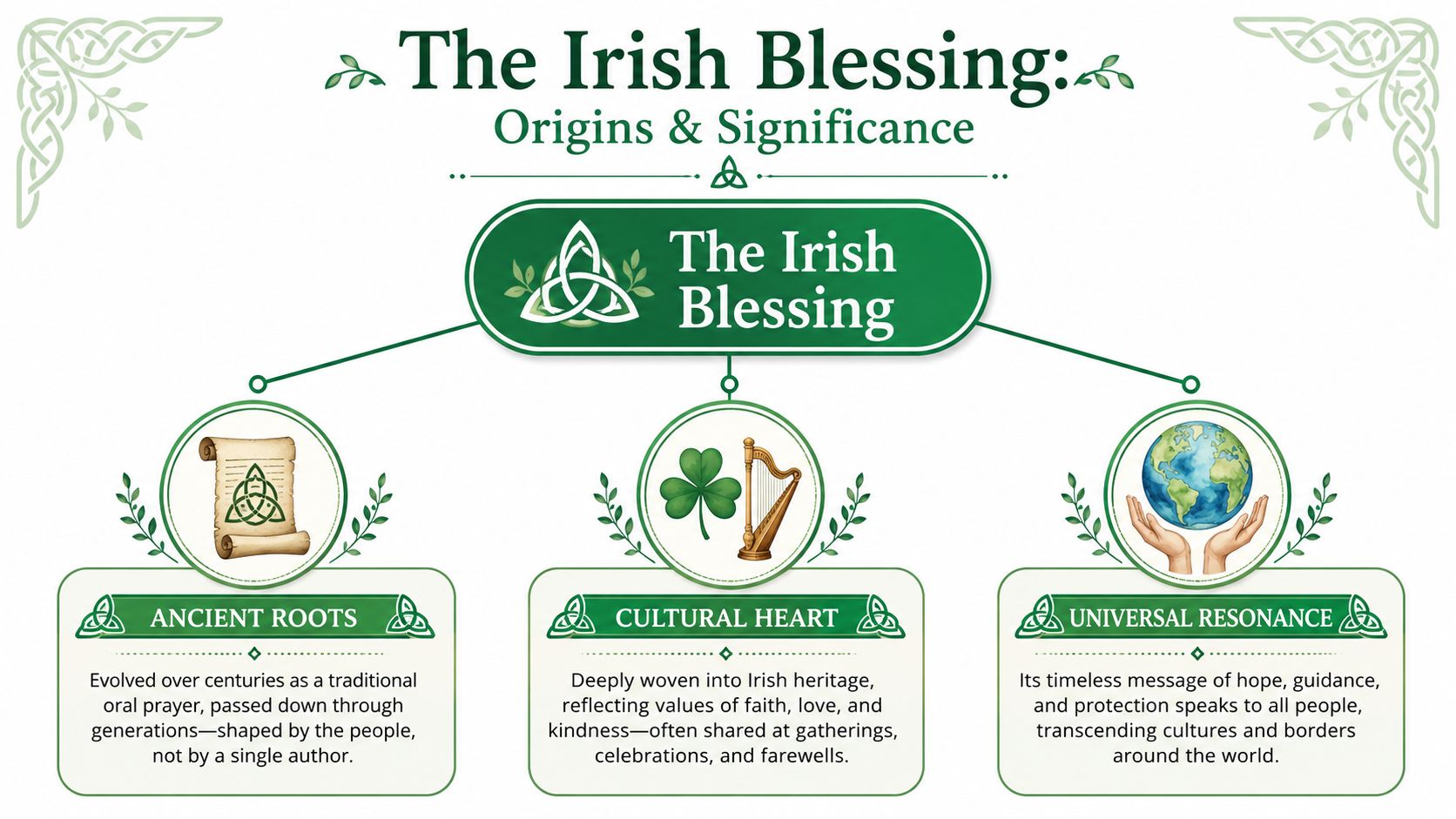
A common moment of hesitation happens right before someone writes the blessing into a card or reads it aloud at a service. They pause and wonder, “Who wrote this?” That question makes sense, especially because the blessing is so well known. Yet the best answer is still a humble one. No single author can be firmly tied to the most familiar version.
Why no single author is named
That uncertainty tells us something useful about the blessing itself. It likely lived first in memory, speech, prayer, and ceremony, then appeared in print later in different forms. Folk material often works this way. A song, proverb, or blessing can belong to a community long before anyone tries to pin it to one name.
That also explains why people sometimes get mixed messages online. One page calls it ancient. Another presents it as a Christian prayer. Another treats it like a modern poem. A discussion of the authorship and authenticity gap shows how easily performance and popular sharing can blur the historical picture.
Practical rule: Treat the Irish blessing as a traditional cultural form, not as a quotation to credit to a famous individual.
A blessing shaped by more than one tradition
Its imagery gives us better clues than a missing byline. The blessing opens with the natural world: road, wind, sun, rain, fields. Those images feel grounded in everyday Irish life, where weather, travel, and land were not poetic decorations but part of survival. Then the final line turns openly Christian with the wish that God may hold the person in the palm of His hand.
That blend matters. It reflects Ireland's layered history, where older seasonal and land-based patterns of thought continued alongside Christian belief rather than disappearing all at once. If you want to see that kind of continuity in another setting, the festival of Imbolc in Irish tradition offers a helpful example of how older customs can remain visible within later cultural forms.
A blessing like this works a bit like a river fed by more than one stream. One current carries natural scenery, weather, and travel. Another carries prayer, protection, and faith. Together, they create the version many people know today.
Variation is part of that history too.
Traditional blessings rarely exist as one frozen master copy. Families shorten them. Singers reshape the rhythm. Speakers choose only the opening line for a toast, or the final line for a funeral card. That does not weaken the tradition. It shows that the blessing is still living, still spoken, and still adapted with care to fit real moments in people's lives.
How to Use the Blessing for Any Occasion
You are standing with a wedding card in one hand and a pen in the other. Or you are trying to choose a reading for a funeral and wondering whether the familiar lines feel comforting or too bright for the room. That is where this blessing becomes more than a lovely quote. It becomes something you use.
The Irish blessing works best when you match the version to the moment. A blessing is a bit like clothing for a ceremony. The same fabric can be adapted for celebration, grief, travel, or everyday encouragement. The heart stays the same, but the length, tone, and language can shift.
That practical choice also opens a door into Irish itself. Learning even one line in Gaeilge helps you hear the blessing as part of a living culture, not only as a piece of English verse. For many readers, that step is an effective way to learn languages because it ties vocabulary to a real occasion, a real memory, and a real human connection.
That is why context matters so much when choosing wording (context matters when choosing wording).
For weddings and new beginnings
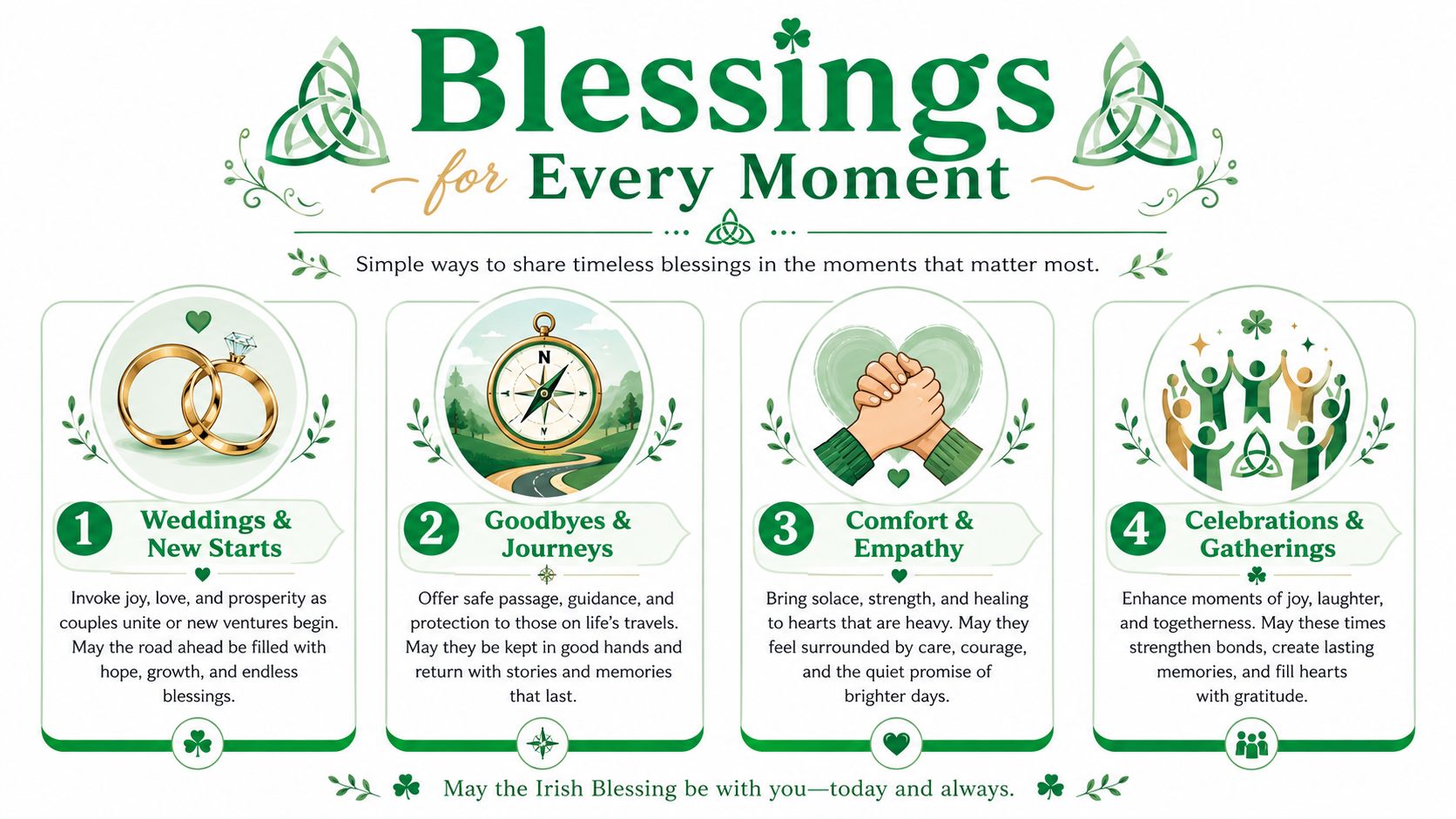
Weddings are one of the easiest places to use the full blessing. The imagery of road, sun, and soft rain looks ahead to shared life. It feels generous without sounding stiff, which is why it works well in a toast, a reading, or a printed program.
A few formats tend to work especially well:
Full ceremonial reading
Use the complete familiar English version for a broad audience. It is recognizable, easy to follow, and well suited to a formal gathering.Short toast format
Use the opening line, then stop after the second or third line. This keeps the feeling warm and memorable without turning a toast into a speech.Heritage touch
Start with Go n-éirí an bóthar leat before continuing in English. That small shift gives the moment an Irish voice while still keeping everyone with you.
If you want to say the Gaeilge line with confidence, break it into sound groups: Guh nyee-ree on BOH-har lat. It does not need to sound perfect to be respectful. Care matters more than accent.
For a wedding card, a light adaptation often feels more personal than copying the full text:
May the road rise to meet you both, and may joy and kindness travel with you in all the years ahead.
For funerals and remembrance
Funerals call for a gentler hand. The full blessing can still work, especially because the closing wish carries tenderness and protection. But the middle lines about sunshine and soft rain may feel too airy for a service shaped by deep grief.
A good test is simple. Read the words aloud and ask whether they sound like comfort offered to the mourners, not a performance by the speaker.
These options are often more fitting:
Use the closing lines only
The final lines usually suit funeral cards, memorial programs, or graveside readings because they focus on care, farewell, and reunion.Choose a shortened excerpt
“May the road rise to meet you” can work at the start, but many families prefer to move quickly to the ending when the mood is solemn.Keep the language plain
If mourners are not familiar with Irish phrases, English may be the kinder choice in the service itself. You can still include a Gaeilge line discreetly on a memorial card if the family has Irish roots or a personal connection to the language.
At a funeral, less is often more.
For everyday encouragement, travel, and milestones
The blessing also lives well outside formal ceremonies. It fits graduations, retirements, farewell parties, housewarmings, and messages to someone leaving for a new chapter. In those settings, the travel imagery feels natural rather than ceremonial.
You do not always need the full version. A single line can do the job:
- For someone starting a new job: “May the road rise to meet you.”
- For a traveler: “May the wind be always at your back.”
- For a note of steady support: “May God hold you in the palm of His hand.”
Each line carries a slightly different mood. The first suggests progress. The second suggests help along the way. The third offers protection. Once you hear those differences, choosing a version gets much easier.
A respectful way to bring Gaeilge into the moment
Using a little Irish can be beautiful, but it should feel thoughtful, not decorative. If you are adding Gaeilge to a speech or card for the first time, keep it short. One line is enough. Say it clearly, then offer the English version. That gives the language presence without leaving listeners behind.
A practical pattern looks like this:
Go n-éirí an bóthar leat.
May the road rise to meet you.
That pairing works well because it welcomes beginners. It also reflects something deeper about Irish heritage. Appreciation grows stronger when it includes language, even in small pieces. A blessing remembered in both English and Gaeilge is not just quoted. It is carried.