
You've probably done this already. You learn a few Irish phrases, manage a short conversation, and then reach the easy part in English: saying goodbye. But in Irish, that last line can make learners pause. You know Slán leat is common, but you're not quite sure when to use it, what its exact meaning is, or why someone might answer with something different.
That uncertainty is normal. Irish goodbyes are simple once you see the pattern, but they aren't built the same way as English goodbyes. The key is that Irish often marks who is going and who is staying. Once that clicks, Slán leat stops being a memorized phrase and becomes something you can use naturally.
Table of Contents
- Your First Irish Goodbye
- What Slán Leat Actually Means
- How to Pronounce Slán Leat Correctly
- The Most Important Rule When to Use Slán Leat
- Example Dialogues and Common Responses
- Tips for Learners and Practicing Your Goodbyes
Your First Irish Goodbye
You finish a short chat with someone in Irish. One of you is about to head off. You know “bye” in English would work, but Irish asks a slightly different question first. Who is going, and who is staying?
That is the first habit to build with Slán leat. It is not just a general farewell you can drop into every situation. It belongs to a directional system. Irish goodbyes often point the wish toward the person who is leaving, which is why learners mix up slán leat and slán agat at the start.
A useful way to picture it is this: Irish farewells work a bit like handing something over. The “slán,” the wish of safety or well-being, is being directed somewhere. If the other person is the one departing, slán leat is often the phrase you reach for. If you miss that sense of direction, the expressions can feel random. Once you notice it, they become much easier to sort out.
Why beginners get stuck
English trains learners to expect one all-purpose goodbye. Irish is more precise. The form can change depending on the situation and on the person the wish is aimed at.
That is why many beginners learn slán leat early, use it broadly, and then feel unsure when they meet a different farewell that looks similar.
Helpful rule: Treat Irish goodbyes as small good wishes sent in a particular direction.
This is simpler than it sounds. Start by asking one question. Who is heading off?
What you want by the end
To use Slán leat with confidence, focus on three things:
- Meaning: know what kind of wish the phrase carries
- Sound: say it clearly and naturally
- Direction: match it to the person who is leaving
Get those three pieces in place, and your goodbye will sound more natural and more Irish. You will also avoid one of the most common learner mistakes before it becomes a habit.
What Slán Leat Actually Means
The most helpful way to learn Slán leat is not to translate it as “goodbye” and stop there. That's useful, but it hides the underlying logic of the phrase.
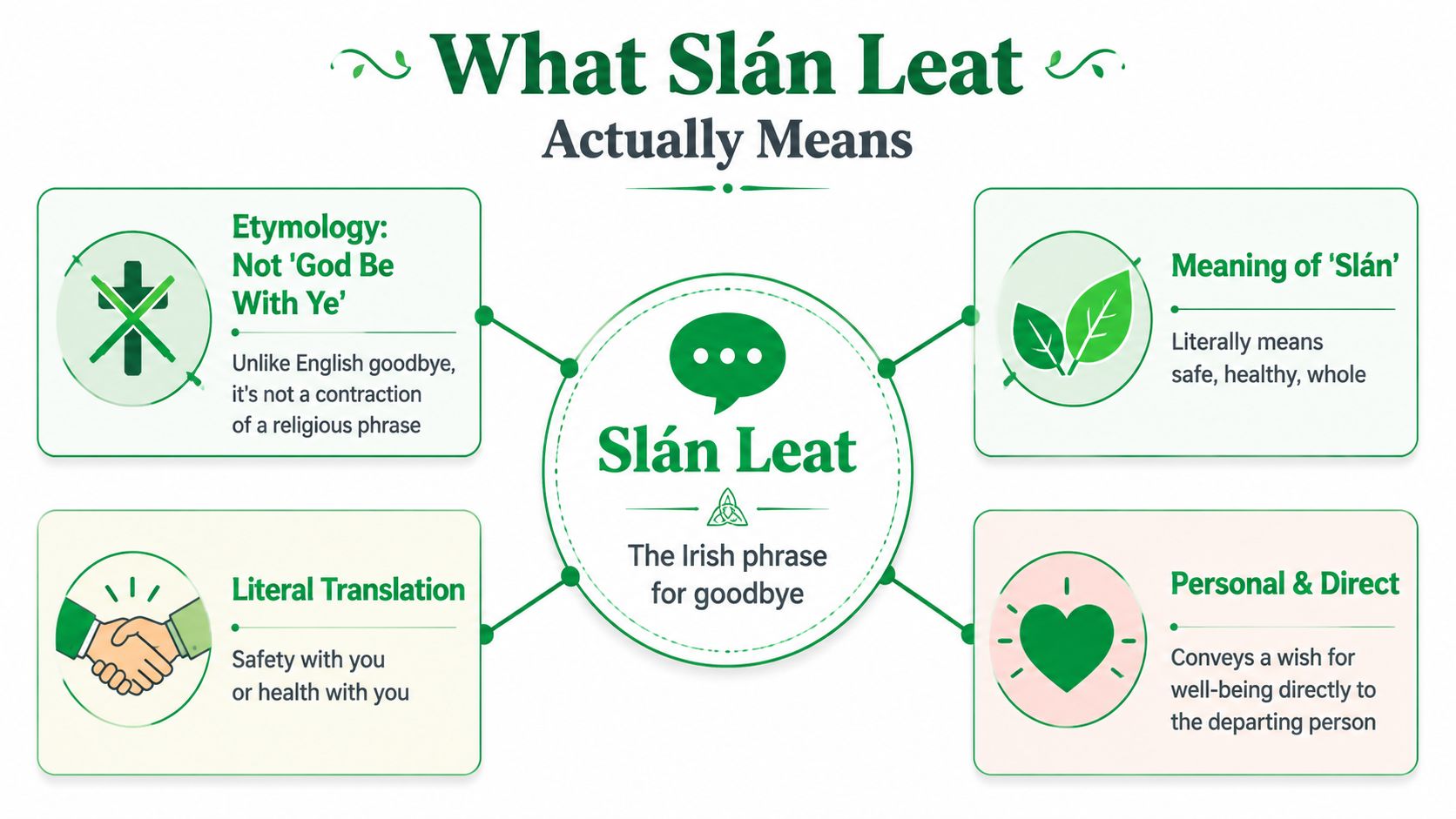
In Irish, slán means “safe”, and Slán leat translates as “safety with you”, which makes it a safety-wish rather than a neutral farewell, as noted in Bitesize Irish's explanation of Irish goodbyes.
Break the phrase into two parts
Consider it this way:
- Slán means safe.
- Leat means with you, when speaking to one person.
Put together, the phrase carries the sense of “safe journey,” “be safe,” or “safety with you.” That's why it feels more personal than a flat “bye.” You aren't only ending a conversation. You're sending someone off with a wish for well-being.
Why that changes everything
When learners understand Slán leat as a wish, not just a label, the rest of the farewell system starts making sense. Irish uses related expressions because the language pays attention to perspective. The wording changes depending on where the “safety” is being directed.
Slán leat works best when you hear it as a parting blessing in miniature.
That's also why the phrase often sticks in memory. It has emotional content. It's practical, but it's also kind.
A useful mindset for remembering it
If you freeze in conversation, don't ask yourself, “What's the Irish word for goodbye?” Ask:
- Who is leaving?
- Who is staying?
- Am I wishing safety with them as they go?
That small shift prevents a lot of common mistakes. It also gives you a better feel for Irish as a language rooted in relationship and context.
How to Pronounce Slán Leat Correctly
For many beginners, pronunciation feels like the hardest part. Irish spelling can look unfamiliar, and that can make a short phrase seem harder than it is.
Start simple. Aim for clear, calm speech, not perfection on day one.

Say it in two pieces first
A beginner-friendly guide sounds like this:
- Slán: roughly like “slawn”
- Leat: roughly like “lat”
Put them together and you get “slawn lat.”
The fada over á matters. It lengthens the vowel, so slán shouldn't sound clipped. Let that first word breathe a little.
Where learners often stumble
Two small issues come up again and again:
- Rushing the first word: If you shorten the vowel too much, Slán loses its shape.
- Overthinking the second word: Leat is short and clean. Don't make it overly elaborate.
Try saying it slowly three times, then at normal speed. The goal is smoothness.
Say the phrase as one friendly send-off, not as two separate vocabulary items.
Hearing the rhythm helps. Listen once, then repeat out loud:
A simple practice routine
If you want the phrase to feel natural, use a tiny repetition drill:
- Read it aloud while looking at the spelling.
- Look away and say it from memory.
- Use it in a full line, such as “Slán leat, a Mháire.”
- Say it with feeling, as if someone is heading out the door.
That last step matters. Irish farewell phrases sound best when they're spoken as real social language, not recited like a list item.
The Most Important Rule When to Use Slán Leat
You are at the door after a coffee with a friend. One of you picks up a coat, the other stays put. That moment decides which Irish goodbye fits.
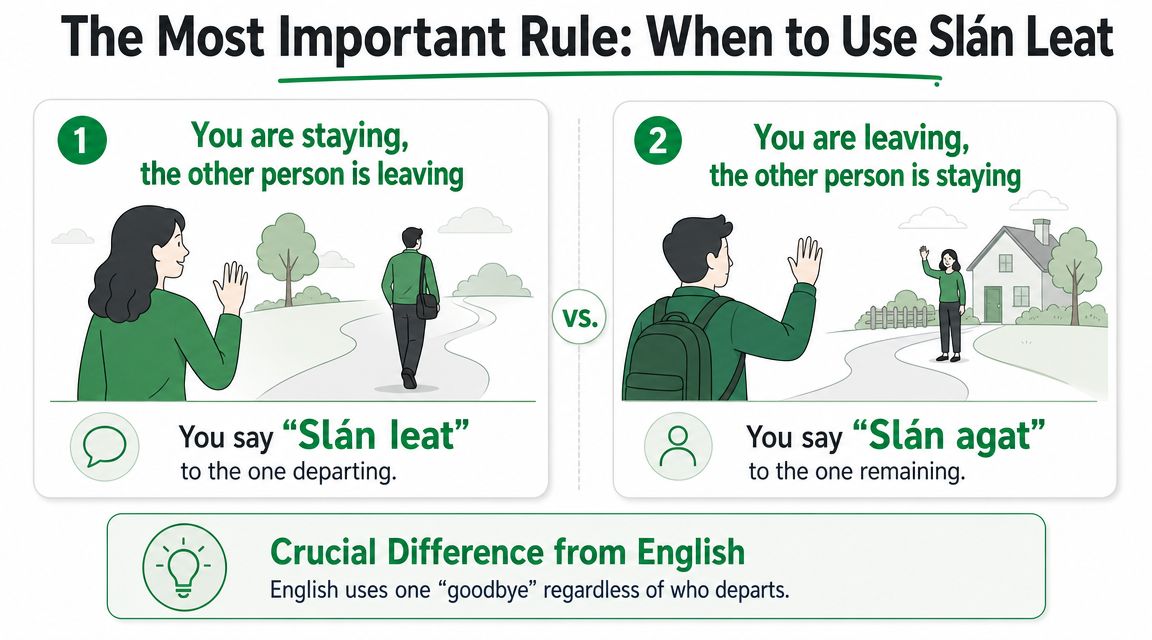
Slán leat is the form you use when the other person is the one going. The easiest way to remember it is to focus on direction. Irish often marks where words are pointing, and farewells do that too. In this phrase, leat means with you, so the goodbye is being sent with the person who is leaving.
Why learners mix up slán leat and slán agat
English uses goodbye for both sides of the exchange, so English speakers are not trained to notice this difference. Irish is more precise. It asks a simple question first. Who is moving away from the conversation?
That is the core rule.
If your friend leaves, you say Slán leat.
If you leave, the person staying may say Slán leat to you, and you reply Slán agat.
A useful learner shortcut is this:
- leat points toward the departing person
- agat stays with the person who remains
You do not need a full grammar lecture to use that well. You just need to notice the direction of the parting, like watching which way the door is swinging.
The pattern in plain English
Here is the system laid out:
| Situation | Phrase |
|---|---|
| You stay, one person leaves | Slán leat |
| You stay, several people leave | Slán leibh |
| You leave, the other person stays | Slán agat |
That plural form matters too. If two or three people are heading off, leibh replaces leat because the goodbye is still directed toward the people who are going, but now the “you” is plural.
A memory trick that helps
Irish goodbyes work a bit like handing something to someone.
With slán leat, you are sending safety or peace with the person on their way.
With slán agat, the farewell sits at the person who is staying.
That image is simple, but it prevents a very common mistake. It also shows why Irish goodbyes are richer than a word-for-word translation. If you enjoy seeing how farewell phrases carry meaning beyond just adiós, Irish gives you a clear example of grammar and social context working together.
Ask yourself one question before you speak: Who is leaving?
Once that becomes a habit, slán leat stops feeling tricky and starts feeling natural.
Example Dialogues and Common Responses
Examples make this click faster than grammar notes do. Read these aloud and pay attention to one question in each exchange: who is leaving?
One person leaves
Aoife is staying at the café. Tom is heading out.
| Situation | Person A (Staying) | Person B (Leaving) |
|---|---|---|
| One friend leaves | Slán leat, a Thom. | Slán agat. |
That response often surprises learners. It isn't random. The two speakers are not standing in the same relationship to the departure, so they don't always use the same phrase back.
A few more natural mini-dialogues
At the front door
- Máire: Slán leat.
- Seán: Slán agat.
After class
- Teacher: Slán leat.
- Student: Slán.
That last reply is useful if you're still building confidence. A simple Slán can keep the exchange moving without making you panic about choosing the perfect form.
If you hesitate, a plain Slán is often a safe fallback while you're still learning the directional forms.
A group leaves
Now the number changes. One person stays behind, and several people are going.
| Situation | Person A (Staying) | Person B (Leaving) |
|---|---|---|
| A group heads off | Slán leibh. | Slán agat. |
Notice the shift from leat to leibh. The farewell is still being directed toward the departing people, but now the “you” is plural.
Common responses you'll hear
Some responses are short and simple. Others add a slightly different tone.
- Slán agat: Useful when you are the one departing and the other person remains.
- Slán: A brief all-purpose response in casual conversation.
- Slán go fóill: “Bye for now,” with a temporary feel.
Here's a final pair you can practise:
- Shopkeeper: Slán leat.
- Customer: Slán go fóill.
Read the examples until you stop translating word by word. When they begin to feel like little scenes rather than grammar puzzles, you're getting somewhere.
Tips for Learners and Practicing Your Goodbyes
A doorway is still the easiest place to train your ear. One person is leaving. One person is staying. Irish often marks that difference more clearly than English does, so a goodbye is not just a fixed label. It is aimed in a direction.
That is the mistake many learners make at first. They learn slán leat as “goodbye,” then use it for every parting. A better habit is to treat Irish farewells like arrows. Slán leat is directed at the person going out the door. Slán agat comes from the person who is going. Once you notice the direction of the movement, the pair starts to make sense.
A simple question helps: Who is heading off right now?
Use that question before you speak, especially in quick everyday moments. At the door. After class. At the end of a phone call. The grammar becomes easier when you attach it to a scene instead of trying to translate word by word.
Keep these learner tips in mind
- Practise with movement: Walk toward the door for slán agat and stay still for slán leat.
- Ask who is leaving: This keeps your focus on direction, which is the pattern.
- Swap roles out loud: Say the farewell once as the person staying, then again as the person departing.
- Use a safe short form: If you hesitate, Slán is a natural reply.
- Add the plural form early: Slán leibh fits the same directional pattern, aimed at more than one person leaving.
Short practice is enough if it is clear and repeated.
- Fanann Máire sa teach: Slán leat.
- Imíonn Seán: Slán agat.
You do not need long grammar drills for this. A few real-life repetitions will do more. Use the phrase when someone leaves the room, when a lesson ends, or when you step away from a counter in a shop. Those small scenes teach the pattern faster because they make the direction visible.
There is cultural meaning in the word slán too. It carries the sense of safety, soundness, and well-being at parting. That helps explain why Irish goodbyes can feel warmer than a plain translation suggests. If you enjoy linking language to the wider Irish year and its traditions, this piece on Imbolc in Irish learning and culture adds useful context.
For guided speaking practice, Gaeilgeoir AI offers conversation practice, pronunciation support, and scenario-based exercises that suit directional phrases like slán leat well: https://learn.gaeilgeoir.ai/