You can spend an hour making Irish flashcards, feel sure you've finally got seo, chomh, or a whole verb pattern into your head, then freeze when someone asks you to use it out loud. That gap between “I studied it” and “I can say it” is exactly where spaced repetition earns its keep, especially for Irish, where mutations, conjugations, and set phrases all have to show up at the right moment.
If you've been guessing at revision intervals or making random piles of vocabulary, you're not failing at Irish. You just need a system that keeps bringing the right material back before it slips away.
Table of Contents
- Why Your Irish Vocabulary Keeps Slipping Away
- The Science Behind Spaced Repetition
- Choosing Your Spaced Repetition Tools
- Creating Flashcards That Actually Work for Irish
- Setting Up Your Review Schedule
- Common Mistakes That Sabotage Your Progress
Why Your Irish Vocabulary Keeps Slipping Away
A learner will often tell me the same story. They study a list of Irish words on Sunday, recognise them on Monday, then blank on Wednesday when the sentence is slightly different. The word didn't vanish, but the brain did what brains do when information isn't revisited at the right time, it started filing it away as optional.
Why cramming feels useful and then falls apart
Cramming gives a short burst of familiarity. You can look at bád, teach, or cailín and think, “Yes, I know this,” because the words are still warm from the last review. But language doesn't reward warm familiarity, it rewards retrieval under pressure, and that's where spaced repetition beats one long study session.
Irish adds another layer because the thing you need to remember is often not just the base word. You need to remember whether it changes after an article, whether it mutates, and whether the phrase lives comfortably in a real conversation. A simple list of English-Irish pairs won't train that kind of memory.
If you want a broader overview of the method, the spaced repetition guide from MasteryMind is a useful companion read, especially if you're trying to understand the logic before you build your own routine. For a more Irish-specific starting point, keep your own word bank close to a learn Irish words page or notebook so you're not hunting through scattered lists later.
Practical rule: if you can recognise a word but can't produce it in a sentence, it isn't secure yet.
Why Irish makes repetition more important, not less
Irish vocabulary is tied to grammar in a way that pure memorisation doesn't always prepare you for. A learner might know bean, but still hesitate when the form changes in a sentence. The same goes for verbs, where one learned item can split into several usable forms depending on tense and context.
That's why spaced repetition matters so much for Irish. It keeps returning words to your attention after the first burst of learning has faded, and it gives you repeated chances to meet them in slightly different forms. That repetition is what turns isolated knowledge into something you can use.
The Science Behind Spaced Repetition
A learner opens a notebook, reviews a few Irish phrases, and feels confident for the moment. A week later, the same forms are hazier, especially the ones that changed after lenition, eclipsis, or a verb ending that looked familiar but never quite stayed put. That gap between recognition and recall is exactly what how to use spaced repetition is designed to address.
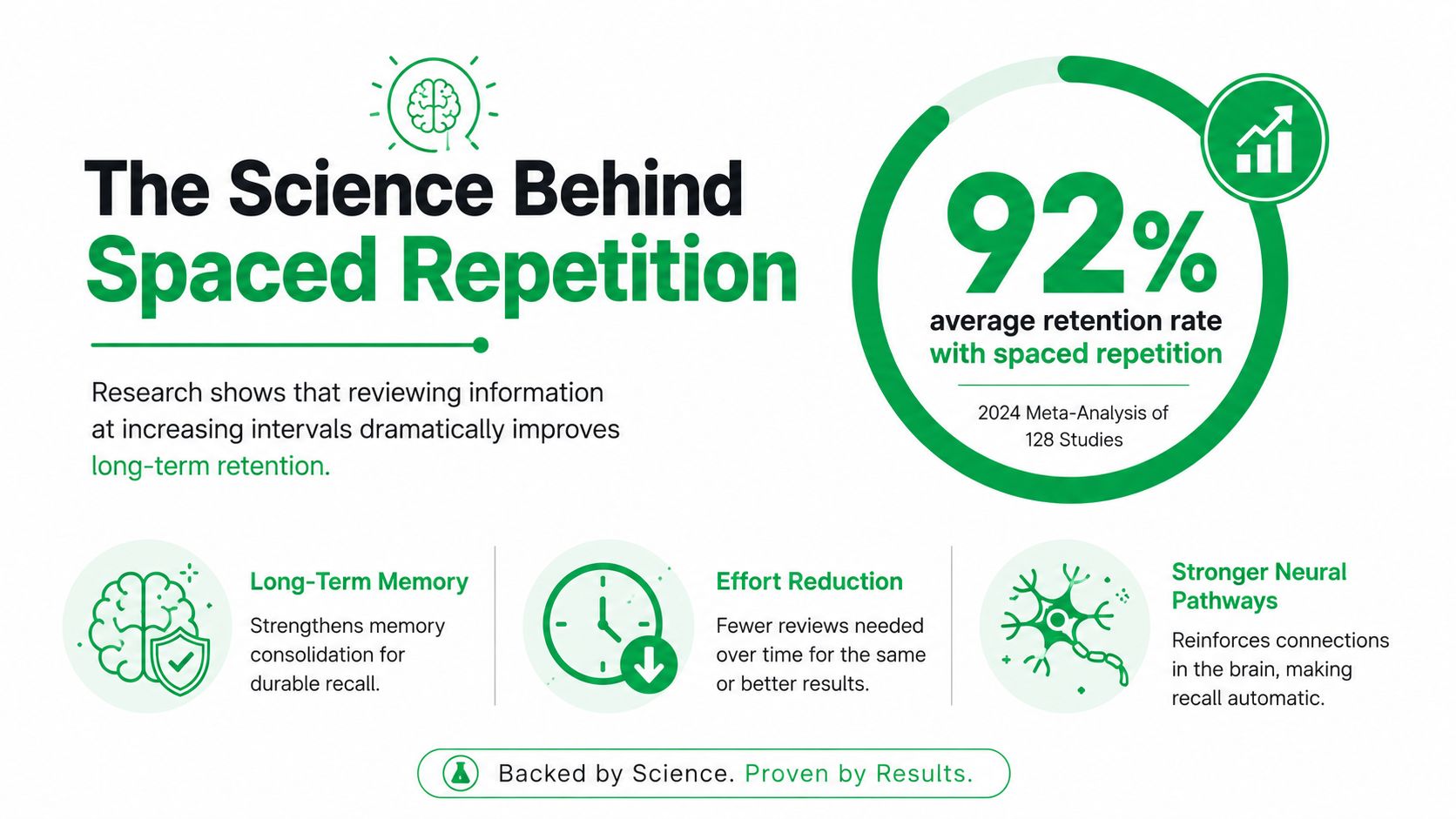
The strongest case for the method comes from the research, not from habit or trendiness. A 2024 systematic review and meta-analysis in medical education found that spaced repetition outperformed standard studying across 21,415 learners, with an overall standardized mean difference of 0.78 (PubMed). The review included 14 studies, with 13 entering the meta-analysis, so the result rests on more than a single classroom trial.
Why the timing matters
The spacing effect comes down to timing. A major review of spacing research reported that after a 7-day delay, a 1-day spacing interval produced about 86% recall, while a 10-day spacing interval produced around 62% recall (PMC review). In another study summarized there, after a 7-day delay, a 3-day interval yielded 83.1% retention and a 14-day interval yielded 80.9%.
Those numbers matter because they show the schedule itself changes what sticks. The best interval is not fixed in stone. It depends on the task and the amount of relearning involved. For Irish, that means a noun, a mutation pattern, and a conversational phrase may each need a different review rhythm.
What this means for Irish learners
Irish asks for more than recognition. You need recall that still works after a word changes shape in a sentence, and you need enough repetition for those changes to feel ordinary. A learner who knows bean on a flashcard may still hesitate when it appears after an article or in a mutated form. The same problem shows up with verbs, where one learned item can split into several usable forms depending on tense and context.
Spaced repetition fits that challenge because it keeps bringing material back just before it slips away. Each return asks your brain to rebuild the answer instead of passively rereading it, and that effort strengthens access over time. For Irish, that matters most with the pieces that sound simple in a list but become slippery in real speech, especially mutations, verb conjugations, and set phrases you want ready in conversation.
The point is not to review everything every day. The point is to revisit material at the moment it starts becoming slightly harder to recall.
That is why the method works so well for long-term retention. It does not just show the same item again. It makes retrieval effort do part of the work, which is exactly what Irish learners need when a phrase has to come out quickly and correctly in conversation.
Choosing Your Spaced Repetition Tools
Start with the tool you will keep using. Dedicated apps like Anki and Quizlet give you more control over card design and review timing, while integrated platforms keep everything in one place and reduce the number of steps between study and review. For Irish learners, that difference matters because a tool only helps if it fits the way you already study.

Dedicated apps and when they fit
Anki works well for learners who want to shape every part of the system, from card format to tags to scheduling. Quizlet is easier to start with and can suit anyone who wants less setup before reviewing. Both can be useful if you like building your own deck and do not mind spending time arranging it.
For Irish, that control is useful because a good card often needs to capture more than a translation. A noun may need its mutation pattern, a verb may need several forms, and a phrase may need the exact wording you would say aloud. If your app lets you separate those pieces cleanly, you can review the form you need instead of a vague approximation.
Integrated platforms and when they help
Some learners stay more consistent when revision sits inside the same space as the rest of their study. Gaeilgeoir AI combines guided practice, topic-based quizzes, and a personal vocabulary list, so you are not jumping between tools while trying to keep a habit alive. That matters on busy days, because the obstacle is often follow-through, not understanding the method. If you want a closer look at how a structured card set can support Irish study, the Irish language flashcards page shows that approach in a practical format.
Good tool choice: the one you will open again tomorrow without negotiating with yourself.
There is also a useful language learning without Anki discussion that makes the case for choosing a system based on your own habits rather than on reputation alone.
What to look for before you commit
Choose the option that supports pronunciation, context, and adaptive review. A deck full of isolated word pairs can feel productive, but it will not help much if your real goal is speaking. For Irish, the tool should let you hear forms, see them in context, and review them often enough that mutations, conjugations, and conversational phrases stop feeling like special cases.
The best setup is the one that keeps presenting the right item at the right moment, without turning preparation into a second job.
Creating Flashcards That Actually Work for Irish
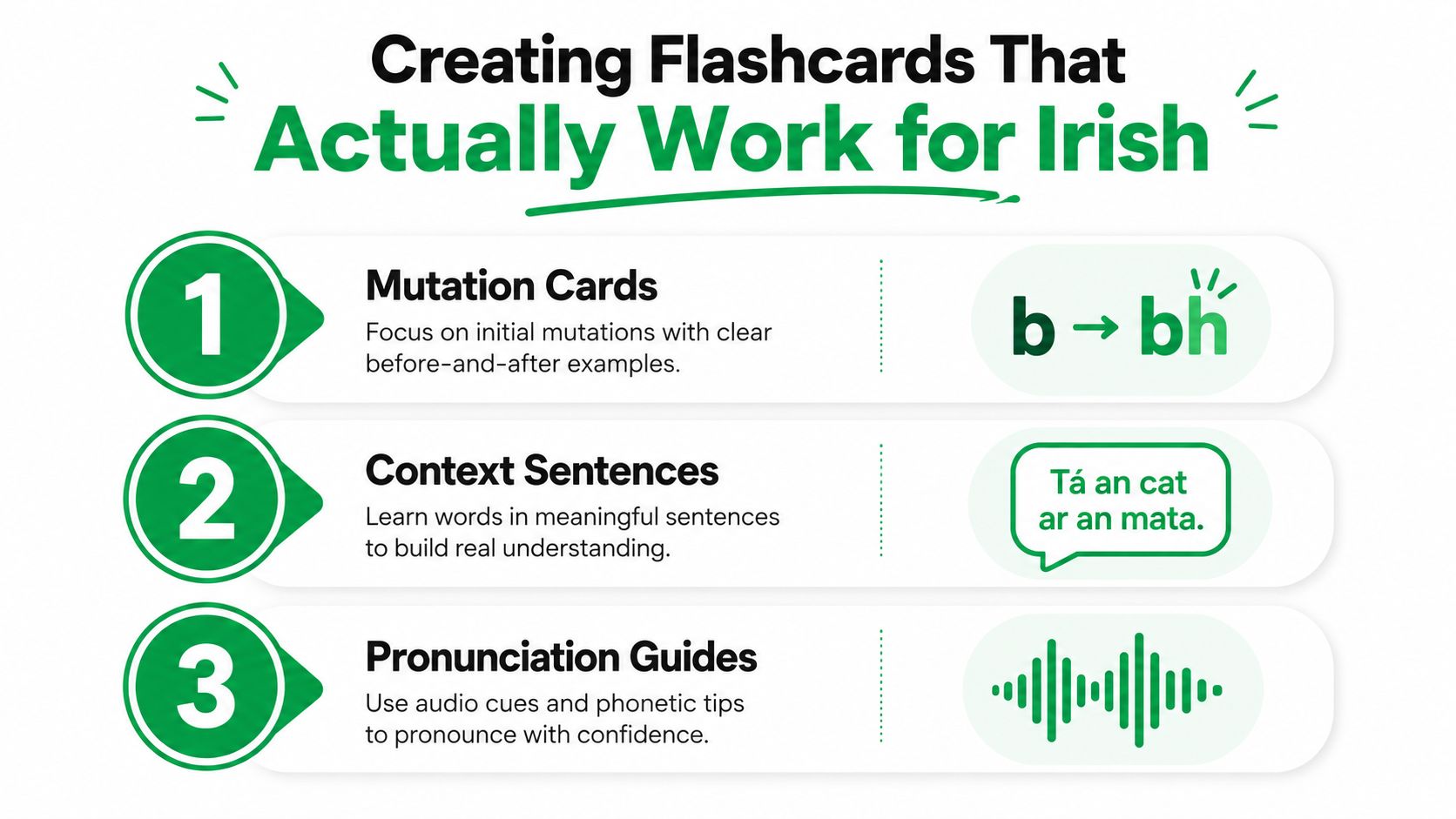
A flashcard should teach one usable thing, not four. If you crowd too much onto a card, you end up recognising the answer instead of recalling it, and that is a weak form of knowledge for Irish. A clean card is easier to retrieve under pressure, especially when you are trying to speak and not just recognise words on a screen.
Build cards around mutations and forms
Irish learners need cards that respect séimhiú and urú. A card for bean should not stay frozen as a dictionary entry if the form you need changes in context. Make the prompt specific enough that you are forced to recall the version that belongs in the sentence, because the mutation is part of the language, not decoration.
The advice on atomic cards from independent spaced repetition guidance becomes very relevant here. Long sequences make poor flashcard targets, so do not try to cram whole paragraphs into one review item. Keep the learning unit small enough that your brain has to retrieve the exact answer, not a fuzzy approximation.
Use sentences for phrases and grammar
For conversational Irish, a bare word is often the wrong unit. A phrase like Tá mé… or An bhfuil tú… belongs in a sentence because that is how you will need it in speech. Sentence cards also show how verbs, pronouns, and word order work together instead of leaving them as disconnected rules.
Practical rule: if a phrase only makes sense in a full sentence, make the card a full sentence.
That rule helps with verb conjugations too. A card that asks for one form in isolation can still be useful, but a card that places the verb inside a real utterance trains both recall and use. For Irish, that extra context often separates knowing a form from being able to say it naturally.
Add pronunciation support without clutter
Pronunciation matters, but it should not bury the main task. Add a sound guide, audio, or a brief phonetic note when a word is likely to be pronounced differently from how an English speaker might guess. Keep it short, because the card still needs to act as a retrieval cue, not a mini textbook.
If you want a practical home for these kinds of cards, the Irish language flashcards page is a useful model for a cleaner study set. And if you want a broader argument for choosing study habits that fit real life, the language learning without Anki discussion is a good reminder that the quality of the review item matters more than the reputation of the tool.
Setting Up Your Review Schedule
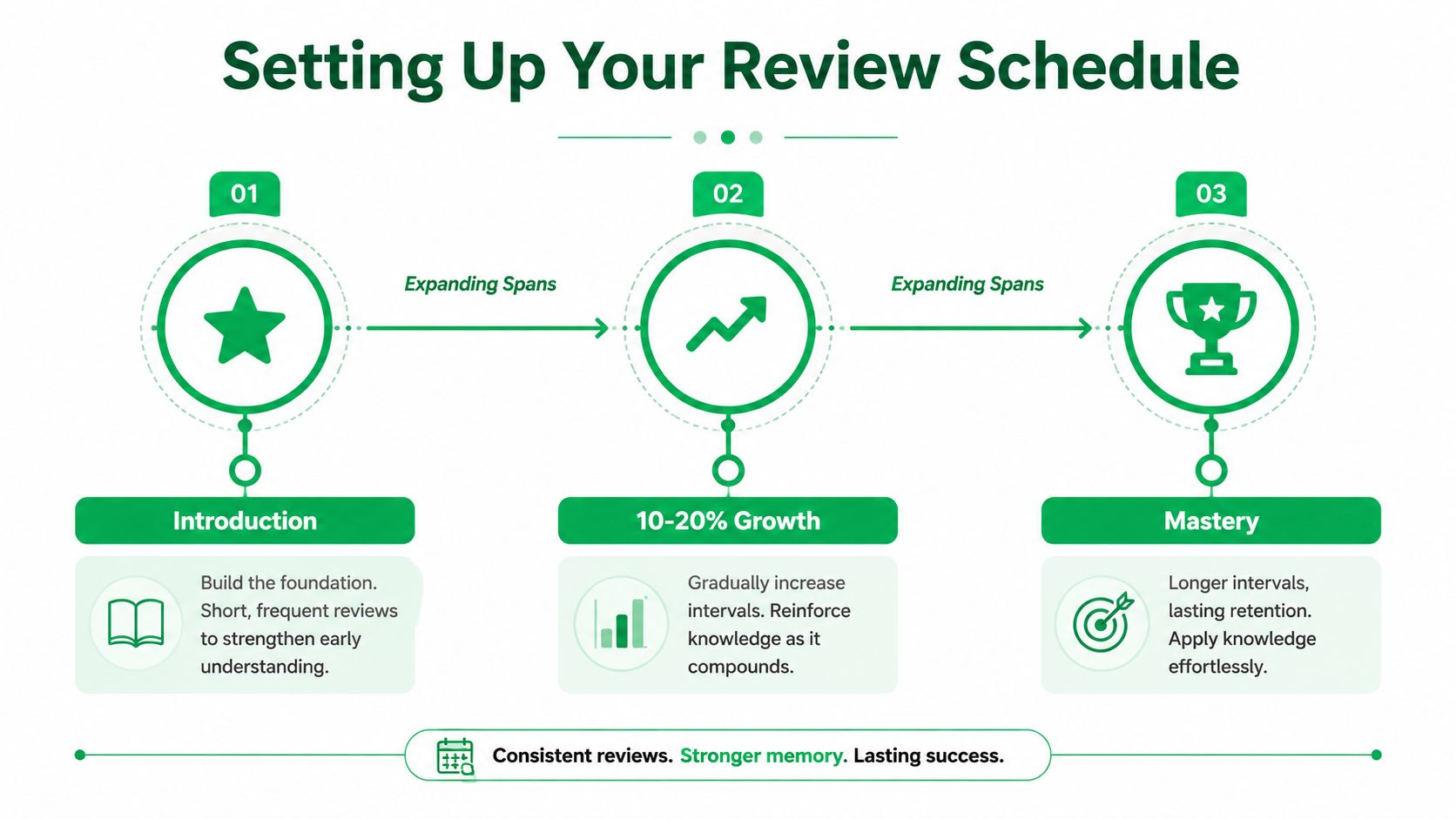
The simplest way to think about spacing is this, the next review should come after a little forgetting has happened, not before and not too late. One practical planning rule from Learner Lab is the 10–20% rule, which treats the time you need to remember something as a starting point for deciding how long the interval should be (Learner Lab). That gives you a rough way to think about review length without pretending every item deserves the same schedule.
Start small, then expand the gap
Khan Academy's guidance is straightforward, begin with a manageable amount of material, use flash cards or spaced-repetition software such as Quizlet or Anki, and make the later reviews longer for items you remember well while shortening the interval for items that still feel shaky (Khan Academy). That matters for Irish because some words settle quickly while verb patterns may need more repeats before they feel stable.
A university guide from Birmingham City University also recommends adapting review frequency based on how well material is remembered, rather than forcing one fixed cadence for everything (BCU spaced repetition guide). That's the right mindset for Irish, especially when you're balancing vocabulary, mutations, and speaking practice.
Reverse-plan when the deadline is fixed
If you're working toward the Leaving Cert or another fixed date, work backward from that deadline instead of hoping the calendar will sort itself out. A reverse-planned schedule keeps the final review close enough to the exam that the material is fresh, while earlier reviews do the heavier lifting. A home study routine can help here too, and a practical overview of that kind of structure is available in how to create a home study routine from Boss as a Service.
Use performance to decide the next interval
The point of the schedule is feedback. If a card comes back easily, it deserves more space before the next review. If you miss it or hesitate, shorten the gap and bring it back sooner.
The daily Irish practice plan can sit alongside this approach when you need a simple routine rather than a complex system. And if your material includes spoken phrases, the embedded video below is a useful reminder that consistency matters more than perfect timing.
Common Mistakes That Sabotage Your Progress
The biggest mistake is not missing a day. The problem is building a system so heavy that you stop trusting it. Learners often create too many cards at once, review them passively, and then decide spaced repetition “doesn't work” because the deck became unmanageable.
Too many cards, too fast
A huge deck feels ambitious on day one and discouraging by day four. If you keep adding every interesting word you meet, you end up with a pile of half-learned items that all need attention at once. Start with material you need, not every word you like the sound of.
Passive review is a trap
Reading a card and thinking, “Yes, I know that,” is not the same as retrieving it. You need to cover the answer, say it, write it, or choose it before you see it. Active recall is the part that does the work.
If you're only recognising the answer, you're rehearsing familiarity, not memory.
Don't ignore hard cards
Hard items aren't clutter, they're the point. A card you miss should come back sooner, not disappear because it's annoying. That's especially true in Irish, where one troublesome mutation or verb form can block a whole sentence.
A detailed math-facts workflow shows how strict this can get in practice, with missed facts shown again before the session ends and reviewed the next day, while fast correct answers move out to longer gaps such as 3 days, 7 days, 14 days, and 30 days (math facts implementation). The exact timing there is for math facts, but the principle is useful for language learners too, difficult items need tighter attention, and easy items can wait longer.
Keep consistency ahead of intensity
A short review done regularly beats a heroic session you can't repeat. If you miss a day, restart calmly instead of scrapping the system. Spaced repetition only helps when it stays part of ordinary study life.
If you want Irish practice that already includes topic-based quizzes, pronunciation support, and a personal list for words you want to see again, Gaeilgeoir AI gives you a structured place to apply spaced repetition without building everything from scratch. Try it with a few words you keep forgetting, then let the review system do the remembering for you.