You've got a Christmas question that sounds simple until you try to answer it for a child, a class, or a card. Say the wrong version, and it feels awkward. Say the right one, and you get a small but satisfying bit of Irish that sounds natural.
Table of Contents
- Why Santa Has More Than One Irish Name
- The Three Main Irish Words for Santa and How to Say Them
- The Grammar Behind Daidí na Nollag
- Other Christmas Phrases Built on the Same Pattern
- Sample Sentences and Mini-Dialogues in Irish
- Common Mistakes Beginners Make with Santa in Irish
- Pronunciation Practice and Where to Keep Learning
- Frequently Asked Questions About Santa in Irish
Why Santa Has More Than One Irish Name
A parent once hears the question in the middle of the Christmas rush, usually while wrapping paper is everywhere and someone is trying to eat one last biscuit before dinner. “What's Santa called in Irish?” It sounds like a one-word lookup, but Irish gives you a few real choices, and each one fits a slightly different situation.
The everyday default is Daidí na Nollag, the formal saint-based form is San Nioclás, and many families also use the informal English-flavoured Santy in ordinary speech. That mix is normal in Ireland, because Irish Christmas vocabulary lives in real family life, not just in dictionaries. Bitesize Irish notes the standard Irish forms, and a wider look at Christmas usage in Ireland shows that these terms sit inside a familiar holiday rhythm, with presents commonly opened on Christmas morning (Christmas in Ireland).
Practical rule: if you want the safest classroom or everyday answer, start with Daidí na Nollag.
A quick note on register
The trick is not memorising three random translations. It's matching the word to the setting. A child's picture caption, a church newsletter, and a family conversation don't all need the same label.
If you're writing for beginners or speaking in a normal holiday setting, Daidí na Nollag is the form that usually sounds most native. If you want the saintly, historical sense, San Nioclás makes that link obvious. If you're in an English-speaking Irish household, Santy may be the word that comes out first, and that's part of the living language too. For more on how Irish varies by region and usage, see this guide to Irish dialects.
The Three Main Irish Words for Santa and How to Say Them
Start with the one most learners should use first: Daidí na Nollag. It means Father Christmas, and in plain English pronunciation it sounds like Daw-dee na NUL-ug. That's the version you can use in a child's story, a festive greeting, or a beginner's classroom without sounding stiff.
San Nioclás is the more transparent saint-based form. It points directly to Saint Nicholas, so it feels a little more formal and a little more historical. Say it like San NIK-lowss, and use it when the saint connection matters, or when you want a more religious tone.
Santy is the informal Irish-English form people hear in everyday life. It isn't the pure Irish-language equivalent in the same way as the two forms above, but it's used in Ireland, especially in casual speech and households where English and Irish mix naturally. Say it like SAN-tee, and use it only when the conversation is relaxed and English-flavoured.
| Irish Form | Literal Meaning | Pronunciation | Best Used For |
|---|---|---|---|
| Daidí na Nollag | Father Christmas | Daw-dee na NUL-ug | Everyday Irish, children, greetings |
| San Nioclás | Saint Nicholas | San NIK-lowss | Formal, religious, historical contexts |
| Santy | Informal Santa | SAN-tee | Casual Irish-English speech |
A good decision rule is simple. If you're unsure, say Daidí na Nollag. If you want the saintly name, use San Nioclás. If you're speaking casually in Irish-English, Santy may be the name people around you say. That choice follows the same real-world pattern described in this Irish words guide, which also notes the everyday use of Santa in Ireland.
The Grammar Behind Daidí na Nollag
The phrase looks neat because Irish grammar is doing real work inside it. Nollaig means Christmas, but in Daidí na Nollag it appears as Nollag in a possessive structure. The article also changes from an to na, which is how Irish marks this kind of possession. Transparent Language explains that pattern clearly, and once you spot it, the phrase stops looking like a fixed label and starts looking like a rule you can reuse.
How the possessive works
English usually puts the possessor first, then the thing owned. Irish often flips that logic and modifies the possessed noun instead. So instead of “Santa of Christmas” as a literal English-style structure, Irish gives you Father of the Christmas, with the grammar packed into the phrase itself.
That's why Daidí na Nollag is more than a holiday name. It shows you how Irish genitive construction behaves in a way you can carry into other phrases. Once you see na marking possession, you're already closer to reading other seasonal expressions correctly. For a deeper grammar walkthrough, this genitive case guide is a useful companion.
Useful pattern: when you see a Christmas phrase in Irish, check whether the second noun is in a possessive form before assuming it's just a dictionary translation.
The same logic helps with other holiday combinations, because Irish Christmas vocabulary is full of these structures. Learners who get the grammar behind Daidí na Nollag usually stop guessing and start recognising patterns. That's the moment the language begins to feel less random.
Other Christmas Phrases Built on the Same Pattern
Once you understand the Nollag pattern, a small cluster of Christmas phrases opens up very quickly. Nollaig Shona means Happy Christmas, while phrases like bronntanas Nollag and cárta Nollag show the same possessive logic in action. Even Oíche Nollag fits the same seasonal family, with Oíche meaning night.
| Irish Phrase | Literal Meaning | Pronunciation |
|---|---|---|
| Nollaig Shona | Happy Christmas | NUL-ig hun-uh |
| bronntanas Nollag | Christmas present | BRUN-ta-nas NUL-ug |
| cárta Nollag | Christmas card | KAWR-ta NUL-ug |
| Oíche Nollag | Christmas Eve | EE-ha NUL-ug |
A simple worksheet can help the pattern stick, especially if you want to practise with a child or a class. Kuraplan's bilingual Christmas vocabulary worksheet is useful because it keeps the vocabulary grouped instead of scattering the words across separate lists.
The reason this matters is easy to miss at first. You are not just collecting festive nouns. You are training your ear to hear how Irish builds meaning around possession and Christmas vocabulary, so every new phrase becomes easier to read and say. That's a much stronger habit than memorising Daidí na Nollag alone.
Sample Sentences and Mini-Dialogues in Irish
A phrase only feels real when it shows up in a sentence. If you want to greet someone on Christmas morning, you can say Nollaig Shona duit, which means Happy Christmas to you. If you're writing a note for children or leaving a message by the fireplace, Daidí na Nollag fits naturally in a line like a name on a card.
Here's a very short model you can repeat aloud:
| Irish | Word-by-word gloss | Natural English |
|---|---|---|
| Is maith liom Daidí na Nollag. | Is good with me Father Christmas | I like Santa. |
| Nollaig Shona, a chara. | Christmas happy, friend | Happy Christmas, friend. |
A parent and child might sound like this at home:
| Speaker | Irish |
|---|---|
| Parent | An bhfuil tú ag súil le Daidí na Nollag anocht? |
| Child | Tá, agus tá bronntanas Nollag uaim. |
The point is not to memorise a script. It's to hear how Daidí na Nollag behaves in ordinary speech, where the Christmas phrase sits inside a full sentence instead of floating alone. If you can say it once in a greeting and once in a question, you've already moved from vocabulary to conversation.
The Bitesize Irish pronunciation clip for Santa Claus is a handy reference if you want to hear the names spoken aloud, and the embedded video below gives you another way to listen for the rhythm.
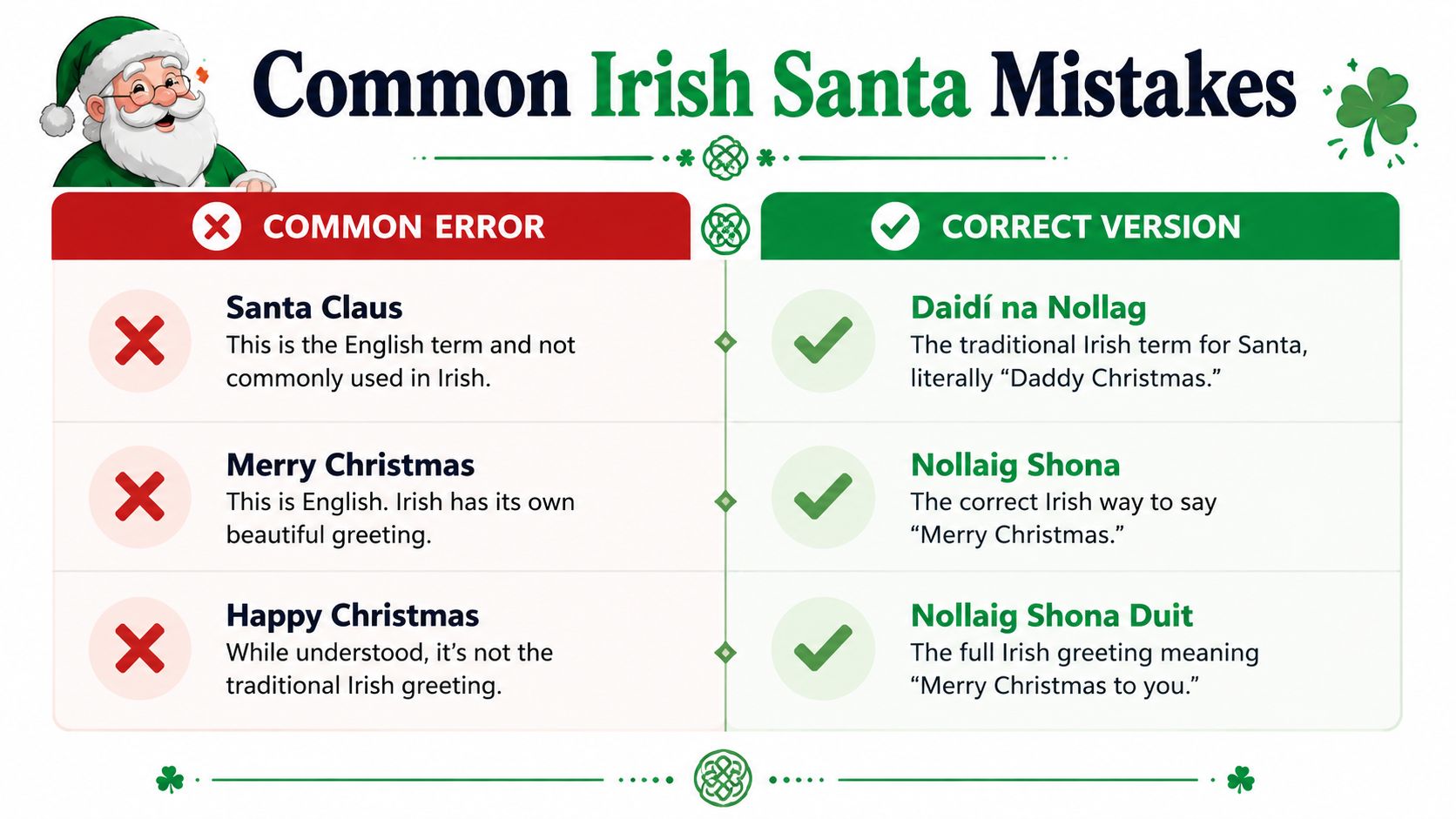
Common Mistakes Beginners Make with Santa in Irish
The most common slip is pronunciation. Beginners often flatten the first word and miss the rhythm of Daidí, so the phrase loses its natural Irish sound. The safer version is Daw-dee na NUL-ug, with the stress kept clear and the Christmas part kept soft.
Another easy mistake is swapping in Athair na Nollag as if it were the everyday form. It may look plausible, but the standard everyday phrase learners are most likely to need is Daidí na Nollag. The reason matters, because learners should use the form that sounds native in normal holiday speech, not just the one that seems closest to English.
Avoid this trap: if the na disappears, the phrase usually stops sounding like Irish.
A third error is overusing San Nioclás in casual chat. That form is real, but it sounds more formal or historical, so it can feel out of place if you're talking to children or writing a cheerful card. Use Daidí na Nollag unless you specifically want the saint-based reference.
The last mistake is forgetting that the right choice depends on context. Everyday Irish, formal religious reference, and Irish-English family speech each have their own natural form. Once you keep that in mind, the phrase becomes much easier to trust.
Pronunciation Practice and Where to Keep Learning
Read Daidí na Nollag out loud three times, then say it again more slowly with the syllables Daw-dee na NUL-ug. After that, listen for the na plus Christmas pattern in any Irish Christmas clip, because your ear will start catching the same structure in other festive phrases. A quick recording on your phone helps too, since you can hear whether your stress pattern matches the model speaker.
For guided practice, this Irish pronunciation guide gives you a useful next step beyond a single word. If you want to turn one phrase into a speaking habit, Gaeilgeoir AI offers guided Irish practice with instant word translations, personalised vocabulary lists, and scenario-based conversation support, including holiday language. It also includes a free three-day trial, costs €9.99 per month, and fits beginners, heritage learners, Leaving Cert students, and busy adults who want to practise on a schedule.

Use the platform, or any speaking partner, to say the phrase aloud until it stops feeling like a lookup and starts feeling like your own vocabulary. That's the point where a holiday word becomes real Irish in your mouth.
Frequently Asked Questions About Santa in Irish
Is Santy really Irish? Yes, in everyday Irish-English speech it is a normal informal form, especially in households where English is the main language. It's not the formal Irish-language equivalent, but it is part of real Irish usage.
How do I address Santa in a letter? Daidí na Nollag is the safest choice for a child's letter in Irish. If the letter is written in a more formal or historical style, San Nioclás can fit that tone better.
What do children in Gaeltacht areas say? Children may hear and use the Irish forms discussed above, especially Daidí na Nollag, while English forms can still appear depending on family language and setting. The key point is that the natural choice follows the home and community context, not just a dictionary entry.
Does Daidí na Nollag appear in Irish-language songs or TV? Yes, the phrase belongs to the wider Irish Christmas vocabulary used in seasonal materials and cultural references. If you're also thinking about sharing Irish-language Christmas content online, AI video SEO for YouTube is a practical reference for making sure festive clips are searchable and easy to find.
If you want a place to practise Daidí na Nollag and the rest of your Irish Christmas vocabulary out loud, Gaeilgeoir AI gives you guided conversation practice, instant translations, and a simple way to build confidence from day one. It's a good next step if you want today's phrase to become part of your everyday Irish instead of staying in a note on your phone.