
Daideo is the Irish word for grandfather, often used in a warm, family-centered way. It's pronounced approximately “daj-oh”, and once you know that, the word starts to feel much more approachable.
Maybe you saw daideo in a children's book, heard it in a family conversation, or typed it into a search engine and got a confusing mix of company listings, products, and unrelated pages. That happens a lot with Irish words. A simple family term can end up buried under results that don't help a learner at all.
That's a pity, because Daideo is exactly the kind of word that opens a door into real Irish. It isn't just vocabulary for a flashcard. It's a word tied to memory, family stories, heritage, and everyday affection. If you're reconnecting with Irish, learning it for the first time, or helping a child understand family words, this is one of those terms worth learning properly.
Table of Contents
- Your Journey to Understanding Daideo
- The Meaning and Pronunciation of Daideo
- Using Daideo in Everyday Sentences
- Daideo vs Seanathair and Regional Terms
- The Cultural Significance of a Daideo
- Practice and Master Daideo with Gaeilgeoir AI
Your Journey to Understanding Daideo
You often meet a new Irish word in a very ordinary moment. A relative says it. A song lyric catches your ear. A school memory returns years later. Then you want more than a one-word translation. You want to know how to say it, when to use it, and what kind of feeling it carries.
Daideo is one of those words. In Irish, it means grandfather. A learner-focused explanation matters here because many search results for this term don't help with the language itself. One credible discussion of the search environment notes that results can skew toward company names, business listings, or retail products instead of explaining the Irish word and how people use it in daily life, which leaves a clear gap for learners looking for meaning and usage guidance through a company listing context that highlights that search mismatch.
That gap can make Irish feel harder than it is. It isn't that the word is complicated. It's that the learner often isn't being met at the right starting point.
Practical rule: When you learn a family word in Irish, learn three things together. Meaning, sound, and one sentence you can actually say.
That approach works especially well with kinship words because they live in real conversation. You don't learn Daideo to passively recognize it once. You learn it so you can say “my grandfather,” introduce someone in a family photo, or understand a story someone tells about home.
The Meaning and Pronunciation of Daideo
Why this word confuses learners
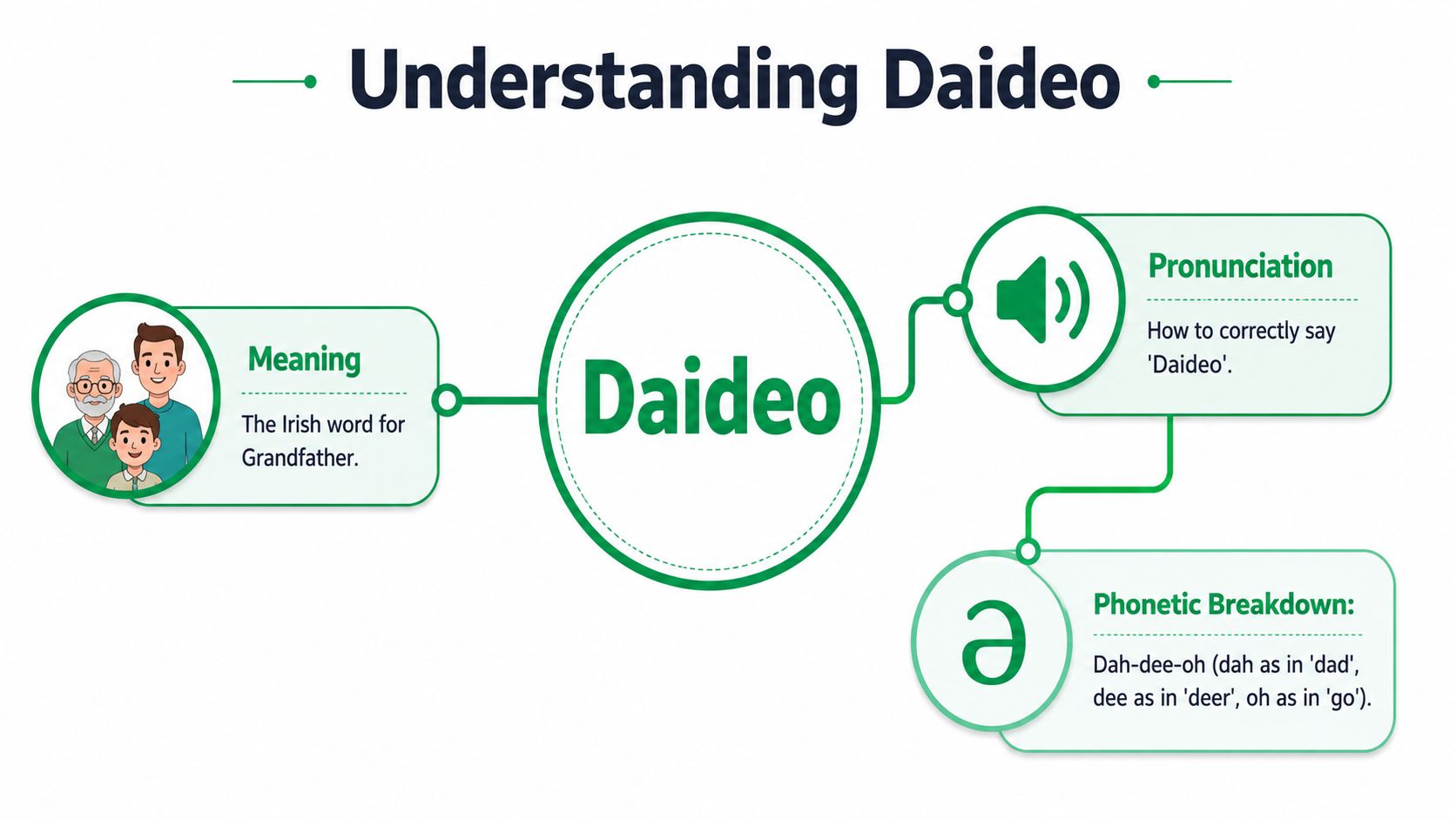
At the simplest level, Daideo means grandfather in Irish. A credible Irish language reference also gives the pronunciation as approximately “daj-oh”, with the stress on the first syllable and a long sound at the end, which helps learners avoid the usual spelling-based guesses in English, as noted in this Irish pronunciation entry for daideo.
Irish spelling can feel unfamiliar at first because you can't always map the letters directly onto English sounds. That's why many beginners hesitate. They see daideo and try to force an English reading onto it.
A better approach is to treat it as a sound pattern, not a spelling puzzle.
How to say Daideo clearly
Say it slowly first: daj-oh.
You can think of it like this:
- First part feels like “daj”
- Second part ends with a clear “oh”
- Stress stays on the first syllable
- Ending should not be clipped too short
If you'd like a broader foundation for sounds like this, an Irish pronunciation guide for beginners can help you build confidence beyond one word.
A short listening model helps too:
Say it aloud before you try to memorize it. Irish often settles into place through the ear faster than through the eye.
If you're curious about formal notation, some learners also like to check IPA when studying pronunciation. That can be useful, but don't let it slow you down. For most beginners, the plain-English sound cue is enough to get started.
The important thing is to say Daideo warmly and naturally, not stiffly. Family words sound best when they feel lived in.
Using Daideo in Everyday Sentences
A word becomes real when you can use it in a sentence. With Daideo, the most useful everyday pattern is talking about your grandfather.
The most useful form to learn first
In Irish, “my” is mo. When mo comes before many nouns, the next sound changes. With Daideo, that gives you mo dhaideo.
This change is called lenition. You don't need to master the full grammar today. You only need to notice the before-and-after pattern:
| English | Basic noun | With “my” |
|---|---|---|
| grandfather | Daideo | mo dhaideo |
That small spelling change matters because it reflects how Irish words behave together in real speech. If you learn mo dhaideo as one useful chunk, you'll sound more natural right away.
For a broader feel for how Irish builds meaning through word order and small grammatical changes, this Irish sentence structure guide is a helpful next step.
Common learner mistake: keeping the noun unchanged and saying mo daideo. You'll often want mo dhaideo instead.
Simple examples you can start using
Here are a few friendly, practical examples:
Seo é mo dhaideo.
This is my grandfather.Tá mo dhaideo sa bhaile.
My grandfather is at home.Is fear cineálta é mo dhaideo.
My grandfather is a kind man.Bhí mé le mo dhaideo inné.
I was with my grandfather yesterday.Is breá liom mo dhaideo.
I love my grandfather.
Notice how often Irish learning comes down to reusable chunks. You don't need a huge vocabulary to say meaningful things. One family word plus a few common structures can already carry a lot of feeling.
Try these short practice tasks:
Introduce a family photo
Say: Seo é mo dhaideo.Describe him in one word
Try: Tá mo dhaideo greannmhar.
My grandfather is funny.Add a memory
Try: Bhí mé le mo dhaideo aréir.
I was with my grandfather last night.
If you're teaching a child, keep it playful. Point to a picture and repeat the phrase together. If you're learning for yourself, say each sentence three times aloud. The rhythm matters as much as the translation.
Daideo vs Seanathair and Regional Terms
Not every Irish speaker uses the same family word in the same way. That's part of the beauty of the language. Daideo is one option, but not the only one.
A quick comparison
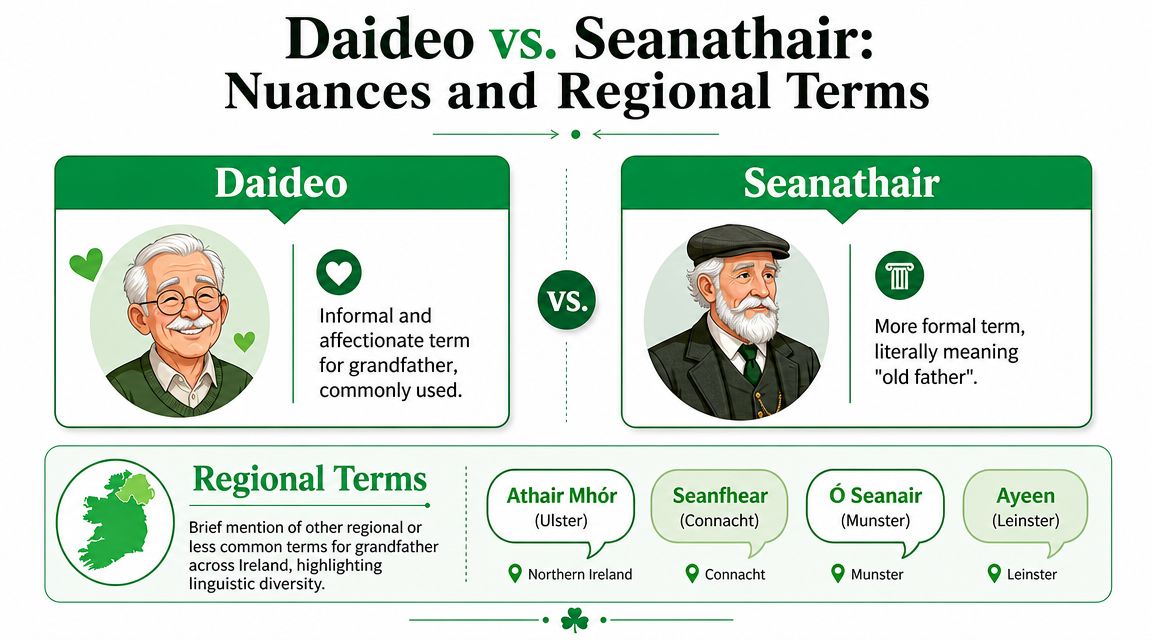
The most common comparison learners meet is Daideo versus Seanathair.
| Term | Usual feel | Rough English equivalent |
|---|---|---|
| Daideo | warm, familiar, affectionate | grandad, grandpa |
| Seanathair | more formal, traditional, dictionary-like | grandfather |
This isn't a strict rule for every family. Some households prefer one term because that's what they've always said. Still, for many learners, Daideo feels more intimate and immediately usable in family speech, while Seanathair can sound more formal.
What about regional variation
Irish is a living language with strong regional identities. Families in different parts of Ireland may prefer different expressions, pronunciations, or affectionate forms. That doesn't mean one version is “the only correct one” and the others are wrong. It means language belongs to people and place.
If dialect differences interest you, a useful follow-on resource is this guide to dialectal differences in Irish.
A good learner mindset is simple:
- Start with one usable word. Daideo is a strong choice.
- Notice alternatives when they appear. Don't panic if you hear something else.
- Respect family habit. Homes often keep their own preferred term.
The best word for grandfather in conversation is often the word your family actually says.
That gives you permission to learn with warmth instead of anxiety. Irish isn't asking you to choose one perfect form forever. It's inviting you into real usage.
The Cultural Significance of a Daideo
More than a dictionary meaning
Some words carry family structure. Others carry family feeling. Daideo does both.
In many Irish-speaking and Irish-rooted families, a grandfather isn't only an older male relative. He may be the person who tells the same story at the fire, remembers older place-names, passes on songs, or uses turns of phrase that younger people hear nowhere else. Even when family life looks modern and busy, the idea of the grandfather as a link to continuity remains powerful.
That's why words like Daideo matter. They hold affection inside them. They can feel less distant than a plain formal label.
Why family words stay with us
Family vocabulary is often among the last language people forget and the first language they want back. Someone may know very little Irish, yet still remember a grandparent term, a blessing, or a pet name from childhood. These are often the words that survive in emigrant families too. They stay because they're attached to voice, not just meaning.
Think of how people speak when they remember a grandparent. They rarely begin with grammar. They begin with texture. The chair by the window. The walk to school. The stories repeated so many times they became part of the house itself.
A heritage word becomes powerful when it names a relationship you can still feel.
That's one reason learners reconnect so strongly through kinship terms. Daideo can be a vocabulary item, yes. It can also be an entry point into personal history. When you say it, you're not only practicing Irish. You're naming a role that often carries wisdom, humour, steadiness, and memory.
Practice and Master Daideo with Gaeilgeoir AI
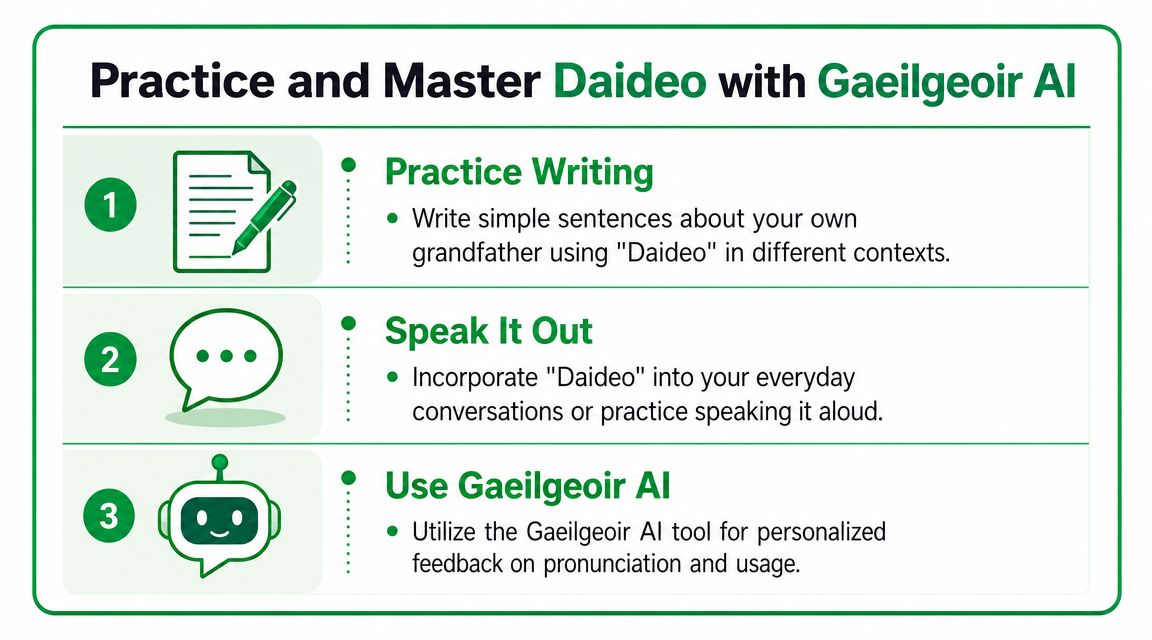
Learning sticks when you use the word in ways that matter to you. Daideo is perfect for that because it's personal, concrete, and easy to place in everyday speech.
Three easy ways to practise
Try a short routine like this:
Write one true sentence. Use a real memory or description, even if it's simple. Bhí mo dhaideo greannmhar. A real sentence is easier to remember than a random one.
Say it while looking at a photo. That keeps the word attached to a person, not just a notebook. Speak slowly and aim for a relaxed rhythm.
Build a tiny family set. Once Daideo feels comfortable, add other family words around it. That helps your brain store vocabulary by relationship, which is how people often use it in conversation.
If you're helping a child learn at home, keep the atmosphere light and repetitive. Songs, family pictures, and short spoken routines work well. Parents looking for broader ideas may also find this guide on teaching kids a second language at home useful.
When guided practice helps most
Some learners do well with self-study at first, then hit a wall when pronunciation, recall, and sentence-building need regular feedback. That's normal. Family words may be emotionally familiar, but using them fluently still takes repetition.
A good practice tool should make it easy to do three things: hear the word, say the word, and use the word in context. That matters far more than memorizing long lists in isolation.
Keep your first goal modest:
- Recognize Daideo when you hear it.
- Say it comfortably.
- Use it in one sentence about your own family.
Once you can do that, the word is no longer abstract. It belongs to your spoken Irish.
If you'd like to turn words like Daideo into real conversation, Gaeilgeoir AI is a practical next step. It helps learners start speaking from day one with guided conversations, pronunciation support, adaptive quizzes, and everyday vocabulary practice built around the most-used Irish words. You can also get started at Learn Gaeilgeoir AI.