Irish Diminutives: A Guide to -Ín, -Óg, and More

You're probably here because you've seen or heard an Irish word ending in -ín and felt that it carried a special kind of charm. Maybe it was cailín, maybe poitín, maybe a place name or a nickname from home. You knew it sounded small, soft, affectionate, or playful, but the rule behind it felt just out of reach.

That instinct is a good one. Irish diminutives aren't just a grammar topic. They're part of the emotional texture of the language. They can make something sound little, loved, familiar, teasing, or gently dismissive, and often the feeling matters as much as the dictionary meaning. If you want Irish to sound alive rather than mechanical, this is one of the best places to start.

Table of Contents

The Hidden Charm in Everyday Irish Words

A lot of learners first notice Irish diminutives by ear. You hear that bright little -een sound at the end of a word and it sticks. Even before you know the rule, you can feel that something is happening. The word sounds closer, softer, more human.

Take cailín. Many beginners meet it early and learn that it means “girl.” Then later they discover that Irish often uses diminutive forms in ways that carry warmth and familiarity, not just strict size. The same goes for poitín, a word many English speakers in Ireland already know in its anglicised form, poteen. The ending isn't decorative. It carries meaning and history.

That's one reason Irish diminutives are so rewarding to learn. They help you notice that grammar in Irish often has personality. A word can shrink in form, but grow in feeling.

Irish gets more expressive when you stop treating endings as mere endings.

Beginners sometimes expect diminutives to work like a simple formula: add a bit, mean “small.” Irish does do that. But it also does more. The same kind of ending can make a thing sound dear, familiar, cute, humble, or lightly comic depending on who says it and how.

That's why learning Irish diminutives isn't only about memorising forms. It's about getting used to the social feel of the language. Once your ear starts picking them up, spoken Irish often feels less distant and more intimate.

What Exactly Are Irish Diminutives

An Irish diminutive is a word form that usually expresses smallness, affection, or a softer emotional tone. In plain English, it's a way of turning a noun into something that sounds smaller, dearer, or more personal.

In Irish, the main suffix for this is -ín, often written in English as -een. It's the best place for any beginner to start because it's the most productive and the most recognisable pattern.
A small wooden bird carving sitting on a wooden surface with a green banner in the background.

A small ending with a big footprint

The suffix -ín has had such a strong influence that it shaped Irish English too, giving English words such as smithereens and poteen. It's not some obscure grammar relic. It's part of a living speech tradition. The Irish language community remains large as well. In 2022, 1,873,997 people aged three and over in Ireland could speak Irish, and 115,065 used Irish weekly, according to Ireland's Census 2022 profile on the Irish language and the Gaeltacht.

That matters for learners. You're not learning a frozen grammar trick. You're learning a pattern still heard in real speech.

The beginner definition that actually helps

If you want the quick working rule, use this:

  • Small thing: a physically smaller version of something
  • Affectionate thing: a warmer or dearer version of something
  • Familiar thing: a word that sounds more local, lived-in, or intimate

That last one is where many learners get caught out. Not every diminutive feels “small.” Sometimes the size meaning fades and the emotional meaning takes over.

Practical rule: If a word ending in -ín feels affectionate or familiar, your instinct is probably on the right track, even before you can fully explain the grammar.

You don't need to master every sound change on day one. First, get comfortable noticing the pattern. Hear the ending. Ask yourself what it does to the tone. That shift in awareness helps more than rote memorisation.

Meet the Main Diminutive Suffixes

You hear a word like poitín or a pet name ending in -ín, and after a while your ear starts to notice a pattern. Irish has a few common endings that can make a word sound smaller, warmer, or more familiar. For beginners, three matter most: -ín, -óg, and -án.
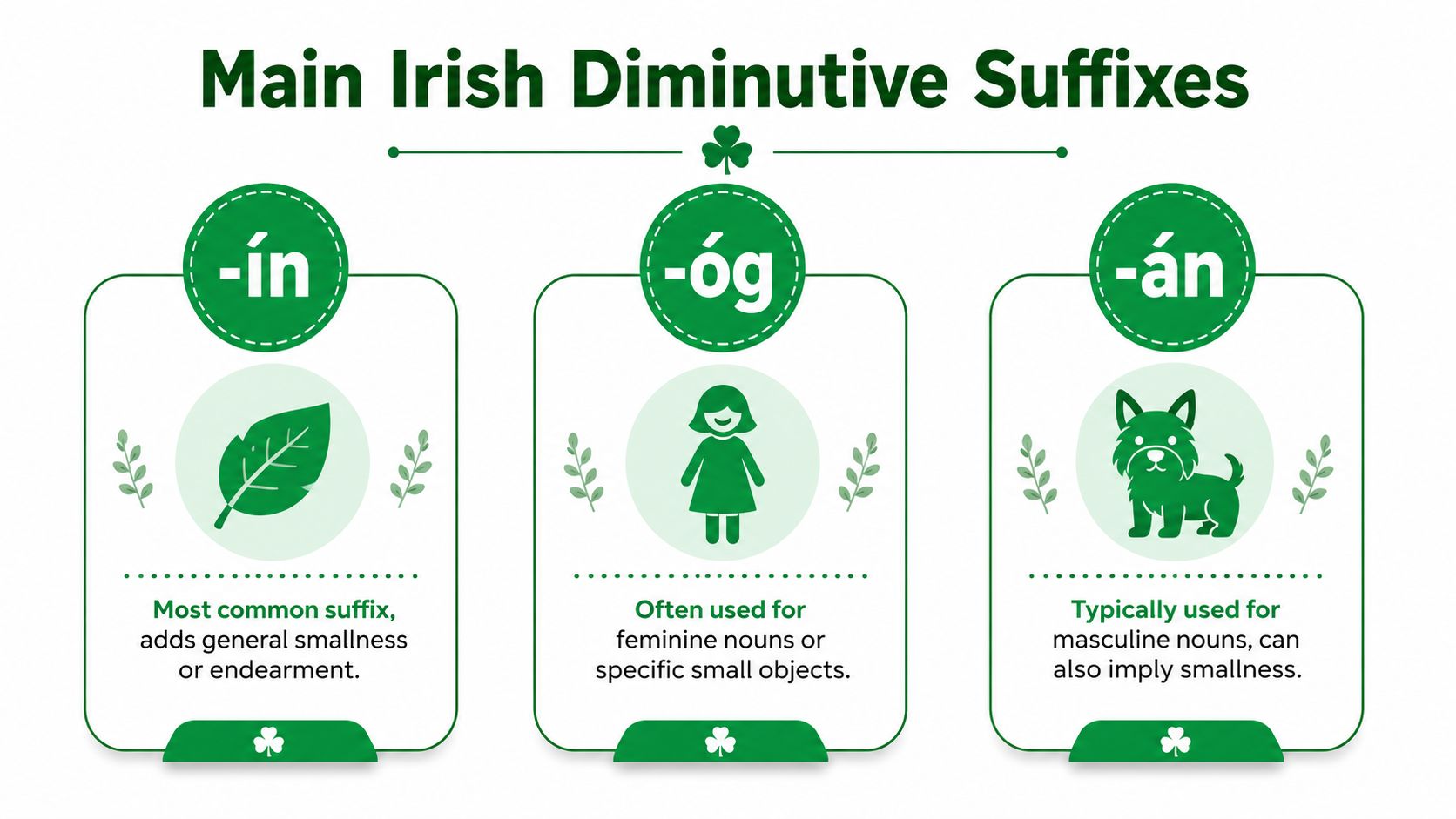
An infographic explaining the main Irish diminutive suffixes, including -ín, -óg, and -án with descriptions.

The suffix -ín

Start here first.

-ín is the clearest and most useful diminutive suffix for a new learner. You will meet it again and again in ordinary vocabulary, in affectionate speech, and in words where the idea of “small” has partly faded into a more intimate tone.

A few familiar examples help. Capall can become capaillín (“pony”), lacha can become lachín (“duckling”), and pota becomes poitín. If you have already seen soft, affectionate words such as puisín, the same feeling appears in many forms built with this ending. You can see that tone more clearly in this guide to the meaning of puisín in Irish.

The key beginner instinct is simple: if you spot -ín, ask two questions. Is the word talking about something small? Or is it making the word feel fond, close, or homely? Very often, both shades are there at once.

The suffix -óg

-óg also appears often, but it behaves a little differently for learners.

Rather than treating it as a suffix you can freely attach to any noun, it helps to meet it through real words and let your ear get used to it. Many -óg words feel established in the language already, almost like ready-made vocabulary items. That means recognition usually comes before confident use.

This matters for spoken Irish. A learner who tries to force every diminutive through one pattern can sound stiff. A learner who notices that some forms simply belong to the language as inherited words starts to sound more natural.

The suffix -án

-án belongs in the picture too. It reminds us that Irish diminutives are not a one-ending system.

For an absolute beginner, the safest takeaway is modest but useful. If you meet -án, keep an open mind about what the ending is doing. Sometimes it contributes a diminutive sense, sometimes the word is best learned as a whole item, and sometimes the emotional colouring matters more than literal size.

That is a very Irish kind of lesson. Grammar gives you the pattern, but usage gives you the feel.

Irish diminutive suffixes compared

Suffix Primary Meaning Common Usage & Notes
-ín Smallness, affection, familiarity The most common and productive suffix for beginners to learn
-óg Diminutive or lexicalised small/familiar sense Often best learned through set vocabulary rather than active guessing
-án Diminutive in some formations Recognised in Irish, but less central for beginners than -ín

A helpful habit is to learn these suffixes in two stages. First, get good at hearing and recognising them. Then start using -ín in your own speech, while treating -óg and -án more cautiously until they feel familiar.

That approach builds confidence fast. It also matches how strong speaking habits grow at Gaeilgeoir AI: notice the pattern, try it aloud, and let real usage shape your instinct.

How Adding a Suffix Changes the Word

The tricky part of Irish diminutives isn't just adding an ending. It's that the word often changes shape on the way. Beginners then start thinking, “I knew the rule, so why doesn't the new word look simple?” That confusion makes sense.

Irish likes sound harmony. When -ín joins a word, it often pulls the sounds before it into a slimmer, “narrower” shape. Teachers usually call that slenderization or palatalisation.
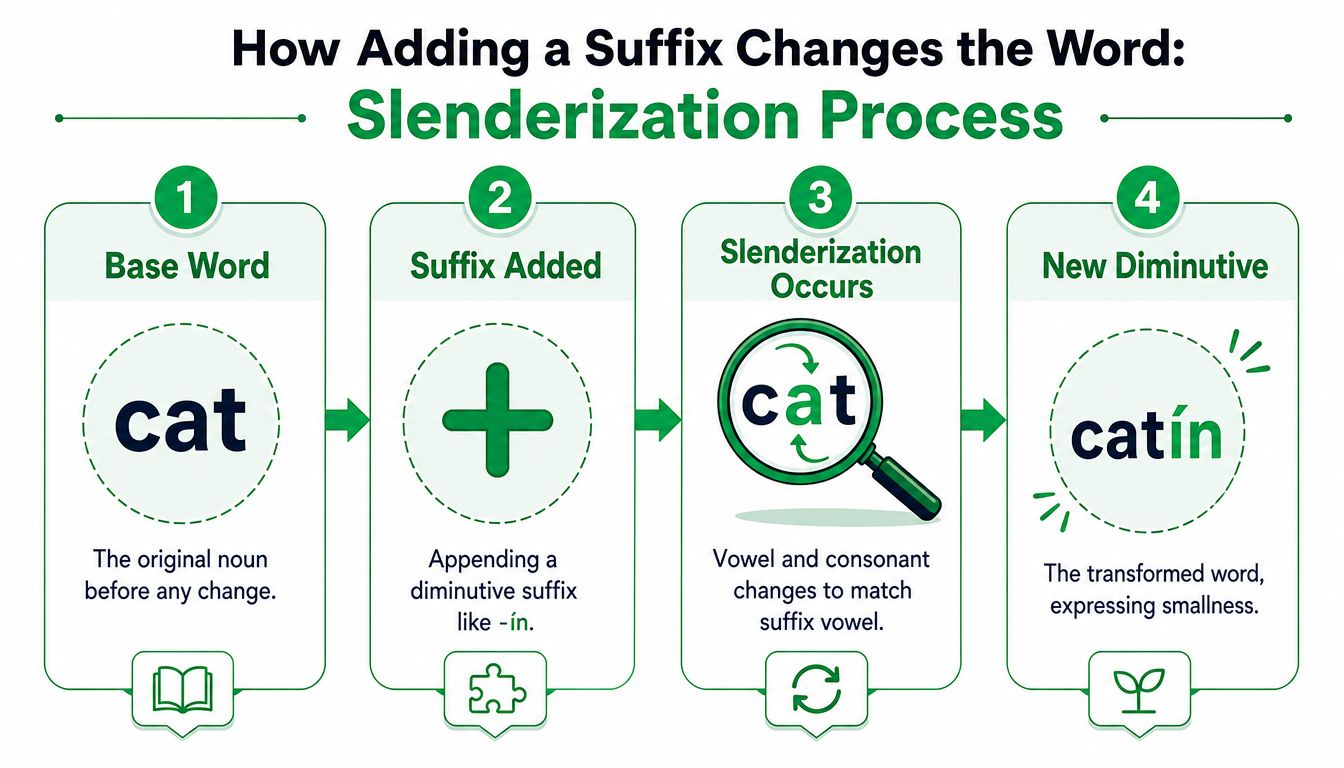
An infographic showing the four-step process of adding a diminutive suffix to create Irish language diminutives.

Why the spelling shifts

A simple way to think about it is this: the í in -ín reaches backward and changes the consonant beside it. Sometimes that means an extra i appears in spelling before the final consonant. That's why forms like capall become capaillín rather than a flat, predictable add-on.

If you've been exploring affectionate vocabulary already, you may have seen this same softness in action in pet words such as puisín, which you can explore in this guide to puisín meaning in Irish.

What happens in pronunciation

The sound change matters too. The suffix -ín triggers palatalisation, and that can alter pronunciation from /s/ to /ʃ/ in some cases, as explained in Stan Carey's discussion of the Irish diminutive suffix -een. You don't need to become a phonologist to use this well. You just need to expect that the ending may affect the sound before it.

That same source also notes that this suffix is so embedded in Irish English speech that people may use it redundantly, as in “a small wireen.” That's a lovely clue about usage. The ending can become less about strict size and more about tone.

If the spelling changes when you add -ín, that doesn't mean the rule failed. It means the rule is working in Irish.

Here's a good beginner method:

  1. Learn the base word
  2. Add the suffix
  3. Check whether the consonant before it has to slim
  4. Say it aloud before you trust your eyes

Irish often makes more sense through the ear than through the page.

Using Diminutives in Cultural Context

Irish diminutives shift from being a grammar exercise to feeling human. The same ending can signal fondness in one situation and mild mockery in another. If you ignore context, you'll miss half the meaning.

Irish diminutive nouns aren't just about size. Wiktionary categorises them by endearment, small size, and small intensity, and it even includes a special sub-category for diminutives of female given names, which you can see in this Irish diminutive nouns category. That's a useful framework because it matches how learners hear them in the wild.

When it means affection

A diminutive can make a word feel dearer. This often happens with names, family language, pet names, or speech directed at children. The speaker isn't reporting size. The speaker is signalling closeness.

If you want to get a feel for that warmer side of Irish, this collection of Irish Gaelic terms of endearment is a helpful companion.

When it means literal smallness

Sometimes the meaning really is practical. A teachín is a small house or cottage. A diminutive road word may suggest a little lane. In these cases, the emotional colour may still be there, but physical smallness is doing real work.

That blend is very Irish. A cottage can be small and beloved at the same time. The language doesn't always split those meanings apart neatly.

When it becomes teasing or dismissive

Tone can also tilt the other way. A diminutive can shrink something socially, not physically. It can make a person, object, or idea sound slight, petty, or faintly ridiculous. Often this isn't harsh. It's playful, ironic, or gently cutting.

That's why beginners should listen for voice and setting, not just endings. A warm smile and a soft tone can turn the same form into affection. A dry tone can turn it into a nudge.

Cultural cue: In Irish, a diminutive often tells you how the speaker feels about the thing, not just what size it is.

When learners grasp that, their Irish starts sounding less translated and more lived-in.

Common Diminutive Words and Names

The fastest way to make Irish diminutives feel natural is to meet them in real words rather than as abstract rules. Some will appear in songs, some in stories, some in placenames, and some in family speech.

Words you'll likely meet early

Here are a few useful examples to watch for:

  • Cailín. Commonly learned as “girl.” For many beginners, this is the first diminutive-shaped word they recognise in everyday Irish.
  • Teachín. From teach (“house”), meaning a small house or cottage. This is one of the cleanest examples of literal smallness.
  • Poitín. From pota in the standard diminutive examples cited earlier. In usage, learners often meet it as the word for poteen.
  • Capaillín. From capall (“horse”), meaning “pony.” This is a great model because it shows both the suffix and the spelling change.
  • Lachín. From lacha (“duck”), meaning “duckling.” A neat example of how compact the result can become.

Some words become so established that learners stop noticing the suffix at all. That's normal. In fact, it's a sign that you're beginning to hear the word as a whole unit rather than mechanically decoding it.

Names and nicknames

Diminutives also show up in personal names and affectionate forms. That matters socially. A name in diminutive form can feel more intimate, softer, or more playful than the plain base form.

You'll sometimes see learners experiment with forms such as Pádraigín or Séamasín. Whether a form feels natural can depend on habit, region, and what people around you say. So use names carefully and learn them from real usage when possible.

If you'd like a broader feel for familiar forms and playful personal naming, this guide to Irish nicknames is a good place to browse.

A smart beginner habit is to keep a tiny “diminutives notebook” with three columns: base word, diminutive, and feeling. Not just meaning. Feeling. That last column trains your ear for culture as well as grammar.

Practice Tips to Master Irish Diminutives

You don't master Irish diminutives by reading one explanation and moving on. You master them by seeing them, hearing them, testing them, and noticing how they land in context. This is one of those areas where active practice beats passive understanding every time.
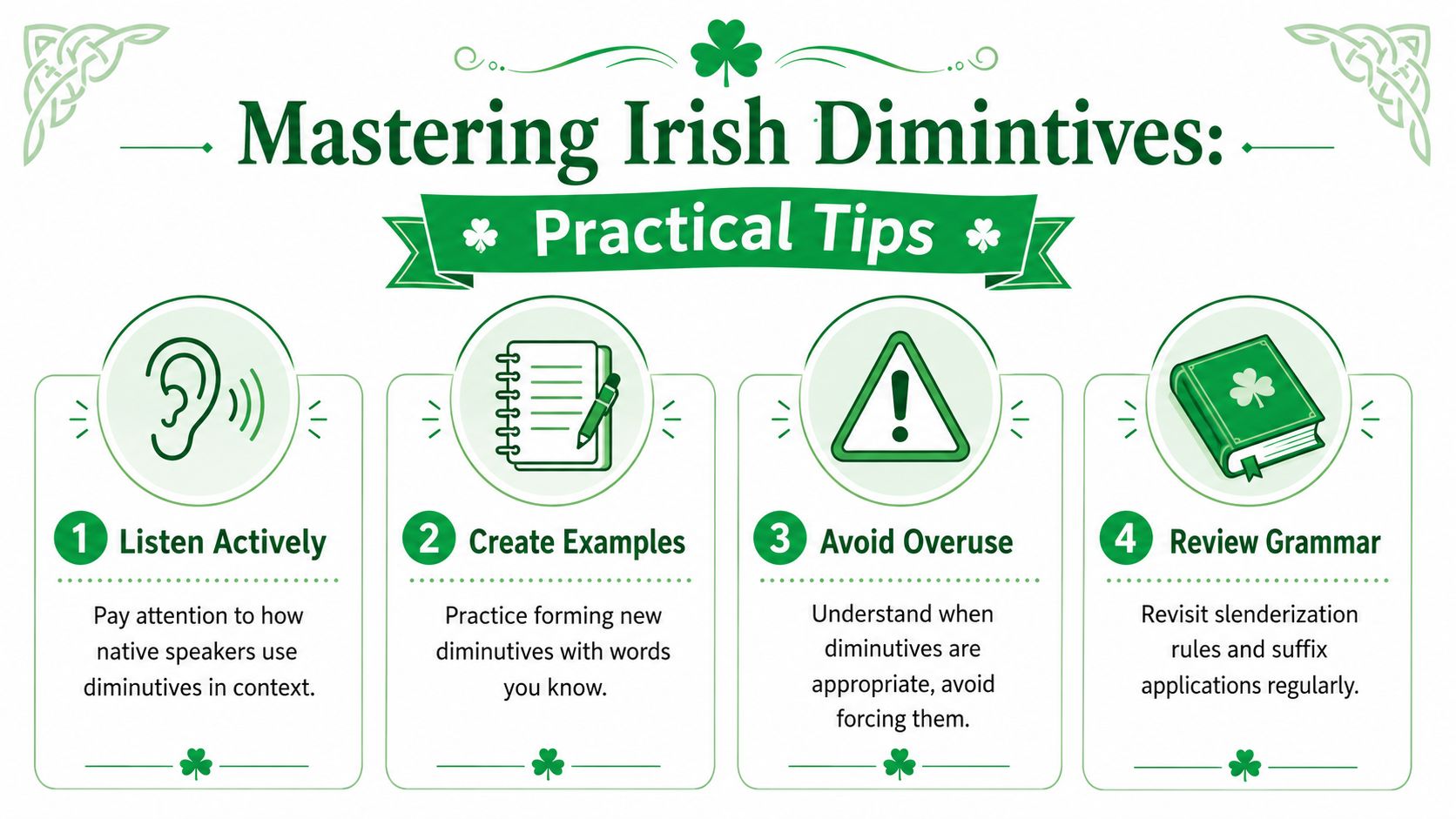
An educational infographic providing four practical tips for mastering Irish diminutives with icons and short descriptions.

A simple routine that works

Try this short practice loop across one week:

  1. Collect five words you already know, such as teach, capall, or pota.
  2. Guess the diminutive form before checking anything.
  3. Say each one aloud and listen for where the word tightens or softens.
  4. Write one mini-sentence using each word in a natural context.
  5. Review the set later, rather than cramming once.

That last step matters. If you want a method for keeping forms like these in long-term memory, this explanation of spaced repetition for language learning is very useful and easy to apply.

Beginner mistakes worth avoiding

A few problems come up again and again:

  • Forcing the suffix onto everything. Not every noun wants a diminutive in everyday speech.
  • Ignoring spelling changes. The suffix may reshape the word, not just attach to it.
  • Treating every diminutive as “cute.” Some are affectionate. Some are practical. Some are teasing.
  • Learning forms without context. If you only memorise translations, you'll miss the tone.

Say the word in a short phrase, not in isolation. Diminutives reveal their meaning best when they live inside a scene.

You'll improve faster if you treat diminutives as conversation tools. Listen for them in speech. Notice who says them and to whom. Repeat phrases that sound natural. Build your own examples, then test whether they still feel warm, small, or playful when spoken aloud.

The objective isn't to pass a grammar quiz. It's to get comfortable enough that when you hear an -ín ending, you don't freeze. You recognise the feeling, and you answer with confidence.


If you want guided, real-world speaking practice with feedback from day one, Gaeilgeoir AI is a smart next step. You can start building confidence with Irish conversation and practical vocabulary at learn.gaeilgeoir.ai. Comments and pingbacks are closed.
What Does Buachaill Mean? a Guide for Irish Learners

Buachaill means boy, and you'll usually hear it pronounced roughly BWA-khill. It's a common Irish word, but it carries more than one layer of meaning, which is why so many learners pause when they first meet it.

Maybe you've seen buachaill in a song title, in a vocabulary list, or in a sentence on a learning app and thought, “Right, it means boy. But what kind of boy? And why does it sometimes seem to change shape?” That instinct is a good one. Irish often looks simple at first glance, then opens into grammar, history, and culture all at once.

That's exactly what makes this word worth learning properly. Buachaill is one of those everyday Irish words that can teach you a lot about how the language works. Once you understand it well, many other nouns start to feel less mysterious.

Table of Contents

Your First Step to Understanding Buachaill

Most learners meet buachaill early. It looks important, sounds memorable, and turns up in places that feel very Irish, from songs to simple textbook dialogues. The first useful thing to know is that it usually means boy, and in some contexts it can also feel like lad or young man.

That's the surface meaning. The deeper value of the word is that it helps you notice three big features of Irish at once: pronunciation, noun forms, and context. If you learn buachaill as more than a one-word translation, you'll start reading Irish with better instincts.

A lot of adult learners do better when they understand the reason behind a pattern, not just the rule itself. If that sounds like you, this piece on understanding adult learning for creators is a helpful reminder that adults often retain more when meaning, context, and structure arrive together.

Practical rule: Don't memorize buachaill as “boy” and stop there. Learn the sound, the form, and one or two real phrases with it.

There's also a cultural reason this word sticks. Buachaill isn't trapped inside beginner exercises. It appears in Irish cultural material and named references, including Buachaill ón Éirne, which shows the word living in widely circulated Irish-language material rather than sitting on the edge of the language (traditional song reference).

If you've ever felt that Irish words seem to do more than their English equivalents, you're noticing something real. Buachaill is a perfect example.

What Buachaill Means and How to Say It

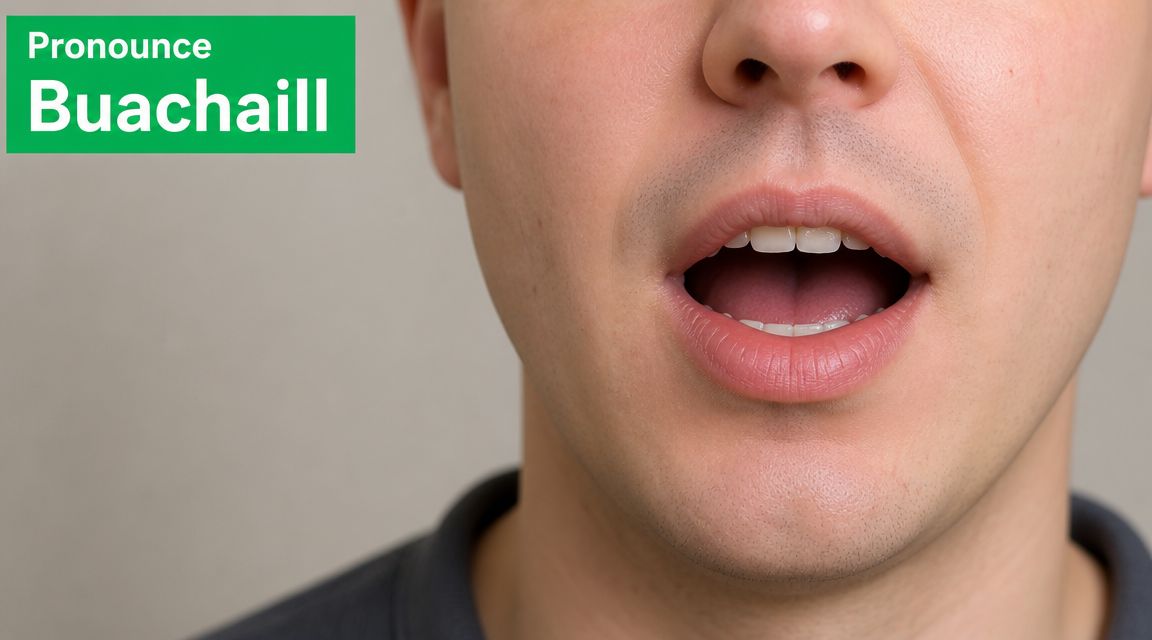
Say it like this: BWA-khill.

The first part, bua, sounds roughly like “bwa.” The ending has that Irish ch sound that many English speakers need time to get comfortable with. It's the kind of sound people often compare to the sound in Scottish loch. You don't need perfect phonetics on day one. You just need to avoid turning it into a hard English “k” or “ch” as in “chair.”

A close-up view of a person's mouth partially open, with the text Pronounce Buachaill above.

A simple way to remember the sound

Try this memory aid:

  • BWA like the opening of “bwah”
  • khill with a throaty kh sound, not a crisp English “kill”

If your pronunciation comes out a bit soft at first, that's normal. Irish pronunciation gets easier when you repeat one word many times in short phrases instead of saying it in isolation.

The core meaning in modern Irish

In current everyday use, buachaill is best understood first as boy. Depending on tone and context, it can also extend to young man or lad. That flexibility matters, because learners sometimes expect an exact age label, and Irish doesn't always work that way.

If you hear buachaill in a simple sentence, “boy” is usually the safest first interpretation.

The word can also appear with other senses in dictionaries, which is where confusion starts. Some sources include meanings such as boyfriend, servant, or older historical senses. Those aren't all equally common in present-day beginner material. The modern everyday meaning is still the one you should anchor first.

A good habit is to learn each new noun with one plain sentence. For this word, a beginner-friendly mental model is:

  • Is buachaill é for “He is a boy”
  • an buachaill for “the boy”
  • mo bhuachaill for a context where the word shifts and may mean “my boy” or, in the right setting, “my boyfriend”

That last example starts to show why this word is worth slowing down for. The meaning changes with context, and the spelling can change with grammar.

The Grammar of Buachaill Made Simple

Irish grammar often feels hardest when learners meet several ideas at once. Buachaill gives you a tidy way to learn them together.

According to a technical grammar reference, buachaill is a masculine noun meaning “boy,” with buachaill as the nominative singular and buachalla as the genitive singular. That matters because Irish uses case endings and mutation patterns in ordinary phrases and compounds (grammar note on forms).

Why masculine nouns matter

When a noun is masculine in Irish, it can affect the form of nearby words and the way phrases are built. You don't need to master the whole gender system to use buachaill well, but you do need to know that it isn't just a label in a dictionary. It has consequences in real sentences.

Think of grammatical gender in Irish as a pattern signal. It tells you that the noun may behave in certain predictable ways.

The genitive form buachalla

The genitive is the form Irish often uses for ideas like “of the boy.” English usually handles that with of or ’s. Irish often changes the noun itself.

A classic example is:

  • hata an bhuachalla = “the hat of the boy” or “the boy's hat”

Here's the key thing to notice. The base word is buachaill, but in this structure you meet bhuachalla. That shift tells you two things are happening together: a case change and an initial mutation.

When the word changes at the front

One of the most recognizable features of Irish is lenition, or séimhiú. In spelling, that often appears as an added h after the first consonant. With buachaill, that can produce bhuachaill or bhuachalla depending on the phrase.

Learners often panic when they see this. Don't. It's still the same word family.

Here's a quick reference table.

Form Irish Example Meaning
buachaill Is buachaill é boy
an buachaill Chonaic mé an buachaill the boy
bhuachaill mo bhuachaill my boy, or my boyfriend depending on context
buachalla hata buachalla a boy's hat, in a possessive-type structure
an bhuachalla hata an bhuachalla the hat of the boy

A few simple patterns are worth keeping in your notebook:

  • Base form stays as buachaill when you're just naming the word.
  • After some grammar triggers the beginning may soften to bh.
  • In possession-type phrases the ending may shift to -a, giving buachalla.

You don't need to predict every mutation instantly. You do need to recognize that buachaill, bhuachaill, and buachalla are connected forms, not separate vocabulary items.

If you build that recognition early, Irish stops feeling random. It starts feeling patterned.

From Cowherds to Boys The History of Buachaill

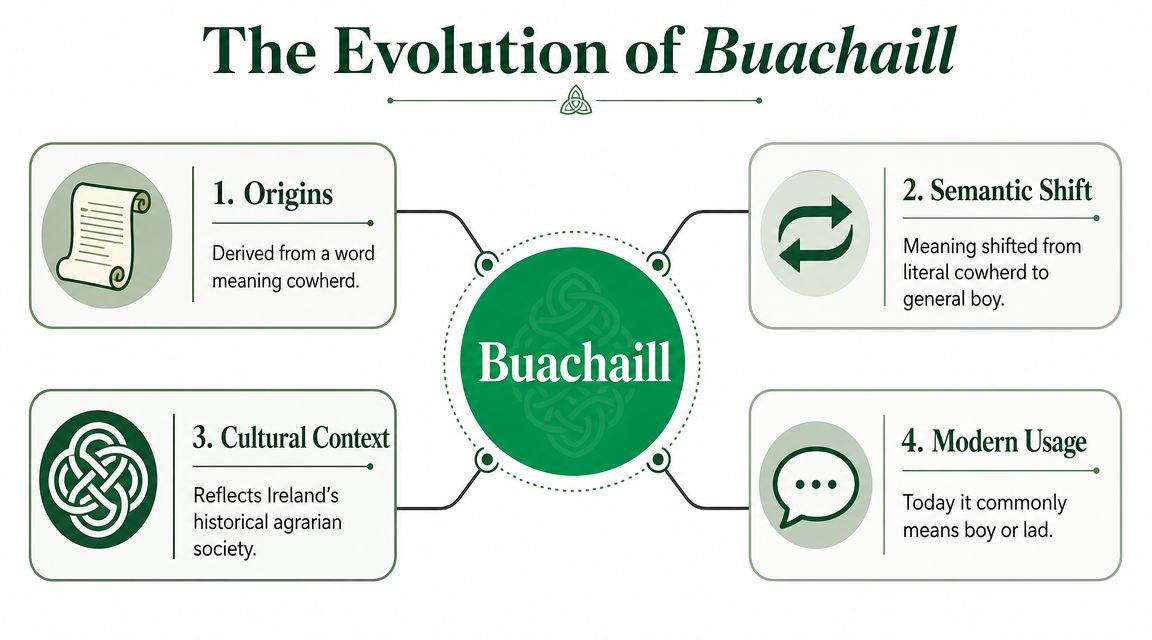
Modern learners usually meet buachaill as a simple everyday noun. But the word has an older life underneath it.

The historical story matters because the meaning didn't begin where it sits now. Etymology notes trace buachaill back to an older sense of cowherd or herdsman in Old Irish, while modern Irish uses it mainly for boy or young man (historical note on semantic shift).

A four-step infographic illustrating the historical evolution and linguistic shift of the Irish word Buachaill.

An older meaning sits underneath the modern one

That jump can feel odd at first. How does a word move from “cowherd” to “boy”?

Language does this all the time. A word starts as the name of a role, job, or social type. Over time, the meaning broadens, narrows, or slides into a related human category. In this case, the older occupational sense gave way to the more general human one.

That older agricultural background can make the word feel more memorable. It also helps explain why some dictionary entries seem wider than the translation you first learned.

For learners interested in Irish seasonal traditions and older cultural contexts, this Gaeilgeoir article on Imbolc pairs nicely with the historical feel behind words like this.

Why this shift helps learners

You don't need etymology to order coffee or introduce yourself in Irish. But for some words, history reduces confusion. Buachaill is one of them.

When a word looks semantically strange, history often explains what modern translation alone can't.

Once you know there's an older “herdsman” layer under the modern “boy,” the word stops seeming arbitrary. It starts to feel like a living piece of culture that travelled through time.

Using Buachaill in Everyday Phrases

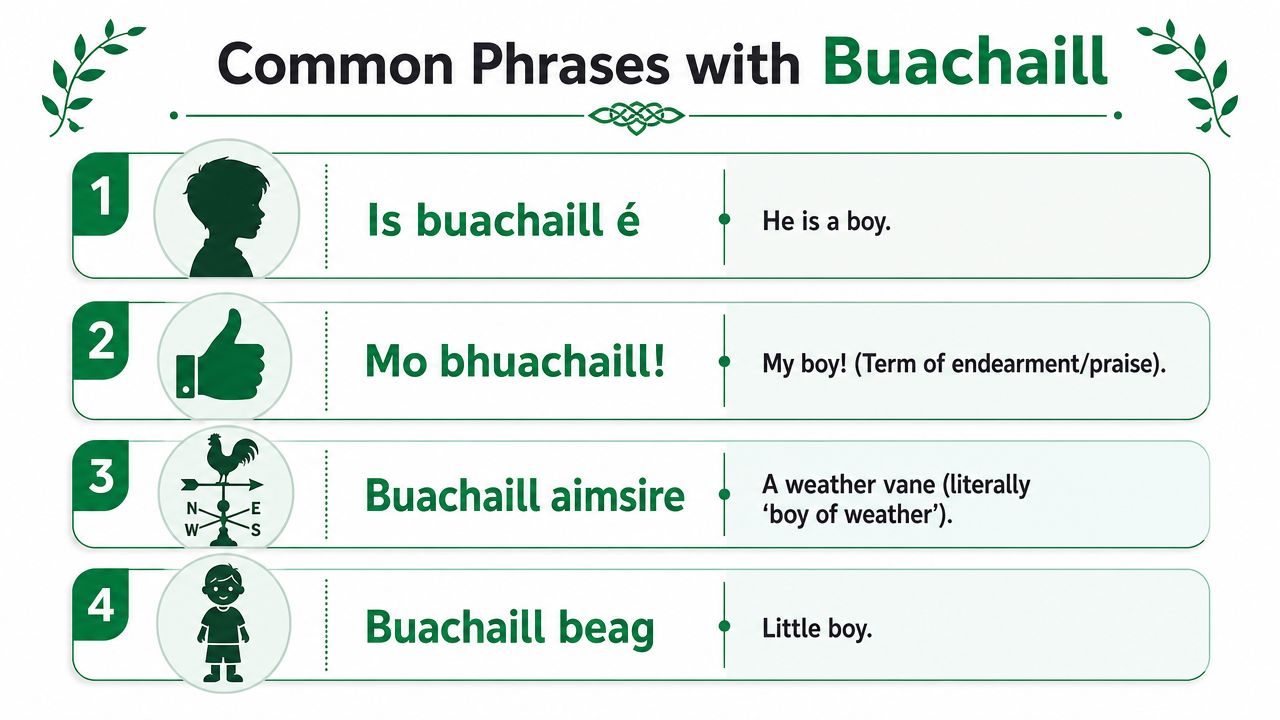
The most useful way to learn buachaill is by grouping its uses by register. In plain English, that means asking what kind of social setting you're in. Neutral conversation. Affection. Romance. Older or cultural usage.

Here's a quick visual before we unpack the details.

An infographic list showing four common Irish phrases using the word buachaill with translations and icons.

A helpful background note from dictionary-style usage pages is that buachaill can cover several senses, including boy, boyfriend, servant, and herdsman, while modern learners often need clearer guidance on which meaning is most common in real contemporary use. The same broad usage picture also points to cultural appearances such as Buachaill ón Éirne (usage range and cultural note).

Neutral everyday uses

These are the safest and most common beginner uses.

  • Is buachaill é
    Pronunciation: roughly iss BWA-khill ay
    Meaning: He is a boy
    Usage note: neutral and plain. Good for basic description.

  • an buachaill
    Pronunciation: roughly un BWA-khill
    Meaning: the boy
    Usage note: ordinary noun phrase. You'll meet this in reading very early.

  • buachaill beag
    Pronunciation: roughly BWA-khill byug
    Meaning: little boy
    Usage note: descriptive and straightforward.

Romantic and affectionate uses

Context begins to do its real work.

  • mo bhuachaill
    Pronunciation: roughly muh VWA-khill
    Meaning: my boy or my boyfriend
    Usage note: tone decides a lot here. In a romantic context, “my boyfriend” is natural. In another setting, it can sound affectionate or praising.

  • buachaill maith
    Pronunciation: roughly BWA-khill mah
    Meaning: good boy
    Usage note: affectionate, approving, or playful depending on who says it and why.

The phrase doesn't carry one fixed emotional color. Always ask who is speaking, to whom, and in what situation.

Here's a short listening aid if you want to hear Irish in a more natural rhythm:

Cultural and named uses

Some uses are easiest to understand as titles, names, or set phrases.

  • Buachaill ón Éirne
    Pronunciation: roughly BWA-khill own AIR-nyeh
    Meaning: Boy from the Erne
    Usage note: cultural title. This is a good reminder that the word isn't just a classroom noun.

  • An Buachaill Bréige
    Usage note: a modern Irish place-name example. It appears as a public-facing trail name in Mid Ulster, listed as a 9 km route with 418 m of elevation gain and an estimated time of 3 to 3.5 hours, which shows the word still lives in geographic naming as well as language study (trail listing with Irish name).

If you're unsure which meaning to choose, use this order:

  1. Start with boy
  2. Consider young man if the context feels broader
  3. Read it as boyfriend only when the relationship context is clear
  4. Treat older senses like herdsman as historical unless the text strongly points there

That habit will keep you accurate most of the time.

Your Next Step in Irish

A single word can open a surprising number of doors. Buachaill starts as “boy,” then quickly teaches you about pronunciation, noun gender, changing endings, mutation, older meanings, and social context.

That's one reason Irish becomes easier when you study words thoroughly instead of collecting long vocabulary lists. You're not just learning one label. You're learning how the language thinks.

If you want to make this stick, practice helps most when you hear the word in short phrases, repeat it aloud, and meet it again in different contexts. Flashcards can help. So can reading song titles and simple dialogues. Gaeilgeoir AI is one tool that supports Irish learning through pronunciation help, guided practice, and real-world vocabulary use, which fits well when you're trying to move a word like buachaill from recognition into active speech.

Screenshot from https://gaeilgeoir.ai

Keep this word close. When you meet it again, you won't just know the translation. You'll know why it looks the way it does, what it can mean, and how to read the tone around it.


If you want to keep building your Irish one useful word at a time, try Gaeilgeoir AI. You can also start learning and practising at learn Gaeilgeoir AI.

Sister in Irish Gaelic: Your Complete Guide to ‘Deirfiúr’

The main modern Irish word for sister is deirfiúr. Irish is a living language with a large speaker and learner base, and in the 2022 census 1,873,997 people over age 3 said they could speak Irish, while 13% said they spoke it daily.

If you're here, you're probably in a very familiar place. You've looked up “sister in Irish Gaelic,” found a translation, and then immediately wondered what to do with it. How do you pronounce it? How do you say my sister? Why does the word seem to change in some sentences?

That's where many beginners get stuck. A dictionary gives you the word, but not the confidence to use it. So let's make this practical. By the end, you'll know how to say deirfiúr, how to hear its shape, and how to build real sentences about your own family.

Table of Contents

Why Learning Family Words in Irish Matters

Many learners don't start with abstract grammar. They start with the people they love. You might want to describe your sister to a grandparent, add a few Irish words to a family card, or reconnect with heritage in a way that feels personal rather than academic.

That's why family words matter so much. They're among the first things you reach for in real conversation. If you know how to say a family term naturally, the language starts feeling usable instead of distant.

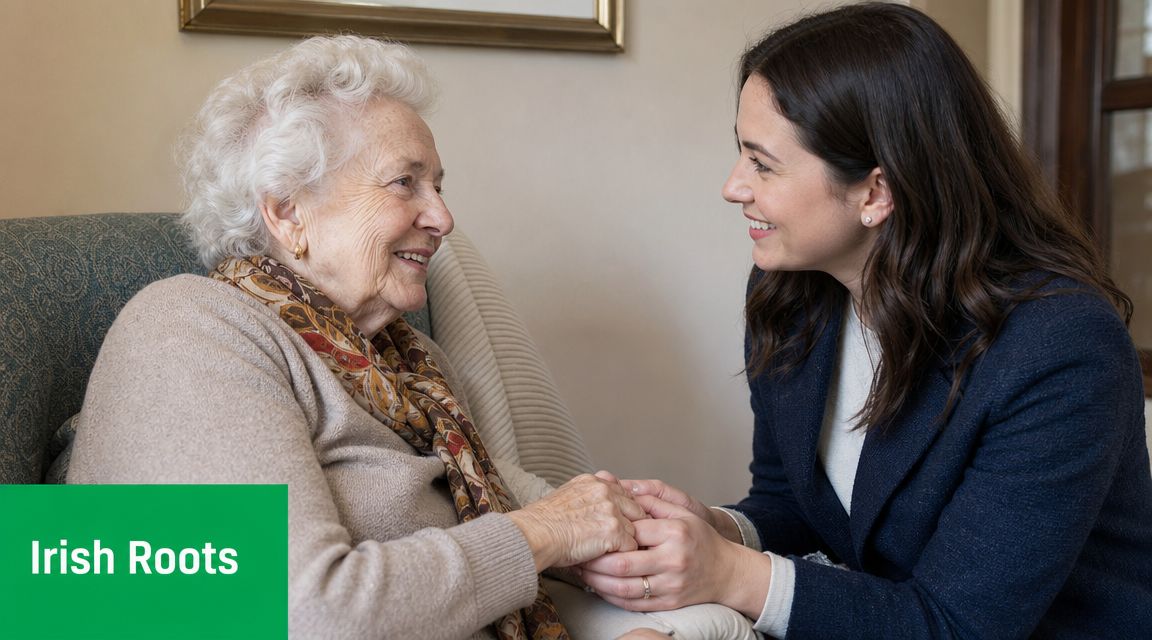
A young woman smiling and holding the hands of an elderly woman during a conversation.

A learner might begin with a simple goal: “I want to say, ‘This is my sister.’” That sounds easy in English. In Irish, it's still very doable, but there are a few small patterns you need to notice. Once you learn them, a lot of other family vocabulary becomes easier too.

If you're building out your home and family vocabulary, this guide to family words in the Irish language can help you widen the picture.

Family terms are often the first words that turn language study into actual communication.

There's also a cultural reason this matters. Irish isn't only a language of old songs, place names, or school memory. It's spoken today in communities across Ireland, including the Gaeltacht, so learning a word like deirfiúr gives you something useful in current contexts.

How to Say Sister in Irish

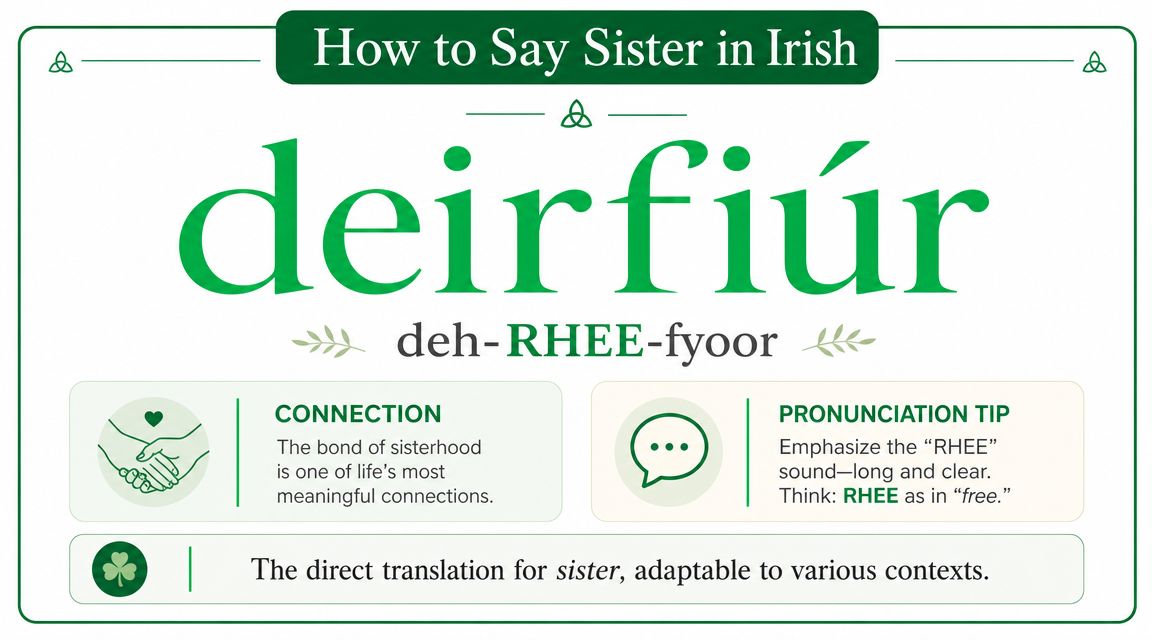
The word you want is deirfiúr. If you're searching for “sister in Irish Gaelic,” this is the standard modern Irish form you'll most often meet in current learning materials and dictionaries.

A common way to ease into the pronunciation is deh-RHEE-fyoor. You may also hear learners describe it more roughly as “drih-foor,” but that can flatten the middle of the word too much. Irish pronunciation is best learned by listening as well as reading, because spelling and sound don't always line up in the way English speakers expect.

An educational infographic showing the Irish word for sister, deirfiúr, with its pronunciation guide and tips.

Start with the shape of the word

Break deirfiúr into two parts in your ear:

  • deir
  • fiúr

Don't worry about making it perfect on day one. Aim for a smooth rhythm rather than a word-by-word English reading. The stress tends to fall strongly near the start, and the ending should sound rounded, not chopped short.

A good beginner habit is to say it in three steps:

  1. Listen first
  2. Repeat slowly
  3. Use it in a tiny phrase

That last step matters most. A word settles in faster when it appears inside a sentence.

Add the article

You'll also see an deirfiúr, which means the sister.

Irish words often appear with small helpers in front of them, meaning that if you only memorize isolated vocabulary, you'll feel lost the moment you meet a sentence. If you learn deirfiúr and an deirfiúr, you already have two useful building blocks.

Here's the simplest pair:

English Irish
sister deirfiúr
the sister an deirfiúr

Modern Irish uses stable, standardized forms, which helps learners a lot. That matters in a language that's actively spoken today. According to Bitesize Irish on deirfiúr, 1,873,997 people over age 3 said in the 2022 census that they could speak Irish, and 13% said they spoke it daily.

Practical rule: Don't stop at the translation. Learn the word, say it aloud, then place it in one short phrase immediately.

One more point that often surprises learners. Irish and Scottish Gaelic are related, but they don't always use the same everyday family words. Modern Irish uses deirfiúr, while Scottish Gaelic commonly uses piuthar. That difference is normal.

Understanding the Grammar of Deirfiúr

Once you know deirfiúr, the next challenge is grammar. Often, beginners think Irish is becoming complicated, but the first ideas are manageable if you treat them as sound patterns instead of rules to fear.

Deirfiúr is a feminine noun

In Irish, nouns belong to grammatical groups, and deirfiúr is a feminine noun. That doesn't mean the word has some magical property. It just means other words around it may behave a certain way.

If that sounds strange, think of it as a category label. English has traces of this kind of idea in older expressions and literary language, but Irish uses it more clearly. You don't need to memorize every feminine noun at once. You only need to notice that deirfiúr is one of them.

Why is this useful? Because later, when you meet phrases around the word, the changes won't feel random.

Irish often softens the first sound

One of the biggest beginner hurdles is séimhiú, usually called lenition in English. This is a kind of sound-softening at the start of a word. In writing, it often shows up as an extra h after the first consonant.

So a word can change shape a little without becoming a different word.

For example:

  • deirfiúr
  • dheirfiúr

That added h tells you the opening sound has softened.

Irish often changes the beginning of a word because of the word in front of it. If you expect that, the language starts making more sense.

You don't need a full mutation chart yet. What matters is the idea that Irish likes flow. Instead of every word staying frozen in one form, the language lets nearby words influence one another.

If you want a fuller explanation of these patterns, this guide to urú and séimhiú rules in Irish is a useful next read.

Hear the change before you try to master it

When beginners see mo dheirfiúr, they often ask, “Why did the word change?” The short answer is that mo triggers that softening.

You don't have to solve every grammar question immediately. Start by noticing these pairs:

Base form Changed form
deirfiúr dheirfiúr

Then say them aloud. The learning order that generally works best is:

  • Notice the pattern
  • Hear the difference
  • Use it in one phrase
  • Repeat often

That's much better than trying to memorize a long grammar table with no examples.

Older and newer forms both exist

Irish also has layers of older and newer vocabulary. One older root word for sister is siúr, while modern everyday Irish commonly uses deirfiúr. That older literary layer still appears in some texts and religious writing, which is why learners sometimes meet more than one form.

As discussed on the Irish Language Forum thread about siúr and deirfiúr, modern standard forms matter in a living language used across the island, including by 71,968 daily Irish users outside the education system in the 2022 census, and the 2021 census in Northern Ireland found 228,617 people with some ability in Irish, equal to 12.45% of the population.

How to Say My Sister Your Sister and Her Sister

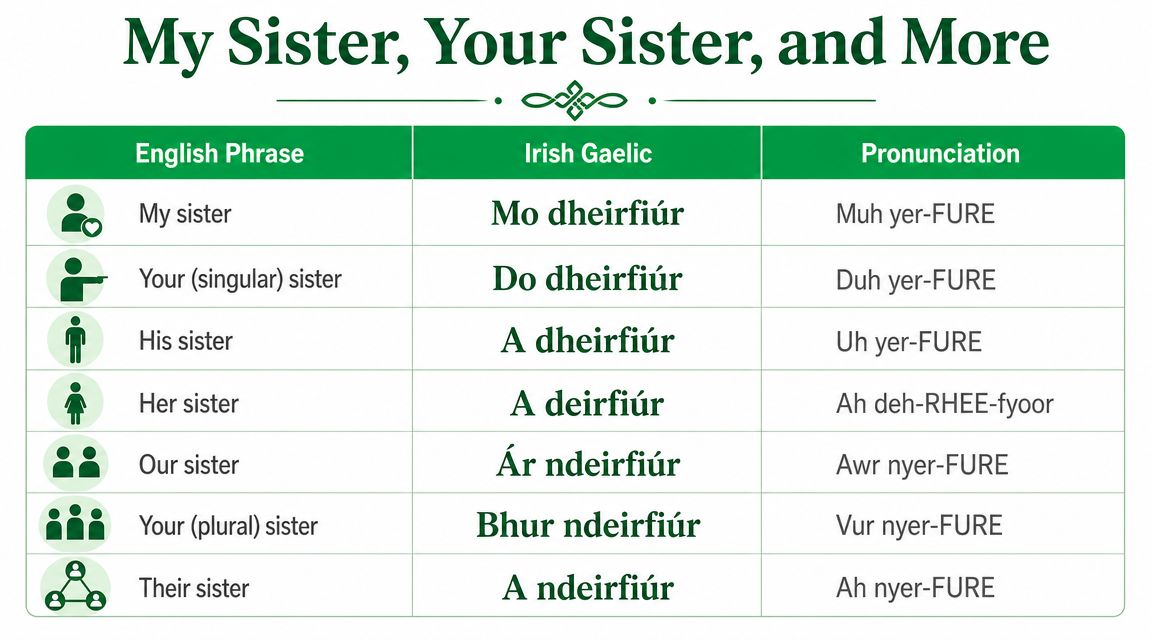
This is the point where the word becomes useful. Once you can say my sister, your sister, and her sister, you can start talking about real people instead of repeating isolated vocabulary.

A table displaying Irish Gaelic phrases for sister, showing possessive pronouns, translations, and phonetic pronunciations.

The key forms side by side

Here are the forms beginners need most:

English Irish Simple pronunciation
my sister mo dheirfiúr muh yer-FURE
your sister do dheirfiúr duh yer-FURE
his sister a dheirfiúr uh yer-FURE
her sister a deirfiúr ah deh-RHEE-fyoor
our sister ár ndeirfiúr awr nyer-FURE
your sister plural bhur ndeirfiúr vur nyer-FURE
their sister a ndeirfiúr ah nyer-FURE

The first thing to notice is the change after mo and do. Both cause lenition, so deirfiúr becomes dheirfiúr.

The common confusion with a

The trickiest pair is this one:

  • a dheirfiúr = his sister
  • a deirfiúr = her sister

They look very similar, but they don't behave the same way. His causes lenition. Her does not.

That small difference can feel frustrating at first, but it becomes familiar quickly if you practise in pairs. Always learn them as a contrast, not as separate facts.

Say these together out loud: a dheirfiúr, a deirfiúr. Your ear will start catching the difference faster than your eyes do.

A useful memory trick

Try this beginner-friendly way to remember the most common forms:

  • mo softens
  • do softens
  • his a softens
  • her a doesn't

That's not the whole grammar system, but it's enough to get moving.

If you want to compare this with another close family word, this guide to mother in Irish Gaelic helps reinforce the same kind of pattern.

The standard modern use of deirfiúr is especially helpful because learners need one dependable everyday form. The discussion on the earlier linked forum source notes the older siúr alongside modern deirfiúr, and that standardization supports clear communication for everyday speakers.

Common Phrases and Sentences Using Deirfiúr

Single words are only the start. The true breakthrough comes when you can say a full sentence without freezing halfway through.

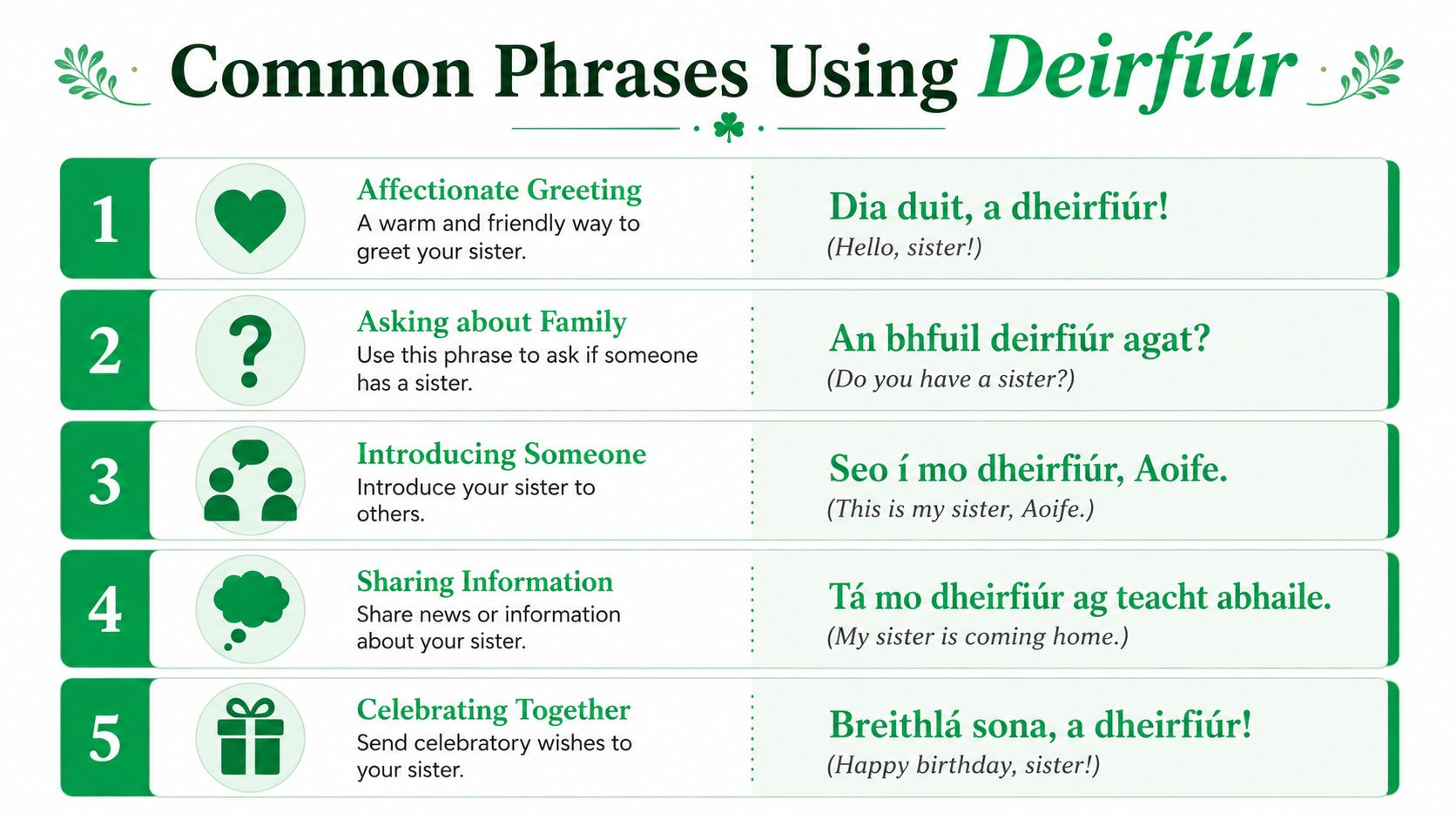
Here are some natural beginner phrases built around deirfiúr.

An educational chart displaying five common Irish phrases using the word deirfiúr for sister with translations.

Short phrases you can start using

  • Seo mo dheirfiúr.
    Pronunciation: shoh muh yer-FURE
    Meaning: This is my sister.

  • An bhfuil deirfiúr agat?
    Pronunciation: an will jer-FURE ah-gut
    Meaning: Do you have a sister?

  • Cad is ainm do do dheirfiúr?
    Pronunciation: cod iss ann-im duh duh yer-FURE
    Meaning: What is your sister's name?

  • Is múinteoir í mo dheirfiúr.
    Pronunciation: iss MOON-choir ee muh yer-FURE
    Meaning: My sister is a teacher.

  • Tá mo dheirfiúr ag teacht abhaile.
    Pronunciation: taw muh yer-FURE egg tyacht uh-wal-yeh
    Meaning: My sister is coming home.

Direct address sounds a little different

When you speak directly to your sister, you may hear:

  • Dia duit, a dheirfiúr!
    Meaning: Hello, sister!

  • Breithlá sona, a dheirfiúr!
    Meaning: Happy birthday, sister!

That direct-address pattern can look unusual, so don't worry if it feels less familiar than mo dheirfiúr. It's enough at first to recognize it when you hear it.

Here's a short video to support your listening practice:

A simple way to practise without overwhelm

Use one sentence pattern and swap in your own details.

Try this mini routine:

  1. Seo mo dheirfiúr.
  2. Is [job] í mo dheirfiúr.
  3. Tá mo dheirfiúr [verb phrase].

That gives you a repeatable frame. You're not inventing Irish from scratch each time. You're using a known structure and changing one piece.

Learn one phrase until it feels easy, then vary one word. That's how confidence grows.

Start Your Irish Language Journey Today

You came looking for the Irish Gaelic word for sister, and now you've got much more than a translation. You know that deirfiúr is the main modern Irish word, you've seen how to pronounce it, and you've worked through the first grammar patterns that appear the moment you try to say my sister or her sister.

That's real progress. It's how Irish becomes speakable. Not by memorizing huge lists, but by learning one useful word well and then putting it into phrases you can say.

Keep going in that same spirit. Stay close to high-frequency words. Say them aloud. Reuse them in short sentences about your own life. That's where fluency starts to feel possible.

If you want the next step, focus on practice that lets you hear, repeat, and respond. The more often you use words like deirfiúr in context, the less they feel like vocabulary items and the more they feel like part of your voice.


If you're ready to move from reading about Irish to speaking it, Gaeilgeoir AI is a strong next step. It helps beginners and returning learners practise real-world Irish through guided conversations, pronunciation support, and everyday vocabulary that you can start using right away.

Start Speaking Irish Today — 25% Off
Use code START25

Learn real Irish for real life with guided practice, pronunciation support, and everyday conversations.

Get 25% off any plan with code START25

Start Speaking Irish Today — 25% Off