What Does Buachaill Mean? a Guide for Irish Learners

Buachaill means boy, and you'll usually hear it pronounced roughly BWA-khill. It's a common Irish word, but it carries more than one layer of meaning, which is why so many learners pause when they first meet it.

Maybe you've seen buachaill in a song title, in a vocabulary list, or in a sentence on a learning app and thought, “Right, it means boy. But what kind of boy? And why does it sometimes seem to change shape?” That instinct is a good one. Irish often looks simple at first glance, then opens into grammar, history, and culture all at once.

That's exactly what makes this word worth learning properly. Buachaill is one of those everyday Irish words that can teach you a lot about how the language works. Once you understand it well, many other nouns start to feel less mysterious.

Table of Contents

Your First Step to Understanding Buachaill

Most learners meet buachaill early. It looks important, sounds memorable, and turns up in places that feel very Irish, from songs to simple textbook dialogues. The first useful thing to know is that it usually means boy, and in some contexts it can also feel like lad or young man.

That's the surface meaning. The deeper value of the word is that it helps you notice three big features of Irish at once: pronunciation, noun forms, and context. If you learn buachaill as more than a one-word translation, you'll start reading Irish with better instincts.

A lot of adult learners do better when they understand the reason behind a pattern, not just the rule itself. If that sounds like you, this piece on understanding adult learning for creators is a helpful reminder that adults often retain more when meaning, context, and structure arrive together.

Practical rule: Don't memorize buachaill as “boy” and stop there. Learn the sound, the form, and one or two real phrases with it.

There's also a cultural reason this word sticks. Buachaill isn't trapped inside beginner exercises. It appears in Irish cultural material and named references, including Buachaill ón Éirne, which shows the word living in widely circulated Irish-language material rather than sitting on the edge of the language (traditional song reference).

If you've ever felt that Irish words seem to do more than their English equivalents, you're noticing something real. Buachaill is a perfect example.

What Buachaill Means and How to Say It

Say it like this: BWA-khill.

The first part, bua, sounds roughly like “bwa.” The ending has that Irish ch sound that many English speakers need time to get comfortable with. It's the kind of sound people often compare to the sound in Scottish loch. You don't need perfect phonetics on day one. You just need to avoid turning it into a hard English “k” or “ch” as in “chair.”
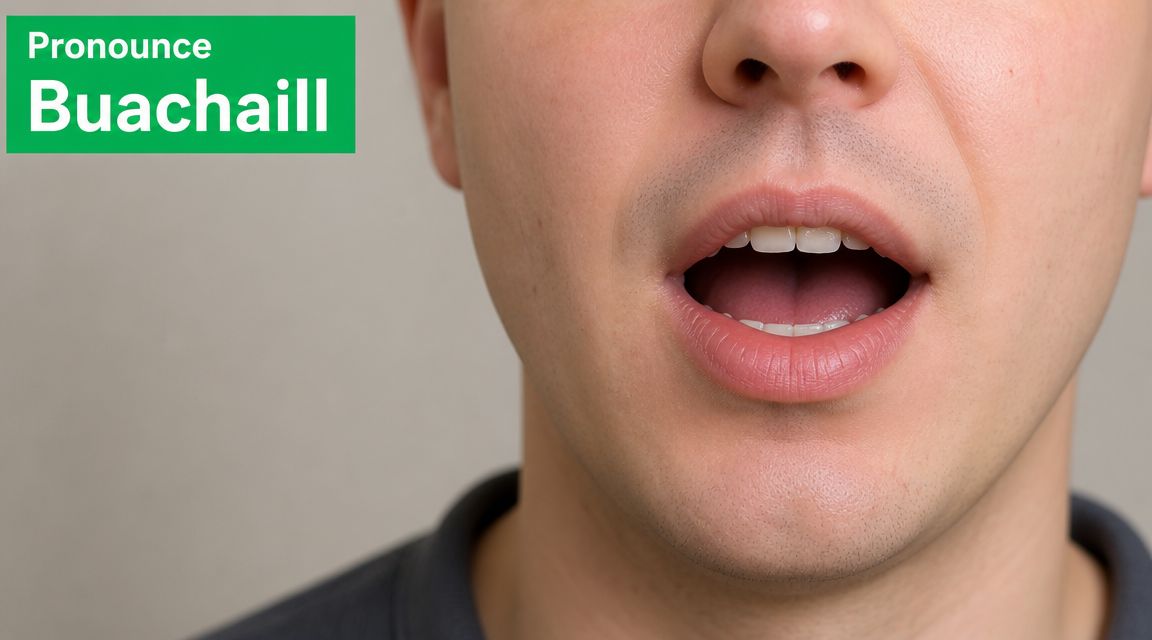
A close-up view of a person's mouth partially open, with the text Pronounce Buachaill above.

A simple way to remember the sound

Try this memory aid:

  • BWA like the opening of “bwah”
  • khill with a throaty kh sound, not a crisp English “kill”

If your pronunciation comes out a bit soft at first, that's normal. Irish pronunciation gets easier when you repeat one word many times in short phrases instead of saying it in isolation.

The core meaning in modern Irish

In current everyday use, buachaill is best understood first as boy. Depending on tone and context, it can also extend to young man or lad. That flexibility matters, because learners sometimes expect an exact age label, and Irish doesn't always work that way.

If you hear buachaill in a simple sentence, “boy” is usually the safest first interpretation.

The word can also appear with other senses in dictionaries, which is where confusion starts. Some sources include meanings such as boyfriend, servant, or older historical senses. Those aren't all equally common in present-day beginner material. The modern everyday meaning is still the one you should anchor first.

A good habit is to learn each new noun with one plain sentence. For this word, a beginner-friendly mental model is:

  • Is buachaill é for “He is a boy”
  • an buachaill for “the boy”
  • mo bhuachaill for a context where the word shifts and may mean “my boy” or, in the right setting, “my boyfriend”

That last example starts to show why this word is worth slowing down for. The meaning changes with context, and the spelling can change with grammar.

The Grammar of Buachaill Made Simple

Irish grammar often feels hardest when learners meet several ideas at once. Buachaill gives you a tidy way to learn them together.

According to a technical grammar reference, buachaill is a masculine noun meaning “boy,” with buachaill as the nominative singular and buachalla as the genitive singular. That matters because Irish uses case endings and mutation patterns in ordinary phrases and compounds (grammar note on forms).

Why masculine nouns matter

When a noun is masculine in Irish, it can affect the form of nearby words and the way phrases are built. You don't need to master the whole gender system to use buachaill well, but you do need to know that it isn't just a label in a dictionary. It has consequences in real sentences.

Think of grammatical gender in Irish as a pattern signal. It tells you that the noun may behave in certain predictable ways.

The genitive form buachalla

The genitive is the form Irish often uses for ideas like “of the boy.” English usually handles that with of or ’s. Irish often changes the noun itself.

A classic example is:

  • hata an bhuachalla = “the hat of the boy” or “the boy's hat”

Here's the key thing to notice. The base word is buachaill, but in this structure you meet bhuachalla. That shift tells you two things are happening together: a case change and an initial mutation.

When the word changes at the front

One of the most recognizable features of Irish is lenition, or séimhiú. In spelling, that often appears as an added h after the first consonant. With buachaill, that can produce bhuachaill or bhuachalla depending on the phrase.

Learners often panic when they see this. Don't. It's still the same word family.

Here's a quick reference table.

Form Irish Example Meaning
buachaill Is buachaill é boy
an buachaill Chonaic mé an buachaill the boy
bhuachaill mo bhuachaill my boy, or my boyfriend depending on context
buachalla hata buachalla a boy's hat, in a possessive-type structure
an bhuachalla hata an bhuachalla the hat of the boy

A few simple patterns are worth keeping in your notebook:

  • Base form stays as buachaill when you're just naming the word.
  • After some grammar triggers the beginning may soften to bh.
  • In possession-type phrases the ending may shift to -a, giving buachalla.

You don't need to predict every mutation instantly. You do need to recognize that buachaill, bhuachaill, and buachalla are connected forms, not separate vocabulary items.

If you build that recognition early, Irish stops feeling random. It starts feeling patterned.

From Cowherds to Boys The History of Buachaill

Modern learners usually meet buachaill as a simple everyday noun. But the word has an older life underneath it.

The historical story matters because the meaning didn't begin where it sits now. Etymology notes trace buachaill back to an older sense of cowherd or herdsman in Old Irish, while modern Irish uses it mainly for boy or young man (historical note on semantic shift).
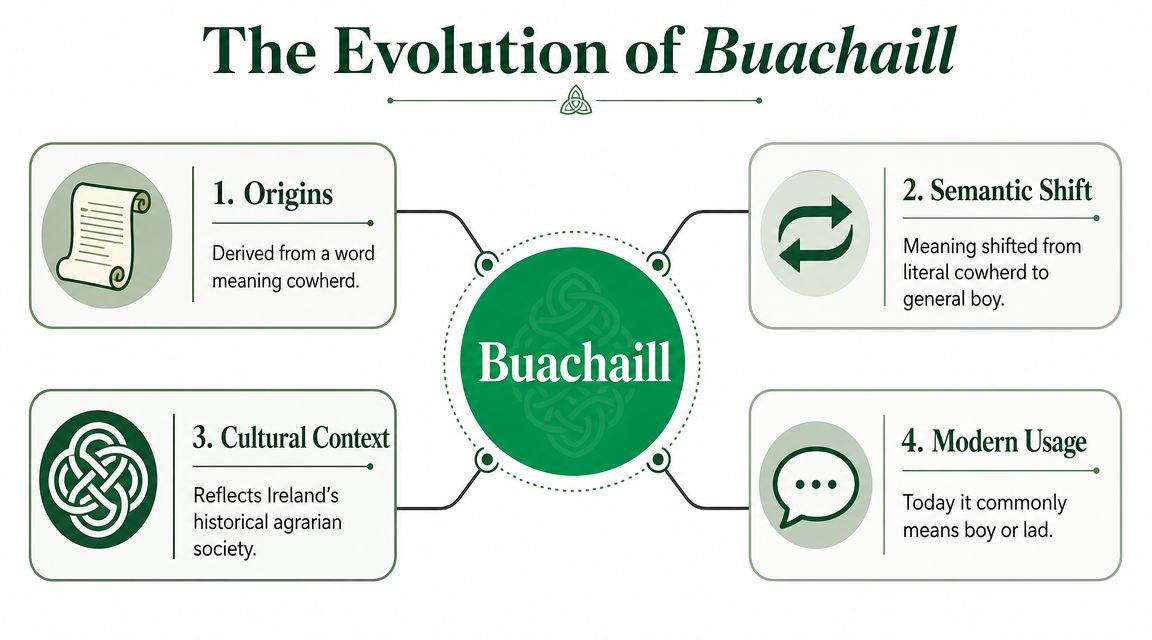
A four-step infographic illustrating the historical evolution and linguistic shift of the Irish word Buachaill.

An older meaning sits underneath the modern one

That jump can feel odd at first. How does a word move from “cowherd” to “boy”?

Language does this all the time. A word starts as the name of a role, job, or social type. Over time, the meaning broadens, narrows, or slides into a related human category. In this case, the older occupational sense gave way to the more general human one.

That older agricultural background can make the word feel more memorable. It also helps explain why some dictionary entries seem wider than the translation you first learned.

For learners interested in Irish seasonal traditions and older cultural contexts, this Gaeilgeoir article on Imbolc pairs nicely with the historical feel behind words like this.

Why this shift helps learners

You don't need etymology to order coffee or introduce yourself in Irish. But for some words, history reduces confusion. Buachaill is one of them.

When a word looks semantically strange, history often explains what modern translation alone can't.

Once you know there's an older “herdsman” layer under the modern “boy,” the word stops seeming arbitrary. It starts to feel like a living piece of culture that travelled through time.

Using Buachaill in Everyday Phrases

The most useful way to learn buachaill is by grouping its uses by register. In plain English, that means asking what kind of social setting you're in. Neutral conversation. Affection. Romance. Older or cultural usage.

Here's a quick visual before we unpack the details.
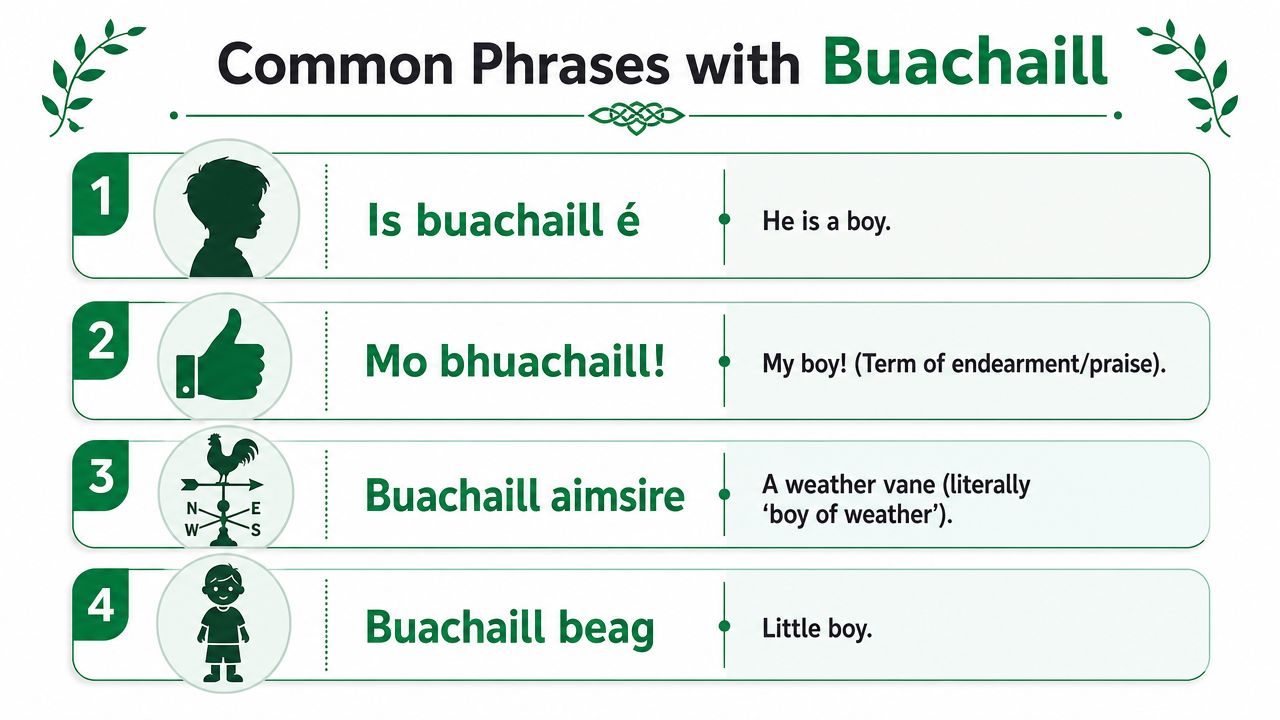
An infographic list showing four common Irish phrases using the word buachaill with translations and icons.

A helpful background note from dictionary-style usage pages is that buachaill can cover several senses, including boy, boyfriend, servant, and herdsman, while modern learners often need clearer guidance on which meaning is most common in real contemporary use. The same broad usage picture also points to cultural appearances such as Buachaill ón Éirne (usage range and cultural note).

Neutral everyday uses

These are the safest and most common beginner uses.

  • Is buachaill é
    Pronunciation: roughly iss BWA-khill ay
    Meaning: He is a boy
    Usage note: neutral and plain. Good for basic description.

  • an buachaill
    Pronunciation: roughly un BWA-khill
    Meaning: the boy
    Usage note: ordinary noun phrase. You'll meet this in reading very early.

  • buachaill beag
    Pronunciation: roughly BWA-khill byug
    Meaning: little boy
    Usage note: descriptive and straightforward.

Romantic and affectionate uses

Context begins to do its real work.

  • mo bhuachaill
    Pronunciation: roughly muh VWA-khill
    Meaning: my boy or my boyfriend
    Usage note: tone decides a lot here. In a romantic context, “my boyfriend” is natural. In another setting, it can sound affectionate or praising.

  • buachaill maith
    Pronunciation: roughly BWA-khill mah
    Meaning: good boy
    Usage note: affectionate, approving, or playful depending on who says it and why.

The phrase doesn't carry one fixed emotional color. Always ask who is speaking, to whom, and in what situation.

Here's a short listening aid if you want to hear Irish in a more natural rhythm:

Cultural and named uses

Some uses are easiest to understand as titles, names, or set phrases.

  • Buachaill ón Éirne
    Pronunciation: roughly BWA-khill own AIR-nyeh
    Meaning: Boy from the Erne
    Usage note: cultural title. This is a good reminder that the word isn't just a classroom noun.

  • An Buachaill Bréige
    Usage note: a modern Irish place-name example. It appears as a public-facing trail name in Mid Ulster, listed as a 9 km route with 418 m of elevation gain and an estimated time of 3 to 3.5 hours, which shows the word still lives in geographic naming as well as language study (trail listing with Irish name).

If you're unsure which meaning to choose, use this order:

  1. Start with boy
  2. Consider young man if the context feels broader
  3. Read it as boyfriend only when the relationship context is clear
  4. Treat older senses like herdsman as historical unless the text strongly points there

That habit will keep you accurate most of the time.

Your Next Step in Irish

A single word can open a surprising number of doors. Buachaill starts as “boy,” then quickly teaches you about pronunciation, noun gender, changing endings, mutation, older meanings, and social context.

That's one reason Irish becomes easier when you study words thoroughly instead of collecting long vocabulary lists. You're not just learning one label. You're learning how the language thinks.

If you want to make this stick, practice helps most when you hear the word in short phrases, repeat it aloud, and meet it again in different contexts. Flashcards can help. So can reading song titles and simple dialogues. Gaeilgeoir AI is one tool that supports Irish learning through pronunciation help, guided practice, and real-world vocabulary use, which fits well when you're trying to move a word like buachaill from recognition into active speech.

Screenshot from https://gaeilgeoir.ai

Keep this word close. When you meet it again, you won't just know the translation. You'll know why it looks the way it does, what it can mean, and how to read the tone around it.


If you want to keep building your Irish one useful word at a time, try Gaeilgeoir AI. You can also start learning and practising at learn Gaeilgeoir AI.
What Does Buachaill Mean? a Guide for Irish Learners

You've probably seen buachaill in a word list, tapped it in an app, or heard it in a song and thought, “Right, that means boy. Done.” That's a useful start, but it's not the whole story.

Buachaill is one of those Irish words that opens several doors at once. It gives you a basic everyday noun, a glimpse of Irish pronunciation, an early lesson in mutation, and a direct line into song and folklore. If you only learn it as a one-word flashcard translation, you miss what makes it memorable.

For beginners, that's often where confusion starts. A dictionary gives one English equivalent, but real speech is messier. Sometimes buachaill means a boy. Sometimes it leans closer to “lad.” In some contexts, it can refer to a boyfriend. Older uses stretch further still.

This is why it helps to slow down and learn the word properly. If you like checking how words behave across contexts, a tool like Lenguia's word analysis tool can also be useful for comparing vocabulary patterns while you build your reading habits.

Table of Contents

Your Introduction to a Core Irish Word

You hear someone say, “Tá an buachaill amuigh.” The sentence is short, but the word in the middle carries more than a plain dictionary gloss. Yes, buachaill usually means “boy.” But it also carries an older social and cultural weight that helps explain why it shows up so naturally in conversation, stories, and older expressions.

For learners, this is one of those words that can seem easy at first and then get fuzzy. You learn “boy,” then later meet meanings like “lad,” “servant,” or “farmhand,” and it starts to feel as if the word is shifting under your feet. The good news is that the uses are connected. You are not learning several unrelated words. You are learning one word with a long working life in Irish.

A helpful way to approach buachaill is to treat it as a core everyday word with a backstory. Its modern meaning is the one you need first. Its older meanings explain why the word has such depth. If you like checking how common words behave across real language use, Lenguia's word analysis tool can also help you compare frequency and context.

Here is the range beginners should keep in mind:

  • Main modern meaning: “boy”
  • Everyday tone in some contexts: “lad” or young male person
  • Older or context-based meaning: “servant” or “farmhand”

That range matters in real learning. Irish often keeps older layers of meaning alive longer than beginners expect, especially in traditional vocabulary. Buachaill is a good example because it sits right at the meeting point of daily speech and older rural life.

It also helps to know what this article is trying to solve. You are not here just to memorise a translation. You want to know when buachaill sounds natural, how it differs from words like garsún and stócach, and why older sources sometimes point in a different direction from modern conversation. Once you see that shift clearly, the word feels much easier to use with confidence.

The Deeper Meaning and Origin of Buachaill

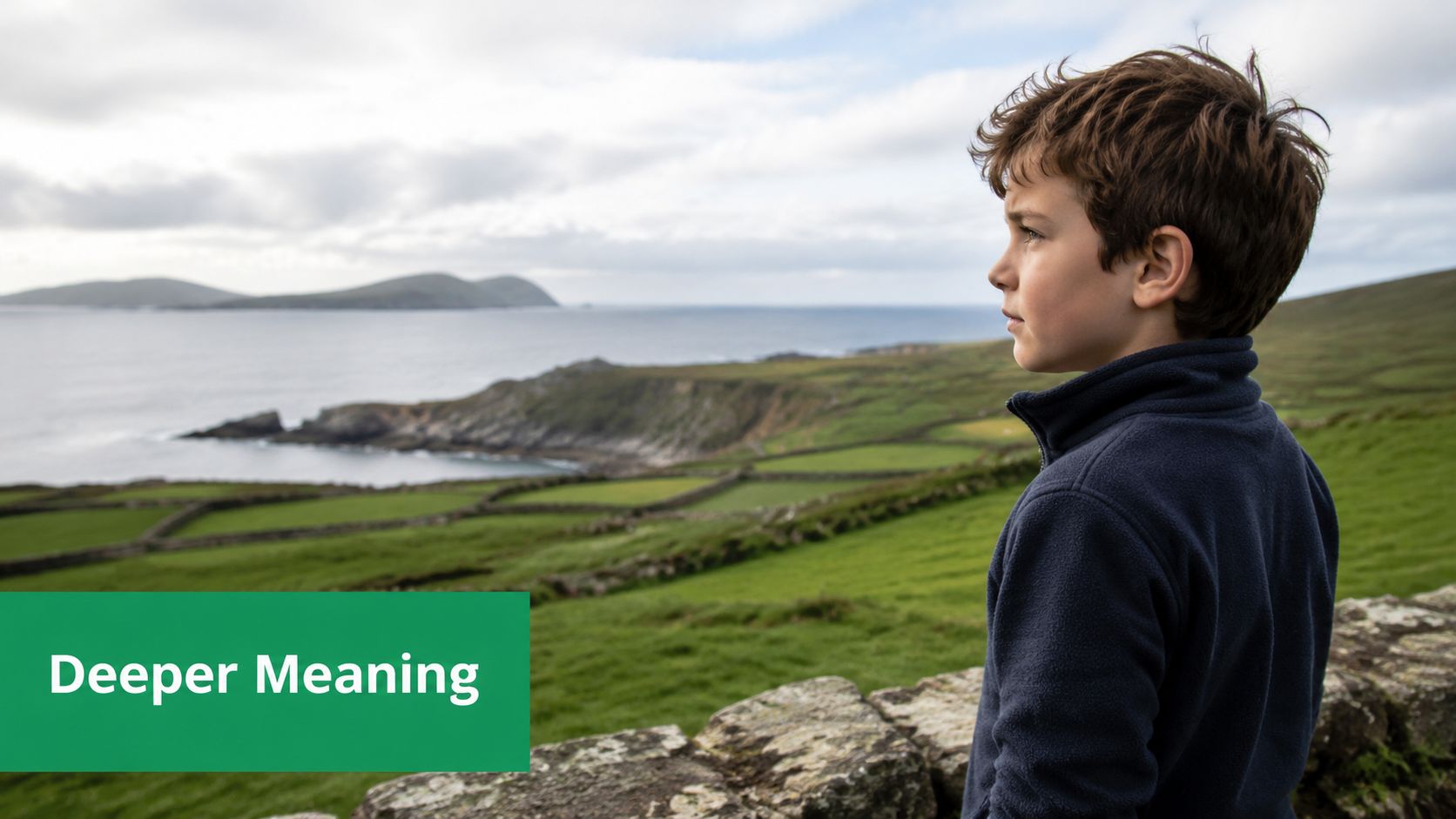
Most learners first meet buachaill as “boy,” and that's correct. But the older meaning is what makes the word stick in your memory. A frequently missed point is that buachaill historically meant “cowherd” or “herdsman,” which shows how the word moved from a pastoral job to a more general meaning over time, as discussed in this note on the word's semantic drift.

A young boy standing outdoors looking at a beautiful green coastal landscape in Ireland.

Why that older meaning helps

If a word once meant “cowherd,” it came from a world where work, land, and livestock shaped daily life. That doesn't mean every modern use still feels rural. It means the word's history still sits behind the modern form.

That kind of change is called semantic drift. A narrow meaning broadens. An occupation becomes a social label. Over time, speakers no longer need to think about cows or herding when they say buachaill. The newer meaning becomes the default one.

A lot of Irish vocabulary makes more sense once you stop asking only “What does this mean now?” and start asking “What did this mean before?”

A simple way to remember the shift

Try this mental path:

  1. Old sense: a herdsman or cowherd
  2. Later sense: a young male worker or lad
  3. Modern basic sense: a boy

That progression won't cover every historical detail, but it gives you a solid learner's map. It also explains why buachaill can feel broader than the English word “boy” in some situations.

This is one reason Irish words often become easier, not harder, when you learn a bit of their history. The story gives the vocabulary shape.

How to Pronounce Buachaill Correctly

Buachaill is a very useful pronunciation word because it pushes you into Irish sound rules instead of English spelling habits. Learner-facing pronunciation guides treat it as a common stumbling block for exactly that reason, and one guide points out that it's a strong benchmark word for Irish-specific phoneme practice in this pronunciation video resource.

For many English speakers, the trouble starts immediately. You look at the spelling and try to force it through English sounds. Irish doesn't reward that approach very often.

A learner-friendly breakdown

A practical approximation is BOO-uh-khill.

Here's how to work through it:

  • Bua: Start with something close to “boo.”
  • Cha: This isn't the English “ch” in “chair.” It's closer to the sound people know from “loch.”
  • Ill: The ending is softer and lighter than a heavy English final “l.”

If your first attempts feel awkward, that's normal. The middle of the word is where most learners lose confidence.

The mistake to avoid

Don't read buachaill as if it were standard English phonics. That usually leads to hard consonants and the wrong vowel quality. Irish spelling is consistent in its own system, but you need to learn that system on its own terms.

A useful practice routine is short and repetitive:

  • Say it slowly: bua-chaill
  • Say it naturally: buachaill
  • Put it in a phrase: an buachaill
  • Repeat it in a sentence: Tá an buachaill anseo.

Say the word out loud before you try to memorize it. Irish becomes easier when your ear joins your study routine.

Once this word feels comfortable, other Irish words with similar sound patterns start feeling less intimidating too.

Understanding the Grammar of Buachaill

The grammar of buachaill is manageable once you break it into a few small pieces. You don't need every case ending on day one. You do need to notice that the word changes shape in normal Irish sentences.

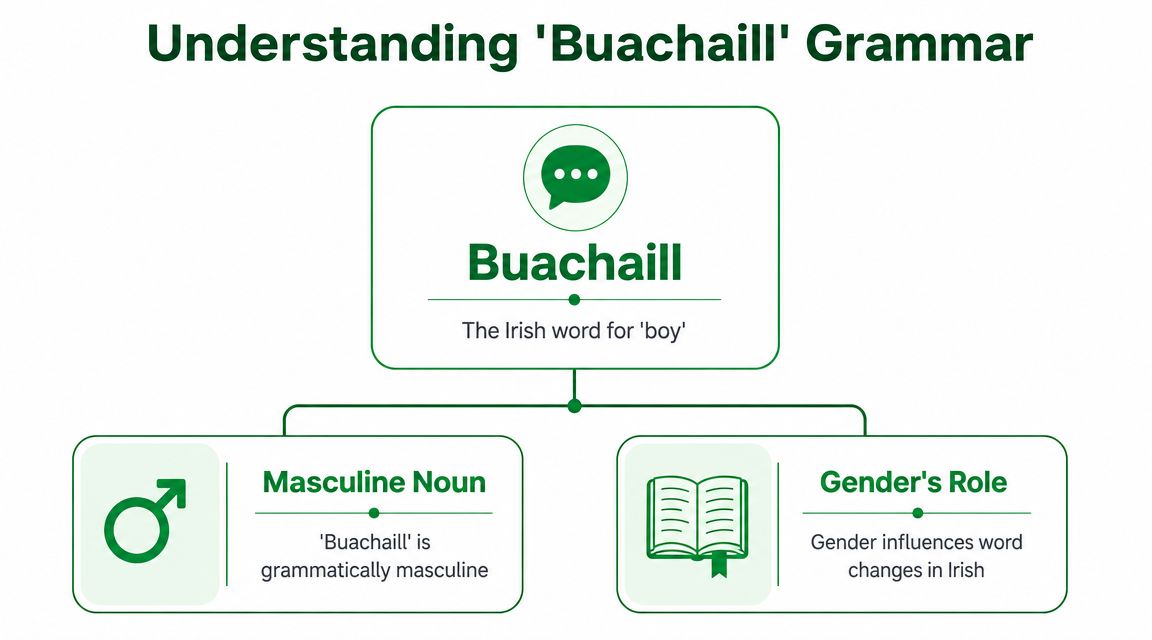
A diagram explaining the Irish word Buachaill, which is a masculine noun meaning boy.

The basic forms

First, buachaill is a masculine noun.

That gives you the most common singular form:

  • buachaill = boy
  • an buachaill = the boy

The plural is:

  • buachaillí = boys

That plural is worth learning early because it appears often and it doesn't look exactly like the singular.

Where the word starts to change

Irish learners often notice forms like mo bhuachaill and wonder why the spelling moved. That's mutation. After certain words, the first consonant changes. In this case, the b lenites to bh.

Some beginner-friendly examples:

  • mo bhuachaill = my boy
  • an buachaill = the boy
  • buachaillí = boys

You may also meet other forms in grammar-heavy contexts. At beginner level, the important thing isn't mastering every chart. It's recognising that Irish nouns don't always stay frozen in one dictionary shape.

What to focus on first

Keep your attention on these three things:

  • Gender matters: Irish nouns are masculine or feminine, and that affects nearby words.
  • Plural matters: learn buachaillí early so you can spot it quickly.
  • Mutation matters: if the first letter changes, it's still the same word underneath.

That mindset saves a lot of frustration. Many beginners think they've met a brand new word, when they've really just met buachaill in work clothes.

How to Use Buachaill in Real Conversations

Dictionary meanings are only the start. The challenge lies in knowing when buachaill sounds natural and when another word might fit better. A key learner problem is that reference pages list several senses for buachaill without always giving clear context, while also pointing toward alternatives such as garsún and stócach, as shown in the Wiktionary entry for buachaill.

A quick comparison that helps

You don't need to treat these words as rigid categories. Real speech is flexible. Still, a comparison table gives you a practical feel for how learners often sort them.

Word Typical Age Range Common Meaning Example Sentence
Buachaill Broad range boy, lad, sometimes boyfriend depending on context Is buachaill ciúin é.
Garsún Younger child little boy, young boy Tá an garsún ag rith.
Stócach Teen years or youth teenage boy, young fellow Is stócach ard é.

Where learners usually get stuck

The biggest confusion is with boyfriend. In the right context, mo bhuachaill can mean my boyfriend. Context does the work. If you're talking about relationships, listeners won't usually assume you mean a child.

Another sticking point is age. Buachaill is broad. That's useful, but it can also feel vague. If you want to sound more specific, garsún often points younger and stócach often points older.

Here's a practical way to understand this:

  • Use buachaill when you want the safest general word.
  • Use garsún when the person is clearly a small child.
  • Use stócach when you mean a teenage boy or young fellow.

If you're unsure, buachaill is usually the safest starting point. Precision can come later.

That's the difference between dictionary knowledge and speaking knowledge. One gives you meanings. The other gives you judgment.

Buachaill in Irish Culture Song and Story

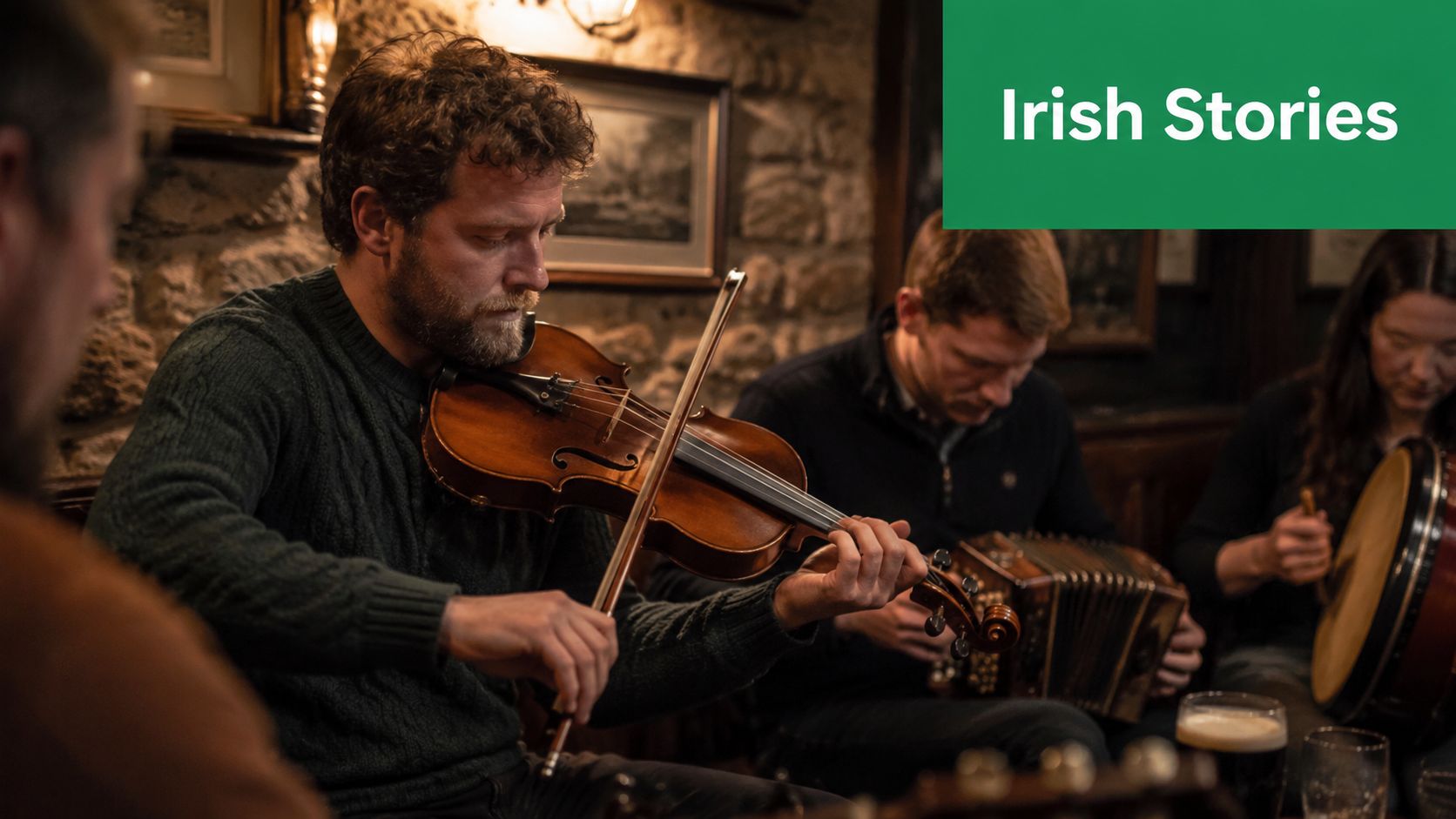
You hear buachaill in a song session, someone calls out a title, and suddenly the word stops feeling like a flashcard. It has a voice, a setting, and a bit of personality.

A group of Irish musicians performing traditional folk music with a violin and accordion in a pub.

That matters for learners. A cultural word is easier to hold onto when it arrives inside a tune or a story instead of sitting alone in a vocabulary list.

Older Irish tradition preserves buachaill in titles and storytelling, including Buachaill Bó an tSléibhe Ruaidhe. That older pattern is useful because it lets you hear the historical layer of the word more clearly. Before buachaill settled into the broad everyday sense of boy or lad, it often pointed more directly to a herdsman or cowherd. Songs and folklore keep that earlier echo alive.

Why songs help the meaning stick

Music gives a word a social life. You are not only learning what buachaill means. You are hearing who the buachaill is in the song world. He might be young, hardworking, romantic, wistful, or slightly roguish. That is the kind of detail dictionaries usually miss.

A title such as Buachaill ón Éirne helps here. The word does not feel clinical in that setting. It feels lived in. For beginners, that is a big advantage, because repeated listening trains your ear to recognise the word quickly and link it to mood as well as meaning.

For another seasonal cultural thread in Irish tradition, you might enjoy this guide to Imbolc in Irish tradition.

More than a label

This is also where buachaill, garsún, and stócach start to separate in a natural way. In song and story, writers and singers choose words for tone as much as age. Buachaill often carries warmth and breadth. It can suit a young man, a lad in a love song, or a figure shaped by work and place. Garsún often feels smaller and younger. Stócach can sound more like a strapping youth or teenage fellow.

So if you meet buachaill in traditional material, do not force it into one narrow English box. Let the setting guide you. In one piece it may feel close to boy. In another, lad is better. In older material, you may even hear the shadow of cowherd behind it.

Here's a performance to pair with the vocabulary:

If you learn Irish through sound as well as grammar, words become easier to remember. Buachaill is a good example of that. In songs and stories, it stops being a simple translation and starts feeling like part of a real Irish-speaking world.

Start Using Buachaill with Confidence

You are chatting in Irish, and you want to say “that boy over there” or “he was a lovely young lad in the song.” This is the point where buachaill stops being a word you recognise and starts becoming a word you can use.

What helps is treating it as a living word, not a dictionary label. Buachaill carries meaning, tone, and history all at once. It can mean boy, lad, or in older contexts carry the sense of a cowherd in the background. That wider range is exactly why it is worth practising in context.

A good learner habit is to build a small circle around the word. Hear it. Say it. Write it. Then compare it with nearby words so your brain starts sorting the differences naturally.

A simple routine works well:

  • Say it aloud in short phrases, not on its own.
  • Write three sentences. One with the meaning of boy, one where lad sounds more natural, and one where you compare it with garsún or stócach.
  • Listen for it in songs or stories so the word stays tied to voice and feeling.
  • Notice the age and tone each time you meet it. Is it a small boy, a teenage lad, or a broader, warmer label for a young man?

That last step matters. Beginners often want one neat English match for each Irish word, but Irish does not always work that way. Garsún often points more clearly to a younger boy. Stócach can suggest a sturdier teenage fellow or young man. Buachaill is often the most flexible of the three, which is why you will meet it so often.

If you want guided practice with pronunciation support, structured grammar help, and conversation-based learning, Gaeilgeoir AI offers one way to turn words like buachaill into active speech instead of passive recognition.

Familiarity is the ultimate goal. Once buachaill feels natural in your mouth, your ear, and your memory, you will start choosing it with much more confidence.

If you want to keep building that kind of practical confidence, Gaeilgeoir AI helps you practise Irish through guided, real-world conversation, pronunciation support, and everyday vocabulary that you can start using straight away.

Start Speaking Irish Today — 25% Off
Use code START25

Learn real Irish for real life with guided practice, pronunciation support, and everyday conversations.

Get 25% off any plan with code START25

Start Speaking Irish Today — 25% Off