You've probably done this already. You typed a phrase into an Irish Gaelic translator, looked at the result, and felt that small drop in your stomach. It might be for a tattoo, a wedding gift, a family crest, a memorial line, a social caption, or a message to grandparents. The words matter, so “close enough” doesn't feel safe.
That instinct is healthy. Irish is a beautiful language, but it's not a language you can treat like a label maker. A translation can be grammatically tidy and still sound wrong to a speaker. It can be literal and still miss the heart of what you meant. It can even be technically understandable while feeling like schoolbook Irish instead of something a real person would say.
The good news is that you don't need to panic, and you don't need to guess. You need the right method for the job.
Table of Contents
- Why Getting an Irish Translation Right Is So Tricky
- The Three Paths Machine Community and Professional
- Common Pitfalls and Why Accuracy Is Hard
- Quick Tips for More Reliable Translations
- When to Use a Tool Versus When to Hire a Pro
- Reduce Your Reliance The Best Translator Is You
Why Getting an Irish Translation Right Is So Tricky
Irish creates a very specific kind of confusion for learners and heritage seekers. Many people have some relationship with the language, but far fewer use it with ease in daily life. The 2022 Irish Census shows that about 1.87 million people report being able to speak Irish, while only about 72,000 speak it daily outside of school. That gap matters.
It means you can easily find someone who recognizes Irish, remembers school Irish, or can follow simple phrases. It's much harder to find someone who can shape a sentence so it sounds natural, accurate, and appropriate for the exact situation. Translation lives in that gap between “I know what that means” and “I'd say it that way.”
Meaning is more than vocabulary
A lot of people approach Irish translation as if it were fridge-magnet language. Take one English word, find one Irish word, put them side by side. That works badly in Irish because grammar changes the shape of meaning.
A simple English phrase like “with love” can shift depending on tone, relationship, and sentence structure. “You” can also become a trap. English uses one word, but Irish may force you to choose a singular or plural form depending on who you're addressing. If you choose the wrong one, the sentence can still look polished to a beginner and still be wrong.
Practical rule: If the translation is permanent, public, or emotional, don't trust a single copy-paste result.
Why online tools feel confident even when they're shaky
Most translation tools are built to be quick. They're good at giving you a draft, a gist, or a starting point. They're not always good at warning you when a phrase has hidden cultural weight or grammatical risk.
That's why people get stuck. You're not only asking, “What does this mean in Irish?” You're often really asking one of these:
- A tattoo question: “What wording will still feel right in ten years?”
- A heritage question: “What would sound respectful rather than touristy?”
- A learner question: “How would a person say this out loud?”
- A practical question: “Do I just need the gist, or do I need precision?”
The answer changes the translation method. That's where most frustration begins, and where most bad Irish translations could have been avoided.
The Three Paths Machine Community and Professional
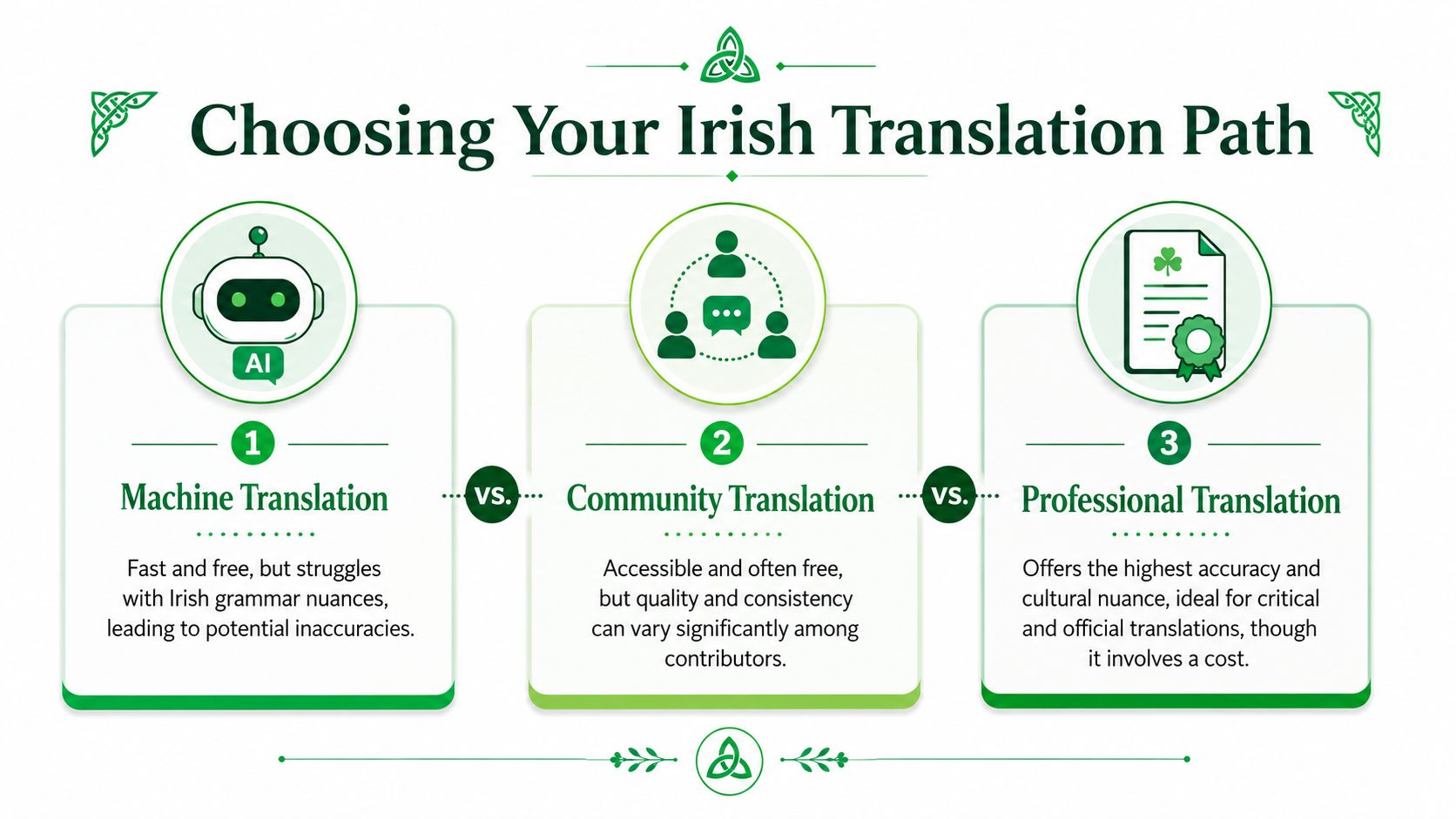
When people look for an Irish Gaelic translator, they usually end up on one of three paths. I think of them like getting directions in a place you don't know well. You can follow the GPS, ask a local, or hire a guide.
Machine translation
Google Translate, Bing Translator, OpenL, and similar tools are the GPS option. They're fast, easy, and often good enough for rough understanding. If you want to know the gist of a post, a menu line, or a short message, this route can help.
The downside is that machine tools often produce language that looks smoother than it is. A beginner sees a neat sentence and assumes it's safe. A speaker may notice that it sounds stiff, oddly literal, or built from standard forms that ignore how Irish really behaves in speech.
Machine tools are most useful when you treat them as draft makers, not authorities.
Community translation
Forums, Reddit threads, Facebook groups, and language communities are the “ask a local” route. This can be a lovely way to get help because you often learn not just the answer, but the reason behind it. People may explain why one phrase sounds too formal, why another sounds bookish, or why your English wording needs to be rethought before it can live naturally in Irish.
Quality still varies. One helpful stranger might be fluent and careful. Another might be generous but uncertain. Community advice is strongest when several speakers agree and explain their choices.
If you're trying to build your own judgment, it also helps to spend time with curated Irish language learning resources so you can start spotting the difference between a rough suggestion and a reliable one.
Professional translation
A professional translator is the private guide. This is the safest choice when the wording carries weight. Tattoos, engraved gifts, memorial inscriptions, official text, branding, and published materials belong here.
A professional does more than convert words. They ask what you mean, who it's for, whether you want a formal or spoken tone, and whether a direct translation is even the best option. Sometimes the best Irish version is not a mirror of the English sentence. It's a rephrasing that protects the meaning.
A translation is only “right” if it fits the situation, the audience, and the kind of Irish you want.
There's also a related issue people forget. If your goal includes speaking or dictation, text alone won't solve it. For audio workflows, it helps to review 10 top ASR tools so you understand what speech technology can and can't do before mixing transcription with translation.
Common Pitfalls and Why Accuracy Is Hard
You copy an English phrase into a translator because it looks simple. Five words in, the Irish answer already has hidden choices about relationship, tone, grammar, and dialect. That is why short phrases can be harder than long ones.
Irish usually goes wrong at the points where English stays vague. English lets you leave certain things fuzzy. Irish often asks you to commit.
The trap is treating translation like label-swapping. Irish is built on grammar patterns that carry meaning in small but important ways. Word order shifts. Initial letters change. Nouns can behave differently depending on their role in the sentence. In benchmark testing of difficult Irish features, researchers found Microsoft Bing Translator succeeded on less than half of those harder cases. That result matters because many people use machine output for exactly the phrases where these details matter most.
Irish grammar carries meaning in places English does not
A translation can look polished and still feel wrong to a speaker. That happens because Irish encodes choices that English often leaves unstated.
Take direct address. English says “you” for one person or many. Irish does not. English can also place words in an order that feels neutral, while Irish may want a different structure to sound natural. Add mutations on top, and a beginner can end up with a sentence that is technically close but socially off.
A good comparison is clothing sizes bought online. Two jackets may look similar in the photo, but one fits your body and the other only resembles it. Translation works the same way. Surface similarity is not the same as a good fit.
Consider “Sleep well, my love.” A tool may produce a neat literal version. A speaker might choose different wording based on affection, age, region, or whether the phrase is tender, poetic, or playful. The English sentence feels fixed. The Irish version has to live in a real relationship.
Basic form matters here. If you want to understand why the front of a word changes, or why a sentence that looks correct still sounds odd, this guide to Irish spelling and mutation patterns gives you a much stronger foundation than opening a second translator tab.
If you cannot explain why a translation is shaped the way it is, treat it as a draft, not a final answer.
Dialect and register shape what sounds natural
Accuracy is not only about grammar. It is also about voice.
Irish has three major dialect groups, and each gives the language a different texture. Munster, Connacht, and Ulster share the same language, but they do not always sound the same on the page or in the mouth. Vocabulary choices, rhythm, and everyday phrasing can differ. A standard version may be correct enough for a worksheet and still feel stiff in conversation.
That matters because people rarely want “Irish in theory.” They want Irish for a purpose. A blessing for a wedding speech needs a different feel from a quick text to a friend. A family motto, tattoo, or inscription carries even more weight. In those cases, the question is not only “Is this grammatical?” It is “Would an Irish speaker naturally say it this way, in this setting?”
This is also why direct translation from English can mislead you. English often packs emotion into compact phrases. Irish sometimes spreads that meaning across a different structure, or chooses an idiom instead of a mirror image. A tool may preserve the English skeleton too closely. The result can be understandable but lifeless, like music played in the right notes and the wrong rhythm.
A short explainer can help you hear some of that tension between standard forms and spoken reality:
Quick Tips for More Reliable Translations
A reliable Irish translation starts with the question behind the question. Are you trying to send a quick text, choose words for a ring, subtitle a clip, or learn how Irish expresses the idea? The answer changes the method. A phrase for skin or stone needs a different level of care from a phrase you are testing for practice.
Start by giving the sentence a real-life setting. Irish is not a code where one English word neatly swaps for one Irish word. It works more like cooking from a different kitchen. The ingredients may be similar, but the recipe changes. If you ask for help, include the purpose, the tone, and who will read or hear it.
A clear prompt usually gets a better result:
- State the use: “This is for an engraved bracelet” is far more useful than “translate this.”
- Describe the tone: warm, formal, prayerful, playful, old-fashioned, or everyday
- Name the audience: one person or several, adult or child, public or private
- Ask for natural Irish: not only “Is this correct?” but also “Would a speaker naturally say this?”
Small details carry a lot of weight in Gaeilge. A tool may miss whether you are speaking to one person or a group. It may copy English word order too closely. It may also produce something grammatical that no one would ever say over tea in Galway, Donegal, or Cork.
That is why a second habit helps. Compare versions.
Run the phrase through two tools or ask two speakers, then look for the fault lines. Where they disagree, there is usually a real language choice hiding underneath. That choice might involve register, dialect feel, or a structure Irish handles differently from English. If you work with media, you can even use broader production tools that translate your videos, then treat the Irish output as a draft that still needs checking by someone with feel for the language.
A reverse check helps too. Translate the Irish back into English and ask a simple question: did the heart of the message stay the same? This will not prove elegance, but it often exposes obvious drift.
Some kinds of English deserve instant caution:
- Mottos and tattoos: short English lines often depend on compression that Irish does not copy neatly
- Blessings and condolences: these live in culture as much as grammar
- Pet names and affection: literal choices can sound stiff or strangely distant
- Jokes and wordplay: the meaning may survive while the charm disappears
One more tip matters more than any app. Ask for explanation, not only an answer. If someone suggests a phrasing, ask why that version works. That is how you start building your own instinct. If your real goal is confidence rather than a one-off translation, working with someone who can explain corrections step by step is often faster than chasing perfect output from tools. A good next step is to find an Irish tutor for enhanced learning.
The best quick test is simple. If the Irish feels like English wearing a green coat, pause and check again.
When to Use a Tool Versus When to Hire a Pro
Not every translation deserves the same level of scrutiny. The fundamental question is risk. If the cost of being wrong is low, a tool is often enough. If the cost of being wrong is embarrassment, permanence, or disrespect, use a human professional.
Low stakes use cases
If you're reading a headline, checking the gist of a short social post, or drafting a casual message for practice, machine translation is fine as a helper. It gives you speed, and speed matters when precision is not the main priority.
If your content is audio-first or visual-first, the workflow may involve more than text. For multilingual media, tools that help translate your videos can be useful in broader content production, though you'll still want Irish checked by someone with real language instinct before publishing.
A tutor can also help if your goal is learning rather than one-off translation. If you want live correction and more confidence in spoken usage, it's worth exploring how to find an Irish tutor for enhanced learning.
High stakes use cases
If the words are going on skin, stone, jewelry, a business sign, a memorial card, or anything public and lasting, use a professional. That's not snobbery. It's respect for the language and for your own intention.
A tattoo is the clearest example. English tattoos often depend on compression. Two or three words carry a life story. Irish may need to reshape that idea to keep its dignity and naturalness. A machine can't reliably judge that. A community reply may be helpful, but if the wording is going to live on your body, you want someone who stands over the final version.
Here's a simple decision table.
| Task | Recommended Method | Reason |
|---|---|---|
| Reading the gist of a short post | Machine translation | Speed matters more than stylistic perfection |
| Checking a casual text draft | Machine plus community check | Good for catching obvious issues |
| Learning how a phrase sounds in conversation | Community or tutor | Spoken Irish often differs from textbook phrasing |
| Tattoo, engraving, memorial line | Professional translator | Permanent use needs accuracy and cultural judgment |
| Business slogan or published copy | Professional translator | Tone, clarity, and public credibility all matter |
Use free tools for exploration. Use professionals for commitment.
Reduce Your Reliance The Best Translator Is You
At a certain point, the most satisfying shift is this one. You stop asking, “What's the Irish for this?” and start asking, “How would I say this myself?”
That's a different relationship with the language. You're no longer standing outside it, hoping a tool will let you in. You begin to feel patterns. You notice when a phrase sounds too English underneath. You hear when something is formal, flat, or alive.
That matters even if you never aim for full fluency. A little real understanding protects you from bad translations better than endless app-switching ever will.
An immersion-first approach helps most here because it focuses on use rather than abstract decoding. Gaeilgeoir AI's learning approach is grounded in the 1,000 most-used Irish words, which gives learners a practical base for real conversation and helps reduce dependence on external translators for everyday situations.
That kind of foundation changes the experience. Instead of translating every tiny thought from English, you begin building Irish from the inside. You also get closer to pronunciation, rhythm, and actual spoken usage, which text-only translators rarely solve well.
The best Irish Gaelic translator for your life won't always be a website. Sometimes it's the part of you that has spent enough time with the language to notice what fits, what jars, and what rings true.
If you want to move beyond copy-paste translation and start building Irish you can use, explore Gaeilgeoir AI. It's a practical way to grow from “What does this mean?” to “I can say this myself.”