You're probably here because you've seen the phrase Irish Thanksgiving somewhere and paused. Maybe it showed up in a family story, on a social post, or in a conversation about Irish heritage. It sounds familiar, but also slightly off. Is it a real holiday in Ireland, an Irish-American tradition, or just a catchy phrase attached to an old story?
The confusion makes sense. “Irish Thanksgiving” gets used for at least two different ideas. One is a piece of Irish-American folklore about a ship from Dublin helping the Pilgrims. The other is much more practical: families in America adding Irish food, music, blessings, or language to a Thanksgiving meal. Those two meanings often get blended together, and that's where people start talking past each other.
This is one of those topics where a simple yes-or-no answer doesn't help much. The history is layered, the identity piece is emotional, and the language side is more interesting than many people expect.
Table of Contents
- What Is an Irish Thanksgiving Anyway
- The Historical Myth of the First Irish Thanksgiving
- How Irish Americans Blend Traditions Today
- Is Thanksgiving Celebrated in Modern Ireland
- Your Practical Irish Language Thanksgiving Toolkit
- A Holiday of Heritage and Gratitude
What Is an Irish Thanksgiving Anyway
You hear the phrase at a family table in Boston or Chicago. Someone mentions an "Irish Thanksgiving," and it can sound like Ireland has its own version of the holiday, with a fixed date and long-standing customs. That is where the confusion begins.
Irish Thanksgiving usually refers to one of two ideas. It can mean a piece of Irish-American folklore tied to early colonial history, or it can mean a Thanksgiving celebration in the United States shaped by Irish family traditions, food, music, memory, or language.
That difference matters. If you blur those ideas together, the topic gets muddy fast. If you separate them, it becomes much easier to understand, a bit like sorting a family recipe box into "old stories" and "what we still cook."
Two common meanings
The first meaning belongs to the world of heritage storytelling. It points to a popular tale that Irish aid helped the Plymouth colonists survive, a story many Irish-American families have passed along with pride. Stories like that matter in diaspora life because they answer a human question: where do we fit in the larger national story? If you enjoy that kind of folklore, these Irish myths and storytelling traditions offer useful cultural context for how memorable narratives take root.
The second meaning is much more concrete. It shows up at the dinner table. An Irish-American household might add colcannon beside the turkey, say a blessing with Irish phrasing, play trad music after the meal, or teach the children a few words of Gaeilge before dessert.
Irish Thanksgiving is best understood as a meeting point of family heritage, American holiday practice, and cultural memory.
Why people get tangled up
Part of the mix-up comes from the name itself. "Irish Thanksgiving" sounds official, as if it belongs on Ireland's national calendar. In Ireland, though, Thanksgiving is not a standard public holiday in the way it is in the United States.
The language side can confuse people too. Irish has a term for Thanksgiving Day, Lá an Altaithe, but that does not mean the holiday developed in Ireland as a shared national tradition. That means Irish speakers can talk about it, just as they can talk about Halloween, baseball, or pumpkin pie.
A good way to keep your footing is to hold three separate ideas in mind: holiday folklore, Irish-American custom, and present-day life in Ireland. Once those are in the right places, the phrase "Irish Thanksgiving" stops feeling mysterious and starts making cultural sense.
The Historical Myth of the First Irish Thanksgiving
You hear the phrase "the first Irish Thanksgiving," and it sounds like a settled chapter from a history textbook. The usual version says the Pilgrims were in desperate trouble at Plymouth, then help arrived from Ireland in the form of provisions sent from Dublin. It is easy to see why that story stayed alive. It gives Irish families, especially Irish Americans, a place inside a founding American memory.
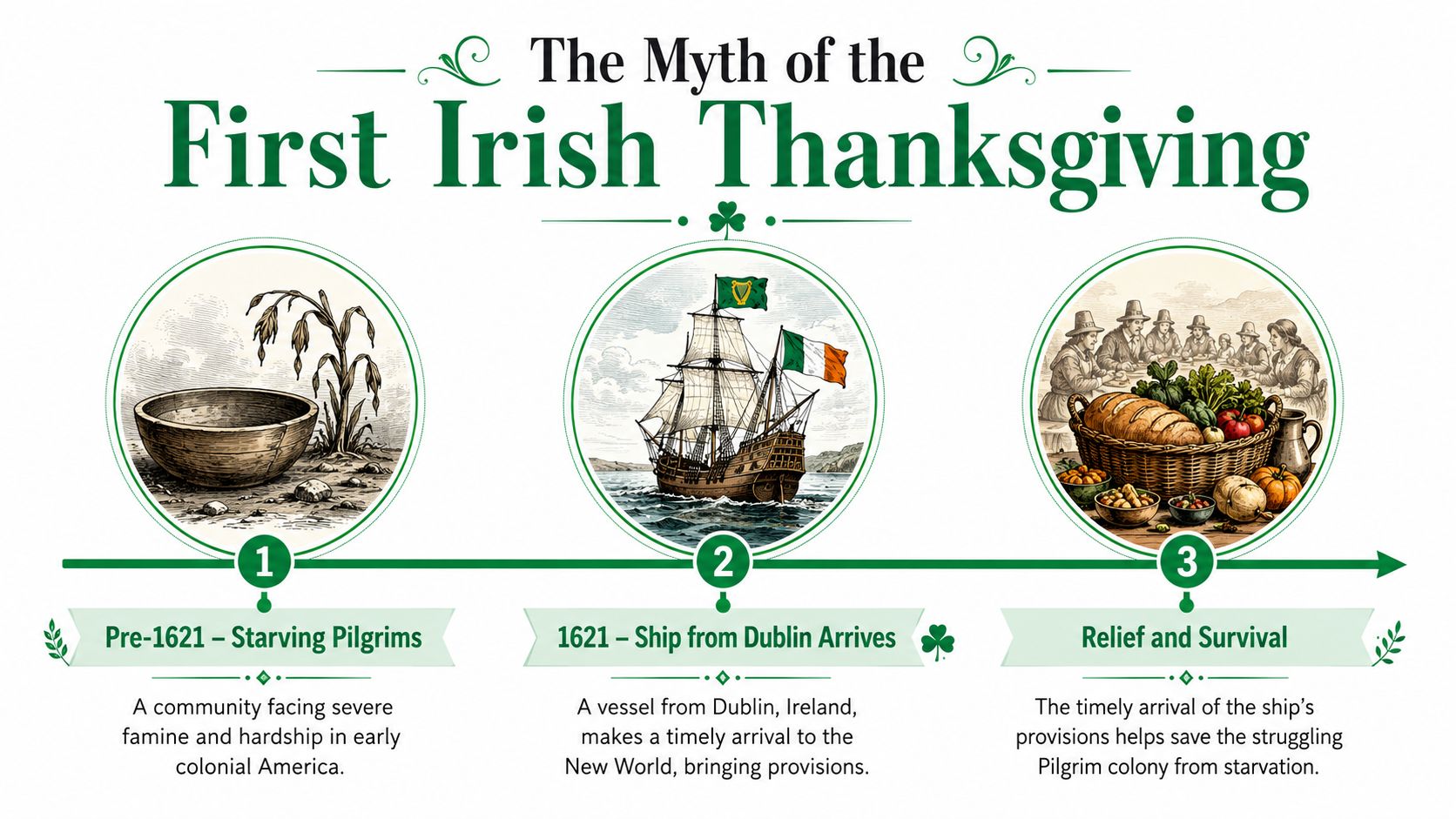
The difficulty is that the timeline does not line up cleanly. A commonly repeated version places the rescue in 1621, but later discussion ties the ship Lyon to 1631. Once those dates shift, the story stops looking like a firm origin point and starts looking more like a piece of heritage folklore built around a real desire to belong.
That does not make the story pointless. Folklore often lasts because it carries emotional truth for a community, even when the historical record stays fuzzy. For Irish Americans, this tale expresses dignity, contribution, and presence. It answers a human question many immigrant families ask: where do we fit in the larger story?
Irish culture has long treated storytelling as a way of holding memory, identity, and pride together. If you want more background on how legends and belonging intertwine, these Irish myths and storytelling traditions offer helpful context.
A practical way to understand this is to separate symbolic value from documentary certainty. Family stories work a bit like heirlooms. They may gather embellishments over time, but they still reveal what a community wanted to remember about itself.
The wider history of Thanksgiving is also more layered than one dramatic rescue scene. Historians point to several moments that shaped the holiday over time, including early European thanksgiving observances in Newfoundland, later colonial thanksgivings in New England, Washington's national proclamation, Lincoln's Civil War era proclamation, and the later federal standardization of the November date. The modern holiday formed gradually through religion, politics, harvest customs, and national mythmaking, as noted earlier in the article's cited historical sources.
That pattern should feel familiar. Many origin stories grow simpler in popular retellings than they are in the archive. You can see the same thing in debates over the historic origins of whiskey, where identity, pride, and evidence often travel together.
Practical rule: treat the “Irish saved Thanksgiving” claim as folklore supported by partial evidence, rather than as a confirmed single origin story.
So where does that leave us? In a useful middle ground. The "first Irish Thanksgiving" story matters because it reflects Irish-American memory and the wish to be seen as contributors to American life. At the same time, careful history asks us to describe it with humility. Meaningful, widely shared, and still open to question is the fairest way to put it.
How Irish Americans Blend Traditions Today
Modern Irish Thanksgiving is easiest to understand at the table. It's usually not about claiming a separate holiday. It's about taking a classic American feast and making room for family heritage.
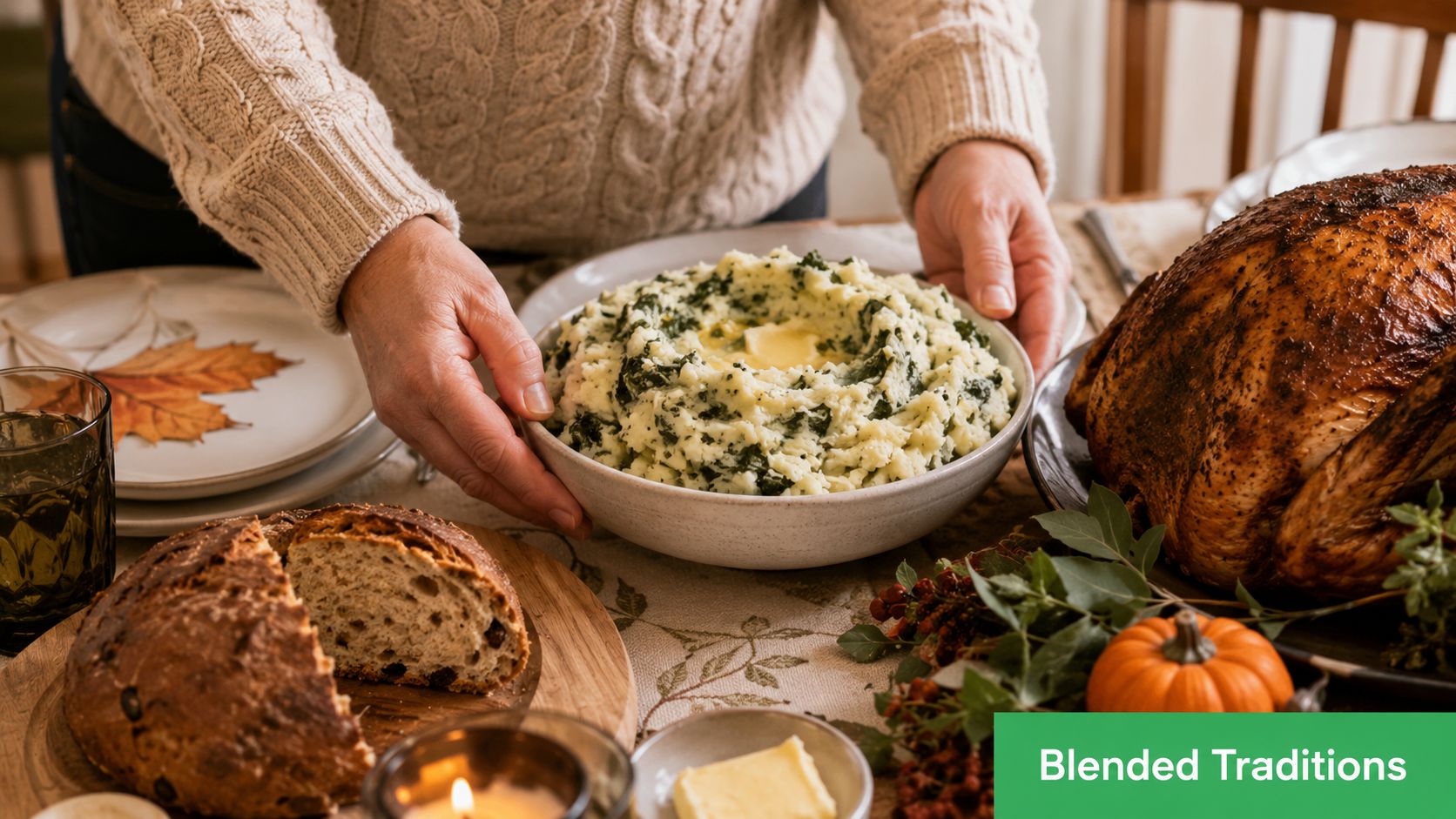
You can see this in small choices. A bowl of mashed potatoes becomes colcannon. Someone brings brown bread. A relative says an old mealtime blessing before the turkey is carved. None of that turns Thanksgiving into an Irish holiday in the formal sense, but it does turn the meal into a family document of sorts.
What shows up on the table
In many homes, the Irish element appears through side dishes more than through the main course. Turkey stays. The supporting cast changes.
A few familiar examples:
- Potato upgrades: Colcannon or boxty can sit comfortably beside turkey and stuffing.
- Root vegetables: Some families prefer the kinds of hearty vegetables that feel closer to Irish home cooking.
- Bread and butter: Soda bread or brown bread adds a very different mood from standard dinner rolls.
- A spoken grace: Gratitude before eating often feels like the most natural bridge between Irish family culture and Thanksgiving.
Those choices work because they don't fight the holiday. They personalize it.
Food music and after-dinner ritual
The atmosphere matters as much as the menu. One household might play traditional Irish music once the dishes are cleared. Another might bring out Irish coffee later in the evening. If the family enjoys spirits, a quick read on the historic origins of whiskey can add some context to the after-dinner conversation without turning the meal into a history lecture.
Here's a good example of the mood many families aim for. The meal still looks recognizably American, but the details carry family memory.
A blended holiday works best when the Irish elements feel lived-in, not staged.
This short clip captures that spirit of Thanksgiving cooking and table warmth:
Some families also use the day to talk about grandparents, migration stories, or the recipes that survived because someone insisted on keeping them. That's often the deepest form of Irish Thanksgiving. Not a costume. Not a slogan. A meal where heritage gets remembered out loud.
Is Thanksgiving Celebrated in Modern Ireland
The short answer
No, Thanksgiving isn't celebrated in Ireland as a national holiday. That's the clearest answer, and it's the one many people need first.
Still, stopping there leaves out the part that helps. The American holiday belongs to North American history, but the ideas behind it, gratitude, harvest, family meals, blessings, are easy to recognize in an Irish setting too.
Where the Irish connection is real
Some Irish writers draw that distinction well. Thanksgiving itself is not an Irish holiday, yet its themes can overlap with older and broader traditions of giving thanks, harvest time, and family gatherings. One example is the connection often made to Samhain, an ancient Celtic harvest festival, along with the everyday custom of mealtime blessings, discussed in this reflection on the Irish connection to Thanksgiving.
That helps answer a common question: if Ireland doesn't celebrate Thanksgiving, why does it still feel like there's something Irish around it? The answer is that people are often sensing values rather than a formal calendar event.
A useful way to think about it is this:
| Question | Better answer |
|---|---|
| Is Thanksgiving an Irish public holiday? | No |
| Do Irish people understand harvest gratitude and family meals? | Absolutely |
| Can Irish families in Ireland still mark the day privately? | Yes, especially through family or American connections |
For some readers, another seasonal comparison helps. If you want to explore how Irish traditions sit on their own terms, not just beside American holidays, this look at St. Stephen's Day in Ireland shows how different the Irish festive calendar can feel.
The cleanest distinction is simple. Thanksgiving is American. Gratitude at the table is universal. Irish culture already has its own ways of expressing that.
That's why “Irish Thanksgiving” works better as a cultural phrase than as a literal holiday label.
Your Practical Irish Language Thanksgiving Toolkit
You are at the table, someone passes the potatoes, and you want to add one small Irish phrase without making the moment feel stiff or performative. That is the sweet spot for this topic. A few well-chosen words in Gaeilge can make the meal feel warmer and more personal, even though Thanksgiving itself belongs to the American calendar rather than the Irish one.
Start with the holiday name, because it gives you a clear anchor. In Irish, Thanksgiving Day is Lá an Altaithe. If you are speaking to one person, say Lá an Altaithe sona duit. If you are greeting a group, say Lá an Altaithe sona daoibh.
That single change from duit to daoibh teaches an important Irish habit. Irish often shifts depending on who you are addressing. It works a bit like changing “you” and “you all” in English, except Irish makes that distinction more clearly.
Useful Irish Thanksgiving phrases
The goal is not to perform a perfect speech. The goal is to use a few phrases that fit naturally around food, family, and thanks.
| English Phrase | Irish Phrase (Gaeilge) | Simple Pronunciation |
|---|---|---|
| Thanksgiving Day | Lá an Altaithe | law on AL-ti-ha |
| Happy Thanksgiving to you (one person) | Lá an Altaithe sona duit | law on AL-ti-ha SUN-a ditch |
| Happy Thanksgiving to you all | Lá an Altaithe sona daoibh | law on AL-ti-ha SUN-a deeve |
| Family | clann | klown |
| Potato | práta | PRAW-ta |
| Turkey | turcaí | TOOR-kee |
| Thanks | go raibh maith agat | guh rev mah ah-gut |
| Thank you all | go raibh maith agaibh | guh rev mah ah-giv |
| Please | le do thoil | leh duh hull |
| Welcome | fáilte | FAWL-cheh |
A few quick notes make this easier to use well:
- Duit is for one person. Daoibh is for more than one.
- Go raibh maith agat is one of the handiest phrases you can bring to any meal.
- Warmth matters more than a polished accent. People usually remember the effort and the kindness behind it.
If you want a clearer feel for everyday Irish thank-you expressions, this guide to go raibh maith agat and when to use it is a helpful next step.
A short table dialogue you can try
Many readers worry they need a long blessing or a formal toast. You do not. A short exchange is enough to make Irish part of the meal.
Host: Lá an Altaithe sona daoibh.
Guests: Go raibh maith agat.
Host: Fáilte.
Guest: Prátaí, le do thoil.
Host: Seo duit.
That little exchange does something important. It turns Irish from a family symbol into a living language used at the exact moment it belongs, around shared food and conversation.
Try practicing in ways that match the meal itself:
- Say the greeting while setting plates or lighting candles.
- Pick two food words, such as práta and turcaí, and repeat them as you cook.
- Pair phrase with action. Say le do thoil when asking for a dish and go raibh maith agat when someone hands it to you.
- Listen and repeat if you can. Irish pronunciation becomes much less intimidating once your ear knows the shape of the sounds.
If you like short, repeatable study methods, these fast language learning strategies can help you build a routine around phrases you will use right away.
One greeting and one thank-you phrase is enough for a first holiday meal.
That is how Irish grows in a family. Not through grand claims about an “Irish Thanksgiving,” but through small, real moments of gratitude spoken aloud.
A Holiday of Heritage and Gratitude
Irish Thanksgiving makes the most sense when you stop asking whether it's “real” in only one way. It's real as folklore for some families. It's real as a blended home tradition for others. It's not a standard Irish holiday, but it does open a meaningful conversation about heritage, gratitude, and how families carry culture across borders.
That's why the myth-versus-reality distinction matters so much. If you treat the old Plymouth story as settled fact, you flatten history. If you dismiss the whole idea because Ireland doesn't officially celebrate Thanksgiving, you flatten culture. The richer answer sits in the middle.
For many people, the best part of an Irish Thanksgiving isn't proving a historical claim. It's making the meal feel like your own family's story. That might mean a blessing, a recipe from a grandparent, a few words in Gaeilge, or even a thoughtful host gift. If you're visiting someone's table and want something a bit more personal than the usual bottle, these unique Thanksgiving gift ideas can spark good ideas.
The unifying thread connecting all of this is simple. Shared food matters. Family memory matters. Gratitude matters. Irish culture has long had room for all three.
If this topic made you want to go beyond a few holiday phrases and start using Irish in everyday life, Gaeilgeoir AI is a practical place to begin. It's built to help learners start speaking from day one with guided conversations, pronunciation support, and real-world practice that fits around a busy schedule.