
If you're searching for colleen in irish, you're probably trying to answer a simple question that turns out not to be simple at all. You may have heard the name Colleen, assumed it was a standard Irish word, and wondered whether people in Ireland still use it in everyday speech.
That confusion makes perfect sense. The catch is that Colleen is not the everyday Irish word. The word you're really looking for is cailín, an Irish noun meaning girl or young woman. Once you separate those two, a lot of other things become easier: pronunciation, grammar, and understanding why something can sound Irish abroad but slightly off in Ireland itself.
This matters for heritage learners, travelers, and students returning to Irish after years away. If you want to sound natural, it's helpful to know when you're dealing with an English given name and when you're dealing with an actual Irish vocabulary word.
Table of Contents
- Introduction Why 'Colleen' Is Not the Word You Hear in Ireland
- The True Origin From Cailín to Colleen
- How to Pronounce Cailín Like a Native Speaker
- Using Cailín in a Sentence Grammar and Forms
- A Tale of Two Worlds The Cultural Context
- Practice Your Irish and Avoid Common Mistakes
- Start Speaking Irish with Confidence Today
Introduction Why 'Colleen' Is Not the Word You Hear in Ireland
You search for “colleen in Irish,” then land in Ireland, hear people speaking, and notice something odd. The word Colleen is not what you usually hear for “girl.” In everyday Irish, the word is cailín.
That confusion is very common, especially for learners from Irish American or Irish diaspora backgrounds. Colleen looks Irish, and it has Irish roots, but in modern use it usually functions as an English given name. Cailín, by contrast, is the ordinary Irish noun for “girl.” If you are also exploring Irish names for girls, this distinction will save you from mixing up a name with a common vocabulary word.
A helpful way to sort this out is to treat the two words as living in related but different worlds. Colleen belongs mostly to English naming tradition. Cailín belongs to Irish speech.
Why learners get tripped up
English often absorbs words from other languages and reshapes them over time. Once that happens, the borrowed form can start behaving differently from the original. That is what causes the confusion here.
So when someone asks about colleen in irish, they are often asking one of two different questions:
- What is the Irish word for “girl”? The answer is cailín.
- Is Colleen a traditional Irish word people in Ireland use in daily speech? Usually, no.
That difference matters in practice. If you say cailín, you are using Irish vocabulary. If you say Colleen, you are usually referring to an English personal name.
One small spelling difference can carry a big cultural difference. That is part of what makes Irish so interesting to learn.
The True Origin From Cailín to Colleen
Cailín came first. Colleen came later.
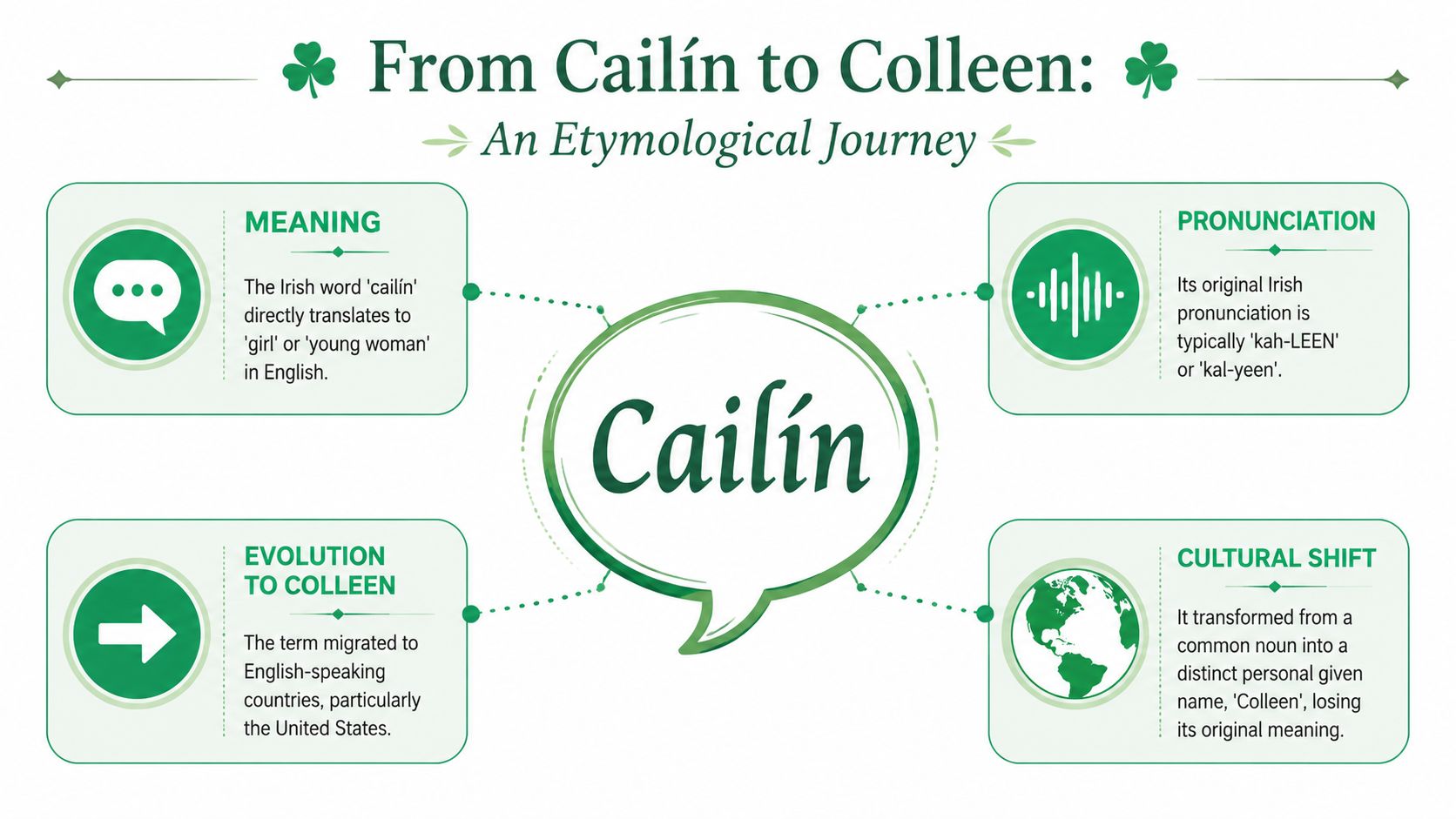
In Irish, cailín is a common noun. It means girl or young woman. It wasn't originally a personal name in the same way English speakers now use Colleen. The name developed after the Irish word moved into English-speaking settings and was reshaped to suit English spelling and sound patterns.
How Anglicization changed the word
A simple way to think about Anglicization is this: a word crosses into English, and English speakers reshape it so it feels easier to spell, say, or recognize.
That happened with cailín. The Irish spelling includes a fada over the final í, and the sound system of Irish doesn't line up neatly with English. As the word moved through the Irish diaspora, especially in English-speaking communities, it became Colleen.
It's a bit like a food name being adapted in another country. The dish may come from one language and culture, but once it settles somewhere else, the spelling and pronunciation often shift. The result still points back to the original, but it isn't the original form anymore.
What the original word means
The meaning stayed simple at the root. Cailín meant girl or young woman. That's important because learners sometimes assume Colleen must have started as an old Irish first name. It didn't. It started as an everyday word.
A helpful next step is to compare it with other traditional girls' names in Irish. This list of Irish names for girls helps show the difference between an actual Irish given name and a common noun that later became a name elsewhere.
When a word becomes familiar abroad, people often forget what it was doing at home. In Ireland, cailín stayed a word. Abroad, Colleen became a name.
Why this matters
If you treat Colleen as though it's the standard Irish word used in Ireland today, your Irish can start to sound imported rather than natural. If you learn cailín instead, you're working with the living language.
That shift in perspective is the essential takeaway. Colleen is related to Irish. Cailín is Irish.
How to Pronounce Cailín Like a Native Speaker
You hear someone in Ireland say cailín, and your ear tells you it sounds a bit like Colleen. That is where many learners get tripped up. The two are related, but if you want your Irish to sound natural, it helps to learn the Irish word on its own terms.

A good learner-friendly version is kah-LEEN. You may also see kal-yeen as a rough guide. Those spellings are only approximations. They point you toward the sound, but they do not capture every detail of Irish pronunciation.
A simple pronunciation breakdown
Split cailín into two parts and say it slowly.
- Cai begins with a broad k sound, followed by a vowel sound that can feel shorter or more open than English speakers expect
- lín sounds close to leen, with the stress on this second syllable
So the rhythm is kah-LEEN.
That stress matters. English speakers often give both syllables equal weight, or they say it exactly like the name Colleen. Native Irish speech usually gives the second syllable more lift, and the l can sound lighter or slimmer than an English l.
The part learners often miss
The slender l in cailín is one of those small Irish details that makes a big difference. It is formed with the tongue placed a little higher and further forward than in many English accents. Language teachers and pronunciation commentators often note that getting sounds like this under control can make a learner sound much more fluent in conversation and oral work.
If that feels abstract, use a simple comparison. English has one general l sound in many learners' minds. Irish treats l more like a sound with different versions depending on the vowels around it. In cailín, the í helps give that l a slender quality.
If you'd like extra help hearing those patterns, this Irish pronunciation guide with clear sound explanations is a useful companion.
Regional variation matters
You will not hear cailín pronounced in exactly the same way in every part of Ireland. Some speakers use a more open first syllable, closer to kah. In parts of Ulster, you may hear a rounder sound that comes closer to coll-een. That helps explain why learners sometimes connect it so quickly with the English name Colleen, and it also fits the wider dialect picture discussed in this discussion of regional pronunciation variation for cailín.
So if you hear more than one version, that is normal. Dialects shape pronunciation, just as regional accents do in English.
Aim for a clear, consistent version first. Your ear for dialect differences will grow with listening.
A listening model helps here:
Where English speakers usually stumble
Three mistakes come up again and again.
- Saying it exactly like the name Colleen. The connection is historical, but the Irish word has its own sound.
- Flattening the stress. The second syllable should stand out more clearly.
- Using a heavy English l. A lighter, slender l will bring you closer to Irish pronunciation.
Practice it in short phrases instead of repeating the word alone. Try an cailín or an cailín óg. That works like learning a tune by singing the whole line rather than one isolated note.
Using Cailín in a Sentence Grammar and Forms
Knowing the word on its own is useful. Using it naturally in a sentence is better.
Cailín is a feminine noun, and like other Irish nouns, it changes form depending on what you're saying. Learners often meet the basic singular first, then get confused when they see cailíní or an chailín. That's normal. The forms are manageable once you see them side by side.
Grammatical forms of cailín
| Form | Irish Example | English Translation |
|---|---|---|
| cailín | Tá cailín anseo. | There is a girl here. |
| an cailín | Tá an cailín sásta. | The girl is happy. |
| cailíní | Tá na cailíní ag imirt. | The girls are playing. |
| na cailíní | Chonaic mé na cailíní inné. | I saw the girls yesterday. |
| an chailín | Seo hata an chailín. | This is the girl's hat. |
What changes and why
A few things are happening in that table.
- Singular basic form: cailín means girl
- With the article: an cailín means the girl
- Plural: cailíní means girls
- Genitive singular: an chailín appears after another noun to show possession, as in hata an chailín or the girl's hat
That little h in an chailín can surprise learners. It's part of a common Irish pattern called lenition. You don't need to master the grammar label on day one. You just need to notice that Irish changes the beginning of words in certain sentence patterns.
Useful starter sentences
Try reading these aloud:
- Is cailín í. She is a girl.
- Tá an cailín sa seomra. The girl is in the room.
- Tá na cailíní anseo. The girls are here.
- Is hata an chailín é. It is the girl's hat.
Use short noun phrases first. an cailín, na cailíní, hata an chailín. Small chunks are easier to remember than isolated rules.
A common beginner mistake
Many learners know a word's meaning but not its grammar behavior. They memorize cailín = girl, then freeze when the word changes shape in a real sentence.
The fix is simple. Learn vocabulary as a mini-family, not as a single dictionary entry. For this one word, that family is:
- cailín
- an cailín
- cailíní
- an chailín
If you can recognize those four, you'll understand much more Irish than you might expect.
A Tale of Two Worlds The Cultural Context
A learner in Boston might hear Colleen at home and assume it is the everyday Irish word. Then they arrive in Ireland, listen to real conversation, and hear cailín instead. That moment of confusion makes sense, because these forms belong to related but different cultural worlds.
In Ireland, cailín remained an ordinary Irish noun used in daily speech. Outside Ireland, especially in diaspora communities, Colleen developed a separate life as an English given name linked with Irish identity. The two are connected by history, but they do not do the same job.

What changed outside Ireland
As noted earlier, Colleen became much more visible abroad as a personal name than it did in Ireland itself. That pattern is common in heritage communities. A word leaves its original setting, keeps its emotional value, and slowly shifts category. In this case, a common noun in Irish fed into a name in English.
That shift matters because learners often expect a straight line from Irish word to modern Irish usage. Language history is rarely that tidy. A family may pass down a name for generations and still not be passing down the current Irish vocabulary item.
Why learners mix them up
The confusion is understandable. If your experience of Irish culture comes through family stories, parish records, or Irish American naming traditions, Colleen can feel deeply Irish. Culturally, it often is. Linguistically, though, it belongs to English naming practice more than to present-day Irish speech.
A useful comparison is this. Cailín works like a normal everyday word such as girl in English. Colleen works like a name such as Mary or Bridget. They share ancestry, but you would not swap one for the other in a sentence.
What this says about Ireland and the diaspora
Ireland and the diaspora preserved different parts of the same inheritance. In Ireland, the word stayed practical and grammatical, part of the living language. In diaspora settings, the form Colleen often carried memory, affection, and ethnic identity.
That difference becomes clearer if you read about the history of Irish language decline and revival. When a language is under pressure, some words survive abroad in altered forms while everyday usage at home continues along its own path.
This is also why keeping good notes helps. If you are sorting out heritage forms, modern vocabulary, and pronunciation, the best ways to track language progress can help you separate "family name knowledge" from "usable Irish."
A heritage name can be meaningful and authentic to a family. It still may not be the word an Irish speaker would use in ordinary conversation.
So the practical takeaway is simple. Use Colleen as a name in English if that is the family or cultural form you know. Use cailín when you want to say girl in Irish. That small distinction clears up a very common misconception.
Practice Your Irish and Avoid Common Mistakes
Once you know the difference, the next step is using it without second-guessing yourself.
The biggest mistake is simple. A learner hears that Colleen comes from Irish, then uses Colleen as if it were the current Irish word for girl. In actual Irish, that sounds off. You want cailín.
Mistakes worth catching early
- Using Colleen as a common noun: Say cailín when you mean girl in Irish.
- Saying the word too much like English: Irish pronunciation needs attention, especially around the l sound.
- Learning it only as an isolated word: Practice it inside phrases and short sentences.
One useful reason to focus on that middle sound is that, for learners, mastering the palatalization of the “l” in cailín can increase perceived fluency by over 28% in oral exams, according to this language learning analysis on cailín pronunciation.
Short drills you can use today
Say each one aloud slowly, then at normal speed:
- Tá cailín anseo.
- Is cailín cliste í.
- Chonaic mé an cailín.
- Tá na cailíní sa pháirc.
- Seo leabhar an chailín.
If speaking feels hard, write them first, then read them. If writing feels hard, copy them by hand once and underline the changing forms.
A simple way to measure progress
A lot of learners improve faster when they track the same tiny skill over time. One day you focus on hearing cailín correctly. Another day you focus on producing an chailín without hesitation. If you want a practical system for logging those small wins, this guide on the best ways to track language progress gives clear note-taking ideas that work well for vocabulary and pronunciation review.
Say the word in a phrase, not in isolation. Real fluency grows from chunks you can reuse.
A quick self-check
Ask yourself these three questions:
- Do I know when to use cailín instead of Colleen?
- Can I say cailín clearly, without forcing it into English pronunciation?
- Can I recognize an chailín and cailíní when I read them?
If the answer is “mostly,” you're in a good place. That's real progress.
Start Speaking Irish with Confidence Today
The key point is straightforward. Colleen and cailín are related, but they are not the same thing. Colleen is an English given name that grew in popularity mainly outside Ireland. Cailín is the actual Irish word learners need when they mean girl or young woman.
That distinction helps you sound more natural. It also helps you approach Irish with more cultural sensitivity. When you use the right form, you're not just being accurate. You're hearing the language on its own terms.
If you've ever felt unsure about Irish words that seem familiar in English, that's normal. This is one of many places where a small correction gives you a much stronger foundation. Learn the actual word, say it clearly, and use it in short everyday phrases. That's how confidence builds.
If you're ready to turn small distinctions like cailín into real speaking ability, Gaeilgeoir AI is a practical next step. You can continue from this exact point, build confidence with everyday Irish, and practice the kind of vocabulary that shows up in conversation.