
You may have seen Anamchara on a necklace, in a book title, on Instagram, or in a list of “beautiful Celtic words.” It tends to arrive wrapped in soft focus. “Soul friend.” “Soulmate.” “A person who just gets you.” It sounds warm, ancient, and instantly meaningful.
That reaction makes sense. It is a beautiful word. But it's also one of the most misunderstood Irish words in circulation. If you're learning Irish, reconnecting with heritage, or trying to use the word well, the surface translation won't quite carry you far enough.
Table of Contents
- The Allure of the Anamchara
- What Anamchara Truly Means
- The Deep Historical Roots of the Anamchara
- How to Pronounce Anamchara and Use It Correctly
- Modern Misconceptions and Pop Culture Usage
- Embracing the Spirit of Anamchara in Your Learning
The Allure of the Anamchara
A learner often meets Anamchara before they meet much Irish at all. The word appears alone, polished and poetic, as if it already explains itself. You see it under a photograph of the sea. You hear it in a wellness conversation. You find it beside English phrases about deep love, fate, or belonging.
That first impression isn't wrong. It is a word with emotional weight. The trouble begins when the emotional feeling gets treated as the full definition.
Many people assume it works like a romantic label. Others use it for a best friend. Some use it as a Celtic alternative to “my person.” If you've browsed pages about Irish Gaelic terms of endearment, you'll know how easy it is to place Irish words into modern relationship categories. Sometimes that works. With Anamchara, it doesn't quite.
A word that sounds simple but isn't
The attraction comes from the literal gloss. “Soul friend” sounds immediately understandable in English. It feels tender and universal.
But Irish words often carry history inside them. A literal translation can open the door, yet it can also mislead. Anamchara is one of those cases where the dictionary-looking answer is only the beginning.
Practical rule: If a word from Irish feels unusually mystical in English, pause before assuming the modern English feeling is the original meaning.
Why people get this word wrong so often
The confusion usually comes from three habits:
- We trust literal translations too quickly. “Soul” plus “friend” sounds transparent, so people stop there.
- We import modern ideas. English speakers hear “soul friend” and think romance, deep friendship, or soulmate language.
- We miss the religious context. Older Irish terms often lived inside monastic and devotional life, not self-help or relationship culture.
So yes, Anamchara is beautiful. But its beauty comes from depth, not vagueness. Once you understand what the word named, it becomes far richer than the popular version.
What Anamchara Truly Means
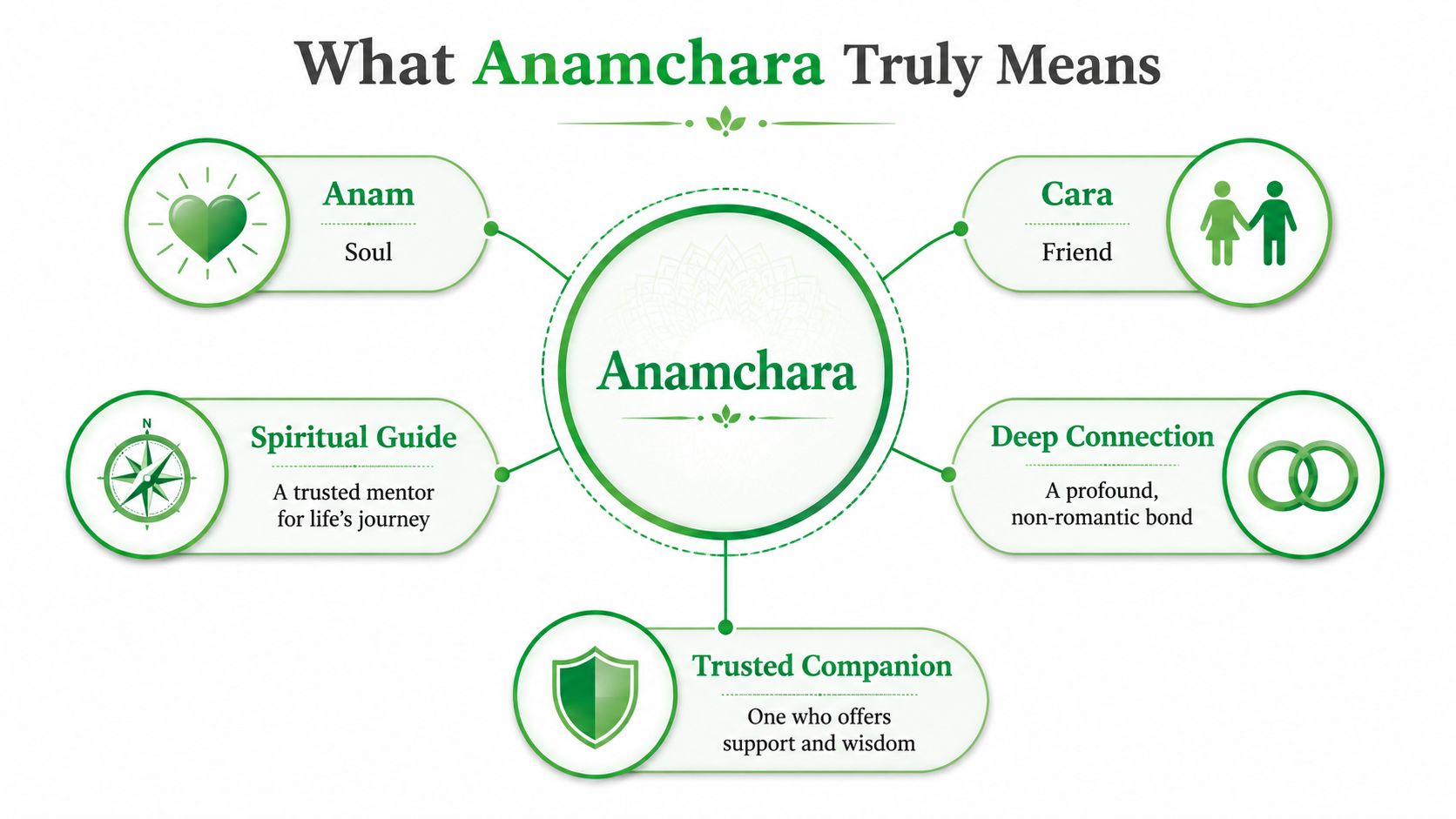
At the most basic level, Anamchara is built from two Irish elements: anam, meaning “soul,” and cara, meaning “friend.” That literal sense is real. But the historical use of the word is much more exact than the English phrase “soul friend” suggests.
The literal meaning and the real meaning
In early Irish monasticism, Anamchara had a technical meaning. It referred to a spiritual director or confessor, not to a casual friend. Dictionaries such as Ó Dónaill and De Bhaldraithe define it as “spiritual adviser,” while McKenna identifies it as the Irish term for “confessor” in Wiktionary's entry on anamchara.
That difference matters. A confessor is not merely someone you feel close to. A spiritual adviser is not just a person with whom you share a bond. The historical Anamchara had responsibility, authority, and a listening role shaped by religious life.
Think of it this way. If someone says “family doctor,” you don't focus only on the word “family” and assume it means a relative. You understand that the phrase names a specific role. Anamchara works similarly. The parts of the word are meaningful, but the whole term points to a defined relationship.
Why the direct translation causes confusion
English speakers usually hear “friend” in a broad modern sense. In the older Irish religious setting, the “friendship” in Anamchara meant profound trust in spiritual guidance.
That's why “soulmate” is a poor substitute. A soulmate suggests perfect emotional or romantic fit. Anamchara historically suggested something more demanding. This was a person to whom one revealed hidden struggles, sought correction, and entrusted the care of one's inner life.
A few distinctions help:
- Not a casual companion. You wouldn't use it for an ordinary friend.
- Not necessarily romantic. The term doesn't point to lovers by default.
- Not just poetic. It names a role with religious seriousness.
The old meaning asks for depth, discipline, and guidance, not simply closeness.
That's why I encourage learners to hold two ideas at once. The literal translation helps you remember the word. The historical meaning helps you respect it. When both stay together, Anamchara becomes much clearer.
The Deep Historical Roots of the Anamchara
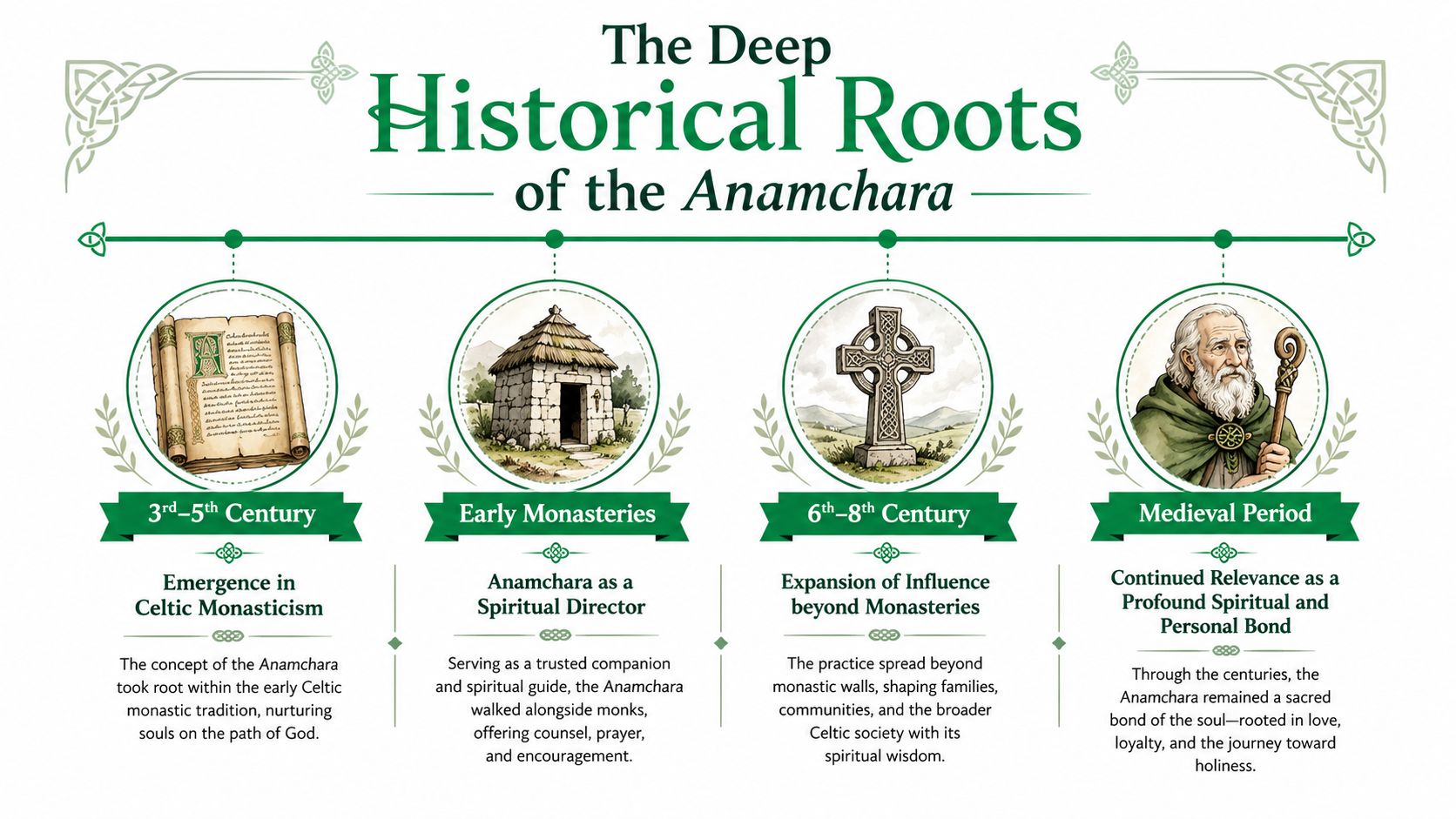
To understand why the word carries such gravity, you have to place it inside the world that shaped it. Anamchara emerged in ancient Celtic monasticism between the 3rd and 5th centuries, where it referred to the trusted teacher and companion to whom a monk confessed confidential aspects of life for spiritual correction, as outlined in the historical overview of Anam Cara.
A role inside early monastic life
This wasn't a decorative title. In early monastic communities, the Anamchara acted as a guide for the soul. A monk brought hidden thoughts, failings, temptations, and fears to this person in confidence. The relationship had honesty at its center.
The role also included teaching. The Anamchara oversaw initiation and tutored new monks. So when we translate the word too lightly, we lose the shape of the life around it. This was part of formation, correction, and spiritual maturity.
If you enjoy exploring words within their physical and historical settings, the places associated with Ireland's early Christian inheritance become more vivid when seen in context. Resources on self-drive Ancient East Ireland trips can help you picture the wider cultural world in which old religious traditions took root.
A relationship of discipline and trust
The concept is also linked to the Desert Fathers and Mothers of Egypt, Syria, and Palestine between the 3rd and 5th centuries, and to earlier Celtic traditions described in Jane Alton's discussion of the anamchara.pdf). In that account, the Anamchara served as confessor and prescriber of penance, a trusted guide for life.
The expectations could be rigorous. Historical descriptions say such a guide should perform two hundred genuflections daily, recite all psalms every day, and celebrate the eucharist on Sundays and Thursdays, with every day being preferable. Those details help us see that this was no loose spiritual friendship. It belonged to a demanding discipline.
Here's the heart of it:
- Confidentiality mattered. The monk revealed inner struggles that might stay hidden from everyone else.
- Guidance was lifelong. The relationship could endure across separation by place and time.
- Formation was practical. The guide did not merely comfort. The guide corrected, instructed, and assigned penance.
A real Anamchara was trusted not because the title sounded lovely, but because the person carried spiritual responsibility.
There's a storytelling dimension here too. Irish tradition often preserves meaning through roles, memory, and lived practice, not through abstract definitions alone. If that side of Irish culture interests you, reflections on seanchaí Irish storytellers offer another window into how language and heritage hold onto old ways of seeing the world.
How to Pronounce Anamchara and Use It Correctly
Once learners know the meaning, they usually want to say the word aloud without freezing. That's a good instinct. Irish pronunciation can feel intimidating at first, but this word becomes manageable when you break it apart.
A simple pronunciation guide
A helpful beginner approximation is ON-um-KHA-ra.
The first part, anam, is usually the easy bit. The harder sound is the ch in chara. It's not the English “ch” in “chair.” It's the throaty Irish sound you hear in Scottish “loch” or German “Bach.”
If that sound is new to you, try this sequence:
- Say cara softly as a rough first attempt.
- Move to KHARA, letting air pass at the back of the mouth.
- Put the pieces together slowly: ON-um-KHA-ra.
For learners who want to train their ear, a dedicated Irish pronunciation guide is useful because Irish spelling becomes much less mysterious once you hear recurring sound patterns.
Say it slowly before you say it naturally. Accuracy comes before speed.
Pronunciation and Common Phrases
| Irish Phrase | Phonetic Pronunciation | English Meaning & Context |
|---|---|---|
| Anamchara | ON-um-KHA-ra | A spiritual adviser or confessor in the historical sense |
| Mo anamchara | muh ON-um-KHA-ra | “My anamchara.” Best used carefully, with awareness of the word's deeper religious history |
| Mo chara | muh KHA-ra | “My friend.” This is the better everyday option for a friend |
| Cara | KHA-ra | “Friend.” A simple, broad term without the special weight of Anamchara |
A few usage notes will save you trouble.
- If you mean friend, use mo chara. It's natural and accurate.
- If you mean partner or lover, don't reach for Anamchara automatically. Modern English-language branding may push you that way, but the older Irish meaning is different.
- If you use mo anamchara, know that it carries historical depth. It can sound poetic in English, but it isn't just a sweet phrase.
A good learner exercise is to test the sentence you want to say. Ask yourself, “Do I mean friend, beloved, or spiritual guide?” If the answer is friend, cara is usually enough. If the answer is beloved, you'll want a different expression. If the answer is spiritual guide, then Anamchara may fit.
Modern Misconceptions and Pop Culture Usage
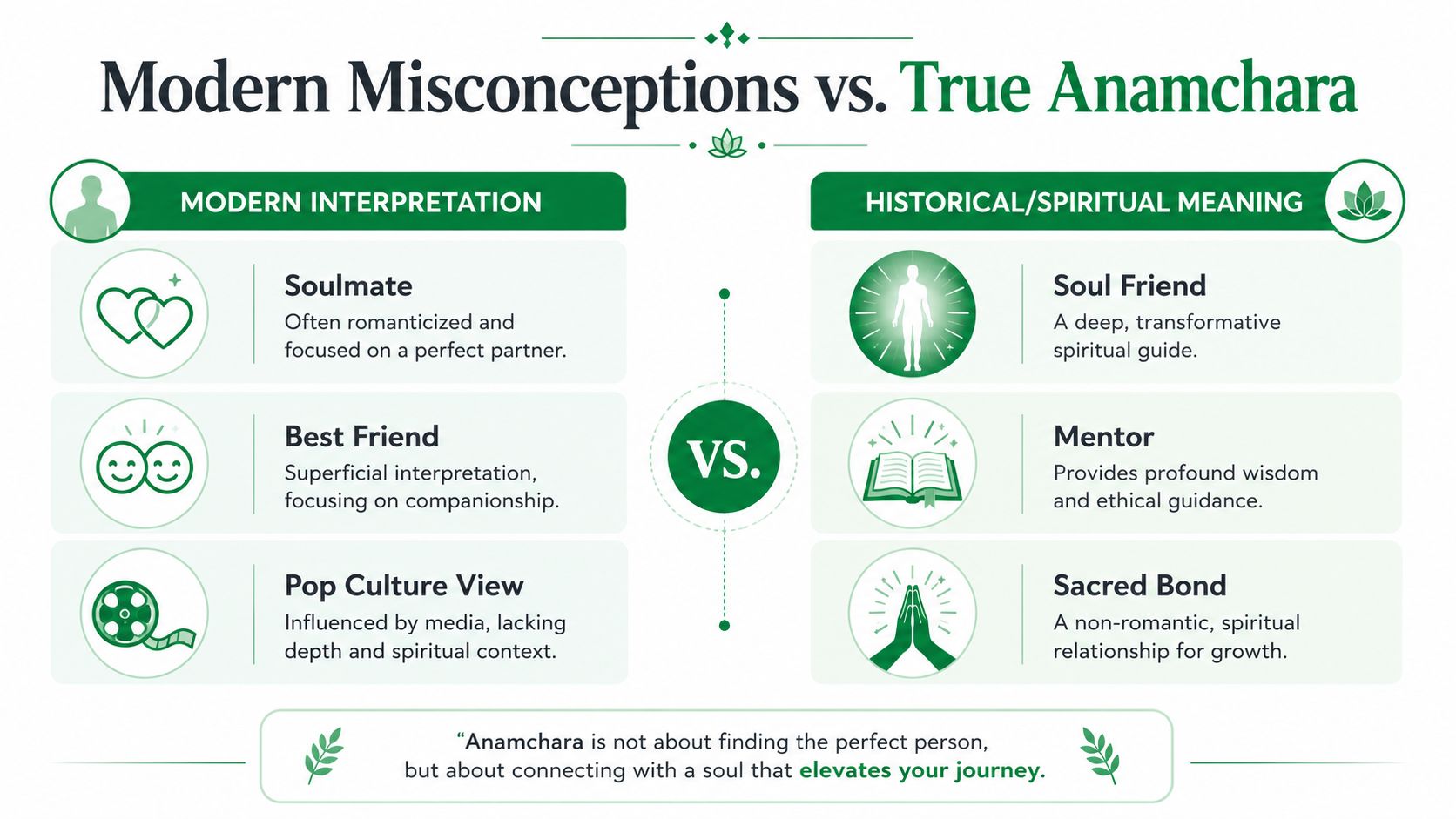
Today, many people meet Anamchara far from its original setting. It appears in tattoo ideas, gift copy, wellness brands, and sentimental captions. In those spaces, it often means “soulmate,” “best friend,” or “the one person who understands me completely.”
How the meaning drifted
This shift is easy to explain. The literal gloss “soul friend” sounds like ready-made modern inspiration. Once the phrase entered English-language spiritual and lifestyle culture, the word's ecclesiastical roots faded from view.
That drift is widely noted. Popular sources often define Anamchara as a platonic or romantic “soul friend” or “soulmate,” while authoritative Irish dictionaries and linguistic experts define it as “confessor” or “spiritual adviser” with no inherent link to lovers or close friends, as discussed in this explanation of what the term anamchara means.
This doesn't mean every modern user is careless. Many are responding to the beauty of the phrase. But a learner deserves to know when a beautiful modern reading has drifted away from the older Irish meaning.
Why this matters for learners
If you're learning Irish, this is about more than pedantry. It's about cultural accuracy.
Here's where confusion tends to show up:
- In translation choices. A learner sees “soulmate” in English and assumes Anamchara is the direct Irish equivalent.
- In identity language. People use the word to signal Celtic feeling without realizing they've changed its meaning.
- In teaching materials. Simplified glosses often drop the religious context because it feels less marketable.
Knowing the original meaning doesn't force you to police everyone else. It simply helps you speak with more care.
There's also a wider lesson here. Language doesn't only carry vocabulary. It carries worldview. When a word travels from monastic Ireland into modern pop culture, it may keep its emotional glow while losing its original function.
That's why I suggest a generous but clear approach. You can appreciate the modern appeal of Anamchara while also recognizing that the traditional term points to something much more specific than romance or companionship. Both facts can sit side by side. One is current usage. The other is historical meaning. For serious learners, the second one should lead.
Embracing the Spirit of Anamchara in Your Learning
The old Anamchara was a guide for the inner journey. Most of us aren't seeking a monastic confessor, but the underlying idea still speaks to language learning. Irish opens more easily when you have trustworthy guidance, regular correction, and a path you can follow.

Many learners don't struggle because they lack motivation. They struggle because they meet Irish in fragments. A few phrases here, a grammar chart there, then a long gap. Progress becomes shaky when there's no steady companion for the road.
That's why structured support matters. Gaeilgeoir AI uses an immersion-first method grounded in the 1,000 most-used Irish words, a foundation designed to help learners build functional ability quickly by prioritizing high-frequency vocabulary, as described in this overview of Gaeilgeoir AI. That kind of structure fits the spirit of good guidance. It keeps learners close to the living core of the language instead of scattering attention across rare terms too early.
A good guide doesn't remove the challenge. A good guide makes the challenge navigable. That's the enduring lesson inside Anamchara. Not vague “soul connection,” but trusted direction, honest learning, and companionship with purpose.
If you want your Irish to become something lived rather than admired from a distance, start with guidance you can return to regularly.
If you're ready to build real spoken Irish with a modern guide, explore Gaeilgeoir AI and start learning at learn Gaeilgeoir AI.