You know the moment. You've rehearsed the phrase in your head, you're sure you know the word, and then the shop assistant or teacher looks at you and your mind goes blank. The air feels a little too quiet, your mouth doesn't quite cooperate, and suddenly a simple language moment feels like a test you didn't study for.
That freeze is language learning anxiety, and it's far more common than most learners think. Research has long shown that anxiety is a measurable barrier to achievement, not a personal flaw, and it shows up in different ways for different people. Some learners only feel it when speaking, others notice it in listening, reading, or any moment where they think they might be judged.
Table of Contents
- What It Feels Like When Words Won't Come
- Defining Language Learning Anxiety
- How Widespread the Problem Really Is
- Skill-Specific Signs and Daily Triggers
- Short-Term Relief You Can Use in the Next Five Minutes
- Long-Term Habits That Rebuild Confidence
- Starting Today With One Low-Stakes Session
What It Feels Like When Words Won't Come
A learner in a coffee shop in Galway can know exactly what they want to say and still sit there in silence, staring at the menu while the barista waits. The phrase is in their head, but the doorway from thought to speech seems locked. That pause is often the first sign that language learning anxiety has taken over the moment.
The feeling usually isn't dramatic. It can be a tight chest before a mock oral, a sudden urge to switch back to English, or the habit of avoiding eye contact so nobody asks a question. Some learners blame themselves for being “bad at languages,” when what's really happening is that their nervous system is treating a practice moment like a threat.
That matters because this struggle isn't rare. A review in the ERIC material notes that about one-third of foreign-language learners experience at least a moderate level of anxiety, while other samples show one third to one half of students with debilitating levels, and higher-education analysis cites anxiety affecting 32% of students globally, with situation-specific anxiety often estimated at 30% to 40% ERIC review. You're not watching your own private failure. You're running into a well-documented learner experience.
Practical rule: if the fear shows up before the words do, the problem is often anxiety management, not ability.
For a simple starting point on Irish-speaking practice, this guide to speaking in Irish can help you connect the feeling of hesitation to a real first step. The important thing is not to wait until confidence arrives. Confidence usually follows action.
Defining Language Learning Anxiety
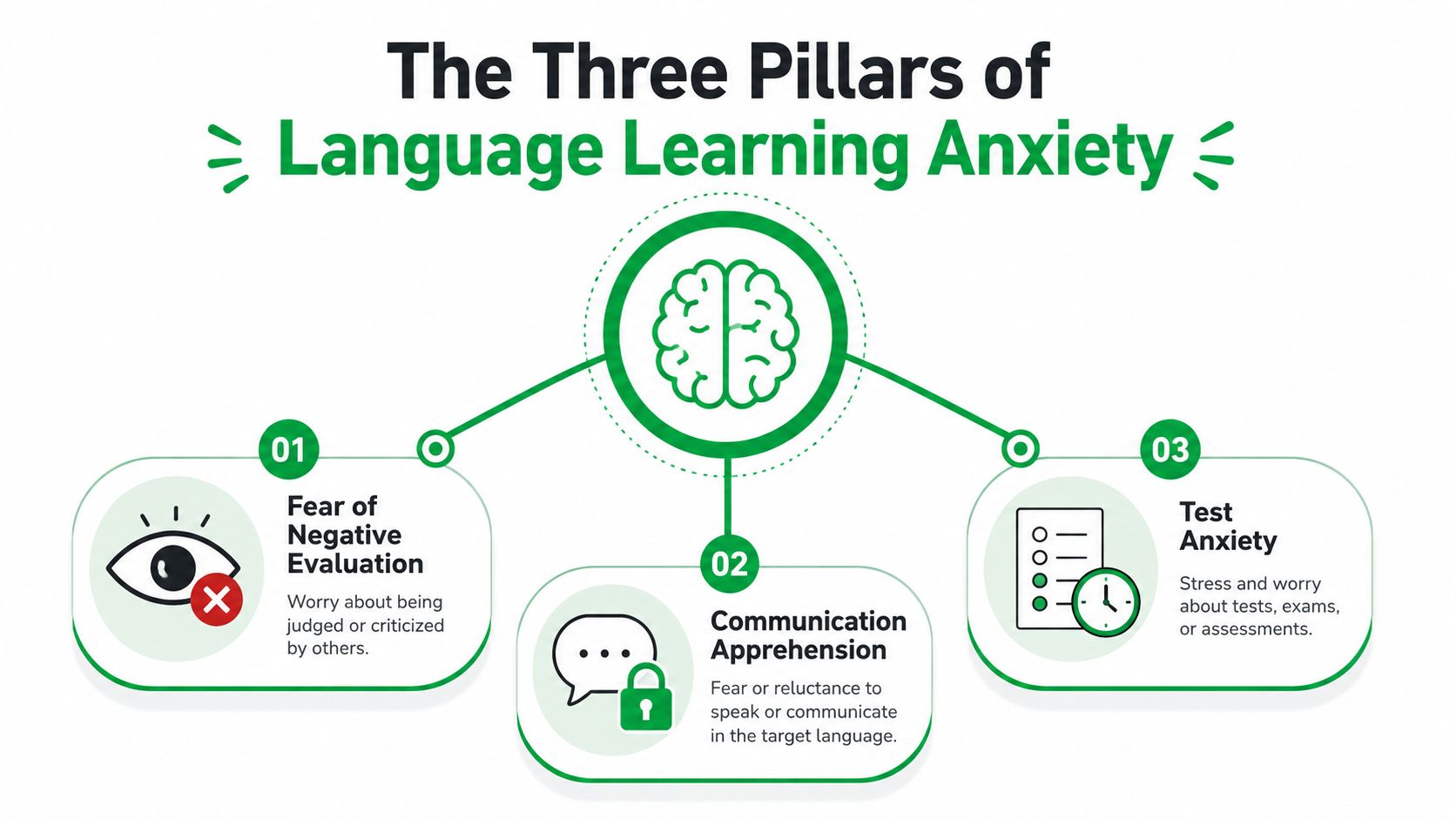
Foreign language anxiety is usually defined in the research literature as a negative emotional response tied to using, learning, or understanding a language PMC review. The Horwitz framework gives it three core parts, and the clearest way to understand it is through ordinary classroom moments.
Fear of negative evaluation
This is the worry that someone will notice your mistake and judge you for it. A learner may avoid saying Gaeilge aloud because they're certain the teacher will correct them sharply, or that classmates will notice every mispronounced consonant. The fear is less about the word itself and more about being seen as wrong.
Communication apprehension
This is the dread that rises when you have to respond in real time. You know the vocabulary, but the pressure of a live exchange makes it hard to retrieve. That's the feeling behind freezing during a conversation, even when you've practiced the material privately.
Test anxiety
This is the panic that appears when performance is graded or formally watched. A learner who speaks more freely in casual practice may blank during a mock oral or any assessed moment. The task hasn't changed, but the stakes have.
A useful question is simple, which part makes your shoulders rise, being corrected, being put on the spot, or being scored?
Separating anxiety from other traits is helpful. Anxiety is not low intelligence, and it isn't proof that you lack motivation. It also isn't the same as shyness, because a quiet learner can still feel confident internally, while a talkative learner can still panic when the language gets real.
For readers who want an outside perspective on stress and support, the resource to compare anxiety counsellors Penticton can be a useful reminder that naming a fear is often the first practical step. For language learners, the same principle applies. Once you know which fear is active, the right practice becomes easier to choose.
How Widespread the Problem Really Is
The hardest part of anxiety is often the private story learners tell themselves. They think everyone else is relaxed, fluent, and effortlessly brave. The research says otherwise.
A major meta-analysis by Teimouri, Goetze, and Plonsky brought together 216 effect sizes from 97 published studies conducted between 1985 and 2017 and found a moderate negative relationship between second-language anxiety and achievement, with an average correlation of r = -0.36. A later meta-analysis of 46 studies found a very similar relationship of r = -0.34 Cambridge meta-analysis. That means anxiety isn't just uncomfortable, it is consistently tied to lower performance across grades and tests.
What those numbers mean in plain English
A correlation like r = -0.36 doesn't mean a learner is doomed. It means anxiety reliably pulls performance downward, enough that researchers can detect the pattern across decades of studies. In other words, if a learner feels tense in language class, there's a good reason the words get harder to find and the recall gets slower.
The prevalence data points to the same conclusion. Language anxiety isn't a fringe issue. It shows up often enough to shape classroom participation, study habits, and willingness to speak. The result is a learner population where worry is common, measurable, and widely shared.
Takeaway: anxiety is not proof that you are failing, it's evidence that the learning moment feels high-stakes to your brain.
That changes the conversation. Instead of asking, “Why am I like this?” the better question is, “What kind of practice lowers the pressure enough for learning to happen?” Once you ask that, the problem becomes workable. Not easy, but workable.
Skill-Specific Signs and Daily Triggers
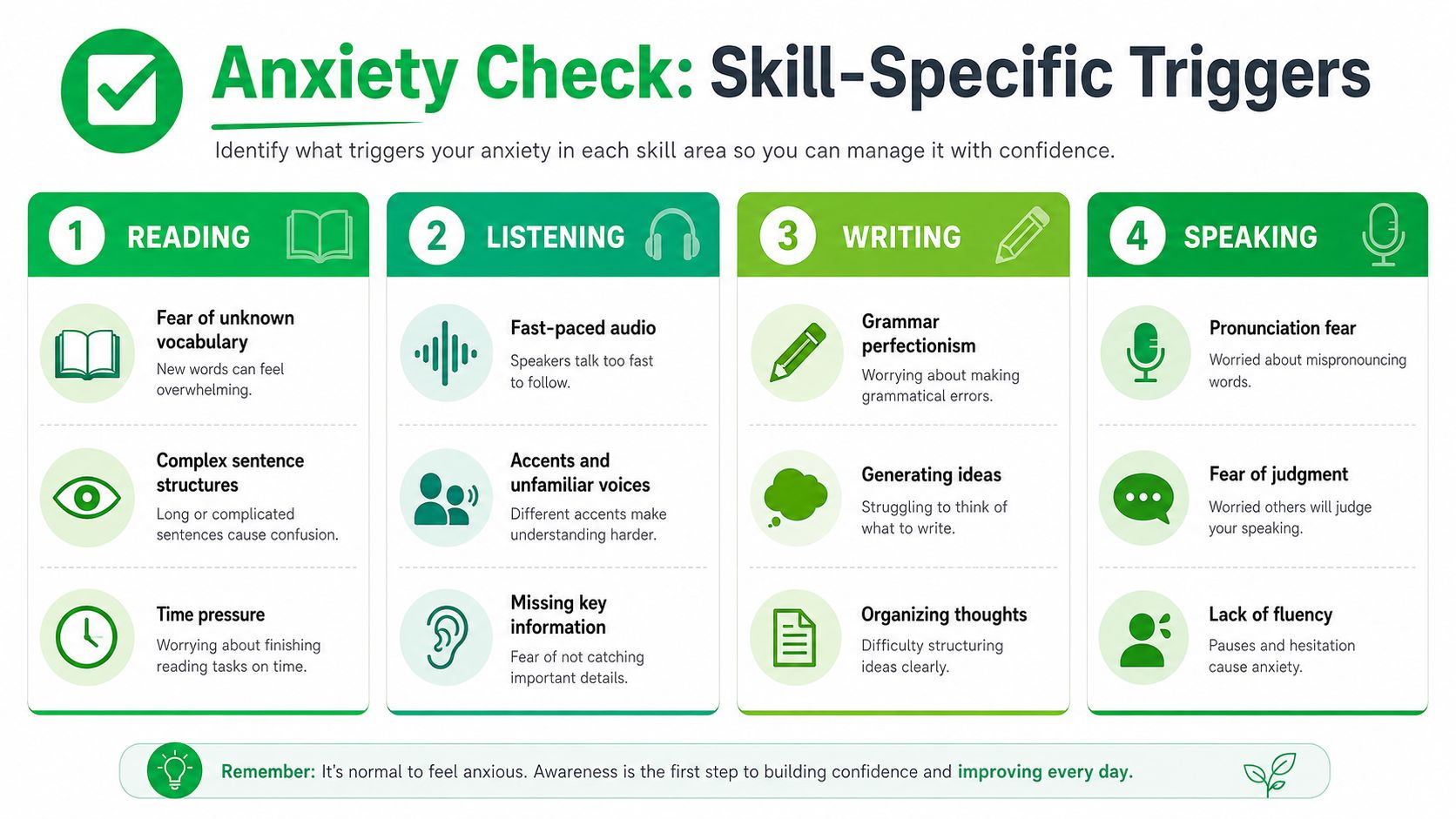
A learner may feel fine while reading and then tense up the moment a listening task begins. Another may follow a conversation on paper, but freeze when the speaker talks too quickly in real time. A 2025 systematic review highlights that technology can reduce anxiety by creating psychological safety and personalized feedback, while it can also raise anxiety through cognitive overload and less human interaction. The same review also points out that the field still focuses too heavily on higher education and needs more work on reading, writing, listening, and VR or AR use 2025 systematic review. That makes the pattern easier to see, the trigger is often tied to a specific skill, not to language learning in general.
This is a common experience, as illustrated in the following clip:
Reading, listening, writing, speaking
Reading can feel safe until the page fills with unfamiliar words. Listening can feel steady until the audio starts moving faster than your mind can sort it out. Writing often stirs up perfectionism, because every sentence seems to demand polish before it is allowed to exist.
Speaking tends to be the most visible trigger, yet it is only one part of the picture. The common pattern is simple. The task becomes time-sensitive, public, or overloaded, and anxiety rises. Once you start noticing the pattern by skill, a bad moment stops looking like one giant problem and starts looking like a specific pressure point.
What tends to set it off
A Cambridge study on online language learning found that the main trigger for speaking anxiety in both groups was not remembering vocabulary learners believed they knew. Learners with mental-health conditions more often pointed to identity and confidence issues, while other learners more often described competence, study, and learning barriers Cambridge online-learning study. That corrects a common mistake in advice. The problem is not always courage. Sometimes it is access, especially under pressure.
For many motivated learners, the first place to look is vocabulary retrieval failure. A word may be present in your head and still refuse to surface when you need it. If you can name the trigger, you can match it with the right kind of practice instead of treating every anxious moment the same way.
- Reading trigger: unknown words pile up and you start guessing instead of understanding.
- Listening trigger: the speed feels too fast, and your mind tries to catch every word at once.
- Writing trigger: you keep restarting sentences because they do not feel polished enough.
- Speaking trigger: the pause between thought and speech makes you feel exposed.
That kind of pattern is easier to work with than a vague fear. It gives you something concrete to observe, and that is often the first step toward calmer practice.
Short-Term Relief You Can Use in the Next Five Minutes
When anxiety spikes, you need something concrete, not a lecture about bravery. Start with the body first, because a calm body gives the brain a better chance of retrieving words.
A five-minute reset
Take one slow breath cycle before you open your practice app. A simple 4-7-8 breathing reset can slow the spiral enough to make the next step possible. Then say one small sentence out loud, even if it feels basic, because motion matters more than polish in the first minute.
Practical rule: make the first sentence so easy that your brain can't argue with it.
Then lower the stakes. Practice alone before practicing with anyone else. Use a pre-rehearsed opening phrase so you don't have to invent the first move under pressure, and if a word blocks you, tap it for translation so momentum doesn't collapse.
A platform like Gaeilgeoir AI fits this stage because it offers guided scenario conversations, tap-to-translate across the platform, and a personalized study list for saving tricky vocabulary. For oral practice, a learner can also use its scenario-based setup alongside fillers for the oral Irish exam so the opening minutes feel less exposed. The point isn't perfection. The point is getting your voice moving before your fear talks you out of it.
Use this reset when you feel stuck:
- Breathe first. Let the body settle before you ask it to perform.
- Start with a sentence you already know. That breaks the silence.
- Translate only what blocks you. Don't stop for every unknown.
- Save the hard word. Put it in a study list and move on.
- Finish one small exchange. Ending well matters more than starting perfectly.
This is short-term relief, not a cure. It buys you a little space, and that space is enough to keep practice alive.
Long-Term Habits That Rebuild Confidence
Short-term calm helps in the moment, but confidence grows from repetition that feels safe enough to repeat tomorrow. One study of college students' foreign-language-learning anxiety in online teaching reported that extracurricular activities accounted for 65% of indicated anxiety-reduction factors, followed by group learning at 46%, tracking tests at 43%, network skills learning at 33%, teachers' network quality at 21%, and learning resources at 18% online-teaching study. The pattern is clear, learners do better when practice is active, social, and easy to revisit.
A habit stack that doesn't feel heavy
Start with a daily five-minute warm-up. It can be one easy dialogue, one pronunciation check, or one quick review of words you already saved. The goal is not intensity, it's showing up often enough that the task stops feeling unfamiliar.
Then add a weekly checkpoint. A lightweight self-test gives your brain proof that recall is improving, which helps the fear of “I'm not getting anywhere” lose some of its force. In a tool like Gaeilgeoir AI, adaptive quizzes with instant feedback can serve that role, and points, multipliers, and leaderboards add a social layer without turning study into a public performance.
Make practice feel safer, not grander
Low-pressure partner or group sessions matter because they normalize the act of being imperfect in front of other people. That's also why realistic Leaving Cert simulations help, they make the exam shape feel familiar before it becomes high-stakes. If a learner wants a structured daily routine, this daily Irish practice plan can anchor the habit without asking them to design everything from scratch.
Helpful frame: confidence usually comes from proof, not from pep talks.
A simple two-week pattern can look like this. Week one, keep the practice short and repeatable. Week two, keep the same rhythm but add one small challenge, like a new scenario or a slightly longer response. The habit is what teaches your nervous system that language use is survivable.
That's where gamified practice has a place. Points, progress markers, and simulation-based repetition don't remove fear on their own, but they make the work feel trackable. For many learners, that trackability is what turns practice from a vague intention into a routine.
Starting Today With One Low-Stakes Session
The first step doesn't need to be bold. It needs to be small enough that you'll do it. Language learning anxiety is widespread, it shifts by skill, and it responds to both short-term relief and long-term habits when the practice is low-stakes and repeatable.
Pick one easy scenario today, like ordering coffee or asking for directions. Open the practice session, use the tap-to-translate safety net if you need it, and finish one exchange before you decide whether you feel ready. Confidence doesn't come first, it shows up after you've already begun.
Gaeilgeoir AI gives you guided Irish conversations, tap-to-translate support, adaptive quizzes, and oral exam simulations in one place, so you can practice without turning every session into a performance. If you want a calmer way to build speaking confidence one small step at a time, visit Gaeilgeoir AI and start with one low-stakes session today.