How Long Does It Take to Learn Irish?

There isn’t one fixed answer to how long it takes to learn Irish.

For some learners, a few months is enough to become comfortable with greetings, common phrases and simple conversations. Reaching a level where you can follow native speech, speak with confidence and use Irish across a wider range of situations usually takes much longer.

The real timeline depends on four things: your starting point, how often you practise, what level you want to reach and how much real Irish you hear and use along the way.

The good news is that you do not need to wait years before Irish starts feeling useful.

A Realistic Timeline for Learning Irish

If you practise consistently, you can think about progress in stages rather than asking when you will suddenly become “fluent”.

After 1 Month

With regular practice, a beginner may be able to recognise common greetings, introduce themselves, understand basic vocabulary and build a few simple sentences.

You might know phrases such as:

Dia dhuit. — Hello.
Conas atá tú? — How are you?
Tá mé go maith. — I am well.
Is maith liom ceol. — I like music.

At this stage, the biggest goal is familiarity. Irish should start looking and sounding less intimidating.

After 3 Months

After a few months of steady study, you may be able to talk about basic everyday topics, understand simple questions and follow parts of short conversations.

Your vocabulary should also begin to feel more connected. Instead of knowing individual words, you start recognising sentence patterns and using them with different vocabulary.

If you want a structured route through this stage, you can learn Irish online with lessons, vocabulary, conversation practice, listening and review working together.

After 6 Months

With consistent practice, six months can be enough to build a useful foundation.

You may be able to describe your day, talk about family or interests, ask and answer common questions and understand more of the Irish you hear in learner-friendly audio.

Your pronunciation and listening should also be noticeably stronger than when you started.

You will still make mistakes. That is completely normal.

After 1 Year

A year of regular Irish can make a significant difference, particularly if your practice includes both structured learning and real exposure to Gaeilge.

At this stage, you may have a much broader vocabulary, understand common grammar patterns and hold simple conversations with less hesitation.

The key phrase here is regular practice.

One year of ten or twenty minutes most days is very different from one year of occasional study.

Your Starting Point Matters

Not everyone begins at zero.

Many people returning to Irish after school discover that they remember more than they expected.

Old vocabulary may come back quickly. Familiar sentence structures can start making sense again, and pronunciation patterns that once felt completely forgotten may still be somewhere in the background.

If you have previous Irish, your early progress may therefore be much faster than that of a complete beginner.

The challenge for returning learners is often less about learning everything again and more about turning passive recognition into active use.

What Do You Mean by “Learn Irish”?

This question changes the timeline more than almost anything else.

If your goal is to understand basic phrases on a trip to Ireland, you could make useful progress relatively quickly.

If your goal is to:

  • have comfortable everyday conversations
  • understand Irish podcasts
  • read Irish books
  • write accurately
  • follow native speakers at natural speed
  • use Irish confidently at work or socially

then you are aiming at a much broader level of proficiency.

There is no single moment when somebody moves from “not knowing Irish” to “knowing Irish”.

Language ability develops gradually.

How Much Irish Should You Study Each Day?

You do not need hours every evening.

For many learners, 15 to 30 minutes of focused practice most days is more sustainable and more useful than a long study session once a week.

A simple routine might include vocabulary review, a short lesson, a few minutes of listening and some active sentence or conversation practice.

The important part is repetition.

Irish vocabulary, grammar and pronunciation become easier when you keep encountering them.

If you want to build that routine with a clear path rather than deciding what to study each day, you can start learning Irish with Gaeilgeoir and combine structured lessons with vocabulary, conversation, quizzes and immersion.

Does Studying More Make You Learn Irish Faster?

Usually, up to a point.

Someone studying for an hour every day will generally progress faster than someone practising for ten minutes twice a week.

But more time only helps if the study is productive.

Spending an hour passively rereading notes may be less useful than twenty focused minutes spent retrieving vocabulary, building sentences and listening to real Irish.

Consistency and quality matter as much as raw study time.

A routine you can maintain for six months will usually beat an intense plan you abandon after two weeks.

How Long Does It Take to Speak Irish?

You can start speaking very early.

You do not need to wait until your grammar is perfect.

Within your first few weeks, you can begin practising greetings, introductions and simple sentences.

For example:

Is mise Aoife. — I am Aoife.
Tá mé i mo chónaí i nGaillimh. — I live in Galway.
Is maith liom ceol. — I like music.

These may seem basic, but they are real Irish.

As your vocabulary grows, the same sentence patterns let you say more.

The important thing is to practise producing language rather than spending months only recognising it.

How Long Does It Take to Understand Spoken Irish?

Listening often takes longer than beginners expect.

A sentence that looks simple on the page can sound completely different when spoken at natural speed.

That is why listening practice should begin early.

Do not wait until you feel “ready”.

Start with short audio. Replay it. Listen for words you recognise. Repeat a phrase after the speaker.

As you hear Irish more frequently, your brain gradually becomes better at separating sounds into meaningful words and phrases.

Podcasts, videos, songs and conversations all help.

Does Irish Grammar Slow Learners Down?

Irish grammar can initially feel unfamiliar because it differs significantly from English.

Word order, mutations and prepositional pronouns are some of the areas that learners often notice early.

But you do not need to master the entire grammar system before making progress.

Learn grammar alongside useful language.

When you see a pattern repeatedly in real sentences, the rule starts to feel less abstract.

The biggest mistake is treating grammar as a gate you must pass through before you are allowed to speak.

It is a tool that helps explain the Irish you are already learning.

How Long Does It Take to Build a Good Irish Vocabulary?

Vocabulary develops continuously.

A beginner can learn useful words within days, but a large active vocabulary takes repeated exposure over months and years.

The important distinction is between recognising a word and being able to retrieve and use it.

You may recognise hundreds of words long before you can produce all of them yourself.

That is normal.

The best vocabulary practice combines review with sentence building, listening and conversation so that words do not remain isolated facts.

Can You Become Fluent in Irish in a Year?

It depends on what you mean by fluent.

A highly motivated learner who spends significant time studying, speaking and immersing themselves in Irish could make substantial progress in a year.

But for most people, one year is better viewed as enough time to build a strong foundation rather than reach the end of the journey.

You could become much more confident, hold basic conversations and understand significantly more Irish.

True ease with a language tends to come from longer-term exposure and use.

What Makes Learning Faster?

Several things consistently help.

Study regularly. Short daily sessions are easier to retain than occasional cramming.

Learn useful vocabulary. Prioritise words you will encounter and use frequently.

Speak early. Do not wait for perfect grammar.

Listen often. Spoken Irish needs to become familiar.

Review old material. New learning is wasted if previous vocabulary disappears.

Use sentences rather than isolated words. Context helps vocabulary and grammar stick.

Combine structure with immersion. Lessons give direction, while real Irish gives the language life.

What Slows Irish Learners Down?

The biggest obstacle is often inconsistency.

Learners also lose time when they constantly switch resources, spend too much time collecting notes, avoid speaking or focus heavily on low-value vocabulary.

Another common problem is expecting progress to feel linear.

Some weeks you will notice obvious improvement. At other times, it can feel as though nothing is changing.

Language learning rarely produces a smooth upward line.

Progress accumulates quietly.

How to Measure Your Progress

Instead of measuring success only by how long you have been studying, ask what you can do now that you could not do three months ago.

Can you introduce yourself?

Can you recognise more words in a podcast?

Can you build a sentence without checking your notes?

Can you follow a short conversation?

Can you understand a song lyric that previously sounded completely unfamiliar?

These are much more useful milestones than simply counting days.

A Better Question Than “How Long Will It Take?”

Instead of asking:

How long until I know Irish?

try asking:

What could my Irish look like six months from now if I practise regularly?

That is a question you can actually influence.

Fifteen minutes a day for six months adds up to dozens of hours of contact with the language.

A little Gaeilge repeated consistently becomes much more powerful than it looks on any individual day.

Learn Irish at a Pace You Can Maintain

There is no prize for finishing Irish quickly.

The goal is to build a relationship with the language that lasts long enough for your knowledge to become genuinely useful.

Gaeilgeoir gives learners a structured place to practise through lessons, vocabulary, personalised study, quizzes and conversation activities, alongside Irish songs and access to podcasts and videos for immersion.

You can start learning Irish with Gaeilgeoir and build a routine around the amount of time you actually have.

Or explore the full Learn Irish Online guide if you want to compare the different ways you can approach learning Gaeilge.

Final Thoughts

So, how long does it take to learn Irish?

Long enough that consistency matters more than shortcuts.

You can learn useful words and phrases within weeks. You can make noticeable conversational progress within months. Becoming genuinely comfortable with Irish takes longer.

The important thing is that you do not have to wait for fluency before the language becomes rewarding.

Every word you understand, every sentence you build and every conversation you follow is already progress.

Start small. Keep returning to Gaeilge. Let the months do some of the work for you.

Go n-éirí leat!

Discover Tá Mé Go Maith: Your Guide to Irish Well-Being

Introduction to “Tá Mé Go Maith”

If you’re embarking on your journey to learn the Irish language, one of the first phrases you should master is “Tá mé go maith.” This simple yet powerful expression translates to “I am well” in English and reflects a positive state of being. Understanding and using this phrase not only enhances your vocabulary but also connects you with the rich cultural heritage of Ireland. In this blog post, we will explore the meaning, usage, and significance of “Tá mé go maith,” along with tips on how to incorporate it into your daily conversations.

The Meaning Behind “Tá Mé Go Maith”

“Tá mé go maith” is a fundamental phrase in Irish that conveys a sense of well-being. Here’s a breakdown of its components:

  • : This is the verb “to be.”
  • : This means “I.”
  • Go maith: This translates to “well.”

When combined, the phrase expresses that you are feeling good or well. It’s often used in response to greetings, making it an essential part of everyday conversation in Irish-speaking communities.

How to Use “Tá Mé Go Maith” in Conversation

Incorporating “Tá mé go maith” into your conversations can help you engage more authentically with native speakers. Here are some scenarios where you might use this phrase:

  1. Responding to Greetings: When someone asks, “Conas atá tú?” (How are you?), you can reply with “Tá mé go maith.”
  2. Expressing Positivity: Use it when discussing your day or feelings, such as after a successful event or a pleasant experience.
  3. Encouraging Others: Sharing your well-being can uplift those around you, fostering a positive atmosphere.

Variations and Related Phrases

To enrich your vocabulary further, consider learning these related phrases:

  • “Tá mé go breá”: I am great.
  • “Níl mé go maith”: I am not well.
  • “Conas atá tú?”: How are you?

These variations will not only enhance your conversational skills but also help you express yourself more accurately.

The Importance of Greetings in Irish Culture

In Irish culture, greetings are more than just formalities; they reflect warmth and connection. Using phrases like “Tá mé go maith” demonstrates respect for the language and its speakers. Here are some key points about the significance of greetings in Ireland:

  • Building Relationships: A simple greeting can open doors to friendships and connections.
  • Cultural Heritage: Speaking Irish honors the traditions and history of the language.
  • Social Norms: Engaging in polite conversation is valued in Irish society.

By incorporating phrases like “Tá mé go maith,” you show appreciation for these cultural nuances.

Tips for Learning Irish with Gaeilgeoir AI

At Gaeilgeoir AI, we offer various AI-powered tools and resources designed to help you learn and practice the Irish language effectively. Here are some tips on how to make the most of our platform:

  1. Interactive Lessons: Utilize our interactive lessons that focus on everyday phrases like “Tá mé go maith.”
  2. Flashcards for Vocabulary Building: Use our flashcards feature to memorize important phrases and their meanings.
  3. Practice Speaking with AI: Engage in conversation practice with our AI tools that simulate real-life dialogues.

For more information on how to start learning Irish, check out our guide to learning Gaelic.

External Resources for Further Learning

To supplement your learning experience, consider exploring reputable external resources that focus on Irish language education. Websites like LetsLearnIrish.com provide valuable insights into various free resources available for learners at all levels.

Conclusion: Embrace Your Journey with “Tá Mé Go Maith”

As you continue on your journey to learn the Irish language, remember that every phrase you master brings you closer to understanding the culture and connecting with its people. By incorporating expressions like “Tá mé go maith,” you’re not just learning a language; you’re embracing a way of life filled with warmth and community.

Ready to take your Irish language skills to the next level?

Sign up for a free trial of Gaeilgeoir AI’s platform today! Join our community of learners who are passionate about mastering the beautiful Irish language.

How Many Hours Does It Take to Learn Irish Effectively?

Learning a new language can be an exciting yet daunting journey, especially when it comes to a language as rich and vibrant as Irish. If you’re wondering how many hours does it take to learn Irish, you’re not alone. Many learners seek guidance on the time commitment required to achieve proficiency in the Irish language. In this post, we will explore the estimated hours needed for different proficiency levels, effective learning strategies, and valuable resources to support your journey.

Understanding the Time Commitment

The time it takes to learn Irish varies significantly based on several factors, including your prior language experience, the intensity of your study, and your personal learning style. According to Teastas Eorpach na Gaeilge (TEG), the organization that administers official Irish language proficiency exams, here are some general estimates:

  • A1 Beginner Level: Approximately 80-100 hours of study.
  • A2 Elementary Level: An additional 160-200 hours after reaching A1.
  • B1 Intermediate Level: An additional 350-400 hours after reaching A2.
  • B2 Upper Intermediate Level: An additional 500-600 hours after reaching B1.
  • C1 Advanced Level: An additional 1,000 hours after reaching B21.

These estimates suggest that reaching a conversational level in Irish could take anywhere from several months to a few years of dedicated study.

Factors Influencing Learning Time

When considering how many hours does it take to learn Irish, it’s essential to understand the factors that can influence this timeline:

  1. Prior Language Experience: If you already speak a language with similar structures or vocabulary, you may find it easier and quicker to learn Irish.
  2. Study Frequency: Regular practice is crucial. Consistent daily study can lead to faster progress compared to sporadic sessions.
  3. Learning Environment: Immersion in an environment where Irish is spoken can significantly enhance your learning speed.
  4. Learning Methods: Utilizing diverse resources such as apps, online courses, and conversation groups can make learning more engaging and effective.
  5. Personal Motivation: Your enthusiasm and commitment will play a significant role in how quickly you progress.

Effective Learning Strategies

To maximize your learning experience and potentially reduce the time it takes to learn Irish, consider implementing these strategies:

1. Set Clear Goals

Establish specific, measurable goals for your language learning journey. Whether it’s mastering basic greetings or holding a conversation, clear objectives will help you stay focused.

2. Utilize AI-Powered Tools

Gaeilgeoir AI offers innovative AI-powered tools that can enhance your learning experience by providing personalized feedback and interactive exercises. These resources can help you practice effectively and track your progress.

3. Engage with Native Speakers

Practicing with native speakers is one of the most effective ways to improve your fluency. Consider joining conversation groups or language exchange programs.

4. Incorporate Multimedia Resources

Use a variety of resources such as podcasts, videos, and online courses to keep your learning dynamic and engaging. For example, check out our guide on how to say good morning in Irish Gaelic for practical phrases you can use daily.

5. Practice Regularly

Consistency is key in language learning. Aim for daily practice, even if it’s just for 15-30 minutes. This can significantly enhance retention and fluency over time.

Recommended Resources for Learning Irish

Here are some valuable resources that can assist you in your journey:

  • Online Courses: Websites like Gaeilgeoir AI offer structured online courses tailored for different proficiency levels.
  • Language Apps: Consider using apps like Duolingo or Rosetta Stone for interactive learning experiences.
  • Podcasts and Videos: Listening to Irish-language podcasts or watching videos can improve your listening skills and pronunciation.
  • Books and Flashcards: Utilize books specifically designed for Irish learners, along with flashcards for vocabulary building.

For more tips on mastering greetings in Irish, visit our page on mastering “Dia duit” – Irish greetings.

Embarking on Your Irish Language Journey

As you embark on your journey to learn Irish, remember that the question of how many hours does it take to learn Irish is not just about numbers; it’s about enjoying the process of discovery and connection with a rich cultural heritage. While estimates suggest varying timelines based on proficiency levels, what matters most is your dedication and passion for learning.If you’re ready to take the next step in your language-learning adventure, consider signing up for a free trial of Gaeilgeoir AI’s platform or joining our community of learners who share the same passion for mastering the beautiful Irish language!

Comparing Irish and Scottish Gaelic Grammar: Key Differences

Learning a new language can be an exciting journey, especially when it involves beautiful languages like Irish and Scottish Gaelic. While both languages share a common heritage and many similarities, they also exhibit distinct grammatical features. In this blog post, we will delve into the comparison of Irish and Scottish Gaelic grammar, exploring their unique characteristics, syntax, and pronunciation to help you better understand these fascinating languages.

Understanding the Basics of Irish and Scottish Gaelic

Irish (Gaeilge) and Scottish Gaelic (Gàidhlig) are both Goidelic languages that belong to the Celtic family. They were historically spoken across much of Western Europe, but over time, they have evolved separately, leading to significant differences in grammar, pronunciation, and vocabulary.

Key Similarities

Before diving into the differences, it’s essential to acknowledge some similarities:

  • Celtic Roots: Both languages share a common Celtic ancestry.
  • Noun Gender: Both Irish and Scottish Gaelic classify nouns as either masculine or feminine.
  • Verb Forms: Each language has distinct forms for verbs that convey tense and aspect.

Despite these similarities, learners often find that the comparison of Irish and Scottish Gaelic grammar reveals more differences than commonalities.

Pronunciation Differences

One of the most noticeable distinctions between Irish and Scottish Gaelic is their pronunciation.

Accent Marks

In Irish, accent marks (síneadh fada) slant to the right (acute), while in Scottish Gaelic, they slant to the left (grave). This difference can affect how words are pronounced and understood. For example:

  • Irish: “fáilte” (welcome)
  • Scottish Gaelic: “fàilte”

Phonetic Variations

The phonetic systems of both languages differ significantly. For instance, while certain sounds may appear similar in spelling, they can be pronounced differently. This can lead to confusion for learners trying to transition from one language to the other.

Grammatical Structures

Word Order

One of the primary grammatical differences lies in word order:

  • Irish: Follows a Verb-Subject-Object (VSO) structure.
    • Example: “Bhuail sé mé.” (He hit me.)
  • Scottish Gaelic: Typically uses a Subject-Verb-Object (SVO) structure.
    • Example: “Thug e orm.” (He hit me.)

This fundamental difference can significantly impact how sentences are constructed in each language.

Noun Declension

Both languages decline nouns based on case and number; however, the specific cases used can differ. In Irish, nouns are declined for nominative, genitive, dative, and vocative cases. In contrast, Scottish Gaelic primarily uses nominative and genitive cases.

Initial Consonant Mutations

Both languages feature initial consonant mutations that change how words are pronounced based on grammatical context. However, the rules governing these mutations differ between Irish and Scottish Gaelic:

  • In Irish, eclipsis is a common form of mutation where the initial consonant is replaced by another sound.
  • In Scottish Gaelic, certain consonants undergo aspiration or lenition depending on their grammatical role.

Vocabulary Differences

While many words may appear similar due to their shared roots, there are notable vocabulary differences between the two languages. For example:

  • “I am tired” in Irish is “Tá tuirseach orm,” while in Scottish Gaelic it is “Tha mi sgith.”

These variations highlight how each language has developed its lexicon independently over time.

Learning Resources for Both Languages

If you’re interested in learning either language or comparing them further, consider utilizing resources like Gaeilgeoir AI’s online courses which offer AI-powered tools tailored for learners at all levels.

Conclusion: Embrace Your Language Journey

Understanding the comparison of Irish and Scottish Gaelic grammar can enrich your experience as you learn these beautiful languages. While they share a common heritage, their unique grammatical features reflect their distinct paths through history.As you embark on your journey to learn either language or both, remember that each offers its own set of challenges and rewards. By embracing these differences and similarities, you’ll gain a deeper appreciation for the rich cultural tapestry woven through the Celtic languages.

Ready to start your journey? Sign up for a free trial of Gaeilgeoir AI’s platform today and join a vibrant community of Irish language learners!

Learn Irish Word for Backpack: Your Guide to Essential Vocabulary

Learning a new language can be an exciting journey, and if you’re interested in the Irish language, you might be wondering how to say everyday words like “backpack.” In Irish, the word for backpack is **”mála scoile.”** This term is essential for anyone looking to engage with the language in practical situations, whether you’re packing for a trip or discussing school supplies. In this blog post, we will explore the importance of learning vocabulary in Irish, provide tips on how to effectively learn new words, and highlight some resources that can help you on your journey.

Why Learning Vocabulary is Important

When learning any language, vocabulary is the foundation of your communication skills. Here are a few reasons why focusing on vocabulary is crucial:

– **Effective Communication:** Knowing the right words allows you to express yourself clearly and understand others better.

– **Cultural Understanding:** Language is deeply tied to culture. Learning specific terms can give you insights into Irish customs and traditions.

– **Confidence Building:** The more words you know, the more confident you will feel when speaking or writing in Irish.

Tips for Learning New Vocabulary

To effectively learn new words like “mála scoile,” consider the following strategies:

#1. Use Flashcards

Flashcards are a great way to memorize vocabulary. Write the Irish word on one side and its English translation on the other. You can use physical cards or apps like Anki or Quizlet to create digital flashcards.

#2. Practice in Context

Instead of memorizing words in isolation, try to use them in sentences. For example, “I put my books in my **mála scoile**” helps reinforce the word in context.

#3. Engage with Native Speakers

Speaking with native speakers is one of the best ways to learn. You can join online forums or local language groups where you can practice your skills.

#4. Utilize Online Resources

There are many online platforms that offer interactive exercises and lessons. Websites like Gaeilgeoir AI provide tools specifically designed for learners of all levels.

Expanding Your Vocabulary: Related Words

As you learn the word for backpack, it’s also beneficial to expand your vocabulary with related terms. Here are some synonyms and related words that might come in handy:

– **Knapsack** – *poca-droma*

– **School bag** – *mála scoile*

– **Travel bag** – *mála taistil*

Incorporating these variations into your learning can enhance your understanding and ability to communicate effectively.

Resources for Learning Irish

To further support your journey in learning Irish, here are some excellent resources:

#Online Courses

  1. Gaeilgeoir AI: Offers AI-powered tools that adapt to your learning style.
  2. Duolingo: A popular app that gamifies language learning.

#Podcasts

Listening to podcasts in Irish can improve your listening skills while exposing you to natural speech patterns. Consider checking out [RTÉ Raidió na Gaeltachta](https://www.rte.ie/radio/rte-radio-na-gaeltachta/) for engaging content.

#Books

Investing in a good textbook can provide structured learning. Look for books that focus on everyday vocabulary and phrases.

#Community Engagement

Join online forums or local groups dedicated to learning Irish. Engaging with others who share your interest can motivate you and provide valuable practice opportunities.

If you’re eager to learn more about specific phrases or greetings in Irish, check out our guide on how to say good morning in Irish Gaelic. This resource will help you expand your conversational skills further.

Start Your Learning Journey Today!

Learning the Irish word for backpack—**”mála scoile”**—is just one small step on your journey towards fluency. By incorporating vocabulary practice into your daily routine, utilizing available resources, and engaging with others, you’ll find yourself making significant progress in no time.

Are you ready to take your first step? Sign up for a free trial of Gaeilgeoir AI’s platform today and join a community of enthusiastic learners just like you! With our innovative tools and supportive environment, you’ll be well on your way to mastering the beautiful Irish language.

How Do Irish Say May God Protect You? A Guide to Irish Blessings

Learning the Irish language can be a rewarding journey, filled with rich culture and beautiful expressions. One common phrase that many learners seek to understand is “how do Irish say may God protect you?” This phrase encapsulates a heartfelt blessing often used in everyday conversation and special occasions. In this blog post, we will explore this phrase, its variations, and other related expressions that will enhance your understanding of the Irish language.

Understanding the Phrase

In Irish, the phrase “may God protect you” is translated as “Go gcoimeádtar tú ag Dia.” This expression is commonly used to convey good wishes and blessings, reflecting the deep-rooted connection between language and culture in Ireland.

Variations of the Phrase

There are several variations of this phrase that you might encounter:

  • “Go gcoimeádtar tú” – May you be kept (safe).
  • “Dia duit” – God be with you.
  • “Slán go fóill” – Safe for now.

These phrases are often used interchangeably in different contexts, showcasing the flexibility of the language.

The Importance of Blessings in Irish Culture

Blessings hold a significant place in Irish culture. They are not just words; they represent a way of life and a connection to heritage. Here are some key aspects of blessings in Irish culture:

  1. Cultural Significance: Blessings often reflect the values and beliefs of the Irish people, emphasizing community, protection, and goodwill.
  2. Language Preservation: Using traditional phrases helps preserve the Irish language and encourages its use among new learners.
  3. Emotional Connection: Blessings evoke feelings of warmth and care, making them a vital part of social interactions.

Common Irish Blessings

Here are some popular Irish blessings that you can incorporate into your conversations:

  • “May the road rise to meet you.”
  • “May your troubles be less and your blessings be more.”
  • “May you have warm words on a cold evening.”

These blessings not only enrich your vocabulary but also provide insight into the values cherished by the Irish people.

How to Practice These Phrases

Learning how to say “may God protect you” and other blessings is just the beginning. Here are some effective ways to practice these phrases:

1. Use Language Apps

Consider using AI-powered language learning tools like Gaeilgeoir AI to help you practice pronunciation and usage in context. These platforms provide interactive lessons that make learning engaging.

2. Join Language Groups

Engage with communities of learners who share your passion for the Irish language. Online forums or local meet-ups can provide valuable opportunities to practice speaking.

3. Listen to Native Speakers

Listening to native speakers can significantly improve your pronunciation and understanding. Resources like RTÉ Raidió na Gaeltachta offer programs entirely in Irish, allowing you to immerse yourself in the language.

The Role of AI in Learning Irish

Artificial Intelligence is transforming language learning by providing personalized experiences tailored to individual needs. Here’s how AI can enhance your learning journey:

  • Adaptive Learning: AI tools assess your progress and adapt lessons accordingly, ensuring a customized learning experience.
  • Speech Recognition: Many platforms utilize speech recognition technology to help learners improve their pronunciation.
  • Interactive Exercises: Engaging exercises keep learners motivated and make practicing fun.

Conclusion: Embark on Your Language Journey

Understanding how do Irish say “may God protect you” is just one step on your journey towards mastering the language. As you explore more phrases and engage with the culture, you’ll find that each word carries a story and a connection to the past.

Embrace this journey with an open heart, and don’t hesitate to reach out for help or resources along the way. Whether it’s signing up for a free trial of Gaeilgeoir AI’s platform or joining a community of Irish language learners, every step counts towards achieving fluency.

Start using these phrases today, and let them guide you through your exploration of the beautiful Irish language!

Mastering Adjectives in Irish: A Comprehensive Guide

Adjectives are crucial in any language for describing nouns and bringing your sentences to life. In Irish (Gaeilge), adjectives behave somewhat differently from English, featuring unique placement and agreements with the nouns they describe. This guide, provided by Gaeilgeoir AI, dives into the essential aspects of adjectives in Irish, offering insights and practical tips to enhance your understanding and usage of these descriptive words in daily conversation and writing.

Understanding Adjectives in Irish

Adjectives in Irish, known as “aídíocht,” play a pivotal role in adding color and detail to communication. They follow certain grammatical rules that differ significantly from those in English:

  • Placement: Generally, adjectives in Irish appear after the noun, unlike in English where they usually precede the noun.
  • Agreement: Adjectives in Irish must agree in gender (masculine or feminine) and number (singular or plural) with the nouns they modify.

Key Rules for Using Adjectives

Gender Agreement

  • If the noun is masculine, the adjective remains in its basic form.
  • For feminine nouns, most adjectives require a specific modification, often involving the softening or lenition of the initial consonant.

Number Agreement

  • When describing singular nouns, adjectives use their singular form.
  • In plural contexts, adjectives change to reflect the plural, often by adding an “-a” at the end for most adjectives.

Examples of Common Adjectives in Irish and Their Usage

To help you understand how adjectives work in various contexts, here are some frequently used adjectives in Irish along with examples:

  1. Mór (big):
    • Singular: “madra mór” (big dog)
    • Plural: “madraí móra” (big dogs)
  2. Beag (small):
    • Singular: “cailín beag” (small girl)
    • Plural: “cailíní beaga” (small girls)
  3. Sean (old):
    • Singular: “teach sean” (old house)
    • Plural: “tithe seana” (old houses)

Enhancing Your Vocabulary with Adjectives

Thematic Vocabulary Building

  • Colors: “dearg” (red), “gorm” (blue), “buí” (yellow)
  • Sizes: “beag” (small), “mór” (big), “ollmhór” (huge)
  • Qualities: “álainn” (beautiful), “uafásach” (terrible), “cliste” (smart)

Practice Techniques

  • Flashcards: Utilize flashcards to memorize adjectives and their forms.
  • Descriptive Writing: Practice writing descriptions of people, places, or things using a variety of adjectives.
  • Role-playing: Engage in role-playing exercises where you describe objects or scenarios to another person using Irish.

Tools and Resources from Gaeilgeoir AI

Gaeilgeoir AI offers a range of tools designed to assist your learning:

  • Interactive Exercises: Engage with dynamic exercises that focus on adjective use and agreement.
  • Customized Learning Paths: Tailored lessons to strengthen your understanding of Irish adjectives based on your proficiency level.
  • Real-Time Feedback: Receive immediate feedback on your usage of adjectives in practice sentences and corrections where necessary.

Conclusion

Adjectives are not just vocabulary words; they are vital tools that infuse your Irish language expression with richness and precision. Understanding and using adjectives correctly can significantly enhance your communication effectiveness. Utilize the resources and strategies suggested by Gaeilgeoir AI to master the use of adjectives in your Irish language journey.

Want to learn more?

Ready to expand your Irish vocabulary and master the art of description? Sign up for a free trial at Gaeilgeoir AI today and explore our extensive learning resources designed for learners at all levels. Join our community and take your Irish language skills to new heights!

Stay Updated: Your Guide to Irish Language News

In the digital era, accessing news in Irish is not just about keeping informed; it’s also a fantastic way to engage with the language on a daily basis and understand Ireland’s culture more deeply. For learners and fluent speakers alike, following Irish language news can enhance language skills, offer cultural insights, and connect you with the Irish-speaking community worldwide. At Gaeilgeoir AI, we understand the importance of this connection and provide the tools and resources necessary to integrate news into your language learning journey effectively.

The Importance of Irish Language News

Staying updated with news in Irish is crucial for several reasons:

  • Language Immersion: Regular exposure to the language through news helps in naturalizing your understanding and boosting your language skills.
  • Cultural Connectivity: News stories provide context about what’s currently happening in Ireland, offering a deeper understanding of the cultural, social, and political landscape.
  • Community Engagement: Discussing news topics with other Irish speakers can enhance your communicative skills and help build connections within the Irish-speaking community.

Top Sources for Irish Language News

  1. RTÉ Raidió na Gaeltachta
    • Overview: As one of Ireland’s primary Irish-language broadcasters, RTÉ Raidió na Gaeltachta offers extensive news coverage, including national and international news, all in Irish.
    • Why Listen: It’s great for auditory learners who appreciate learning through listening.
    • Listen to RTÉ Raidió na Gaeltachta
  2. Tuairisc.ie
    • Overview: An Irish-language news website that provides comprehensive articles on current affairs, sports, culture, and more.
    • Why Read: Ideal for those who prefer reading to improve their language proficiency.
    • Visit Tuairisc.ie
  3. TG4
    • Overview: TG4 is not only a television broadcaster but also offers a wide range of news in video format on its platform, making it accessible for those who prefer visual content.
    • Why Watch: Perfect for visual learners and those interested in seeing news presentations.
    • Watch News on TG4

How to Incorporate News into Your Irish Language Learning Routine

Daily News Briefs

Make it a habit to start or end your day with news in Irish. Even if you understand only segments initially, regular listening or reading will improve your comprehension over time.

Vocabulary Building

Keep a notebook or digital document handy to jot down new words and phrases you encounter in news articles or broadcasts. Later, use these new terms when practicing speaking or writing.

Discussion and Debate

Engage with other learners or speakers by discussing news topics. This not only helps you practice the language but also deepens your understanding of various viewpoints and cultural contexts.

Tools and Features from Gaeilgeoir AI to Support Your Learning

At Gaeilgeoir AI, we complement your news-based learning with:

  • Interactive Exercises: Tailored exercises that reflect current news themes, helping you practice relevant vocabulary and grammar.
  • AI-Powered Pronunciation Guides: Perfect your news-related vocabulary pronunciation with our real-time corrective feedback.
  • Cultural Context Modules: Gain insights into the historical and cultural background of prominent news stories.

Conclusion

Incorporating Irish language news into your daily routine is a powerful strategy to enhance your language skills and stay connected with Irish culture. Whether you prefer reading articles, listening to the radio, or watching news broadcasts, there is a wealth of resources available to suit every learning style.

Want to learn more?

Are you ready to enhance your Irish language skills and stay connected with Ireland’s vibrant culture? Sign up for a free trial at Gaeilgeoir AI today, where we provide all the tools you need to seamlessly integrate Irish news into your learning routine. Join our community and start your journey towards Irish fluency with confidence!

Can You Learn Irish On Your Own? Yes, Here’s How!

Yes, you can learn Irish by yourself.

You don’t necessarily need to attend weekly classes, hire a private tutor or live in a Gaeltacht to make meaningful progress with Gaeilge. With a good learning structure, regular listening and enough opportunities to actually use what you learn, independent study can take you surprisingly far.

The challenge isn’t really whether Irish can be learned independently. It’s knowing what to study, what order to study it in and how to avoid spending months collecting vocabulary without becoming comfortable using the language.

If you want to teach yourself Irish, this guide will show you how to build a realistic learning routine, which parts of Gaeilge deserve your attention first and where independent learners tend to get stuck.

Is Irish Difficult to Learn by Yourself?

Irish can initially feel unusual to an English speaker.

The spelling system looks unfamiliar. Sentence structures don’t always behave like their English equivalents. Words can change at the beginning depending on their grammatical context, and the Irish you hear can vary between dialects.

None of that makes Irish impossible to learn independently.

What it does mean is that randomly memorising words probably won’t get you very far.

A good self-study approach should combine several parts of the language:

Vocabulary gives you the words you need.

Grammar and sentence patterns show you how those words work together.

Listening helps you recognise Irish when it is actually spoken.

Pronunciation helps you understand the relationship between written and spoken Gaeilge.

Active practice teaches you to retrieve and use what you’ve learned.

The mistake is assuming you have to master one of these completely before moving to the next. You don’t.

They should develop together.

Start With Useful Irish, Not Everything at Once

When you’re teaching yourself, it’s tempting to begin with enormous vocabulary lists or detailed grammar explanations.

Start smaller.

Focus on Irish you can imagine yourself actually using.

That might include greetings, introducing yourself, numbers, common verbs, food and drink, family, weather, places and everyday activities.

Learn phrases such as:

Dia dhuit. — Hello.

Conas atá tú? — How are you?

Tá mé go maith. — I am well.

Is maith liom ceol. — I like music.

Tá caife agam. — I have coffee.

The purpose isn’t to memorise hundreds of phrases. It’s to start noticing reusable patterns.

Once you understand Is maith liom…, for example, you can begin changing what comes afterwards rather than learning every possible sentence separately.

If you want a structured starting point without committing to a paid course, you can learn Irish online for free and begin building those foundations.

Build Your Irish Vocabulary Gradually

You obviously need words to speak a language, but more vocabulary isn’t automatically better.

Knowing 500 words you can’t retrieve when you need them is less useful than having a smaller vocabulary you can comfortably recognise and use.

Focus first on high-frequency and personally useful Irish.

If you enjoy music, learn words that allow you to talk about music. If you’re learning Irish to reconnect with family, prioritise vocabulary around people, places and everyday life. If you’re travelling in Ireland, practical phrases may matter more initially.

Whatever vocabulary you choose, practise retrieving it.

Don’t just read:

madra — dog

Cover the Irish and ask yourself:

dog → ?

Then try putting the answer into a sentence:

Tá madra agam.

That extra step starts turning passive vocabulary into usable Gaeilge.

Learn Irish Through Sentences, Not Just Individual Words

Individual words are useful building blocks, but eventually you need to understand how they fit together.

Instead of learning only:

caife — coffee

learn:

Ba mhaith liom caife.
I would like coffee.

Instead of only:

ceol — music

learn:

Is maith liom ceol.
I like music.

Sentences give vocabulary context while exposing you to Irish grammar naturally.

As you encounter similar structures repeatedly, patterns that initially seemed strange begin to become familiar.

You can then substitute different words into those patterns and start creating your own sentences.

That’s one of the points where independent learning starts becoming much more interesting: you’re no longer simply remembering Gaeilge. You’re producing it.

Listen to Irish From the Beginning

Don’t wait until you think your Irish is “good enough” before listening to native or fluent speakers.

Start early.

At first, you may understand very little. That’s normal.

You’re training your ear to recognise the sounds, rhythm and patterns of the language.

Listen to Irish through podcasts, videos, songs, radio, television and learning materials with audio.

You don’t have to understand everything.

Try listening for a word you recently learned. Then a phrase. Then a sentence.

A useful exercise is to choose a very short piece of audio, listen to it several times and repeat one sentence after the speaker.

Try to copy the rhythm and sound rather than pronouncing the words according to English spelling conventions.

If you’re looking for a more structured way to combine listening with lessons, vocabulary and practice, our guide to how to learn Irish online explains the different approaches you can use.

Don’t Let Irish Pronunciation Scare You

Irish spelling can look intimidating when you first encounter it.

The solution isn’t to ignore pronunciation. It’s to gradually learn how the spelling system works.

Irish has its own sound patterns. Once you become familiar with them, words that initially looked unpredictable start making much more sense.

Pay particular attention to the distinction between broad and slender consonants and to common combinations of vowels and consonants.

Most importantly, listen while you learn.

Seeing an Irish word and hearing it pronounced together is much more useful than trying to guess its pronunciation from the spelling alone.

And don’t expect yourself to sound perfect immediately. Your goal as a beginner is to become increasingly comfortable producing Irish sounds, not to achieve flawless pronunciation in your first week.

What About Irish Grammar?

You need grammar, but you don’t need to learn the entire grammar system before you’re allowed to speak.

That approach can make Irish feel unnecessarily difficult.

Instead, learn grammar alongside useful sentences.

When you encounter a pattern, ask what is happening and why.

Over time, you can gradually develop your understanding of things such as verb forms, sentence structure, mutations, prepositional pronouns and the way possession and other ideas are expressed in Irish.

Grammar is most useful when it explains Irish you’ve already begun encountering.

Think of it as a tool for understanding the language rather than a giant set of rules you have to memorise before doing anything interesting.

Create a Daily Irish Routine

Independent learning works much better when Irish becomes something you do regularly.

That doesn’t mean studying for two hours every evening.

For many learners, 15 or 20 focused minutes most days is much more sustainable than occasional marathon sessions.

A simple self-study routine might look like this:

5 minutes — Vocabulary

Review previously learned words and introduce a few new ones.

5 minutes — Sentences

Use some of those words in simple Irish sentences.

5 minutes — Listening

Listen to a short podcast, video, song or audio clip.

5 minutes — Active practice

Complete a quiz, practise a conversation, retrieve sentences from memory or say something about your day in Irish.

You can make the routine longer when you have time, but you don’t have to.

The important thing is returning to Gaeilge regularly.

Can Apps Help You Teach Yourself Irish?

Yes, particularly if you’re learning independently.

The biggest disadvantage of self-study is that nobody is standing beside you saying, “Here’s what you should work on next.”

A well-structured learning platform can provide some of that direction.

Gaeilgeoir brings together structured lessons, vocabulary, personalised study lists, quizzes, conversation practice and other learning activities so that you don’t have to build your entire study system yourself.

You can also use songs as part of your learning and access dozens of Irish podcasts and videos for immersion.

The point isn’t to spend every minute inside an app.

It’s to use technology to give your independent learning structure, then combine that structure with exposure to real Gaeilge.

Do You Need an Irish Teacher or Tutor?

Not necessarily.

Plenty of progress can be made independently, particularly at beginner and intermediate levels.

But that doesn’t mean teachers are useless.

A good teacher or tutor can identify mistakes you haven’t noticed, explain difficult concepts, help with pronunciation and give you genuine conversational practice.

The question therefore isn’t:

“Self-study or teacher?”

It can simply be:

“What would help me most at this stage?”

You might learn independently most of the week and occasionally work with a tutor. You might attend a conversation group while following an online programme. Or you might begin entirely by yourself and add speaking practice later.

These approaches aren’t mutually exclusive.

What About Irish Dialects?

Irish is traditionally associated with three major dialect areas: Munster, Connacht and Ulster.

You’ll encounter differences in pronunciation, vocabulary and sometimes grammar.

As an independent learner, don’t let this stop you from starting.

You don’t need to learn three versions of every sentence.

Choose good learning materials, become comfortable with the Irish you’re studying and gradually expose yourself to speakers from different areas.

Over time, you’ll start noticing differences without having to consciously memorise every variation.

If you have a particular connection to an area or Gaeltacht community, you may eventually decide to focus more heavily on that dialect.

Common Mistakes When Learning Irish by Yourself

One of the biggest dangers of independent learning is spending a lot of time around Irish without actually using it.

You can watch lessons, collect vocabulary lists and read grammar explanations while rarely asking your brain to retrieve anything.

Try to avoid these common traps.

Only learning vocabulary. Words matter, but you need sentences and context too.

Avoiding speaking because you aren’t ready. You’ll never feel completely ready. Start with simple sentences.

Ignoring listening. Written Irish and spoken Irish need to develop together.

Trying to learn too much at once. A smaller amount retained well is more valuable than racing through material.

Constantly changing resources. The next app, book or course isn’t necessarily going to solve the problem. Give one structured approach enough time to work.

Expecting perfect consistency. Missing Tuesday doesn’t mean you’ve failed. Start again on Wednesday.

How Long Does It Take to Learn Irish by Yourself?

There’s no useful single answer.

It depends on what you mean by “learn Irish”, how frequently you practise, what experience you already have and how much contact you have with the language.

Someone who studied Irish at school may rediscover vocabulary and structures surprisingly quickly.

A complete beginner has more foundations to build.

And someone aiming for comfortable conversation has a different goal from someone who simply wants to understand basic phrases.

Rather than obsessing over how many months fluency should take, measure smaller improvements.

Can you introduce yourself?

Can you understand a short exchange?

Can you recognise words in a podcast?

Can you describe your day?

Can you remember vocabulary you learned last month?

Those are real signs of progress.

How to Know Whether Your Irish Is Improving

Language progress can be difficult to notice because you experience it gradually.

Every few weeks, return to something you previously found difficult.

Listen to the same audio. Revisit an old lesson. Try answering the same questions. Look at vocabulary you struggled to remember.

You may discover that something which once required intense concentration now feels relatively ordinary.

That’s progress.

You can also keep a short Irish diary or occasionally record yourself speaking for a minute or two. Looking back several months later can make improvement much easier to see.

The Best Way to Learn Irish Independently

There isn’t one perfect method, but there is a useful principle:

Combine structure with immersion.

Structure gives you direction.

It helps you build vocabulary systematically, understand grammar, practise useful sentences and keep progressing rather than randomly jumping between topics.

Immersion shows you the language outside those lessons.

Songs, podcasts, videos, conversations, television and reading allow you to see and hear Gaeilge being used for something real.

You need both.

A structured course without exposure can feel artificial. Pure immersion without enough foundational knowledge can leave a beginner completely lost.

Bring them together and each makes the other more useful.

Start Learning Irish by Yourself With Gaeilgeoir

You absolutely can teach yourself Irish, but you don’t have to design every part of the learning process from scratch.

Gaeilgeoir gives independent learners a structured way to build their Irish through lessons, the 1,000 Word Way, personalised study lists, quizzes, conversation practice and gamified activities.

You can then move beyond structured learning through Irish songs and dozens of podcasts and videos designed to help bring more Gaeilge into your day.

If you want to see the broader learning options available, explore our guide to learn Irish online.

Or, if you’d rather begin without paying, you can learn Irish online for free and start building your foundation first.

Final Thoughts

So, can you learn Irish by yourself?

Yes.

You need a sensible structure, regular contact with Gaeilge and opportunities to retrieve and use what you’ve learned.

Start with useful vocabulary. Put it into sentences. Listen to Irish from the beginning. Learn grammar as you encounter it. Speak before you feel completely ready. And build a routine that’s realistic enough to survive your actual life.

You don’t need to know everything before Irish becomes useful.

You just need to keep making the next part of it familiar.

Go n-éirí leat!

Irish, Gaelic and Celtic: What’s the Difference?

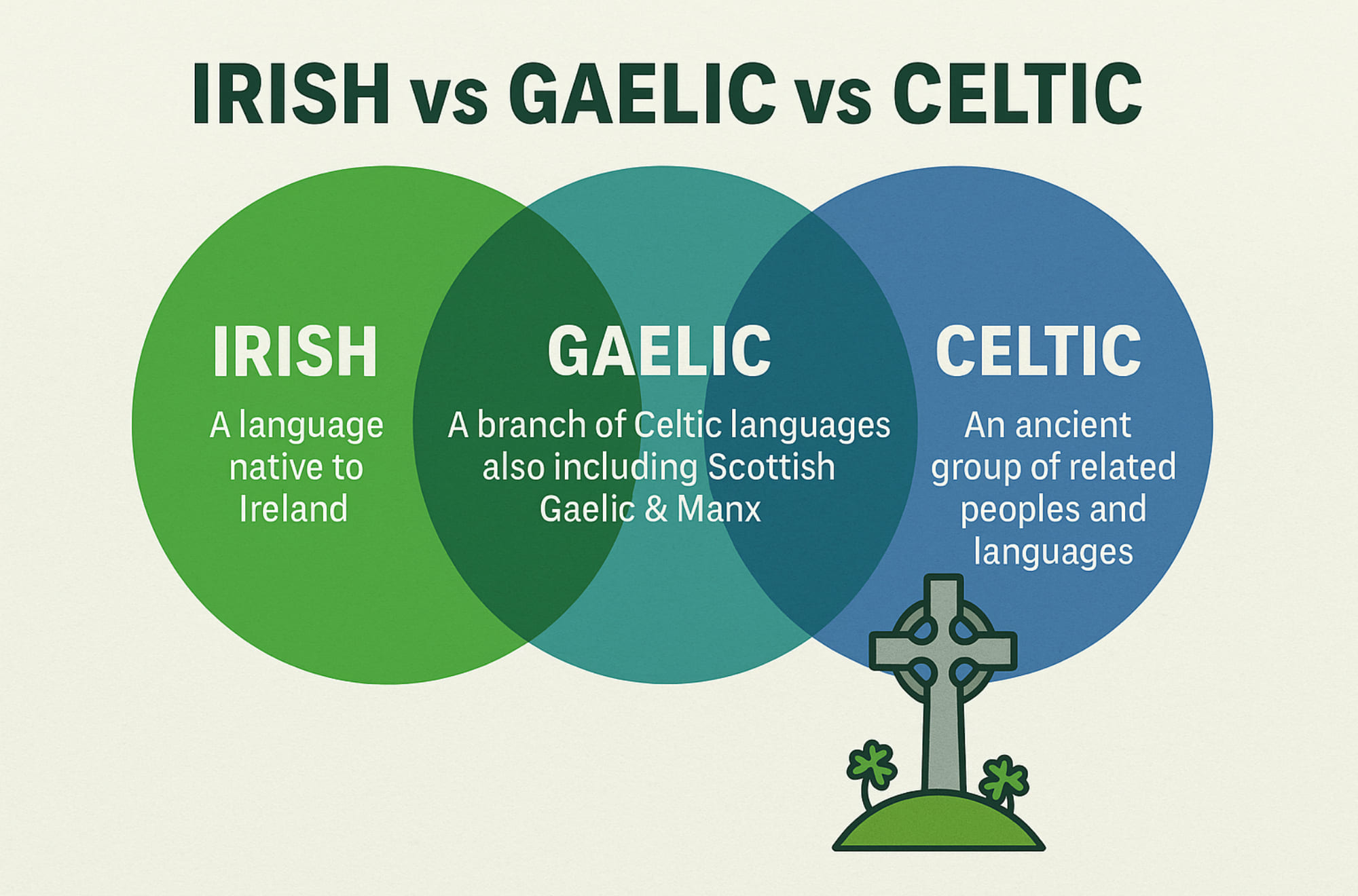
Irish, Gaelic and Celtic are closely connected terms, but they don’t mean the same thing.

The simplest way to understand the difference is this:

Irish (Gaeilge) is a specific language.

Goidelic, sometimes referred to more broadly as Gaelic, is the branch of the Celtic language family containing Irish, Scottish Gaelic and Manx.

Celtic is the much larger language family that includes Irish and Scottish Gaelic as well as Welsh, Breton and Cornish.

So Irish is Celtic, and Irish is a Goidelic language, but not every Celtic language is Irish or Gaelic.

That distinction sounds simple once you see it laid out, but the terms are frequently mixed together, particularly outside Ireland.

Let’s look at what each one actually means.

What Is Irish?

Irish, or Gaeilge, is the indigenous Celtic language of Ireland.

It belongs to the Goidelic branch of the Celtic language family and is closely related to Scottish Gaelic and Manx.

Irish is the first official language of Ireland and an official language of the European Union. Today, you’ll encounter Gaeilge in schools, broadcasting, public signage, government services, literature, music and everyday life, particularly in Irish-speaking Gaeltacht communities.

If you’re talking specifically about the language spoken in Ireland, Irish or Gaeilge is normally the clearest term to use.

For a broader introduction to the language, including its history, structure, dialects and how it is used today, explore our Irish Language Guide.

Is Irish the Same as Gaelic?

This is where things become slightly more complicated.

People sometimes use Gaelic to refer to Irish, particularly outside Ireland. You may also encounter the term Irish Gaelic.

Those terms aren’t incomprehensible, but in Ireland the language is normally called Irish in English and Gaeilge in Irish.

The word Gaelic can have different meanings depending on context.

In linguistic discussions, it may be used in connection with the group containing:

  • Irish
  • Scottish Gaelic
  • Manx

These languages form the Goidelic branch of the Celtic language family.

In Scotland, however, simply saying Gaelic will usually be understood as referring specifically to Scottish Gaelic.

So if you say you’re “learning Gaelic”, people may not necessarily know whether you mean Irish or Scottish Gaelic.

If you’re learning the language of Ireland, “I’m learning Irish” is generally the clearest way to say it.

What Are the Goidelic Languages?

Irish doesn’t sit alone.

Its closest relatives are Scottish Gaelic and Manx, and together these three languages form the Goidelic branch of the Celtic language family.

They share historical roots and have noticeable similarities, but they are distinct languages.

BranchLanguages
GoidelicIrish, Scottish Gaelic, Manx
Brittonic/BrythonicWelsh, Breton, Cornish

This distinction is important because Celtic languages aren’t all equally closely related.

Irish and Scottish Gaelic are more closely related to one another than Irish and Welsh, for example, because Irish and Scottish Gaelic belong to the same branch.

If you’d like to understand those relationships in more detail, our Goidelic languages guide explores Irish, Scottish Gaelic and Manx and how they developed.

What Does Celtic Mean?

Celtic is the broadest of the three terms.

In language terms, Celtic refers to a family of related languages.

Modern Celtic languages include:

Irish — Ireland
Scottish Gaelic — Scotland
Manx — Isle of Man
Welsh — Wales
Breton — Brittany
Cornish — Cornwall

These languages are related historically, but they are not different dialects of one modern “Celtic language”.

There is no single language you can learn today called simply Celtic.

If somebody speaks Irish, they’re speaking a Celtic language.

If somebody speaks Welsh, they’re also speaking a Celtic language.

But an Irish speaker and a Welsh speaker are not therefore speaking the same language.

A Simple Way to Remember the Difference

Think of the terms as a family tree.

Celtic is the large family.

Within that family are different branches, including Goidelic and Brittonic/Brythonic.

Within the Goidelic branch, you find Irish, Scottish Gaelic and Manx.

So the hierarchy looks roughly like this:

Celtic languages
Goidelic languages
Irish (Gaeilge)

Or, to put it another way:

Irish is Goidelic.
Goidelic is Celtic.
But Celtic doesn’t automatically mean Irish.

That one distinction clears up most of the confusion.

Irish vs Scottish Gaelic

Irish and Scottish Gaelic are closely related, but they are separate languages.

Both developed from earlier forms of Gaelic and consequently share vocabulary, grammatical structures and other features.

But pronunciation, spelling, vocabulary and usage have diverged over time.

The Irish word for the Irish language is:

Gaeilge

Scottish Gaelic is:

Gàidhlig

Even those names show both the historical relationship and the modern difference.

A speaker of one language may recognise features of the other, particularly with experience, but you shouldn’t assume that studying Scottish Gaelic is the same as studying Irish.

If your goal is to learn the language of Ireland, look for resources specifically teaching Irish or Gaeilge.

Is Welsh Gaelic?

No.

This is one of the easiest ways to see why the terminology matters.

Welsh is absolutely a Celtic language, but it isn’t a Goidelic or Gaelic language.

Welsh belongs to the Brittonic/Brythonic side of the Celtic family alongside Breton and Cornish.

Irish belongs to the Goidelic side alongside Scottish Gaelic and Manx.

So:

Irish = Celtic + Goidelic

Welsh = Celtic + Brittonic

Both are Celtic. Only one is Goidelic.

Why Do People Say “Irish Gaelic”?

You’ll frequently encounter the term Irish Gaelic, particularly outside Ireland.

Usually, it’s being used to distinguish Irish from Scottish Gaelic or to make clear that someone is talking about the Irish language rather than Irish English.

The meaning is therefore generally understandable.

However, Irish is the normal English name for the language in Ireland, while Gaeilge is its name in Irish.

If you want the least ambiguous terminology, use:

Irish when speaking English.

Gaeilge when using the Irish name.

You don’t generally need to add “Gaelic”.

Is Gaelic a Language?

It depends on what someone means.

In a Scottish context, Gaelic commonly means Scottish Gaelic, which is indeed a specific language.

In broader historical or linguistic discussion, Gaelic can refer to the linguistic tradition associated with Irish, Scottish Gaelic and Manx.

This ambiguity is precisely why Goidelic is useful when talking about the language family.

Saying “the Goidelic languages” makes it clear that you’re discussing Irish, Scottish Gaelic and Manx as a group rather than referring to one language called Gaelic.

Our Goidelic languages guide goes into this relationship in more detail.

What About Celtic Culture?

The word Celtic isn’t limited to linguistics.

It’s also widely used when discussing culture, history, music, mythology, art and identity.

Ireland, Scotland, Wales, Brittany, Cornwall and the Isle of Man are commonly associated with the modern Celtic world, although the histories and cultures of these places are far from identical.

This is why you’ll encounter phrases such as:

Celtic mythology

Celtic music

Celtic art

Celtic nations

In these cases, Celtic is being used as a broader cultural or historical description rather than the name of a particular language.

It’s important not to collapse all of those cultures into one thing.

Irish mythology, for example, belongs within a wider Celtic context, but it also has its own characters, literary traditions and historical development.

Irish Is a Living Language, Not Just a Historical One

Discussions of “Celtic” culture can sometimes make Irish sound like something belonging entirely to the distant past.

It doesn’t.

Gaeilge is a living modern language.

People speak it at home, at school and at work. Books are published in Irish. Television and radio are produced in Irish. Music, podcasts, online videos and social media are created through Gaeilge.

There are communities where Irish remains part of everyday life, as well as speakers and learners throughout Ireland and around the world.

Understanding where Irish sits within the Celtic language family is useful, but Gaeilge is much more than a branch on a historical family tree.

If you want to explore the language itself rather than just its classification, the Irish Language Guide is the best next step.

Irish, Gaelic and Celtic at a Glance

TermWhat it meansExamples
Irish / GaeilgeA specific Celtic languageIrish
GoidelicA branch of the Celtic language familyIrish, Scottish Gaelic, Manx
GaelicContext-dependent; often Scottish Gaelic or associated with the Goidelic languagesScottish Gaelic; broader Gaelic tradition
CelticThe wider language family and a broader cultural termIrish, Welsh, Breton, Scottish Gaelic, Manx, Cornish

The most important distinction is that these aren’t three competing names for exactly the same thing.

They describe different levels of the linguistic family tree.

Frequently Asked Questions

Are Irish and Gaelic the same language?

Not exactly. Irish is a specific language. “Gaelic” can refer specifically to Scottish Gaelic or be used more broadly in relation to the Goidelic languages. When referring to Ireland’s language in English, Irish is usually the clearest term.

Is Irish a Celtic language?

Yes. Irish belongs to the Goidelic branch of the Celtic language family.

Is Irish Gaelic or Celtic?

Irish is both Goidelic and Celtic. Goidelic describes its immediate branch of the language family, while Celtic describes the wider family.

Are Irish and Scottish Gaelic the same?

No. They are closely related Goidelic languages with shared historical origins, but modern Irish and Scottish Gaelic are distinct languages.

Is Welsh Gaelic?

No. Welsh is Celtic but belongs to the Brittonic/Brythonic branch rather than the Goidelic branch.

What is Gaeilge?

Gaeilge is the Irish-language name for the Irish language.

Should I call the language Irish or Irish Gaelic?

If you’re referring to the language of Ireland in English, Irish is normally the simplest and clearest choice. In Irish, call it Gaeilge.

Explore the Irish Language Further

Understanding the terminology is useful because it gives you a clearer picture of where Gaeilge fits.

If your main interest is Irish itself, continue with our Irish Language Guide for a broader introduction to Gaeilge, including its structure, history and use.

If you’re particularly interested in how Irish relates to Scottish Gaelic and Manx, explore the Goidelic languages guide.

Once you understand the family tree, the terminology becomes much simpler:

Irish is the language. Goidelic is its branch. Celtic is the wider family.

Start Speaking Irish Today — 25% Off
Use code START25

Learn real Irish for real life with guided practice, pronunciation support, and everyday conversations.

Get 25% off any plan with code START25

Start Speaking Irish Today — 25% Off