When learning Irish grammar, one of the most rewarding milestones is understanding relative clauses. These structures allow you to connect ideas, add detail, and create more natural, flowing sentences. Many learners search specifically for relative clauses examples in Irish to make sense of how these clauses work in practice. Once you see them in action, they become a powerful tool for expressing yourself more fluently.
In this guide, we’ll break down what relative clauses are, explain the difference between direct and indirect forms, and provide plenty of examples to help you use them with confidence.
What Are Relative Clauses in Irish?
A relative clause is a clause that gives extra information about a noun. In English, this is usually done with words like “who,” “that,” or “which.”
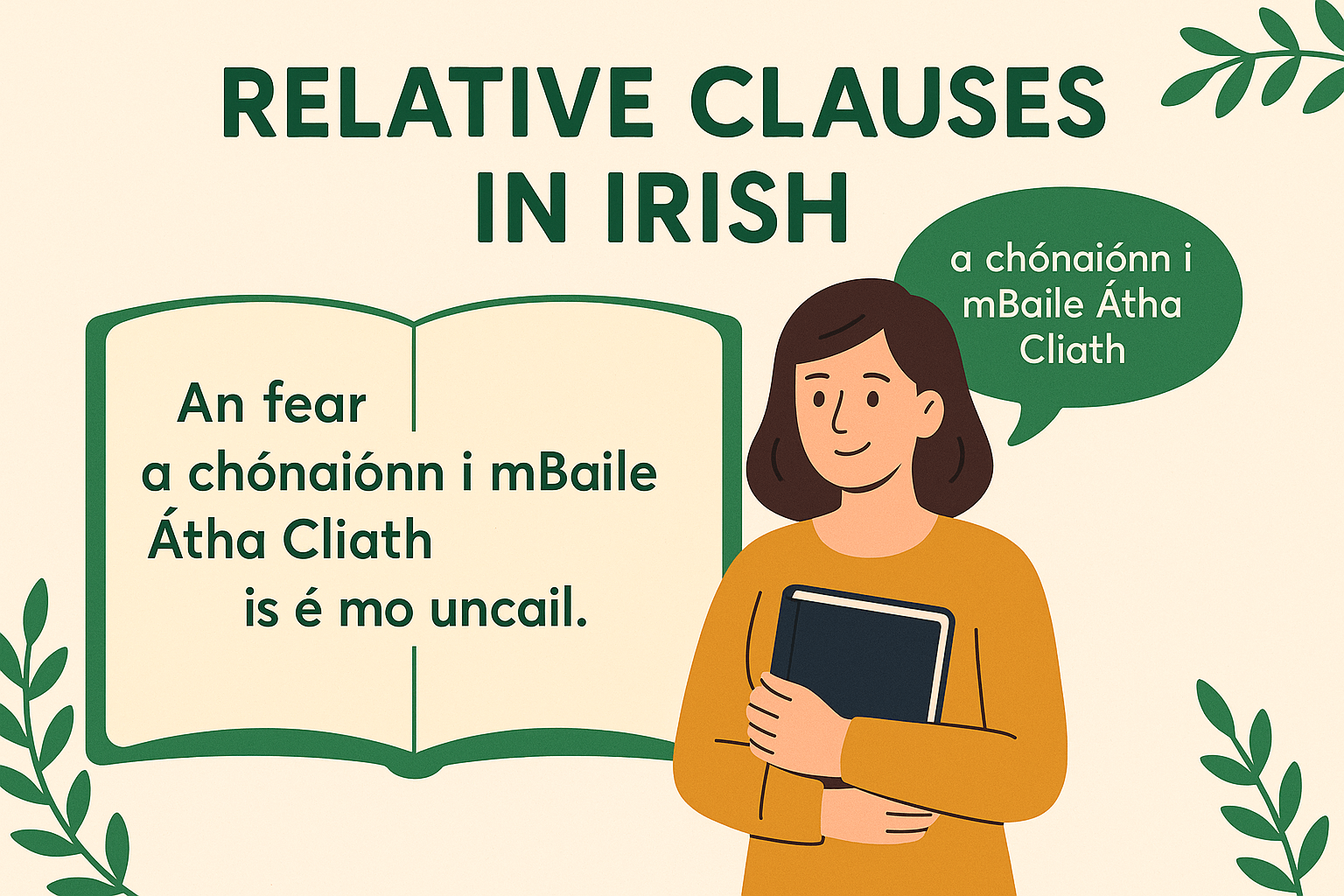
English: The man who lives in Dublin is my uncle.
Irish: An fear a chónaíonn i mBaile Átha Cliath is é mo uncail.
Notice how the Irish relative clause uses a plus a verb form to connect the ideas.
Two Types of Relative Clauses
Irish has two main types of relative clauses:
1. The Direct Relative Clause
This is used when the noun in question is the subject of the relative clause.
Example:
An bhean a labhair liom – The woman who spoke to me.
2. The Indirect Relative Clause
This is used when the noun in question is the object of the clause, or when a preposition is involved.
Example:
An fear a bhfaca mé – The man whom I saw.
An teach a bhfuil cónaí orm ann – The house in which I live.
Key Rules for Relative Clauses in Irish
Understanding how to form these clauses is crucial. Here are the main patterns:
Direct Relative Clause
Uses a followed by lenition (séimhiú) if possible.
If the verb begins with a vowel, a is followed by h- sound.
Examples:
An páiste a chonaic tú – The child who saw you.
An fear a oibríonn anseo – The man who works here.
Indirect Relative Clause
Uses a followed by eclipsis (urú) if possible.
Sometimes requires special relative forms of irregular verbs.
Examples:
An fear a bhfeicim – The man whom I see.
An rud a bhfuil mé ag smaoineamh air – The thing I’m thinking about.
Common Relative Clauses Examples in Irish
Here are some sentences that highlight the difference between direct and indirect relative clauses:
An carr a cheannaigh sí – The car that she bought.
An múinteoir a mhúineann Gaeilge – The teacher who teaches Irish.
An fear a bhfuil an hata dearg aige – The man who has the red hat.
An leabhar a léigh mé inné – The book that I read yesterday.
An áit a mbeidh an ceolchoirm ar siúl – The place where the concert will take place.
These examples show how relative clauses allow you to link ideas naturally.
Irregular Verbs in Relative Clauses
One challenge for learners is that certain irregular verbs have special relative forms. For example:
Feic (to see) → a bhfeic
Faigh (to get) → a bhfaigheann
Abair (to say) → a deir
Example:
An fear a dúirt sé – The man he said.
An cailín a bhfuair an duais – The girl who got the prize.
If you’d like to strengthen your grasp of verbs before tackling relative clauses, check out our guide on how to conjugate Irish verbs.
Why Relative Clauses Matter
Understanding relative clauses examples in Irish helps you:
Create more complex, expressive sentences.
Avoid repeating the same simple sentence structures.
Understand Irish literature and conversation more clearly.
Imagine the difference:
Beginner level: Tá an fear ann. Tá hata aige. (The man is there. He has a hat.)
With relative clause: An fear a bhfuil hata aige. (The man who has a hat.)
Practical Tips for Mastering Relative Clauses
Start simple: Learn a few high-frequency patterns like an duine a bhfuil…
Practice with context: Use relative clauses in sentences about your own life.
Pay attention to mutations: Remember lenition for direct and eclipsis for indirect clauses.
Listen and read: Exposure in songs, books, and media will reinforce the patterns.
Use AI tools: With Gaeilgeoir AI, you can practice constructing relative clauses and receive instant corrections.
How Gaeilgeoir AI Supports Learners
At Gaeilgeoir AI, we know grammar can be intimidating at first. Our AI-powered tools simplify these concepts by:
Giving you interactive exercises with instant feedback.
Offering AI conversation practice where relative clauses appear naturally.
Providing step-by-step guides to grammar concepts, including prepositions, pronouns, and verbs.
If you’re still at the beginning of your journey, start with our Irish language lessons for beginners to build confidence before diving deeper into clauses.
Quick Practice Exercise
Try rewriting these into Irish with relative clauses:
The book that I read yesterday.
The man who lives in Galway.
The house in which we are staying.
(Answers: An leabhar a léigh mé inné. An fear a chónaíonn i nGaillimh. An teach a bhfuilimid ag fanacht ann.)
Final Thoughts
Relative clauses are one of the most powerful tools in Irish grammar. Once you grasp the difference between direct and indirect forms, you can unlock a whole new level of fluency. By working with real relative clauses examples in Irish, you’ll gain the confidence to weave richer, more natural sentences.
At Gaeilgeoir AI, our mission is to make this process engaging and rewarding. With AI-powered tools and supportive resources, you can practice grammar in context and grow more fluent every day.
👉 Ready to bring your Irish to the next level? Sign up here for free and start practicing with our community of learners today.
Learning Irish can be a rewarding adventure, but one of the trickiest parts of grammar for many students is figuring out how to use the genitive case in Irish. If you’ve ever wondered why a noun suddenly changes form when showing possession or relationship, you’ve encountered the genitive. Mastering this case is key to sounding natural and accurate in Irish, and with the right guidance, it can become second nature.
At Gaeilgeoir AI, we believe grammar should be clear and approachable. In this guide, you’ll learn what the genitive case is, how to use it in everyday sentences, and practical strategies for mastering it with confidence.
What Is the Genitive Case?
In simple terms, the genitive case shows a relationship between two nouns. It often expresses possession, but it can also show description or classification.
For example:
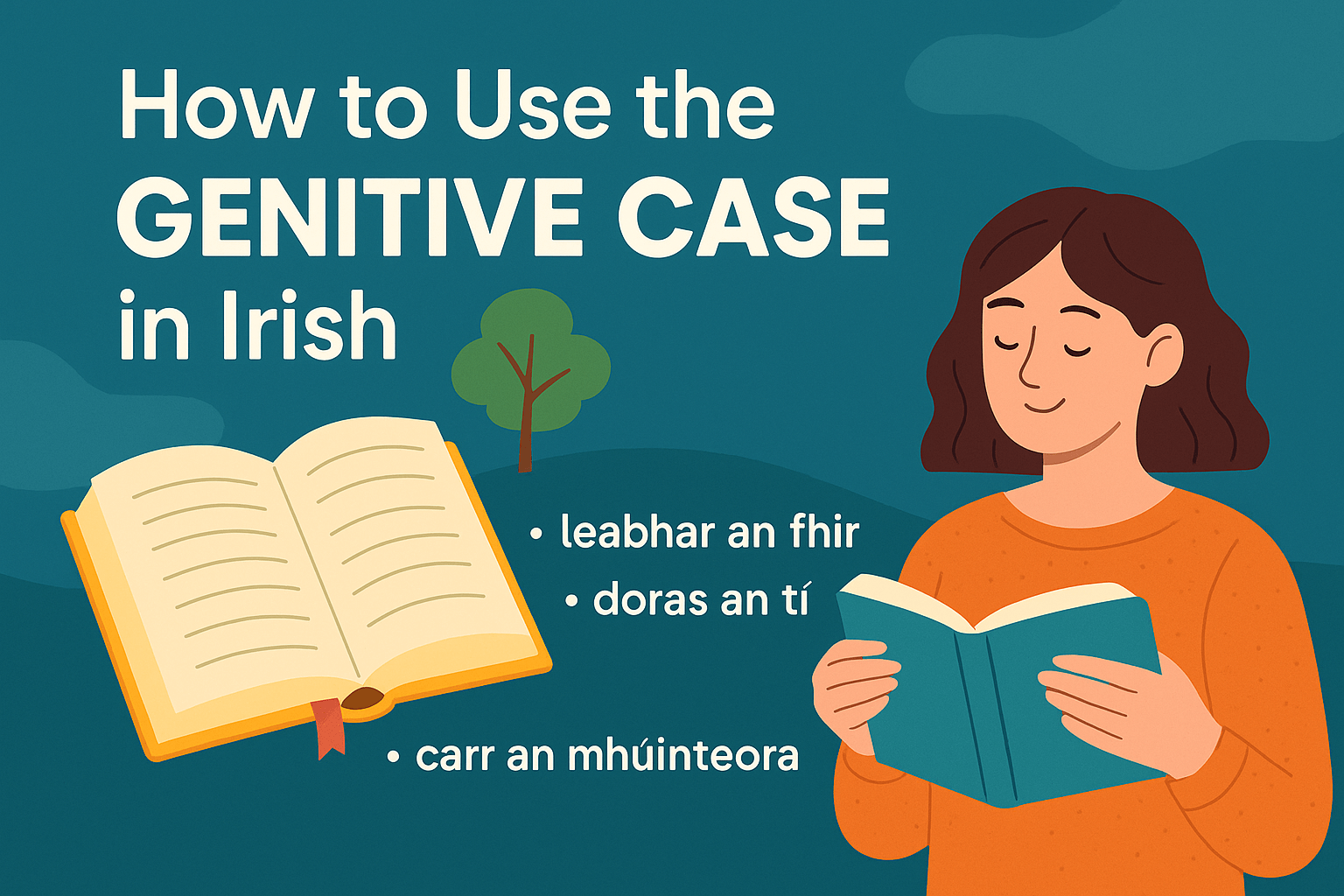
leabhar an fhir – “the man’s book” (fir is the genitive of fear).
doras an tí – “the door of the house” (tí is the genitive of teach).
So, whenever you see one noun “belonging” to another, you’re likely dealing with the genitive.
Why Is the Genitive Important?
Understanding how to use the genitive case in Irish opens up the ability to:
Express ownership (carr an mhúinteora – the teacher’s car).
Indicate categories (cupán tae – a cup of tea).
Create natural expressions and idioms.
Because the genitive is so common, you’ll hear it in daily speech, songs, and literature. It’s not just a grammar exercise—it’s a living part of Irish.
Core Rules of the Genitive Case
1. Masculine vs. Feminine Nouns
The endings of nouns often change differently depending on gender.
Masculine nouns often add -a or -e in the genitive singular.
fear → fir (man → of the man)
bád → báid (boat → of the boat)
Feminine nouns may add -e or -í.
bean → mná (woman → of the woman)
sráid → sráide (street → of the street)
2. Article Usage
When the definite article an is used before the genitive:
Masculine singular nouns take séimhiú (lenition):
leabhar an mhic – the boy’s book.
Feminine singular nouns take urú (eclipsis):
ceann na mná – the woman’s head.
3. Plurals in the Genitive
Genitive plurals can be irregular, but a key point is that after na (the plural article), the genitive plural noun usually appears:
leabhair na bhfear – the books of the men.
Examples in Everyday Context
Here are some examples to show you how to use the genitive case in Irish naturally:
Páiste na mban – the child of the women.
Amhrán na hÉireann – the song of Ireland (the national anthem).
Seán mhic an tSaoi – Seán, son of the wise man.
Each of these shows the genitive shaping meaning in subtle but essential ways.
Common Mistakes to Avoid
Forgetting the mutations: Remember that lenition or eclipsis often accompany the genitive.
Confusing nominative and genitive forms:teach (house) is nominative; tí is genitive.
Over-simplifying: Not all nouns follow predictable patterns—memorization and exposure are key.
Practical Tips for Learners
Mastering the genitive is about practice and patterns. Here’s how you can build confidence:
Learn by collocations: Instead of studying forms in isolation, learn phrases like geata an tí (the gate of the house).
Read Irish texts: Even children’s books provide repeated exposure to genitive structures.
Use AI-powered practice tools: Platforms like Gaeilgeoir AI give you real-time correction so you can see instantly if you’ve used the genitive correctly.
Focus on frequent words first: Master common genitive forms (fir, mná, tí) before tackling rare ones.
How Gaeilgeoir AI Can Help
Our mission at Gaeilgeoir AI is to make grammar like the genitive case less intimidating. Through our AI-driven tools, you can:
Practice with adaptive exercises that give feedback.
Use AI chat partners that naturally incorporate genitive structures.
Access easy-to-follow guides that explain rules step by step.
Mutations like séimhiú and urú play a major role in how the genitive case appears in sentences.
For a broader cultural view, learning the genitive also enriches your understanding of classic Irish literature and poetry.
Practice Activity
Try rewriting these simple sentences in the genitive case:
The dog’s house.
The women’s story.
The book of the teacher.
Check your answers with a resource like Gaeilgeoir AI’s practice platform to get instant confirmation.
Final Thoughts
Learning how to use the genitive case in Irish may seem like a challenge, but it’s also a milestone in becoming fluent and confident. Once you get comfortable with these patterns, you’ll find Irish grammar feels less like memorisation and more like music—flowing naturally from one word to the next.
At Gaeilgeoir AI, we’re here to guide you every step of the way. With our interactive, AI-powered platform, you can practice grammar in real conversations and see progress fast.
Learning Irish grammar can sometimes feel like solving a fascinating puzzle. One of the most common challenges for learners is understanding urú vs séimhiú rules in Irish. These two processes—known as eclipsis (urú) and lenition (séimhiú)—are essential to mastering the structure of the language. If you’ve ever wondered why some words begin with “bh” instead of “b,” or why “g” might change to “ng,” this guide is for you.
At Gaeilgeoir AI, we know that learning these rules can feel daunting at first. But with practice, they become second nature—and understanding them can unlock fluency faster than you think. Let’s explore these core rules of Irish grammar, step by step.
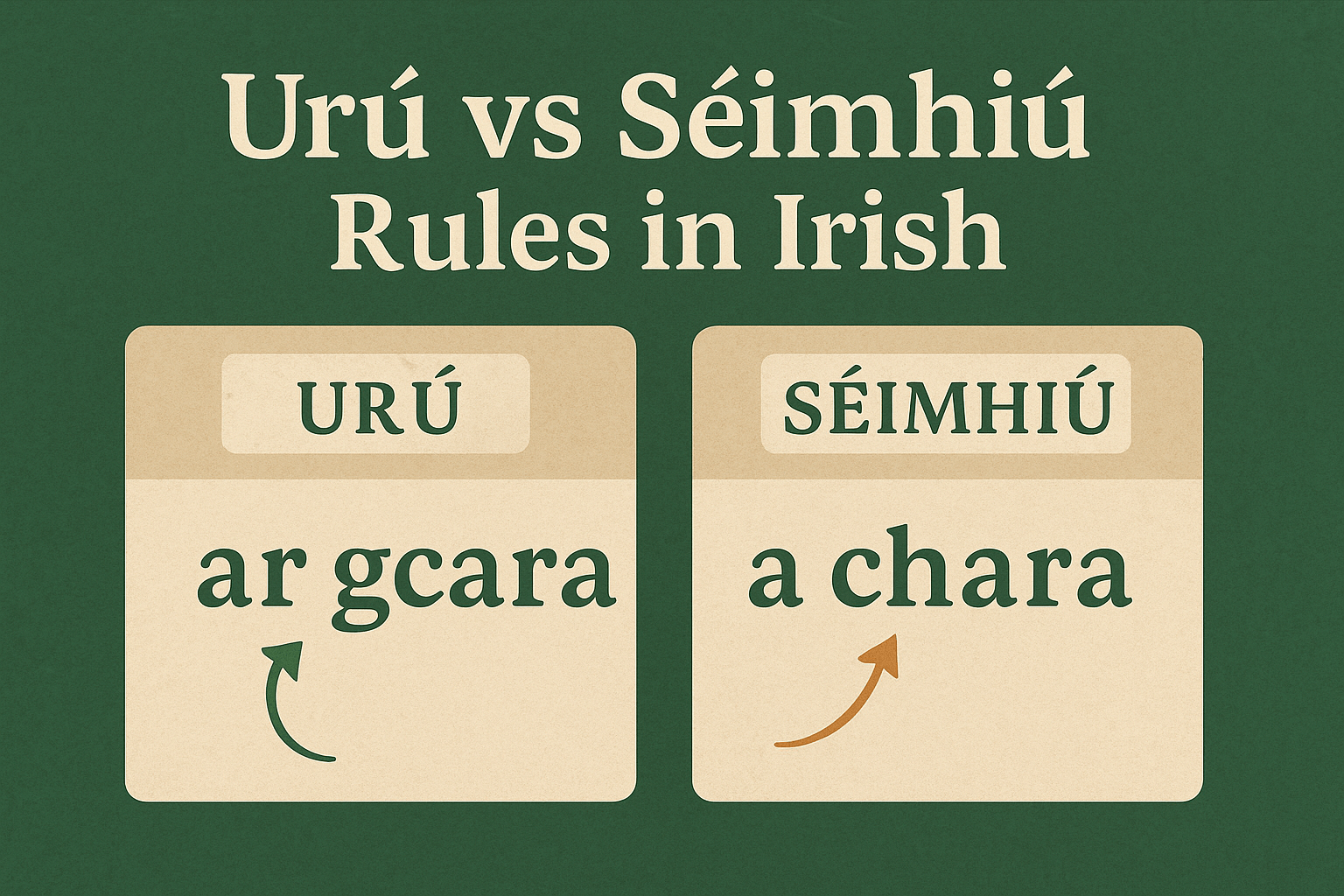
What Are Séimhiú and Urú?
Séimhiú (Lenition)
Séimhiú, also called lenition, is the softening of a consonant. It’s shown by adding an “h” after the initial consonant of a word.
Examples:
b → bh (bád → bhád)
c → ch (carr → charr)
m → mh (mac → mhac)
This change affects both the pronunciation and meaning within a sentence.
Urú (Eclipsis)
Urú, or eclipsis, means “covering.” A new letter is placed in front of the original consonant, and the new letter is pronounced.
Examples:
b → mb (bord → mbord)
c → gc (cathair → gcathair)
d → nd (dorás → ndorás)
Urú often signals grammatical relationships, such as after certain prepositions or numbers.
Urú vs Séimhiú: Key Differences
Séimhiú adds an “h” to soften the consonant.
Urú adds a new letter in front to “cover” the sound.
Séimhiú often shows possession, gender, or certain prepositional triggers.
Urú often follows numbers, prepositions, and plural forms.
By seeing urú vs séimhiú side by side, learners can start to recognise patterns rather than memorise endless lists.
When to Use Séimhiú
You’ll encounter séimhiú in many everyday contexts. Some of the main rules include:
After the possessive adjectivesmo (my), do (your), and a (his):
mo chat (my cat) → mo chat
a bhád (his boat)
After certain prepositions with “h”
ar + bean → ar bhean (on a woman)
To mark feminine nouns in the nominative case after the definite article:
an bhean (the woman)
When to Use Urú
Urú rules are slightly different and often tied to number and grammar triggers:
After the number “seacht,” “ocht,” “naoi,” and “deich”
seacht gcarr (seven cars)
After the possessive adjectives ár (our), bhur (your, plural), and a (their):
ár mbád (our boat)
a gcarr (their car)
After the preposition i (in):
i gcathair (in a city)
Common Mistakes Learners Make
Mixing up séimhiú and urú because they both alter the beginning of a word.
Forgetting that urú changes the pronunciation more dramatically than séimhiú.
Over-applying rules: not every noun or verb gets a mutation.
Our learners often find that practicing with AI-powered sentence builders makes these rules far easier to internalize. Instead of memorising lists, they get instant feedback and see grammar in context.
Why Are Mutations So Important in Irish?
Irish is a highly inflected language. Mutations like séimhiú and urú aren’t just decorative—they change meaning and grammar. They:
Show relationships between words.
Mark gender, number, and case.
Help maintain rhythm and sound flow in speech.
This is part of what gives Irish its beautiful, musical quality.
Practical Examples
Here are a few sentences showing urú vs séimhiú rules in Irish:
Tá a bhád ag seoladh. (His boat is sailing.) → séimhiú after “a.”
Tá ár mbád anseo. (Our boat is here.) → urú after “ár.”
Chonaic mé an bhean. (I saw the woman.) → séimhiú after “an” with a feminine noun.
Tá mé i gcathair mhór. (I am in a big city.) → urú after “i,” and séimhiú for the adjective.
By working through examples like these, learners quickly see the logic of the system.
How Gaeilgeoir AI Helps
At Gaeilgeoir AI, we offer interactive AI-powered tools designed to simplify these rules. Our platform provides:
Grammar explainers with interactive examples.
Practice drills where learners get real-time corrections.
AI conversation partners that let you practice urú and séimhiú naturally.
Read aloud: Hearing the difference between “bord” and “mbord” reinforces memory.
Practice daily: A few sentences a day with mutations help retention.
Use AI tools: Instant feedback means you won’t reinforce mistakes.
Learn in context: Focus on sentences, not isolated words.
Final Thoughts
Understanding the urú vs séimhiú rules in Irish is one of the most important steps toward fluency. These mutations are not barriers but gateways to mastering the rhythm, structure, and elegance of Irish. With the right guidance, they transform from confusing rules into natural patterns.
At Gaeilgeoir AI, we’re here to make that journey easier. Whether you’re just beginning or polishing your skills, our tools will help you unlock Irish grammar with confidence.
👉 Ready to put your learning into practice? Sign up for free and join our growing community of learners who are bringing Irish to life every day.
When we think about romance in poetry, names like Shakespeare or Rumi might come to mind. But Ireland has a poetic tradition just as rich, filled with tenderness, longing, and lyrical beauty. Irish poems about love capture not only the emotions of the heart but also the rhythm of the Irish language itself. From medieval verses sung in Gaelic to modern works inspired by heritage, these poems tell stories of passion, devotion, and sometimes heartbreak.
For learners of Irish, exploring these poems is more than literary study—it’s a way to connect with history and practice the musicality of Gaeilge. Love poetry provides both cultural insight and linguistic inspiration.
Why Love Poetry Matters in Irish Tradition
Love has always been central to Irish verse, whether in the early bardic schools, folk ballads, or contemporary poetry. In Ireland, poetry wasn’t just an art form—it was a living expression of identity and memory.
Bardic Poetry (12th–17th centuries): Court poets composed intricate verses about honor, loyalty, and love, often using Irish as the medium.
Folk Songs and Ballads: Many traditional songs, passed down orally, center on love—sometimes joyful, sometimes tragic.
Modern Poets: Writers like W.B. Yeats, Seamus Heaney, and Nuala Ní Dhomhnaill carry forward the theme of love with fresh interpretations.
These works remind us that grá (love) has always been a defining part of Ireland’s literary voice.
Themes in Irish Love Poetry
Irish poems about love often weave together several recurring themes:
Longing Across Distance – Many poems reflect separation caused by emigration, war, or social divides.
Nature as Metaphor – Landscapes, rivers, and seasons are used to express emotional states.
Spiritual Love – Romantic love is often interlaced with faith or mythological references.
Unspoken Desire – Subtlety and suggestion often replace direct expression, reflecting cultural nuances.
The Irish language itself lends a poetic rhythm to these themes. For example, words like mo chroí (“my heart”) and a stór (“my treasure”) appear frequently in verse and song. If you’d like to explore affectionate terms, check out our Irish Gaelic Terms of Endearment guide.
Famous Irish Poems About Love
While there are countless verses to choose from, here are a few highlights that stand out in Ireland’s love poetry tradition:
1. “Róisín Dubh” (Dark Rosaleen)
A political allegory disguised as a love poem, this 16th-century work describes devotion to Ireland as if it were devotion to a beloved woman. It blends patriotism with longing, showing how love poetry could serve multiple purposes.
2. “The Song of Wandering Aengus” – W.B. Yeats
This poem follows the mythological figure Aengus as he searches for a mysterious girl he saw in a dream. It’s both a love poem and a meditation on longing and destiny.
3. “Mise Éire” – Pádraic Pearse
Though not a traditional love poem, this piece personifies Ireland as a mother, evoking deep emotional attachment and sacrifice.
4. Contemporary Poetry
Modern poets like Eavan Boland often explore love in personal and domestic settings, bridging traditional imagery with modern life.
The Irish Language of Love
Irish expressions of love are striking for their warmth and imagery. Here are a few examples that often appear in poetry:
Mo ghrá thú – You are my love.
A chroí – My heart.
Mo mhuirnín – My darling or beloved.
Grá síoraí – Eternal love.
Learning these phrases deepens your appreciation of love poems in Irish. To expand your romantic vocabulary, you might also enjoy our guide on How to Say “I Love You” in Irish.
Irish Love Poetry and Mythology
Many Irish poems about love draw on mythological figures. For example:
Deirdre of the Sorrows: One of the most tragic love stories in Irish myth, often retold in verse.
Cú Chulainn and Emer: A legendary warrior and his beloved, symbolizing passion and loyalty.
The Tuatha Dé Danann: Gods and goddesses whose romances influenced folklore and poetic imagery.
Love in Irish poetry is rarely just personal—it often connects to myth, history, and identity.
Why Love Poetry Helps Language Learners
Reading Irish poems about love isn’t only for literature fans—it’s a fantastic tool for language learners. Here’s why:
Emotional Vocabulary: Love poems are filled with expressive words and phrases.
Cultural Context: They reveal how Irish culture views affection, loyalty, and passion.
Memorable Learning: Poetry’s rhythm and rhyme make it easier to remember new words.
Pronunciation Practice: Reading poems aloud helps with the musical flow of Irish.
If you’re starting your Irish journey, pairing poetry with resources like our Basic Irish Conversation Guide makes learning more dynamic.
Connecting Poetry and Festivals
Irish poems about love are often tied to festivals and seasonal cycles. For example:
At Bealtaine, poems celebrating fertility and romance were common.
Seasonal imagery—spring blossoms, summer fields, autumn harvests—often symbolize different stages of love.
This seasonal connection reflects Ireland’s close bond between land, life, and language.
Love Poetry in Global Irish Communities
Irish emigrants carried love poems and songs across the world—to the United States, Argentina, and beyond. For many, singing or reciting Irish poems was a way of keeping home close. Even today, Irish diaspora communities use poetry to connect with their heritage.
This global reach shows that the language of love is universal, but Irish poetry gives it a unique voice.
Final Thoughts
Irish poems about love are more than just romantic verses—they are windows into Ireland’s soul. From medieval laments to modern reflections, these poems express the depth of human affection in ways that remain timeless.
For learners of Irish, engaging with poetry provides not only linguistic practice but also cultural enrichment. Every phrase of love in Gaeilge carries centuries of history and meaning.
So why not take a step into Ireland’s poetic heart? Learn a phrase, read a verse aloud, or even try writing your own poem in Irish.
If you want the short answer first, the standard Irish word is cara. Mo chara means “my friend,” while a chara is usually a direct form of address—closer to “friend” or “dear friend” at the start of a greeting or message, not the ordinary way to say “my friend.” That distinction matters, because learners often search for “my friend in Irish,” “friend in Irish,” or a chara meaning and end up using the wrong form in real conversation.
At Gaeilgeoir AI, we try to separate standard Irish from Irish-English slang instead of blending them together. In our reviews of learner mistakes, this is one of the most common points of confusion: people memorize a chara from letters or email openings, then use it where mo chara or plain cara would sound more natural.
How We Chose the Irish Words and Phrases in This Guide
This guide prioritizes forms that are supported by standard Irish references, then labels clearly when something belongs to Irish English rather than Irish itself. We checked dictionary and usage sources such as teanglann.ie and grammar guidance from Foras na Gaeilge before including any term as Irish vocabulary. If a phrase is common in Ireland but English in structure—such as “sound” or “mate”—we identify it as Irish English slang, not Gaelic.
We also excluded unsupported “internet Irish” that looks plausible but lacks dictionary backing or clear native usage. In practice, that means this page focuses on cara, mo chara, a chara, and useful plural forms, because those address translation issues more effectively than a grab-bag of banter. Pages tend to be less accurate when every affectionate nickname in Ireland is treated as an Irish-language equivalent.
Why Slang Matters in Language Learning
What matters here is accuracy of register. Not every term on this page is actually Irish slang: cara is standard Irish vocabulary, mo chara and a chara are affectionate or situational Irish forms, and words like “sound” or “mate” belong to Irish English slang instead. That distinction helps you avoid sounding odd in writing and speech. I’ve found that learners progress faster when they know which expressions are dictionary Irish and which are part of bilingual everyday life in Ireland, especially because Irish remains a living but unevenly used language: the 2022 census recorded 1,873,997 people able to speak Irish, yet daily use outside education was far lower, as summarized by Conradh na Gaeilge’s facts and figures. If you like learning through playful context, resources such as more from Learniverse can also help you notice register and tone rather than memorizing isolated words.
Common Ways to Say “Friend in Irish Slang”
The most useful way to think about this is by function, not by loose translation. Cara is the standard noun “friend.” Mo chara means “my friend.” A chara is the vocative form used when speaking or writing directly to someone, especially in greetings and openings. Those core forms are more important than collecting random nicknames.
Cara — the standard word for “friend”
Meaning: friend When to use it: when naming or describing a friend in an ordinary sentence Formality: neutral; works in standard spoken and written Irish Example:Is cara dílis í. Translation: “She is a loyal friend.” Caution: don’t use cara by itself as if it were always a greeting; if you are addressing someone directly, a chara is often the better fit.
Standard dictionaries list cara as the base noun for “friend,” which makes it the safest answer for most learners looking for the Irish word for friend; see the entry on teanglann’s dictionary.
Mo chara — “my friend”
Meaning: my friend When to use it: when referring to your friend in a sentence, or occasionally in warm, affectionate speech Formality: informal to neutral, depending on tone Example:Seo mo chara nua. Translation: “This is my new friend.” Caution: learners sometimes swap this with a chara, but they are not interchangeable; mo chara refers to someone, while a chara addresses them directly.
This is one of the clearest forms for everyday use because the meaning is transparent: possessive mo + noun. In teaching notes, I usually recommend mastering this before trying more stylized greetings, because it maps neatly onto ordinary English sentences. If you were searching mo chara meaning, this is the core answer.
A chara — direct address, not the usual way to say “my friend”
Meaning: friend / dear friend when addressing someone directly When to use it: at the start of a letter, email, message, or spoken greeting to a person Formality: common in greetings; can sound warm, polite, or slightly formal depending on context Example:Dia dhuit, a chara. Translation: “Hello, my friend” or more naturally “Hello, friend.” Caution: this does not usually mean “my friend” in the same grammatical way as mo chara.
The form reflects the vocative, the pattern Irish uses for direct address. For a fuller breakdown, see our guide on “A Chara” in Irish and compare it with general grammar explanations in teanglann’s grammar resources. If you want the short version of a chara meaning in Irish, think “direct address,” not simple possession.
“Sound” — Irish English slang, not an Irish-language word
Meaning: decent, reliable, pleasant; by extension, someone you rate positively When to use it: casual English conversation in Ireland Formality: strongly informal Example:She’s sound; you’ll get on with her. Translation: already English; roughly “She’s great / easy to get along with.” Caution: don’t treat “sound” as a translation of cara. It can describe a person positively without meaning “friend.”
This belongs in the conversation because many readers really are hearing Irish and Irish-English mixed together. Still, it should be labeled as Hiberno-English slang, not Irish vocabulary.
What about the plural: “friends” and “my friends”?
For plural meanings, learners are usually better served by standard forms than by chasing slang plurals. The regular plural of cara is cairde, so “friends in Irish” is commonly expressed with that noun, and “my friends in Irish” is mo chairde.
Example:Tá mo chairde ag teacht anocht. Translation: “My friends are coming tonight.” Caution: if you are greeting multiple people, you would usually change the whole phrase rather than force a plural version of a chara into every situation.
The core words on this page do not radically change from one Irish dialect to another. Cara, mo chara, and a chara are broadly understood across the language, so most learners should prioritize those standard forms first. What varies more by region is pronunciation, rhythm, and the surrounding phrasing, not the basic meaning of the noun itself.
That is why broad claims about one province having a completely different everyday Irish word for friends are usually overstated. Authoritative dictionary sources present cara as the standard form across Irish, while dialect differences tend to show up in speech patterns and local idiom rather than in replacing the word altogether; for background, see our overview of Dialectal Differences in Irish and the reference tools at teanglann.ie. In editing learner examples, I’ve found that trying to sound “regional” too early creates more mistakes than confidence. Get the standard form right first, then notice local flavor as you listen to real speakers.
How to Use “Friend in Irish Slang” in Conversations
The easiest way to sound natural is to match the phrase to the situation: direct greeting, ordinary reference, or group address.
Greeting someone directly: Dia dhuit, a chara
Example:Dia dhuit, a chara. Translation: “Hello, friend” / “Hello, my friend.” Context note: This works naturally as a greeting or message opening and carries a warm, slightly affectionate tone.
Pronunciation help: a chara is roughly “uh KHAR-uh,” with the ch like the sound in Scottish “loch,” not a hard English k. The key point is grammar: a chara is vocative, so it is for speaking to someone.
Referring to someone: Seo mo chara nua
Example:Seo mo chara nua. Translation: “This is my new friend.” Context note: This is the form you want in ordinary spoken conversation when introducing or mentioning a friend.
Pronunciation help: mo chara is roughly “muh KHAR-uh.” In my review experience, this is the form learners underuse because they have seen a chara more often in writing. If you mean “my friend” in Irish in a regular sentence, mo chara is usually the safer choice.
Talking about friendship in general: Is cara maith é
Example:Is cara maith é. Translation: “He is a good friend.” Context note: This is standard descriptive Irish, useful in conversation, writing, or study exercises.
Here the plain noun cara does the job. No greeting tone, no possessive—just the basic word.
Speaking to multiple friends
Example:Dia daoibh, a chairde. Translation: “Hello, friends.” Context note: This is the natural pattern for greeting a group, whether spoken aloud or used at the start of a group message.
If you want to say “hi friends” rather than “my friends,” this kind of grouped greeting is what you want. If you mean “my friends,” use a sentence such as Tá mo chairde anseo (“My friends are here”). That difference answers the common hesitation between addressing a group and referring to one.
Mixing in Irish-English slang
Example:Tá sé sound go leor. Translation: “He’s very sound.” Context note: This is casual Irish-English influence and belongs in informal speech, not careful translation work.
It can be useful to recognize this kind of code-switching, especially in modern Ireland, but it should not replace learning the underlying Irish forms.
How Gaeilgeoir AI Brings Slang to Life
At Gaeilgeoir AI, we know that mastering both formal and slang Irish makes learning fun and practical. Here’s how our platform helps:
AI-Powered Chat Practice: Talk with an AI “friend” who responds naturally, teaching you how to use slang in context.
Cultural Notes: Every slang word comes with explanations of when and where to use it.
Personalized Flashcards: Save new phrases like a chara or “sound” directly into your study deck.
By learning slang alongside grammar, you won’t just study Irish—you’ll live it.
Tips for Mastering Irish Slang for Friend
Listen to Native Speakers
Watch Irish TV shows, movies, or YouTube videos to hear slang in action.
Practice with Real People
Join Irish learning groups online or in person. Friends will correct and encourage you.
Use Gaeilgeoir AI
Our AI tools help you rehearse casual phrases so you’re ready to use them in conversation.
Keep a Slang Journal
Write down every slang term you come across and practice sentences with it.
The Cultural Value of Friendship in Ireland
In Ireland, friendships aren’t just social connections—they’re part of identity. Language reflects that closeness through affectionate nicknames, humor, and teasing. To call someone sound or a chara is to place them within a circle of trust.
By learning how to say “friend in Irish slang,” you’re stepping into that cultural rhythm—one that prizes warmth, wit, and loyalty.
Frequently Asked Questions
Is it a chara or mo chara?
Use mo chara when you mean “my friend” in a normal sentence: Seo mo chara. Use a chara when you are speaking or writing directly to the person: Dia dhuit, a chara. The confusion happens because both can be translated loosely into natural English, but they do different grammatical jobs.
What do Irish people call a friend?
In Irish itself, the standard word is cara. In everyday Ireland, you will also hear Irish-English terms such as “mate,” “pal,” or “sound,” depending on region, age, and context. The important thing is not to confuse bilingual slang with the core Irish noun.
What does slán mo chara mean?
It means “goodbye, my friend” or “farewell, my friend.” Slán is a common Irish leave-taking word, and mo chara adds the sense of “my friend.” It sounds warm and affectionate rather than highly formal.
How do you say “hi friends” in Irish?
A natural option is Dia daoibh, a chairde, which addresses a group directly. If you are talking about your friends rather than greeting them, use a sentence with mo chairde, such as Tá mo chairde anseo (“My friends are here”).
What does a chara mean in Irish?
A chara is a direct-address form that means “friend” or “dear friend” in greetings, openings, and messages. It is especially common at the start of letters and emails. It does not usually function as the ordinary dictionary answer for “my friend.”
What is the Irish word for “friends”?
The standard plural is cairde. If you want to say “my friends,” use mo chairde. Those are the forms most learners should remember first because they are standard, widely understood, and more useful than trying to invent a slang plural.
Conclusion: Make a Friend in Irish (and in Learning)
Saying “friend in Irish slang” is more than a vocabulary exercise—it’s a key to cultural connection. From a chara to “sound,” each phrase carries its own weight of meaning, humor, and affection.
Whether you’re writing a formal note or joking with a mate, knowing the right words helps you belong. And with tools like Gaeilgeoir AI, you can practice Irish in ways that are fun, natural, and connected to Ireland’s living culture.
👉 Ready to learn with us? Start your free trial today and bring the warmth of Irish friendships into your language journey.
In Ireland, the day after Christmas is known as St Stephens Day (December 26th). While other countries call it Boxing Day, in Ireland the holiday carries its own unique blend of history, folklore, and cultural traditions. From the legendary Wren Boys processions to the festive gatherings of families and friends, St Stephens Day remains a special occasion that reflects Ireland’s deep sense of community and storytelling.
But beyond the parades and celebrations, St Stephens Day also offers us an opportunity to explore Ireland’s cultural identity—especially through the Irish language (Gaeilge). Just as Christmas traditions are filled with greetings and blessings, many Irish families still use festive Gaelic phrases to mark the day.
In this article, we’ll explore the origins of St Stephens Day, the customs that make it uniquely Irish, and how learners of Irish can enrich their celebration with language.
The Origins of St Stephens Day
St Stephens Day commemorates Saint Stephen, regarded in Christian tradition as the first martyr. His feast day has been celebrated on December 26th for centuries across Europe. In Ireland, however, it took on unique characteristics shaped by folklore, rural life, and local identity.
According to legend, a wren bird betrayed St Stephen, leading to his capture and martyrdom. This tale gave rise to one of Ireland’s most unusual folk traditions—the Wren Boys.
The Wren Boys Tradition
On St Stephens Day, groups of young people—called Wren Boys—would once dress in straw costumes or masks, parade through villages, and sing songs about “hunting the wren.” Traditionally, they carried a pole decorated with holly and a captured (or symbolic) wren, going door-to-door to collect donations.
Though the custom of capturing real birds has faded, many communities in rural Ireland still mark St Stephens Day with Wren Day parades, music, and dancing. It’s a vibrant example of how folklore and festivity combine in Irish culture.
Key features of Wren Day include:
Costumes: Straw hats, painted faces, or colorful outfits.
Music: Traditional Irish instruments like the bodhrán and tin whistle.
Community Spirit: Funds collected often go toward local charities or community projects.
This blending of myth, faith, and fun makes St Stephens Day feel distinctly Irish.
St Stephens Day in Modern Ireland
Today, St Stephens Day is a time for:
Family Gatherings: Many households enjoy another festive meal and exchange small gifts.
Sporting Events: Football and horse racing are especially popular.
Social Outings: Pubs and music sessions come alive with holiday cheer.
Community: Parades and charity events keep the day connected to its folk roots.
Unlike the quieter reflection of Christmas Day, St Stephens Day has an outward, social energy. It’s about neighbors, friends, and communities coming together.
Irish Language and St Stephens Day
Holidays are a wonderful opportunity to practice the Irish language. On St Stephens Day, you’ll hear many traditional greetings and expressions in Irish. Here are a few to add to your vocabulary:
Lá Fhéile Stiofáin sona duit! – Happy St Stephen’s Day to you!
Nollaig shona agus athbhliain faoi mhaise daoibh! – Merry Christmas and a Happy New Year to you all!
Go maire tú an lá! – May you enjoy the day!
Learning simple greetings like these helps keep Gaeilge alive in holiday traditions. If you’re new to Irish, check out our Basic Irish Conversation Guide for easy ways to get started.
Why St Stephens Day Matters
St Stephens Day is more than just a “day after Christmas.” It captures several themes that resonate with Ireland’s history and culture:
Community: The Wren Boys tradition emphasizes local unity.
Folklore: Myths about the wren connect ancient beliefs to Christian stories.
Language: Irish phrases and songs keep cultural memory alive.
Celebration: Sport, music, and food showcase Ireland’s joy for life.
For learners of Irish, engaging with these traditions adds a deeper dimension to studying the language—it connects words to lived experience.
How to Celebrate St Stephens Day (Wherever You Are)
Even if you’re not in Ireland, there are ways to honor the spirit of St Stephens Day:
Learn a Wren Song: Traditional verses often include Irish words and folk rhythms.
Cook an Irish Meal: Leftover turkey and ham are staples on December 26th.
Practice Greetings in Irish: Even one or two phrases can enrich the celebration.
Support a Cause: Like the Wren Boys’ collections, donate to a local charity.
The day also has a place within the broader Gaelic calendar of feasts and festivals. Unlike ancient celebrations such as Bealtaine or Samhain, St Stephens Day is rooted in Christian tradition, yet it absorbed older folk elements. This blending of old and new is typical of Irish culture—where pagan, Christian, and modern influences often overlap.
For learners, understanding the calendar gives context to many Irish phrases and sayings, which often refer to feast days or seasonal changes.
Final Thoughts
St Stephens Day may fall in the shadow of Christmas, but in Ireland, it’s a day with its own special spirit. From the colorful Wren Boys to the warm greetings in Gaeilge, the holiday connects history, folklore, and language.
Whether you celebrate with music, sport, or simply by learning a new Irish phrase, you’re participating in a tradition that has lasted for centuries.
👉 If you’d like to carry the spirit of St Stephens Day into your own learning journey, you can start exploring Irish with Gaeilgeoir AI and join a worldwide community of learners keeping the language alive.
The Ulster Cycle is one of the great collections of medieval Irish mythology, brimming with tales of warriors, gods, and legendary battles. These stories—rich with characters like Cú Chulainn, Queen Medb, and Conchobar mac Nessa—are not just epic adventures, but also linguistic treasures. Written in early forms of the Irish language, they give us a direct window into Ireland’s cultural and linguistic heritage.
For learners of Irish today, the Ulster Cycle offers more than mythology. It provides an opportunity to engage with authentic historical texts, deepen cultural understanding, and explore the rhythms of a language that has carried Ireland’s stories for centuries. At Gaeilgeoir AI, our mission is to make such connections between language and culture accessible through AI-powered tools that guide learners on their journey.
What Is the Ulster Cycle?
The Ulster Cycle is one of the four major cycles of Irish mythology, alongside:
The Mythological Cycle – tales of the Tuatha Dé Danann and the creation myths of Ireland.
The Fenian Cycle – heroic adventures of Fionn mac Cumhaill and his warriors.
The Historical Cycle – stories about the legendary kings of Ireland.
The Ulster Cycle focuses on the warriors of the kingdom of Ulster, especially during the reign of King Conchobar. The centerpiece of the cycle is the Táin Bó Cúailnge (“The Cattle Raid of Cooley”), a sprawling epic recounting the war sparked by Queen Medb’s attempt to seize a prized bull from Ulster.
Key Themes in the Ulster Cycle
Heroism and Sacrifice: Cú Chulainn’s feats on the battlefield embody courage and loyalty.
Conflict and Honor: Much of the cycle revolves around battles, oaths, and rivalries.
Cultural Identity: The stories preserve names, places, and customs that still resonate in modern Irish culture.
The Ulster Cycle as a Language Resource
For Irish language learners, the Ulster Cycle is more than myth—it’s a living linguistic archive. The tales were preserved in manuscripts like the Book of Leinster and the Lebor na hUidre (“Book of the Dun Cow”), written in Old and Middle Irish. Studying these works can help learners:
Recognize Ancient Vocabulary: Words that survive in today’s Irish often appear in their earlier forms.
Appreciate Dialects: Some Ulster traditions highlight linguistic differences that still exist in Ulster Irish today.
Deepen Cultural Context: Understanding stories in their original language provides insight into idioms, phrasing, and worldview.
If you’d like a broader foundation before diving into mythological texts, check out our Ancient Irish Language Guide, which introduces the basics of Old and Middle Irish.
Why Myths Help You Learn Irish
You might wonder: why use myth and legend as a learning tool when modern conversations seem more practical? The answer lies in engagement and memory.
1. Stories Stick
Humans remember narratives better than isolated vocabulary lists. The adventures of Cú Chulainn or the cunning strategies of Queen Medb are far more memorable than abstract grammar drills.
2. Vocabulary in Context
When you encounter a phrase in a story, you see it in action—embedded in a cultural and emotional setting. This makes it easier to recall and reuse.
3. Cultural Motivation
Learning Irish isn’t just about communication. It’s about connecting to a heritage that stretches back over a thousand years. The Ulster Cycle gives learners a sense of belonging to something greater.
How Gaeilgeoir AI Can Help
At Gaeilgeoir AI, we use artificial intelligence to make Irish language learning engaging and effective. Imagine:
Interactive Storytelling: Read simplified retellings of Ulster Cycle tales with AI-powered translations and vocabulary support.
Smart Flashcards: Automatically generate flashcards from the myths you’re reading.
Conversational Practice: Chat with an AI partner who can roleplay as characters from Irish legend, helping you practice real dialogue while immersed in mythology.
Our tools bridge the gap between the epic texts of the past and your modern-day learning goals.
Learning from the Ulster Cycle: Practical Tips
Here are a few strategies to make mythology a rewarding part of your Irish learning routine:
1. Start with Summaries
Begin by reading modern English summaries of the Ulster Cycle before tackling Irish versions. This gives you context for new words.
2. Focus on Names and Places
Learn the Irish pronunciation of names like Cú Chulainn (koo-khul-in) or Medb (mayv). Understanding these key words will make the stories feel more familiar.
3. Use AI Assistance
Leverage AI tools to translate unfamiliar words, suggest grammar explanations, and create practice sentences from mythological texts.
4. Practice Retelling
Try retelling parts of the story in your own Irish, even if it’s simple at first. For example:
Bhí Cú Chulainn láidir agus cróga. (“Cú Chulainn was strong and brave.”)
Connecting Past and Present
The Ulster Cycle reminds us that language is more than communication—it’s the vessel of culture. The words we speak today echo voices from centuries ago, preserved in stories of battles, love, and destiny. By learning Irish, you’re not just memorizing vocabulary. You’re participating in a living tradition that links modern learners to ancient heroes.
For a broader look at how Irish has evolved over the centuries, you might enjoy our article on the History of Learning Gaeilge.
Conclusion: Begin Your Journey with Myth and Language
The Ulster Cycle is more than a mythological treasure—it’s an invitation to explore Irish culture and language in one of its most authentic forms. By combining ancient stories with modern tools, you can make learning Irish both meaningful and enjoyable.
Whether you’re curious about medieval manuscripts or simply inspired by tales of legendary warriors, the Irish language opens the door to a deeper connection with Ireland’s heritage.
👉 Ready to begin? Sign up today and let Gaeilgeoir AI guide you on your path—from ancient epics to everyday Irish conversation.
Ireland does not observe one universally recognized irish independence day. The date most often linked to Ireland's independence day is 21 January 1919, when the first Dáil Éireann met and issued a declaration of independence, but 1916, 1921, and 1922 also matter. So if you are asking when Irish independence day is, the best short answer is 21 January 1919, with the important caveat that it is not an official public holiday.
For Ireland, independence was also cultural. The Irish language, or Gaeilge, became one of the clearest symbols of national identity.
How We Framed Irish Independence Day in This Article
Because there is no single uncontested national holiday, we treated this as a history question rather than a festival guide. I prioritized 21 January 1919 as the clearest direct answer, while still distinguishing the Easter Rising, the treaty, and the Irish Free State as separate milestones.
Not as a single annual public holiday. The date most often associated with independence day Ireland is 21 January 1919, when the first Dáil met in Dublin and declared independence. But the wider process unfolded across several milestones:
1916 – Easter Rising: a failed insurrection that reshaped nationalist politics.
1918 – General election: Sinn Féin won 73 of 105 Irish seats and used that mandate to form a separate parliament, as noted in the BBC's backgrounder.
21 January 1919 – Declaration of independence: the date most commonly cited when people ask when is ireland's independence day.
1919–1921 – War of Independence: independence had to be fought for after the declaration.
6 December 1921 – Anglo-Irish Treaty: the treaty ended the war.
1922 – Irish Free State: the settlement created self-government in 26 counties, while 6 remained in the United Kingdom, as outlined by Britannica.
So, does Ireland have an independence day? Not in the standard public-holiday sense. 21 January 1919 is the strongest one-date answer, but Ireland remembers independence through several anniversaries rather than one universally celebrated day.
The Irish Language in the Struggle for Independence
Gaeilge was more than a language in the independence era; it was a marker of national identity. By the late 19th century, Irish had declined sharply, but its revival became closely tied to political self-determination.
The Gaelic League (Conradh na Gaeilge): promoted Irish as a living language and symbol of national pride.
Revolutionary leaders: figures such as Patrick Pearse and Thomas MacDonagh saw language as central to freedom.
Cultural nationalism: the idea that a nation without its own language had lost part of itself shaped the wider movement.
For learners today, that legacy still matters. Our Ancient Irish Language Guide explores that deeper history, and for audio-first study, SparkPod's guide offers useful language-learning context.
Why Irish Independence Day Isn’t Widely Celebrated
The main reason is historical ambiguity. Ireland's path to independence did not produce one simple, uncontested national anniversary. 1916 is the symbolic uprising, 21 January 1919 is the strongest declaration date, and 1921–1922 mark the treaty settlement and state formation.
Partition also shaped public memory. The treaty created the Irish Free State in 26 counties while 6 remained in the United Kingdom, as summarized by Britannica. That complexity made a single celebratory ireland independence day less likely.
St. Patrick's Day became the more visible public expression of Irish identity, especially abroad, while seasonal traditions such as Bealtaine reflect a much older cultural calendar. As a result, Irish nationhood is often expressed through heritage and commemoration rather than one formal independence holiday.
The Irish Language as a Living Legacy
Although irish independence day is not widely celebrated as a holiday, the language remains one of the clearest living links to independence. Irish is the first official language of Ireland, is taught in schools, and survives in Gaeltacht communities as well as among global learners.
If you want a practical starting point, basic Irish conversation is a useful way to connect with that legacy through everyday expressions.
Frequently Asked Questions
When did Ireland gain independence from Britain?
There is no single date that covers the whole process. The best one-date answer is 21 January 1919, but the Anglo-Irish Treaty of 1921 and the Irish Free State in 1922 were also crucial.
Does Ireland have independence day?
Not as a single, universally observed public holiday. People often use 21 January 1919 as the closest answer.
When is Irish Independence Day celebrated?
If one date is needed, 21 January is the strongest answer, but it is mainly a historical reference point rather than a major annual holiday.
What is Ireland's national day?
Ireland's national day is St. Patrick's Day, celebrated on 17 March.
Why isn't 21 January a major public holiday?
Because Irish independence is tied to several milestones, and the legacy of partition and civil conflict made the history more complex than one straightforward annual celebration.
Final Thoughts
If you want the clearest answer to when is irish independence day, it is 21 January 1919. But Ireland does not treat that date as a universally celebrated public holiday, because independence unfolded through declaration, war, treaty, and state formation.
That is why ireland's independence day is best understood as a historical milestone rather than a single modern festival. If you'd like to mark it meaningfully, learning a few words of Gaeilge is still a fitting tribute.
👉 Curious to start learning? You can explore Irish online and join a global community keeping the language alive.
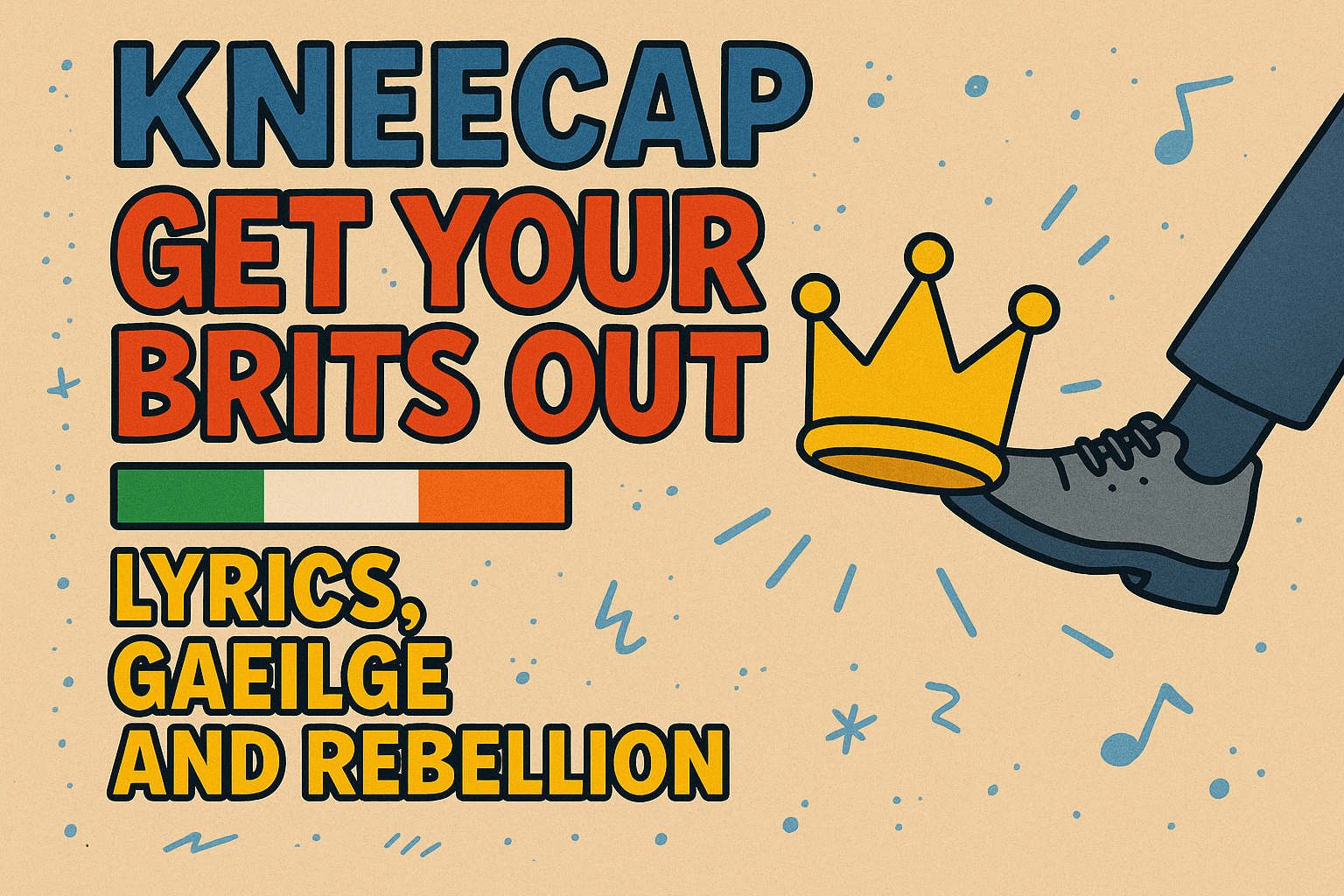
If you want the full kneecap hood lyrics, this page gives you more than a pasted lyric sheet. Below, you’ll find the commonly circulated H.O.O.D text, selected Irish-to-English translations, notes on Belfast slang, and a clear explanation of what “hood” is doing in the song: both as a class insult and as a label Kneecap throws back in the face of the people using it.
That matters because H.O.O.D lands differently once you hear its layers. It is a Belfast rap track built on code-switching, local references, and political shorthand, not just a catchy chorus. Kneecap’s wider profile as an Irish-language rap trio has been covered by outlets like The Guardian’s feature on the group, and that context helps explain why listeners keep returning to this song for meaning as much as for lyrics.
At Gaeilgeoir AI, we reviewed the lines with the highest risk of being misheard or over-literalized. I found that the hardest parts were not the obvious Irish phrases, but the moments where Irish, English, and Belfast slang collide in the same bar; those are the lines we annotate most heavily below.
How We Reviewed the H.O.O.D Lyrics and Translations
We treated this as an editorial lyrics-and-meaning page, not a word-for-word certified transcript. The base text below follows the commonly circulated version of the song, then we add translations only where they materially help: Irish phrases, mixed-language bars, and slang that a non-Belfast listener could easily miss.
Our rule was simple: translate the sense of the line, not just the dictionary meaning of each word. In practice, that means some glosses are approximate rather than literal, especially where Kneecap compress local speech, drop grammatical particles, or use slang terms that do cultural work beyond plain translation. I also flagged places where a line appears unstable across lyric copies, because pretending every word is settled would make the page less trustworthy, not more.
For broader context, Irish itself has long been shaped by region, code-switching, and everyday speech outside formal classrooms; Foras na Gaeilge’s overview of the language is a useful baseline if you want to understand why a rap track can sound very different from textbook Irish.
Watch: Kneecap – Hood
If you want to isolate lines, ad-libs, or chorus layers while studying the delivery, there’s more from Isolate Audio on current vocal-removal tools that can make fast lyric checking easier.
Full Kneecap Hood Lyrics with Translations
The text below reproduces the commonly circulated hood lyrics for H.O.O.D. We translate the Irish phrases and the slang-heavy lines most likely to trip up listeners, but we do not pretend every bar has one perfectly literal English equivalent; where the wording is unstable or highly local, we say so.
[Tús / Intro: Móglaí Bap] Here, tell him Who’s the most violent person you know except Arlene (Ha ha ha ha ha haaaa) Oh that would be you kid (ha ha ha ha) Respect
[Véarsa 1 / Verse 1: Mo Chara] Focain caite amach arís (F**kin’ thrown out again) Barraíocht piontaí le barraíocht snaois (Too many pints with too much snuff) Equals a cocktail brave for unleashin’ the beast Oíche mhór amach fuinne, at least (A big night out anyway, at least)
Troid eile, he’s beatin’ some fella Tá an R.U.C. anseo anois [?] eile (The R.U.C. [police] are here now, another [?]) Fucked in to the back of the jeep, he falls asleep He does it every week
[Droichead 1 / Bridge 1: Mo Chara] Tiocfaidh ár lá (Our day will come), get the Brits out lad! A one way ticket please I’ve lost my bus pass
[Véarsa 2 / Verse 2: Mo Chara] Isteach san offie (Into the off-license) He’s lookin’ some tins man Ag cailleadh focan foighde anois man (Losing f**kin’ patience now, man)
“Keep ‘er lit ta fuck or fuckin’ fuck off” Jesus said on the cross Two tins of Boost, 20 fegs and the fuck is still lost Who’s next, me miss, son would you like a bag? For your shopping, not your nose, I see your ankle tag
Fuck you curfew, dislocated eyesocket Overnight, cop shop with two grams in his pocket Just his reputation now he’s known for being a rocket In his dreams 9mm loaded…
[Cúrfa / Chorus: Móglaí Bop & Mo Chara] I’m a H – Double O – D. Low life scum, that’s what they say about me ‘Cause I’m a H – Double O – D. Low life scum, that’s what they say about me
[Véarsa 3 / Verse 3: Móglaí Bop] A dog with a job, what the fuck is that? When our poor Micky’s just sittin’ in the flat Sippin’ on his cans and smokin’ rollies ‘Cause all the best jobs are taken by the dolies
[Véarsa 4 / Verse 4: Móglaí Bop] Squidgy black, yeah craic, and mo spliff achan lá (Squidgy black [hash], yeah craic, and my spliff every day) Beat the fash and the sesh, get that note off my car Ach anois, Hector’s stash, má tá pús san áit (But now, Hector’s stash, if there’s gear in the place) Ach ar dtús, cúpla líne, sula n-éiríonn seo aisteach (But first, a couple of lines before this gets weird)
[Droichead 1 / Bridge 1: Móglaí Bop & Mo Chara] It’s gonna be a blood bath It’s gonna be a blood bath It’s gonna be a blood bath (It’s gonna be a blood bath)
[Véarsa 5 / Verse 5: Móglaí Bop & Mo Chara] Throw a hook, a jab and a boot I sneak a quick toot then I fire another boot For callin’ me a fruit For tryna take the loot But Billy won’t be bothering anymore hoods
‘Nois cúpla ceist (Now a couple of questions), do ya want it in your chest? Or your knees or your head? DJ Próvaí has the lead You can beg, you can plead, you can tell us what we need You can change your name But you’re all the fuckin’ same
[Cúrfa / Chorus: Móglaí Bop & Mo Chara] I’m a H – Double O – D. Low life scum, that’s what they say about me ‘Cause I’m a H – Double O – D. Low life scum, that’s what they say about me I’m a H – Double O – D. Low life scum, that’s what they say about me ‘Cause I’m a H – Double O – D. Low life scum, that’s what they say about me
Editorial notes on ambiguous lines
“Tá an R.U.C. anseo anois [?] eile”: this is the shakiest line in circulated transcripts. The opening clearly points to the police arriving, but the final word or phrase is inconsistently rendered. We’ve left the uncertainty visible rather than forcing a neat translation.
“Ag cailleadh focan foighde anois”: the sense is straightforward—someone is losing patience—but in performance the line is compressed hard, which is why many listeners mishear it. I’d treat this as a meaning-first gloss, not a classroom-perfect transcription.
“má tá pús san áit”: this is a good example of why kneecap h.o.o.d lyrics need commentary, not just transcription. The phrase is often glossed loosely because the local slang value of pús in context matters as much as the literal wording.
What Is Hood All About?
H.O.O.D is built from fragments of a specific social world: off-licenses, police vans, sectarian shorthand, nights out, class contempt, and black comedy. The song moves quickly because it is not trying to tell a clean narrative. Instead, it stacks scenes and slogans until the chorus lands as a verdict imposed from outside: “low life scum, that’s what they say about me.”
That is the key to reading hood kneecap lyrics well. “Hood” here is not just imported U.S. rap language. It is filtered through Belfast, where class, neighborhood identity, and political memory all shape how an insult lands. One reason the term feels legible across rap scenes is that hood-themed language travels easily through the genre; a lyric analysis of Billboard-era country and R&B/hip-hop songs found that R&B/hip-hop lyrics were marked by a distinct vocabulary set, including profanity and socially coded terms that carry identity and attitude rather than simple description.
Irish Phrases in Hood: What They Mean
Kneecap’s best lines often work because they refuse to stay in one language for long. Irish gives a phrase rhythm, edge, and local identity; English often delivers the punchline; Belfast slang ties the line to place. When I reviewed the track line by line, the most revealing bars were the ones where a literal translation was technically possible but still failed to explain why the line sounds funny, aggressive, or intimate.
Below is a breakdown of some key phrases from the kneecap lyrics in H.O.O.D and how they function in context:
Irish Phrase / Line
Translation
Cultural Context
Focain caite amach arís
“Thrown out again”
Not formal Irish; the point is the exasperated, familiar cycle of getting ejected after a session.
Oíche mhór amach
“Big night out”
A common phrase for a heavy social night, not something solemn or literary.
Troid eile
“Another fight”
Fast, clipped phrasing that turns violence into routine background action.
Tiocfaidh ár lá
“Our day will come”
A loaded republican slogan; in the song it arrives with swagger and provocation, not neutral description.
Isteach san offie
“Into the off-licence”
“Offie” is local shorthand for an off-licence shop; the line is instantly urban and colloquial.
Ag cailleadh focan foighde anois
“Losing f**king patience now”
The force comes from the blend of Irish structure with profanity-heavy street speech.
Achan lá
“Every day”
A distinctly northern/Hiberno-English-adjacent phrase that listeners outside Belfast may not catch at speed.
Má tá pús san áit
Approx. “if there’s gear/hash in the place”
This is one of the least literal lines on the page; local usage drives the meaning more than textbook Irish.
Cúpla líne
“A couple of lines”
In everyday Irish cúpla just means “a couple,” but the surrounding context makes the drug reference clear.
‘Nois cúpla ceist
“Now a couple of questions”
Threat framed almost politely; the tonal contrast is part of the joke.
The chorus deserves its own note. In this track, H.O.O.D works two ways at once. First, it echoes the way working-class young men are dismissed as trash, criminals, or a problem to be managed. Second, by spelling it out and repeating the accusation, Kneecap reclaim the word as a badge of solidarity and defiance. That is why “hood” in the song cannot be reduced to a neutral geographic label; it is a social judgment being mocked, worn, and weaponized at the same time.
Irish Phrase / Line
Translation
Cultural Context
Focain caite amach arís
“Thrown out again”
Party chaos, someone getting ejected—again.
Oíche mhór amach
“Big night out”
Standard slang in Irish for a heavy session.
Tiocfaidh ár lá
“Our day will come”
Republican slogan turned chant; Kneecap flip it for energy.
Isteach san offie
“Into the off-licence”
Buying alcohol. Very Belfast context.
Cúpla líne
“A couple of lines”
Slang reference, often to drugs.
Má tá pús san áit
“If there’s hash in the place”
Mix of Irish and local slang; shows hybrid speech.
Pronunciation: Making the Lyrics Flow
The hardest thing about h.o.o.d lyrics is often not vocabulary but delivery. Irish words that look long on the page are shortened, stressed, or swallowed to fit the beat, and Belfast pronunciation adds another layer.
A few examples from the track:
Tiocfaidh ár lá: learners may expect each word to land cleanly and separately, but in rap delivery the phrase is pushed as a slogan. The rhythm matters as much as the vowel quality, so it sounds tighter and more percussive than a slow classroom reading.
Isteach san offie: this line blends an Irish directional phrase with Belfast shop slang. What stands out when you listen closely is how quickly the Irish part is dispatched before the more conversational “offie” lands.
Achan lá: on the page it looks simple, but the local pronunciation and pacing can make it pass by in a blur. This is exactly the kind of phrase that sends listeners back to lyric pages after one listen.
I noticed that many of the lines people replay are not the most difficult semantically; they are the ones where accent and meter hide the boundaries between words. If you want to train your ear beyond this song, our Irish Pronunciation Guide breaks down the sound patterns that make rap verses feel faster than they look.
Why Kneecap Matters for Irish Learners
Kneecap matter because they place Irish in domains where many learners were never taught to expect it: jokes, insults, drugs talk, club energy, anti-authority posturing, and ordinary urban life. That is useful pedagogically because a language only feels alive when you hear it outside sanitized examples.
They also show how minority-language revival can be messy, not just respectable. I think that is one reason kneecap hood draws so much attention: the song does not ask permission to make Irish contemporary. It assumes Irish already belongs in rap. In a global music market, that kind of local language performance travels fast; even outside Ireland, contemporary rap titles still lean on hood-coded language, as shown by releases like “Facts” on Shazam, which is one small reminder that the term retains commercial and cultural visibility across scenes.
How to Use Hood Lyrics in Your Study Routine
Here’s a five-step hack to turn the track into your personal Irish lesson:
Listen once without the lyrics – just to vibe.
Read the lyrics with translations – note down Irish words.
Repeat lines out loud – mimic rhythm and accent.
Build a flashcard deck – add slang like oíche mhór or tiocfaidh ár lá.
Freestyle practice – swap in your own vocab over the beat.
With Gaeilgeoir AI, you can even paste the lyrics into the platform, generate instant vocab lists, and test yourself. It’s the kind of “study” that doesn’t feel like study at all.
Hood, Identity, and Rebellion
There’s a reason Kneecap provoke such divided reactions. Their songs collapse distinctions that authority figures often prefer to keep tidy: Irish versus English, culture versus chaos, heritage versus nightlife, politics versus comedy. In H.O.O.D, that collision is the point.
The word “hood” is especially effective because it arrives with baggage. In many rap traditions, hood language signals neighborhood identity, exclusion, survival, and status. In Belfast, Kneecap adapt that charge to a place marked by class pressure and political history. I read the chorus less as self-description than as ventriloquism: they repeat what respectable society says about a certain kind of young, working-class body, then turn the insult into a chant.
From Lyrics to Learning
The best use of this page is not passive reading. Take one verse, listen twice, mark the Irish phrases, then compare the literal meaning with the social meaning. That gap—between what a line says and what it does—is where Kneecap become valuable for learners.
For that reason, kneecap hood lyrics are worth studying even if you already know the chorus. The song is a compact lesson in code-switching, slang, and how identity gets built through voice. Ready to put music into your learning toolkit? Start your journey with Gaeilgeoir AI.
👉 Sign up here for free and bring Irish into your playlist, your vocabulary, and your daily life.
Frequently Asked Questions
What does “hood” mean in the song H.O.O.D?
In this track, “hood” is not just a borrowed rap label for a neighborhood. It points to the way working-class young people are branded as dangerous or worthless, then flips that judgment into a repeated, defiant identity marker in the chorus.
What does “hood” mean in Ireland or Belfast usage?
In Belfast, listeners will hear “hood” through local class politics as much as through global hip-hop culture. It can imply a rough area, a rough reputation, or the kind of person respectable society looks down on; Kneecap use that loaded meaning rather than a neutral dictionary sense.
Are the Kneecap H.O.O.D lyrics fully in Irish?
No. The song switches between English, Irish, and Belfast slang constantly. That mix is part of the appeal, and it is also why so many listeners look up kneecap h.o.o.d lyrics after hearing the track.
Why are some translations on this page approximate?
Because some lines depend on delivery, slang, or unstable circulating transcriptions rather than clean written Irish. We translate for sense first, and where a line is genuinely uncertain, we say so instead of pretending there is one perfect version.
What is Kneecap’s biggest song?
That depends on whether you mean streaming totals, cultural impact, or the song most associated with the group at a given moment. H.O.O.D is one of the tracks that regularly pulls people into their catalog because it captures their mix of Irish, satire, provocation, and Belfast specificity so clearly.
What was Kneecap’s first song?
Early attention around the trio centered on breakout material that established their irreverent bilingual style before wider international coverage followed. If you are tracing their development, it makes sense to start with the early singles and then compare them with H.O.O.D to hear how the political jokes, slang density, and Irish-English switching sharpen over time.
When you search for Kneecap the recap lyrics, you’re diving into a track that’s much more than music. The Recap by Belfast rap trio Kneecap—Mo Chara, Móglaí Bap, and DJ Provaí—mixes Irish and English with biting political satire, local pride, and rebellion.
At Gaeilgeoir AI, we see songs like The Recap not only as art but also as a vibrant example of Gaeilge in action. By exploring the Kneecap the recap lyrics, learners can see how Irish thrives in modern, edgy contexts.
Kneecap The Recap Lyrics
[Intro] There’s a little bit of breaking news to bring you And that is that counter terrorism police will investigate the rap trio, Kneecap
[Verse 1: Mo Chara] Mothaíomse bliss (I feel bliss) Le titim dorachadas (With the fall of darkness) Loitering cúl sráide (Loitering in a back street) Táim sa tóir ar the rich (I’m chasing the rich) An rialtas anois in bits (The government is now in bits) Kneecap gave them a frisk Sporán le notaí (A wallet with notes) But we know they’ve got more than this Gréim láimhe and we’ll stroll to the bank (Hand in hand and we’ll stroll to the bank) Gimme Kemi’s money and give her my thanks We’ll call it reparations, Badenoch, ya wank Tried to take my money but I came and collected it back
[Chorus] Nah, nah, nah Imithe le fada (Gone long ago) It’s Kneecap, the recap; Ríthe Bhéal Feirste (Kings of Belfast) Nah, nah, nah Imithe le fada (Gone long ago) Ar chrónaigh sibh Provaí, Móglaí Bap agus Mo Chara (You crowned Provaí, Móglaí Bap, and Mo Chara)
Nah, nah, nah Imithe le fada (Gone long ago) It’s Kneecap, the recap; Ríthe Bhéal Feirste (Kings of Belfast) Nah, nah, nah Imithe le fada (Gone long ago) Ar chrónaigh sibh Provaí, Móglaí Bap agus Mo Chara (You crowned Provaí, Móglaí Bap, and Mo Chara)
[Verse 2: Móglaí Bap] Kemi ya wally Tá an scríobhneacht ar na ballaí (The writing is on the walls) You like to think that you’re fooling everybody But you’re not Just like the Iron Lady Your career is gonna rot Tá d’am de chac imithe ar smacht (Your time of sht has gone out of control)* Kneecap ar ais anois (Kneecap is back now) Le rud a chur i gceart (To set something right) Anseo a ndéantar raic (Here’s where trouble is made) Tá muid tinn de do chac (We’re sick of your sht)* Kemi ya wally Tá Maggie ag coladh ina leaba (Maggie is sleeping in her bed) Is cuma cén cinneadh (It doesn’t matter what decision) You just cumadh cé chomh [?] (You just made up how [?]) Tá tú chomh lán de chac (You’re so full of sht)* Cosúil le do cheannaireacht (Just like your leadership) Go for a crack Some fellas from the lower whack
[Bridge: Mo Chara] When they see me Téann na láimhe ina bpoca (Hands go into pockets) Who’s shouting yeah Cos I’m here to stroke ya Is maith liom na bróga sin (I like those shoes) Luadh couple of nóta (A couple of notes were mentioned) Seems they suit me I’ll take them home lad You backing up Badenoch Cry into your sherry Had enough Badenoch You thought it’s momentary Called your bluff Badenoch Belfast to Derry shouting “Fuck Badenoch”
[Chorus] Nah, nah, nah Imithe le fada (Gone long ago) It’s Kneecap, the recap; Ríthe Bhéal Feirste (Kings of Belfast) Nah, nah, nah Imithe le fada (Gone long ago) Ar chrónaigh sibh Provaí, Móglaí Bap agus Mo Chara (You crowned Provaí, Móglaí Bap, and Mo Chara)
Nah, nah, nah Imithe le fada (Gone long ago) It’s Kneecap, the recap; Ríthe Bhéal Feirste (Kings of Belfast) Nah, nah, nah Imithe le fada (Gone long ago) Ar chrónaigh sibh Provaí, Móglaí Bap agus Mo Chara (You crowned Provaí, Móglaí Bap, and Mo Chara)
[Outro: DJ Provaí] Good effort, Kemi Hard luck in the elections Onwards and upwards Free Palestine
Breaking Down Kneecap The Recap Lyrics
The Kneecap the recap lyrics pack layers of humor, cultural pride, and political commentary. Let’s unpack the key themes.
1. Political Satire
Much of the track targets Kemi Badenoch, critiquing UK politics with sharp wit. Lines about reparations, Margaret Thatcher, and “crying into your sherry” show Kneecap’s flair for bold satire.
2. Irish-English Code-Switching
Lyrics like “Mothaíomse bliss / Le titim dorachadas” show how Kneecap switch between Irish and English, making Gaeilge part of the modern rap scene. This reflects everyday bilingual life in Belfast.
3. Pride in Belfast
The chorus—“Ríthe Bhéal Feirste” (Kings of Belfast)—is an unapologetic claim to cultural authority and local pride.
4. Humor and Rebellion
Even while mocking politicians, the group keeps things playful, mixing insults, irony, and clever wordplay.
Why The Recap Sparked Headlines
The intro mentions counter-terrorism police looking into Kneecap, which wasn’t just artistic drama—it reflected real controversy. The group often attracts headlines for their unapologetic politics, cultural pride, and frequent use of Irish.
This controversy only amplifies their impact, ensuring songs like The Recap reach audiences beyond Ireland.
Learning Irish Through Kneecap The Recap Lyrics
For learners, Kneecap the recap lyrics aren’t just entertaining—they’re educational. Here’s why:
Real Vocabulary – Everyday Irish phrases appear alongside slang and satire.
Pronunciation Practice – Fast-paced delivery helps learners hear authentic sounds.
Cultural Insight – The lyrics reflect Belfast’s politics and humor.
Confidence Building – Shows Irish is a living, modern language.
A few phrases in the Kneecap the recap lyrics are especially useful for learners:
“Mothaíomse bliss” – I feel bliss.
“Le titim dorachadas” – With the fall of darkness.
“Tá tú chomh lán de chac” – You’re so full of sh*t.
“Ríthe Bhéal Feirste” – Kings of Belfast.
These phrases show both poetic expression and slang—two sides of living Irish.
Kneecap’s Role in Language Revival
Kneecap the recap lyrics are part of a bigger picture: the revival of Gaeilge in modern music. By blending Irish into rap, Kneecap prove that the language is not just historical—it’s relevant, edgy, and global.
Other Irish rappers and folk artists are also incorporating Gaeilge, but Kneecap’s unapologetic style stands out, reaching young people who might never engage with the language otherwise.
From Lyrics to Learning: How to Practice
Here’s how to use Kneecap the recap lyrics as part of your study routine:
Listen and Repeat – Focus on rhythm and pronunciation.
Spot the Irish – Highlight Gaeilge words in the lyrics.
Translate Small Parts – Don’t overwhelm yourself; focus on a verse.
Sing Along – Using rap as practice improves fluency and recall.
The Kneecap the recap lyrics show us that Irish is alive, rebellious, and unapologetically modern. They mix humor, politics, and cultural pride in a way that inspires both fans and learners.
For anyone studying Gaeilge, songs like The Recap offer a chance to practice vocabulary, hear authentic Irish in action, and connect with contemporary culture.
Want to take your Irish learning beyond lyrics? Join our community at Gaeilgeoir AI and explore modern, AI-powered tools designed to help you grow your skills. Start free today.
Start Speaking Irish Today — 25% Off Use code START25
Learn real Irish for real life with guided practice, pronunciation support, and everyday conversations.