
I first heard “MAM” in a room full of people who expected a joke, a provocation, or a hard-edged chant. Instead, the song landed softly, and nobody talked over it.
Table of Contents
- Understanding Kneecap's Most Personal Song
- The Cultural Context Behind MAM
- Kneecap MAM Lyrics and Full English Translation
- A Line-by-Line Irish Language Breakdown
- Pronunciation Guide and Practice Activities
- Bring Irish Music into Your Learning Journey
Understanding Kneecap's Most Personal Song
Kneecap built their name on swagger, argument, taboo topics, and sharp political edge. So when learners search for kneecap mam lyrics, they often expect slang, punchlines, or something hard to decode. What they find instead is one of the warmest and most teachable songs in modern Irish-language music.
That contrast matters for language learners. A song with emotional clarity gives you better access to meaning. You’re not only hearing words. You’re hearing gratitude, memory, and everyday family language that sticks in the mind far more easily than a random vocabulary list.
For a beginner or returning learner, “MAM” works well because it gives you three things at once:
- Repeated core phrases that are easier to remember after a few listens
- Simple but meaningful vocabulary about family, work, care, and appreciation
- A mix of Irish and English that lowers the barrier if full Irish lyrics still feel intimidating
Practical rule: If a song makes you want to sing along before you fully understand it, it’s usually a strong language-learning text.
The chorus is a good example. Even if you know only a little Irish, a line like “Seo ceann do na mná, a bhíonn ag obair gach lá” is learnable because the structure repeats naturally and the message is direct. You can hear the rhythm, identify key nouns, and start mapping grammar onto something emotionally real.
That’s why I don’t treat “MAM” as just a translation exercise. I treat it as a compact lesson in modern Irish usage, pronunciation, and culture.
The Cultural Context Behind MAM
Kneecap come from Belfast, and their public image has long been tied to confrontational rap, bilingual wordplay, and a style that doesn’t try to smooth out rough edges. That’s part of why “MAM” caught people off guard. The song didn’t abandon their identity. It revealed another side of it.
Why the song hit differently
According to a lyric background summary for Kneecap’s “MAM”, the single was released in December 2020 and marked a clear shift from the group’s usual provocative hip-hop style. The same source notes that the song became a heartfelt tribute to mothers and was directly shaped by the tragic suicide of Móglaí Bap’s mother, while also explaining that the track had already been in development before her death. That detail matters because it changes how we hear the song. It wasn’t written as a neat public statement afterward. It became something more painful and more personal as events changed around it.
The song also blended Irish and English to express gratitude for the kind of labour mothers often do unassumingly. Not glamorous work. Daily work. Care work. The kind learners instantly recognise once they understand the lines.
One more detail gives the song extra weight. Proceeds from “MAM” supported Samaritans, a suicide prevention charity, which ties the song’s personal grief to a wider act of care in the world.
A song can be rebellious in one context and deeply tender in another. “MAM” does both without sounding false.
Why this matters for learners
If you only read the lyrics as isolated lines, you’ll miss why they feel so direct. The tenderness isn’t accidental. It stands against the band’s usual public stance, and that tension is part of the song’s force.
That’s also why songs are useful in language study. They carry social meaning, not just vocabulary. If you’re interested in how communal singing and lyric recall help memory, this short piece on karaoke history from MyKaraoke Video is a handy side read. Singing culture often gives language learners a way into pronunciation and repetition without making practice feel like homework.
Kneecap’s wider story also helps place “MAM” in their creative arc. If you want to see how their later work is framed in a different mode, this note on the Kneecap Fenian album gives useful context.
Kneecap MAM Lyrics and Full English Translation
If you came here looking for kneecap mam lyrics, you probably want two things. First, a clear sense of what the song says. Second, a version you can study without bouncing between tabs and half-correct snippets online.
A quick note before the learning table below. Because lyric rights can be complex, I’m not reproducing a complete official text of the song here. For study purposes, it’s often better to work with key lines and a faithful learning translation anyway. That keeps the focus on comprehension, grammar, and pronunciation.
Key lines for study
| Irish line | Plain English meaning |
|---|---|
| Seo ceann do na mná | This one is for the women |
| a bhíonn ag obair gach lá | who are working every day |
| MAM | Mam |
| do na mná | for the women |
| gach lá | every day |
Those lines are enough to begin serious study because they contain a lot of useful Irish structure. You have a demonstrative opening, a prepositional phrase, a relative clause, and a common time phrase. That’s more than enough material for a beginner or intermediate learner to mine.
How to read the chorus naturally
Take the line Seo ceann do na mná. A learner often tries to translate word by word in rigid order. That leads to awkward English like “Here head to the women” or “This head for the women,” because ceann can mean “head” in some contexts but also “one” or “a thing/item” in others. In this lyric, it means “this one.”
Then look at a bhíonn ag obair gach lá. Many learners freeze at this point because the phrase doesn’t map neatly onto basic schoolbook English. The clean reading is “who are working every day” or more naturally “who work every day.”
Don’t chase a perfect one-word match for every Irish word. Chase the meaning of the full phrase.
A learner-friendly way to use the lyrics
Try this three-pass method with the song:
Pass one, just listen
Don’t stop the track. Only notice repeated words such as mná, obair, and lá.Pass two, mark the chunks
Break the chorus into thought groups: Seo ceann / do na mná / a bhíonn ag obair / gach lá.Pass three, speak with meaning
Say the line as if you’re dedicating something to someone you care about. Emotion helps rhythm, and rhythm helps memory.
Where beginners usually get stuck
A few confusion points show up again and again:
- “Mná” looks strange because learners know bean for “woman.” Irish often changes a noun’s form depending on grammar. You’re seeing one of those changes.
- “Bíonn” isn’t the basic present tense beginners usually meet first. It expresses something habitual or repeated.
- “Ag obair” is a verbal noun phrase. In plain terms, it works like “working.”
If you only study one part of the song, study the chorus. It gives you high-frequency grammar wrapped in a line that’s emotionally memorable.
A Line-by-Line Irish Language Breakdown
A good song line does more than sound nice. It hides grammar inside rhythm. “MAM” is excellent for that because the key phrases are short, natural, and full of structures that appear all over everyday Irish.
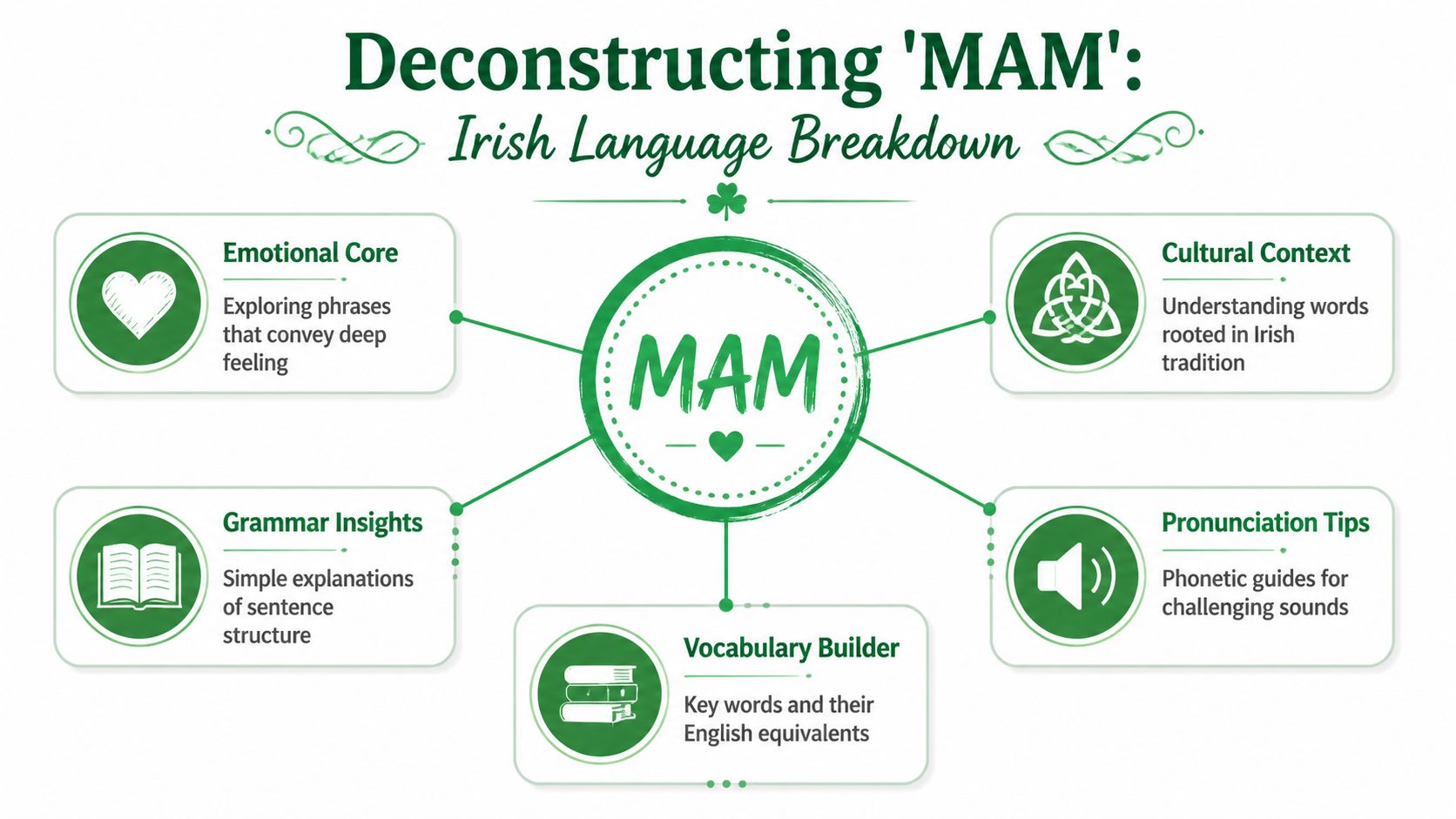
As noted on Kneecap’s band page), “MAM” was released in December 2020 with minimalistic production and had over 1 million YouTube views by 2024, which helps explain why so many learners encounter it early when exploring modern Irish-language music.
Phrase 1 and what Seo is doing
Seo ceann do na mná
Start with seo. It usually means “this” or “here.” In song language, it often works like a presenter's gesture. You’re offering something to someone.
- seo = this
- ceann = one, item, one piece
- do na mná = for the women
A natural translation is “This one is for the women.”
Phrase 2 and the meaning of mná
The form mná often throws beginners. You learn bean for “woman,” then suddenly the song gives you mná.
Here’s the useful takeaway:
| Base form | Related form in the lyric | Meaning |
|---|---|---|
| bean | mná | woman, women depending on structure |
You don’t need to master every noun pattern immediately. You only need to notice that Irish changes word forms more often than English does. That’s normal, not a sign that you’ve missed a whole chapter.
Phrase 3 and why bíonn matters
a bhíonn ag obair gach lá
This is one of the most valuable chunks in the whole song. Bíonn is the habitual present of the verb “to be.” It describes actions that happen regularly.
Compare the feel:
- tá sí ag obair = she is working right now
- bíonn sí ag obair = she works, or she is usually working
That’s why the lyric carries the sense of everyday effort, not a single moment.
Grammar shortcut: When you see bíonn, think “usually is” or “habitually is.”
Phrase 4 and how ag obair works
Ag obair means working. This is a verbal noun structure. In learner-friendly English, that means Irish often builds ongoing actions with ag + verbal noun.
Examples based on the same pattern:
- ag canadh = singing
- ag ithe = eating
- ag foghlaim = learning
Once you know that pattern, song lyrics become much less mysterious.
Phrase 5 and the time marker gach lá
Gach lá is a great everyday phrase because you can reuse it immediately.
- gach = every
- lá = day
You can swap in new nouns later:
- gach oíche = every night
- gach seachtain = every week
That’s one reason songs help so much. A single lyric chunk can become a model for dozens of your own sentences.
Phrase 6 and the little word a
Learners often skip over a because it looks too small to matter. It matters a lot. In this line, it introduces a relative clause, which is a clause that adds information about the women.
So instead of learning a technical rule first, learn the feeling of the line:
- na mná = the women
- a bhíonn ag obair gach lá = who work every day
If you can understand that relationship, your grammar is already improving.
Pronunciation Guide and Practice Activities
Irish spelling gets much easier when you stop expecting English rules from it. “MAM” is a nice training ground because the repeated phrases let you rehearse the same sounds several times without boredom.

Say these words out loud
Use these as rough learner approximations, not perfect phonetic truth:
| Word or phrase | Say it roughly like |
|---|---|
| Seo | shoh |
| ceann | kyan or kyown, depending on accent |
| mná | mraw or mnah |
| bíonn | bee-un |
| ag obair | ag ober |
| gach lá | gahkh law |
If your version isn’t perfect, that’s fine. Aim for confidence first, accuracy second. Then refine.
For a deeper foundation, this Irish pronunciation guide is useful when you want to connect song sounds to broader pronunciation patterns.
Say the line slowly once, rhythmically once, and naturally once. Those are three different skills.
Three practice activities that actually help
1. Echo-and-pause practice
Play the chorus. Pause after each chunk and repeat it back.
Try this sequence:
- Seo ceann
- do na mná
- a bhíonn ag obair
- gach lá
This is better than repeating the whole line badly ten times. Short chunks train your ear.
2. Rewrite the dedication
Keep the grammar frame and change the ending.
Examples:
- Seo ceann do m’athair
- Seo ceann do mo chara
- Seo ceann do na daoine a chabhraíonn liom
You don’t need to write poetry. You need to reuse structure.
3. Record your own version
If you want a playful way to hear rhythm and stress, tools that create singing voices from text can help you experiment with melody and timing before you try your own spoken or sung version. Use that kind of tool carefully. The value is in hearing phrase flow, not in outsourcing your practice.
A small listening challenge
Listen once and identify only these items:
- A family word
- A time phrase
- A work-related phrase
That trains selective listening. It also stops you from panicking when you don’t understand every word.
Bring Irish Music into Your Learning Journey
Music gives you something textbooks often can’t. It gives memory a reason to care. When a learner remembers a line from “MAM,” they’re not just recalling vocabulary. They’re recalling voice, rhythm, feeling, and cultural context all at once.
That’s why songs like this deserve a place in your routine. Not as a break from study, but as part of study. A single chorus can teach noun forms, habitual action, pronunciation habits, and social meaning in one sitting. You’re far more likely to remember gach lá from a song than from an isolated flashcard.

A simple way to build this into study
You don’t need an elaborate system. Try this weekly cycle:
- One listen for enjoyment so the song stays alive as music
- One focused listen with notes where you mark useful chunks
- One speaking session where you read or sing lines aloud
- One writing task where you adapt a phrase into your own Irish
If you enjoy looking at how songs travel and reach new listeners, this guide on strategies for musicians to get heard is a worthwhile side read because it helps explain how modern tracks move through online spaces and find audiences beyond their local scene.
For more lyric-based learning, the Kneecap Irish Goodbye lyrics guide is another useful comparison point. It lets you see how tone, vocabulary, and learner difficulty can change from one song to another.
The best Irish study material is often the material you’ll return to willingly.
That’s the core value of kneecap mam lyrics for learners. The song is emotionally direct, linguistically rich, and short enough to revisit often. That combination is rare. When you find it, use it.
If you want to turn songs like “MAM” into real speaking progress, Gaeilgeoir AI is a strong next step. It helps beginners and intermediate learners practise Irish through guided conversations, pronunciation support, adaptive quizzes, and real-world scenarios, so the phrases you recognise in music become language you can use.