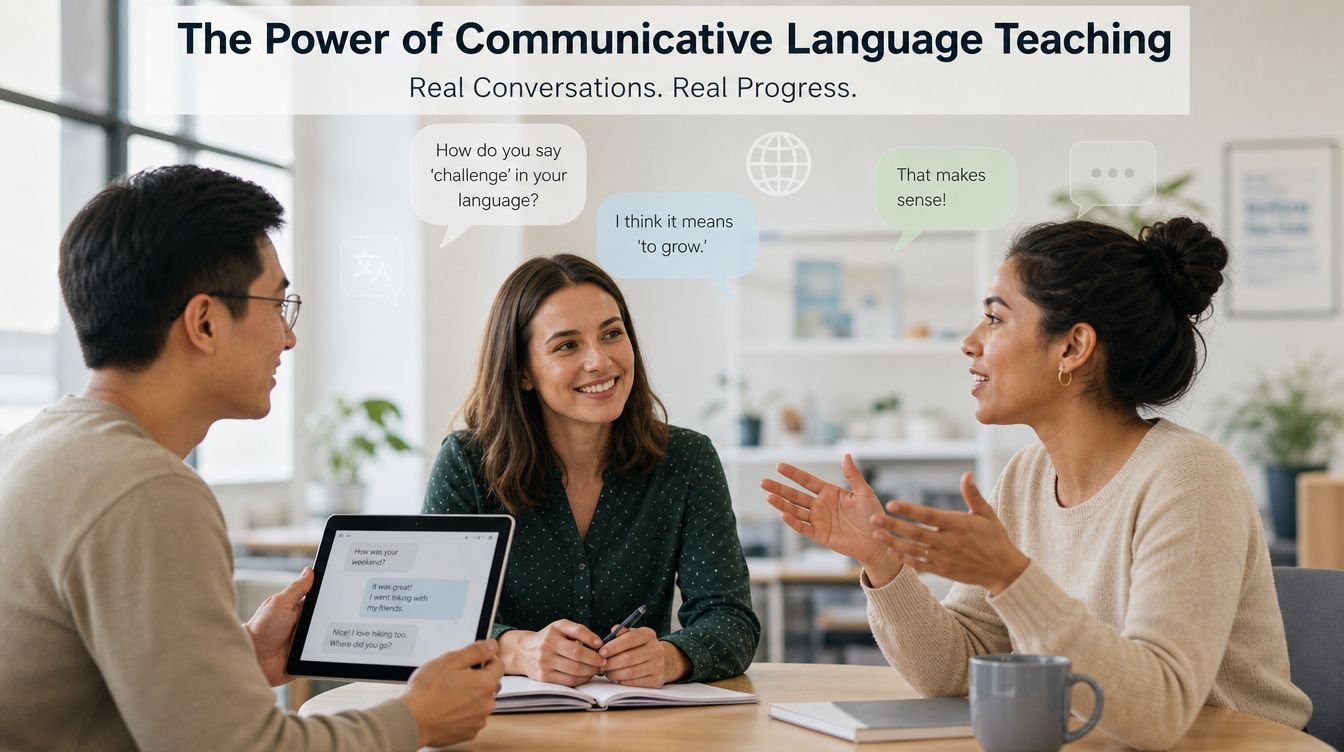
You know the answer until somebody asks you to say it. A Leaving Cert student in Galway can recognise Irish vocabulary, complete grammar exercises, and explain a verb ending on paper, then freeze when someone asks, “Cá raibh tú ar laethanta saoire?” The words are familiar, but producing an answer in real time feels entirely different.
Another learner may know fewer rules but have spent a holiday using broken, practical sentences at a market. They ask for what they need, misunderstand a reply, try again, and leave with language they can use. That contrast captures the central problem in language education: recognising language and producing language are separate skills.
Communicative language learning addresses that gap by making meaning, interaction, and purposeful speech central to practice. Its value becomes especially clear in Irish, where everyday conversation and the Leaving Cert oral exam both require learners to respond, describe, ask, clarify, and continue speaking rather than identify correct forms.
Table of Contents
- Why Learners Can Read a Language but Still Cannot Speak It
- What Communicative Language Learning Means
- Core Principles That Drive Every Communicative Lesson
- How Communicative Learning Differs from Older Methods
- Classroom and Self-Study Activities That Build Real Speaking Skills
- Assessing Communicative Ability in the Classroom and the Leaving Cert Oral
- Where AI Conversation Tools Fit in Communicative Practice
- Putting It All Together and Starting to Speak Today
Why Learners Can Read a Language but Still Cannot Speak It
Traditional schooling often gives learners abundant practice with recognition. You read a passage, underline a verb, translate a sentence, or choose the correct ending. These activities can build useful knowledge, but they don't necessarily prepare you to retrieve language while another person is waiting for your answer.
That Galway student may have studied the vocabulary for holidays many times. They might recognise laethanta saoire immediately and understand a written question about a trip. The difficulty appears when the brain must select a subject, choose a tense, arrange the words, pronounce them, and respond without the safety of a page.
Recognition is not production
Reading lets you pause and look back. Conversation keeps moving. A written exercise usually tells you what grammatical structure to use, while a real question leaves you to decide how to express your meaning.
This is why a learner can score well on a translation exercise and still give short, hesitant answers aloud. The learner hasn't failed to learn anything. They've practised the wrong part of the skill for the situation they now face.
Practical rule: If the assessment requires spontaneous speech, a large part of revision must also require spontaneous speech.
The market learner had a different experience. Their sentences may have been inaccurate, but each one solved a problem. They needed to request an item, understand a price, respond to a question, or repair a misunderstanding. That practical pressure created retrieval practice connected to meaning, not just a list of isolated forms.
Why Irish learners feel this sharply
Irish learners often move between several kinds of knowledge. They may recognise a phrase from a textbook, remember a poem, and understand a teacher's explanation, yet struggle to describe a photograph or answer a personal question. The oral exam exposes that difference because the learner must use language as an active tool.
The answer isn't to abandon grammar or reading. Both support speaking. The answer is to give speaking its own deliberate practice through tasks that resemble real interaction. Communicative language learning exists for exactly this failure pattern, shifting the target from knowing about a language to using it with another person.
What Communicative Language Learning Means
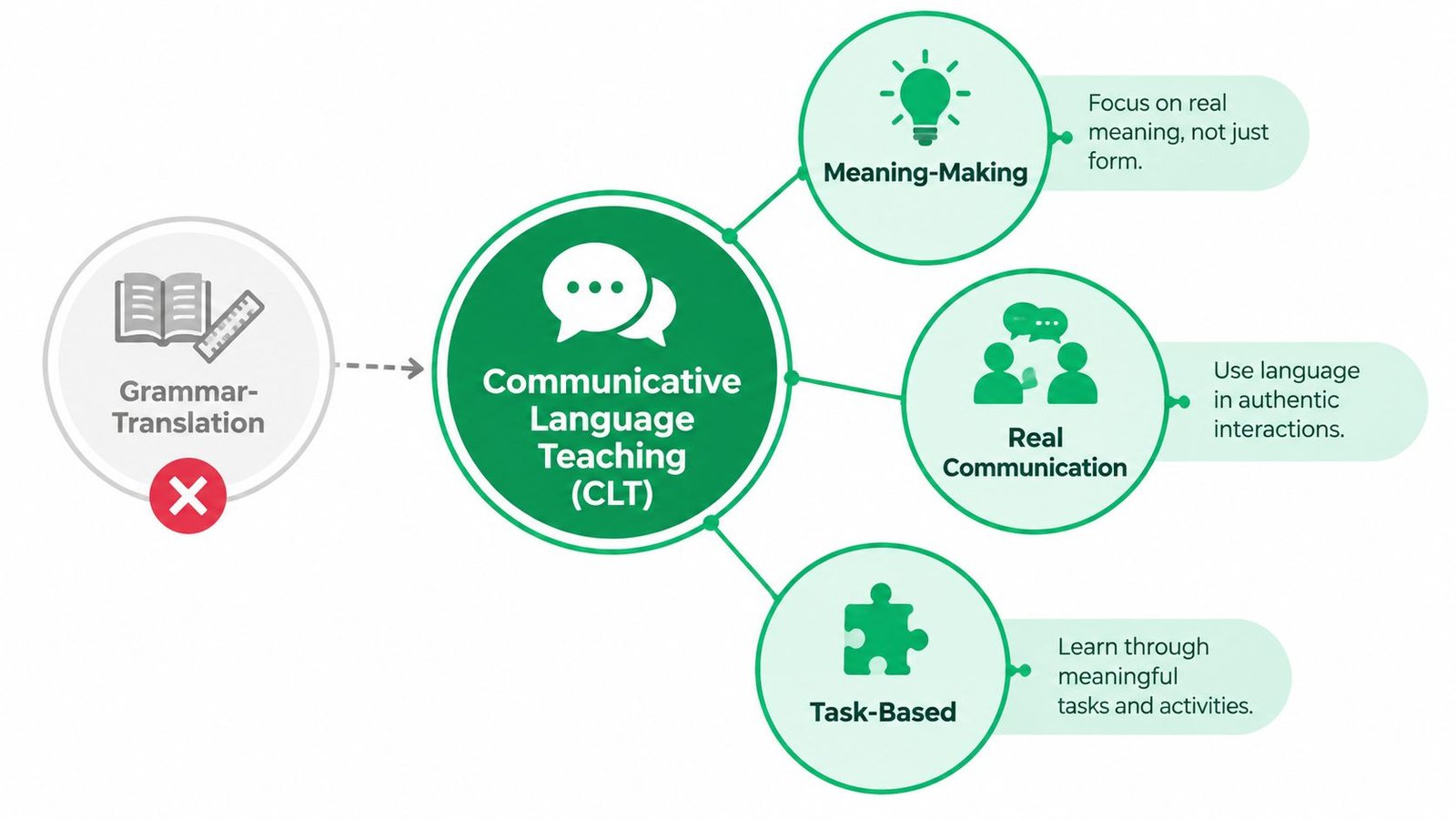
A learner preparing for the Leaving Cert oral may know verb endings, recognise textbook phrases, and still hesitate when asked to describe a photograph. Communicative language learning, often discussed as Communicative Language Teaching, or CLT, addresses that gap by making language a tool for meaning. Learners order food, exchange missing information, discuss a film, ask for directions, or solve a problem because they have something to accomplish.
This differs from the grammar-translation method many Irish adults remember from school. Grammar-translation often centres on conjugations, written exercises, and word-by-word work with texts. CLT can still teach a verb form, but the form appears because learners need it to communicate a message.
Dell Hymes gave the approach an important foundation by introducing the concept of communicative competence in 1966, followed by wider pedagogic adoption in the 1970s, as described in this historical account of communicative language teaching. Communicative competence means more than knowing whether a sentence is grammatically possible. It includes knowing what to say, when to say it, to whom, and how.
For an Irish learner, that might mean choosing how to greet someone at a Gaeltacht gathering, explain where they live, or answer a Leaving Cert oral question. A correct sentence can still sound too direct, too formal, or unsuitable for the listener. Communicative learning therefore develops language knowledge alongside social judgement.
Language is a tool for tasks
A beginner learning Spanish through CLT might practise ordering a coffee, choosing between two drinks, and responding when the server asks a follow-up question. Reciting the subjunctive may have value, but it does not solve that immediate communicative need.
An Irish learner could use the same principle to describe a photograph, give a personal response, then ask a partner a related question. The activity brings vocabulary, grammar, pronunciation, listening, and turn-taking together. An AI conversation tool can provide another round of practice, especially when the learner asks for follow-up questions rather than memorised prompts.
CLT is not anti-grammar. It places grammar in service of communication. A teacher might briefly explain a tense after learners struggle to describe a past event, then give them another opportunity to use it with a new partner. The rule supports the message, rather than becoming the entire lesson.
Core Principles That Drive Every Communicative Lesson
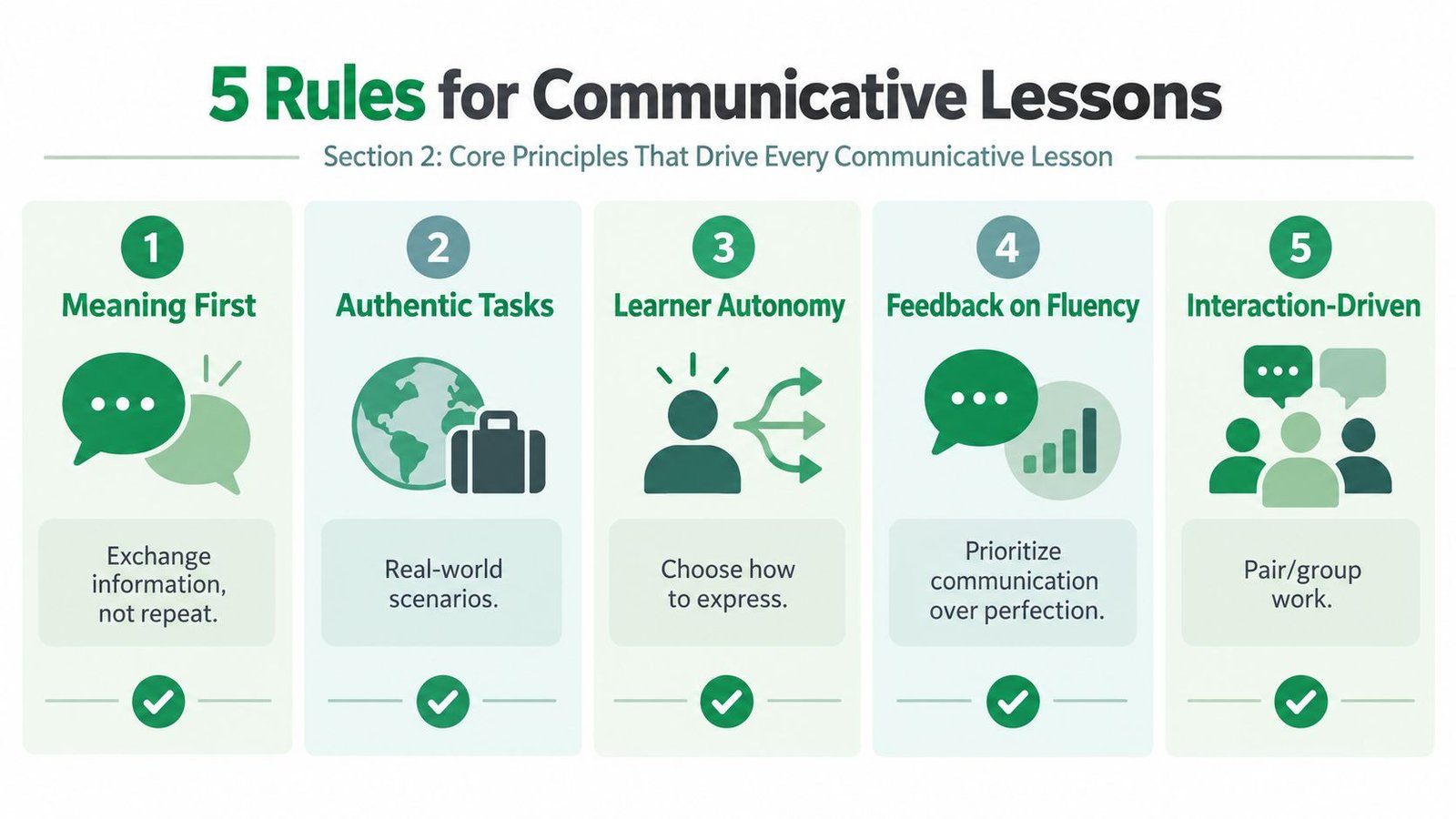
A useful way to apply communicative language learning is to reduce the theory to practical decisions. Before choosing an exercise, ask whether learners need to exchange meaning, make choices, listen to another person, and find their own way to express an idea.
Meaning comes before parroting
A communicative task creates a genuine information need. If Student A has one half of a Dublin bus timetable and Student B has the other half, neither learner should be able to complete the task alone. They must ask questions and compare information to find a suitable meeting time.
The exact language can be supported with a small phrase bank, but learners shouldn't repeat a model with no reason to listen. The point is to make a decision based on what the partner says.
Authenticity gives language a purpose
Real menus, short podcast clips, directions, public notices, and Leaving Cert sceitimí questions give learners language connected to life outside the classroom. Materials don't need to be difficult to be authentic. A simple café menu can prompt choices, preferences, prices, and polite requests.
Fluency and accuracy develop together
Early communicative practice should allow a learner to keep going even when the form isn't perfect. A teacher can note recurring errors and address them after the activity, rather than interrupting every sentence.
A learner who says a message imperfectly has still demonstrated useful progress. They retrieved language, took a risk, and communicated an intention.
Conversation requires repair
Real speakers ask for repetition, confirm details, rephrase, and use another word when the first one doesn't arrive. These behaviours are not emergency measures reserved for advanced learners. They are part of communicative competence.
Skills work as a network
Reading can provide ideas for a discussion. Listening can supply phrases for a role-play. Writing can help a learner organise a short answer before speaking it. Hymes, Halliday, and Wilkins each serve as useful historical anchors for thinking about language as social action and purposeful use, but the classroom test remains practical: does the activity help learners do something with language?
A short classroom video can make these principles easier to visualise:
How Communicative Learning Differs from Older Methods
The clearest comparison concerns what learners do with language. Grammar-translation asks learners to analyse and convert language, audio-lingual teaching asks them to repeat controlled patterns, and CLT asks them to use language to reach an outcome.
| Dimension | Grammar-Translation | Audio-Lingual | Communicative Language Learning |
|---|---|---|---|
| Content | Rules, texts, vocabulary equivalents | Sentence patterns and model dialogues | Meaning, functions, and useful language |
| Input | Written passages and translation exercises | Repetition, substitution, and patterned drills | Realistic prompts, recordings, objects, and tasks |
| Learner activity | Translate sentences and explain forms | Repeat and manipulate a model | Exchange information, negotiate, and make decisions |
| What gets measured | Written accuracy and grammatical knowledge | Control of selected patterns | Ability to understand and sustain interaction |
A Leaving Cert Irish class using grammar-translation might translate a prose passage and identify unfamiliar forms. That work can deepen reading and grammatical awareness, but it doesn't require the learner to answer an unexpected question.
An audio-lingual classroom, associated with the drill-heavy practices that developed before CLT, might operate like a language laboratory. The teacher gives a model, learners repeat it, and the class substitutes a different noun or verb. This can build pronunciation and automaticity for a narrow pattern, yet learners may not know how to adapt the pattern when the conversation changes.
The communicative classroom
In a communicative task, two students might plan a weekend in Galway using Irish. One has preferences about activities, while the other has constraints involving time, transport, or weather. They need to suggest, reject, clarify, and settle on a plan.
The task creates pressure to act on meaning. Learners can't rely on a memorised dialogue because their partner's answer determines what happens next.
Older methods can build passive knowledge, and selected drills still have a place when learners need controlled pronunciation or form practice. CLT adds the missing bridge. It turns that knowledge into usable speech by requiring learners to make choices and respond under the changing conditions of interaction.
Classroom and Self-Study Activities That Build Real Speaking Skills
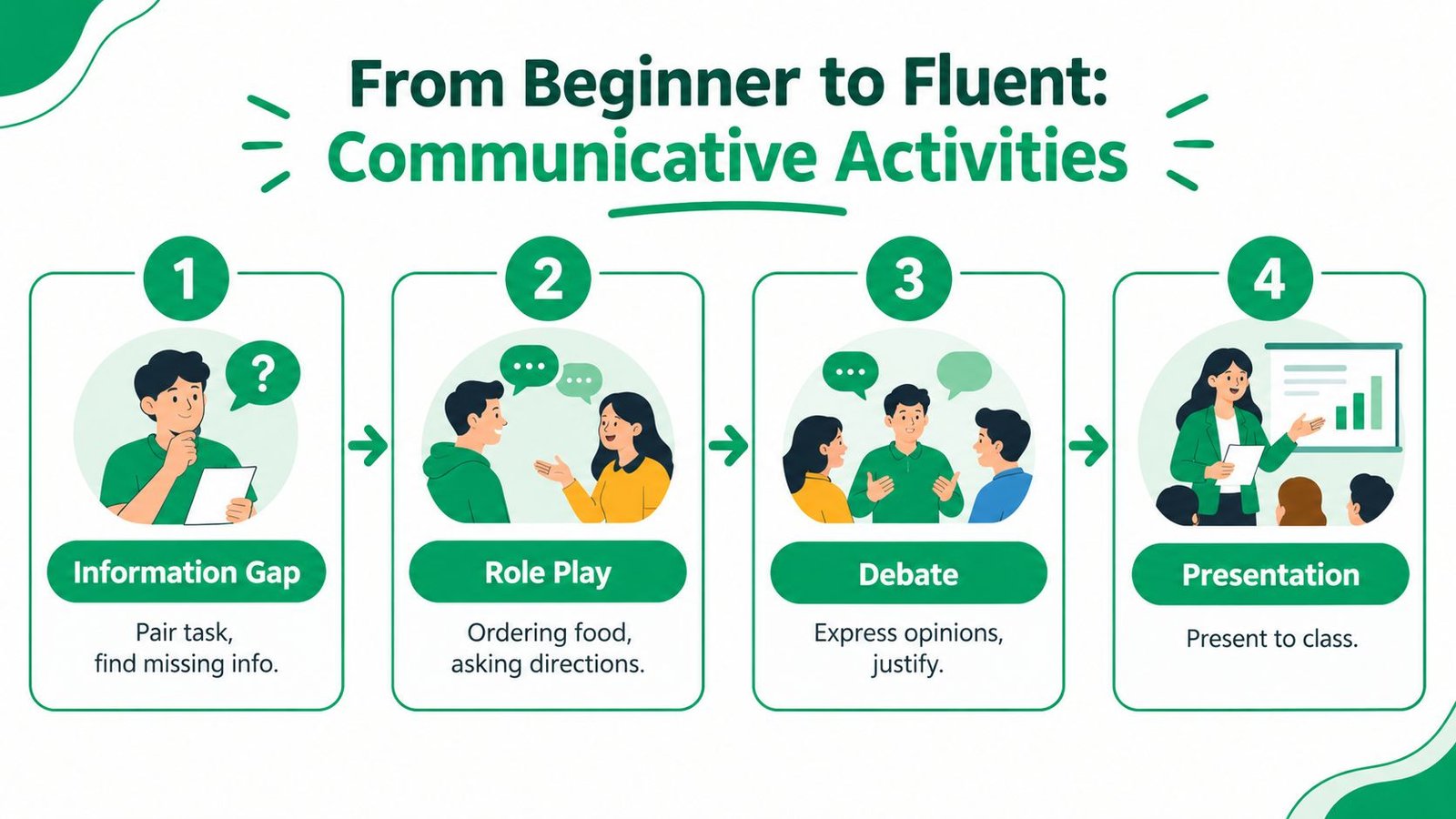
Communicative practice works best when difficulty increases gradually. A beginner shouldn't be dropped into an unstructured debate, but they should move from supported exchanges toward more independent speaking.
Begin with an information gap
Give Student A a schedule with missing activities and Student B a matching set of missing times or rooms. Each learner asks questions in the target language to complete the picture.
For Irish, a teacher might provide a simple weekend plan with gaps for am, áit, or gníomhaíocht. Useful prompts could include questions about where an event takes place and when it starts. The learner has a reason to ask, listen, and record the answer.
Try it now: Write a small schedule, cover several details, and ask an AI partner or study partner questions until you can reconstruct it.
Add a role-play with a decision
Role-play becomes communicative when the learner has an objective, not just lines to recite. Order food in a café, return a faulty item, or ask for directions in Connemara while responding to the information you receive.
A useful Irish scenario gives the learner a destination and a problem, such as missing a turn or needing to ask whether a place is nearby. The partner should avoid delivering a fixed speech. They can answer in different ways so the learner must listen and adapt.
Prompt: “Tá tú i gcaifé. Ordaigh deoch agus bia, freagair ceist amháin, agus athraigh d'ordú má tá rud éigin ar iarraidh.”
Use a jigsaw listening task
Give each learner half of a short story. They listen separately, make notes, then retell their part to a partner who has missing information. This develops listening, memory, sequencing, and spontaneous speech at the same time.
For self-study, shadow a short dialogue first. Play a line, repeat it with the same rhythm, and then record yourself answering a related question without reading. Follow that with a short AI conversation session so the rehearsed language has to transfer into a new exchange.
Prompt: “Éist le scéal gearr faoi lá saoire. Inis an chuid atá agat, ansin cuir ceist amháin chun an chuid atá ar iarraidh a fháil.”
Keep correction light
Correction should protect communication while still making improvement visible. During a fluent attempt, note one or two high-value errors rather than interrupting every phrase. Afterward, offer a natural reformulation and ask the learner to reuse it in a new sentence.
Self-study learners can keep a short transcript of a recording, mark phrases that broke down, and practise those phrases in a different scenario. Learners who want a human partner can use this guide to finding language exchange partners to create more opportunities for real interaction.
Assessing Communicative Ability in the Classroom and the Leaving Cert Oral
A communicative assessment asks what a learner can do with language, not only whether they can identify a correct form. A fill-in-the-gap exercise may show control of a verb ending, while an interview, picture description, role-play, or problem-solving discussion shows whether the learner can retrieve and adapt language.
The Leaving Certificate Irish oral exam makes that distinction concrete. It is worth 240 marks, or 40% of the overall Irish exam, and lasts about 15 minutes, according to this research report on the Irish oral exam. Its four parts are Reception, Poetry Reading, Description of a series of pictures, and Conversation. The marks are distributed as follows:
- Reception: 5 marks
- Poetry Reading: 35 marks
- Description of a series of pictures: 80 marks
- Conversation: 120 marks
What the conversation section reveals
Conversation is the largest component. Guidance on the oral test identifies vocabulary range, fluency, and accuracy as important scoring dimensions, with one marking split assigning 75 marks to Irish repertoire and 45 marks to ability in Irish, meaning fluency and accuracy, as shown in this official oral examination guidance.
That structure changes revision priorities. A learner needs more than memorised written answers. They need to sustain an exchange, handle a follow-up question, describe something clearly, and recover after a mistake.
A classroom rubric can listen for three signals:
- Hesitation patterns: Does the learner pause briefly and continue, or abandon the message?
- Repair strategies: Can they rephrase when a word is missing?
- Clarification: Do they ask the partner to repeat or explain?
Teachers can combine a can-do checklist mapped to CEFR levels with recorded mini-talks, peer evaluation, and one-to-one speaking quizzes. Students preparing with Leaving Cert Irish oral questions should practise flexible answers rather than learning large blocks word for word. Independent exam guidance also recommends fluid, natural material and speaking-led revision, noting that five weeks can still allow major progress when preparation is organised topic by topic in this oral preparation resource.
Where AI Conversation Tools Fit in Communicative Practice
AI conversation tools can expand communicative practice when access to a teacher or partner is limited. They can provide repeated role-plays, respond to a learner's choices, generate low-pressure speaking opportunities, show transcripts, and offer pronunciation feedback. Those features map neatly onto CLT because the learner still has to understand a prompt and produce a meaningful response.
An AI partner can simulate ordering food, asking for directions, introducing yourself, or answering an oral-exam topic. It can also repeat a scenario without showing impatience, which helps learners who avoid speaking because they fear making mistakes in front of another person.
Where the evidence is promising
Recent reviews report that AI conversational tutors can support speaking performance, pronunciation, motivation, confidence, and reduced speaking anxiety, while also identifying unresolved questions about evaluation, privacy, and secure handling of learner information in this review of AI-supported conversation practice. The practical implication is encouraging but limited: AI can create more opportunities to speak, yet learners still need to judge whether feedback is accurate and whether an interaction feels socially natural.
AI also doesn't fully reproduce human negotiation of meaning. A sympathetic person can interpret hesitation, humour, indirectness, and cultural cues in ways a system may miss. Open-ended cultural explanations deserve human verification, even if a simple written correction is useful as a first pass.
Use AI for repetition, not isolation. Let it increase your speaking volume, then use human interaction to test whether your language works with a real listener.
Privacy deserves plain attention. Don't share personal details that aren't necessary for practice, and choose platforms that clearly explain how learner information is retained and used for training. Gaeilgeoir AI is one focused option for Irish learners, combining guided real-world conversation, pronunciation support, adaptive quizzes, instant explanations, and Leaving Cert oral simulations in a single study environment. You can explore its AI language tutors as part of a broader routine that also includes teachers, classmates, or conversation partners.
Putting It All Together and Starting to Speak Today
Communicative language learning asks for a change in habit. Instead of waiting until every rule is secure, you produce language in a meaningful situation, notice what breaks down, and practise a better version. Accuracy remains important, but it grows more effectively when attached to something you wanted to say.
A simple weekly routine can keep that process manageable:
- Monday: Listen to a short Irish podcast clip and shadow one minute.
- Tuesday: Complete an information-gap speaking task with a study partner or AI.
- Wednesday: Review your transcript and note three useful phrases.
- Thursday: Role-play ordering coffee in Irish for five minutes.
- Friday: Record an answer to a Leaving Cert-style personal question and compare it with a model.
- Saturday: Join an online conversation circle or peer call.
- Sunday: Review the week and choose one phrase to keep using.
The routine works because each activity has a clear purpose. Listening supplies material, interaction forces retrieval, recording makes progress visible, and review turns errors into the next practice target. You don't need a long study session to begin. You need regular opportunities to say something that another listener, human or AI, can understand.
Gaeilgeoir AI offers guided Irish conversations, pronunciation support, adaptive quizzes, everyday scenario practice, and targeted Leaving Cert preparation for learners who need flexible speaking practice. Visit Gaeilgeoir AI and start your first Irish conversation today.